Chapter 3
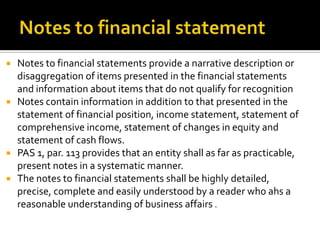
   Notes to financial statements provide a narrative description or
    disaggregation of items presented in the financial statements
    and information about items that do not qualify for recognition
   Notes contain information in addition to that presented in the
    statement of financial position, income statement, statement of
    comprehensive income, statement of changes in equity and
    statement of cash flows.
   PAS 1, par. 113 provides that an entity shall as far as practicable,
    present notes in a systematic manner.
   The notes to financial statements shall be highly detailed,
    precise, complete and easily understood by a reader who ahs a
    reasonable understanding of business affairs .
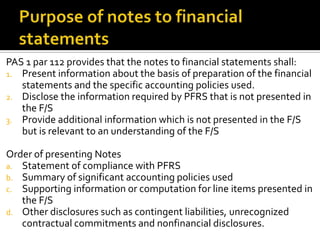
PAS 1 par 112 provides that the notes to financial statements shall:
1. Present information about the basis of preparation of the financial
   statements and the specific accounting policies used.
2. Disclose the information required by PFRS that is not presented in
   the F/S
3. Provide additional information which is not presented in the F/S
   but is relevant to an understanding of the F/S

Order of presenting Notes
a. Statement of compliance with PFRS
b. Summary of significant accounting policies used
c. Supporting information or computation for line items presented in
   the F/S
d. Other disclosures such as contingent liabilities, unrecognized
   contractual commitments and nonfinancial disclosures.
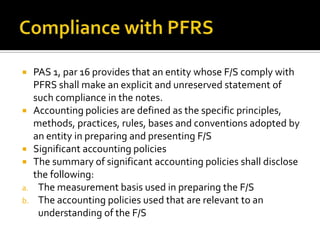
 PAS 1, par 16 provides that an entity whose F/S comply with
  PFRS shall make an explicit and unreserved statement of
  such compliance in the notes.
 Accounting policies are defined as the specific principles,
  methods, practices, rules, bases and conventions adopted by
  an entity in preparing and presenting F/S
 Significant accounting policies
 The summary of significant accounting policies shall disclose
  the following:
a. The measurement basis used in preparing the F/S
b. The accounting policies used that are relevant to an
   understanding of the F/S
  Disclosures of judgment
PAS 1, par 122 provides that an entity shall disclose the judgments that
   management has made in the process of applying accounting policies and that
   have a significant effect on the amounts recognized in the F/S
Disclosures of estimation uncertainty
PAS 1, par 125 an entity shall disclose information about the assumptions it makes
   about the future and other major sources of uncertainty at the end of the
   reporting period that have a significant risk of resulting in a material adjustment
   to the carrying amount of assets and liabilities within the next financial year.
Other disclosures
PAS 1 par 138, provides that an entity shall disclose the following:
a.  Domicile and legal form of the entity, its country of incorporation and the
    address of the business
b. Nature of the entity’s operations and its principal activities
c.  The name of the parent and the ultimate parent of the group.
Par 137 provides that an entity shall disclose the following
1.  The amount of dividends proposed or declared before the financial statements
    were authorized for issue but not recognized as distribution during the period
    and the related amount per share.
2. The amount of any cumulative preference dividends not recognized.


RELATED PARTIES

In accordance with PAS 24, par.9 the following terms are defined:

Related Party – parties are considered to be related if one party has
a.  The ability to control the other party
b. The ability to exercise significant influence over the other party
c.  Joint control over the entity.
Related party transaction is a transfer of resources or obligations between related
    parties, regardless of whether a price is charged.
CONTROL – ownership, directly or             Examples of related parties
  indirectly through subsidiaries of         1. Entities that directly or indirectly
  more than half of the voting power            through one or more
  of an entity, or a substantial interest       intermediaries, control or are
  in voting power and the power to              controlled by or under common
  direct by statute or agreement, the           control with the reporting entity.
  financial and operating policies of           (AFFILIATES parent, the subsidiary
  the management of the entity. The             and fellow subsidiaries)
  power to govern                            2. Associates – entities for which the
                                                investments are accounted for by
SIGNIFICANT INFLUENCE is the power              the equity method. If the
   to participate in the financial and          investment in ORDINARY SHARES
   operating policy decision of an entity       is 20% to 50% the equity method is
   but not control of those policies. i.e.      used in accounting for the
   share ownership of 20% or more.              investment.
                                             3. Venturer in a joint venture
JOINT CONTROL – is the contractually         4. Key management personnel
   agreed sharing of control over an         5. Close family members of an
   economic activity.                           individual
PAS 24, par 20 provides examples of      Transactions with Government –related
   related party transactions:              entities
1.  Purchase and sale of goods
2. Purchase and sale of property and     Under the amended version of PAS 24, a
    other asset                             reporting entity is exempted from
3.  Rendering or receiving services         providing the normal disclosures for
4. Leases                                   transactions with:
5.  Transfer of research and             1.   A government that has control, joint
    development                               control or significant influence over
6. License agreement                          the entity
7.  Finance arrangements, including      2. Other entities controlled, jointly
    loans and equity contributions in         controlled or significantly influenced
    cash or in kind.                          by the same government.
8. Guarantee and collateral
9. Settlement of liabilities on behalf
    of the entity or by the entity on
    behalf of another party
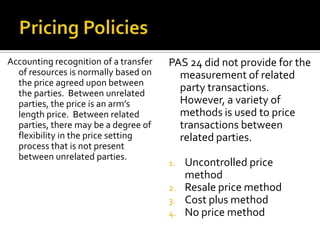
Accounting recognition of a transfer   PAS 24 did not provide for the
  of resources is normally based on      measurement of related
  the price agreed upon between
  the parties. Between unrelated
                                         party transactions.
  parties, the price is an arm’s         However, a variety of
  length price. Between related          methods is used to price
  parties, there may be a degree of      transactions between
  flexibility in the price setting       related parties.
  process that is not present
  between unrelated parties.
                                       1.   Uncontrolled price
                                            method
                                       2.   Resale price method
                                       3.   Cost plus method
                                       4.   No price method
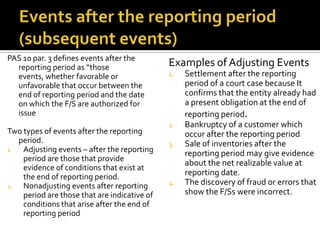
PAS 10 par. 3 defines events after the
  reporting period as “those                  Examples of Adjusting Events
  events, whether favorable or                1.   Settlement after the reporting
  unfavorable that occur between the               period of a court case because It
  end of reporting period and the date             confirms that the entity already had
  on which the F/S are authorized for              a present obligation at the end of
  issue                                            reporting period.
                                              2.   Bankruptcy of a customer which
Two types of events after the reporting            occur after the reporting period
   period.                                    3.   Sale of inventories after the
1.  Adjusting events – after the reporting         reporting period may give evidence
    period are those that provide
                                                   about the net realizable value at
    evidence of conditions that exist at
    the end of reporting period.                   reporting date.
2.  Nonadjusting events after reporting       4.   The discovery of fraud or errors that
    period are those that are indicative of        show the F/Ss were incorrect.
    conditions that arise after the end of
    reporting period
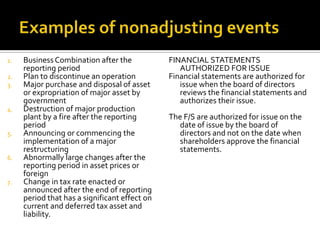
1.   Business Combination after the            FINANCIAL STATEMENTS
     reporting period                             AUTHORIZED FOR ISSUE
2.   Plan to discontinue an operation          Financial statements are authorized for
3.   Major purchase and disposal of asset         issue when the board of directors
     or expropriation of major asset by           reviews the financial statements and
     government                                   authorizes their issue.
4.   Destruction of major production
     plant by a fire after the reporting       The F/S are authorized for issue on the
     period                                      date of issue by the board of
5.   Announcing or commencing the                directors and not on the date when
     implementation of a major                   shareholders approve the financial
     restructuring                               statements.
6.   Abnormally large changes after the
     reporting period in asset prices or
     foreign
7.   Change in tax rate enacted or
     announced after the end of reporting
     period that has a significant effect on
     current and deferred tax asset and
     liability.
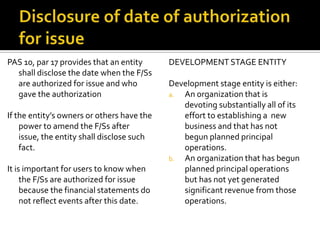
PAS 10, par 17 provides that an entity      DEVELOPMENT STAGE ENTITY
  shall disclose the date when the F/Ss
  are authorized for issue and who          Development stage entity is either:
  gave the authorization                    a. An organization that is
                                               devoting substantially all of its
If the entity’s owners or others have the      effort to establishing a new
    power to amend the F/Ss after              business and that has not
    issue, the entity shall disclose such      begun planned principal
    fact.                                      operations.
                                            b. An organization that has begun
It is important for users to know when         planned principal operations
     the F/Ss are authorized for issue         but has not yet generated
     because the financial statements do       significant revenue from those
     not reflect events after this date.       operations.
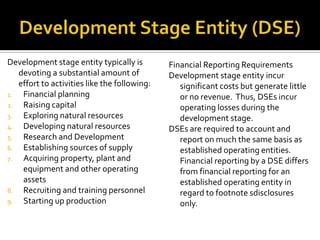
Development stage entity typically is         Financial Reporting Requirements
   devoting a substantial amount of           Development stage entity incur
   effort to activities like the following:      significant costs but generate little
1.  Financial planning                           or no revenue. Thus, DSEs incur
2. Raising capital                               operating losses during the
3.  Exploring natural resources                  development stage.
4. Developing natural resources               DSEs are required to account and
5.  Research and Development                     report on much the same basis as
6. Establishing sources of supply                established operating entities.
7.  Acquiring property, plant and                Financial reporting by a DSE differs
    equipment and other operating                from financial reporting for an
    assets                                       established operating entity in
8. Recruiting and training personnel             regard to footnote sdisclosures
9. Starting up production                        only.

Chapter 3 notes to financial statements

  • 1.
  • 2.
    Notes to financial statements provide a narrative description or disaggregation of items presented in the financial statements and information about items that do not qualify for recognition  Notes contain information in addition to that presented in the statement of financial position, income statement, statement of comprehensive income, statement of changes in equity and statement of cash flows.  PAS 1, par. 113 provides that an entity shall as far as practicable, present notes in a systematic manner.  The notes to financial statements shall be highly detailed, precise, complete and easily understood by a reader who ahs a reasonable understanding of business affairs .
  • 3.
    PAS 1 par112 provides that the notes to financial statements shall: 1. Present information about the basis of preparation of the financial statements and the specific accounting policies used. 2. Disclose the information required by PFRS that is not presented in the F/S 3. Provide additional information which is not presented in the F/S but is relevant to an understanding of the F/S Order of presenting Notes a. Statement of compliance with PFRS b. Summary of significant accounting policies used c. Supporting information or computation for line items presented in the F/S d. Other disclosures such as contingent liabilities, unrecognized contractual commitments and nonfinancial disclosures.
  • 4.
     PAS 1,par 16 provides that an entity whose F/S comply with PFRS shall make an explicit and unreserved statement of such compliance in the notes.  Accounting policies are defined as the specific principles, methods, practices, rules, bases and conventions adopted by an entity in preparing and presenting F/S  Significant accounting policies  The summary of significant accounting policies shall disclose the following: a. The measurement basis used in preparing the F/S b. The accounting policies used that are relevant to an understanding of the F/S
  • 5.
     Disclosuresof judgment PAS 1, par 122 provides that an entity shall disclose the judgments that management has made in the process of applying accounting policies and that have a significant effect on the amounts recognized in the F/S Disclosures of estimation uncertainty PAS 1, par 125 an entity shall disclose information about the assumptions it makes about the future and other major sources of uncertainty at the end of the reporting period that have a significant risk of resulting in a material adjustment to the carrying amount of assets and liabilities within the next financial year. Other disclosures PAS 1 par 138, provides that an entity shall disclose the following: a. Domicile and legal form of the entity, its country of incorporation and the address of the business b. Nature of the entity’s operations and its principal activities c. The name of the parent and the ultimate parent of the group.
  • 6.
    Par 137 providesthat an entity shall disclose the following 1. The amount of dividends proposed or declared before the financial statements were authorized for issue but not recognized as distribution during the period and the related amount per share. 2. The amount of any cumulative preference dividends not recognized. RELATED PARTIES In accordance with PAS 24, par.9 the following terms are defined: Related Party – parties are considered to be related if one party has a. The ability to control the other party b. The ability to exercise significant influence over the other party c. Joint control over the entity. Related party transaction is a transfer of resources or obligations between related parties, regardless of whether a price is charged.
  • 7.
    CONTROL – ownership,directly or Examples of related parties indirectly through subsidiaries of 1. Entities that directly or indirectly more than half of the voting power through one or more of an entity, or a substantial interest intermediaries, control or are in voting power and the power to controlled by or under common direct by statute or agreement, the control with the reporting entity. financial and operating policies of (AFFILIATES parent, the subsidiary the management of the entity. The and fellow subsidiaries) power to govern 2. Associates – entities for which the investments are accounted for by SIGNIFICANT INFLUENCE is the power the equity method. If the to participate in the financial and investment in ORDINARY SHARES operating policy decision of an entity is 20% to 50% the equity method is but not control of those policies. i.e. used in accounting for the share ownership of 20% or more. investment. 3. Venturer in a joint venture JOINT CONTROL – is the contractually 4. Key management personnel agreed sharing of control over an 5. Close family members of an economic activity. individual
  • 8.
    PAS 24, par20 provides examples of Transactions with Government –related related party transactions: entities 1. Purchase and sale of goods 2. Purchase and sale of property and Under the amended version of PAS 24, a other asset reporting entity is exempted from 3. Rendering or receiving services providing the normal disclosures for 4. Leases transactions with: 5. Transfer of research and 1. A government that has control, joint development control or significant influence over 6. License agreement the entity 7. Finance arrangements, including 2. Other entities controlled, jointly loans and equity contributions in controlled or significantly influenced cash or in kind. by the same government. 8. Guarantee and collateral 9. Settlement of liabilities on behalf of the entity or by the entity on behalf of another party
  • 9.
    Accounting recognition ofa transfer PAS 24 did not provide for the of resources is normally based on measurement of related the price agreed upon between the parties. Between unrelated party transactions. parties, the price is an arm’s However, a variety of length price. Between related methods is used to price parties, there may be a degree of transactions between flexibility in the price setting related parties. process that is not present between unrelated parties. 1. Uncontrolled price method 2. Resale price method 3. Cost plus method 4. No price method
  • 10.
    PAS 10 par.3 defines events after the reporting period as “those Examples of Adjusting Events events, whether favorable or 1. Settlement after the reporting unfavorable that occur between the period of a court case because It end of reporting period and the date confirms that the entity already had on which the F/S are authorized for a present obligation at the end of issue reporting period. 2. Bankruptcy of a customer which Two types of events after the reporting occur after the reporting period period. 3. Sale of inventories after the 1. Adjusting events – after the reporting reporting period may give evidence period are those that provide about the net realizable value at evidence of conditions that exist at the end of reporting period. reporting date. 2. Nonadjusting events after reporting 4. The discovery of fraud or errors that period are those that are indicative of show the F/Ss were incorrect. conditions that arise after the end of reporting period
  • 11.
    1. Business Combination after the FINANCIAL STATEMENTS reporting period AUTHORIZED FOR ISSUE 2. Plan to discontinue an operation Financial statements are authorized for 3. Major purchase and disposal of asset issue when the board of directors or expropriation of major asset by reviews the financial statements and government authorizes their issue. 4. Destruction of major production plant by a fire after the reporting The F/S are authorized for issue on the period date of issue by the board of 5. Announcing or commencing the directors and not on the date when implementation of a major shareholders approve the financial restructuring statements. 6. Abnormally large changes after the reporting period in asset prices or foreign 7. Change in tax rate enacted or announced after the end of reporting period that has a significant effect on current and deferred tax asset and liability.
  • 12.
    PAS 10, par17 provides that an entity DEVELOPMENT STAGE ENTITY shall disclose the date when the F/Ss are authorized for issue and who Development stage entity is either: gave the authorization a. An organization that is devoting substantially all of its If the entity’s owners or others have the effort to establishing a new power to amend the F/Ss after business and that has not issue, the entity shall disclose such begun planned principal fact. operations. b. An organization that has begun It is important for users to know when planned principal operations the F/Ss are authorized for issue but has not yet generated because the financial statements do significant revenue from those not reflect events after this date. operations.
  • 13.
    Development stage entitytypically is Financial Reporting Requirements devoting a substantial amount of Development stage entity incur effort to activities like the following: significant costs but generate little 1. Financial planning or no revenue. Thus, DSEs incur 2. Raising capital operating losses during the 3. Exploring natural resources development stage. 4. Developing natural resources DSEs are required to account and 5. Research and Development report on much the same basis as 6. Establishing sources of supply established operating entities. 7. Acquiring property, plant and Financial reporting by a DSE differs equipment and other operating from financial reporting for an assets established operating entity in 8. Recruiting and training personnel regard to footnote sdisclosures 9. Starting up production only.