Academic Vocabulary
Instruction using
Marzano’s
Six-Step Plan
* 1
Mark Barratt
You will:
Understand characteristics of effective
vocabulary instruction, and
Apply a six-step process for direct instruction
in vocabulary.
Incorporate various vocabulary teaching
strategies.
* 2
By the end of the next two
sessions…
Impact of Direct Vocabulary
Instruction
•Research shows a student in the 50th percentile
in terms of ability to comprehend the subject
matter taught in school, with no direct vocabulary
instruction, scores in the 50th percentile ranking.
•The same student, after specific content-area
terms have been taught in a specific way, raises
his/her comprehension ability to the 83rd
percentile.
🞂 there is a 38,000,000 word gap, by age 4,
between impoverished and middle-class
children
* 4
Building academic background knowledge
through direct vocabulary instruction is
particularly beneficial for students who
do not come from advantaged
backgrounds because…
🞂 18-24% increase on standardized tests for
students living in poverty
🞂 21-29% increase on standardized tests for ELL
students
* 5
Research Findings
Why should we explicitly teach
academic vocabulary using a
process?
Student Engagement
What influences whether students are paying attention to the teacher or
the lesson?
◆energy
◆affect/emotions
◆ interest/curiosity
◆ challenge
◆routines
What influences students’ beliefs about the importance what they are
learning or doing?
◆perceptions of learning
◆long term goals
◆short term goals
◆perception of relevance /usefulness
What influences students’ sense of efficacy related to the task or
learning
◆ perceptions of intelligence
◆ past experiences
◆Level of autonomy
◆ perceptions of access to knowledge and resources.
* 6
What It Means to Us…
•It is not necessary for all vocabulary terms
to be directly taught.
•Yet, direct instruction of vocabulary has
been proven to make an impact.
🞂 BICS –language of the playground and social interaction
🞂 CALP –cognitive and academic language, the language of the
curriculum
* 8
BICS & CALP
* 9
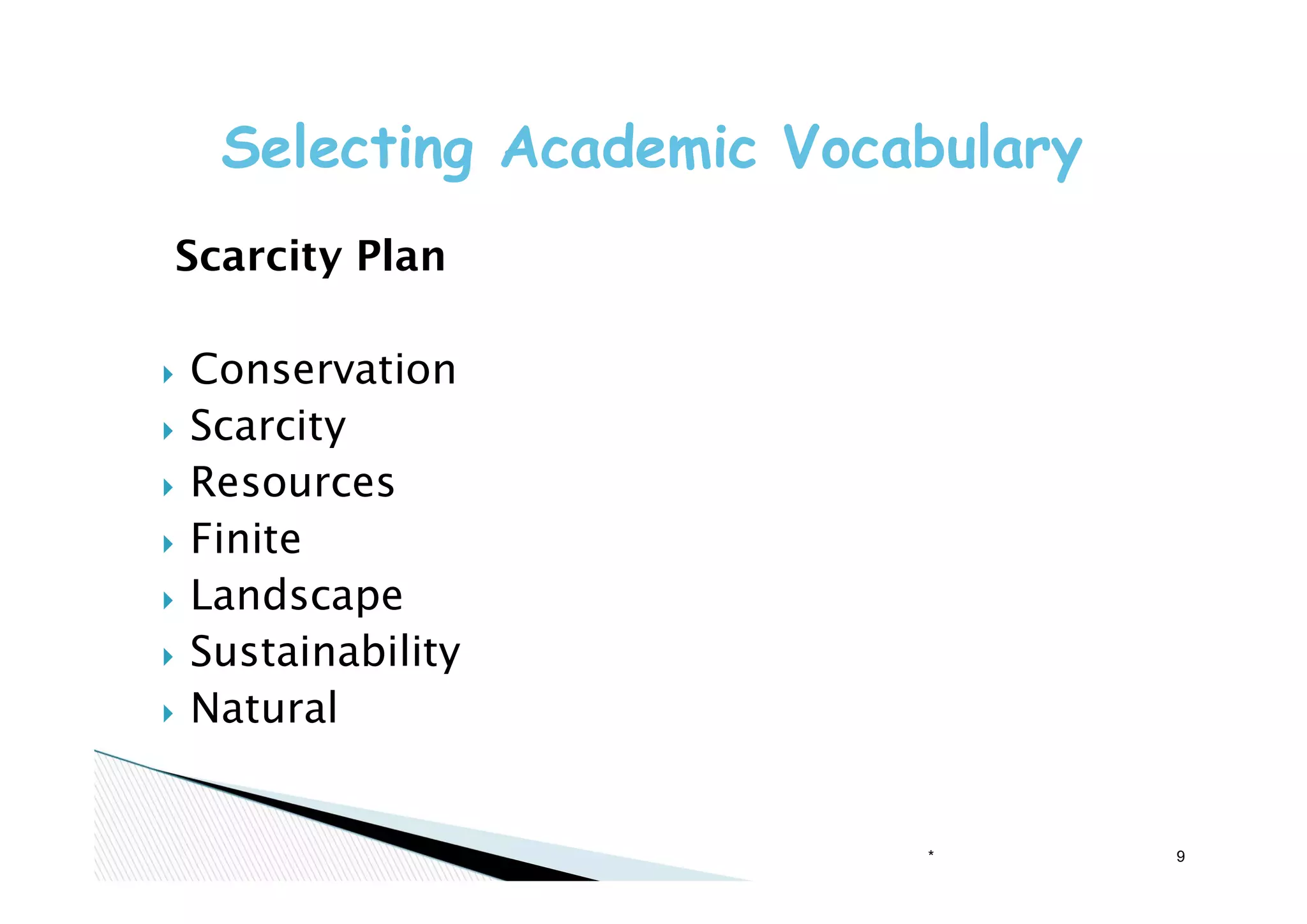
Selecting Academic Vocabulary
Scarcity Plan
🞂 Conservation
🞂 Scarcity
🞂 Resources
🞂 Finite
🞂 Landscape
🞂 Sustainability
🞂 Natural
Six-Steps for Teaching New
Terms
•First 3 steps – introduce and
develop initial understanding.
•Last 3 steps – shape and sharpen
understanding.
Step 1
•Provide a description,
explanation, or example of new
term.
•Our term for today is: Drought
Do not just repeat the
dictionary
Step 1 contd
•Tell a story that integrates the term
•Use digital image as the stimulus in
understanding the information
•Use current events to help make the terms
applicable to something familiar to students
•Describe your own mental pictures of the
terms
•Find or make pictures that exemplify the
term
Step 2
•Students restate explanation
of new term in own words.
Step 2 contd
• Allow the students to discus the terms in
partners or small groups
• Provide more descriptions, explanations or
examples if necessary
• Remind learners to use their own words, no
parroting of the teacher’s description or reading
from the dictionary
Step 3
•Students create a
nonlinguistic representation of
term.
Draw a picture
Cut outs
Step 4
•Students periodically do activities
that help add to knowledge of
vocabulary terms.
A list of activities can be found at:
TeachNet, GameAquarium, quizlet.com, sedl.org,
Word Scrambler, myplick.com and the
cmsdmathcoaches.pbworks.com.
Step 4 contd
•Identify synonyms or antonyms
•List related words/mind mapping
•Draw a graphic
•Write a metaphor or an analogy
•Compare and contrast terms
•Sentence Stems
•Free Association (warm up)
•Venn Diagram
Review Activity
Solving Analogy Problems
•One or two terms are missing. Please think
about statements below, turn to your elbow
partner and provide terms that will complete
following analogies.
Grass is to field as word is to ______.
Decibel is to sound as _____ is to _____.
Step 5
•Students are asked to discuss
terms with one another.
“Talk a Mile a Minute”
Activity
•Teams of 3-4
•Designate a “talker” for each round.
•Try to get team to say each word by
quickly describing them.
•May not use words in category title or
rhyming words.
Wave
Pacific
Tropical fish
Algae
Moon
Ship
* 21
Geometry
Radius
Congruent figures
Angle
Triangle
Reflection
Squares
2 D
Step 6
•Students are involved in games
that allow them to play with
terms.
🞂 Games are the most underused instructional
tool in education (Barth)
🞂 Games help teachers keep new terms in the
forefront of students’ thinking (Tomlinson)
🞂 Games allow students to reexamine their
understandings of terms (O’Brien)
🞂 Provide opportunities for students to work
together and possibly lowers anxiety (J&J)
Step 6 contd
Vocabulary Charades
Game Activity
•Please stand.
•Using your arms, legs, and bodies, show
the meaning of each term below:
–square
–diameter
–triangle
One Way of Keeping Track of
Student Progress
Level 4: I understand even more about the term than when
I was taught.
Level 3: I understand the term and I’m not confused about
any part of what it means.
Level 2: I’m a little uncertain about what the term means,
but I have a general idea.
Level 1: I’m very uncertain about the term. I really don’t
understand what it means.
Management
•10 terms in the IC Plan so 1 per week for
10 weeks to teach target terms.
•As part of the Spelling Programme set
time to engage students in vocabulary
activities, adding to knowledge base.
•Allow students to discuss terms.
•Encourage students to add information
into their language books.

Academic vocabulary

  • 1.
  • 2.
    You will: Understand characteristicsof effective vocabulary instruction, and Apply a six-step process for direct instruction in vocabulary. Incorporate various vocabulary teaching strategies. * 2 By the end of the next two sessions…
  • 3.
    Impact of DirectVocabulary Instruction •Research shows a student in the 50th percentile in terms of ability to comprehend the subject matter taught in school, with no direct vocabulary instruction, scores in the 50th percentile ranking. •The same student, after specific content-area terms have been taught in a specific way, raises his/her comprehension ability to the 83rd percentile.
  • 4.
    🞂 there isa 38,000,000 word gap, by age 4, between impoverished and middle-class children * 4 Building academic background knowledge through direct vocabulary instruction is particularly beneficial for students who do not come from advantaged backgrounds because…
  • 5.
    🞂 18-24% increaseon standardized tests for students living in poverty 🞂 21-29% increase on standardized tests for ELL students * 5 Research Findings Why should we explicitly teach academic vocabulary using a process?
  • 6.
    Student Engagement What influenceswhether students are paying attention to the teacher or the lesson? ◆energy ◆affect/emotions ◆ interest/curiosity ◆ challenge ◆routines What influences students’ beliefs about the importance what they are learning or doing? ◆perceptions of learning ◆long term goals ◆short term goals ◆perception of relevance /usefulness What influences students’ sense of efficacy related to the task or learning ◆ perceptions of intelligence ◆ past experiences ◆Level of autonomy ◆ perceptions of access to knowledge and resources. * 6
  • 7.
    What It Meansto Us… •It is not necessary for all vocabulary terms to be directly taught. •Yet, direct instruction of vocabulary has been proven to make an impact.
  • 8.
    🞂 BICS –languageof the playground and social interaction 🞂 CALP –cognitive and academic language, the language of the curriculum * 8 BICS & CALP
  • 9.
    * 9 Selecting AcademicVocabulary Scarcity Plan 🞂 Conservation 🞂 Scarcity 🞂 Resources 🞂 Finite 🞂 Landscape 🞂 Sustainability 🞂 Natural
  • 10.
    Six-Steps for TeachingNew Terms •First 3 steps – introduce and develop initial understanding. •Last 3 steps – shape and sharpen understanding.
  • 11.
    Step 1 •Provide adescription, explanation, or example of new term. •Our term for today is: Drought Do not just repeat the dictionary
  • 12.
    Step 1 contd •Tella story that integrates the term •Use digital image as the stimulus in understanding the information •Use current events to help make the terms applicable to something familiar to students •Describe your own mental pictures of the terms •Find or make pictures that exemplify the term
  • 13.
    Step 2 •Students restateexplanation of new term in own words.
  • 14.
    Step 2 contd •Allow the students to discus the terms in partners or small groups • Provide more descriptions, explanations or examples if necessary • Remind learners to use their own words, no parroting of the teacher’s description or reading from the dictionary
  • 15.
    Step 3 •Students createa nonlinguistic representation of term. Draw a picture Cut outs
  • 16.
    Step 4 •Students periodicallydo activities that help add to knowledge of vocabulary terms. A list of activities can be found at: TeachNet, GameAquarium, quizlet.com, sedl.org, Word Scrambler, myplick.com and the cmsdmathcoaches.pbworks.com.
  • 17.
    Step 4 contd •Identifysynonyms or antonyms •List related words/mind mapping •Draw a graphic •Write a metaphor or an analogy •Compare and contrast terms •Sentence Stems •Free Association (warm up) •Venn Diagram
  • 18.
    Review Activity Solving AnalogyProblems •One or two terms are missing. Please think about statements below, turn to your elbow partner and provide terms that will complete following analogies. Grass is to field as word is to ______. Decibel is to sound as _____ is to _____.
  • 19.
    Step 5 •Students areasked to discuss terms with one another.
  • 20.
    “Talk a Milea Minute” Activity •Teams of 3-4 •Designate a “talker” for each round. •Try to get team to say each word by quickly describing them. •May not use words in category title or rhyming words.
  • 21.
  • 22.
  • 23.
    Step 6 •Students areinvolved in games that allow them to play with terms.
  • 24.
    🞂 Games arethe most underused instructional tool in education (Barth) 🞂 Games help teachers keep new terms in the forefront of students’ thinking (Tomlinson) 🞂 Games allow students to reexamine their understandings of terms (O’Brien) 🞂 Provide opportunities for students to work together and possibly lowers anxiety (J&J) Step 6 contd
  • 25.
    Vocabulary Charades Game Activity •Pleasestand. •Using your arms, legs, and bodies, show the meaning of each term below: –square –diameter –triangle
  • 26.
    One Way ofKeeping Track of Student Progress Level 4: I understand even more about the term than when I was taught. Level 3: I understand the term and I’m not confused about any part of what it means. Level 2: I’m a little uncertain about what the term means, but I have a general idea. Level 1: I’m very uncertain about the term. I really don’t understand what it means.
  • 27.
    Management •10 terms inthe IC Plan so 1 per week for 10 weeks to teach target terms. •As part of the Spelling Programme set time to engage students in vocabulary activities, adding to knowledge base. •Allow students to discuss terms. •Encourage students to add information into their language books.