Grade 8 Mathematics 

    Assessment


Eligible Texas Essential

 Knowledge and Skills


          Texas Education Agency

        Student Assessment Division

                Spring 2011
STAAR Grade 8 Mathematics Assessment
Reporting Category 1:

Numbers, Operations, and Quantitative Reasoning 

The student will demonstrate an understanding of numbers, operations,

and quantitative reasoning.


(8.1)	   Number, operation, and quantitative reasoning. The student
         understands that different forms of numbers are appropriate for different
         situations. The student is expected to

          (A)	    compare and order rational numbers in various forms including
                  integers, percents, and positive and negative fractions and
                  decimals; Readiness Standard
          (B)	    select and use appropriate forms of rational numbers to solve real-
                  life problems including those involving proportional relationships;
                  Supporting Standard
          (C) 	   approximate (mentally [and with calculators]) the value of irrational
                  numbers as they arise from problem situations (such as π, 2 ); and
                  Supporting Standard
          (D) 	 express numbers in scientific notation, including negative
                exponents, in appropriate problem situations.
                Supporting Standard
(8.2)	   Number, operation, and quantitative reasoning. The student selects
         and uses appropriate operations to solve problems and justify solutions.
         The student is expected to

          (A) 	   select appropriate operations to solve problems involving rational
                  numbers and justify the selections; Supporting Standard
          (B)	    use appropriate operations to solve problems involving rational
                  numbers in problem situations; Readiness Standard
          (C)	    evaluate a solution for reasonableness; and Supporting Standard
          (D) 	 use multiplication by a given constant factor (including unit rate) to
                represent and solve problems involving proportional relationships
                including conversions between measurement systems.
                Supporting Standard


STAAR Grade 8 Mathematics	                                               Page 2 of 7

                                    Texas Education Agency

                                  Student Assessment Division

                                          Spring 2011
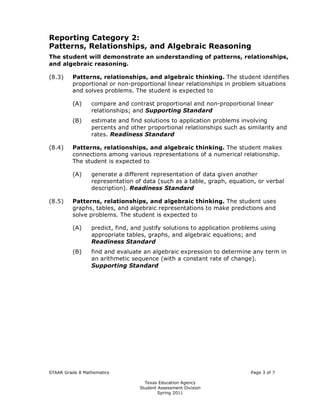
Reporting Category 2:

Patterns, Relationships, and Algebraic Reasoning

The student will demonstrate an understanding of patterns, relationships,
and algebraic reasoning.

(8.3)	   Patterns, relationships, and algebraic thinking. The student identifies
         proportional or non-proportional linear relationships in problem situations
         and solves problems. The student is expected to

         (A)	    compare and contrast proportional and non-proportional linear
                 relationships; and Supporting Standard
         (B) 	   estimate and find solutions to application problems involving
                 percents and other proportional relationships such as similarity and
                 rates. Readiness Standard

(8.4)	   Patterns, relationships, and algebraic thinking. The student makes
         connections among various representations of a numerical relationship.
         The student is expected to

         (A)	    generate a different representation of data given another
                 representation of data (such as a table, graph, equation, or verbal
                 description). Readiness Standard

(8.5)	   Patterns, relationships, and algebraic thinking. The student uses
         graphs, tables, and algebraic representations to make predictions and
         solve problems. The student is expected to

         (A)     predict, find, and justify solutions to application problems using
                 appropriate tables, graphs, and algebraic equations; and
                 Readiness Standard
         (B)	    find and evaluate an algebraic expression to determine any term in
                 an arithmetic sequence (with a constant rate of change).
                 Supporting Standard


STAAR Grade 8 Mathematics	                                                Page 3 of 7

                                    Texas Education Agency

                                  Student Assessment Division

                                          Spring 2011
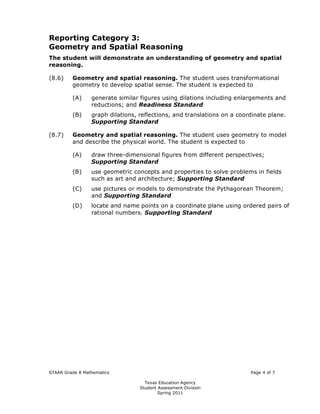
Reporting Category 3:

Geometry and Spatial Reasoning 

The student will demonstrate an understanding of geometry and spatial 

reasoning.


(8.6)	   Geometry and spatial reasoning. The student uses transformational
         geometry to develop spatial sense. The student is expected to

         (A)	    generate similar figures using dilations including enlargements and
                 reductions; and Readiness Standard
         (B) 	   graph dilations, reflections, and translations on a coordinate plane.
                 Supporting Standard

(8.7)	   Geometry and spatial reasoning. The student uses geometry to model
         and describe the physical world. The student is expected to

         (A)     draw three-dimensional figures from different perspectives;
                 Supporting Standard
         (B)	    use geometric concepts and properties to solve problems in fields
                 such as art and architecture; Supporting Standard
         (C)	    use pictures or models to demonstrate the Pythagorean Theorem;
                 and Supporting Standard
         (D)	    locate and name points on a coordinate plane using ordered pairs of
                 rational numbers. Supporting Standard


STAAR Grade 8 Mathematics	                                               Page 4 of 7

                                    Texas Education Agency

                                  Student Assessment Division

                                          Spring 2011
Reporting Category 4:

Measurement

The student will demonstrate an understanding of the concepts and uses

of measurement.


(8.8)	   Measurement. The student uses procedures to determine measures of
         three-dimensional figures. The student is expected to

         (A)	    find lateral and total surface area of prisms, pyramids, and cylinders
                 using [concrete] models and nets (two-dimensional models);
                 Supporting Standard
         (B)	    connect models of prisms, cylinders, pyramids, spheres, and cones
                 to formulas for volume of these objects; and Supporting Standard
         (C)	    estimate measurements and use formulas to solve application
                 problems involving lateral and total surface area and volume.
                 Readiness Standard

(8.9)	   Measurement. The student uses indirect measurement to solve problems.
         The student is expected to

         (A)     use the Pythagorean Theorem to solve real-life problems; and
                 Readiness Standard
         (B) 	   use proportional relationships in similar two-dimensional figures or
                 similar three-dimensional figures to find missing measurements.
                 Readiness Standard

(8.10)	 Measurement. The student describes how changes in dimensions affect
        linear, area, and volume measures. The student is expected to

         (A)	    describe the resulting effects on perimeter and area when
                 dimensions of a shape are changed proportionally; and
                 Supporting Standard
         (B) 	   describe the resulting effect on volume when dimensions of a solid
                 are changed proportionally. Supporting Standard


STAAR Grade 8 Mathematics	                                               Page 5 of 7

                                    Texas Education Agency

                                  Student Assessment Division

                                          Spring 2011
Reporting Category 5:

Probability and Statistics

The student will demonstrate an understanding of probability and 

statistics.


(8.11)	 Probability and statistics. The student applies concepts of theoretical
        and experimental probability to make predictions. The student is
        expected to

         (A)     find the probabilities of dependent and independent events; and
                 Readiness Standard
         (B)	    use theoretical probabilities and experimental results to make
                 predictions and decisions. Supporting Standard

(8.12)	 Probability and statistics. The student uses statistical procedures to

        describe data. The student is expected to


         (A) 	   use variability (range, including interquartile range (IQR)) and select
                 the appropriate measure of central tendency to describe a set of
                 data and justify the choice for a particular situation;
                 Supporting Standard
         (B) 	   draw conclusions and make predictions by analyzing trends in
                 scatterplots; and Supporting Standard
         (C)	    select and use an appropriate representation for presenting and
                 displaying relationships among collected data, including line plots,
                 line graphs, stem and leaf plots, circle graphs, bar graphs, box and
                 whisker plots, histograms, and Venn diagrams, with and without the
                 use of technology. Supporting Standard

(8.13)	 Probability and statistics. The student evaluates predictions and
        conclusions based on statistical data. The student is expected to

         (A)	    evaluate methods of sampling to determine validity of an inference
                 made from a set of data; and Supporting Standard
         (B) 	   recognize misuses of graphical or numerical information and
                 evaluate predictions and conclusions based on data analysis.
                 Readiness Standard


STAAR Grade 8 Mathematics	                                               Page 6 of 7

                                    Texas Education Agency

                                  Student Assessment Division

                                          Spring 2011
Underlying Processes and Mathematical Tools

These skills will not be listed under a separate recording category.
Instead, they will be incorporated into at least 75% of the test questions
in reporting categories 1–5 and will be identified along with content
standards.

(8.14)	 Underlying processes and mathematical tools. The student applies 

        Grade 8 mathematics to solve problems connected to everyday

        experiences, investigations in other disciplines, and activities in and

        outside of school. The student is expected to


         (A)	    identify and apply mathematics to everyday experiences, to
                 activities in and outside of school, with other disciplines, and with
                 other mathematical topics;
         (B) 	   use a problem-solving model that incorporates understanding the
                 problem, making a plan, carrying out the plan, and evaluating the
                 solution for reasonableness;
         (C)	    select or develop an appropriate problem-solving strategy from a
                 variety of different types, including drawing a picture, looking for a
                 pattern, systematic guessing and checking, acting it out, making a
                 table, working a simpler problem, or working backwards to solve a
                 problem; and
         (D) 	 select tools such as real objects, manipulatives, paper/pencil, and
               technology or techniques such as mental math, estimation, and
               number sense to solve problems.

(8.15)	 Underlying processes and mathematical tools. The student
        communicates about Grade 8 mathematics through informal and
        mathematical language, representations, and models. The student is
        expected to

         (A) 	   communicate mathematical ideas using language, efficient tools,
                 appropriate units, and graphical, numerical, physical, or algebraic
                 mathematical models.

(8.16)	 Underlying processes and mathematical tools. The student uses
        logical reasoning to make conjectures and verify conclusions. The student
        is expected to

         (A)	    make conjectures from patterns or sets of examples and
                 nonexamples; and
         (B) 	   validate his/her conclusions using mathematical properties and
                 relationships.


STAAR Grade 8 Mathematics	                                                Page 7 of 7

                                    Texas Education Agency

                                  Student Assessment Division

                                          Spring 2011

Assess curr mathg08

  • 1.
    Grade 8 Mathematics Assessment Eligible Texas Essential Knowledge and Skills Texas Education Agency Student Assessment Division Spring 2011
  • 2.
    STAAR Grade 8Mathematics Assessment Reporting Category 1: Numbers, Operations, and Quantitative Reasoning The student will demonstrate an understanding of numbers, operations, and quantitative reasoning. (8.1) Number, operation, and quantitative reasoning. The student understands that different forms of numbers are appropriate for different situations. The student is expected to (A) compare and order rational numbers in various forms including integers, percents, and positive and negative fractions and decimals; Readiness Standard (B) select and use appropriate forms of rational numbers to solve real- life problems including those involving proportional relationships; Supporting Standard (C) approximate (mentally [and with calculators]) the value of irrational numbers as they arise from problem situations (such as π, 2 ); and Supporting Standard (D) express numbers in scientific notation, including negative exponents, in appropriate problem situations. Supporting Standard (8.2) Number, operation, and quantitative reasoning. The student selects and uses appropriate operations to solve problems and justify solutions. The student is expected to (A) select appropriate operations to solve problems involving rational numbers and justify the selections; Supporting Standard (B) use appropriate operations to solve problems involving rational numbers in problem situations; Readiness Standard (C) evaluate a solution for reasonableness; and Supporting Standard (D) use multiplication by a given constant factor (including unit rate) to represent and solve problems involving proportional relationships including conversions between measurement systems. Supporting Standard STAAR Grade 8 Mathematics Page 2 of 7 Texas Education Agency Student Assessment Division Spring 2011
  • 3.
    Reporting Category 2: Patterns,Relationships, and Algebraic Reasoning The student will demonstrate an understanding of patterns, relationships, and algebraic reasoning. (8.3) Patterns, relationships, and algebraic thinking. The student identifies proportional or non-proportional linear relationships in problem situations and solves problems. The student is expected to (A) compare and contrast proportional and non-proportional linear relationships; and Supporting Standard (B) estimate and find solutions to application problems involving percents and other proportional relationships such as similarity and rates. Readiness Standard (8.4) Patterns, relationships, and algebraic thinking. The student makes connections among various representations of a numerical relationship. The student is expected to (A) generate a different representation of data given another representation of data (such as a table, graph, equation, or verbal description). Readiness Standard (8.5) Patterns, relationships, and algebraic thinking. The student uses graphs, tables, and algebraic representations to make predictions and solve problems. The student is expected to (A) predict, find, and justify solutions to application problems using appropriate tables, graphs, and algebraic equations; and Readiness Standard (B) find and evaluate an algebraic expression to determine any term in an arithmetic sequence (with a constant rate of change). Supporting Standard STAAR Grade 8 Mathematics Page 3 of 7 Texas Education Agency Student Assessment Division Spring 2011
  • 4.
    Reporting Category 3: Geometryand Spatial Reasoning The student will demonstrate an understanding of geometry and spatial reasoning. (8.6) Geometry and spatial reasoning. The student uses transformational geometry to develop spatial sense. The student is expected to (A) generate similar figures using dilations including enlargements and reductions; and Readiness Standard (B) graph dilations, reflections, and translations on a coordinate plane. Supporting Standard (8.7) Geometry and spatial reasoning. The student uses geometry to model and describe the physical world. The student is expected to (A) draw three-dimensional figures from different perspectives; Supporting Standard (B) use geometric concepts and properties to solve problems in fields such as art and architecture; Supporting Standard (C) use pictures or models to demonstrate the Pythagorean Theorem; and Supporting Standard (D) locate and name points on a coordinate plane using ordered pairs of rational numbers. Supporting Standard STAAR Grade 8 Mathematics Page 4 of 7 Texas Education Agency Student Assessment Division Spring 2011
  • 5.
    Reporting Category 4: Measurement Thestudent will demonstrate an understanding of the concepts and uses of measurement. (8.8) Measurement. The student uses procedures to determine measures of three-dimensional figures. The student is expected to (A) find lateral and total surface area of prisms, pyramids, and cylinders using [concrete] models and nets (two-dimensional models); Supporting Standard (B) connect models of prisms, cylinders, pyramids, spheres, and cones to formulas for volume of these objects; and Supporting Standard (C) estimate measurements and use formulas to solve application problems involving lateral and total surface area and volume. Readiness Standard (8.9) Measurement. The student uses indirect measurement to solve problems. The student is expected to (A) use the Pythagorean Theorem to solve real-life problems; and Readiness Standard (B) use proportional relationships in similar two-dimensional figures or similar three-dimensional figures to find missing measurements. Readiness Standard (8.10) Measurement. The student describes how changes in dimensions affect linear, area, and volume measures. The student is expected to (A) describe the resulting effects on perimeter and area when dimensions of a shape are changed proportionally; and Supporting Standard (B) describe the resulting effect on volume when dimensions of a solid are changed proportionally. Supporting Standard STAAR Grade 8 Mathematics Page 5 of 7 Texas Education Agency Student Assessment Division Spring 2011
  • 6.
    Reporting Category 5: Probabilityand Statistics The student will demonstrate an understanding of probability and statistics. (8.11) Probability and statistics. The student applies concepts of theoretical and experimental probability to make predictions. The student is expected to (A) find the probabilities of dependent and independent events; and Readiness Standard (B) use theoretical probabilities and experimental results to make predictions and decisions. Supporting Standard (8.12) Probability and statistics. The student uses statistical procedures to describe data. The student is expected to (A) use variability (range, including interquartile range (IQR)) and select the appropriate measure of central tendency to describe a set of data and justify the choice for a particular situation; Supporting Standard (B) draw conclusions and make predictions by analyzing trends in scatterplots; and Supporting Standard (C) select and use an appropriate representation for presenting and displaying relationships among collected data, including line plots, line graphs, stem and leaf plots, circle graphs, bar graphs, box and whisker plots, histograms, and Venn diagrams, with and without the use of technology. Supporting Standard (8.13) Probability and statistics. The student evaluates predictions and conclusions based on statistical data. The student is expected to (A) evaluate methods of sampling to determine validity of an inference made from a set of data; and Supporting Standard (B) recognize misuses of graphical or numerical information and evaluate predictions and conclusions based on data analysis. Readiness Standard STAAR Grade 8 Mathematics Page 6 of 7 Texas Education Agency Student Assessment Division Spring 2011
  • 7.
    Underlying Processes andMathematical Tools These skills will not be listed under a separate recording category. Instead, they will be incorporated into at least 75% of the test questions in reporting categories 1–5 and will be identified along with content standards. (8.14) Underlying processes and mathematical tools. The student applies Grade 8 mathematics to solve problems connected to everyday experiences, investigations in other disciplines, and activities in and outside of school. The student is expected to (A) identify and apply mathematics to everyday experiences, to activities in and outside of school, with other disciplines, and with other mathematical topics; (B) use a problem-solving model that incorporates understanding the problem, making a plan, carrying out the plan, and evaluating the solution for reasonableness; (C) select or develop an appropriate problem-solving strategy from a variety of different types, including drawing a picture, looking for a pattern, systematic guessing and checking, acting it out, making a table, working a simpler problem, or working backwards to solve a problem; and (D) select tools such as real objects, manipulatives, paper/pencil, and technology or techniques such as mental math, estimation, and number sense to solve problems. (8.15) Underlying processes and mathematical tools. The student communicates about Grade 8 mathematics through informal and mathematical language, representations, and models. The student is expected to (A) communicate mathematical ideas using language, efficient tools, appropriate units, and graphical, numerical, physical, or algebraic mathematical models. (8.16) Underlying processes and mathematical tools. The student uses logical reasoning to make conjectures and verify conclusions. The student is expected to (A) make conjectures from patterns or sets of examples and nonexamples; and (B) validate his/her conclusions using mathematical properties and relationships. STAAR Grade 8 Mathematics Page 7 of 7 Texas Education Agency Student Assessment Division Spring 2011