Number	
  and	
  
Number	
  Theory	
         Grade	
  5 2.1.5.A:	
  Apply	
  number	
  patterns	
  to	
  count	
  and	
  compare	
  values	
  of	
  whole	
  numbers,	
  fractions,	
  and	
  decimals.
                                      2.1.5.B:	
  Use	
  number	
  theory	
  concepts	
  and	
  models	
  to	
  represent	
  or	
  rename	
  whole	
  numbers,	
  fractions,	
  	
  
2.1	
                      	
         and	
  decimals.
	
                         	
         2.1.5.C:	
  Use	
  models	
  to	
  represent	
  the	
  concept	
  of	
  an	
  integer,	
  fraction,	
  decimal,	
  or	
  percent.
                                      2.1.5.D:	
  Apply	
  place	
  value	
  concepts	
  to	
  order	
  and	
  compare	
  decimals	
  and	
  to	
  express	
  whole	
  numbers	


         and	
  decimals	
  in	
  expanded	
  notation.
                                      2.1.5.E:	
  Develop	
  and	
  apply	
  number	
  theory	
  concepts	
  (e.g.,	
  primes,	
  factors,	
  multiples,	
  composites)	
  to	


         represent	
  numbers	
  in	
  various	
  ways.
                                      2.1.5.F:	
  Understand	
  the	
  concepts	
  of	
  multiplication	
  and	
  division	
  and	
  use	
  the	
  inverse	
  relationships	


         between	
  multiplication	
  and	
  division,	
  to	
  determine	
  unknown	
  quantities	
  in	
  equations.	


Computation	
  and	
                  2.2.5.B:	
  Multiply	
  and	
  divide	
  single-­‐	
  and	
  double-­‐digit	
  numbers;	
  add	
  and	
  subtract	
  fractions	
  and	
  mixed	
  
Estimation	
               Grade	
  5 	
  numbers;	
  add,	
  subtract,	
  multiply	
  and	
  divide	
  decimals.
                                      2.2.5.D:	
  Estimate	
  results	
  from	
  calculations	
  with	
  basic	
  operations	
  of	
  whole	
  numbers	
  and	
  decimals	
  and	
  	
  
2.2	
                      	
         check	
  the	
  reasonableness	
  of	
  those	
  estimates.	


Measurement	
  and	
                  2.3.5.A:	
  Use	
  concrete	
  objects	
  to	
  demonstrate	
  the	
  meaning	
  of	
  measurement	
  quantities	
  (e.g.,	
  perimeter,	
  	
  
Estimation	
               Grade	
  5 area,	
  weight,	
  capacity).
                                      2.3.5.B:	
  Select	
  and	
  use	
  appropriate	
  instruments	
  and	
  units	
  for	
  measuring	
  quantities	
  to	
  a	
  specified	
  level	
  of	
  
2.3	
                      	
         	
  accuracy.
	
                         	
         2.3.5.C:	
  Calculate	
  perimeter	
  and	
  area,	
  and	
  sums	
  and	
  differences	
  of	
  measurements.
	
                         	
         2.3.5.D:	
  Perform	
  basic	
  conversions	
  within	
  a	
  system.
                                      2.3.5.F:	
  Estimate	
  and	
  verify	
  measurements	
  of	
  length,	
  perimeter,	
  area,	
  volume,	
  capacity,	
  temperature,	


         time,	
  weight,	
  and	
  angles.	


2.4:	
  Mathematical	
                2.4.5.A:	
  Use	
  models,	
  number	
  facts,	
  properties	
  and	
  relationships	
  to	
  draw	
  conclusions	
  and	
  explain	
  reasons	
  	
  
Reasoning	
  and	
         Grade	
  5 for	
  conclusions.
Connections	


             2.4.5.B:	
  Use	
  if…then	
  statements	
  to	
  express	
  conditional	
  relationships.	


2.5:	
  Mathematical	
  
Problem	
  Solving	
                        2.5.5.A:	
  Develop	
  a	
  plan	
  to	
  analyze	
  a	
  problem,	
  identify	
  the	
  information	
  needed	
  to	
  solve	
  the	
  problem,	
  carry	
  
and	
                                       	
  out	
  the	
  plan,	
  check	
  whether	
  an	
  answer	
  makes	
  sense,	
  and	
  explain	
  how	
  the	
  problem	
  was	
  solved	
  in	
  grade	
  	
  
Communication	
                  Grade	
  5 appropriate	
  contexts.
                                            2.5.5.B:	
  Use	
  appropriate	
  mathematical	
  terms,	
  vocabulary,	
  language,	
  symbols,	
  and	
  graphs	
  to	
  explain	


         clearly	
  and	
  logically	
  solutions	
  to	
  problems.	


2.6:	
  Statistics	
  and	
  
Data	
  Analysis	
               	
         2.6.4.E:	
  Determine	
  the	
  reasonableness	
  of	
  a	
  statement	
  based	
  on	
  a	
  comparison	
  to	
  data	
  displayed	
  in	
  a	
  graph.
	
                               Grade	
  5 2.6.5.A:	
  Gather	
  data	
  from	
  surveys	
  and	
  observations	
  from	
  sources	
  outside	
  the	
  classroom	
  or	
  home.
                                            2.6.5.B:	
  Use	
  pictures,	
  tallies,	
  tables,	
  charts,	
  bar	
  graphs,	
  line	
  graphs,	
  diagrams,	
  and	
  graphs	
  to	
  organize,	


         display,	
  and	
  analyze	
  data.
                                            2.6.5.C:	
  Calculate	
  mean	
  and	
  range,	
  identify	
  the	
  median	
  and	
  the	
  mode	
  of	
  a	
  set	
  of	
  data,	
  and	
  use	
  these	


         quantities	
  to	
  describe	
  the	
  data.
	
                               	
         2.6.5.D:	
  Compare	
  data	
  using	
  multiple	
  categories	
  displayed	
  in	
  a	
  graph.
                                            2.6.5.E:	
  Determine	
  the	
  reasonableness	
  of	
  a	
  statement	
  based	
  on	
  a	
  comparison	
  to	
  data	
  displayed	
  in	
  a	


         graph	
  and	
  summarized	
  by	
  numerical	
  measures.	


   2.7:	
  Probability	
  and	
  PGrade	
  5 2.7.5.A:	
  Predict	
  and	
  calculate	
  the	
  likelihood	
  of	
  simple	
  events.
                                     redictions
                                                2.7.5.B:	
  Predict	
  and	
  determine	
  why	
  some	
  outcomes	
  of	
  a	
  particular	
  event	
  are	
  certain,	
  more	
  likely,	
  less	


          likely,	
  equally	
  likely,	
  or	
  impossible.
	
                                  	
          2.7.5.C:	
  Express	
  probabilities	
  as	
  fractions	
  and/or	
  decimals.
                                                2.7.5.D:	
  List	
  all	
  possible	
  combinations	
  and	
  arrangements	
  of	
  outcomes	
  of	
  an	
  experiment	
  (e.g.,	
  tree	


          diagrams,	
  matrices)
                               	
             2.7.5.E:	
  Compare	
  predictions	
  based	
  on	
  theoretical	
  probability	
  and	
  experimental	
  results.	


   2.8:	
  Algebra	
  and	
  Functions 5 2.8.5.A:	
  Use	
  the	
  concept	
  of	
  equality	
  to	
  demonstrate	
  understanding	
  of	
  the	
  distributive	
  property.
                                  Grade	
  
                                             2.8.5.B:	
  Select	
  and	
  use	
  strategies,	
  including	
  concrete	
  objects,	
  to	
  solve	
  number	
  sentences	
  (equations	
  and	


         inequalities)	
  and	
  explain	
  the	
  method	
  of	
  solution.
                                             2.8.5.C:	
  Recognize,	
  describe,	
  extend,	
  create,	
  replicate,	
  and	
  form	
  a	
  rule	
  for	
  a	
  variety	
  of	
  patterns,	
  sequences,	


         and	
  relationships	
  verbally,	
  numerically,	
  symbolically,	
  and	
  graphically.
	
                                	
         2.8.5.D:	
  Determine	
  a	
  functional	
  rule	
  from	
  a	
  table	
  or	
  graph.
                                             2.8.5.E:	
  Use	
  concrete	
  objects	
  and	
  combinations	
  of	
  symbols	
  and	
  numbers	
  to	
  create	
  expressions,	
  equations,	


         and	
  inequalities	
  that	
  model	
  mathematical	
  situations.
                                             2.8.5.F:	
  Describe	
  data	
  represented	
  in	
  equations,	
  inequalities,	
  tables,	
  or	
  graphs	
  and/or	
  create	
  a	
  story	
  that	


         matches	
  that	
  data.	


                                             2.9.5.A:	
  Identify,	
  describe,	
  and	
  define	
  1-­‐,	
  2-­‐,	
  and	
  3-­‐dimensional	
  shapes	
  and	
  their	
  related	
  parts,	
  and	
  classify	
  	
  
2.9	
  Geometry	
                 Grade	
  5 and	
  compare	
  2-­‐	
  and	
  3-­‐	
  dimensional	
  shapes	
  on	
  the	
  basis	
  of	
  their	
  properties.
                                             2.9.5.B:	
  Predict	
  and	
  describe	
  the	
  result	
  of	
  a	
  translation	
  (slide),	
  rotation	
  (turn),	
  or	
  reflection	
  (flip)	
  of	
  a	
  2-­‐	


         dimensional	
  shape.
                                             2.9.5.C:	
  Identify	
  location	
  of	
  points	
  with	
  fractional	
  or	
  decimal	
  coordinates	
  on	
  a	
  number	
  line	
  or	
  on	
  a	
  2-­‐	


         dimensional	
  coordinate	
  system.	


                                             2.10.5.A:	
  Identify	
  and	
  compare	
  parts	
  of	
  right	
  triangles,	
  including	
  right	
  angles,	
  acute	
  angles,	
  hypotenuses,	


   2.10:	
  Trigonometry Grade	
  5 and	
  legs.	


2.11:	
  Concepts	
  of	
  
Calculus	
                        Grade	
  5 2.11.5.A:	
  Make	
  comparisons	
  of	
  numbers	
  (e.g.,	
  more,	
  less,	
  same,	
  least,	
  most,	
  greater	
  than,	
  less	
  than).
	
                                	
         2.11.5.B:	
  Describe	
  the	
  relationship	
  between	
  rates	
  of	
  change	
  and	
  another	
  variable	
  (e.g.,	
  time,	
  temperature).
	
                                	
         2.11.5.C:	
  Estimate	
  areas	
  and	
  volumes	
  of	
  shapes	
  and	
  solids	
  as	
  the	
  sums	
  of	
  areas	
  of	
  tiles	
  and	
  volumes	
  of	
  cubes.	


5th grade math standards

  • 1.
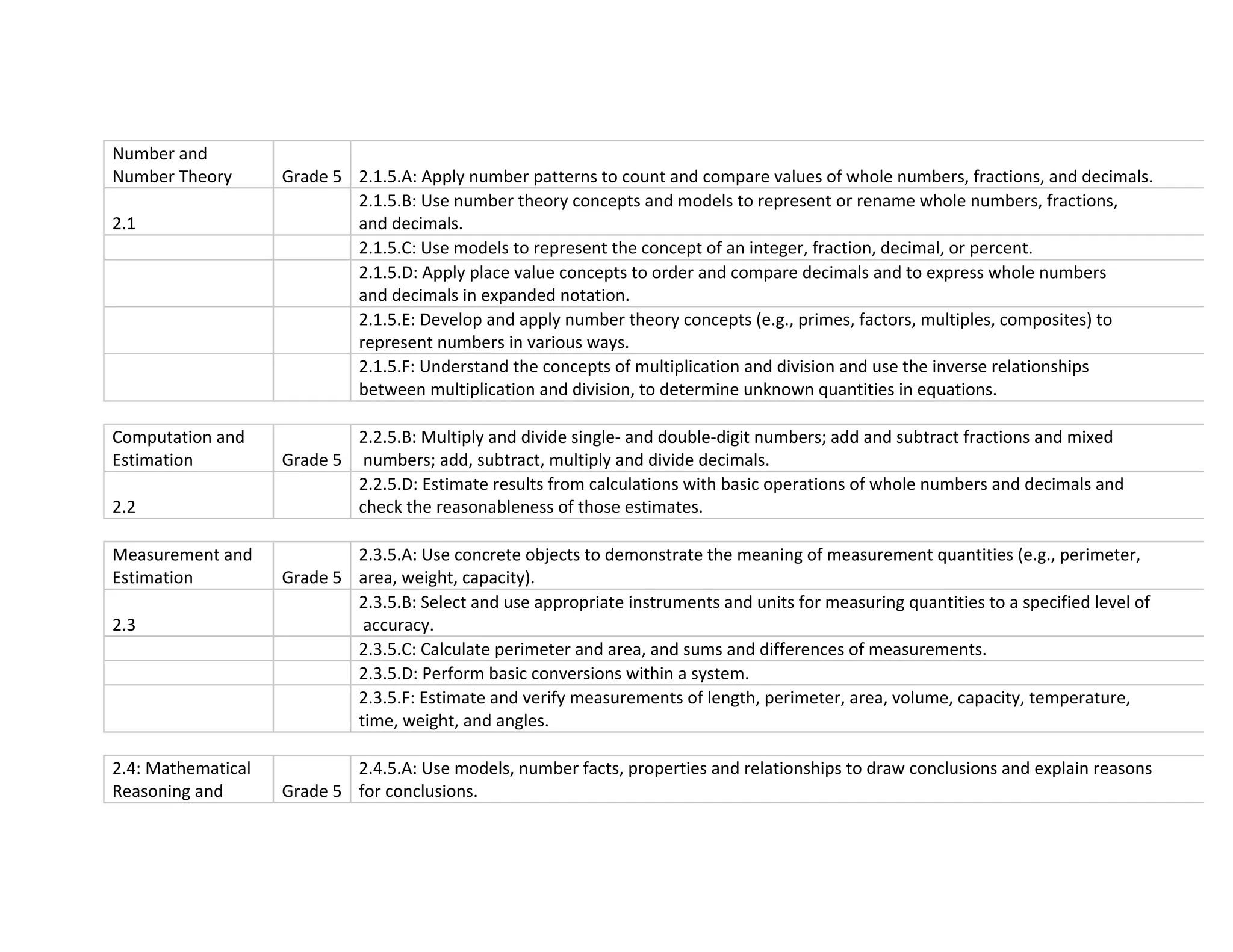
    Number  and   Number  Theory   Grade  5 2.1.5.A:  Apply  number  patterns  to  count  and  compare  values  of  whole  numbers,  fractions,  and  decimals. 2.1.5.B:  Use  number  theory  concepts  and  models  to  represent  or  rename  whole  numbers,  fractions,     2.1     and  decimals.     2.1.5.C:  Use  models  to  represent  the  concept  of  an  integer,  fraction,  decimal,  or  percent. 2.1.5.D:  Apply  place  value  concepts  to  order  and  compare  decimals  and  to  express  whole  numbers         and  decimals  in  expanded  notation. 2.1.5.E:  Develop  and  apply  number  theory  concepts  (e.g.,  primes,  factors,  multiples,  composites)  to         represent  numbers  in  various  ways. 2.1.5.F:  Understand  the  concepts  of  multiplication  and  division  and  use  the  inverse  relationships         between  multiplication  and  division,  to  determine  unknown  quantities  in  equations.     Computation  and   2.2.5.B:  Multiply  and  divide  single-­‐  and  double-­‐digit  numbers;  add  and  subtract  fractions  and  mixed   Estimation   Grade  5  numbers;  add,  subtract,  multiply  and  divide  decimals. 2.2.5.D:  Estimate  results  from  calculations  with  basic  operations  of  whole  numbers  and  decimals  and     2.2     check  the  reasonableness  of  those  estimates.     Measurement  and   2.3.5.A:  Use  concrete  objects  to  demonstrate  the  meaning  of  measurement  quantities  (e.g.,  perimeter,     Estimation   Grade  5 area,  weight,  capacity). 2.3.5.B:  Select  and  use  appropriate  instruments  and  units  for  measuring  quantities  to  a  specified  level  of   2.3      accuracy.     2.3.5.C:  Calculate  perimeter  and  area,  and  sums  and  differences  of  measurements.     2.3.5.D:  Perform  basic  conversions  within  a  system. 2.3.5.F:  Estimate  and  verify  measurements  of  length,  perimeter,  area,  volume,  capacity,  temperature,         time,  weight,  and  angles.     2.4:  Mathematical   2.4.5.A:  Use  models,  number  facts,  properties  and  relationships  to  draw  conclusions  and  explain  reasons     Reasoning  and   Grade  5 for  conclusions.
  • 2.
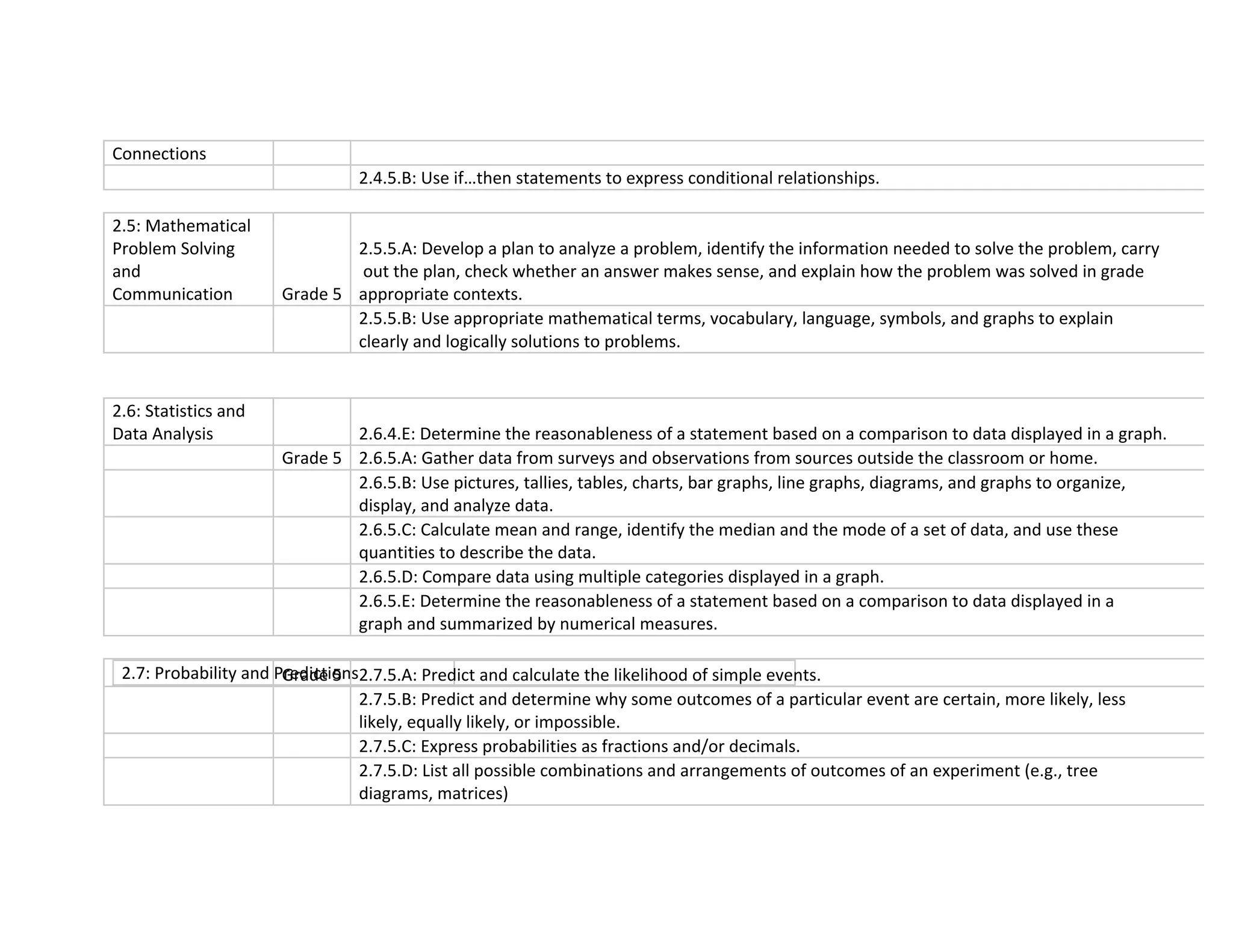
    Connections       2.4.5.B:  Use  if…then  statements  to  express  conditional  relationships.     2.5:  Mathematical   Problem  Solving   2.5.5.A:  Develop  a  plan  to  analyze  a  problem,  identify  the  information  needed  to  solve  the  problem,  carry   and    out  the  plan,  check  whether  an  answer  makes  sense,  and  explain  how  the  problem  was  solved  in  grade     Communication   Grade  5 appropriate  contexts. 2.5.5.B:  Use  appropriate  mathematical  terms,  vocabulary,  language,  symbols,  and  graphs  to  explain         clearly  and  logically  solutions  to  problems.       2.6:  Statistics  and   Data  Analysis     2.6.4.E:  Determine  the  reasonableness  of  a  statement  based  on  a  comparison  to  data  displayed  in  a  graph.   Grade  5 2.6.5.A:  Gather  data  from  surveys  and  observations  from  sources  outside  the  classroom  or  home. 2.6.5.B:  Use  pictures,  tallies,  tables,  charts,  bar  graphs,  line  graphs,  diagrams,  and  graphs  to  organize,         display,  and  analyze  data. 2.6.5.C:  Calculate  mean  and  range,  identify  the  median  and  the  mode  of  a  set  of  data,  and  use  these         quantities  to  describe  the  data.     2.6.5.D:  Compare  data  using  multiple  categories  displayed  in  a  graph. 2.6.5.E:  Determine  the  reasonableness  of  a  statement  based  on  a  comparison  to  data  displayed  in  a         graph  and  summarized  by  numerical  measures.       2.7:  Probability  and  PGrade  5 2.7.5.A:  Predict  and  calculate  the  likelihood  of  simple  events. redictions 2.7.5.B:  Predict  and  determine  why  some  outcomes  of  a  particular  event  are  certain,  more  likely,  less         likely,  equally  likely,  or  impossible.     2.7.5.C:  Express  probabilities  as  fractions  and/or  decimals. 2.7.5.D:  List  all  possible  combinations  and  arrangements  of  outcomes  of  an  experiment  (e.g.,  tree         diagrams,  matrices)
  • 3.
        2.7.5.E:  Compare  predictions  based  on  theoretical  probability  and  experimental  results.       2.8:  Algebra  and  Functions 5 2.8.5.A:  Use  the  concept  of  equality  to  demonstrate  understanding  of  the  distributive  property. Grade   2.8.5.B:  Select  and  use  strategies,  including  concrete  objects,  to  solve  number  sentences  (equations  and         inequalities)  and  explain  the  method  of  solution. 2.8.5.C:  Recognize,  describe,  extend,  create,  replicate,  and  form  a  rule  for  a  variety  of  patterns,  sequences,         and  relationships  verbally,  numerically,  symbolically,  and  graphically.     2.8.5.D:  Determine  a  functional  rule  from  a  table  or  graph. 2.8.5.E:  Use  concrete  objects  and  combinations  of  symbols  and  numbers  to  create  expressions,  equations,         and  inequalities  that  model  mathematical  situations. 2.8.5.F:  Describe  data  represented  in  equations,  inequalities,  tables,  or  graphs  and/or  create  a  story  that         matches  that  data.     2.9.5.A:  Identify,  describe,  and  define  1-­‐,  2-­‐,  and  3-­‐dimensional  shapes  and  their  related  parts,  and  classify     2.9  Geometry   Grade  5 and  compare  2-­‐  and  3-­‐  dimensional  shapes  on  the  basis  of  their  properties. 2.9.5.B:  Predict  and  describe  the  result  of  a  translation  (slide),  rotation  (turn),  or  reflection  (flip)  of  a  2-­‐         dimensional  shape. 2.9.5.C:  Identify  location  of  points  with  fractional  or  decimal  coordinates  on  a  number  line  or  on  a  2-­‐         dimensional  coordinate  system.     2.10.5.A:  Identify  and  compare  parts  of  right  triangles,  including  right  angles,  acute  angles,  hypotenuses,       2.10:  Trigonometry Grade  5 and  legs.     2.11:  Concepts  of   Calculus   Grade  5 2.11.5.A:  Make  comparisons  of  numbers  (e.g.,  more,  less,  same,  least,  most,  greater  than,  less  than).     2.11.5.B:  Describe  the  relationship  between  rates  of  change  and  another  variable  (e.g.,  time,  temperature).     2.11.5.C:  Estimate  areas  and  volumes  of  shapes  and  solids  as  the  sums  of  areas  of  tiles  and  volumes  of  cubes.