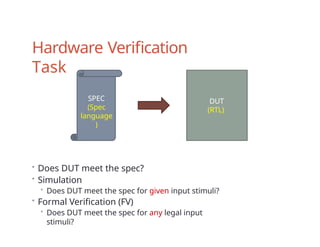
Hardware Verification
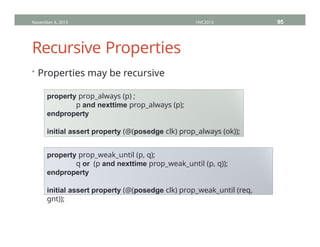
Task
• DoesDUT meet the spec?
• Simulation
• Does DUT meet the spec for given input stimuli?
• Formal Verification (FV)
• Does DUT meet the spec for any legal input
stimuli?
DUT
(RTL)
SPEC
(Spec
language
)
5.
SystemVerilog Assertions (SVA)
•SystemVerilog (proliferation of Verilog) is a unified
hardware design, specification, and verification
language
• RTL/gate/transistor level
• Assertions (SVA)
• Testbench (SVTB)
• API
• SVA is a formal specification language
• Native part of SystemVerilog [SV12]
• Good for simulation and formal verification
6.
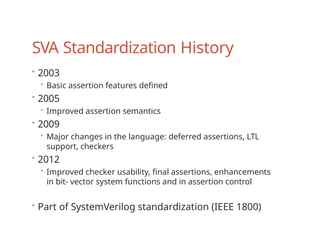
SVA Standardization History
•2003
• Basic assertion features defined
• 2005
• Improved assertion semantics
• 2009
• Major changes in the language: deferred assertions, LTL
support, checkers
• 2012
• Improved checker usability, final assertions, enhancements
in bit- vector system functions and in assertion control
• Part of SystemVerilog standardization (IEEE 1800)
Linear Time Model.Global Clock
• We assume that the time is linear:
• There is one global clock (AKA system clock or reference
clock) which always ticks (never stops)
• All signal changes are synchronized with the ticks of the
global clock
• Global clock introduces the notion of discrete time in the
system
• 0, 1, 2, …
• Each number corresponds to a tick of the global clock
November 4, 2013 HVC2013 10
[Pnu77
]
14.
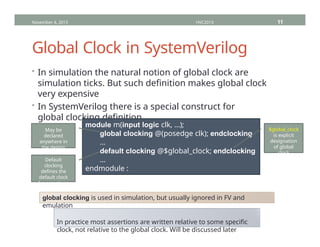
Global Clock inSystemVerilog
• In simulation the natural notion of global clock are
simulation ticks. But such definition makes global clock
very expensive
• In SystemVerilog there is a special construct for
global clocking definition
November 4, 2013 HVC2013 11
module m(input logic clk, …);
global clocking @(posedge clk); endclocking
…
default clocking @$global_clock; endclocking
…
endmodule :
m
May be
declared
anywhere in
the design
Default
clocking
defines the
default clock
for assertions
$global_clock
is explicit
designation
of global
clock
global clocking is used in simulation, but usually ignored in FV and
emulation
In practice most assertions are written relative to some specific
clock, not relative to the global clock. Will be discussed later
15.
Formal Verification
Model
• Kripkestructure: M = Q, I, V, R
• Q – Finite set of states
• I ⊆ Q – Set of initial states
• V – Set of Boolean variables (labels)
• L: Q → 2V – Labeling function mapping each state to the
set of variables that are true in this state
• R ⊆ Q × Q – (Left total) transition relation
• Shows to which states it is possible to transition from given
state
November 4, 2013 HVC2013 12
[Kr63
]
16.
Formal Verification Model.
Example
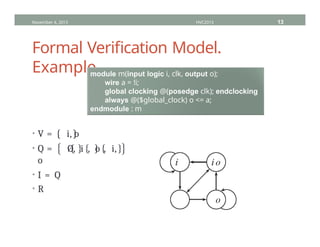
•V = i, o
• Q = Ø, i , o , i,
o
• I = Q
• R
November 4, 2013 HVC2013 13
module m(input logic i, clk, output o);
wire a = !i;
global clocking @(posedge clk); endclocking
always @($global_clock) o <= a;
endmodule : m
17.
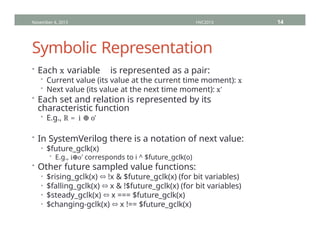
Symbolic Representation
• Eachx variable is represented as a pair:
• Current value (its value at the current time moment): x
• Next value (its value at the next time moment): x'
• Each set and relation is represented by its
characteristic function
• E.g., R = i ⊕ o'
• In SystemVerilog there is a notation of next value:
• $future_gclk(x)
• E.g., i o
⊕ ′ corresponds to i ^ $future_gclk(o)
• Other future sampled value functions:
• $rising_gclk(x) ⬄ !x & $future_gclk(x) (for bit variables)
• $falling_gclk(x) ⬄ x & !$future_gclk(x) (for bit variables)
• $steady_gclk(x) ⬄ x === $future_gclk(x)
• $changing-gclk(x) ⬄ x !== $future_gclk(x)
November 4, 2013 HVC2013 14
18.
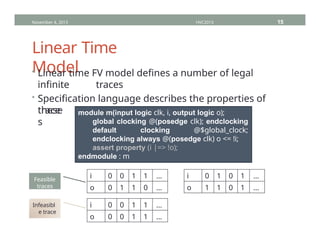
Linear Time
Model
• Lineartime FV model defines a number of legal
infinite traces
• Specification language describes the properties of
these
trace
s
November 4, 2013 HVC2013 15
module m(input logic clk, i, output logic o);
global clocking @(posedge clk); endclocking
default clocking @$global_clock;
endclocking always @(posedge clk) o <= !i;
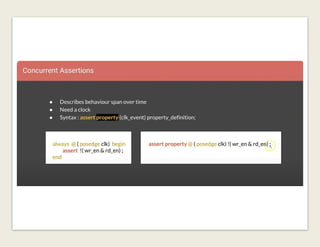
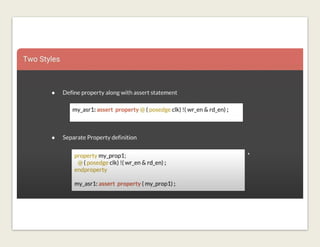
assert property (i |=> !o);
endmodule : m
i 0 0 1 1 …
o 0 1 1 0 …
i 0 1 0 1 …
o 1 1 0 1 …
i 0 0 1 1 …
o 0 0 1 1 …
Feasible
traces
Infeasibl
e trace
19.
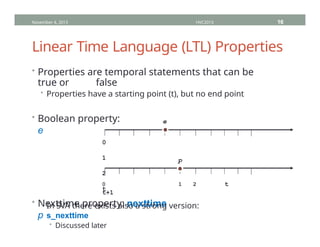
Linear Time Language(LTL) Properties
• Properties are temporal statements that can be
true or false
• Properties have a starting point (t), but no end point
• Boolean property:
e
November 4, 2013 HVC2013 16
0
1
2
t
• Nexttime property: nexttime
p
e
0 1 2 t
t+1
• In SVA there exists also a strong version:
s_nexttime
• Discussed later
p
20.
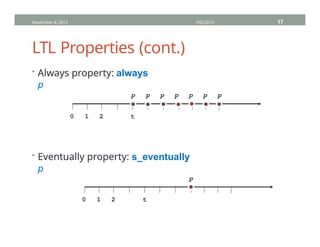
LTL Properties (cont.)
•Always property: always
p
• Eventually property: s_eventually
p
November 4, 2013 HVC2013 17
0 1 2 t
p p p p p p p
0 1 2 t
p
21.
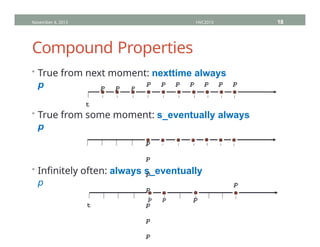
Compound Properties
• Truefrom next moment: nexttime always
p
• Infinitely often: always s_eventually
p
p p p
November 4, 2013 HVC2013 18
t
p
t
• True from some moment: s_eventually always
p
p
p
p
p
p
p
p
p p p p p p p
p p p
22.
Boolean Connectives
• Negation:not p
• Conjunction: p and q
• Disjunction: p or q
• Implication: p implies
q
• Equivalence: p iff q
• Condition: if (e) p else
q
• Case
November 4, 2013 HVC2013 19
23.
Counterexample
• Counterexample –trace witnessing a property
failure
• In general case – infinite
• May be finite
• Meaning that any infinite extension of this finite
trace is a counterexample
November 4, 2013 HVC2013 20
24.
Safety and
Liveness
• Safetyproperties
• All their counterexample are
finite
• E.g., always e
!e
• Hybrid properties also exist
• Sometimes also called
“liveness”
November 4, 2013 HVC2013 21
!e !e
0 1 2 t
• Liveness properties
• All their counterexamples are
infinite
• E.g., s_eventually e
!e !e !e !e !e !e !e
!e !e
0
[AS87, KV01]
25.
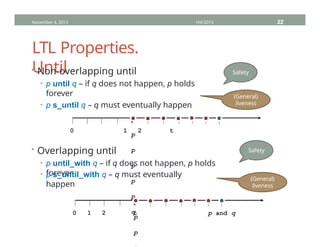
LTL Properties.
Until
• Non-overlappinguntil
• p until q – if q does not happen, p holds
forever
• p s_until q – q must eventually happen
p
p
p
p
p
p
q
0 1 2 t
• Overlapping until
• p until_with q – if q does not happen, p holds
forever
• p s_until_with q – q must eventually
happen
p
p
p
November 4, 2013 HVC2013 22
0 1 2 t p and q
Safety
Safety
(General)
liveness
(General)
liveness
26.
Bounded
Versions
November 4, 2013HVC2013 23
Property Semantics
[s_]nexttime [m] p [s_]nexttime … [s_]nexttime p
[s_]eventually [m:n] p [s_]nexttime [m] p or … or [s_]nexttime [n] p
s_eventually [m:$] p s_nexttime [m] s_eventually p
[s_]always [m:n] p [s_]nexttime [m] p and … and [s_]nexttime [m] p
always [m:$] p nexttime [m] always p
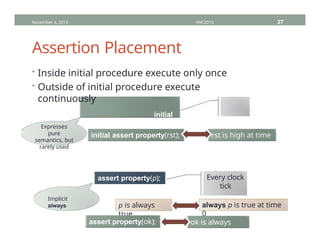
Assertion Placement
November 4,2013 HVC2013 27
• Inside initial procedure execute only once
• Outside of initial procedure execute
continuously
initial
Once
assert property(p);
assert property(p); Every clock
tick
Expresses
pure
semantics, but
rarely used
initial assert property(rst);
p is always
true
rst is high at time
0
Implicit
always always p is true at time
0
assert property(ok); ok is always
high
31.
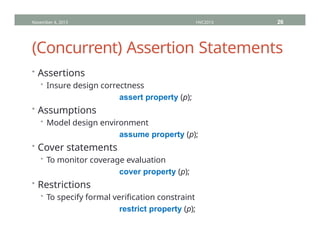
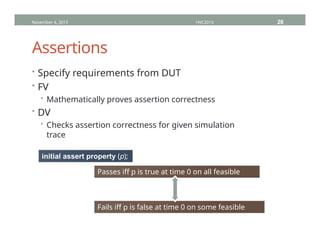
Assertions
• Specify requirementsfrom DUT
• FV
• Mathematically proves assertion correctness
• DV
• Checks assertion correctness for given simulation
trace
November 4, 2013 HVC2013 28
initial assert property (p);
Passes iff p is true at time 0 on all feasible
traces
Fails iff p is false at time 0 on some feasible
trace
32.
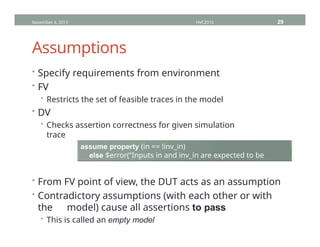
Assumptions
• Specify requirementsfrom environment
• FV
• Restricts the set of feasible traces in the model
• DV
• Checks assertion correctness for given simulation
trace
November 4, 2013 HVC2013 29
assume property (in == !inv_in)
else $error(“Inputs in and inv_in are expected to be
inverse”);
• From FV point of view, the DUT acts as an assumption
• Contradictory assumptions (with each other or with
the model) cause all assertions to pass
• This is called an empty model
33.
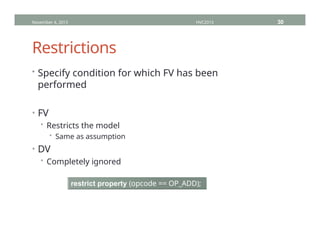
Restrictions
• Specify conditionfor which FV has been
performed
• FV
• Restricts the model
• Same as assumption
• DV
• Completely ignored
November 4, 2013 HVC2013 30
restrict property (opcode == OP_ADD);
34.
Cove
r
November 4, 2013HVC2013 31
• Specify scenario you wish to observe
• FV
• Mathematically prove that the property holds on some
feasible trace
• DV
• Capture scenario in simulation trace
cover property (read[*2]);
• From FV point of
view
initial cover property (p);
passes
initial assert property (not p);
fail
s
35.
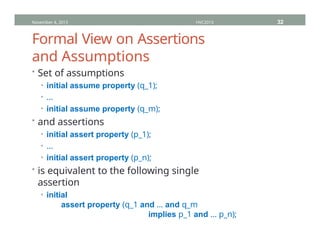
Formal View onAssertions
and Assumptions
• Set of assumptions
• initial assume property (q_1);
• …
• initial assume property (q_m);
• and assertions
• initial assert property (p_1);
• …
• initial assert property (p_n);
• is equivalent to the following single
assertion
• initial
assert property (q_1 and … and q_m
implies p_1 and … p_n);
November 4, 2013 HVC2013 32
36.
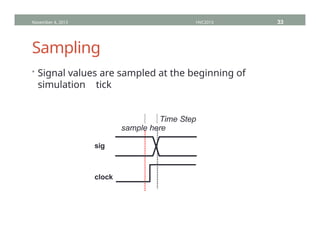
November 4, 2013HVC2013 33
Sampling
• Signal values are sampled at the beginning of
simulation tick
Time Step
sample here
sig
clock
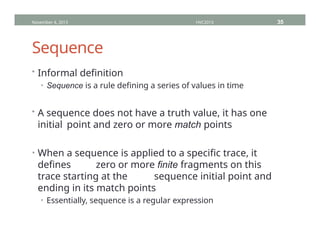
Sequence
• Informal definition
•Sequence is a rule defining a series of values in time
• A sequence does not have a truth value, it has one
initial point and zero or more match points
• When a sequence is applied to a specific trace, it
defines zero or more finite fragments on this
trace starting at the sequence initial point and
ending in its match points
• Essentially, sequence is a regular expression
November 4, 2013 HVC2013 35
39.
Example
November 4, 2013HVC2013 36
2 3
4
2 3
4
• Read is followed by write in one or two clock
ticks
• read ##[1:2] write
• Let starting point of this sequence be t = 2
No match
2 3
4
Single match at
3
2 3
4
Single match at
4
2 3
4
Two matches (at 3 and
4)
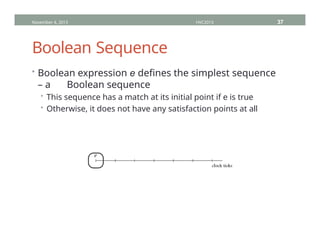
40.
Boolean Sequence
• Booleanexpression e defines the simplest sequence
– a Boolean sequence
• This sequence has a match at its initial point if e is true
• Otherwise, it does not have any satisfaction points at all
November 4, 2013 HVC2013 37
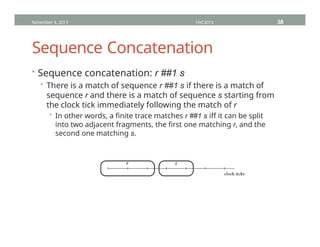
41.
Sequence Concatenation
• Sequenceconcatenation: r ##1 s
• There is a match of sequence r ##1 s if there is a match of
sequence r and there is a match of sequence s starting from
the clock tick immediately following the match of r
• In other words, a finite trace matches r ##1 s iff it can be split
into two adjacent fragments, the first one matching r, and the
second one matching s.
November 4, 2013 HVC2013 38
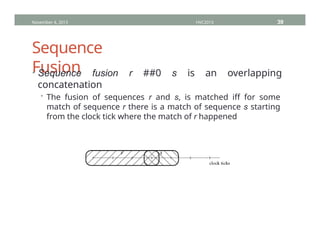
42.
Sequence
Fusion
• Sequence fusionr ##0 s is an overlapping
concatenation
• The fusion of sequences r and s, is matched iff for some
match of sequence r there is a match of sequence s starting
from the clock tick where the match of r happened
November 4, 2013 HVC2013 39
43.
Zero Repetition (EmptySequence)
• s[*0]
• sequence admitting only an empty match
• Matches on any trace but the trace fragment is empty (does not
contain clock ticks)
November 4, 2013 HVC2013 40
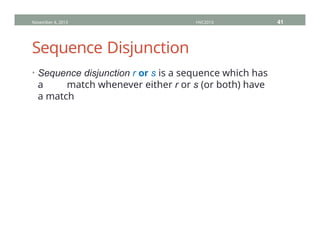
44.
Sequence Disjunction
• Sequencedisjunction r or s is a sequence which has
a match whenever either r or s (or both) have
a match
November 4, 2013 HVC2013 41
45.
Consecutive Repetition
• Repetition
•r[*0] is an empty
sequence
• If n > 0 (const.)
• r[*n] ⬄ r[*n-1] ##1 r
• Finite repetition range
• r[*n:n] ⬄ r[*n]
• r[*m:n] ⬄ r[*m:n-1] or r[*n], m <
n
November 4, 2013 HVC2013 42
46.
Infinite Repetition
Range
• Infiniterange: repeat s n or more times
• Formal definition
• Sequence s[*1:$] matches trace fragment i : j if it is possible
to divide this trace fragment into one or more consecutive
fragments so that each such fragment matches s
• s[*0:$] ⬄ s[*0] or s[*1:$]
• s[*n:$] ⬄ s[*0:n-1] or s[*1:$], n > 1
• Shortcuts (SVA 2009)
• s[*] ⬄ s[*0:$] – Zero or more times
• s[+] ⬄ s[*1:$] – One or more times
November 4, 2013 HVC2013 43
s[*n:$] does not mean that sequence s is repeated infinitely
many times, but that it is repeated n or more (finite) number
of times
47.
Sequence Concatenation and
Delay
•r ##0 s is a sequence fusion
• r ##1 s is a sequence concatenation
• r ##n s, where n > 1 is defined
recursively
• r ##n s ⬄ r ##1 1[*n-1] ##1 s
• ##n s ⬄ 1[*n] ##1
s
November 4, 2013 HVC2013 44
48.
Delay
Ranges
• r ##[0:0]s ⬄ r ##0 s
• r ##[m:n] s ⬄ (r ##1 1[*m-1:n-1] ##1 s), where n ≥ m
> 0
• r ##[0:n] s ⬄ (r ##0 s) or (r ##[1:n] s), where n > 0
• r ##[m:$] s ⬄ (r ##1 1[*m-1:$] ##1 s), where m > 0
• r ##[0:$] s ⬄ (r ##0 s) or (r ##[1:$] s), where n > 0
• ##[m:n] s ⬄ 1 ##[m:n] s, where n ≥ m ≥ 0
• ##[m:$] s ⬄ 1 ##[m:$] s, where m ≥ 0
• Shortcuts (SVA 2009)
• ##[*] ⬄ ##[*0:$]
• ##[+] ⬄ ##[*1:$]
November 4, 2013 HVC2013 45
49.
Other Sequence Operators
•Go to repetition: e[->n], e[->m:n]
• e is a Boolean
• Non-consecutive repetition: e[=n],
e[=m:n]
• e is a Boolean
• Intersection: r intersect s
• Conjunction: r and s
• Containment: r within s
• Throughout: e throughout s
• First match: first_match(r)
• Sequence methods
• r.triggered
• r.matched
November 4, 2013 HVC2013 46
50.
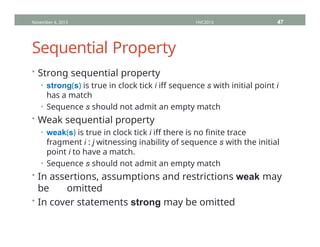
Sequential Property
• Strongsequential property
• strong(s) is true in clock tick i iff sequence s with initial point i
has a match
• Sequence s should not admit an empty match
• Weak sequential property
• weak(s) is true in clock tick i iff there is no finite trace
fragment i : j witnessing inability of sequence s with the initial
point i to have a match.
• Sequence s should not admit an empty match
• In assertions, assumptions and restrictions weak may
be omitted
• In cover statements strong may be omitted
November 4, 2013 HVC2013 47
51.
Sequential Properties.
Examples
• initialassert property (rst[*2]);
• Same as initial assert property (weak(rst[*2]));
• For global clock it is also the same as initial assert
property
(strong(rst[*2]));
• initial assert property
(rst[*]);
• Admits empty match
• initial assert property (rst[*] ##1 ready);
• Same as initial assert property (rst until ready);
• initial assert property (strong(rst[*] ##1
ready));
• Same as initial assert property (rst s_until ready);
• initial assert property (##[*] ready);
• Tautology
• initial assert property (strong(##[*] ready));
• Same as initial assert property (s_eventually ready);
November 4, 2013 HVC2013 48
³
52.
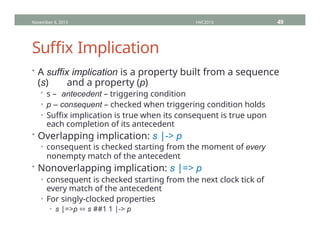
Suffix Implication
• Asuffix implication is a property built from a sequence
(s) and a property (p)
• s – antecedent – triggering condition
• p – consequent – checked when triggering condition holds
• Suffix implication is true when its consequent is true upon
each completion of its antecedent
• Overlapping implication: s |-> p
• consequent is checked starting from the moment of every
nonempty match of the antecedent
• Nonoverlapping implication: s |=> p
• consequent is checked starting from the next clock tick of
every match of the antecedent
• For singly-clocked properties
• s |=>p ⬄ s ##1 1 |-> p
November 4, 2013 HVC2013 49
53.
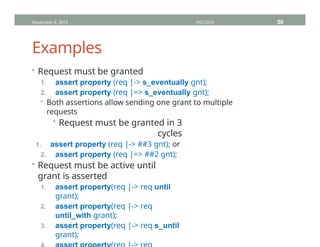
Examples
• Request mustbe granted
1. assert property (req |-> s_eventually gnt);
2. assert property (req |=> s_eventually gnt);
• Both assertions allow sending one grant to multiple
requests
• Request must be granted in 3
cycles
1. assert property (req |-> ##3 gnt); or
2. assert property (req |=> ##2 gnt);
• Request must be active until
grant is asserted
1. assert property(req |-> req until
grant);
2. assert property(req |-> req
until_with grant);
3. assert property(req |-> req s_until
grant);
November 4, 2013 HVC2013 50
54.
Vacuit
y
• What dowe check in previous assertions if
requests cannot be produced by the model?
• Assertion holds vacuously if it is redundant
• E.g., the previous assertions may be rewritten in this
case as
assert property (not req);
• FV tools provide vacuity check
• The cost is rather high
November 4, 2013 HVC2013 51
[Ar03
]
55.
Suffix Conjunction
• Asuffix conjunction is a property built from a sequence
(s) and a property (p)
• s – antecedent – triggering condition
• p – consequent – checked when triggering condition holds
• Suffix conjunction is true when its consequent is true upon at
least one completion of its antecedent
• Overlapping conjunction: s #-# p
• Nonoverlapping conjunction: s #=# p
• Example:
• Reset is initially high and when it becomes low it remains low
forever
• initial assert property (rst[+] ##1 !rst |=> always !
rst);
• initial assert property (rst[+] ##1 !rst #=# always !
rst);
November 4, 2013 HVC2013 52
Passes if rst
is always
high
Fails if rst
is always
high
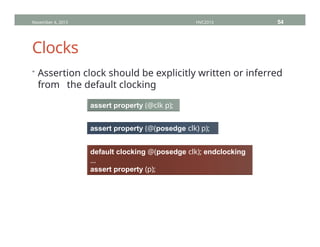
Clocks
November 4, 2013HVC2013 54
• Assertion clock should be explicitly written or inferred
from the default clocking
assert property (@clk p);
assert property (@(posedge clk) p);
default clocking @(posedge clk); endclocking
…
assert property (p);
58.
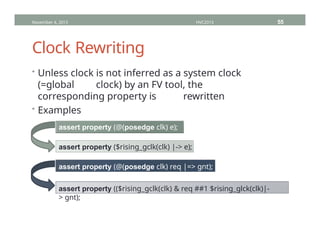
Clock Rewriting
November 4,2013 HVC2013 55
• Unless clock is not inferred as a system clock
(=global clock) by an FV tool, the
corresponding property is rewritten
• Examples
assert property (@(posedge clk) e);
assert property ($rising_gclk(clk) |-> e);
assert property (@(posedge clk) req |=> gnt);
assert property (($rising_gclk(clk) & req ##1 $rising_glck(clk)|-
> gnt);
59.
Clock Fairness
• Clockis fair if it ticks infinitely many times
• Without any preliminary knowledge clock fairness is
not guaranteed
• Clock may stop ticking at some moment
• Global clock is fair by its definition
November 4, 2013 HVC2013 56
60.
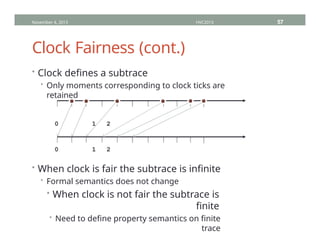
Clock Fairness (cont.)
01 2
• When clock is fair the subtrace is infinite
• Formal semantics does not change
• When clock is not fair the subtrace is
finite
• Need to define property semantics on finite
trace
November 4, 2013 HVC2013 57
• Clock defines a subtrace
• Only moments corresponding to clock ticks are
retained
0 1 2
61.
Weak and StrongProperties
• Weak operators do not require clock to tick
• Strong operators require clock to tick enough
times
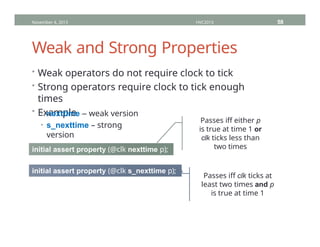
• Example
• nexttime – weak version
• s_nexttime – strong
version
November 4, 2013 HVC2013 58
initial assert property (@clk nexttime p);
initial assert property (@clk s_nexttime p);
Passes iff either p
is true at time 1 or
clk ticks less than
two times
Passes iff clk ticks at
least two times and p
is true at time 1
62.
Weak and StrongProperties. Negation
• Negation inverts weakness
• E.g., not, antecedent in implies
• Example
• not always p ⬄ s_eventually not p
November 4, 2013 HVC2013 59
63.
Mixing Weak andStrong
Properties
• Mixing weak and strong properties in most cases in
non- intuitive and should be avoided
• Also for performance reasons
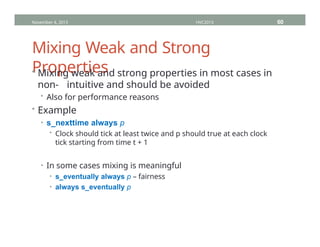
• Example
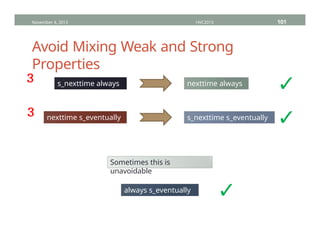
• s_nexttime always p
• Clock should tick at least twice and p should true at each clock
tick starting from time t + 1
• In some cases mixing is meaningful
• s_eventually always p – fairness
• always s_eventually p
November 4, 2013 HVC2013 60
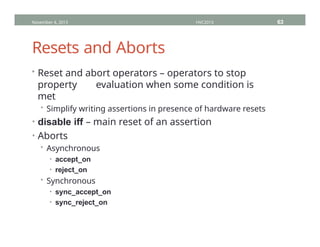
Resets and Aborts
•Reset and abort operators – operators to stop
property evaluation when some condition is
met
• Simplify writing assertions in presence of hardware resets
• disable iff – main reset of an assertion
• Aborts
• Asynchronous
• accept_on
• reject_on
• Synchronous
• sync_accept_on
• sync_reject_on
November 4, 2013 HVC2013 63
67.
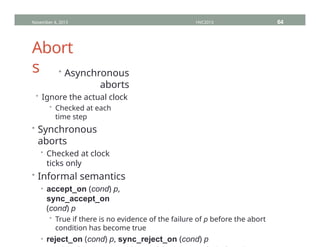
Abort
s • Asynchronous
aborts
•Ignore the actual clock
• Checked at each
time step
• Synchronous
aborts
• Checked at clock
ticks only
• Informal semantics
• accept_on (cond) p,
sync_accept_on
(cond) p
• True if there is no evidence of the failure of p before the abort
condition has become true
• reject_on (cond) p, sync_reject_on (cond) p
November 4, 2013 HVC2013 64
One More example
•reject_on(rst) 1[*3]
• Property 1[*3] can never fail
• Therefore, reject_on(rst) 1[*3] fails iff rst becomes high any
time during first three clock cycles
• sync_reject_on(rst) 1[*3] is equivalent to !rst[*3]
November 4, 2013 HVC2013 67
71.
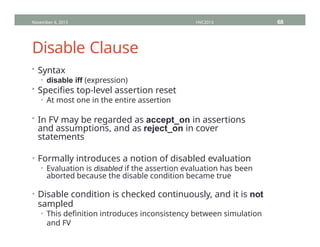
Disable Clause
• Syntax
•disable iff (expression)
• Specifies top-level assertion reset
• At most one in the entire assertion
• In FV may be regarded as accept_on in assertions
and assumptions, and as reject_on in cover
statements
• Formally introduces a notion of disabled evaluation
• Evaluation is disabled if the assertion evaluation has been
aborted because the disable condition became true
• Disable condition is checked continuously, and it is not
sampled
• This definition introduces inconsistency between simulation
and FV
November 4, 2013 HVC2013 68
72.
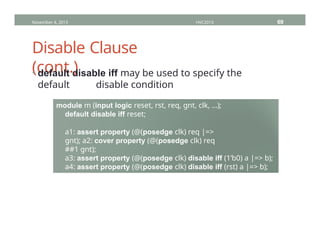
Disable Clause
(cont.)
November 4,2013 HVC2013 69
• default disable iff may be used to specify the
default disable condition
module m (input logic reset, rst, req, gnt, clk, …);
default disable iff reset;
a1: assert property (@(posedge clk) req |=>
gnt); a2: cover property (@(posedge clk) req
##1 gnt);
a3: assert property (@(posedge clk) disable iff (1’b0) a |=> b);
a4: assert property (@(posedge clk) disable iff (rst) a |=> b);
endmodule : m
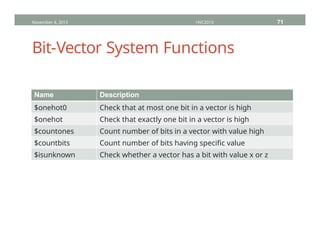
Bit-Vector System Functions
November4, 2013 HVC2013 71
Name Description
$onehot0 Check that at most one bit in a vector is high
$onehot Check that exactly one bit in a vector is high
$countones Count number of bits in a vector with value high
$countbits Count number of bits having specific value
$isunknown Check whether a vector has a bit with value x or z
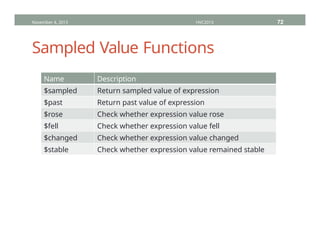
75.
Sampled Value Functions
November4, 2013 HVC2013 72
Name Description
$sampled Return sampled value of expression
$past Return past value of expression
$rose Check whether expression value rose
$fell Check whether expression value fell
$changed Check whether expression value changed
$stable Check whether expression value remained stable
76.
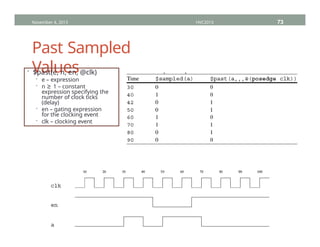
Past Sampled
Values
November 4,2013 HVC2013 73
• $past(e, n, en, @clk)
• e – expression
• n ≥ 1 – constant
expression specifying the
number of clock ticks
(delay)
• en – gating expression
for the clocking event
• clk – clocking event
77.
Values Before InitialClock Tick
• What happens if for a given time-step there are
not enough previous clock ticks?
• $past(e) returns an initial value of e
• The initial value of e is that as computed using the
initial values stated in the declaration of the
variables involved in e
• If a static variable has no explicit initialization, the default value
of the corresponding type is used, even if the variable is
assigned a value in an initial procedure
November 4, 2013 HVC2013 74
FV tools may ignore variable initialization everywhere, except in
checker constructs. Also, many FV tools consider all variables to
be of two-state value type, and therefore they assume that
$past(e) is 0 in clock tick 0 for any e
Global Clocking SampledValue
Functions
• May be used only if global clock has is defined
• Past
• $past_gclk(e) ⬄ $past(e, 1, 1, @$global_clock)
• $rose_gclk(e) ⬄ $rose(e, @$global_clock)
• $fell_gclk(e) ⬄ $fell(e, @$global_clock)
• $changed_gclk(e) ⬄ $changed(e, @$global_clock)
• $stable_gclk(e) ⬄ $stable(e, @$global_clock)
• Future
• $future_gclk(e) – Sampled value of e in the next tick of the global
clock
• $rising_gclk(e) ⬄ $sampled(LSB(e))!== 1 && $future_gclk(LSB(e)) === 1
• $falling_gclk(e) ⬄ $sampled(LSB(e))!== 0 && $future_gclk(LSB(e)) ===
0
• $changing_gclk(e) ⬄ $sampled(e) !== $future_gclk(e)
• $steady_gclk(e) ⬄ $sampled(e) === $future_gclk(e)
• Cannot be nested or used in reset conditions
November 4, 2013 HVC2013 76
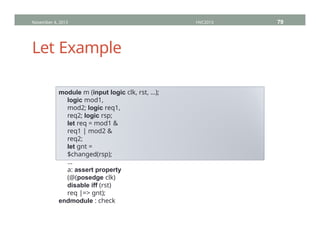
Let Declaration
November 4,2013 HVC2013 78
let identifier [(port, port, …)] = expression;
• “Compile-time macro” for integral expressions
• Follow normal scoping rules
• Formal arguments may be typed or untyped
• Formal arguments can have default actual arguments
• May be included in a package
• May easily be processed by tools for linting and
statistical reporting
• Typical usage
• Templates for Boolean assertions
• Instrumental code
• Does not introduce new variables
• Visible to debuggers
82.
Let Example
November 4,2013 HVC2013 79
module m (input logic clk, rst, …);
logic mod1,
mod2; logic req1,
req2; logic rsp;
let req = mod1 &
req1 | mod2 &
req2;
let gnt =
$changed(rsp);
…
a: assert property
(@(posedge clk)
disable iff (rst)
req |=> gnt);
endmodule : check
Checker
s
• Checkers areSystemVerilog containers to
package verification code
• Both assertions and modeling
• Checker is a kind of hybrid of module, property
and assertion
• May contain (almost) the same constructs as a module
• Is instantiated as a property (in place)
• Placed as an assertion
• Acts as an assertion with complex internal implementation
November 4, 2013 HVC2013 82
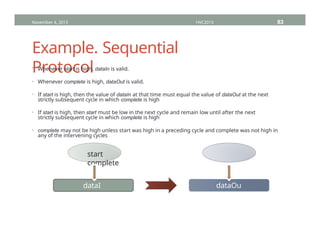
86.
Example. Sequential
Protocol
November 4,2013 HVC2013 83
dataI
n
dataOu
t
• Whenever start is high, dataIn is valid.
• Whenever complete is high, dataOut is valid.
• If start is high, then the value of dataIn at that time must equal the value of dataOut at the next
strictly subsequent cycle in which complete is high
• If start is high, then start must be low in the next cycle and remain low until after the next
strictly subsequent cycle in which complete is high
• complete may not be high unless start was high in a preceding cycle and complete was not high in
any of the intervening cycles
start
complete
Checker Binding
November 4,2013 HVC2013 85
module top;
logic clock, snda, sndb, sndc, rcva, rcvb,
rcvc;
...
trans ta (clock, snda, rcva);
trans tb (clock, sndb, rcvb);
trans #(2) tc (clock, sndc,
rcvc); endmodule : top
module trans #(DEL=1) (input logic clock, in, output logic
out);
if (DEL == 1) begin : b
always @(posedge clock) out <= in;
end
else begin : b
logic [DEL - 2: 0] tmp;
always @(posedge clock)
begin tmp[0] <= in;
for (int i = 1; i < DEL - 1; i++) tmp[i] <= tmp[i-1];
out <= tmp[DEL - 2];
end
end
endmodule :
trans
checker eventually_granted (req, gnt,
…);
…
endchecker : eventually_granted
checker request_granted (req, gnt, n,
…);
…
endchecker : request_granted
bind trans eventually_granted check_in2out(in, out, posedge
clock); bind trans: ta, tb request_granted delay1(in, out,,
posedge clock); bind trans: tc request_granted delay2(in, out, 2,
posedge clock);
89.
Free Variables
• Checkermay have free variables
• Behave non-deterministically (like free or constrained inputs)
• FV: consider all possible values imposed by assumptions
and assignments
• Simulation: their values are randomized
• Free variable values are never sampled
• Limitations
• Continuous and blocking assignments to free
variables are illegal
November 4, 2013 HVC2013 86
rand bit r;
bit [2:0] x;
…
assign x = r ? 3’d3 : 3’d5;
rand bit a;
always_ff @clk a <= !a;
Informal Definition
• Localvariable is a variable associated with an evaluation
attempt
• Local variables are not sampled
November 4, 2013 HVC2013 91
checker data_consistency (start, complete, dataIn,
dataOut,
event clk, untyped rst);
default clocking @clk; endclocking
default disable iff rst;
property p_data_check;
var type(dataIn)
data;
(start, data = dataIn) ##1 complete[->1] |-> dataOut ==
data;
endproperty : p_data_check
a1: assert property (p_data_check);
endchecker : data_consistency
Local
variabl
e
Matc
h
item
95.
Example
November 4, 2013HVC2013 92
• Check that the value of dataIn when start is high
coincides with the value of dataOut read in n clock
ticks
• If n = const
assert property (start |-> ##n dataOut == $past(dataIn, n) );
• If n is not const
property data_check;
var type(n) ctr;
(start, ctr = n - 1) ##1 (ctr > 0, ctr--)[*] ##1 (ctr == 0)
|-> dataOut = dataIn;
endproperty : data_check
assert property (data_check);
96.
Local vs. RigidVariables
• Local variables are “broader” than rigid variables
• They are mutable
• Local variables are more intuitive
• Local variables are supported in simulation, rigid
variables are not
• Rigid variables are FV friendly – their
implementation is straightforward
• Efficient implementation of local variables in FV is
challenging
November 4, 2013 HVC2013 93
Assertion Compilation forFV
• Assertions are usually compiled into finite automata
[Var96]
• Typical for FV and emulation
• Sometimes done for simulation as well
• Safety assertions are compiled into (conventional)
finite automata on finite words
• Liveness and hybrid assertions are compiled into
finite automata on infinite words (e.g., Büchi
automata):
• Finite automata on finite words + fairness conditions
• Complexity of automaton reflects well FV efficiency
• Another factor is the number of state variables in
the model
November 4, 2013 HVC2013 97
Avoid Large andDistant Time
Windows
November 4, 2013 HVC2013 99
assert property (start ##1 !complete[0:1000] ##1 complete |=>
done);
assert property (start ##1 complete[->1] |=>
done);
⇕
assert property (start ##1 !complete[*] ##1 complete |=>
done);
³
✓
Also applies to bounded property operators and
$past
103.
Avoid Using LivenessAssertions
Unless
November 4, 2013 HVC2013 100
Really Needed
Request must be active until grant is
asserted
assert property(req |-> req s_until
grant);
assert property(req |-> req until
grant);
³
✓
Do you really
want to check
that grant is
eventually
received?
Strong
operators have
clumsier syntax
to prevent
inadvertent
usage
Clock is
fair
assert property (s_eventually clk);
✓
assert property (req |-> ##[1:1000]
gnt);
assert property (req |-> s_eventually
gnt);
³
✓
Liveness
assertion is
usually better
than a safety
assertion with a
large time
window
104.
Avoid Mixing Weakand Strong
Properties
November 4, 2013 HVC2013 101
s_nexttime always
p
nexttime always
p
nexttime s_eventually
p
s_nexttime s_eventually
p
Sometimes this is
unavoidable
always s_eventually
p
³
³
✓
✓
✓
105.
Past vs. Future
November4, 2013 HVC2013 102
• Future value functions are cheap in FV
• Recall that each variable is represented as a pair (v,
v')
• Past value functions are more expensive
• They introduce new flip-flops (=variables)
• Need to optimize the usage of $past
logic check;
logic [31:0] a, b, c;
assert property (##1 check |-> $past(c) == $past(a) +
$past(b));
assert property (##1 check |-> $past(c == a +
b));
³
✓
106.
Intersection Family
expensiv
e
November 4,2013 HVC2013 103
• Sequence operators from intersection family (intersect, and,
within) are expensive
• These operators are not inefficient by themselves, but allow to
concisely code complex sequences
• Use only where appropriate
Each transaction should contain two read requests and three write
requests
Common case
assert property (start |-> read[=2] intersect write[=3] intersect complete[-
>1]);
If known that all reads come after writes
assert property (start |-> write[=3] ##1 read[=2] intersect complete[->1]);
• Top-level conjunction in a sequence promoted to property is
not
assert property (en |-> r and
s);
assert property (en |-> (r and s) ##1
a);
This is
rather
efficient
107.
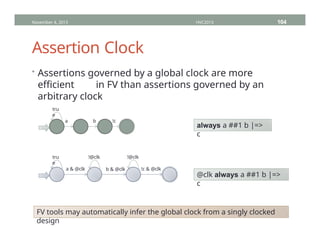
Assertion Clock
• Assertionsgoverned by a global clock are more
efficient in FV than assertions governed by an
arbitrary clock
November 4, 2013 HVC2013 104
tru
e
a !c
b
always a ##1 b |=>
c
tru
e
a & @clk !c & @clk
b & @clk
!@clk !@clk
@clk always a ##1 b |=>
c
FV tools may automatically infer the global clock from a singly clocked
design
108.
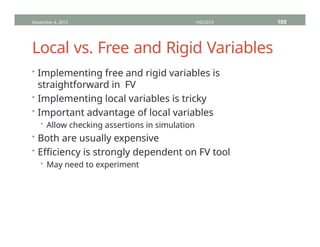
Local vs. Freeand Rigid Variables
• Implementing free and rigid variables is
straightforward in FV
• Implementing local variables is tricky
• Important advantage of local variables
• Allow checking assertions in simulation
• Both are usually expensive
• Efficiency is strongly dependent on FV tool
• May need to experiment
November 4, 2013 HVC2013 105
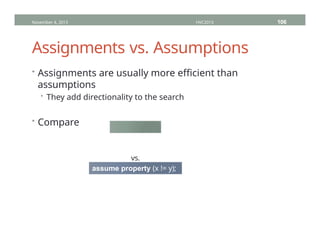
109.
Assignments vs. Assumptions
November4, 2013 HVC2013 106
• Assignments are usually more efficient than
assumptions
• They add directionality to the search
• Compare
assign x = !y;
vs.
assume property (x != y);
110.
Overlapping vs.
Nonoverlapping Transactions
•Nonoverlapping transactions may be
modeled deterministically
• Overlapping transactions usually require
nondeterministic modeling
• E.g., local or rigid variables
• Compare:
• Sequential protocol
vs.
November 4, 2013 HVC2013 107
property p_data_check;
var type(dataIn) data;
(start, data = dataIn) ##1 complete[->1]
|-> dataOut == data;
endproperty : p_data_check
If it is known that transactions cannot overlap, model them as
nonoverlapping
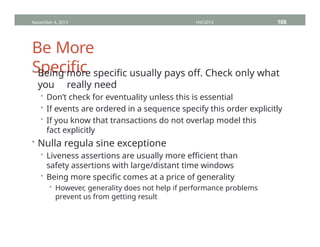
111.
Be More
Specific
• Beingmore specific usually pays off. Check only what
you really need
• Don’t check for eventuality unless this is essential
• If events are ordered in a sequence specify this order explicitly
• If you know that transactions do not overlap model this
fact explicitly
• Nulla regula sine exceptione
• Liveness assertions are usually more efficient than
safety assertions with large/distant time windows
• Being more specific comes at a price of generality
• However, generality does not help if performance problems
prevent us from getting result
November 4, 2013 HVC2013 108
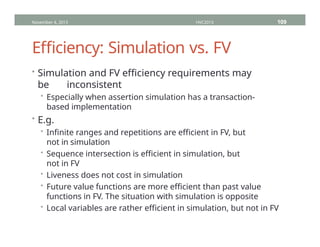
112.
Efficiency: Simulation vs.FV
• Simulation and FV efficiency requirements may
be inconsistent
• Especially when assertion simulation has a transaction-
based implementation
• E.g.
• Infinite ranges and repetitions are efficient in FV, but
not in simulation
• Sequence intersection is efficient in simulation, but
not in FV
• Liveness does not cost in simulation
• Future value functions are more efficient than past value
functions in FV. The situation with simulation is opposite
• Local variables are rather efficient in simulation, but not in FV
November 4, 2013 HVC2013 109
Convergence Between SVAand
SVTB
• Coverage features are divided between SVA and SVTB
• Assertion coverage belongs to SVA
• Covergroups belong to SVTB
• Currently there is no organic connection between the
two
• Syntax and semantics are absolutely different
• One can consider temporal coverage specification
by integrating sequences and covergroups
November 4, 2013 HVC2013 111
115.
Standard Packages
• SVAprovides basic assertion capabilities and
some sugaring
• There are many useful properties and functions that
could be reused, but are not a basic part of the language
• It makes sense to standardize them by creating standard
property packages
• PSL has some of such common properties embedded into
the language, e.g., never, before, next_event, etc.
November 4, 2013 HVC2013 112
116.
Assertion Libraries
• UsingSVA checker mechanism it is possible to
create a powerful and flexible standard
assertion library with concise library assertion
invocation
• Kind of “next generation” OVL
November 4, 2013 HVC2013 113
117.
AMS Assertions
• AMS= Analog and Mixed Signals
• The intention is to merge SystemVerilog and Verilog-
AMS
• This includes development of AMS assertions and including
them into SVA
• The initial step was done in SV2012: real type support in SVA
• No continuous time support yet
November 4, 2013 HVC2013 114
118.
TLM Assertions
• SVAcovers RTL assertions
• TLM assertions are different
• Unclocked or approximately clocked
• SVA is too low level for TLM
• Need to extend SVA to cover TLM
needs
November 4, 2013 HVC2013 115
119.
Checkers for UVM
•UVM – Universal Verification Methodology
• Widely used in verification
• Includes verification level – monitors – to check
design correctness
• Part of TB
• Uses completely different mechanism, does not explore
the strength of assertions
• Implemented as class methods
• Challenge
• Checkers currently cannot be instantiated in classes
• Need to enhance them to allow their usage in UVM
November 4, 2013 HVC2013 116
• [Ar03] -R.Armoni et al., Enhanced Vacuity Detection in
Linear Temporal Logic, 2003
• [AS87] - B. Alpern, F.B. Schneider, Recognizing safety and
liveness, 1987
• [Kr63] - S. Kripke. Semantical Considerations on Modal
Logic, 1963
• [KV01] - O. Kupferman, M.Y. Vardi, Model checking of
safety properties, 2001
• [Pnu77] - A. Pnueli. The temporal logic of programs, 1977
• [PSL10] - IEEE Standard for Property Specification language
(PSL), 2010
• [SV12] - IEEE Standard for SystemVerilog, 2012
• [Var96] - M. Vardi. An Automata-Theoretic Approach
• to Linear Temporal Logic, 1996
November 4, 2013 HVC2013 118
![SystemVerilog Assertions (SVA)
• SystemVerilog (proliferation of Verilog) is a unified
hardware design, specification, and verification
language
• RTL/gate/transistor level
• Assertions (SVA)
• Testbench (SVTB)
• API
• SVA is a formal specification language
• Native part of SystemVerilog [SV12]
• Good for simulation and formal verification](https://image.slidesharecdn.com/assertion-250215041541-f2e7b6c0/85/Assertiona-in-system-verilog-verification-pptx-5-320.jpg)
![Linear Time Model. Global Clock
• We assume that the time is linear:
• There is one global clock (AKA system clock or reference
clock) which always ticks (never stops)
• All signal changes are synchronized with the ticks of the
global clock
• Global clock introduces the notion of discrete time in the
system
• 0, 1, 2, …
• Each number corresponds to a tick of the global clock
November 4, 2013 HVC2013 10
[Pnu77
]](https://image.slidesharecdn.com/assertion-250215041541-f2e7b6c0/85/Assertiona-in-system-verilog-verification-pptx-13-320.jpg)
![Formal Verification
Model
• Kripke structure: M = Q, I, V, R
• Q – Finite set of states
• I ⊆ Q – Set of initial states
• V – Set of Boolean variables (labels)
• L: Q → 2V – Labeling function mapping each state to the
set of variables that are true in this state
• R ⊆ Q × Q – (Left total) transition relation
• Shows to which states it is possible to transition from given
state
November 4, 2013 HVC2013 12
[Kr63
]](https://image.slidesharecdn.com/assertion-250215041541-f2e7b6c0/85/Assertiona-in-system-verilog-verification-pptx-15-320.jpg)
![Safety and
Liveness
• Safety properties
• All their counterexample are
finite
• E.g., always e
!e
• Hybrid properties also exist
• Sometimes also called
“liveness”
November 4, 2013 HVC2013 21
!e !e
0 1 2 t
• Liveness properties
• All their counterexamples are
infinite
• E.g., s_eventually e
!e !e !e !e !e !e !e
!e !e
0
[AS87, KV01]](https://image.slidesharecdn.com/assertion-250215041541-f2e7b6c0/85/Assertiona-in-system-verilog-verification-pptx-24-320.jpg)
![Bounded
Versions
November 4, 2013 HVC2013 23
Property Semantics
[s_]nexttime [m] p [s_]nexttime … [s_]nexttime p
[s_]eventually [m:n] p [s_]nexttime [m] p or … or [s_]nexttime [n] p
s_eventually [m:$] p s_nexttime [m] s_eventually p
[s_]always [m:n] p [s_]nexttime [m] p and … and [s_]nexttime [m] p
always [m:$] p nexttime [m] always p](https://image.slidesharecdn.com/assertion-250215041541-f2e7b6c0/85/Assertiona-in-system-verilog-verification-pptx-26-320.jpg)
![Cove
r
November 4, 2013 HVC2013 31
• Specify scenario you wish to observe
• FV
• Mathematically prove that the property holds on some
feasible trace
• DV
• Capture scenario in simulation trace
cover property (read[*2]);
• From FV point of
view
initial cover property (p);
passes
initial assert property (not p);
fail
s](https://image.slidesharecdn.com/assertion-250215041541-f2e7b6c0/85/Assertiona-in-system-verilog-verification-pptx-34-320.jpg)
![Example
November 4, 2013 HVC2013 36
2 3
4
2 3
4
• Read is followed by write in one or two clock
ticks
• read ##[1:2] write
• Let starting point of this sequence be t = 2
No match
2 3
4
Single match at
3
2 3
4
Single match at
4
2 3
4
Two matches (at 3 and
4)](https://image.slidesharecdn.com/assertion-250215041541-f2e7b6c0/85/Assertiona-in-system-verilog-verification-pptx-39-320.jpg)
![Zero Repetition (Empty Sequence)
• s[*0]
• sequence admitting only an empty match
• Matches on any trace but the trace fragment is empty (does not
contain clock ticks)
November 4, 2013 HVC2013 40](https://image.slidesharecdn.com/assertion-250215041541-f2e7b6c0/85/Assertiona-in-system-verilog-verification-pptx-43-320.jpg)
![Consecutive Repetition
• Repetition
• r[*0] is an empty
sequence
• If n > 0 (const.)
• r[*n] ⬄ r[*n-1] ##1 r
• Finite repetition range
• r[*n:n] ⬄ r[*n]
• r[*m:n] ⬄ r[*m:n-1] or r[*n], m <
n
November 4, 2013 HVC2013 42](https://image.slidesharecdn.com/assertion-250215041541-f2e7b6c0/85/Assertiona-in-system-verilog-verification-pptx-45-320.jpg)
![Infinite Repetition
Range
• Infinite range: repeat s n or more times
• Formal definition
• Sequence s[*1:$] matches trace fragment i : j if it is possible
to divide this trace fragment into one or more consecutive
fragments so that each such fragment matches s
• s[*0:$] ⬄ s[*0] or s[*1:$]
• s[*n:$] ⬄ s[*0:n-1] or s[*1:$], n > 1
• Shortcuts (SVA 2009)
• s[*] ⬄ s[*0:$] – Zero or more times
• s[+] ⬄ s[*1:$] – One or more times
November 4, 2013 HVC2013 43
s[*n:$] does not mean that sequence s is repeated infinitely
many times, but that it is repeated n or more (finite) number
of times](https://image.slidesharecdn.com/assertion-250215041541-f2e7b6c0/85/Assertiona-in-system-verilog-verification-pptx-46-320.jpg)
![Sequence Concatenation and
Delay
• r ##0 s is a sequence fusion
• r ##1 s is a sequence concatenation
• r ##n s, where n > 1 is defined
recursively
• r ##n s ⬄ r ##1 1[*n-1] ##1 s
• ##n s ⬄ 1[*n] ##1
s
November 4, 2013 HVC2013 44](https://image.slidesharecdn.com/assertion-250215041541-f2e7b6c0/85/Assertiona-in-system-verilog-verification-pptx-47-320.jpg)
![Delay
Ranges
• r ##[0:0] s ⬄ r ##0 s
• r ##[m:n] s ⬄ (r ##1 1[*m-1:n-1] ##1 s), where n ≥ m
> 0
• r ##[0:n] s ⬄ (r ##0 s) or (r ##[1:n] s), where n > 0
• r ##[m:$] s ⬄ (r ##1 1[*m-1:$] ##1 s), where m > 0
• r ##[0:$] s ⬄ (r ##0 s) or (r ##[1:$] s), where n > 0
• ##[m:n] s ⬄ 1 ##[m:n] s, where n ≥ m ≥ 0
• ##[m:$] s ⬄ 1 ##[m:$] s, where m ≥ 0
• Shortcuts (SVA 2009)
• ##[*] ⬄ ##[*0:$]
• ##[+] ⬄ ##[*1:$]
November 4, 2013 HVC2013 45](https://image.slidesharecdn.com/assertion-250215041541-f2e7b6c0/85/Assertiona-in-system-verilog-verification-pptx-48-320.jpg)
![Other Sequence Operators
• Go to repetition: e[->n], e[->m:n]
• e is a Boolean
• Non-consecutive repetition: e[=n],
e[=m:n]
• e is a Boolean
• Intersection: r intersect s
• Conjunction: r and s
• Containment: r within s
• Throughout: e throughout s
• First match: first_match(r)
• Sequence methods
• r.triggered
• r.matched
November 4, 2013 HVC2013 46](https://image.slidesharecdn.com/assertion-250215041541-f2e7b6c0/85/Assertiona-in-system-verilog-verification-pptx-49-320.jpg)
![Sequential Properties.
Examples
• initial assert property (rst[*2]);
• Same as initial assert property (weak(rst[*2]));
• For global clock it is also the same as initial assert
property
(strong(rst[*2]));
• initial assert property
(rst[*]);
• Admits empty match
• initial assert property (rst[*] ##1 ready);
• Same as initial assert property (rst until ready);
• initial assert property (strong(rst[*] ##1
ready));
• Same as initial assert property (rst s_until ready);
• initial assert property (##[*] ready);
• Tautology
• initial assert property (strong(##[*] ready));
• Same as initial assert property (s_eventually ready);
November 4, 2013 HVC2013 48
³](https://image.slidesharecdn.com/assertion-250215041541-f2e7b6c0/85/Assertiona-in-system-verilog-verification-pptx-51-320.jpg)
![Vacuit
y
• What do we check in previous assertions if
requests cannot be produced by the model?
• Assertion holds vacuously if it is redundant
• E.g., the previous assertions may be rewritten in this
case as
assert property (not req);
• FV tools provide vacuity check
• The cost is rather high
November 4, 2013 HVC2013 51
[Ar03
]](https://image.slidesharecdn.com/assertion-250215041541-f2e7b6c0/85/Assertiona-in-system-verilog-verification-pptx-54-320.jpg)
![Suffix Conjunction
• A suffix conjunction is a property built from a sequence
(s) and a property (p)
• s – antecedent – triggering condition
• p – consequent – checked when triggering condition holds
• Suffix conjunction is true when its consequent is true upon at
least one completion of its antecedent
• Overlapping conjunction: s #-# p
• Nonoverlapping conjunction: s #=# p
• Example:
• Reset is initially high and when it becomes low it remains low
forever
• initial assert property (rst[+] ##1 !rst |=> always !
rst);
• initial assert property (rst[+] ##1 !rst #=# always !
rst);
November 4, 2013 HVC2013 52
Passes if rst
is always
high
Fails if rst
is always
high](https://image.slidesharecdn.com/assertion-250215041541-f2e7b6c0/85/Assertiona-in-system-verilog-verification-pptx-55-320.jpg)

![Asynchronous Aborts.
Example
November 4, 2013 HVC2013 65
assert property(@(posedge clk)
accept_on (retry) a |=> reject_on(bad)
b[*2]);](https://image.slidesharecdn.com/assertion-250215041541-f2e7b6c0/85/Assertiona-in-system-verilog-verification-pptx-68-320.jpg)
![Synchronous Aborts. Example
November 4, 2013 HVC2013 66
assert property(@(posedge clk)
sync_accept_on (retry) a |=> sync_reject_on(bad)
b[*2]);](https://image.slidesharecdn.com/assertion-250215041541-f2e7b6c0/85/Assertiona-in-system-verilog-verification-pptx-69-320.jpg)
![One More example
• reject_on(rst) 1[*3]
• Property 1[*3] can never fail
• Therefore, reject_on(rst) 1[*3] fails iff rst becomes high any
time during first three clock cycles
• sync_reject_on(rst) 1[*3] is equivalent to !rst[*3]
November 4, 2013 HVC2013 67](https://image.slidesharecdn.com/assertion-250215041541-f2e7b6c0/85/Assertiona-in-system-verilog-verification-pptx-70-320.jpg)
![Let Declaration
November 4, 2013 HVC2013 78
let identifier [(port, port, …)] = expression;
• “Compile-time macro” for integral expressions
• Follow normal scoping rules
• Formal arguments may be typed or untyped
• Formal arguments can have default actual arguments
• May be included in a package
• May easily be processed by tools for linting and
statistical reporting
• Typical usage
• Templates for Boolean assertions
• Instrumental code
• Does not introduce new variables
• Visible to debuggers](https://image.slidesharecdn.com/assertion-250215041541-f2e7b6c0/85/Assertiona-in-system-verilog-verification-pptx-81-320.jpg)
![Sequence and Property
Declaration
November 4, 2013 HVC2013 80
module m(input logic clk, rst, …);
logic my_req;
logic gnt;
sequence two_reqs(req);
req[*2];
endsequence
property delayed_grant(int n);
nexttime [n] gnt;
endproperty
…
req_granted: assert property (@(posedge clk) disable iff (rst)
two_reqs(my_req) |-> delayed_grant(2);
endmodule](https://image.slidesharecdn.com/assertion-250215041541-f2e7b6c0/85/Assertiona-in-system-verilog-verification-pptx-83-320.jpg)
![Sequential Protocol Verification
Checker
November 4, 2013 HVC2013 84
checker seq_protocol (start, complete, dataIn, dataOut, event
clk);
endproperty
default clocking @clk; endclocking
var type(dataIn) data;
property match (first, last); first |
=> !first until_with last;
always_ff @clk if (start) data
<= dataIn;
a_data_check: assert property (complete |-> dataOut ==
data); a_no_start: assert property (match(start, complete));
a_no_complete: assert property (match(complete, start));
initial
a_initial_no_complete: assert property (!complete
throughout start[->1]);
endchecker : seq_protocol](https://image.slidesharecdn.com/assertion-250215041541-f2e7b6c0/85/Assertiona-in-system-verilog-verification-pptx-87-320.jpg)
![Checker Binding
November 4, 2013 HVC2013 85
module top;
logic clock, snda, sndb, sndc, rcva, rcvb,
rcvc;
...
trans ta (clock, snda, rcva);
trans tb (clock, sndb, rcvb);
trans #(2) tc (clock, sndc,
rcvc); endmodule : top
module trans #(DEL=1) (input logic clock, in, output logic
out);
if (DEL == 1) begin : b
always @(posedge clock) out <= in;
end
else begin : b
logic [DEL - 2: 0] tmp;
always @(posedge clock)
begin tmp[0] <= in;
for (int i = 1; i < DEL - 1; i++) tmp[i] <= tmp[i-1];
out <= tmp[DEL - 2];
end
end
endmodule :
trans
checker eventually_granted (req, gnt,
…);
…
endchecker : eventually_granted
checker request_granted (req, gnt, n,
…);
…
endchecker : request_granted
bind trans eventually_granted check_in2out(in, out, posedge
clock); bind trans: ta, tb request_granted delay1(in, out,,
posedge clock); bind trans: tc request_granted delay2(in, out, 2,
posedge clock);](https://image.slidesharecdn.com/assertion-250215041541-f2e7b6c0/85/Assertiona-in-system-verilog-verification-pptx-88-320.jpg)
![Free Variables
• Checker may have free variables
• Behave non-deterministically (like free or constrained inputs)
• FV: consider all possible values imposed by assumptions
and assignments
• Simulation: their values are randomized
• Free variable values are never sampled
• Limitations
• Continuous and blocking assignments to free
variables are illegal
November 4, 2013 HVC2013 86
rand bit r;
bit [2:0] x;
…
assign x = r ? 3’d3 : 3’d5;
rand bit a;
always_ff @clk a <= !a;](https://image.slidesharecdn.com/assertion-250215041541-f2e7b6c0/85/Assertiona-in-system-verilog-verification-pptx-89-320.jpg)
![Rigid Variables
• Rigid variables = constant free
variables
November 4, 2013 HVC2013 87
checker data_consistency (start, complete, dataIn,
dataOut,
event clk, untyped rst);
default clocking @clk; endclocking
default disable iff rst;
rand const type(dataIn)
data;
a1: assert property (start && data == dataIn ##1 complete[-
>1]
|-> dataOut == data);
endchecker : data_consistency
Rigid
variabl
e](https://image.slidesharecdn.com/assertion-250215041541-f2e7b6c0/85/Assertiona-in-system-verilog-verification-pptx-90-320.jpg)
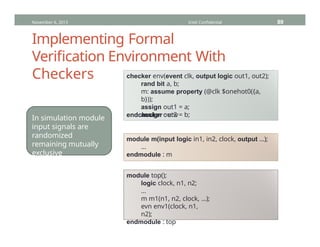
![Modular Assertion Modeling
checker check_fsm(logic [1:0] state, event
clk); logic [1:0] astate = IDLE; // Abstract
state model_fsm c1(state, clk, astate);
check_assertions c2(state, astate, clk);
endchecker
checker model_fsm(input event clk, output
logic [1:0] astate = IDLE);
always @clk
case (astate)
IDLE: astate <= …;
…
default: astate <= ERR;
endcase
endchecker
checker
check_
assertions(state,
astate, event clk);
d
efault
clockin
November 6, 2013 Intel Confidential 88](https://image.slidesharecdn.com/assertion-250215041541-f2e7b6c0/85/Assertiona-in-system-verilog-verification-pptx-91-320.jpg)
![Informal Definition
• Local variable is a variable associated with an evaluation
attempt
• Local variables are not sampled
November 4, 2013 HVC2013 91
checker data_consistency (start, complete, dataIn,
dataOut,
event clk, untyped rst);
default clocking @clk; endclocking
default disable iff rst;
property p_data_check;
var type(dataIn)
data;
(start, data = dataIn) ##1 complete[->1] |-> dataOut ==
data;
endproperty : p_data_check
a1: assert property (p_data_check);
endchecker : data_consistency
Local
variabl
e
Matc
h
item](https://image.slidesharecdn.com/assertion-250215041541-f2e7b6c0/85/Assertiona-in-system-verilog-verification-pptx-94-320.jpg)
![Example
November 4, 2013 HVC2013 92
• Check that the value of dataIn when start is high
coincides with the value of dataOut read in n clock
ticks
• If n = const
assert property (start |-> ##n dataOut == $past(dataIn, n) );
• If n is not const
property data_check;
var type(n) ctr;
(start, ctr = n - 1) ##1 (ctr > 0, ctr--)[*] ##1 (ctr == 0)
|-> dataOut = dataIn;
endproperty : data_check
assert property (data_check);](https://image.slidesharecdn.com/assertion-250215041541-f2e7b6c0/85/Assertiona-in-system-verilog-verification-pptx-95-320.jpg)

![Assertion Compilation for FV
• Assertions are usually compiled into finite automata
[Var96]
• Typical for FV and emulation
• Sometimes done for simulation as well
• Safety assertions are compiled into (conventional)
finite automata on finite words
• Liveness and hybrid assertions are compiled into
finite automata on infinite words (e.g., Büchi
automata):
• Finite automata on finite words + fairness conditions
• Complexity of automaton reflects well FV efficiency
• Another factor is the number of state variables in
the model
November 4, 2013 HVC2013 97](https://image.slidesharecdn.com/assertion-250215041541-f2e7b6c0/85/Assertiona-in-system-verilog-verification-pptx-100-320.jpg)
![Automaton-Based Compilation.
Example
November 4, 2013 HVC2013 98
tru
e
a a a b !c
tru
e
a b !c
a
tru
e
a !c
b always a ##1 b |=> c
always a[*3] ##1 b |=>
c always a[+] ##1 b |
=> c](https://image.slidesharecdn.com/assertion-250215041541-f2e7b6c0/85/Assertiona-in-system-verilog-verification-pptx-101-320.jpg)
![Avoid Large and Distant Time
Windows
November 4, 2013 HVC2013 99
assert property (start ##1 !complete[0:1000] ##1 complete |=>
done);
assert property (start ##1 complete[->1] |=>
done);
⇕
assert property (start ##1 !complete[*] ##1 complete |=>
done);
³
✓
Also applies to bounded property operators and
$past](https://image.slidesharecdn.com/assertion-250215041541-f2e7b6c0/85/Assertiona-in-system-verilog-verification-pptx-102-320.jpg)
![Avoid Using Liveness Assertions
Unless
November 4, 2013 HVC2013 100
Really Needed
Request must be active until grant is
asserted
assert property(req |-> req s_until
grant);
assert property(req |-> req until
grant);
³
✓
Do you really
want to check
that grant is
eventually
received?
Strong
operators have
clumsier syntax
to prevent
inadvertent
usage
Clock is
fair
assert property (s_eventually clk);
✓
assert property (req |-> ##[1:1000]
gnt);
assert property (req |-> s_eventually
gnt);
³
✓
Liveness
assertion is
usually better
than a safety
assertion with a
large time
window](https://image.slidesharecdn.com/assertion-250215041541-f2e7b6c0/85/Assertiona-in-system-verilog-verification-pptx-103-320.jpg)
![Past vs. Future
November 4, 2013 HVC2013 102
• Future value functions are cheap in FV
• Recall that each variable is represented as a pair (v,
v')
• Past value functions are more expensive
• They introduce new flip-flops (=variables)
• Need to optimize the usage of $past
logic check;
logic [31:0] a, b, c;
assert property (##1 check |-> $past(c) == $past(a) +
$past(b));
assert property (##1 check |-> $past(c == a +
b));
³
✓](https://image.slidesharecdn.com/assertion-250215041541-f2e7b6c0/85/Assertiona-in-system-verilog-verification-pptx-105-320.jpg)
![Intersection Family
expensiv
e
November 4, 2013 HVC2013 103
• Sequence operators from intersection family (intersect, and,
within) are expensive
• These operators are not inefficient by themselves, but allow to
concisely code complex sequences
• Use only where appropriate
Each transaction should contain two read requests and three write
requests
Common case
assert property (start |-> read[=2] intersect write[=3] intersect complete[-
>1]);
If known that all reads come after writes
assert property (start |-> write[=3] ##1 read[=2] intersect complete[->1]);
• Top-level conjunction in a sequence promoted to property is
not
assert property (en |-> r and
s);
assert property (en |-> (r and s) ##1
a);
This is
rather
efficient](https://image.slidesharecdn.com/assertion-250215041541-f2e7b6c0/85/Assertiona-in-system-verilog-verification-pptx-106-320.jpg)
![Overlapping vs.
Nonoverlapping Transactions
• Nonoverlapping transactions may be
modeled deterministically
• Overlapping transactions usually require
nondeterministic modeling
• E.g., local or rigid variables
• Compare:
• Sequential protocol
vs.
November 4, 2013 HVC2013 107
property p_data_check;
var type(dataIn) data;
(start, data = dataIn) ##1 complete[->1]
|-> dataOut == data;
endproperty : p_data_check
If it is known that transactions cannot overlap, model them as
nonoverlapping](https://image.slidesharecdn.com/assertion-250215041541-f2e7b6c0/85/Assertiona-in-system-verilog-verification-pptx-110-320.jpg)


![• [Ar03] - R.Armoni et al., Enhanced Vacuity Detection in
Linear Temporal Logic, 2003
• [AS87] - B. Alpern, F.B. Schneider, Recognizing safety and
liveness, 1987
• [Kr63] - S. Kripke. Semantical Considerations on Modal
Logic, 1963
• [KV01] - O. Kupferman, M.Y. Vardi, Model checking of
safety properties, 2001
• [Pnu77] - A. Pnueli. The temporal logic of programs, 1977
• [PSL10] - IEEE Standard for Property Specification language
(PSL), 2010
• [SV12] - IEEE Standard for SystemVerilog, 2012
• [Var96] - M. Vardi. An Automata-Theoretic Approach
• to Linear Temporal Logic, 1996
November 4, 2013 HVC2013 118](https://image.slidesharecdn.com/assertion-250215041541-f2e7b6c0/85/Assertiona-in-system-verilog-verification-pptx-121-320.jpg)


