CVS Caremark Corporation
NOTICE OF ANNUAL MEETING OF STOCKHOLDERS
MAY 7, 2008
8:00 A.M.
CVS Caremark Corporation
One CVS Drive
Woonsocket, Rhode Island 02895
To our stockholders:
We are pleased to invite you to attend our 2008 annual meeting of stockholders to:
Ⅲ Elect 12 directors;
Ⅲ Ratify the appointment of Ernst & Young LLP as the Company’s independent registered public
accounting firm for 2008;
Ⅲ Act on three stockholder proposals to be presented; and
Ⅲ Conduct other business properly brought before the meeting.
Stockholders of record at the close of business on March 12, 2008 may vote at the meeting.
Your vote is important. Whether or not you plan to attend the meeting, please vote your shares. In
addition to voting in person or by mail, stockholders of record have the option of voting by telephone or via the
Internet. If your shares are held in the name of a bank, broker or other holder of record (i.e., in “street name”),
please check your proxy card or other voting instructions to see which of these options are available to you. Even
if attending the meeting in person, we encourage you to vote in advance by mail, phone or Internet.
By Order of the Board of Directors,
Thomas M. Ryan
Chairman of the Board, President and Chief Executive Officer
Important Notice Regarding the Availability of Proxy Materials for the Stockholder Meeting to Be Held
on May 7, 2008.
The proxy statement and annual report to security holders are available at http://investor.cvs.com.
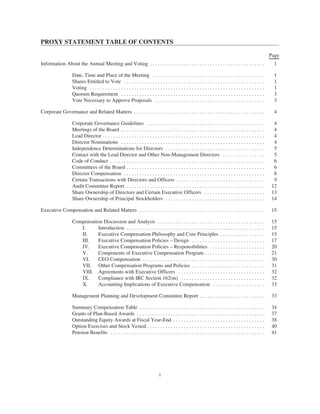
PROXY STATEMENT TABLE OF CONTENTS
Page
Information About the Annual Meeting and Voting . . . . . . . . . . . . . . . . . . . . . . . . . . . . . . . . . . . . . . . . . . . . 1
Date, Time and Place of the Meeting . . . . . . . . . . . . . . . . . . . . . . . . . . . . . . . . . . . . . . . . . . . 1
Shares Entitled to Vote . . . . . . . . . . . . . . . . . . . . . . . . . . . . . . . . . . . . . . . . . . . . . . . . . . . . . . 1
Voting . . . . . . . . . . . . . . . . . . . . . . . . . . . . . . . . . . . . . . . . . . . . . . . . . . . . . . . . . . . . . . . . . . . 1
Quorum Requirement . . . . . . . . . . . . . . . . . . . . . . . . . . . . . . . . . . . . . . . . . . . . . . . . . . . . . . . 3
Vote Necessary to Approve Proposals . . . . . . . . . . . . . . . . . . . . . . . . . . . . . . . . . . . . . . . . . . 3
Corporate Governance and Related Matters . . . . . . . . . . . . . . . . . . . . . . . . . . . . . . . . . . . . . . . . . . . . . . . . . . 4
Corporate Governance Guidelines . . . . . . . . . . . . . . . . . . . . . . . . . . . . . . . . . . . . . . . . . . . . . 4
Meetings of the Board . . . . . . . . . . . . . . . . . . . . . . . . . . . . . . . . . . . . . . . . . . . . . . . . . . . . . . . 4
Lead Director . . . . . . . . . . . . . . . . . . . . . . . . . . . . . . . . . . . . . . . . . . . . . . . . . . . . . . . . . . . . . . 4
Director Nominations . . . . . . . . . . . . . . . . . . . . . . . . . . . . . . . . . . . . . . . . . . . . . . . . . . . . . . . 4
Independence Determinations for Directors . . . . . . . . . . . . . . . . . . . . . . . . . . . . . . . . . . . . . . 5
Contact with the Lead Director and Other Non-Management Directors . . . . . . . . . . . . . . . . 5
Code of Conduct . . . . . . . . . . . . . . . . . . . . . . . . . . . . . . . . . . . . . . . . . . . . . . . . . . . . . . . . . . . 6
Committees of the Board . . . . . . . . . . . . . . . . . . . . . . . . . . . . . . . . . . . . . . . . . . . . . . . . . . . . . 6
Director Compensation . . . . . . . . . . . . . . . . . . . . . . . . . . . . . . . . . . . . . . . . . . . . . . . . . . . . . . 8
Certain Transactions with Directors and Officers . . . . . . . . . . . . . . . . . . . . . . . . . . . . . . . . . . 9
Audit Committee Report . . . . . . . . . . . . . . . . . . . . . . . . . . . . . . . . . . . . . . . . . . . . . . . . . . . . . 12
Share Ownership of Directors and Certain Executive Officers . . . . . . . . . . . . . . . . . . . . . . . 13
Share Ownership of Principal Stockholders . . . . . . . . . . . . . . . . . . . . . . . . . . . . . . . . . . . . . . 14
Executive Compensation and Related Matters . . . . . . . . . . . . . . . . . . . . . . . . . . . . . . . . . . . . . . . . . . . . . . . . 15
Compensation Discussion and Analysis . . . . . . . . . . . . . . . . . . . . . . . . . . . . . . . . . . . . . . . . . 15
I. Introduction . . . . . . . . . . . . . . . . . . . . . . . . . . . . . . . . . . . . . . . . . . . . . . . . . . . . . 15
II. Executive Compensation Philosophy and Core Principles . . . . . . . . . . . . . . . . . 15
III. Executive Compensation Policies – Design . . . . . . . . . . . . . . . . . . . . . . . . . . . . 17
IV. Executive Compensation Policies – Responsibilities . . . . . . . . . . . . . . . . . . . . . 20
V. Components of Executive Compensation Program . . . . . . . . . . . . . . . . . . . . . . . 21
VI. CEO Compensation . . . . . . . . . . . . . . . . . . . . . . . . . . . . . . . . . . . . . . . . . . . . . . . 30
VII. Other Compensation Programs and Policies . . . . . . . . . . . . . . . . . . . . . . . . . . . . 31
VIII. Agreements with Executive Officers . . . . . . . . . . . . . . . . . . . . . . . . . . . . . . . . . 32
IX. Compliance with IRC Section 162(m) . . . . . . . . . . . . . . . . . . . . . . . . . . . . . . . . 32
X. Accounting Implications of Executive Compensation . . . . . . . . . . . . . . . . . . . . 33
Management Planning and Development Committee Report . . . . . . . . . . . . . . . . . . . . . . . . . 33
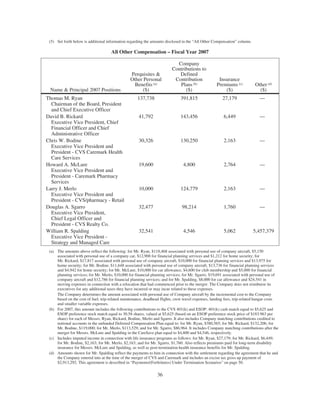
Summary Compensation Table . . . . . . . . . . . . . . . . . . . . . . . . . . . . . . . . . . . . . . . . . . . . . . . . 34
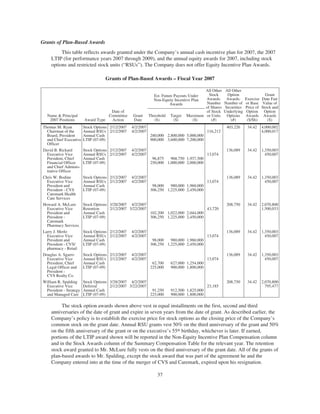
Grants of Plan-Based Awards . . . . . . . . . . . . . . . . . . . . . . . . . . . . . . . . . . . . . . . . . . . . . . . . . 37
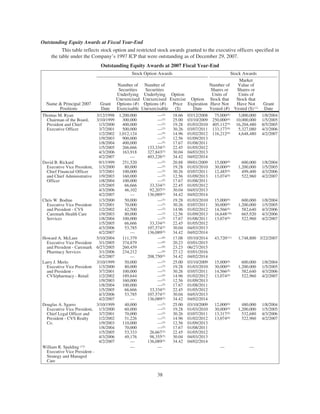
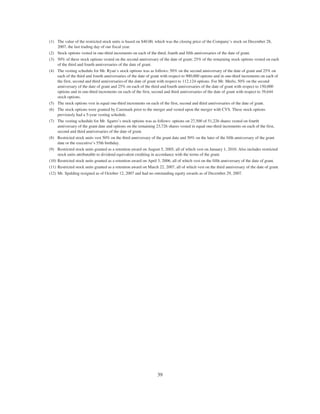
Outstanding Equity Awards at Fiscal Year-End . . . . . . . . . . . . . . . . . . . . . . . . . . . . . . . . . . . 38
Option Exercises and Stock Vested . . . . . . . . . . . . . . . . . . . . . . . . . . . . . . . . . . . . . . . . . . . . . 40
Pension Benefits . . . . . . . . . . . . . . . . . . . . . . . . . . . . . . . . . . . . . . . . . . . . . . . . . . . . . . . . . . . 41
i
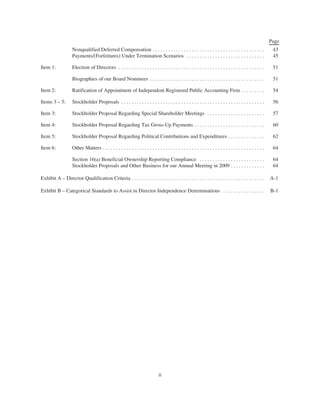
Page
Nonqualified Deferred Compensation . . . . . . . . . . . . . . . . . . . . . . . . . . . . . . . . . . . . . . . . . . . 43
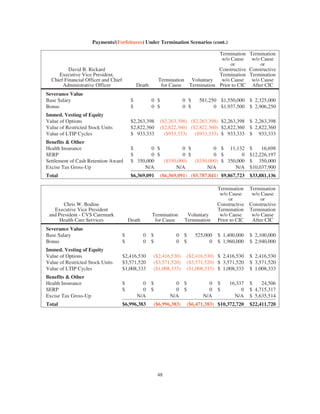
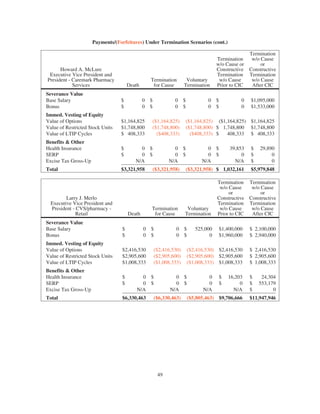
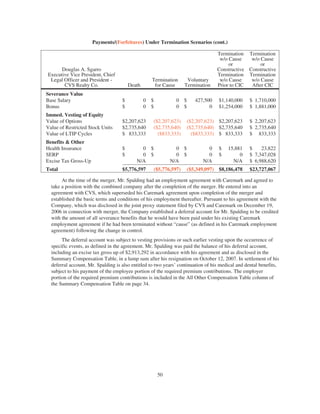
Payments/(Forfeitures) Under Termination Scenarios . . . . . . . . . . . . . . . . . . . . . . . . . . . . . . 45
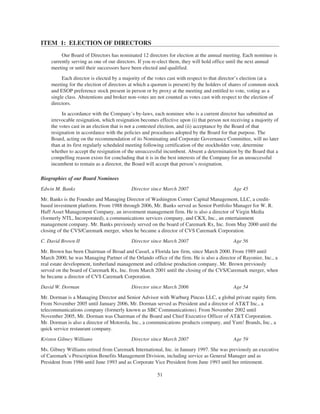
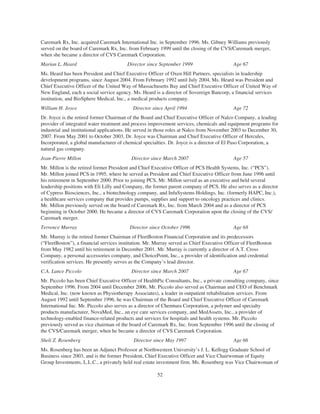
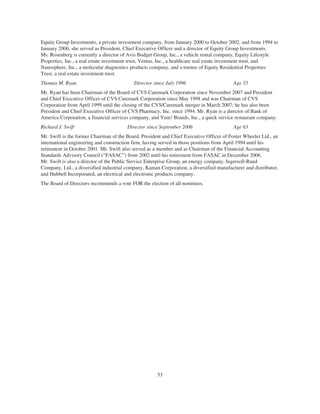
Item 1: Election of Directors . . . . . . . . . . . . . . . . . . . . . . . . . . . . . . . . . . . . . . . . . . . . . . . . . . . . . . . . 51
Biographies of our Board Nominees . . . . . . . . . . . . . . . . . . . . . . . . . . . . . . . . . . . . . . . . . . . . 51
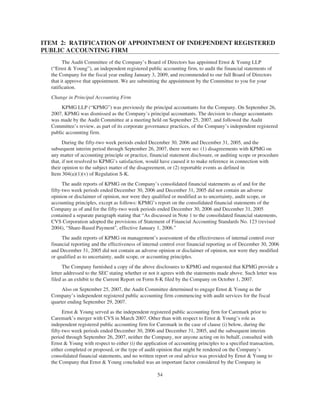
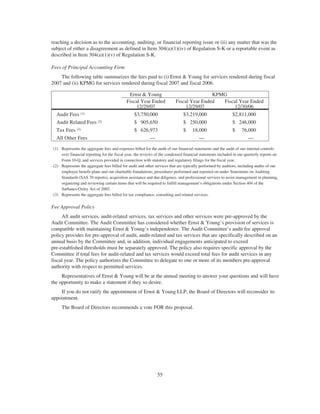
Item 2: Ratification of Appointment of Independent Registered Public Accounting Firm . . . . . . . . . 54
Items 3 – 5: Stockholder Proposals . . . . . . . . . . . . . . . . . . . . . . . . . . . . . . . . . . . . . . . . . . . . . . . . . . . . . . . 56
Item 3: Stockholder Proposal Regarding Special Shareholder Meetings . . . . . . . . . . . . . . . . . . . . . . 57
Item 4: Stockholder Proposal Regarding Tax Gross-Up Payments . . . . . . . . . . . . . . . . . . . . . . . . . . . 60
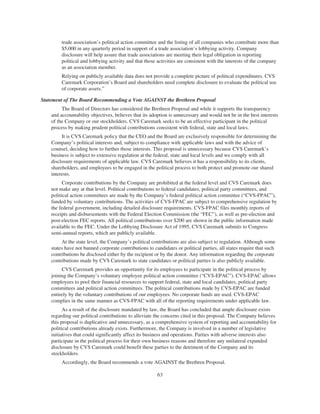
Item 5: Stockholder Proposal Regarding Political Contributions and Expenditures . . . . . . . . . . . . . . 62
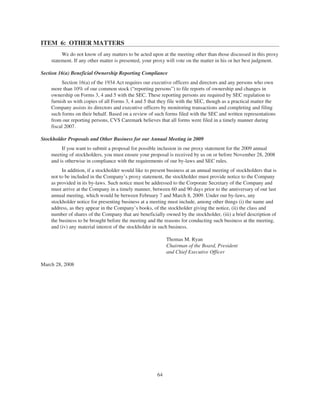
Item 6: Other Matters . . . . . . . . . . . . . . . . . . . . . . . . . . . . . . . . . . . . . . . . . . . . . . . . . . . . . . . . . . . . . . 64
Section 16(a) Beneficial Ownership Reporting Compliance . . . . . . . . . . . . . . . . . . . . . . . . . 64
Stockholder Proposals and Other Business for our Annual Meeting in 2009 . . . . . . . . . . . . . 64
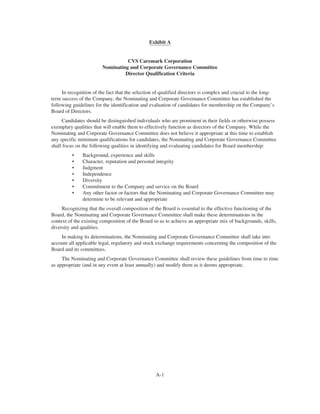
Exhibit A – Director Qualification Criteria . . . . . . . . . . . . . . . . . . . . . . . . . . . . . . . . . . . . . . . . . . . . . . . . . . . A-1
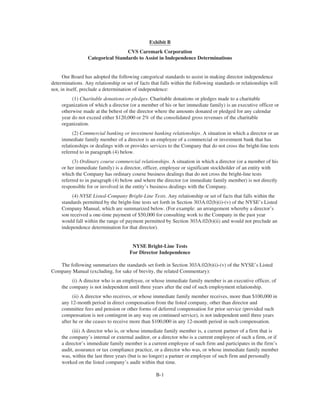
Exhibit B – Categorical Standards to Assist in Director Independence Determinations . . . . . . . . . . . . . . . . B-1
ii
INFORMATION ABOUT THE ANNUAL MEETING AND VOTING
The Board of Directors of CVS Caremark Corporation (the “Company” or “CVS Caremark”) is soliciting your
proxy to vote at our 2008 annual meeting of stockholders (or at any adjournment of the meeting). This proxy
statement summarizes the information you need to know to vote at the meeting.
We began mailing this proxy statement and the enclosed proxy card on or about March 28, 2008 to all
stockholders entitled to vote. The Company’s 2007 Annual Report, which includes our financial statements, is
being sent with this proxy statement.
Date, Time and Place of the Meeting
Date: May 7, 2008
Time: 8:00 a.m.
Place: One CVS Drive
Woonsocket, Rhode Island 02895
Shares Entitled to Vote
Stockholders entitled to vote are those who owned CVS Caremark common stock or Series One ESOP
convertible preference stock (referred to throughout this proxy statement as the “ESOP preference stock”) at
the close of business on the record date, March 12, 2008. As of the record date, there were approximately
1,443,163,153 shares of common stock and approximately 3,774,429 shares of ESOP preference stock
outstanding. All ESOP preference stock is held by the Bank of New York Mellon, as Trustee under the
401(k) Plan and the Employee Stock Ownership Plan of CVS Caremark Corporation and Affiliated
Companies (the “Plan”). The Plan consists of both a 401(k) Plan (the “401(k)”) and an Employee Stock
Ownership Plan (the “ESOP”).
Each share of CVS Caremark common stock that you own entitles you to one vote. Each share of
ESOP preference stock is entitled to the number of votes equal to the number of shares of common stock
into which the share of ESOP preference stock could be converted on the record date, rounded up to the next
tenth of a share, which equals 4.6 votes per share. The ESOP preference stock is entitled to vote on all
matters submitted to a vote of holders of common stock, voting with the common stock as a single class.
Each participant in the ESOP instructs the Trustee of the ESOP how to vote his or her shares. As to
unallocated shares and shares with respect to which the Trustee receives no timely voting instructions, the
Trustee, pursuant to the ESOP Trust Agreement, votes these shares in the same proportion as it votes all the
shares as to which it has received timely voting instructions.
Voting
Whether or not you plan to attend the annual meeting, we urge you to vote. You may vote by calling a
toll-free telephone number, by using the Internet or by mailing your signed proxy card in the postage-paid
envelope provided. If you vote by telephone or the Internet, you do NOT need to return your proxy card.
Returning the proxy card by mail or voting by telephone or Internet will not affect your right to attend the
meeting and change your vote, if desired.
If your shares are held in the name of a bank, broker or other holder of record (a “nominee”), you will
receive instructions from the nominee that you must follow in order for your shares to be voted. Certain of
these institutions offer telephone and Internet voting.
The enclosed proxy card indicates the number of shares that you own as of the record date.
Voting instructions are included on your proxy card. If you properly fill in your proxy card and send it
to us in time to vote, or vote by telephone or the Internet, one of the individuals named on your proxy card
(your “proxy”) will vote your shares as you have directed. If you sign the proxy card but do not make
specific choices, your proxy will follow the Board’s recommendations and vote your shares:
Ⅲ “FOR” the election of all 12 nominees for director (as described beginning on page 51);
Ⅲ “FOR” the ratification of the appointment of Ernst & Young LLP as the Company’s
independent registered public accounting firm for fiscal 2008 (as described beginning on
page 54); and
Ⅲ “AGAINST” each of the three stockholder proposals to be presented (as described beginning
on page 56).
If any other matter is presented at the meeting, your proxy will vote in accordance with his or her best
judgment. At the time this proxy statement went to press, we knew of no other matters to be acted on at the
meeting.
Revoking your proxy card
You may revoke your proxy card by:
Ⅲ sending in another signed proxy card with a later date;
Ⅲ providing subsequent telephone or Internet voting instructions;
Ⅲ notifying our Corporate Secretary in writing before the meeting that you have revoked your
proxy card; or
Ⅲ voting in person at the meeting.
Voting in person
If you plan to attend the meeting and vote in person, we will give you a ballot when you arrive.
However, if your shares are held in the name of a nominee, you must bring an account statement or letter
from the nominee indicating that you were the beneficial owner of the shares on March 12, 2008, the record
date for voting.
Appointing your own proxy
If you want to give your proxy to someone other than the individuals named as proxies on the proxy
card, you may cross out the names of those individuals and insert the name of the individual you are
authorizing to vote. Either you or that authorized individual must present the proxy card at the meeting.
Proxy solicitation
We are soliciting this proxy on behalf of our Board of Directors and will bear the solicitation expenses.
We are making this solicitation by mail but we may also solicit by telephone, e-mail or in person. We have
hired Morrow & Co., LLC for a fee of $25,000, plus out-of-pocket expenses, to provide customary
assistance to us in the solicitation. We will reimburse banks, brokerage houses and other institutions,
nominees and fiduciaries, if they request, for their expenses in forwarding proxy materials to beneficial
owners.
2
Householding
Under SEC rules, a single set of annual reports and proxy statements may be sent to any household at
which two or more Company stockholders reside if they appear to be members of the same family. Each
stockholder continues to receive a separate proxy card. This procedure, referred to as householding, reduces
the volume of duplicate information stockholders receive and reduces mailing and printing expenses for the
Company. Brokers with accountholders who are Company stockholders may be householding our proxy
materials. As indicated in the notice previously provided by these brokers to our stockholders, a single
annual report and proxy statement will be delivered to multiple stockholders sharing an address unless
contrary instructions have been received from an affected stockholder. Once you have received notice from
your broker that it will be householding communications to your address, householding will continue until
you are notified otherwise or until you revoke your consent. If, at any time, you no longer wish to
participate in householding and would prefer to receive a separate annual report and proxy statement, please
notify your broker. Stockholders who currently receive multiple copies of the annual report and proxy
statement at their address and who would prefer that their communications be householded should contact
their broker.
Quorum Requirement
A quorum of stockholders is necessary to hold a valid meeting. The presence in person or by proxy at
the meeting of holders of shares representing a majority of the votes of the common stock and the ESOP
preference stock entitled to vote constitutes a quorum. Abstentions and broker “non-votes” are counted as
present for establishing a quorum. A broker non-vote occurs on an item when a broker is not permitted to
vote on that item absent instruction from the beneficial owner of the shares and no instruction is given.
Vote Necessary to Approve Proposals
Ⅲ Item 1. Election of Directors. Each director is elected by a majority of the votes cast with respect to
that director’s election (at a meeting for the election of directors at which a quorum is present) by the
holders of shares of common stock and ESOP preference stock present in person or by proxy at the
meeting and entitled to vote, voting as a single class.
A “majority of votes cast” means that the number of votes “for” a director’s election must exceed 50%
of the votes cast with respect to that director’s election. Votes “against” a director’s election will count
as a vote cast, but “abstentions” and “broker non-votes” will not count as a vote cast with respect to
that director’s election.
Ⅲ All other proposals. For all other proposals, approval is by affirmative vote (at a meeting at which a
quorum is present) of a majority of the votes represented by the shares of common stock and the ESOP
preference stock present at the meeting in person or by proxy and entitled to vote, voting as a single
class. Abstentions are counted as shares present or represented and voting and have the effect of a vote
against.
Ⅲ Broker voting. Under current New York Stock Exchange (“NYSE”) rules, if the record holder of your
shares (usually a bank, broker or other nominee) holds your shares in its name, your record holder is
permitted to vote your shares on Item 1, Election of Directors, and Item 2, Ratification of Auditors, in
its discretion, even if it does not receive voting instructions from you. On all other Items your record
holder is not permitted to vote your shares without your instructions and such shares (broker non-votes)
have no effect on the vote.
3
CORPORATE GOVERNANCE AND RELATED MATTERS
Corporate Governance Guidelines
The Company’s Board of Directors acts as the ultimate decision-making body of the Company and
advises and oversees management, who are responsible for the day-to-day operations and management of
the Company. In carrying out its responsibilities, the Board reviews and assesses the Company’s long-term
strategy and its strategic, competitive and financial performance. The Board has adopted Corporate
Governance Guidelines, which are available on our investor relations website at http://investor.cvs.com and
also available to stockholders at no charge upon request to the Company’s Corporate Secretary. These
guidelines meet or exceed the listing standards adopted by the NYSE, on which the Company’s common
stock is listed.
Meetings of the Board
During 2007, there were twelve meetings of the Board of Directors of the Company. All of our
directors at the time of the Company’s 2007 annual meeting of stockholders attended the annual meeting.
Directors are expected to make every effort to attend the annual meeting of stockholders, all Board meetings
and the meetings of the Committees on which they serve. Each director attended at least 75% of the
meetings of the Board and of Committees of which he or she was a member, except Mr. Edwin L. Banks,
who attended 73.3% of the meetings that occurred while he was a member (five of seven Board meetings,
one of two Nominating and Corporate Governance Committee meetings and five of six Audit Committee
meetings). The Company notes that three of the four meetings that Mr. Banks failed to attend occurred the
same day, on which he had an unavoidable conflict.
One Board meeting was our annual meeting of non-management directors. The non-management
directors also regularly hold executive sessions during which the Company’s management does not
participate. Until the Board appointed its Lead Director (see below), the Chairs of the Audit, Management
Planning and Development and Nominating and Corporate Governance Committees, respectively, acted as
presiding director at meetings or executive sessions of non-management directors (or parts thereof) on a
rotating basis.
Lead Director
In November 2007, the Board amended its Corporate Governance Guidelines and appointed
Mr. Terrence Murray as its Lead Director. Under the amended Guidelines the Lead Director: has the
authority to call, and leads, non-management director and independent director sessions; may retain
independent legal, accounting or other advisors in connection with these sessions; presides at all meetings of
the Board at which the Chairman is not present; facilitates communication between the Chairman and the
independent directors; advises the Chairman of the informational needs of the Board; advises the Chairman
regarding Board meeting agendas and as to the appropriate schedule of Board meetings; and may request
inclusion of additional agenda items.
Director Nominations
Under the Company’s Corporate Governance Guidelines, the Nominating and Corporate Governance
Committee recommends to the Board criteria for Board membership, and recommends individuals for
membership on the Company’s Board of Directors. Criteria used by the Committee in nominating directors
are found in the Nominating and Corporate Governance Committee charter. A copy of Annex A to said
charter, the Director Qualification Criteria, is attached to this proxy statement as Exhibit A. When
considering current directors for re-nomination to the Board, the Committee takes into account the
performance of each director. The Committee also reviews the composition of the Board in light of the
current challenges and needs of the Board and the Company, and determines whether it may be appropriate
4
to add or remove individuals after considering, among other things, the need for audit committee expertise
and issues of independence, judgment, diversity, age, skills, background and experience. As desired, the
Committee may confer with the Chairman and other directors as to the foregoing matters.
If a stockholder would like to nominate a person for election or re-election to the Board, he or she must
provide notice to the Company as provided in its by-laws. Such notice must be addressed to the Corporate
Secretary of the Company and must arrive at the Company in a timely manner, between 60 and 90 days
prior to the anniversary of our last annual meeting of stockholders. The notice must include (i) the name and
address, as they appear in the Company’s books, of the stockholder giving the notice, (ii) the class and
number of shares of the Company that are beneficially owned by the stockholder, (iii) a written consent
indicating that the candidate is willing to be named in the proxy statement as a nominee and to serve as a
director if elected, and (iv) any other information that the Securities and Exchange Commission (“SEC”)
would require to be included in a proxy statement when a stockholder submits a proposal.
The retirement age for CVS Caremark directors is 72. The Company’s Corporate Governance
Guidelines provide that no director who is or would be over the age of 72 at the expiration of his or her
current term may be nominated to a new term, unless the Board waives the retirement age for a specific
director in exceptional circumstances. Such a waiver has been granted with respect to Dr. William H. Joyce,
Chair of the Company’s Audit Committee, who is presently 72. The Board considered a waiver of the
retirement age in this case appropriate and in the best interests of the Company in light of the exceptional
experience and expertise of Dr. Joyce.
Independence Determinations for Directors
Under the Company’s Corporate Governance Guidelines, a majority of our Board must be comprised
of directors who meet the director independence requirements set forth in the Corporate Governance Rules
of the NYSE applicable to listed companies. Under the NYSE Corporate Governance Rules, no director
qualifies as “independent” unless the Board affirmatively determines that the director has no material
relationship with the Company (either directly or as a partner, shareholder or officer of an organization that
has a relationship with the Company). The basis for a Board’s determination that a relationship is not
material must be disclosed in the Company’s annual proxy statement. In this regard, the Board may adopt
and disclose categorical standards to assist it in making determinations of independence, which are attached
to this proxy statement as Exhibit B.
The Nominating and Corporate Governance Committee of the Board undertook its annual review of
director independence in March 2008, and determined that each of Mr. Banks, C. David Brown II, David W.
Dorman, Kristen Gibney Williams, Marian L. Heard, Dr. Joyce, Jean-Pierre Millon, Mr. Murray, C.A.
Lance Piccolo, Sheli Z. Rosenburg and Richard W. Swift, is independent. Mr. Ryan is considered an inside
director because of his current employment as President and Chief Executive Officer of the Company.
In the course of its review as to the independence of each director, the Committee considered
transactions and relationships between each director or any member of his or her immediate family, on the
one hand, and the Company and its subsidiaries, on the other. Specifically, the Committee in making its
recommendation and the Board in making its determination considered that, consistent with the categorical
standards, each of Mr. Murray and a member of his immediate family, and Mr. Dorman, is a significant
equity holder in entities with which the Company has ordinary course business dealings that do not cross
any of the NYSE bright-line tests, and with respect to which the director or family member is not directly
responsible for or involved in such entity’s business dealings with the Company.
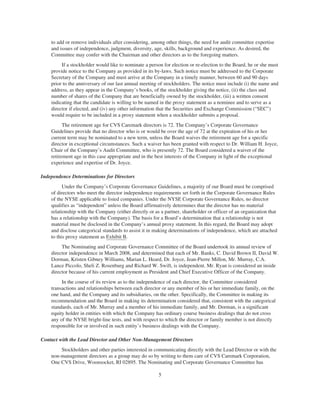
Contact with the Lead Director and Other Non-Management Directors
Stockholders and other parties interested in communicating directly with the Lead Director or with the
non-management directors as a group may do so by writing to them care of CVS Caremark Corporation,
One CVS Drive, Woonsocket, RI 02895. The Nominating and Corporate Governance Committee has
5
approved a process for handling letters received by the Company and addressed to the Lead Director or to
non-management members of the Board. Under that process, the Corporate Secretary of the Company
reviews all such correspondence and regularly forwards to the Board a summary of all such correspondence
and copies of all correspondence that, in the opinion of the Corporate Secretary, deals with the functions of
the Board or committees thereof or that he otherwise determines requires their attention. Directors shall
from time to time review a log of all correspondence received by the Company that is addressed to members
of the Board and may request copies of any such correspondence. Concerns relating to accounting, internal
accounting controls or auditing matters will be promptly brought to the attention of the Company’s internal
audit department and handled in accordance with procedures established by the Audit Committee with
respect to such matters.
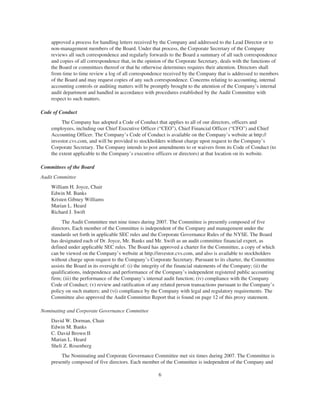
Code of Conduct
The Company has adopted a Code of Conduct that applies to all of our directors, officers and
employees, including our Chief Executive Officer (“CEO”), Chief Financial Officer (“CFO”) and Chief
Accounting Officer. The Company’s Code of Conduct is available on the Company’s website at http://
investor.cvs.com, and will be provided to stockholders without charge upon request to the Company’s
Corporate Secretary. The Company intends to post amendments to or waivers from its Code of Conduct (to
the extent applicable to the Company’s executive officers or directors) at that location on its website.
Committees of the Board
Audit Committee
William H. Joyce, Chair
Edwin M. Banks
Kristen Gibney Williams
Marian L. Heard
Richard J. Swift
The Audit Committee met nine times during 2007. The Committee is presently composed of five
directors. Each member of the Committee is independent of the Company and management under the
standards set forth in applicable SEC rules and the Corporate Governance Rules of the NYSE. The Board
has designated each of Dr. Joyce, Mr. Banks and Mr. Swift as an audit committee financial expert, as
defined under applicable SEC rules. The Board has approved a charter for the Committee, a copy of which
can be viewed on the Company’s website at http://investor.cvs.com, and also is available to stockholders
without charge upon request to the Company’s Corporate Secretary. Pursuant to its charter, the Committee
assists the Board in its oversight of: (i) the integrity of the financial statements of the Company; (ii) the
qualifications, independence and performance of the Company’s independent registered public accounting
firm; (iii) the performance of the Company’s internal audit function; (iv) compliance with the Company
Code of Conduct; (v) review and ratification of any related person transactions pursuant to the Company’s
policy on such matters; and (vi) compliance by the Company with legal and regulatory requirements. The
Committee also approved the Audit Committee Report that is found on page 12 of this proxy statement.
Nominating and Corporate Governance Committee
David W. Dorman, Chair
Edwin M. Banks
C. David Brown II
Marian L. Heard
Sheli Z. Rosenberg
The Nominating and Corporate Governance Committee met six times during 2007. The Committee is
presently composed of five directors. Each member of the Committee is independent of the Company and
6
management under the standards set forth in the Corporate Governance Rules of the NYSE. The Board has
approved a charter for the Committee, a copy of which can be viewed on the Company’s website at
http://investor.cvs.com, and also is available to stockholders without charge upon request to the Company’s
Corporate Secretary. Pursuant to its charter, the Committee has responsibility for: (i) identifying individuals
qualified to become Board members; (ii) recommending to the Board director nominees for election at the
next annual or special meeting of stockholders at which directors are to be elected or to fill any vacancies or
newly-created directorships that may occur between such meetings; (iii) recommending directors for
appointment to Board committees; (iv) making recommendations to the Board as to determinations of
director independence; (v) evaluating Board performance; and (vi) reviewing and assessing the Company’s
Corporate Governance Guidelines and overseeing compliance with such Guidelines.
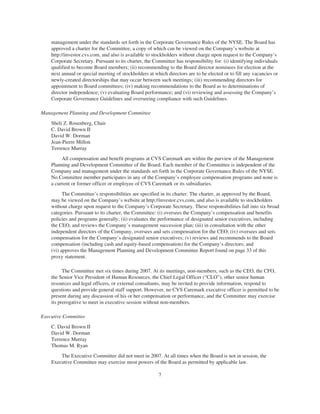
Management Planning and Development Committee
Sheli Z. Rosenberg, Chair
C. David Brown II
David W. Dorman
Jean-Pierre Millon
Terrence Murray
All compensation and benefit programs at CVS Caremark are within the purview of the Management
Planning and Development Committee of the Board. Each member of the Committee is independent of the
Company and management under the standards set forth in the Corporate Governance Rules of the NYSE.
No Committee member participates in any of the Company’s employee compensation programs and none is
a current or former officer or employee of CVS Caremark or its subsidiaries.
The Committee’s responsibilities are specified in its charter. The charter, as approved by the Board,
may be viewed on the Company’s website at http://investor.cvs.com, and also is available to stockholders
without charge upon request to the Company’s Corporate Secretary. These responsibilities fall into six broad
categories. Pursuant to its charter, the Committee: (i) oversees the Company’s compensation and benefits
policies and programs generally; (ii) evaluates the performance of designated senior executives, including
the CEO, and reviews the Company’s management succession plan; (iii) in consultation with the other
independent directors of the Company, oversees and sets compensation for the CEO; (iv) oversees and sets
compensation for the Company’s designated senior executives; (v) reviews and recommends to the Board
compensation (including cash and equity-based compensation) for the Company’s directors; and
(vi) approves the Management Planning and Development Committee Report found on page 33 of this
proxy statement.
The Committee met six times during 2007. At its meetings, non-members, such as the CEO, the CFO,
the Senior Vice President of Human Resources, the Chief Legal Officer (“CLO”), other senior human
resources and legal officers, or external consultants, may be invited to provide information, respond to
questions and provide general staff support. However, no CVS Caremark executive officer is permitted to be
present during any discussion of his or her compensation or performance, and the Committee may exercise
its prerogative to meet in executive session without non-members.
Executive Committee
C. David Brown II
David W. Dorman
Terrence Murray
Thomas M. Ryan
The Executive Committee did not meet in 2007. At all times when the Board is not in session, the
Executive Committee may exercise most powers of the Board as permitted by applicable law.
7
Director Compensation
For the Board year commencing on May 9, 2007, the Company has provided the following
compensation to our non-employee directors for their services as directors:
Annual Retainer Fees, Meeting Fees and Equity Awards
Ⅲ Each non-employee director has received an annual retainer of $65,000 and attendance fees of $2,000
for each Board meeting attended, $1,000 for each telephonic Board meeting attended and $1,000 for
each Committee meeting attended.
Ⅲ Each non-employee director who chaired a Committee of the Board received an additional retainer of
$8,000, except the Chair of the Audit Committee, who received $15,000.
Ⅲ Under the 1997 Incentive Compensation Plan (the “1997 ICP”), non-employee directors received an
annual award of 4,000 shares of common stock for their service during the preceding year (pro rated
for partial-year service). In addition, following the merger of CVS and Caremark, former Caremark
directors received 6,680 shares of CVS Caremark common stock under the 1997 ICP for the service
during the preceding year, including service prior to the merger.
Director Fees Payable in Stock; Stock Ownership Guidelines; Other Items
At least one half of the annual non-employee director retainer fee is paid in CVS Caremark common
stock. Directors may elect to receive all retainer and attendance fees in common stock. A director may also
choose to defer receipt of such shares. Deferred shares are credited with dividend equivalents. Directors are
eligible to receive stock options, but typically do not receive them; they do not participate in a pension plan or
nonqualified deferred compensation plan with above market earnings. Directors are eligible to participate in
the Employee Discount Program and are subject to the same terms of the program as Company employees.
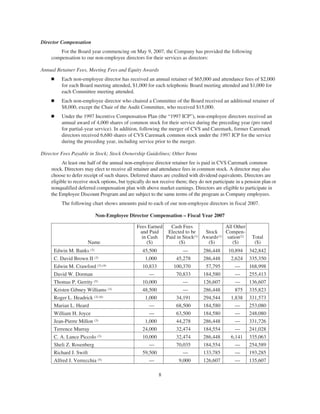
The following chart shows amounts paid to each of our non-employee directors in fiscal 2007.
Non-Employee Director Compensation – Fiscal Year 2007
Name
Fees Earned
and Paid
in Cash
($)
Cash Fees
Elected to be
Paid in Stock(1)
($)
Stock
Awards(1)
($)
All Other
Compen-
sation(2)
($)
Total
($)
Edwin M. Banks (3) 45,500 — 286,448 10,894 342,842
C. David Brown II (3) 1,000 45,278 286,448 2,624 335,350
Edwin M. Crawford (3) (4) 10,833 100,370 57,795 — 168,998
David W. Dorman — 70,833 184,580 — 255,413
Thomas P. Gerrity (5) 10,000 — 126,607 — 136,607
Kristen Gibney Williams (3) 48,500 — 286,448 875 335,823
Roger L. Headrick (3) (6) 1,000 34,191 294,544 1,838 331,573
Marian L. Heard — 68,500 184,580 — 253,080
William H. Joyce — 63,500 184,580 — 248,080
Jean-Pierre Millon (3) 1,000 44,278 286,448 — 331,726
Terrence Murray 24,000 32,474 184,554 — 241,028
C. A. Lance Piccolo (3) 10,000 32,474 286,448 6,141 335,063
Sheli Z. Rosenberg — 70,035 184,554 — 254,589
Richard J. Swift 59,500 — 133,785 — 193,285
Alfred J. Verrecchia (5) — 9,000 126,607 — 135,607
8
(1) These awards are fully vested at grant and the amounts shown represent both the fair market value and the full fair value at grant
under FAS 123(R). As of December 29, 2007, our directors had deferred receipt of shares of Company common stock as follows:
Mr. Dorman, 10,040; Ms. Heard, 46,572; Dr. Joyce, 65,740; Ms. Rosenberg, 18,189; and Mr. Swift, 4,052.
(2) Company contributions for director health and prescription benefits following the merger of CVS and Caremark.
(3) Joined the Board effective March 22, 2007, at the time of the merger of CVS and Caremark.
(4) Retired from the Board effective November 7, 2007.
(5) Retired from the Board effective March 22, 2007, at the time of the merger of CVS and Caremark.
(6) Retired from the Board effective July 2, 2007.
In January 2008, the Management Planning and Development Committee recommended, and the Board
approved, a new compensation program for the Company’s non-employee directors, commencing with the
Board year that begins on May 7, 2008. The Committee believes that a full-retainer approach, rather than
meeting fees, better reflects the ongoing accountabilities of directors. Service on the Board requires
directors to commit significant amounts of time to Company matters year-round, not only at meetings. The
full-retainer approach also facilitates administration of the directors’ compensation program. Each
non-employee director will receive an annual retainer of $260,000. Additional annual retainers will be paid
as follows: Chairs of the Nominating and Corporate Governance and Management Planning and
Development Committees, $10,000 each; Chair of the Audit Committee, $20,000; and Lead Director,
$20,000. Each of the retainers will be paid semi-annually; at least 75% of each retainer must be paid in
shares of Company common stock, and directors may elect to receive all of their retainers in stock. The
payment of annual and additional retainers in substantially all Company common stock (or fully in
Company common stock at a director’s election) is consistent with our policy of using equity compensation
to better align directors’ interests with shareholders, and enhances the directors’ ability to meet and continue
to comply with the stock ownership guidelines described below. Directors may continue to elect to defer
receipt of shares; deferred shares will be credited with dividend equivalents.
All non-employee directors must own a minimum of 10,000 shares of CVS Caremark common stock.
Directors must attain this minimum ownership level within five years of being elected to the Board, and
must retain ownership of a minimum of 10,000 shares for at least six months after leaving the Board. Each
of our directors has attained the minimum ownership level except Messrs. Brown and Swift, who joined the
Board in March 2007 and September 2006, respectively, and, according to the guidelines, each has five
years from the date he joined the Board to achieve compliance.
Caremark Rx, Inc. had provided medical, dental and prescription drug coverage to its directors and
their eligible dependents while the director was serving on its board. Messrs. Banks and Piccolo, who
currently serve as directors of the Company, will continue their medical and dental coverage for two
calendar years after the merger, paying the same premium rates as Company employees. The Company has
extended to all directors the option to enroll themselves and their eligible dependents in the Company’s
prescription drug benefit program, paying the same premium rates as employees. If a director retires from
the Board with at least five years of service, the Company will allow continued participation in the
prescription drug benefit plan, but the director must bear the full cost of the premium.
Certain Transactions with Directors and Officers
In accordance with SEC rules, the Board has adopted a written Related Person Transaction Policy (the
“Policy”). The Audit Committee of the Board has been designated as the Committee responsible for
reviewing, approving or ratifying any related person transactions under the Policy.
Pursuant to the Policy, all executive officers, directors, director nominees and any 5% beneficial
owners of the Company’s securities are required to notify the Company’s CLO or Corporate Secretary of
any financial transaction, arrangement or relationship, or series of similar transactions, arrangements or
relationships, involving the Company in which an executive officer, director, director nominee, 5%
beneficial owner or any immediate family member of such a person has a direct or indirect material interest.
Such officers, directors, nominees, 5% beneficial owners and their immediate family members are
considered “related persons” under the Policy.
9
For the above purposes, “immediate family member” includes a person’s spouse, parents, siblings,
children, in-laws, step-relatives and any other person sharing the household (other than a tenant or
household employee).
The CLO or the Corporate Secretary will present any reported new related person transactions, and
proposed transactions involving related persons, to the Audit Committee at its next regular meeting. The
Committee shall review transactions to determine whether the related person involved has a direct or
indirect material interest in the transaction. The Committee may conclude, upon review of all relevant
information, that the transaction does not constitute a related person transaction, and thus that no further
review is required under the Policy. On an annual basis, the Committee shall review previously approved
related person transactions, under the standards described below, to determine whether such transactions
should continue.
In reviewing the transaction or proposed transaction, the Committee shall consider all relevant facts
and circumstances, including without limitation the commercial reasonableness of the terms, the benefit and
perceived benefit, or lack thereof, to the Company, opportunity costs of alternate transactions, the
materiality and character of the related person’s direct or indirect interest, and the actual or apparent conflict
of interest of the related person. The Committee will not approve or ratify a related person transaction unless
it shall have determined that, upon consideration of all relevant information, the transaction is in, or not
inconsistent with, the best interests of the Company and its stockholders.
If after the review described above, the Committee determines not to approve or ratify a related person
transaction (whether such transaction is being reviewed for the first time or has previously been approved
and is being re-reviewed), the transaction will not be entered into or continued, as the Committee shall
direct.
Notwithstanding the foregoing, the following types of transactions are deemed not to create or involve
a material interest on the part of the related person and will not be reviewed, nor will they require approval
or ratification, under the Policy:
(i) Transactions involving the purchase or sale of products or services in the ordinary course of
business, not exceeding $120,000.
(ii) Transactions in which the related person’s interest derives solely from his or her service as a
director of another corporation or organization that is a party to the transaction.
(iii) Transactions in which the related person’s interest derives solely from his or her ownership of less
than 10% of the equity interest in another entity (other than a general partnership interest) which is
a party to the transaction.
(iv) Transactions in which the related person’s interest derives solely from his or her ownership of a
class of equity securities of the Company and all holders of that class of equity securities received
the same benefit on a pro rata basis.
(v) Transactions in which the related person’s interest derives solely from his or her service as a
director, trustee or officer (or similar position) of a not-for-profit organization or charity that
receives donations from the Company, which donations are made in accordance with the
Company’s matching program that is available on the same terms to all employees of the
Company.
(vi) Compensation arrangements of any executive officer, other than an individual who is an
immediate family member of a related person, if such arrangements have been approved by the
Management Planning and Development Committee.
(vii) Director compensation arrangements, if such arrangements have been approved by the Board.
10
(viii) Indemnification payments and payments made under directors and officers indemnification
insurance policies or made pursuant to the certificate of incorporation or by-laws of the Company
or any of its subsidiaries or pursuant to any policy, agreement or instrument.
The Board reviews the Policy on an annual basis and will make changes as appropriate.
Additionally, under the Company’s Corporate Governance Guidelines and its Code of Conduct, with
respect to any transaction in which a director or executive officer has a personal interest, such that a
potential conflict of interest could arise, the director or executive officer must report the matter immediately
to the Company’s CLO or the Corporate Compliance Officer who will, where appropriate, report the matter
to the Nominating and Corporate Governance Committee for evaluation and appropriate resolution.
If a director has a personal interest in a matter before the Board, the director shall disclose the interest
to the full Board, will recuse himself or herself from participation in the discussion and will not vote on the
matter.
Furthermore, proposed charitable contributions, or pledges of charitable contributions, by the Company
within any given fiscal year in an aggregate amount exceeding $120,000, to an entity for which a director or
a member of his or her immediate family serves as a director, officer, employee or member of such entity’s
fund-raising organization or committee, will be subject to prior review and approval by the Audit
Committee (with notification to the Nominating and Corporate Governance Committee).
In addition, under the Nominating and Corporate Governance Committee’s charter, such Committee
shall evaluate the possibility that a director’s independence may be compromised or impaired for Board or
committee purposes if director compensation exceeds customary levels, if the Company makes substantial
charitable contributions to an organization with which a director is affiliated, or if the Company enters into
consulting contracts with (or provides other indirect forms of compensation to) a director (which consulting
contracts or other indirect forms of compensation are expressly prohibited for Audit Committee members).
Mr. Andrew Crawford, the son of Mr. E. Mac Crawford, the former Chairman of the Board of CVS
Caremark, was employed by the Company as Senior Vice President of Industry Analysis and Underwriting
until he left the Company in October 2007. Compensation and benefits received by Andrew Crawford for
2007 consisted of: $250,000 in base salary, $295,000 in annual bonus amounts, $260,000 in transition bonus
amounts relating to prior Caremark strategic initiatives and $60,000 in benefits and severance amounts. In
addition, upon his resignation he received distributions of $910,000 in cash and $310,000 in restricted stock
as severance amounts payable under his pre-existing Caremark employment agreement and carried forward
under his continuing agreement with the Company. Further, Andrew Crawford exercised stock options that
had been granted to him by Caremark prior to the merger with CVS, with an aggregate value of
approximately $5,800,000.
Upon Mr. E. Mac Crawford’s retirement from his role as Chief Executive Officer of Caremark in
connection with the merger of CVS and Caremark, he was entitled to certain benefits under Caremark
arrangements which pre-dated the merger. Pursuant to his pre-existing employment agreement with
Caremark, he received an aggregate severance payment of $26,400,000 and is entitled to continuation of
welfare benefits (e.g., health, dental, disability and life insurance) on a tax-neutral basis through
September 1, 2015. Under Caremark’s pre-existing Supplemental Executive Retirement Plan he is entitled
to a pension benefit equal to 60% of his average annual base salary during the three years preceding his
retirement. The benefit is calculated based on the present value of a monthly life annuity and is being paid in
six annual installments. Under a pre-existing survivor benefit agreement, Caremark was required to transfer
to Mr. Crawford a life insurance policy with a minimum death benefit of $17,000,000 and a minimum cash
value of $3,666,256. Caremark maintained a life insurance policy for Mr. Crawford and in 2007 the
Company made the final premium payment on this policy and transferred the policy to Mr. Crawford,
together with a tax gross-up equal to the federal income taxes incurred by Mr. Crawford in connection with
the policy transfer, as required under the survivor benefit agreement.
11
Certain of Caremark’s executive officers and other eligible employees participated in a relocation
program as a result of Caremark’s relocation of its corporate headquarters from Birmingham, Alabama to
Nashville, Tennessee. In order to facilitate the relocation of these employees, Caremark entered into a
relocation services agreement with an independent relocation company (the “Relocation Company”)
pursuant to which eligible employees received certain relocation assistance and related services. In addition
to assisting employees in finding appropriate housing in the new location, the agreement provided for the
Relocation Company to purchase a transferring employee’s former residence at a value equal to the fair
market valuation of the property or the amount that the employee had invested in the property, whichever
was greater. Following execution of a purchase agreement between the Relocation Company and the
transferring employee, the Relocation Company paid to the transferring employee the agreed purchase price
of the employee’s residence using funds provided by Caremark. The Relocation Company then marketed the
house for resale to an unrelated buyer, and Caremark incurred the costs associated with, and received the net
proceeds from, that resale. The Relocation Company received a fee from Caremark for services provided to
each employee. Under the relocation program, in 2004 Caremark relocated Mr. Crawford and the Relocation
Company purchased Mr. Crawford’s former home for $2,903,305. The home was sold in 2007 and the
Company incurred a loss and related costs totaling $975,000.
Audit Committee Report
The Audit Committee of the Board of Directors (for purposes of this report, the “Committee”) is
composed of five independent directors. Set forth below is the report of the Committee on its activities with
respect to CVS Caremark’s audited financial statements for the fiscal year ended December 29, 2007 (the
“audited financial statements”).
Ⅲ The Committee has reviewed and discussed the audited financial statements with management;
Ⅲ The Committee has discussed with Ernst & Young LLP, the Company’s independent registered
public accounting firm, the matters required to be discussed by Statement on Auditing Standards
No. 61, as amended and as adopted by the Public Company Accounting Oversight Board
(“PCAOB”) in Rule 3200T;
Ⅲ The Committee has received the written disclosures and the letter from Ernst & Young LLP
required by Independence Standards Board Standard No. 1, as adopted by the PCAOB in Rule
3600T, and has discussed with Ernst & Young LLP its independence from the Company; and
Ⅲ Based on the review and discussions referred to above and relying thereon, the Committee has
recommended to the Board of Directors that the audited financial statements be included in CVS
Caremark’s Annual Report on Form 10-K for the fiscal year ended December 29, 2007, for filing
with the SEC.
March 4, 2008
William H. Joyce, Chair
Edwin M. Banks
Kristen Gibney Williams
Marian L. Heard
Richard J. Swift
12
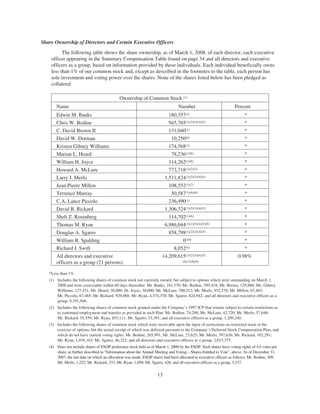
Share Ownership of Directors and Certain Executive Officers
The following table shows the share ownership, as of March 1, 2008, of each director, each executive
officer appearing in the Summary Compensation Table found on page 34 and all directors and executive
officers as a group, based on information provided by these individuals. Each individual beneficially owns
less than 1% of our common stock and, except as described in the footnotes to the table, each person has
sole investment and voting power over the shares. None of the shares listed below has been pledged as
collateral.
Ownership of Common Stock (1)
Name Number Percent
Edwin M. Banks 180,357(1) *
Chris W. Bodine 945,765(1)(2)(3)(4)(5) *
C. David Brown II 131,040(1) *
David W. Dorman 10,250(6) *
Kristen Gibney Williams 174,568(1) *
Marian L. Heard 78,236(1)(6) *
William H. Joyce 114,262(1)(6) *
Howard A. McLure 773,718(1)(2)(3) *
Larry J. Merlo 1,511,824(1)(2)(3)(4)(5) *
Jean-Pierre Millon 108,552(1)(7) *
Terrence Murray 50,587(1)(6)(8) *
C.A. Lance Piccolo 236,490(1) *
David B. Rickard 1,306,324(1)(2)(3)(4)(5) *
Sheli Z. Rosenberg 114,702(1)(6) *
Thomas M. Ryan 6,986,044(1)(2)(3)(4)(5)(9) *
Douglas A. Sgarro 858,798(1)(2)(3)(4)(5) *
William R. Spalding 0(10) *
Richard J. Swift 8,052(6) *
All directors and executive
officers as a group (21 persons)
14,209,615(1)(2)(3)(4)(5)
(6)(7)(8)(9)
0.98%
*Less than 1%.
(1) Includes the following shares of common stock not currently owned, but subject to options which were outstanding on March 1,
2008 and were exercisable within 60 days thereafter: Mr. Banks, 161,170; Mr. Bodine, 595,434; Mr. Brown, 129,860; Ms. Gibney
Williams, 127,431; Ms. Heard, 30,000; Dr. Joyce, 30,000; Mr. McLure, 700,512; Mr. Merlo, 932,578; Mr. Millon, 67,465;
Mr. Piccolo, 67,465; Mr. Rickard, 929,088; Mr. Ryan, 4,374,370; Mr. Sgarro, 624,942; and all directors and executive officers as a
group, 9,191,568.
(2) Includes the following shares of common stock granted under the Company’s 1997 ICP that remain subject to certain restrictions as
to continued employment and transfer as provided in such Plan: Mr. Bodine, 74,288; Mr. McLure, 43,720; Mr. Merlo, 57,640;
Mr. Rickard, 55,559; Mr. Ryan, 855,111; Mr. Sgarro, 53,391; and all executive officers as a group, 1,209,240.
(3) Includes the following shares of common stock which were receivable upon the lapse of restrictions on restricted stock or the
exercise of options, but the actual receipt of which was deferred pursuant to the Company’s Deferred Stock Compensation Plan, and
which do not have current voting rights: Mr. Bodine, 265,991; Mr. McLure, 23,625; Mr. Merlo, 397,636; Mr. Rickard, 102,291;
Mr. Ryan, 1,076,163; Mr. Sgarro, 46,322; and all directors and executive officers as a group, 2,015,375.
(4) Does not include shares of ESOP preference stock held as of March 1, 2008 by the ESOP. Such shares have voting rights of 4.6 votes per
share, as further described in “Information about the Annual Meeting and Voting – Shares Entitled to Vote”, above. As of December 31,
2007, the last date on which an allocation was made, ESOP shares had been allocated to executive officers as follows: Mr. Bodine, 309;
Mr. Merlo, 1,252; Mr. Rickard, 333; Mr. Ryan, 1,699; Mr. Sgarro, 426; and all executive officers as a group, 5,337.
13
(5) Includes the following hypothetical shares of common stock held in notional accounts in the Company’s unfunded Deferred
Compensation Plan, which do not have current voting rights: Mr. Bodine, 7,469; Mr. Merlo, 2,753; Mr. Rickard, 12,905; Mr. Ryan,
11,851; Mr. Sgarro, 6,594; and all executive officers as a group, 45,928.
(6) Includes the following shares of common stock constituting deferred non-employee director compensation, which do not have
current voting rights: Mr. Dorman, 10,250; Ms. Heard, 46,755; Dr. Joyce, 65,872; Ms. Rosenberg, 18,189; Mr. Swift, 4,052; and all
non-employee directors as a group, 145,118.
(7) Includes 40,931 shares held in a family trust. Mr. Millon disclaims beneficial ownership of these shares.
(8) Includes 2,148 shares held by a family-related limited liability company of which Mr. Murray holds a membership interest.
Mr. Murray disclaims beneficial ownership of these shares.
(9) Includes 37,000 shares held by a family foundation. Mr. Ryan disclaims beneficial ownership of these shares.
(10) Mr. Spalding resigned from the Company as of October 12, 2007.
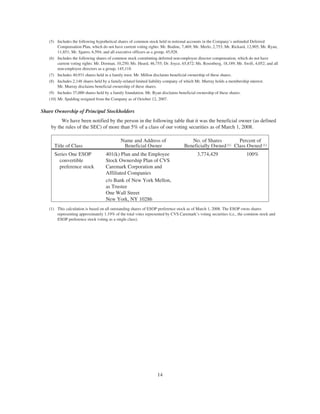
Share Ownership of Principal Stockholders
We have been notified by the person in the following table that it was the beneficial owner (as defined
by the rules of the SEC) of more than 5% of a class of our voting securities as of March 1, 2008.
Title of Class
Name and Address of
Beneficial Owner
No. of Shares
Beneficially Owned (1)
Percent of
Class Owned (1)
Series One ESOP
convertible
preference stock
401(k) Plan and the Employee
Stock Ownership Plan of CVS
Caremark Corporation and
Affiliated Companies
3,774,429 100%
c/o Bank of New York Mellon,
as Trustee
One Wall Street
New York, NY 10286
(1) This calculation is based on all outstanding shares of ESOP preference stock as of March 1, 2008. The ESOP owns shares
representing approximately 1.19% of the total votes represented by CVS Caremark’s voting securities (i.e., the common stock and
ESOP preference stock voting as a single class).
14
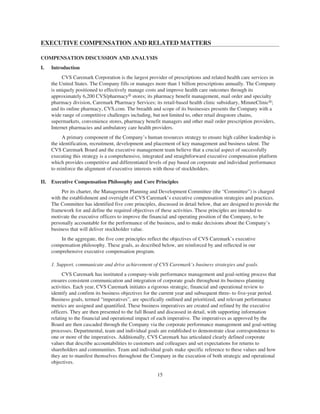
EXECUTIVE COMPENSATION AND RELATED MATTERS
COMPENSATION DISCUSSION AND ANALYSIS
I. Introduction
CVS Caremark Corporation is the largest provider of prescriptions and related health care services in
the United States. The Company fills or manages more than 1 billion prescriptions annually. The Company
is uniquely positioned to effectively manage costs and improve health care outcomes through its
approximately 6,200 CVS/pharmacy® stores; its pharmacy benefit management, mail order and specialty
pharmacy division, Caremark Pharmacy Services; its retail-based health clinic subsidiary, MinuteClinic®;
and its online pharmacy, CVS.com. The breadth and scope of its businesses presents the Company with a
wide range of competitive challenges including, but not limited to, other retail drugstore chains,
supermarkets, convenience stores, pharmacy benefit managers and other mail order prescription providers,
Internet pharmacies and ambulatory care health providers.
A primary component of the Company’s human resources strategy to ensure high caliber leadership is
the identification, recruitment, development and placement of key management and business talent. The
CVS Caremark Board and the executive management team believe that a crucial aspect of successfully
executing this strategy is a comprehensive, integrated and straightforward executive compensation platform
which provides competitive and differentiated levels of pay based on corporate and individual performance
to reinforce the alignment of executive interests with those of stockholders.
II. Executive Compensation Philosophy and Core Principles
Per its charter, the Management Planning and Development Committee (the “Committee”) is charged
with the establishment and oversight of CVS Caremark’s executive compensation strategies and practices.
The Committee has identified five core principles, discussed in detail below, that are designed to provide the
framework for and define the required objectives of these activities. These principles are intended to
motivate the executive officers to improve the financial and operating position of the Company, to be
personally accountable for the performance of the business, and to make decisions about the Company’s
business that will deliver stockholder value.
In the aggregate, the five core principles reflect the objectives of CVS Caremark’s executive
compensation philosophy. These goals, as described below, are reinforced by and reflected in our
comprehensive executive compensation program.
1. Support, communicate and drive achievement of CVS Caremark’s business strategies and goals.
CVS Caremark has instituted a company-wide performance management and goal-setting process that
ensures consistent communication and integration of corporate goals throughout its business planning
activities. Each year, CVS Caremark initiates a rigorous strategic, financial and operational review to
identify and confirm its business objectives for the current year and subsequent three- to five-year period.
Business goals, termed “imperatives”, are specifically outlined and prioritized, and relevant performance
metrics are assigned and quantified. These business imperatives are created and refined by the executive
officers. They are then presented to the full Board and discussed in detail, with supporting information
relating to the financial and operational impact of each imperative. The imperatives as approved by the
Board are then cascaded through the Company via the corporate performance management and goal-setting
processes. Departmental, team and individual goals are established to demonstrate clear correspondence to
one or more of the imperatives. Additionally, CVS Caremark has articulated clearly defined corporate
values that describe accountabilities to customers and colleagues and set expectations for returns to
shareholders and communities. Team and individual goals make specific reference to these values and how
they are to manifest themselves throughout the Company in the execution of both strategic and operational
objectives.
15
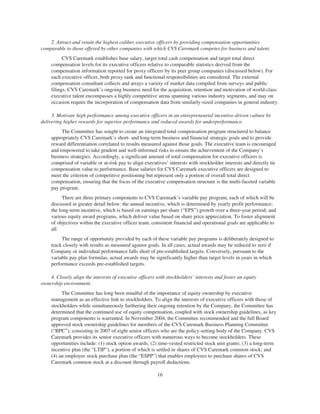
2. Attract and retain the highest caliber executive officers by providing compensation opportunities
comparable to those offered by other companies with which CVS Caremark competes for business and talent.
CVS Caremark establishes base salary, target total cash compensation and target total direct
compensation levels for its executive officers relative to comparable statistics derived from the
compensation information reported for proxy officers by its peer group companies (discussed below). For
each executive officer, both proxy rank and functional responsibilities are considered. The external
compensation consultant collects and arrays a variety of market data compiled from surveys and public
filings. CVS Caremark’s ongoing business need for the acquisition, retention and motivation of world-class
executive talent encompasses a highly competitive arena spanning various industry segments, and may on
occasion require the incorporation of compensation data from similarly-sized companies in general industry.
3. Motivate high performance among executive officers in an entrepreneurial incentive-driven culture by
delivering higher rewards for superior performance and reduced awards for underperformance.
The Committee has sought to create an integrated total compensation program structured to balance
appropriately CVS Caremark’s short- and long-term business and financial strategic goals and to provide
reward differentiation correlated to results measured against those goals. The executive team is encouraged
and empowered to take prudent and well-informed risks to ensure the achievement of the Company’s
business strategies. Accordingly, a significant amount of total compensation for executive officers is
comprised of variable or at-risk pay to align executives’ interests with stockholder interests and directly tie
compensation value to performance. Base salaries for CVS Caremark executive officers are designed to
meet the criterion of competitive positioning but represent only a portion of overall total direct
compensation, ensuring that the focus of the executive compensation structure is the multi-faceted variable
pay program.
There are three primary components to CVS Caremark’s variable pay program, each of which will be
discussed in greater detail below: the annual incentive, which is determined by yearly profit performance;
the long-term incentive, which is based on earnings per share (“EPS”) growth over a three-year period; and
various equity award programs, which deliver value based on share price appreciation. To foster alignment
of objectives within the executive officer team, consistent financial and operational goals are applicable to
all.
The range of opportunity provided by each of these variable pay programs is deliberately designed to
track closely with results as measured against goals. In all cases, actual awards may be reduced to zero if
Company or individual performance falls short of pre-established targets. Conversely, pursuant to the
variable pay plan formulas, actual awards may be significantly higher than target levels in years in which
performance exceeds pre-established targets.
4. Closely align the interests of executive officers with stockholders’ interests and foster an equity
ownership environment.
The Committee has long been mindful of the importance of equity ownership by executive
management as an effective link to stockholders. To align the interests of executive officers with those of
stockholders while simultaneously furthering their ongoing retention by the Company, the Committee has
determined that the continued use of equity compensation, coupled with stock ownership guidelines, as key
program components is warranted. In November 2004, the Committee recommended and the full Board
approved stock ownership guidelines for members of the CVS Caremark Business Planning Committee
(“BPC”), consisting in 2007 of eight senior officers who are the policy-setting body of the Company. CVS
Caremark provides its senior executive officers with numerous ways to become stockholders. These
opportunities include: (1) stock option awards; (2) time-vested restricted stock unit grants; (3) a long-term
incentive plan (the “LTIP”), a portion of which is settled in shares of CVS Caremark common stock; and
(4) an employee stock purchase plan (the “ESPP”) that enables employees to purchase shares of CVS
Caremark common stock at a discount through payroll deductions.
16
5. Reward results achieved short-term and, in the long-term, stockholder value creation.
In defining and designing the specific elements of CVS Caremark’s executive compensation program,
the Committee intends to structure a balance between achieving robust short-term, or annual, results and
ensuring the long-term success of the Company. To reinforce the importance of balancing these
perspectives, the executive officers are regularly provided both short- and long-term incentive award
opportunities. Opportunities in CVS Caremark’s long-term incentive programs increase at higher levels of
responsibility, as executive officers in these leadership roles have the greatest influence on the Company’s
strategic direction and results over time. Performance metrics for both short- and long-term incentive
compensation programs are defined financial indicators, such as operating profit or EPS, each of which are
objectively measured and publicly disclosed.
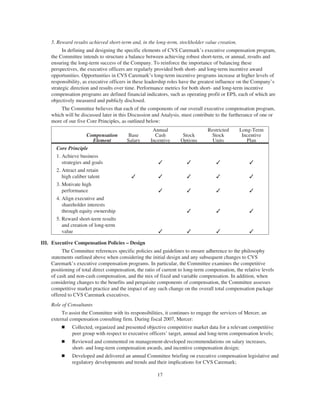
The Committee believes that each of the components of our overall executive compensation program,
which will be discussed later in this Discussion and Analysis, must contribute to the furtherance of one or
more of our five Core Principles, as outlined below:
Compensation
Element
Base
Salary
Annual
Cash
Incentive
Stock
Options
Restricted
Stock
Units
Long-Term
Incentive
Plan
Core Principle
1. Achieve business
strategies and goals ✓ ✓ ✓ ✓
2. Attract and retain
high caliber talent ✓ ✓ ✓ ✓ ✓
3. Motivate high
performance ✓ ✓ ✓ ✓
4. Align executive and
shareholder interests
through equity ownership ✓ ✓ ✓
5. Reward short-term results
and creation of long-term
value ✓ ✓ ✓ ✓
III. Executive Compensation Policies – Design
The Committee references specific policies and guidelines to ensure adherence to the philosophy
statements outlined above when considering the initial design and any subsequent changes to CVS
Caremark’s executive compensation programs. In particular, the Committee examines the competitive
positioning of total direct compensation, the ratio of current to long-term compensation, the relative levels
of cash and non-cash compensation, and the mix of fixed and variable compensation. In addition, when
considering changes to the benefits and perquisite components of compensation, the Committee assesses
competitive market practice and the impact of any such change on the overall total compensation package
offered to CVS Caremark executives.
Role of Consultants
To assist the Committee with its responsibilities, it continues to engage the services of Mercer, an
external compensation consulting firm. During fiscal 2007, Mercer:
Ⅲ Collected, organized and presented objective competitive market data for a relevant competitive
peer group with respect to executive officers’ target, annual and long-term compensation levels;
Ⅲ Reviewed and commented on management-developed recommendations on salary increases,
short- and long-term compensation awards, and incentive compensation design;
Ⅲ Developed and delivered an annual Committee briefing on executive compensation legislative and
regulatory developments and trends and their implications for CVS Caremark;
17
Ⅲ Collected market data and provided recommendations for approval by the Board for
non-employee director compensation; and
Ⅲ Conducted an in-depth analysis of CVS Caremark’s stock plan share utilization past practices and
future needs.
As provided in its charter, the Committee has the authority to determine the scope of the external
compensation consultant’s services and may terminate the engagement at any time. The external
compensation consultant reports to the Committee Chair.
The executive compensation services performed for the Committee are by far the most significant
component of the direct consulting relationship that CVS Caremark has with Mercer; fees for those services
accounted for over 92% of the total fees charged by Mercer to CVS Caremark in 2007. On occasion, CVS
Caremark’s human resources department uses Mercer for general human resources and compensation
consulting. In 2007, the Company engaged Mercer to collect and organize competitive market data for key
non-executive positions, such as pharmacists. In addition, CVS Caremark has contracted with IBM
Corporation to perform a variety of HR services. An affiliate of Mercer is a subcontractor of IBM delivering
defined benefit administration services to CVS Caremark and other IBM clients through a strategic alliance
between IBM and the Mercer affiliate. All billing, project management and contract negotiations for this
relationship are handled by IBM.
1. Total Direct Compensation and Performance Competitive Positioning
In consultation with Mercer, the Committee initiates an annual review of the peer group against which
financial performance and competitive positioning of compensation programs are assessed. The principal
criteria used to determine membership in the peer group include revenue size and industry segment, with
consideration also given to geographic scope, diversification of operations and comparability of
compensation practices. In 2007, the Committee reviewed the peer group for purposes of evaluating 2007
compensation levels, and made certain changes to reflect CVS Caremark’s increased size and dual
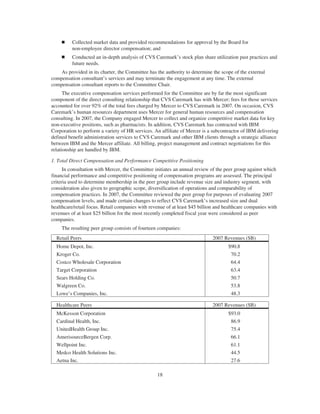
healthcare/retail focus. Retail companies with revenue of at least $45 billion and healthcare companies with
revenues of at least $25 billion for the most recently completed fiscal year were considered as peer
companies.
The resulting peer group consists of fourteen companies:
Retail Peers 2007 Revenues ($B)
Home Depot, Inc. $90.8
Kroger Co. 70.2
Costco Wholesale Corporation 64.4
Target Corporation 63.4
Sears Holding Co. 50.7
Walgreen Co. 53.8
Lowe’s Companies, Inc. 48.3
Healthcare Peers 2007 Revenues ($B)
McKesson Corporation $93.0
Cardinal Health, Inc. 86.9
UnitedHealth Group Inc. 75.4
AmerisourceBergen Corp. 66.1
Wellpoint Inc. 61.1
Medco Health Solutions Inc. 44.5
Aetna Inc. 27.6
18
Wal-Mart, Rite Aid and Express Scripts continue to be viewed as reference points, but their data are
excluded from the quantitative analyses of compensation levels because they fall outside of the size criteria.
The Company recommends, and the Committee and Board approve, financial performance targets that
are deemed to be aggressive in their reach, and as such, if achieved, can deliver superior value to
stockholders. In recent years, CVS Caremark’s performance, as measured by total shareholder return,
revenue and profit growth, and other financial indicators, has consistently ranked in the upper quartiles
when compared to the financial results of its peer group. Consistent with the setting of “stretch”
performance targets and the relative value of their achievement as measured by return to stockholders, CVS
Caremark positions its target total direct compensation, which comprises base salary plus annual and long-
term incentives, for its executive officers between the 50th and 75th percentiles of that of the organizations in
its peer group. The Committee believes that it is appropriate to reward the executive management team with
compensation above the competitive median if the financial targets associated with the variable pay
programs are delivered or exceeded. Conversely, if the financial targets are missed, rewards are reduced.
Based on the achievement of aggressive financial and operational performance targets, 2007 actual pay is
above target, which is consistent with our stated goal of rewarding the executive management team with
compensation above the competitive market median when performance warrants and shareholder value is
delivered.
2. Current versus Long-Term Compensation
The Committee believes that a well-balanced executive compensation program must simultaneously
motivate and reward participants to deliver annual financial results while maintaining focus on long-term
goals that track financial progress and value creation. These long-term goals include both profitability as
well as total shareholder value, typically measured through returns on the Company’s common stock. The
Committee also recognizes that while stock prices are generally a true indicator of corporate performance
over time, external factors that are beyond CVS Caremark’s influence may also have a substantive impact
on its stock price. Consequently, it believes that both dimensions must be present and independently
measured in the CVS Caremark executive compensation program.
Over the last several years, a three-pillar long-term incentive program, made up of stock options, time-
vested restricted stock units and the LTIP, which has settled historically in equal parts cash and stock, has
represented the majority of both the compensation opportunity as well as the actual rewards for the CVS
Caremark executive management team. The Committee believes that this approach, complemented by the
annual incentive plan, provides an optimal structure to achieve the financial objectives of stockholders while
concurrently extending to executive management competitive cash compensation and a substantial wealth
creation opportunity derived from value created through growth in the price of CVS Caremark common
stock.
3. Cash versus Non-Cash Compensation
The Committee recognizes the competitive need to ensure an appropriate amount of current cash, in the
form of base salary, annual incentive and the cash portion of the LTIP, for the executive officers, and has
structured the total direct compensation program accordingly. In years in which performance exceeds target,
the annual incentive, delivered entirely in cash, and the cash portion of the LTIP may increase substantially.
As part of its annual review of the competitiveness and efficacy of the CVS Caremark compensation
program, the Committee monitors the relative levels of cash and non-cash compensation to ensure that it
places maximum focus on the non-cash components while still paying cash compensation that is within the
market practice spectrum of its peer group.
19
4. Fixed versus Variable Compensation
As a general practice for middle-level through senior management positions at CVS Caremark, variable
compensation has an increasingly important role as the scope and span of business responsibilities increase.
Each manager is held accountable for objective financial and operational goals that are defined, established
and measured for his or her specific position. Target rewards for achievement of these goals are associated
with either the annual or long-term compensation programs, as appropriate. Actual awards will vary
substantially from year to year, and from manager to manager, based on actual performance against these
goals. For the executive management team, this emphasis on variable compensation is enforced through the
annual incentive program, the LTIP, and the service-based equity award program, which ties a significant
amount of additional variable compensation to the executive’s continued employment (subject to the vesting
and forfeiture provisions of the stockholder-approved incentive plan) and the performance of CVS
Caremark common stock over the vesting and option life periods. The performance metrics for the annual
incentive and LTIP and the range of opportunity relative to target are consistent for the entire group of
executive officers, including the CEO; however, in determining individual awards the Committee
considered the appropriate individual target incentive opportunity.
For fiscal year 2007, the percentage of target total direct compensation represented by at-risk pay
(short- and long-term incentives) for CVS Caremark’s executive officers specified in the Summary
Compensation Table on page 34 was as follows:
Target At-Risk Compensation as % of Total Direct Compensation
Executive
Target Fixed
Compensation
%
Target
Short-Term
Compensation
%
Target
Long-Term
Compensation
%
Thomas M. Ryan 10% 20% 70%
David B. Rickard 18% 23% 59%
Chris W. Bodine 15% 21% 64%
Howard A. McLure 15% 22% 63%
Larry J. Merlo 15% 21% 64%
Douglas A. Sgarro 16% 17% 67%
IV. Executive Compensation Policies – Responsibilities
The Committee views the executive compensation process at CVS Caremark as an ongoing and
iterative responsibility with several key milestone events. In the first quarter of the year following the
performance year, CVS Caremark’s finance department prepares and presents numerous schedules to the
Committee to provide a comprehensive overview of the Company’s performance relative to the annual and
long-term incentive plan periods just concluded. This presentation includes remarks by the CEO and CFO to
provide context and background to the financial results. It also contemplates an annual and multi-year
comparison of CVS Caremark’s performance versus that of the companies in its peer group. Key financial
metrics, including total shareholder return, growth in revenue and operating profit, and stock price
performance, are discussed, with a focus on the Company’s relative ranking within the peer group and
against other relevant performance indices.
Early in January of the year following the performance year, the CEO meets with the independent
directors of the Board to present a self-assessment of his performance against the strategic, operational and
financial goals of the Company that were approved by the Board at the beginning of the performance year.
The independent directors meet privately to discuss and assess the overall performance of the CEO during
the performance year. Each Committee member and all other independent directors participate in this
discussion, which is facilitated by the Lead Director and the Committee Chair.
20
The Committee members incorporate the assessments of the independent directors into their
consideration of the CEO’s total compensation, particularly in the potential application of negative
discretion to the determination of his annual incentive compensation award and equity compensation grants.
The Committee may also apply negative discretion, as it deems appropriate and as described below, in the
determination of the final annual incentive awards and equity compensation grants for the other executive
officers.
During the same time period, the CEO discusses with the Committee the performance and contribution
of each of the executive officers, with specific attention to progress toward specific strategic, operational
and financial goals assigned at the beginning of the year. His assessment includes a review of each officer’s
strengths and areas of opportunity, potential future assignments, development strategies, and role in the
Company’s management succession plan. The Committee and the Board also have the opportunity to meet
with each of the executive officers at various times during the year, which allows them to form their own
assessment of each individual’s performance.
V. Components of Executive Compensation Program
The architecture of CVS Caremark’s executive compensation program consists of individual elements
that fulfill the dual purpose of specifically addressing one or more core principles of the program while
simultaneously complementing other elements. The individual elements are: base salary; an annual
incentive opportunity, payable in cash; a three-pillar long-term incentive structure including stock options,
restricted stock units and the LTIP, payable in cash and restricted stock units; supplemental executive
retirement plans; and other benefits, including limited perquisites. Each of these elements and its treatment
during the 2007 performance year is described in detail below.
1. Base Salary
The Committee annually reviews the base salaries of designated senior executives, including the CEO,
and considers increases based on corporate profitability, competitive salaries, position responsibility levels
and individual qualifications and performance. A key component of this review is a comparison of current
salaries against those reported for comparable positions in CVS Caremark’s peer group. The Committee also
assesses internal salary levels within CVS Caremark, both with respect to the other executive officers and to
other senior employees generally. Base salaries may be adjusted at the Committee’s discretion, which it
generally chooses to exercise when competitive data indicate a significant market lag or in recognition of
outstanding individual performance or an increase in the executive’s functional responsibilities.
In 2007, salaries of executive officers were increased to maintain or improve competitive position
against target, as well as to provide merit increases. The Company is committed to a pay-for-performance
philosophy, and after careful deliberation and for specific reasons, the Committee approved the following
salaries for the current executives specified in the Summary Compensation Table. Mr. Ryan’s base salary
was adjusted to $1,400,000, which approximates the 75th percentile of salaries reported for other CEOs in
the CVS Caremark peer group for 2007. The Committee recognizes the long tenure of Mr. Ryan as an
executive officer of CVS Caremark and his sustained contribution to the Company’s success. Mr. Rickard’s
base salary was adjusted to $775,000 from $725,000. Mr. Sgarro’s salary was raised to $570,000 from
$525,000. The base salaries of Messrs. Rickard and Sgarro each approximate the 75th percentile in
recognition of responsibilities that increased in scope and complexity as a result of the merger of CVS and
Caremark. The annual salaries for Messrs. Bodine and Merlo each were increased to $700,000 from
$650,000 upon their promotions in January 2007, to President, Health Care Services and President, CVS/
pharmacy – Retail, respectively, approximating the median. Mr. McLure’s annual salary was raised to
$730,000 from $728,000, which is between the median and the 75th percentile. All of the salary increases for
the current executive officers were determined and approved by the Committee at its March meetings and
were effective in April 2007, except for Messrs. Bodine and Merlo, as noted above.
21
The salaries that CVS Caremark paid to Messrs. Ryan, Rickard, Bodine, McLure, Merlo, Sgarro and
Spalding during fiscal 2007 are shown in the Summary Compensation Table on page 34. For Messrs.
McLure and Spalding, the salary figures are reflective of the base salaries paid to them by the Company
since the closing of the merger on March 22, 2007 and, in the case of Mr. Spalding, until his resignation on
October 12, 2007.
2. Annual Incentive Awards
CVS Caremark maintains an annual management incentive plan, currently administered under the
Company’s 1997 Incentive Compensation Plan (the “1997 ICP”), which rewards corporate employees based
on performance relative to predetermined financial and operational objectives established for the year. The
annual management incentive plan reflects the Company’s pay-for-performance philosophy in which a
significant portion of executive compensation is at-risk and linked to both individual and Company
performance. Executive officers participate in this annual incentive plan; their awards are based on CVS
Caremark’s actual performance against an operating profit target established at the beginning of the year.
The establishment of the financial target, the measurement of performance against the target, and the
subsequent determination of awards to participants are implemented in a manner consistent with the
requirements of Section 162(m) of the Internal Revenue Code (“IRC Section 162(m)”) to ensure
deductibility of all compensation awarded under the annual incentive plan to executive officers.
The Committee commenced the annual incentive award cycle in March 2007 with its consideration and
approval of the operating profit target against which the performance of the executive officers would be
measured. In its assessment of the 2007 target, the Committee reviewed CVS Caremark’s past performance
against the prior year annual operating profit target, the Company’s strategic and operational goals for 2007,
current and projected external business conditions, and the progress represented by the 2007 annual goal
against CVS Caremark’s long-term financial objectives. At its March 2007 meeting, the Committee paid
particular attention to the challenge posed by completing the successful integration of the pending merger
with Caremark Rx, Inc. while still maintaining superior financial and operational results from legacy CVS
stores and other businesses.
For fiscal 2007, the financial performance target for annual incentives was $4,371.1 million in
operating profit, defined as earnings before interest and taxes and inclusive of the impact of the merger of
CVS and Caremark. This target, which reflected the anticipated positive results from the merger,
represented an increase of $1,929.5 million or 79% over the prior year. The Committee continues to believe
that operating profit is the most appropriate performance metric for the annual incentive plan as it measures
management’s success in delivering short-term shareholder value while maintaining momentum toward the
achievement of longer-term financial progress. In keeping with prior years’ practices, the Committee
reviewed and affirmed specific events the financial impact of which would be excluded from the calculation
of actual performance at year-end. These events include but are not limited to significant mergers,
divestitures or acquisitions, required changes in accounting principles or policies, litigation reserves or
settlements, and events that are unusual in nature or infrequent in occurrence.
The Committee also established a target annual incentive opportunity for each executive officer. This
opportunity is expressed as a percentage of base salary and is determined using a variety of relevant factors
including but not limited to the competitive landscape established by CVS Caremark’s designated peer
group, the Committee’s assessment of the aggressiveness of the level of growth reflected in the 2007
operating profit target, and the desired ratios of cash to non-cash and fixed to variable compensation for the
executive officer. While the Committee considered the appropriate target incentive opportunity separately
for each officer, the performance targets, plan design and range of opportunity relative to target are
consistent for the entire group of executive officers, including the CEO. Any award earned under the annual
incentive plan is payable fully in cash by March 15 of the year following the performance year, unless the
executive had previously made a voluntary deferral election under the CVS Deferred Compensation Plan or
the Caremark Rx, Inc. Deferred Compensation Plan.
22
For all officers, the target annual incentive percentage represents the percentage of base salary that may
be paid if CVS Caremark’s actual performance equals the operating profit target established at the
beginning of the year. The Committee uses a formula to establish a payout level based on actual
performance relative to the operating profit target. The formula determines the percentage of the target
incentive to be paid, based on actual profit results, with a minimum, below which no payment will be made,
and an established upper limitation. For 2007, if performance exceeds the operating profit target by 6% or
greater, the level of payout increases to a maximum of 200% of the designated target percentage of salary. If
performance misses target, the actual award decreases substantially. If actual performance falls to the
threshold level of 80% of target, the award decreases to 10% of the target opportunity. If actual performance
is less than the 80% threshold, the payout level reduces to zero.
The annual incentive opportunity, determined based on an executive’s position and peer group data,
established for fiscal 2007 for performance at target, expressed as a percentage of base salary, for each
executive officer was:
2007 Principal Position(s) (Name)
Annual Incentive
Opportunity At Target
Performance Levels
Chairman, President and CEO (Ryan) 200%
EVP, CFO and CAO (Rickard) 125%
EVP and President – CVS Caremark Health Care Services (Bodine) 140%
EVP and President – Caremark Pharmacy Services (McLure) 140%
EVP and President – CVS/pharmacy - Retail (Merlo) 140%
EVP, CLO and President – CVS Realty Co. (Sgarro) 110%
Once the Committee establishes the level of payout determined by actual performance at year-end, it
may then apply negative discretion to adjust the actual award. Its consideration may include its assessment
of the executive officer’s actual performance and contribution to the achievement of strategic, operational
and financial goals, competitive considerations, and any other factor it deems appropriate. In no event will
the actual award exceed the designated salary percentage indicated by level of performance.
After the end of fiscal 2007, the Committee reviewed CVS Caremark’s actual performance against the
operating profit performance goal set at the beginning of the year. Pursuant to the previously established
definitions of financial events that would be excluded from the calculation of results, the fiscal 2007
operating profit performance was $4,718.6 million, which exceeded the target by $347.5 million, or $0.15
per share.
Based on these results, the Committee applied minimal negative discretion in approving the annual
cash incentive awards for Messrs. Ryan, Rickard, Bodine, McLure, Merlo and Sgarro for performance for
the 2007 fiscal year. Additionally, Mr. Ryan’s annual incentive award was limited to $5 million by the terms
of our 1997 ICP. The annual cash incentive amounts are included in the Non-Equity Incentive Plan
Compensation column of the Summary Compensation Table on page 34. Additional information about the
annual incentive awards and opportunities is shown in the Grants of Plan-Based Awards Table on page 37.
The Committee believes that these cash incentive awards are consistent with the Company’s strategy of
rewarding its executive officers for the achievement of important, challenging business goals and excellent
financial and operational results for the year.
3. Long-Term Incentive Compensation
The Committee believes strongly in the use of long-term incentive compensation for executives to
reinforce four strategic objectives:
Ⅲ to focus on the importance of returns to stockholders;
Ⅲ to promote the achievement of long-term performance goals;
23
Ⅲ to encourage executive retention; and
Ⅲ to promote meaningful levels of Company stock ownership by executives.
The Committee has developed a multi-faceted integrated long-term incentive approach to achieve these
strategic objectives. The key elements of this approach are an annual stock option grant, which serves to
align the interests of executives with those of CVS Caremark’s stockholders; an annual restricted stock unit
award, which vests contingent upon significant continued employment with the Company; and the LTIP,
which rewards multi-year financial success and is paid equally in cash and Company common stock. The
Committee believes that this three-pillar structure properly balances both the incentive required to drive
achievement of the four strategic objectives noted above as well as the amount and timing of the rewards
delivered for successful achievement of those objectives. All three of these long-term incentive
compensation elements are delivered under the provisions of the stockholder-approved 1997 ICP.
To determine the overall opportunity and appropriate proportions of the components, the Committee
considered a variety of factors, including competitive market positioning against comparable executives in
CVS Caremark’s peer group, potential economic value realized, timing of vesting, and taxation. All of these
factors were considered within the context of the challenges presented by the strategic, financial and
operating goals established for CVS Caremark by the full Board for both 2007 and the longer-term. In the
first quarter of 2007, the Committee reviewed survey data compiled and analyzed by the external
compensation consultant on total compensation packages and the value of long-term incentive awards at
organizations within the Company’s peer group. The Committee also considered, except in the case of the
award to the CEO, the recommendations of the CEO for each of the executive officers. In conjunction with
the external market review, the Committee considered the potential effectiveness of the retentive value of
the outstanding equity and other arrangements currently in place for the executive team to determine
whether additional awards to secure continued employment with the Company were warranted.
The Committee considered the impact of the equity component of the long-term compensation
programs on shares outstanding and the calculation of the Company’s “burn rate”, or share utilization for
compensation purposes. Each of the three components of the CVS Caremark long-term executive
compensation structure has a separate and distinct impact on the Company’s outstanding shares. The
Committee considered these impacts, both individually and in the aggregate, in its determination of the
appropriate relative levels of each component within the overall award opportunity. Restricted stock units
dilute the outstanding shares when they vest regardless of the market price of the Company’s common
stock. Since stock options become dilutive only if they are “in the money,” and their accounting cost is
lower than that of the restricted stock units, each option is considered by the Committee to have potentially
less of an impact on earnings per share. To determine the overall impact of the awards and anticipate share
utilization, after consultation with its external compensation consultant, consistent with the practices of at
least one institutional shareholder advisory service, and considering the Company’s accounting cost for
options, the Committee assumed that one restricted stock unit equals four stock options.
The Committee established the vesting periods for restricted stock unit and stock option grants with the
objective of maximizing executive retention and providing a competitively designed equity program. It also
reaffirmed the three-year performance cycle of the LTIP as the appropriate interval to establish and measure
achievement of a long-term financial goal as it is consistent with the Company’s strategic long-term
planning cycle. The Committee was also mindful of the need to stagger these vesting and performance cycle
dates to ensure the release of various rewards over a period of successive years.
In February 2007, the Committee concluded its comprehensive assessment of the competitive
landscape, the impact on shares outstanding and the timing and potential economic impact offered by the
future vesting of restricted stock unit grants and the vesting and exercise of stock option grants. Several
guiding principles emerged from this assessment:
(1) each of the three components (stock option grant, restricted stock unit grant, and the LTIP) will
have a material role in the delivery of long-term compensation;
24
(2) the combination of the target opportunity for the three components will represent the majority of the
target total direct compensation opportunity for each executive officer and generally will be at least
60% of the total direct compensation opportunity;
(3) each of the three components will be earned independently, i.e., successful achievement of the
three-year financial goal established for the LTIP will not trigger or accelerate vesting of the restricted
stock unit or stock option grants; conversely, any awards payable under the LTIP will be based solely
on results as measured against the relevant performance metric and not affected by any value realized
by the restricted stock unit or stock option grants;
(4) for the CEO, each component of the target long-term opportunity will have approximately equal
weight;
(5) the combination of restricted stock units awarded through the annual grant plus the shares delivered
through the LTIP will equal approximately one-third (one-half for the CEO) of the total long-term
opportunity; and
(6) 50% of the LTIP will continue to be paid in cash due to the executives’ needs for current cash to
meet tax obligations occasioned on the settlement of restricted stock unit awards, but the target cash
component of the long-term incentive compensation component will not exceed 25% of the total target
long-term compensation.
To determine the target proportions of each long-term compensation component for 2007, the
Committee applied the principles described above, incorporated its assessment of competitive positioning
and dilutive impact on shares outstanding and determined the following allocations:
% of Overall Target Long-Term
Opportunity (“LTO”)
Executive
Total
LTIP
Stock Option
Grant
Stock
Grant
Thomas M. Ryan 36% 32% 32%
David B. Rickard 40% 45% 15%
Chris W. Bodine 41% 44% 15%
Howard A. McLure 41% 44% 15%
Larry J. Merlo 41% 44% 15%
Douglas A. Sgarro 38% 47% 15%
The annual cycle for setting goals, establishing award opportunities, assessing performance and
determining final awards for the long-term incentive compensation plans parallels that of the annual
incentive plan. As described above, the Committee sets a range of long-term award opportunity for each of
the executive officers for each of the three components of long-term compensation: the LTIP, stock options,
and restricted stock units. A more detailed overview of each of the three components is presented below.
The Committee conducted a final review of the total equity-denominated awards that are included in
the target compensation opportunities for the executive officers in the context of the Company’s overall
equity compensation program. It reviewed estimates of stock option and restricted stock unit awards to be
made to CVS Caremark officers and other employees during the balance of fiscal 2007 against the
Company’s desired burn rate of less than 1.5% and the reserve of shares established under the 1997 ICP.
The Committee determined that it could make the proposed awards to the executive officers and the
projected additional awards to other employees and still remain within the Company’s targeted burn rate.
25
Following is an overview and the 2007 results for each of the components of CVS Caremark’s long-
term incentive compensation.
A. The Long-Term Incentive Plan
The LTIP is intended to encourage executives to focus on long-term financial progress with the
ultimate objective of enhancing shareholder value, while simultaneously promoting executive retention by
requiring an executive to forfeit his or her award if employment terminates under certain circumstances
before the end of the performance period. The LTIP, introduced in 2002, consists of overlapping three-year
performance cycles, with a new cycle commencing each year. The performance metric used in the LTIP is
the compound annual growth rate of earnings per share (“EPS CAGR”). The executives participating in the
LTIP are directly accountable to the shareholders for influencing earnings per share. A target EPS is also
used as a goal in the Company’s long-term strategic plan.
For all cycles, the Committee determines an award opportunity for each participant at the beginning of
the cycle. The award opportunity is denominated in dollars, and represents the award that will be earned if
actual results over the three-year performance period equal the financial goal established by the Committee
at the commencement of the period. The actual award will vary based on performance: if results exceed the
goal by 25% or more, the award will increase up to a maximum of 200% of the target award opportunity; if
results fall short of the goal by 20% or more, the award is reduced to zero. Payout levels between the
minimum and maximum are interpolated. The correlation between actual award and level of performance
relative to the goal is formulaically prescribed at the beginning of the cycle; neither the Committee nor any
member of management may exercise any discretion to modify the award once results are determined.
LTIP awards are delivered 50% in cash and 50% in shares of CVS Caremark common stock. Although
the stock is non-forfeitable when earned, effective with the cycle ending in 2007 the executive is prohibited
from selling or trading the shares for two years following the grant date, which encourages stock ownership
and further reinforces an alignment of executives’ interests with that of stockholders. All LTIP awards,
whether cash or stock, must be paid by March 15 of the year following the last year of the performance
cycle unless the executive has previously made a deferral election under the CVS Deferred Compensation
Plan or the CVS Deferred Stock Plan.
The process by which the Committee establishes the LTIP financial goal is similar to and concurrent
with that used to determine the annual incentive target. Any permitted exclusions from actual results for
purposes of calculating long-term incentive awards generally mirror those established for the annual
incentive plan but will also include any specific adjustments pertinent to EPS, as necessary. Once
established, the LTIP goal remains constant throughout the three-year performance cycle and is not subject
to adjustment or modification. Should an event that qualifies as a permitted exclusion occur, results are
adjusted to reflect the impact of that event and documented accordingly upon the conclusion of the cycle.
The performance goal for the cycle ending December 31, 2007 was an EPS CAGR of 16.0%. After the
application of the permitted exclusions to the calculation of performance results (the same as those
described above for the annual incentive plan), the actual result for the period was an EPS CAGR of 18.2%.
Based on this level of performance, award payouts were 56% above target. All of the executive officers
specified in the Summary Compensation Table except for Messrs. McLure and Spalding participated for the
full duration of the cycle. The cash portion of the LTIP award for the cycle ending December 31, 2007 for
each executive officer is reported in the Non-Equity Incentive Plan Compensation column of the Summary
Compensation Table on page 34. The corresponding stock portion of the LTIP award for the cycle ending
December 31, 2007 for each executive officer is reported in the Stock Awards column of the Summary
Compensation Table.
During or prior to 2007, the Committee has established LTIP cycles with EPS CAGR goals for the
three-year periods ending December 31, 2008 and December 31, 2009. The Committee and management
believe that disclosure of an EPS growth target over a three-year prospective period would result in
competitive harm to the Company, and, accordingly, have not disclosed the specific targets for these cycles.
26
The Committee believes that the specific performance targets for these cycles is at least as challenging as
the performance targets established for prior LTIP cycles and that the award opportunities established for
these cycles have been calibrated accordingly. EPS CAGR targets for all cycles are in excess of 10%, and in
the judgment of the Committee and management, will represent significant value creation for shareholders if
achieved.
B. Stock Option and Restricted Stock Unit Grants
In 2007, the Committee continued its general policy of making annual stock option grants to executives
and other key employees. For CVS Caremark executive officers and other members of management, stock
options comprise a major component of the Company’s long-term incentive program. As in prior years, the
Committee awarded stock options to full-time pharmacists and store managers, a critical employee
population for CVS Caremark, with the objective of fostering retention with the Company while offering a
long-term compensation opportunity that would differentiate CVS Caremark as an employer of choice.
In 2007, CVS Caremark granted stock options to three groups: the annual executive grant on April 2,
2007, which awarded 11,482,618 options to 2,126 selected executives and other key employees, including
the executive officers; the annual key store employee grant on August 15, 2007, which awarded 1,345,331
options, representing slightly more than 10% of all options granted in 2007, to 10,872 full-time pharmacists
and store managers with at least three years of service with the Company; and new hire grants, comprising
117,590 options awarded over the course of 2007 to 16 key new colleagues. As part of the annual executive
grant on April 2, 2007, 61 of the executives and key employees received 247,588 restricted stock units.
All CVS Caremark stock options are nonqualified stock options granted and administered under the
provisions of the 1997 ICP and the 2004 Caremark Rx, Inc. Stock Incentive Plan. Since 2004, the
contractual term of all CVS Caremark options has been fixed at seven years. Authority to grant stock
options and any other form of equity compensation to CVS Caremark executives and employees is limited
to the Committee or a designated individual member of the Committee; no member of management or any
other Company employee may authorize any equity compensation or amend the terms and conditions of any
previous equity grants. The Committee has consistently approved annual equity grants, including stock
options, in the first quarter of each year and has made such awards without regard to the timing of the
release of the Company’s financial results for the year or the timing of the release of any other material
non-public information.
In March 2007, the Board adopted a Stock Option Policy providing that any stock option granted to a
recipient will have an exercise price equal to the closing price of the Company’s underlying stock on the
date that the option is granted (the “grant date”), with a grant date in a given fiscal year to be established
generally based on the Company’s customary and normal grant cycle. When a grant to an existing employee
is outside the annual grant cycle, the grant date will not be coordinated with the release of material
non-public information that has been or will be disclosed within thirty days on either side of any such grant
date. When an executive is hired after a fiscal year has begun, the grant date will be the later of the hire date
and the date the Committee approves the award.
Total long-term compensation opportunity for each executive officer, including the equity components,
is considered and determined early in the year as part of the overall process of establishing performance
goals and the correlating compensation framework to support the achievement of those goals. This long-
term compensation opportunity is expressed as a target value with a minimum and maximum range,
denominated in dollars, for each of the three components of long-term pay. At its January meeting, the
Committee reviews current competitive market information supplied by the external compensation
consultant and considers peer company performance results to date. In February of each year, CVS
Caremark releases its prior year earnings and financial statements; at that time, the Committee assesses the
Company’s performance against short- and long-term goals. The CEO presents to the Committee his
recommendations for stock option and restricted stock unit awards for the other executive officers, outlining
his assessment of each officer’s performance, contribution and anticipated future role within the Company.
27
In addition, the Committee members consult with other independent directors to determine the appropriate
award for the CEO within the competitive range established earlier.
In accordance with the sequence described above, at its meeting on February 12, 2007, the Committee
took a number of actions:
Ⅲ It approved the value of annual equity awards for each of the executive officers, except for
Mr. McLure, as well as the CEO. Awards were at or slightly above target levels, reflecting
achievement of the Company’s short-term strategic goals and significant progress toward long-
term objectives, particularly the completion of the Eckerd integration while sustaining core
business results at or above plan. Concurrent with the approval of awards for executive officers,
the Committee approved the total value of options and restricted stock units to be granted to all
participants in the annual executive grant, as well as the target, minimum and maximum
opportunities and participation rate guidelines for each eligible group of employees.
Ⅲ The grant date for annual stock option and restricted stock unit awards was set as the first business
day of the Company’s second quarter, which was April 2, 2007. The exercise price for stock
option grants was established as the closing price of CVS Caremark common stock on the grant
date.
Ⅲ The Committee approved the proportion of option value to restricted stock unit value within each
equity award. For the executive officers other than the CEO and for CVS Caremark vice
presidents and senior vice presidents, that ratio was set at 75% option value and 25% restricted
stock unit value. For the CEO, the proportion was equally divided between stock option value and
restricted stock unit value. For all other CVS Caremark employees who received annual equity
awards, the entire value of the award was delivered in stock options.
Mr. McLure’s stock option award was recommended by the CEO and approved by the Committee in
March 2007, after the consummation of the merger. Consistent with standing Caremark practice, the value
of his 2007 award was delivered fully in stock options. It is the intent of management and the Committee
that his future annual equity awards will be comprised of both options and restricted stock units in the same
proportion as other executive officers.
In July 2007, the grant date and terms and conditions for the pharmacist and store manager stock option
grant were finalized. Eligibility in the program was tenure-based with an altered vesting schedule (detailed
below) to promote retention. Terms and conditions mirrored those of the executive stock option grant.
The Committee established the vesting schedule for the 2007 equity awards as follows:
Ⅲ Options granted to executives on April 2, 2007 will vest in three equal installments on each of the
first, second and third anniversaries of the grant.
Ⅲ Options granted to store managers and pharmacists on August 15, 2007 will vest on the third
anniversary of the grant date.
Ⅲ Restrictions on 50% of the restricted stock units granted to BPC members will lapse on the third
anniversary of the grant. Restrictions on the remaining 50% of the units will lapse on the fifth
anniversary of the grant or the executive’s 55th birthday, whichever is later.
Ⅲ Restrictions on restricted stock units granted to other CVS Caremark employees will lapse on the
fourth anniversary of the grant date. No restricted stock units were granted to pharmacists or store
managers.
Ⅲ Vesting on options and restricted stock units will be accelerated upon certain termination events.
The number of options awarded on April 2, 2007, as part of the executive grant was determined by
dividing the dollar value of options approved by the Committee at its February meeting by $9.92, which was
the value of each option as of April 2, 2007 calculated under the Black-Scholes pricing model. A similar
28
process was followed for the pharmacist and store manager grant in August 2007. The number of restricted
stock units awarded as part of the executive grant was determined by dividing the dollar value of restricted
stock units approved by the Committee at its February meeting by $34.42, which was the closing price of
CVS Caremark common stock on April 2, 2007.
The fair market value of the restricted stock units granted on March 22, 2007 to Mr. McLure in
connection with his retention agreement (described in Section VIII – Agreements with Executive Officers,
below) was $34.31 per unit. The retention award fully vests on the third anniversary of the date of grant.
The 2007 expense associated with the stock options and restricted stock units granted to Messrs. Ryan,
Rickard, Bodine, McLure, Merlo, Sgarro and Spalding during fiscal 2007 and prior years is shown in the
Summary Compensation Table on page 34. Additional information about the 2007 awards, including stock
option exercise price, the number of shares subject to each award and the grant date fair value, is shown in
the Grants of Plan-Based Awards Table on page 37.
4. Supplemental Executive Retirement Plan
CVS Caremark has established and maintains an unfunded Supplemental Executive Retirement Plan
for Select Senior Management of the Company (the “SERP”). The SERP is designed to supplement the
retirement benefits of selected executive employees. Caremark established and CVS Caremark has
maintained an unfunded Special Executive Retirement Plan (the “SRP”) for selected executives, among
them Messrs. McLure and Spalding. An overview of the SERP and SRP design and the actuarial present
value of the accumulated pension benefits of Messrs. Ryan, Rickard, Bodine, McLure, Merlo, Sgarro and
Spalding as of the end of fiscal 2007 are shown in the Pension Benefits Table on page 42.
5. Other Benefits
The Company maintains medical and dental insurance, life insurance and short- and long-term
disability insurance programs for all of its employees, as well as customary vacation, leave of absence, and
other similar policies. Executive officers are eligible to participate in these programs on the same basis and
with the same level of financial subsidy by CVS Caremark as the rest of the Company’s salaried employees.
Similarly, executive officers except for Mr. McLure may participate in the CVS Future Fund, which is
the Company’s qualified defined contribution or 401(k) plan. An eligible CVS Caremark employee may
defer up to 85% of his or her total eligible compensation, defined as salary plus annual incentive, to a
maximum defined by the Internal Revenue Service; in 2007, that maximum was $15,500. After the first full
year of employment, CVS Caremark will match the employee’s deferral dollar-for-dollar up to a maximum
equaling 5% of total eligible compensation. CVS Caremark matching cash and ESOP preference stock
contributions for executive officers specified in the table who deferred eligible compensation into the Future
Fund are a component of the All Other Compensation Table on page 36. Mr. McLure is eligible to
participate in Care$ave, the Caremark qualified defined contribution or 401(k) plan, which matches
employee deferrals dollar-for-dollar up to 3%, and 50% of the next 2% of deferrals equaling 4% of total
eligible compensation. Company contributions for Mr. McLure are also reported in the All Other
Compensation Table.
CVS Caremark offers other benefits which are available to eligible employees, including executive
officers, as follows:
A. CVS Deferred Compensation Plan, Caremark Rx, Inc. Deferred Compensation Plan and CVS Deferred
Stock Plan
Executive officers and selected other senior employees may choose to defer compensation once earned
and vested into the CVS Deferred Compensation Plan or the Caremark Rx, Inc. Deferred Compensation
Plan (depending on eligibility) and the CVS Deferred Stock Plan, which are available to all non-store U.S.
employees who meet the Internal Revenue Code definition of a “highly compensated employee.” Both
29
deferred compensation plans offer a variety of investment crediting choices. Each year, the amount of a
participant’s deferred compensation account increases or decreases based on the appreciation and/or
depreciation in the value of the investment crediting alternatives selected by the participant. Under the CVS
Deferred Stock Plan, deferred shares fluctuate in value based on the performance of CVS Caremark stock,
further enhancing the Company’s focus on stock ownership. The individual contributions of Messrs. Ryan,
Rickard, Bodine, McLure, Merlo and Sgarro during fiscal 2007 to the CVS Deferred Compensation Plan,
the Caremark Rx, Inc. Deferred Compensation Plan and the CVS Deferred Stock Plan, including earnings
on those contributions, any distributions during 2007 and total account balances as of the end of the fiscal
year, are shown in the Nonqualified Deferred Compensation Table on page 44.
B. Perquisites and Other Personal Benefits
Except for the few items discussed in this section, CVS Caremark generally does not provide
perquisites or other personal benefits for its executive officers. The Committee believes that this policy is
consistent with the Company’s philosophy to maximize the amount of “at-risk” pay of its executive officers.
CVS Caremark also does not provide any additional cash compensation to any of the executive officers to
reimburse them for any income tax liability (with the exception of certain circumstances following a change
in control) that may arise and become due and payable as a result of their receipt of any cash or equity
compensation, benefit or perquisite.
CVS Caremark provides an allowance to each of the executive officers to cover the cost of a Company-
provided financial planner to assist with personal financial planning and estate planning. These amounts are
reported in detail in the All Other Compensation Table on page 36; for 2007, they ranged from $5,000 to $13,736.
The Company maintains corporate aircraft that may be used by Company employees to conduct
Company business. Pursuant to an executive security program established by the Board upon the
Committee’s recommendation, the Committee requires the CEO to use the Company’s aircraft for all travel
needs, including personal travel, in order to minimize and more efficiently utilize his travel time, protect the
confidentiality of his travel and the Company’s business, and enhance his personal security. Certain other
executive officers specified in the tables were also permitted to use the Company’s corporate aircraft for
personal travel on a very limited basis during fiscal 2007. The value of the personal use of Company aircraft
by the CEO and any other executive officer is treated as income taxable to the executive. The Company
provides no reimbursement for this cost nor does it pay the tax or any other expense associated with this
cost on behalf of the executive.
CVS Caremark also requires that the CEO use a Company-provided car and driver for business-related
travel and very limited personal travel. In addition, CVS Caremark provides an allowance to the executive
officers to cover the costs of the installation and maintenance of security monitoring systems in their homes.
While the Committee believes the security costs described in the preceding two paragraphs are business
expenses, disclosure of these costs as personal benefits is required. The value of these items is treated as
income taxable to the executives. In addition, Caremark provided a flexible spending allowance to
Mr. McLure, which is described under the Nonqualified Deferred Compensation section on page 44, and
other benefits comparable to those provided to the executives specified in the tables. The Company provides
no reimbursement for these costs nor does it pay the taxes or any other expenses associated with these costs
on behalf of the executives.
The aggregate incremental cost to the Company of providing these personal benefits to Messrs. Ryan,
Rickard, Bodine, McLure, Merlo and Sgarro during fiscal 2007 is shown in the Summary Compensation
Table on page 34.
VI. CEO Compensation
The Company’s 2007 performance ranks in the top third of our peer group for revenue growth,
operating income growth, diluted EPS growth, and total shareholder return. The Company also
outperformed key annual financial targets established by the Board. Our results for total shareholder return
30
for one- , three- and five-year periods exceeded both the S&P 500 and the Dow Jones Industrial Indices. In
addition to superior financial results, during 2007 we closed the transformative merger of equals with
Caremark, creating the nation’s premier integrated pharmacy services provider, and completed the
integration and re-launch of the former Osco and Sav-On stores that the Company acquired in 2006. Based
on these results, the Committee made the following compensation decisions for the CEO:
Type Target Actual
Base Salary $ 1,400,000 $ 1,400,000
Annual Cash Incentive $ 2,800,000 $ 5,000,000
LTIP Cycle III (2005 – 2007) $ 3,600,000 $ 5,616,000
Stock Option Grant $ 3,250,000 $ 4,000,002
Restricted Stock Unit Grant $ 3,250,000 $ 4,000,017
Total Direct Compensation $14,300,000 $20,016,019
VII. Other Compensation Programs and Policies
1. Employee Stock Purchase Plan
CVS Caremark encourages all employees, including executive officers, to participate in stock
ownership through the Company’s Employee Stock Purchase Plan (the “ESPP”), which has been designed
to comply with Section 423 of the Internal Revenue Code. The ESPP, in accordance with Internal Revenue
Service guidelines, gives employees the opportunity to purchase shares of the Company’s common stock
with up to 15% of their base salary, subject to IRS limits. The Committee and CVS Caremark management
believe that the ESPP encourages employees (including executive officers) to increase their ownership in
the Company and further aligns their economic interests with those of the Company’s stockholders.
Approximately 16,280 employees throughout CVS Caremark participate in the ESPP; almost half of that
number are pharmacists. The purchase price at which the Company’s common stock may be acquired under
the ESPP is equal to eighty-five percent (85%) of the lesser of (a) the fair market value of the shares on the
first day of a six-month offering period or (b) the fair market value of the shares on the last day of the
six-month offering period. Participants are required to hold their purchased shares for a minimum of two
years following the commencement of the offering period. The ESPP is designed to appeal primarily to
non-executive employees and is not intended to be a meaningful element in executive compensation.
Nonetheless, certain executive officers do participate in the ESPP and it does support the Company’s
philosophy of furthering an executive officer’s ownership stake in the Company.
2. Stock Ownership Guidelines
The Committee has long been mindful of the importance of equity ownership by directors and
executive management as an effective link to stockholders and, as such, the Board instituted stock
ownership guidelines for all directors and members of the Company’s BPC and requires that directors and
BPC members achieve compliance with the ownership requirements within five years of becoming a
director or BPC member. BPC members must maintain ownership levels equaling or exceeding three times
their base salary, except for the CEO, who must maintain ownership levels at least five times his base
salary. Shares included in the calculation to assess compliance with the guidelines include shares owned
outright, unvested restricted stock and stock units, shares held in the Deferred Stock Plan, shares of ESOP
preference stock, and shares purchased through the ESPP. Unexercised stock options do not count toward
satisfying the guidelines. The Committee believes that these requirements strongly emphasize its philosophy
of equity ownership for the Board and executive management, which in turn reinforces alignment with
stockholder interests. The CEO, each of the executive officers specified in the tables, and each of the
directors is in compliance with the stock ownership guidelines or is within the five-year period of having
31
been elected. The Share Ownership Table on page 13 shows the current stock ownership levels of each
director and each executive officer specified in the Summary Compensation Table.
VIII. Agreements with Executive Officers
CVS Caremark has entered into employment agreements (the “Agreements”) with Messrs. Ryan,
Rickard, Bodine, Merlo and Sgarro, which have been previously disclosed. Among other provisions, these
Agreements specify payments to be made to the executives in the event of termination under various
conditions. Details of payments made to the executives upon various termination scenarios may be found in
Payments/(Forfeitures) Under Termination Scenarios, beginning on page 45.
In connection with the merger of CVS and Caremark, the Company also entered into a retention
agreement with Mr. McLure. In exchange for Mr. McLure’s agreement to the cancellation of his prior
Caremark employment agreement and his agreement to restrictive covenants in favor of the Company, the
retention agreement establishes the basis of his continued employment and provides him with certain cash
and equity-based retention incentives, which are set forth in the compensation tables below.
Our executive officers generally have long tenure with the Company and have provided the vision and
leadership that have built CVS Caremark into the successful enterprise that it is today. The Committee
believes that the interests of stockholders will be best served if the interests of our senior management are
aligned with our stockholders. Providing change-in-control benefits should eliminate, or at least reduce, the
reluctance of senior management to pursue potential change-in-control transactions that may be in
stockholders’ best interests. The security of competitive change-in-control arrangements serves to eliminate
distraction caused by uncertainty about personal financial circumstances during a period in which the
Company requires focused and thoughtful leadership to ensure a successful outcome. Accordingly, CVS
Caremark’s employment agreements provide certain specified “double trigger” severance benefits to the
covered executives in the event of their termination under certain circumstances following a change in
control. The Committee believes a “double trigger”, rather than a “single trigger”, severance benefit
provision is more appropriate as it provides for continuity in management following a change in control.
Information regarding the provisions for the treatment of equity awards, the SERP and other benefits can be
found in Payments/(Forfeitures) Under Termination Scenarios, beginning on page 45.
The tables beginning on page 46 provide details on estimated payments that would be made to the
executives whose employment terminates following a change in control. Actual payments made to
Mr. Spalding following his resignation on October 12, 2007 are also described in that section.
The Committee reviews the severance benefits annually with the assistance of its executive
compensation consultant to evaluate both their effectiveness and competitiveness. The review in fiscal 2007
found the current level of benefits to be within competitive norms for design.
IX. Compliance with IRC Section 162(m)
IRC Section 162(m) generally disallows a tax deduction to public companies for compensation over $1
million paid to a company’s chief executive officer and the three other most highly compensated executive
officers at year end, other than the chief financial officer. Qualifying performance-based compensation will
not be subject to the deduction limit if certain requirements are met.
The Committee’s policy is to generally preserve corporate tax deductions by qualifying as
performance-based compensation that is over $1,000,000 and that is paid to executive officers specified
in the tables. To this end, the Board adopted and stockholders approved the 1997 ICP and the 2007
Incentive Plan, which permit annual incentive awards and stock options (and certain other awards) to
qualify as performance-based compensation not subject to the limitation on deductibility. However,
maintaining tax deductibility is but one consideration among many – and is not the most important
consideration – in the design of the compensation program for senior executives. The Committee considers
the anticipated tax treatment both to the Company and the executive in its review and approval of
32
compensation grants and awards. The deductibility of some types of compensation payments will be
contingent upon the timing of an executive’s vesting or exercise of previously granted rights, and is also
subject to amendment or modification based on changes to applicable tax law. The Committee may, from
time to time, conclude that certain compensation arrangements are in the best interest of CVS Caremark and
its stockholders and consistent with its stated compensation philosophy and strategy despite the fact that
such arrangements might not, in whole or in part, qualify for tax deductibility. As a general practice the only
elements of the multi-faceted CVS Caremark executive compensation program that currently do not comply
with the deduction rules of IRC Section 162(m) are any base salaries above $1,000,000 (which presently
applies only to Mr. Ryan) and certain time-vested restricted stock unit awards. However, most of these units
have been voluntarily deferred to termination of service, which will preserve their deductibility under
current federal tax regulations. The majority of the variable pay opportunities offered to the CVS Caremark
executive team, including the annual incentive award, outstanding and future cycles of the LTIP and the
annual stock option award, are performance-based and fully deductible.
X. Accounting Implications of Executive Compensation
Effective January 1, 2006, CVS Caremark was required to recognize compensation expense of all
stock-based awards pursuant to the principles set forth in FAS 123(R). Consequently, the Company began
recording a compensation expense in its financial statements for stock options and other equity awards
granted during fiscal 2006 and thereafter. Despite the accounting change, the Committee believes that stock
options and other forms of equity compensation are an essential component of the Company’s equity
strategy, and it intends to continue to offer options and restricted stock units as a major portion of its long-
term incentives.
Management Planning and Development Committee Report
The Management Planning and Development Committee has reviewed and discussed the
Compensation Discussion and Analysis above with management and based on that review and discussion
the Committee recommended to the Board of Directors that the Compensation Discussion and Analysis be
included in this proxy statement.
March 5, 2008
Sheli Z. Rosenberg, Chair
C. David Brown II
David W. Dorman
Jean-Pierre Millon
Terrence Murray
33
Summary Compensation Table
The following Summary Compensation Table shows information about the compensation received by
the Company’s CEO, CFO and each of our three other most highly compensated executive officers required
to be reported during the 2007 fiscal year for services rendered to the Company in all capacities, as well as
Mr. Spalding, who resigned on October 12, 2007 but is required to be included under SEC rules. Although
we are not required to report information for Mr. McLure, we have decided to do so voluntarily because he
is President of Caremark Pharmacy Services, a primary component of the Company’s overall business.
Summary Compensation Table
Name & Principal
2007 Positions(1) Year Salary ($)
Bonus
($)
Stock
Awards
($) (2)
Option
Awards
($) (3)
Non-Equity
Incentive
Plan
Compen-
sation
($) (4)
Change in
Pension
Value and
Nonqualified
Deferred
Compen-
sation
Earnings ($)
All
Other
Compen-
sation
($) (5) Total ($)
Thomas M. Ryan
Chairman of the
Board, President and
Chief Executive
Officer
2007
2006
1,350,000
1,150,000
—
—
9,390,798
5,692,839
3,486,931
3,979,334
7,808,034
8,172,600
3,505,295
4,726,410
556,732
298,826
26,097,790
24,020,009
David B. Rickard
Executive Vice
President, Chief
Financial Officer and
Chief Administrative
Officer
2007
2006
762,500
713,750
—
—
1,154,633
395,897
997,795
952,455
2,435,022
2,413,200
599,572
729,853
191,697
488,064
6,141,219
5,693,219
Chris W. Bodine
Executive Vice
President and President
- CVS Caremark
Health Care Services
2007
2006
698,370
630,000
—
—
1,207,139
466,520
1,060,064
998,956
2,535,022
2,213,200
1,194,007
1,481,897
162,739
133,025
6,857,341
5,923,598
Howard A. McLure
Executive Vice
President and President
- Caremark Pharmacy
Services
2007 589,462 — 388,898 512,032 1,950,000 67,034 27,164 3,534,590
Larry J. Merlo
Executive Vice
President and President
- CVS/pharmacy -
Retail
2007
2006
698,370
630,000
—
—
1,110,839
383,278
1,060,064
998,815
2,535,022
2,213,200
1,556,303
1,588,909
136,942
96,501
7,097,540
5,910,703
Douglas A. Sgarro
Executive Vice
President, Chief Legal
Officer and President -
CVS Realty Co.
2007
2006
558,750
517,500
—
—
1,055,578
308,722
963,555
794,530
1,835,022
1,661,000
549,824
458,768
132,451
29,220
5,095,180
3,769,740
William R. Spalding
Executive Vice
President - Strategy
and Managed Care
2007 435,038 — 795,477 512,032 627,000 54,623 5,499,528 7,923,698
(1) Mr. Ryan served as Chairman, Chief Executive Officer and President of CVS Corporation from January 1, 2007 through March 21,
2007 and became Chairman of CVS Caremark Corporation on November 7, 2007. During the interim, he served as President and
CEO of CVS Caremark Corporation. Messrs. Bodine and Merlo were promoted to Executive Vice President of CVS Corporation
34
and President of CVS Health Services, and Executive Vice President of CVS Corporation and President of CVS/pharmacy – Retail,
respectively, in January 2007. Mr. McLure was appointed Executive Vice President of CVS Caremark Corporation and President of
Caremark Pharmacy Services on March 22, 2007, upon the merger of CVS and Caremark. Also on March 22, 2007, Mr. Spalding
was appointed Executive Vice President – Strategy and Managed Care of CVS Caremark Corporation; he resigned his position on
October 12, 2007.
(2) The figures shown represent the total expense recorded in 2007 in accordance with FAS 123(R) for annual restricted stock unit
awards granted in 2004, 2005, 2006 and 2007. Please see “Stock Incentive Plans” included in the “Notes to Consolidated Financial
Statements” found in the Company’s Annual Report to Stockholders for the fiscal year ended December 29, 2007. In addition, for
2007, the figures include the stock portion of the 2005-2007 LTIP award, which represents 50% of the total award value earned for
the performance period (the remaining 50% is paid as cash and reflected in the Non-Equity Incentive Compensation Plan column).
The figures also include the 2007 expense associated with the retention awards granted to Messrs. Ryan and Bodine in 2005 and
2006, respectively.
(3) The figures shown are the total expense recorded in 2007 in accordance with FAS 123(R) for stock option awards granted in 2003,
2004, 2005, 2006 and 2007. For information regarding the assumptions used in determining a fair value using the Black-Scholes
Option Pricing Model, please see “Stock Incentive Plans” included in the “Notes to the Consolidated Financial Statements” found in
the Company’s Annual Report to Stockholders for the fiscal year ended December 29, 2007.
(4) The figures shown include the following amounts for the annual cash incentive and the cash portion of the 2005-2007 LTIP award,
respectively, for each of the executives as follows: for Mr. Ryan, $5,000,000 and $2,808,034; for Mr. Rickard, $1,850,000 and
$585,022; for each of Messrs. Bodine and Merlo, $1,950,000 and $585,022; and for Mr. Sgarro, $1,250,000 and $585,022. Messrs.
McLure and Spalding were not eligible to participate in the LTIP and the amounts shown reflect their annual cash incentive.
35
(5) Set forth below is additional information regarding the amounts disclosed in the “All Other Compensation” column.
All Other Compensation – Fiscal Year 2007
Name & Principal 2007 Positions
Perquisites &
Other Personal
Benefits (a)
($)
Company
Contributions to
Defined
Contribution
Plans (b)
($)
Insurance
Premiums (c)
($)
Other (d)
($)
Thomas M. Ryan
Chairman of the Board, President
and Chief Executive Officer
137,738 391,815 27,179 —
David B. Rickard
Executive Vice President, Chief
Financial Officer and Chief
Administrative Officer
41,792 143,456 6,449 —
Chris W. Bodine
Executive Vice President and
President - CVS Caremark Health
Care Services
30,326 130,250 2,163 —
Howard A. McLure
Executive Vice President and
President - Caremark Pharmacy
Services
19,600 4,800 2,764 —
Larry J. Merlo
Executive Vice President and
President - CVS/pharmacy - Retail
10,000 124,779 2,163 —
Douglas A. Sgarro
Executive Vice President,
Chief Legal Officer and
President - CVS Realty Co.
32,477 98,214 1,760 —
William R. Spalding
Executive Vice President -
Strategy and Managed Care
32,541 4,546 5,062 5,457,379
(a) The amounts above reflect the following: for Mr. Ryan, $118,468 associated with personal use of company aircraft, $5,150
associated with personal use of a company car, $12,908 for financial planning services and $1,212 for home security; for
Mr. Rickard, $17,817 associated with personal use of company aircraft, $10,000 for financial planning services and $13,975 for
home security; for Mr. Bodine, $11,648 associated with personal use of company aircraft, $13,736 for financial planning services
and $4,942 for home security; for Mr. McLure, $10,000 for car allowance, $4,600 for club membership and $5,000 for financial
planning services; for Mr. Merlo, $10,000 for financial planning services; for Mr. Sgarro, $19,691 associated with personal use of
company aircraft and $12,786 for financial planning services; and for Mr. Spalding, $8,000 for car allowance and $24,541 in
moving expenses in connection with a relocation that had commenced prior to the merger. The Company does not reimburse its
executives for any additional taxes they have incurred or may incur related to these expenses.
The Company determines the amount associated with personal use of Company aircraft by the incremental cost to the Company
based on the cost of fuel, trip-related maintenance, deadhead flights, crew travel expenses, landing fees, trip-related hangar costs
and smaller variable expenses.
(b) For 2007, this amount includes the following contributions to the CVS 401(k) and ESOP: 401(k) cash match equal to $5,625 and
ESOP preference stock match equal to 30.58 shares, valued at $5,625 (based on an ESOP preference stock price of $183.963 per
share) for each of Messrs. Ryan, Rickard, Bodine, Merlo and Sgarro. It also includes Company matching contributions credited to
notional accounts in the unfunded Deferred Compensation Plan equal to: for Mr. Ryan, $380,565; for Mr. Rickard, $132,206; for
Mr. Bodine, $119,000; for Mr. Merlo, $113,529; and for Mr. Sgarro, $86,964. It includes Company matching contributions after the
merger for Messrs. McLure and Spalding in the Care$ave plan equal to $4,800 and $4,546, respectively.
(c) Includes imputed income in connection with life insurance programs as follows: for Mr. Ryan, $27,179; for Mr. Rickard, $6,449;
for Mr. Bodine, $2,163; for Mr. Merlo, $2,163; and for Mr. Sgarro, $1,760. Also reflects premiums paid for long-term disability
insurance for Messrs. McLure and Spalding, as well as post-termination health insurance benefits for Mr. Spalding.
(d) Amounts shown for Mr. Spalding reflect the payments to him in connection with the settlement regarding the agreement that he and
the Company entered into at the time of the merger of CVS and Caremark and includes an excise tax gross up payment of
$2,913,292. This agreement is described in “Payments/(Forfeitures) Under Termination Scenarios” on page 50.
36
Grants of Plan-Based Awards
This table reflects awards granted under the Company’s annual cash incentive plan for 2007, the 2007
LTIP (for performance years 2007 through 2009), and the annual equity awards for 2007, including stock
options and restricted stock units (“RSUs”). The Company does not offer Equity Incentive Plan Awards.
Grants of Plan-Based Awards – Fiscal Year 2007
Est. Future Payouts Under
Non-Equity Incentive Plan
Awards
All Other
Stock
Awards:
Number
of Shares
of Stock
or Units
(#)
All Other
Option
Awards:
Number of
Securities
Underlying
Options
(#)
Exercise
or Base
Price of
Option
Awards
($/Sh)
Grant
Date Fair
Value of
Stock and
Option
Awards
($)
Name & Principal
2007 Positions Award Type
Date of
Committee
Action
Grant
Date
Threshold
($)
Target
($)
Maximum
($)
Thomas M. Ryan
Chairman of the
Board, President
and Chief Executive
Officer
Stock Options 2/12/2007 4/2/2007 403,226 34.42 4,000,002
Annual RSUs 2/12/2007 4/2/2007 116,212 4,000,017
Annual Cash 280,000 2,800,000 5,000,000
LTIP (07-09) 900,000 3,600,000 7,200,000
David B. Rickard
Executive Vice
President, Chief
Financial Officer
and Chief Adminis-
trative Officer
Stock Options 2/12/2007 4/2/2007 136,089 34.42 1,350,003
Annual RSUs 2/12/2007 4/2/2007 13,074 450,007
Annual Cash 96,875 968,750 1,937,500
LTIP (07-09) 250,000 1,000,000 2,000,000
Chris W. Bodine
Executive Vice
President and
President - CVS
Caremark Health
Care Services
Stock Options 2/12/2007 4/2/2007 136,089 34.42 1,350,003
Annual RSUs 2/12/2007 4/2/2007 13,074 450,007
Annual Cash 98,000 980,000 1,960,000
LTIP (07-09) 306,250 1,225,000 2,450,000
Howard A. McLure
Executive Vice
President and
President -
Caremark
Pharmacy Services
Stock Options 3/28/2007 4/2/2007 208,750 34.42 2,070,800
Retention 2/12/2007 3/22/2007 43,720 1,500,033
Annual Cash 102,200 1,022,000 2,044,000
LTIP (07-09) 306,250 1,225,000 2,450,000
Larry J. Merlo
Executive Vice
President and
President - CVS/
pharmacy - Retail
Stock Options 2/12/2007 4/2/2007 136,089 34.42 1,350,003
Annual RSUs 2/12/2007 4/2/2007 13,074 450,007
Annual Cash 98,000 980,000 1,960,000
LTIP (07-09) 306,250 1,225,000 2,450,000
Douglas A. Sgarro
Executive Vice
President, Chief
Legal Officer and
President -
CVS Realty Co.
Stock Options 2/12/2007 4/2/2007 136,089 34.42 1,350,003
Annual RSUs 2/12/2007 4/2/2007 13,074 450,007
Annual Cash 62,700 627,000 1,254,000
LTIP (07-09) 225,000 900,000 1,800,000
William R. Spalding
Executive Vice
President - Strategy
and Managed Care
Stock Options 3/28/2007 4/2/2007 208,750 34.42 2,070,800
Deferral 2/12/2007 3/22/2007 23,185 795,477
Annual Cash 91,250 912,500 1,825,000
LTIP (07-09) 225,000 900,000 1,800,000
The stock option awards shown above vest in equal installments on the first, second and third
anniversaries of the date of grant and expire in seven years from the date of grant. As described earlier, the
Company’s policy is to establish the exercise price for stock options as the closing price of the Company’s
common stock on the grant date. Annual RSU grants vest 50% on the third anniversary of the grant and 50%
on the fifth anniversary of the grant or on the executive’s 55th birthday, whichever is later. If earned,
portions of the LTIP award shown will be reported in the Non-Equity Incentive Plan Compensation column
and in the Stock Awards column of the Summary Compensation Table for the relevant year. The retention
stock award granted to Mr. McLure fully vests on the third anniversary of the grant date. All of the grants of
plan-based awards to Mr. Spalding, except the stock award that was part of the agreement he and the
Company entered into at the time of the merger of CVS and Caremark, expired upon his resignation.
37
Outstanding Equity Awards at Fiscal Year-End
This table reflects stock option and restricted stock awards granted to the executive officers specified in
the table under the Company’s 1997 ICP that were outstanding as of December 29, 2007.
Outstanding Equity Awards at 2007 Fiscal Year-End
Stock Option Awards Stock Awards
Name & Principal 2007
Positions
Grant
Date
Number of
Securities
Underlying
Unexercised
Options (#)
Exercisable
Number of
Securities
Underlying
Unexercised
Options (#)
Unexercisable
Option
Exercise
Price
($)
Option
Expiration
Date
Number of
Shares or
Units of
Stock that
Have Not
Vested (#)
Market
Value of
Shares or
Units of
Stock that
Have Not
Vested ($) (1)
Grant
Date
Thomas M. Ryan
Chairman of the Board,
President and Chief
Executive Officer
3/12/1998 1,200,000 —(2) 18.66 03/12/2008 75,000(8) 3,000,000 1/8/2004
3/10/1999 300,000 —(3) 25.00 03/10/2009 250,000(8) 10,000,000 1/5/2005
1/3/2000 400,000 —(3) 19.28 01/03/2010 405,112(9) 16,204,480 8/5/2005
3/7/2001 500,000 —(3) 30.26 03/07/2011 133,177(8) 5,327,080 4/3/2006
1/2/2002 1,012,124 —(4) 14.96 01/02/2012 116,212(8) 4,648,480 4/2/2007
1/9/2003 900,000 —(3) 12.56 01/09/2013
1/8/2004 400,000 —(5) 17.67 01/08/2011
1/5/2005 266,666 133,334(5) 22.45 01/05/2012
4/3/2006 163,918 327,843(5) 30.04 04/03/2013
4/2/2007 — 403,226(5) 34.42 04/02/2014
David B. Rickard
Executive Vice President,
Chief Financial Officer
and Chief Administrative
Officer
9/1/1999 251,520 —(2) 20.88 09/01/2009 15,000(8) 600,000 1/8/2004
1/3/2000 80,000 —(3) 19.28 01/03/2010 30,000(8) 1,200,000 1/5/2005
3/7/2001 100,000 —(3) 30.26 03/07/2011 12,485(8) 499,400 4/3/2006
1/9/2003 160,000 —(3) 12.56 01/09/2013 13,074(8) 522,960 4/2/2007
1/8/2004 100,000 —(5) 17.67 01/08/2011
1/5/2005 66,666 33,334(5) 22.45 01/05/2012
4/3/2006 46,102 92,207(5) 30.04 04/03/2013
4/2/2007 — 136,089(5) 34.42 04/02/2014
Chris W. Bodine
Executive Vice President
and President - CVS
Caremark Health Care
Services
1/3/2000 50,000 —(3) 19.28 01/03/2010 15,000(8) 600,000 1/8/2004
3/7/2001 70,000 —(3) 30.26 03/07/2011 30,000(8) 1,200,000 1/5/2005
1/2/2002 42,500 —(3) 14.96 01/02/2012 14,566(8) 582,640 4/3/2006
1/9/2003 80,000 —(3) 12.56 01/09/2013 16,648(10) 665,920 4/3/2006
1/8/2004 100,000 —(5) 17.67 01/08/2011 13,074(8) 522,960 4/2/2007
1/5/2005 66,666 33,334(5) 22.45 01/05/2012
4/3/2006 53,785 107,574(5) 30.04 04/03/2013
4/2/2007 — 136,089(5) 34.42 04/02/2014
Howard A. McLure
Executive Vice President
and President - Caremark
Pharmacy Services
5/10/2004 111,379 —(6) 17.08 05/10/2014 43,720(11) 1,748,800 3/22/2007
3/1/2005 374,879 —(6) 20.23 03/01/2015
6/27/2005 260,459 —(6) 23.23 06/27/2015
3/1/2006 234,212 —(6) 27.12 03/01/2016
4/2/2007 — 208,750(5) 34.42 04/02/2014
Larry J. Merlo
Executive Vice President
and President -
CVS/pharmacy - Retail
3/10/1999 50,000 —(3) 25.00 03/10/2009 15,000(8) 600,000 1/8/2004
1/3/2000 80,000 —(3) 19.28 01/03/2010 30,000(8) 1,200,000 1/5/2005
3/7/2001 100,000 —(3) 30.26 03/07/2011 14,566(8) 582,640 4/3/2006
1/2/2002 189,644 —(4) 14.96 01/02/2012 13,074(8) 522,960 4/2/2007
1/9/2003 160,000 —(3) 12.56 01/09/2013
1/8/2004 100,000 —(5) 17.67 01/08/2011
1/5/2005 66,666 33,334(5) 22.45 01/05/2012
4/3/2006 53,785 107,574(5) 30.04 04/03/2013
4/2/2007 — 136,089(5) 34.42 04/02/2014
Douglas A. Sgarro
Executive Vice President,
Chief Legal Officer and
President - CVS Realty
Co.
3/10/1999 40,000 —(3) 25.00 03/10/2009 12,000(8) 480,000 1/8/2004
1/3/2000 60,000 —(3) 19.28 01/03/2010 30,000(8) 1,200,000 1/5/2005
3/7/2001 70,000 —(3) 30.26 03/07/2011 13,317(8) 532,680 4/3/2006
1/2/2002 51,226 —(7) 14.96 01/02/2012 13,074(8) 522,960 4/2/2007
1/9/2003 110,000 —(3) 12.56 01/09/2013
1/8/2004 70,000 —(5) 17.67 01/08/2011
1/5/2005 53,333 26,667(5) 22.45 01/05/2012
4/3/2006 49,176 98,355(5) 30.04 04/03/2013
4/2/2007 — 136,089(5) 34.42 04/02/2014
William R. Spalding (12)
Executive Vice President -
Strategy and Managed
Care
— — — —
38
(1) The value of the restricted stock units is based on $40.00, which was the closing price of the Company’s stock on December 28,
2007, the last trading day of our fiscal year.
(2) Stock options vested in one-third increments on each of the third, fourth and fifth anniversaries of the date of grant.
(3) 50% of these stock options vested on the second anniversary of the date of grant; 25% of the remaining stock options vested on each
of the third and fourth anniversaries of the date of grant.
(4) The vesting schedule for Mr. Ryan’s stock options was as follows: 50% on the second anniversary of the date of grant and 25% on
each of the third and fourth anniversaries of the date of grant with respect to 900,000 options and in one-third increments on each of
the first, second and third anniversariesof the date of grant with respect to 112,124 options. For Mr. Merlo, 50% on the second
anniversary of the date of grant and 25% on each of the third and fourth anniversaries of the date of grant with respect to 150,000
options and in one-third increments on each of the first, second and third anniversaries of the date of grant with respect to 39,644
stock options.
(5) The stock options vest in equal one-third increments on each of the first, second and third anniversaries of the date of grant.
(6) The stock options were granted by Caremark prior to the merger and vested upon the merger with CVS. These stock options
previously had a 5-year vesting schedule.
(7) The vesting schedule for Mr. Sgarro’s stock options was as follows: options on 27,500 of 51,226 shares vested on fourth
anniversary of the grant date and options on the remaining 23,726 shares vested in equal one-third increments on each of the first,
second and third anniversaries of the date of grant.
(8) Restricted stock units vest 50% on the third anniversary of the grant date and 50% on the later of the fifth anniversary of the grant
date or the executive’s 55th birthday.
(9) Restricted stock units granted as a retention award on August 5, 2005, all of which vest on January 1, 2010. Also includes restricted
stock units attributable to dividend equivalent crediting in accordance with the terms of the grant.
(10) Restricted stock units granted as a retention award on April 3, 2006, all of which vest on the fifth anniversary of the date of grant.
(11) Restricted stock units granted as a retention award on March 22, 2007, all of which vest on the third anniversary of the date of grant.
(12) Mr. Spalding resigned as of October 12, 2007 and had no outstanding equity awards as of December 29, 2007.
39
Option Exercises and Stock Vested
The table below reflects information for the fiscal year ended December 29, 2007 concerning options
exercised and vesting of previously granted restricted stock units for each of the executive officers specified
in the table. Each of the executives deferred settlement of the restricted stock units except Mr. Spalding,
who was issued shares upon the vesting of his stock units.
Option Exercises and Stock Vested – Fiscal Year 2007
Name & Principal 2007 Positions
Option Awards Stock Awards
Number of
Shares Acquired
on Exercise
(#)
Value
Realized on
Exercise
($)
Number of
Shares Acquired
on Vesting
(#)
Value Realized
on Vesting
($)
Thomas M. Ryan
Chairman of the Board,
President and Chief Executive
Officer
391,320 7,504,689 75,000 2,334,750
David B. Rickard
Executive Vice President,
Chief Financial Officer and
Chief Administrative Officer
197,652 4,453,001 15,000 466,950
Chris W. Bodine
Executive Vice President and
President - CVS Caremark
Health Care Services
94,912 1,787,764 15,000 466,950
Howard A. McLure
President Executive Vice
President and President -
Caremark Pharmacy Services
610,000 15,814,757 — —
Larry J. Merlo
Executive Vice President and
President -
CVS/pharmacy - Retail
330,440 6,254,608 15,000 466,950
Douglas A. Sgarro
Executive Vice President,
Chief Legal Officer and
President - CVS Realty Co.
140,460 2,968,667 12,000 373,560
William R. Spalding
Executive Vice President -
Strategy and Managed Care
1,171,156 18,686,250 23,185 925,082
The options exercised by Mr. Ryan were due to expire on February 27, 2008 under the terms of the
stock option agreement. Mr. Merlo exercised his stock options pursuant to a 10b5-1 selling plan previously
entered into, and these options were due to expire on February 27, 2008 and March 12, 2008. Mr. Bodine
exercised 17,400 stock options that were due to expire on February 27, 2008. The shares acquired by
Mr. Spalding were in connection with the exercise of stock options previously awarded to him by Caremark
and the settlement of his deferral account described in “Payments/(Forfeitures) Under Termination
Scenarios” on page 50.
40
Pension Benefits
The Company has established and maintains an unfunded Supplemental Executive Retirement Plan for
Select Senior Management of the Company (the “SERP”). As the Company does not have a qualified
defined benefit plan, the SERP is designed to supplement the retirement benefits of selected executives.
Under the SERP’s benefit formula, executives selected for participation (including each of the executive
officers specified in the table and certain other executives) will receive an annual benefit commencing on
the later of age 55 or retirement, equal to 1.6% of a three-year average of final compensation (as defined in
the SERP) for each year of service up to 30 years, with no offset for any amounts provided by the
Company’s qualified plans, Social Security or other retirement benefits. As part of a retention agreement
entered into with Mr. Ryan in August 2005, the 30-year limit on service will be removed for Mr. Ryan if he
remains employed with the Company through December 31, 2009, or if he terminates earlier by reason of
death or disability or is terminated by the Company without cause.
Final compensation for purposes of the SERP’s benefit formula is the average of the executive’s three
highest years of annual salary and annual cash bonus during the last ten years of service. The estimated credited
years of benefit service for Messrs. Ryan, Rickard, Bodine, Merlo, and Sgarro as of the measurement date of
December 31, 2007 were 30, 8, 21, 29 years, and 10 years, respectively. Benefits under the SERP’s benefit
formula are payable in annual installments for the life of the executive, unless the executive has made an advance
election in accordance with plan and IRS rules, to have the benefit paid in the form of a lump sum or joint and
survivor annuity of equivalent actuarial value. As of the measurement date, no executive has made an election to
receive his benefit on account of termination of employment in the form of a lump sum.
No benefits are payable to an eligible executive until he or she terminates employment. After
termination of employment, SERP benefits are payable (i) immediately, if the executive is age 55 or older at
the time of termination, regardless of years of service, or (ii) upon reaching age 55, if the executive is
younger than 55 at the time of termination and five or more years of Company service were completed prior
to termination. As of the measurement date, only Messrs. Ryan and Rickard are eligible for an immediate
annuity benefit.
The accumulated values for the Pension Table and Summary Compensation Table are based on the
benefit accrued as of the measurement date payable as a single life annuity commencing on the earliest
unreduced retirement age (55) using assumptions which include a 6.25% discount rate as of December 31,
2007. Annual benefits accrued as of the measurement date and payable as a single life annuity at the earliest
unreduced retirement age are: for Mr. Ryan, $2,427,033; for Mr. Rickard, $150,088; for Mr. Bodine,
$708,633; for Mr. Merlo, $951,667; and for Mr. Sgarro, $259,214. Each of the executives is fully vested in
his accrued benefit. The accrued benefit for Mr. Ryan reflects his waiver of his rights to $100,967 of that
benefit, and the accrued benefit for Mr. Rickard reflects his waiver of his rights to $161,465 of that benefit.
For further information regarding pension assumptions, please see the Notes to the Consolidated Financial
Statements in our Annual Report to Stockholders for the fiscal year ended December 29, 2007. In the event
an executive elects to receive a lump sum, the present value of accumulated SERP benefits as of the
measurement date, based on the SERP’s assumptions for determining lump sums, would be: for Mr. Ryan,
$43,084,690; for Mr. Rickard, $2,264,077; for Mr. Bodine, $11,771,811; for Mr. Merlo, $16,042,251; and
for Mr. Sgarro, $3,858,400.
Mr. McLure participates in the Caremark Rx, Inc. Special Retirement Plan (the “SRP”). The SRP was
effective January 1, 2006. The SRP benefit (payable at age 60) is equal to 2.5% of the participant’s final
average compensation multiplied by years of credited service. No more than 20 years of credited service can
be counted in the pension formula. Final average compensation is the average of the base salary paid during
the 36-month period prior to termination of employment. Years of credited service includes the number of
full twelve-month periods during which the participant was employed by the company or one of its
subsidiaries. SRP benefits are paid on a monthly basis over a 10-year period. The monthly benefit accrued
as of the measurement date and payable as a single life annuity at the earliest unreduced retirement age is
$14,427. The estimated credited years of benefit service for Mr. McLure as of the measurement date of
December 31, 2007 was 10 years.
41
A participant is fully vested in his SRP benefit at age 60, or at age 58 with 15 years of credited service.
Benefits that commence prior to age 60 are reduced by 0.5% for each full month that benefits commence
prior to age 60. For purposes of calculating benefits under the SRP, Mr. McLure received one additional
year of credited service.
The December 31, 2007 present values for the Pension Benefits Table and the Summary Compensation
Table are calculated using a 6.25% discount rate and the SRP’s normal retirement age of 60.
Pension Benefits Table – Fiscal Year 2007
Name & Principal
2007 Positions Plan Name
Number of Years
of Credited Service
(#)
Present Value
of Accumulated
Benefit ($)
Payments
During Last
Fiscal Year ($)
Thomas M. Ryan
Chairman of the Board,
President and Chief
Executive Officer
Supplemental Executive
Retirement Plan for Select
Senior Management
30 25,782,372 —
David B. Rickard
Executive Vice
President, Chief
Financial Officer and
Chief Administrative
Officer
Supplemental Executive
Retirement Plan for Select
Senior Management
8 1,675,282 —
Chris W. Bodine
Executive Vice
President and President
- CVS Caremark Health
Care Services
Supplemental Executive
Retirement Plan for Select
Senior Management
21 7,595,837 —
Howard A. McLure
Executive Vice
President and President
- Caremark Pharmacy
Services
Caremark Rx, Inc. Special
Retirement Plan (SRP)
10 742,852 —
Larry J. Merlo
Executive Vice
President and President
- CVS/pharmacy -
Retail
Supplemental Executive
Retirement Plan for Select
Senior Management
29 10,514,017 —
Douglas A. Sgarro
Executive Vice
President, Chief Legal
Officer and President -
CVS Realty Co.
Supplemental Executive
Retirement Plan for Select
Senior Management
10 2,202,801 —
William R. Spalding
Executive Vice
President - Strategy and
Managed Care
Caremark Rx, Inc. Special
Retirement Plan (SRP)
9 636,914 —
42
Nonqualified Deferred Compensation
Executive officers and selected other senior employees may participate in the CVS Deferred
Compensation Plan and the CVS Deferred Stock Plan, which are available to all non-store U.S. employees
who meet the plan’s definition of a “highly compensated employee.” The Deferred Compensation Plan
allows eligible participants to defer payment of a portion of their salary and all or a portion of their annual
incentive (and in the case of executive officers, all or a portion of the LTIP cash award) as part of their
personal retirement or financial planning. To qualify for participation in the Deferred Compensation Plan,
an eligible employee must have deferred the maximum amount permitted into the CVS 401(k) Plan, the
Future Fund. For 2007, that maximum amount was $15,500 per year. The Company provides a
dollar-for-dollar match for base salary and annual cash incentive deferrals into the Future Fund and the
Deferred Compensation Plan, up to a combined maximum of 5% of eligible compensation.
The investment crediting options for the Deferred Compensation Plan mirror those offered for the
Future Fund. Each year, the amount of a participant’s deferred compensation account increases or decreases
based on the appreciation and/or depreciation in the value of the investment crediting alternatives selected
by the participant. There are no vesting requirements on deferred amounts or earnings on deferred amounts.
Executive officers and other highly-compensated Company employees are eligible to participate in the
CVS Deferred Stock Plan, in which they may elect to defer settlement of restricted stock units beyond the
scheduled vesting date. Dividend equivalents are reinvested during the deferral period. Of the 5 executive
officers specified in the table who participate in the Plan, Messrs. Ryan and Merlo have utilized the
Deferred Stock Plan the most extensively, choosing to defer substantial portions of their equity-based
compensation.
Executive officers are not permitted to defer proceeds of stock option exercises.
Except for Messrs. McLure and Spalding, amounts shown in the table below, for “Cash” and “Stock”
are deferred pursuant to the CVS Deferred Compensation Plan and the CVS Deferred Stock Compensation
Plan, respectively, and also include $3,528,229 due from the Company upon the death of the executive
under an unfunded “death benefit only” life insurance arrangement for each executive.
Amounts shown for Messrs. McLure and Spalding are deferred pursuant to Caremark’s capital
accumulation plan, under which executives were provided a flexible spending allowance to purchase
specified benefits. Any remaining balance from the allowance was deferred for a defined time period and
credited to the executive’s account in the capital accumulation plan as if in a choice of investment options.
Each year’s flexible spending allowance was subject to a non-competition agreement that, if violated,
resulted in forfeiture of all covered allowances. In addition, the amount shown for Mr. McLure includes
$1,691,581 due from the Company, which represents a pre-retirement death benefit under an unfunded
“death benefit only” life insurance arrangement for Mr. McLure.
In addition, the amounts shown for Mr. McLure reflect the balance as of December 29, 2007 in his
deferral account, which is more fully described following the table.
43
Nonqualified Deferred Compensation – Fiscal Year 2007
Name & 2007 Principal
Positions Type
Executive
Contributions
in Last FY
($) (1)
Registrant
Contributions
in Last FY
($) (2)
Aggregate
Earnings
in Last FY
($) (3)
Aggregate
Withdrawals/
Distributions
($) (4)
Aggregate
Balance at
Last FYE
($) (5)
Thomas M. Ryan
Chairman of the Board,
President and Chief
Executive Officer
Cash 1,996,804 380,565 411,222 2,935,768 9,327,831
Stock 4,021,046 — 11,562,344 5,639,417 50,235,456
David B. Rickard (6)
Executive Vice
President, Chief
Financial Officer and
Chief Administrative
Officer
Cash 2,182,873 132,206 873,238 — 15,203,075
Stock 773,526 — 657,941 9,075 2,909,859
Chris W. Bodine
Executive Vice
President and President -
CVS Caremark Health
Care Services
Cash 114,792 119,000 251,670 — 5,513,184
Stock 773,526 — 2,174,308 9,075 9,447,780
Howard A. McLure
Executive Vice
President and President -
Caremark Pharmacy
Services
Cash — — 85,839 — 4,407,844
Stock — — 138,061 — 943,591
Larry J. Merlo
Executive Vice
President and President -
CVS/pharmacy - Retail
Cash 104,375 113,529 33,188 — 3,958,165
Stock 773,526 — 3,394,193 928,599 14,705,473
Douglas A. Sgarro
Executive Vice
President, Chief Legal
Officer and President -
CVS Realty Co.
Cash 262,500 86,964 169,005 — 5,054,825
Stock 629,029 — 334,394 5,432,555 1,572,049
William R. Spalding
Executive Vice
President - Strategy and
Managed Care
Cash — — 69,312 128,868 10,772
Stock — — — — —
(1) The cash contributions are included in amounts shown in the Non-Equity Compensation Plan column of the Summary
Compensation Table. The stock contributions represent deferred settlement of restricted stock units granted in prior years which
vested in 2007. In addition, the following percentages represent amounts (exclusive of earnings) previously reported in the
Summary Compensation Table for this year and last year for each of the executives’ cash and stock accounts: for Mr. Ryan, 100%
and 73%; for Mr. Rickard, 100% and 72%; for Mr. Bodine, 100% and 75%; for Mr. Merlo, 100% and 75%; and for Mr. Sgarro,
100% and 87%. Messrs. McLure and Spalding did not contribute to the Deferred Compensation Plan.
44
(2) All amounts shown are also disclosed in the Summary Compensation Table under All Other Compensation.
(3) All of the stock earnings shown are attributable to dividend equivalents and an increase in the Company’s common stock price.
(4) For Mr. Ryan, the cash distribution is from the 2003 LTIP. For Messrs. Ryan and Merlo, stock distributions include amounts from
the 2003 and 2005 LTIP. For Mr. Sgarro, stock distributions include amounts from 1997 and 1998 awards under the Partnership
Equity Program, 1998 and 2000 retention awards, a 1999 performance-based restricted stock award, and 2001, 2003 and 2004
LTIP. All amounts distributed from the Deferred Stock Plan include cash dividend payments.
(5) The following percentages represent amounts (exclusive of earnings) previously reported in the Summary Compensation Table for
this year and last year for each of the executives’ cash and stock accounts: for Mr. Ryan, 47% and 8%; for Mr. Rickard, 19% and
27%; for Mr. Bodine, 7% and 8%; for Mr. Merlo, 9% and 5%; and for Mr. Sgarro, 7% and 40%. Messrs. McLure and Spalding did
not contribute to the Deferred Compensation Plan.
(6) Included in this balance is Mr. Rickard’s cash retention amount of $350,000 which will not be paid to him unless he remains
employed until December 20, 2010, or, if earlier, upon his death, termination without cause or constructive termination without
cause.
Mr. McLure had an employment agreement with Caremark and agreed to take a position with the
combined company after the completion of the merger. He entered into an agreement with CVS (on behalf
of the combined company), which superseded his Caremark agreement upon consummation of the merger
and established the basic terms and conditions of his employment thereafter. Pursuant to the agreement with
the Company, which was disclosed in the joint proxy statement filed by CVS and Caremark on
December 19, 2006 in connection with the merger, the Company established a deferral account for
Mr. McLure that was credited with the amount of all severance benefits that he would have been paid under
his existing Caremark employment agreement following the change in control. The total value of the
deferral account was comprised of 75% cash and 25% restricted stock units, based on the value of the
Company’s common stock on the date of the completion of the merger. During the three-year deferral
period, the Company will credit interest earned on the cash portion of the deferral account based on the
treasury interest rate and will credit dividend equivalents on the restricted stock unit portion of the deferral
account when dividends are paid on the Company’s common stock. Any restricted stock units in the deferral
account will be settled in properly registered shares of the Company’s common stock.
Mr. McLure is fully vested in his deferral account because he was entitled to receive these benefits
upon the change in control of Caremark. These benefits will be distributed to him in a lump sum as soon as
practicable after the third anniversary of the completion of the merger or such later date selected by
Mr. McLure, but will be distributed earlier upon his death or any termination of employment.
Payments/(Forfeitures) Under Termination Scenarios
The tables below show the amounts that would be received or forfeited by each specified executive
officer under various termination scenarios, assuming (i) that the termination occurred on December 29,
2007 and (ii) that amounts that have been paid or are payable in all events, such as the non-equity incentive
amounts and the stock portions of the LTIP earned with respect to fiscal year 2007 and disclosed in the
Stock Award and Non-Equity Incentive Plan Compensation columns of the Summary Compensation Table
on page 34, the amounts in the nonqualified deferred compensation plans discussed beginning on page 43
and the amounts payable under the pension plans discussed beginning on page 41, are not included in the
tables below, nor is any amount for stock options that are vested and exercisable as of December 29, 2007.
With respect to the tables below:
Ⅲ Messrs. Ryan, Rickard, Bodine, McLure, Merlo, and Sgarro are not retirement eligible as of
December 29, 2007.
Ⅲ The amounts paid as base salary upon Voluntary Termination reflect the Company’s option
to continue to pay 50% of the executive’s salary for 18 months in consideration for
compliance with a non-compete provision.
45
Ⅲ The Option Value is determined by multiplying the number of unvested options outstanding
as of December 29, 2007 by the difference between the exercise price and the closing price
on December 28, 2007 ($40.00), the last trading day of the Company’s fiscal year. Generally,
the grant agreements provide for the following post-termination exercise periods, but in no
case will the post-termination exercise period be longer than the original option term:
Ⅲ In the case of termination due to death, during the one-year period following termination
Ⅲ In the case of constructive termination without cause prior to a change in control, during
the severance period
Ⅲ In the case of constructive termination without cause after a change in control, during
the remainder of the option term
Ⅲ In the cases of termination for cause or voluntary termination, generally there is no post-
termination exercise period, except in the case of voluntary termination, options granted
prior to December 31, 2005 may be exercised for a period of 90 days following
termination.
Ⅲ The value of the restricted stock units is determined by multiplying the number of restricted
stock units as of December 29, 2007 by the closing price on December 28, 2007 ($40.00), the
last trading day of the Company’s fiscal year.
Ⅲ Other than Mr. Ryan, an executive will be paid a benefit under the SERP based on an
assumed 30 years of credited service with the Company if he is terminated following a
change in control. His termination benefit will be paid as a lump sum following the change in
control unless he has elected an annuity benefit prior to the change in control. The amounts
shown the tables for “termination without cause post-change in control” represents the lump
sum value of the incremental benefit attributable to the additional credited service granted
due to the change in control, based on the plan’s assumptions.
Ⅲ The Value of LTIP Cycles assumes pro rated payments are made for outstanding Long-Term
Incentive Plan Cycle V (two-thirds; years 2006 – 2008) and Cycle VI (one-third; years 2007
– 2009).
Ⅲ Additional assumptions for the Excise Tax Gross-Up Calculation are as follows:
Ⅲ Marginal federal, Rhode Island and FICA tax rates of 35%, 8% and 1.45%, respectively
Ⅲ December 2007 short-, mid- and long-term AFR of 4.61%, 4.91% and 5.60%,
respectively
Ⅲ Stock options are rolled over into acquirer options and are valued in accordance with
revenue procedure 2003-68 and Q & A 24(c) of IRC 280G. This calculation is an
estimate for proxy disclosure only. Payments on a change in control may differ based on
factors such as transaction price, timing of employment termination and payments,
methodology for valuing stock options, changes in compensation and reasonable
compensation analyses.
In the event of a covered termination prior to a change in control of the Company, Mr. Ryan would
receive a cash severance payment equal to three times the sum of his annual base salary plus his current
annual cash incentive at target. In the event of his covered termination following a change in control, he
would receive a cash severance payment equal to three times the sum of his annual base salary plus the
greater of the average of the last three years’ annual bonuses or his target bonus.
46
The value of the restricted stock units for Mr. Ryan also includes the value of a special one-time award
of 400,000 restricted stock unit retention award granted in August 2005.
Under the terms of his Retention Agreement, Mr. Ryan would immediately vest in any additional
credited service he has earned in excess of 30 years for purposes of his SERP benefit in the case of his
termination due to death or constructive termination without cause. The figure shown is the present value of
the incremental annuity benefit that is attributable to the additional service that would be earned pursuant to
his Retention Agreement, based on the SERP benefit assumptions.
Payments/(Forfeitures) Under Termination Scenarios
Thomas M. Ryan
Chairman of the Board,
President and Chief
Executive Officer Death
Termination
for Cause
Voluntary
Termination
Termination
w/o Cause or
Constructive
Termination
w/o Cause
Prior to CIC
Termination
w/o Cause or
Constructive
Termination
w/o Cause
After CIC
Severance Value
Base Salary $ 0 $ 0 $ 1,050,000 $ 4,200,000 $ 4,200,000
Bonus $ 0 $ 0 $ 0 $ 8,400,000 $12,300,000
Immed. Vesting of Equity
Value of Options $ 7,857,635 ($7,857,635) ($7,857,635) $ 7,857,635 $ 7,857,635
Value of Restricted Stock
Units $39,180,040 ($39,180,040) ($39,180,040) $39,180,040 $39,180,040
Value of LTIP Cycles $ 3,600,000 ($3,600,000) ($3,600,000) $ 3,600,000 $ 3,600,000
Benefits & Other
Health Insurance $ 0 $ 0 $ 0 $ 16,014 $ 16,014
SERP $ 2,025,582 ($4,981,353) ($4,981,353) $ 4,981,353 $ 4,981,353
Excise Tax Gross-Up N/A N/A N/A N/A $14,955,610
Total $52,663,257 ($55,619,028) ($54,569,028) $68,235,042 $87,090,652
In the event of their covered termination prior to a change in control of the Company, each of Messrs.
Rickard, Bodine, Merlo and Sgarro would receive a cash severance payment equal to two times the sum of
his annual base salary plus his current annual cash incentive at target. In the event of a covered termination
following a change in control, the executive would receive a cash severance payment equal to three times
the sum of his annual base salary plus his annual target cash incentive. Mr. McLure would receive a cash
severance payment equal to one and one-half times the sum of his annual base salary plus his annual target
cash incentive in the event of his covered termination following a change in control.
47
Payments/(Forfeitures) Under Termination Scenarios (cont.)
David B. Rickard
Executive Vice President,
Chief Financial Officer and Chief
Administrative Officer Death
Termination
for Cause
Voluntary
Termination
Termination
w/o Cause
or
Constructive
Termination
w/o Cause
Prior to CIC
Termination
w/o Cause
or
Constructive
Termination
w/o Cause
After CIC
Severance Value
Base Salary $ 0 $ 0 $ 581,250 $1,550,000 $ 2,325,000
Bonus $ 0 $ 0 $ 0 $1,937,500 $ 2,906,250
Immed. Vesting of Equity
Value of Options $2,263,398 ($2,263,398) ($2,263,398) $2,263,398 $ 2,263,398
Value of Restricted Stock Units $2,822,360 ($2,822,360) ($2,822,360) $2,822,360 $ 2,822,360
Value of LTIP Cycles $ 933,333 ($933,333) ($933,333) $ 933,333 $ 933,333
Benefits & Other
Health Insurance $ 0 $ 0 $ 0 $ 11,132 $ 16,698
SERP $ 0 $ 0 $ 0 $ 0 $12,226,197
Settlement of Cash Retention Award $ 350,000 ($350,000) ($350,000) $ 350,000 $ 350,000
Excise Tax Gross-Up N/A N/A N/A N/A $10,037,900
Total $6,369,091 ($6,369,091) ($5,787,841) $9,867,723 $33,881,136
Chris W. Bodine
Executive Vice President
and President - CVS Caremark
Health Care Services Death
Termination
for Cause
Voluntary
Termination
Termination
w/o Cause
or
Constructive
Termination
w/o Cause
Prior to CIC
Termination
w/o Cause
or
Constructive
Termination
w/o Cause
After CIC
Severance Value
Base Salary $ 0 $ 0 $ 525,000 $ 1,400,000 $ 2,100,000
Bonus $ 0 $ 0 $ 0 $ 1,960,000 $ 2,940,000
Immed. Vesting of Equity
Value of Options $2,416,530 ($2,416,530) ($2,416,530) $ 2,416,530 $ 2,416,530
Value of Restricted Stock Units $3,571,520 ($3,571,520) ($3,571,520) $ 3,571,520 $ 3,571,520
Value of LTIP Cycles $1,008,333 ($1,008,333) ($1,008,333) $ 1,008,333 $ 1,008,333
Benefits & Other
Health Insurance $ 0 $ 0 $ 0 $ 16,337 $ 24,506
SERP $ 0 $ 0 $ 0 $ 0 $ 4,715,317
Excise Tax Gross-Up N/A N/A N/A N/A $ 5,635,514
Total $6,996,383 ($6,996,383) ($6,471,383) $10,372,720 $22,411,720
48
Payments/(Forfeitures) Under Termination Scenarios (cont.)
Howard A. McLure
Executive Vice President and
President - Caremark Pharmacy
Services Death
Termination
for Cause
Voluntary
Termination
Termination
w/o Cause or
Constructive
Termination
w/o Cause
Prior to CIC
Termination
w/o Cause
or
Constructive
Termination
w/o Cause
After CIC
Severance Value
Base Salary $ 0 $ 0 $ 0 $ 0 $1,095,000
Bonus $ 0 $ 0 $ 0 $ 0 $1,533,000
Immed. Vesting of Equity
Value of Options $1,164,825 ($1,164,825) ($1,164,825) ($1,164,825) $1,164,825
Value of Restricted Stock Units $1,748,800 ($1,748,800) ($1,748,800) $ 1,748,800 $1,748,800
Value of LTIP Cycles $ 408,333 ($408,333) ($408,333) $ 408,333 $ 408,333
Benefits & Other
Health Insurance $ 0 $ 0 $ 0 $ 39,853 $ 29,890
SERP $ 0 $ 0 $ 0 $ 0 $ 0
Excise Tax Gross-Up N/A N/A N/A N/A $ 0
Total $3,321,958 ($3,321,958) ($3,321,958) $ 1,032,161 $5,979,848
Larry J. Merlo
Executive Vice President and
President - CVS/pharmacy -
Retail Death
Termination
for Cause
Voluntary
Termination
Termination
w/o Cause
or
Constructive
Termination
w/o Cause
Prior to CIC
Termination
w/o Cause
or
Constructive
Termination
w/o Cause
After CIC
Severance Value
Base Salary $ 0 $ 0 $ 525,000 $1,400,000 $ 2,100,000
Bonus $ 0 $ 0 $ 0 $1,960,000 $ 2,940,000
Immed. Vesting of Equity
Value of Options $2,416,530 ($2,416,530) ($2,416,530) $2,416,530 $ 2,416,530
Value of Restricted Stock Units $2,905,600 ($2,905,600) ($2,905,600) $2,905,600 $ 2,905,600
Value of LTIP Cycles $1,008,333 ($1,008,333) ($1,008,333) $1,008,333 $ 1,008,333
Benefits & Other
Health Insurance $ 0 $ 0 $ 0 $ 16,203 $ 24,304
SERP $ 0 $ 0 $ 0 $ 0 $ 553,179
Excise Tax Gross-Up N/A N/A N/A N/A $ 0
Total $6,330,463 ($6,330,463) ($5,805,463) $9,706,666 $11,947,946
49
Payments/(Forfeitures) Under Termination Scenarios (cont.)
Douglas A. Sgarro
Executive Vice President, Chief
Legal Officer and President -
CVS Realty Co. Death
Termination
for Cause
Voluntary
Termination
Termination
w/o Cause
or
Constructive
Termination
w/o Cause
Prior to CIC
Termination
w/o Cause
or
Constructive
Termination
w/o Cause
After CIC
Severance Value
Base Salary $ 0 $ 0 $ 427,500 $1,140,000 $ 1,710,000
Bonus $ 0 $ 0 $ 0 $1,254,000 $ 1,881,000
Immed. Vesting of Equity
Value of Options $2,207,623 ($2,207,623) ($2,207,623) $2,207,623 $ 2,207,623
Value of Restricted Stock Units $2,735,640 ($2,735,640) ($2,735,640) $2,735,640 $ 2,735,640
Value of LTIP Cycles $ 833,333 ($833,333) ($833,333) $ 833,333 $ 833,333
Benefits & Other
Health Insurance $ 0 $ 0 $ 0 $ 15,881 $ 23,822
SERP $ 0 $ 0 $ 0 $ 0 $ 7,347,028
Excise Tax Gross-Up N/A N/A N/A N/A $ 6,988,620
Total $5,776,597 ($5,776,597) ($5,349,097) $8,186,478 $23,727,067
At the time of the merger, Mr. Spalding had an employment agreement with Caremark and agreed to
take a position with the combined company after the completion of the merger. He entered into an
agreement with CVS, which superseded his Caremark agreement upon completion of the merger and
established the basic terms and conditions of his employment thereafter. Pursuant to his agreement with the
Company, which was disclosed in the joint proxy statement filed by CVS and Caremark on December 19,
2006 in connection with merger, the Company established a deferral account for Mr. Spalding to be credited
with the amount of all severance benefits that he would have been paid under his existing Caremark
employment agreement if he had been terminated without “cause” (as defined in his Caremark employment
agreement) following the change in control.
The deferral account was subject to vesting provisions or such earlier vesting upon the occurrence of
specific events, as defined in the agreement. Mr. Spalding was paid the balance of his deferral account,
including an excise tax gross up of $2,913,292 in accordance with his agreement and as disclosed in the
Summary Compensation Table, in a lump sum after his resignation on October 12, 2007. In settlement of his
deferral account, Mr. Spalding is also entitled to two years’ continuation of his medical and dental benefits,
subject to his payment of the employee portion of the required premium contributions. The employer
portion of the required premium contributions is included in the All Other Compensation Table column of
the Summary Compensation Table on page 34.
50
ITEM 1: ELECTION OF DIRECTORS
Our Board of Directors has nominated 12 directors for election at the annual meeting. Each nominee is
currently serving as one of our directors. If you re-elect them, they will hold office until the next annual
meeting or until their successors have been elected and qualified.
Each director is elected by a majority of the votes cast with respect to that director’s election (at a
meeting for the election of directors at which a quorum is present) by the holders of shares of common stock
and ESOP preference stock present in person or by proxy at the meeting and entitled to vote, voting as a
single class. Abstentions and broker non-votes are not counted as votes cast with respect to the election of
directors.
In accordance with the Company’s by-laws, each nominee who is a current director has submitted an
irrevocable resignation, which resignation becomes effective upon (i) that person not receiving a majority of
the votes cast in an election that is not a contested election, and (ii) acceptance by the Board of that
resignation in accordance with the policies and procedures adopted by the Board for that purpose. The
Board, acting on the recommendation of its Nominating and Corporate Governance Committee, will no later
than at its first regularly scheduled meeting following certification of the stockholder vote, determine
whether to accept the resignation of the unsuccessful incumbent. Absent a determination by the Board that a
compelling reason exists for concluding that it is in the best interests of the Company for an unsuccessful
incumbent to remain as a director, the Board will accept that person’s resignation.
Biographies of our Board Nominees
Edwin M. Banks Director since March 2007 Age 45
Mr. Banks is the Founder and Managing Director of Washington Corner Capital Management, LLC, a credit-
based investment platform. From 1988 through 2006, Mr. Banks served as Senior Portfolio Manager for W. R.
Huff Asset Management Company, an investment management firm. He is also a director of Virgin Media
(formerly NTL, Incorporated), a communications services company, and CKX, Inc., an entertainment
management company. Mr. Banks previously served on the board of Caremark Rx, Inc. from May 2000 until the
closing of the CVS/Caremark merger, when he became a director of CVS Caremark Corporation.
C. David Brown II Director since March 2007 Age 56
Mr. Brown has been Chairman of Broad and Cassel, a Florida law firm, since March 2000. From 1989 until
March 2000, he was Managing Partner of the Orlando office of the firm. He is also a director of Rayonier, Inc., a
real estate development, timberland management and cellulose production company. Mr. Brown previously
served on the board of Caremark Rx, Inc. from March 2001 until the closing of the CVS/Caremark merger, when
he became a director of CVS Caremark Corporation.
David W. Dorman Director since March 2006 Age 54
Mr. Dorman is a Managing Director and Senior Advisor with Warburg Pincus LLC, a global private equity firm.
From November 2005 until January 2006, Mr. Dorman served as President and a director of AT&T Inc., a
telecommunications company (formerly known as SBC Communications). From November 2002 until
November 2005, Mr. Dorman was Chairman of the Board and Chief Executive Officer of AT&T Corporation.
Mr. Dorman is also a director of Motorola, Inc., a communications products company, and Yum! Brands, Inc., a
quick service restaurant company.
Kristen Gibney Williams Director since March 2007 Age 59
Ms. Gibney Williams retired from Caremark International, Inc. in January 1997. She was previously an executive
of Caremark’s Prescription Benefits Management Division, including service as General Manager and as
President from 1986 until June 1993 and as Corporate Vice President from June 1993 until her retirement.
51
Caremark Rx, Inc. acquired Caremark International Inc. in September 1996. Ms. Gibney Williams previously
served on the board of Caremark Rx, Inc. from February 1999 until the closing of the CVS/Caremark merger,
when she became a director of CVS Caremark Corporation.
Marian L. Heard Director since September 1999 Age 67
Ms. Heard has been President and Chief Executive Officer of Oxen Hill Partners, specialists in leadership
development programs, since August 2004. From February 1992 until July 2004, Ms. Heard was President and
Chief Executive Officer of the United Way of Massachusetts Bay and Chief Executive Officer of United Way of
New England, each a social service agency. Ms. Heard is a director of Sovereign Bancorp, a financial services
institution, and BioSphere Medical, Inc., a medical products company.
William H. Joyce Director since April 1994 Age 72
Dr. Joyce is the retired former Chairman of the Board and Chief Executive Officer of Nalco Company, a leading
provider of integrated water treatment and process improvement services, chemicals and equipment programs for
industrial and institutional applications. He served in those roles at Nalco from November 2003 to December 30,
2007. From May 2001 to October 2003, Dr. Joyce was Chairman and Chief Executive Officer of Hercules,
Incorporated, a global manufacturer of chemical specialties. Dr. Joyce is a director of El Paso Corporation, a
natural gas company.
Jean-Pierre Millon Director since March 2007 Age 57
Mr. Millon is the retired former President and Chief Executive Officer of PCS Health Systems, Inc. (“PCS”).
Mr. Millon joined PCS in 1995, where he served as President and Chief Executive Officer from June 1996 until
his retirement in September 2000. Prior to joining PCS, Mr. Millon served as an executive and held several
leadership positions with Eli Lilly and Company, the former parent company of PCS. He also serves as a director
of Cypress Biosciences, Inc., a biotechnology company, and InfuSystems Holdings, Inc. (formerly HAPC, Inc.),
a healthcare services company that provides pumps, supplies and support to oncology practices and clinics.
Mr. Millon previously served on the board of Caremark Rx, Inc. from March 2004 and as a director of PCS
beginning in October 2000. He became a director of CVS Caremark Corporation upon the closing of the CVS/
Caremark merger.
Terrence Murray Director since October 1996 Age 68
Mr. Murray is the retired former Chairman of FleetBoston Financial Corporation and its predecessors
(“FleetBoston”), a financial services institution. Mr. Murray served as Chief Executive Officer of FleetBoston
from May 1982 until his retirement in December 2001. Mr. Murray is currently a director of A.T. Cross
Company, a personal accessories company, and ChoicePoint, Inc., a provider of identification and credential
verification services. He presently serves as the Company’s lead director.
C.A. Lance Piccolo Director since March 2007 Age 67
Mr. Piccolo has been Chief Executive Officer of HealthPic Consultants, Inc., a private consulting company, since
September 1996. From 2004 until December 2006, Mr. Piccolo also served as Chairman and CEO of Benchmark
Medical, Inc. (now known as Physiotherapy Associates), a leader in outpatient rehabilitation services. From
August 1992 until September 1996, he was Chairman of the Board and Chief Executive Officer of Caremark
International Inc. Mr. Piccolo also serves as a director of Chemtura Corporation, a polymer and specialty
products manufacturer, NovaMed, Inc., an eye care services company, and MedAssets, Inc., a provider of
technology-enabled finance-related products and services for hospitals and health systems. Mr. Piccolo
previously served as vice chairman of the board of Caremark Rx, Inc. from September 1996 until the closing of
the CVS/Caremark merger, when he became a director of CVS Caremark Corporation.
Sheli Z. Rosenberg Director since May 1997 Age 66
Ms. Rosenberg has been an Adjunct Professor at Northwestern University’s J. L. Kellogg Graduate School of
Business since 2003, and is the former President, Chief Executive Officer and Vice Chairwoman of Equity
Group Investments, L.L.C., a privately held real estate investment firm. Ms. Rosenberg was Vice Chairwoman of
52
Equity Group Investments, a private investment company, from January 2000 to October 2002, and from 1994 to
January 2000, she served as President, Chief Executive Officer and a director of Equity Group Investments.
Ms. Rosenberg is currently a director of Avis Budget Group, Inc., a vehicle rental company, Equity Lifestyle
Properties, Inc., a real estate investment trust, Ventas, Inc., a healthcare real estate investment trust, and
Nanosphere, Inc., a molecular diagnostics products company, and a trustee of Equity Residential Properties
Trust, a real estate investment trust.
Thomas M. Ryan Director since July 1996 Age 55
Mr. Ryan has been Chairman of the Board of CVS Caremark Corporation since November 2007 and President
and Chief Executive Officer of CVS Caremark Corporation since May 1998 and was Chairman of CVS
Corporation from April 1999 until the closing of the CVS/Caremark merger in March 2007; he has also been
President and Chief Executive Officer of CVS Pharmacy, Inc. since 1994. Mr. Ryan is a director of Bank of
America Corporation, a financial services company, and Yum! Brands, Inc., a quick service restaurant company.
Richard J. Swift Director since September 2006 Age 63
Mr. Swift is the former Chairman of the Board, President and Chief Executive Officer of Foster Wheeler Ltd., an
international engineering and construction firm, having served in those positions from April 1994 until his
retirement in October 2001. Mr. Swift also served as a member and as Chairman of the Financial Accounting
Standards Advisory Council (“FASAC”) from 2002 until his retirement from FASAC in December 2006.
Mr. Swift is also a director of the Public Service Enterprise Group, an energy company, Ingersoll-Rand
Company, Ltd., a diversified industrial company, Kaman Corporation, a diversified manufacturer and distributor,
and Hubbell Incorporated, an electrical and electronic products company.
The Board of Directors recommends a vote FOR the election of all nominees.
53
ITEM 2: RATIFICATION OF APPOINTMENT OF INDEPENDENT REGISTERED
PUBLIC ACCOUNTING FIRM
The Audit Committee of the Company’s Board of Directors has appointed Ernst & Young LLP
(“Ernst & Young”), an independent registered public accounting firm, to audit the financial statements of
the Company for the fiscal year ending January 3, 2009, and recommended to our full Board of Directors
that it approve that appointment. We are submitting the appointment by the Committee to you for your
ratification.
Change in Principal Accounting Firm
KPMG LLP (“KPMG”) was previously the principal accountants for the Company. On September 26,
2007, KPMG was dismissed as the Company’s principal accountants. The decision to change accountants
was made by the Audit Committee at a meeting held on September 25, 2007, and followed the Audit
Committee’s review, as part of its corporate governance practices, of the Company’s independent registered
public accounting firm.
During the fifty-two week periods ended December 30, 2006 and December 31, 2005, and the
subsequent interim period through September 26, 2007, there were no: (1) disagreements with KPMG on
any matter of accounting principle or practice, financial statement disclosure, or auditing scope or procedure
that, if not resolved to KPMG’s satisfaction, would have caused it to make reference in connection with
their opinion to the subject matter of the disagreement, or (2) reportable events as defined in
Item 304(a)(1)(v) of Regulation S-K.
The audit reports of KPMG on the Company’s consolidated financial statements as of and for the
fifty-two week periods ended December 30, 2006 and December 31, 2005 did not contain an adverse
opinion or disclaimer of opinion, nor were they qualified or modified as to uncertainty, audit scope, or
accounting principles, except as follows: KPMG’s report on the consolidated financial statements of the
Company as of and for the fifty-two week periods ended December 30, 2006 and December 31, 2005
contained a separate paragraph stating that “As discussed in Note 1 to the consolidated financial statements,
CVS Corporation adopted the provisions of Statement of Financial Accounting Standards No. 123 (revised
2004), “Share-Based Payment”, effective January 1, 2006.”
The audit reports of KPMG on management’s assessment of the effectiveness of internal control over
financial reporting and the effectiveness of internal control over financial reporting as of December 30, 2006
and December 31, 2005 did not contain an adverse opinion or disclaimer of opinion, nor were they modified
or qualified as to uncertainty, audit scope, or accounting principles.
The Company furnished a copy of the above disclosures to KPMG and requested that KPMG provide a
letter addressed to the SEC stating whether or not it agrees with the statements made above. Such letter was
filed as an exhibit to the Current Report on Form 8-K filed by the Company on October 1, 2007.
Also on September 25, 2007, the Audit Committee determined to engage Ernst & Young as the
Company’s independent registered public accounting firm commencing with audit services for the fiscal
quarter ending September 29, 2007.
Ernst & Young served as the independent registered public accounting firm for Caremark prior to
Caremark’s merger with CVS in March 2007. Other than with respect to Ernst & Young’s role as
independent registered public accounting firm for Caremark in the case of clause (i) below, during the
fifty-two week periods ended December 30, 2006 and December 31, 2005, and the subsequent interim
period through September 26, 2007, neither the Company, nor anyone acting on its behalf, consulted with
Ernst & Young with respect to either (i) the application of accounting principles to a specified transaction,
either completed or proposed, or the type of audit opinion that might be rendered on the Company’s
consolidated financial statements, and no written report or oral advice was provided by Ernst & Young to
the Company that Ernst & Young concluded was an important factor considered by the Company in
54
reaching a decision as to the accounting, auditing, or financial reporting issue or (ii) any matter that was the
subject of either a disagreement as defined in Item 304(a)(1)(iv) of Regulation S-K or a reportable event as
described in Item 304(a)(1)(v) of Regulation S-K.
Fees of Principal Accounting Firm
The following table summarizes the fees paid to (i) Ernst & Young for services rendered during fiscal
2007 and (ii) KPMG for services rendered during fiscal 2007 and fiscal 2006.
Ernst & Young KPMG
Fiscal Year Ended
12/29/07
Fiscal Year Ended
12/29/07
Fiscal Year Ended
12/30/06
Audit Fees (1) $3,750,000 $3,219,000 $2,811,000
Audit Related Fees (2) $ 905,650 $ 250,000 $ 246,000
Tax Fees (3) $ 626,973 $ 18,000 $ 76,000
All Other Fees — — —
(1) Represents the aggregate fees and expenses billed for the audit of our financial statements and the audit of our internal controls
over financial reporting for the fiscal year, the reviews of the condensed financial statements included in our quarterly reports on
Form 10-Q, and services provided in connection with statutory and regulatory filings for the fiscal year.
(2) Represents the aggregate fees billed for audit and other services that are typically performed by auditors, including audits of our
employee benefit plans and our charitable foundations, procedures performed and reported on under Statements on Auditing
Standards (SAS 70 reports), acquisition assistance and due diligence, and professional services to assist management in planning,
organizing and reviewing certain items that will be required to fulfill management’s obligations under Section 404 of the
Sarbanes-Oxley Act of 2002.
(3) Represents the aggregate fees billed for tax compliance, consulting and related services.
Fee Approval Policy
All audit services, audit-related services, tax services and other services were pre-approved by the
Audit Committee. The Audit Committee has considered whether Ernst & Young’s provision of services is
compatible with maintaining Ernst & Young’s independence. The Audit Committee’s audit fee approval
policy provides for pre-approval of audit, audit-related and tax services that are specifically described on an
annual basis by the Committee and, in addition, individual engagements anticipated to exceed
pre-established thresholds must be separately approved. The policy also requires specific approval by the
Committee if total fees for audit-related and tax services would exceed total fees for audit services in any
fiscal year. The policy authorizes the Committee to delegate to one or more of its members pre-approval
authority with respect to permitted services.
Representatives of Ernst & Young will be at the annual meeting to answer your questions and will have
the opportunity to make a statement if they so desire.
If you do not ratify the appointment of Ernst & Young LLP, the Board of Directors will reconsider its
appointment.
The Board of Directors recommends a vote FOR this proposal.
55
ITEMS 3 – 5: STOCKHOLDER PROPOSALS
The Company has received three proposals from its stockholders that are included in this proxy
statement. In accordance with SEC rules, we are reprinting each proposal and its supporting statement as
they were submitted to us. The Company is not responsible for the contents of the stockholder proposals or
supporting statements. Some of the following stockholder proposals or supporting statements contain
assertions (including as to governance rankings) that we believe are incorrect or misleading. We have not
attempted to refute all of the inaccuracies contained in the proposals. For example, we in fact have a strong
corporate governance record. In recognition of this, our Company has consistently received high scores on
the RiskMetrics (formerly Institutional Shareholder Services) Corporate Governance Quotient, as of
March 1, 2008 outperforming over 75% of all companies on the S&P 500 and over 93% of all companies
within our industry group.
The Company’s Board of Directors urges a vote AGAINST each of the following stockholder
proposals, for the reasons detailed after each proposal and supporting statement.
56
ITEM 3: STOCKHOLDER PROPOSAL REGARDING SPECIAL SHAREHOLDER
MEETINGS
On or about November 8, 2007, the Company received the following proposal from Mr. William
Steiner, 112 Abbottsford Gate, Piermont, New York 10968, beneficial owner of 10,000 shares of the
Company’s stock. In accordance with SEC rules, we are reprinting the proposal and supporting statement
(the “William Steiner Proposal”) in this proxy statement as they were submitted to us:
“Special Shareholder Meetings
RESOLVED, Special Shareholder Meetings, Shareholders ask our board to amend our bylaws and any
other appropriate governing documents in order that there is no restriction on the shareholder right to call a
special meeting, compared to the standard allowed by applicable law on calling a special meeting.
Special meetings allow investors to vote on important matters, such as a takeover offer, that can arise
between annual meetings. If shareholders cannot call special meetings, management may become insulated
and investor returns may suffer.
Shareholders should have the ability to call a special meeting when they think a matter is sufficiently
important to merit expeditious consideration. Shareholder control over timing is especially important
regarding a major acquisition or restructuring, when events unfold quickly and issues may become moot by
the next annual meeting.
Fidelity and Vanguard support a shareholder right to call a special meeting. The proxy voting
guidelines of many public employee pension funds, including the New York City Employees Retirement
System, also favor this right.
Eighteen (18) proposals on this topic averaged 56%-support in 2007 – including 74%-support at
Honeywell (HON) according to RiskMetrics (formerly Institutional Shareholder Services).
The merits of this proposal should also be considered in the context of our company’s overall corporate
governance structure and individual director performance. For instance in 2007 the following structure and
performance issues were reported:
Ⅲ The Corporate Library http://www.thecorporatelibrary.com, an independent investment research
firm, rated our company:
“D” in Corporate Governance.
“Very High Concern” in executive pay.
“High Overall Governance Risk Assessment”
Ⅲ We had no Independent Chairman – Independent oversight concern.
Ⅲ Two directors had non-director links with our company – Independence concern:
Mr. Piccolo
Ms. Williams
Ⅲ Two of our directors held 5 directorships – Over-commitment concern:
Mr. Swift
Ms. Rosenberg
Ⅲ No shareholder right to:
1) Cumulative voting.
2) Act by written consent.
3) Call a special meeting.
57
Additionally:
Ⅲ Three directors were designated as “Problem Directors” due to their involvement with the
FleetBoston board, which approved a major round of executive rewards even as the company was
under investigation by regulators for multiple instances of improper activity:
Mr. Ryan
Mr. Murray
Ms. Heard
Ⅲ Ms. Heard received 32% withhold votes at our 2007 annual meeting yet served on 2 of our key
board committees.
Ⅲ Mr. Headrick (no longer on our board) received a 42% withhold votes in 2007 amid criticism over
his role as a Caremark director in approving the sale to CVS.
Ⅲ Plus these directors served on the following boards rated D by The Corporate Library
1) Mr. Ryan Bank of America (BAC)
2) Ms. Rosenberg Avis Budget (CAR)
3) Mr. Swift Ingersoll-Rand (CEM)
4) Mr. Piccolo Chemtura Corp. (CEM)
5) Mr. Dorman Motorola (MOT)
The above concerns shows [sic] there is room for improvement and reinforces the reason to take one
step forward now and encourage our board to respond positively to this proposal:
Special Shareholder Meetings –
Yes on 3”
Statement of The Board Recommending a Vote AGAINST the William Steiner Proposal
This proposal requests “our board to amend our bylaws and any other appropriate governing
documents in order that there is no restriction on the shareholder right to call a special meeting compared to
the standard allowed by applicable law on calling a special meeting.”
CVS Caremark is strongly committed to good governance practices and is keenly interested in the
views and concerns of our stockholders. We believe, however, that the William Steiner Proposal is vague
and misleading, in that it is not clear what the proponent is requesting or how the Company would be
expected to implement it if it were adopted.
The “standard allowed by applicable law” for calling a special meeting, is determined by
Section 211(d) of the Delaware General Corporation Law (“DGCL”), which provides that “[s]pecial
meetings of the stockholders may be called by the board of directors or by such person or persons as may be
authorized by the certificate of incorporation or by the bylaws.” This section of the DGCL does not
automatically vest the stockholders with the right to call a special meeting and thus there is no standard to
define the content of the right to call a special meeting. Accordingly, the William Steiner Proposal does not
specify with any reasonable certainty exactly what the stockholders are voting for or determine what actions
or measures the Board should take to implement the William Steiner Proposal.
It is possible to read the William Steiner Proposal as saying that stockholders should have an unfettered
right to call a special meeting. In that regard, we would observe that calling a special meeting of
stockholders is not a matter to be taken lightly. We believe that a special meeting should only be held to
cover extraordinary events when fiduciary, strategic, significant transactional or similar considerations
dictate that the matter be addressed on an expeditious basis, rather than waiting until the next annual
meeting.
Organizing and preparing for a special meeting involve significant management commitment of time
and focus. The William Steiner Proposal, if intended by the proponent to remove any restrictions on calling
a special meeting (and approved by stockholders and adopted by the Board), would allow unfettered ability
58
of any stockholder (regardless of size or holding period of ownership stake) to call a special meeting at any
time and with any frequency, and potentially covering agenda items relevant to particular constituencies as
opposed to stockholders generally. We believe that adopting such a standard for calling special meetings
would present a real risk of significant cost, management distraction and diversion of management and
financial resources to address a possibly unlimited number of special meetings. We therefore believe that
such a standard would not be in the best interest of stockholders.
We also note that the William Steiner Proposal contains an error, in that it asserts that “Ms. Heard
received 32% withhold votes”, when in fact over 92% of the votes cast were in favor of Ms. Heard’s
election at our 2007 annual meeting of stockholders.
Accordingly, the Board recommends a vote AGAINST the William Steiner Proposal.
59
ITEM 4: STOCKHOLDER PROPOSAL REGARDING TAX GROSS-UP
PAYMENTS
On or about November 19, 2007, the Company received the following proposal from The American
Federation of State, County and Municipal Employees, AFL-CIO (“AFSCME”), 1625 L Street, N.W.,
Washington, D.C. 20036, beneficial owners of 2,174 shares of the Company’s stock. In accordance with
SEC rules, we are reprinting the proposal and supporting statement (the “AFSCME Proposal”) in this proxy
statement as they were submitted to us:
“RESOLVED, that stockholders of CVS/Caremark [sic] Corporation (“CVS/Caremark” or the
“Company”) urge the compensation committee of the board of directors to adopt a policy that the
Company will not make or promise to make to its senior executives any tax gross-up payment (“Gross-
up”), except for Gross-ups provide pursuant to a plan, policy or arrangement applicable to management
employees of the Company generally, such as a relocation or expatriate tax equalization policy. For
purposes of this proposal, a Gross-up is defined as any payment to or on behalf of the senior executive
whose amount is calculated by reference to an actual or estimated tax liability of the senior executive.
The policy should be implemented in a way that does not violate any existing contractual obligation of
the Company or the terms of any compensation or benefit plan currently in effect.
Supporting Statement
As long-term CVS/Caremark stockholders, we support compensation programs that tie pay closely to
performance and that deploy company resources efficiently. In our view, tax gross-ups for senior
executives – reimbursing a senior executive for tax liability or making payment to a taxing authority on
a senior executive’s behalf – are not consistent with these principles. At CVS/Caremark, Chairman and
CEO Lewis Campbell [sic] is entitled to receive $13,841,501 in gross-ups on excise taxes in the event
of a termination without cause or constructive termination without cause after a change in control.
Because the amount of gross-up payments depends on a variety of external factors such as the tax rate
– and not on company performance – tax gross-ups sever the pay/performance link. Moreover, a
company may incur a large gross-up obligation in order to enable a senior executive to receive a
relatively small amount of compensation. That fact led Paula Todd of compensation consultant Towers
Perrin to call gross-ups “an incredibly inefficient use of shareholders’ money.” (“When Shareholders
Pay the CEO’s Tax Bill,” Business Week (Mar. 5, 2007))
The amounts involved in tax gross-ups can be sizeable, especially gross-ups relating to excess
parachute payment excise taxes, which apply in a change-of-control context. Michael Kesner of
Deloitte Consulting has estimated that gross-up payments on executives’ excess golden parachute
excise taxes can account for 8% of a merger’s total cost. (Gretchen Morgenson, “The CEO’s Parachute
Cost What?” The New York Times (Feb. 4, 2007))
This proposal does not seek to eliminate gross-ups or similar payments that are available broadly to the
Company’s management employees. Gross-ups that compensate employees for taxes due on certain
relocation payments or to equalize taxation on employees serving in expatriate assignments, for
example, which are extended to a large number of employees under similar circumstances, are much
smaller and do not raise concerns about fairness and misplaced incentives.
We urge stockholders to vote FOR this proposal.”
Statement of The Board Recommending a Vote AGAINST the AFSCME Proposal
The Company’s Board of Directors unanimously recommends that you vote against the AFSCME
Proposal because it is unnecessary and it is not in the best interests of the Company or its stockholders.
The Board and its Management Planning and Development Committee (the “Committee”) are
committed to designing, implementing and administrating a compensation program for senior executives
that aligns with and supports our business strategy while ensuring an appropriate link between pay,
60
company performance, and results for stockholders. Any tax gross-up arrangement for a senior executive is
subject to review and approval of the Committee. The Committee analyzes the need for a gross-up
arrangement and considers the possible alternatives and the costs and benefits of each. The Committee
determines on a case-by-case basis whether a tax gross-up is appropriate and in the best interest of the
Company and its stockholders.
We believe that our executives should pay their own income taxes and we do not have a policy of
providing tax gross-ups for income taxes. Tax gross-ups are used to address limited situations where the
compensation intended for an executive might be unavoidably impacted by tax rules. In these situations, tax
gross-ups are often the only effective way to provide the intended benefit to an executive without paying the
executive too much or too little. It is critical that the Committee retain the ability to offer gross-up
protections in the limited scenarios where they make sense.
Like many companies, CVS Caremark provides certain change in control protections to its executives,
and as with many companies, these protections include tax gross-ups to offset the added excise taxes that
might apply in a change in control scenario. For example, a large portion of our senior executives’
compensation is in the form of incentive awards which vest over multiple years of service and seek to
reward long-term performance. Unless protections were offered, in the event of a change in control it is
possible, if not likely, that members of senior management would lose their jobs and forfeit the intended
benefits of the awards. Like many companies, CVS Caremark has provided protections for these awards, but
applicable tax rules can impose excise taxes when awards vest in connection with a change in control or a
termination of employment coincident to a change in control. Thus, for reasons beyond an executive’s
control, the executive can be placed in the position of either losing an award or retaining the award but
paying a significant excise tax which depletes the intended benefit of the award.
The rules for determining the application and amount of the change in control excise tax are arcane and
often produce arbitrary results which severely penalize some executives while not affecting other executives
at all. We believe that it is appropriate to provide protections that address the inequities produced by the
excise tax rules and retain the incentive value of the awards we have granted to our executives. We want to
continue to provide our senior executives with incentives tied to the long-term performance of the Company
and we want to design these awards so that if the time comes when a change in control might be in the best
interest of the Company and its stockholders, our senior management will have all the right incentives, and
no unintended disincentives, to remain with the Company through the process with a full focus on the
interests of the CVS Caremark and its stockholders.
The Board believes that it is essential that the Committee have access to the full range of compensation
tools to enable CVS Caremark to compete for the best executive talent available and to retain that talent,
both in the ordinary course and during any critical phase of strategic change that the Company might face.
The Board believes that the AFSCME Proposal would inappropriately limit the Company’s ability to
offer fair and competitive protections to current and prospective senior executives and would therefore be
contrary to the best interests of the Company and its stockholders.
Accordingly, the Board recommends a vote AGAINST the AFSCME Proposal.
61
ITEM 5: STOCKHOLDER PROPOSAL REGARDING POLITICAL
CONTRIBUTIONS AND EXPENDITURES
On or about November 28, 2007, the Company received the following proposal from The Brethren
Benefit Trust, Inc. (“Brethren”), 1505 Dundee Avenue, Elgin, IL 60120, beneficial owners of 10,125 shares
of the Company’s stock. The Company subsequently received the same proposal from the following
stockholders: Catholic Health East (Newtown Square, PA – 44,317 shares); and Catholic Healthcare West
(San Francisco, CA – over $2,000 worth of Company stock). In accordance with SEC rules, we are
reprinting the proposal and supporting statement (the “Brethren Proposal”) in this proxy statement as they
were submitted to us:
“Resolved, that the shareholders of CVS Caremark Corporation hereby request that the Company
provide a report, updated semi-annually, disclosing the company’s:
1. Policies and procedures for political contributions and expenditures (both direct and indirect)
made with corporate funds.
2. Monetary and non-monetary political contributions and expenditures not deductible under section
162 (e)(1)(B) of the Internal Revenue Code, including but not limited to contributions to or
expenditures on behalf of political candidates, political parties, political committees and other
political entities organized and operating under 26 USC Sec. 527 of the Internal Revenue Code
and any portion of any dues or similar payments made to any tax exempt organization that is used
for an expenditure or contribution if made directly by the corporation would not be deductible
under section 162 (e)(1)(B) of the Internal Revenue Code. The report shall include the following:
a. An accounting of company funds that are used for political contributions or expenditures as
described above;
b. Identification of the person or persons in the company who participated in making the
decisions to make the political contribution or expenditure; and
c. The internal guidelines or policies, if any, governing the company’s political contributions
and expenditures.
The report shall be presented to the board of directors’ audit committee or other relevant oversight
committee and posted on the company’s website to reduce costs.
Supporting Statement
As long-term shareholders of CVS Caremark Corporation, we support transparency and accountability
in corporate spending on political activities. These activities include direct and indirect political
contributions to candidates, political parties or political organizations; independent expenditures; or
electioneering communications on behalf of a federal, state or local candidate.
CVS Caremark Corporation contributed at least $6 million in corporate funds since the 2002 election
cycle. (CQ’s PoliticalMoneyLine: http://moneyline.cq.com/pm1/home.do and National Institute on
Money in State Politics: http://www.followthemoney.org/index.phtml.)
However, its payments to trade associations used for political activities are un-disclosed. Disclosure is
in the best interest of the company’s shareholders. Absent a system of accountability, company assets
can be used for policy objectives that are not shared by and may be inimical to the interests of company
and its shareholders.
Trade Associations engage in political activity that may support or conflict with the company’s
positions on important issues like universal access to healthcare, biomedical research and women’s
health choices.
The recently enacted Honest Leadership and Open Government Act requires greater disclosure of trade
association political and lobbying activity including the reporting of all contributions bundled by a
62
trade association’s political action committee and the listing of all companies who contribute more than
$5,000 in any quarterly period in support of a trade association’s lobbying activity. Company
disclosure will help assure that trade associations are meeting their legal obligation in reporting
political and lobbying activity and that those activities are consistent with the interests of the company
as an association member.
Relying on publicly available data does not provide a complete picture of political expenditures. CVS
Caremark Corporation’s Board and shareholders need complete disclosure to evaluate the political use
of corporate assets.”
Statement of The Board Recommending a Vote AGAINST the Brethren Proposal
The Board of Directors has considered the Brethren Proposal and while it supports the transparency
and accountability objectives, believes that its adoption is unnecessary and would not be in the best interests
of the Company or our stockholders. CVS Caremark seeks to be an effective participant in the political
process by making prudent political contributions consistent with federal, state and local laws.
It is CVS Caremark policy that the CEO and the Board are exclusively responsible for determining the
Company’s political interests and, subject to compliance with applicable laws and with the advice of
counsel, deciding how to further those interests. This proposal is unnecessary because CVS Caremark’s
business is subject to extensive regulation at the federal, state and local levels and we comply with all
disclosure requirements of applicable law. CVS Caremark believes it has a responsibility to its clients,
shareholders, and employees to be engaged in the political process to both protect and promote our shared
interests.
Corporate contributions by the Company are prohibited at the federal level and CVS Caremark does
not make any at that level. Political contributions to federal candidates, political party committees, and
political action committees are made by the Company’s federal political action committee (“CVS-FPAC”),
funded by voluntary contributions. The activities of CVS-FPAC are subject to comprehensive regulation by
the federal government, including detailed disclosure requirements. CVS-FPAC files monthly reports of
receipts and disbursements with the Federal Election Commission (the “FEC”), as well as pre-election and
post-election FEC reports. All political contributions over $200 are shown in the public information made
available to the FEC. Under the Lobbying Disclosure Act of 1995, CVS Caremark submits to Congress
semi-annual reports, which are publicly available.
At the state level, the Company’s political contributions are also subject to regulation. Although some
states have not banned corporate contributions to candidates or political parties, all states require that such
contributions be disclosed either by the recipient or by the donor. Any information regarding the corporate
contributions made by CVS Caremark to state candidates or political parties is also publicly available.
CVS Caremark provides an opportunity for its employees to participate in the political process by
joining the Company’s voluntary employee political action committee (“CVS-EPAC”). CVS-EPAC allows
employees to pool their financial resources to support federal, state and local candidates, political party
committees and political action committees. The political contributions made by CVS-EPAC are funded
entirely by the voluntary contributions of our employees. No corporate funds are used. CVS-EPAC
complies in the same manner as CVS-FPAC with all of the reporting requirements under applicable law.
As a result of the disclosure mandated by law, the Board has concluded that ample disclosure exists
regarding our political contributions to alleviate the concerns cited in this proposal. The Company believes
this proposal is duplicative and unnecessary, as a comprehensive system of reporting and accountability for
political contributions already exists. Furthermore, the Company is involved in a number of legislative
initiatives that could significantly affect its business and operations. Parties with adverse interests also
participate in the political process for their own business reasons and therefore any unilateral expanded
disclosure by CVS Caremark could benefit these parties to the detriment of the Company and its
stockholders.
Accordingly, the Board recommends a vote AGAINST the Brethren Proposal.
63
ITEM 6: OTHER MATTERS
We do not know of any matters to be acted upon at the meeting other than those discussed in this proxy
statement. If any other matter is presented, your proxy will vote on the matter in his or her best judgment.
Section 16(a) Beneficial Ownership Reporting Compliance
Section 16(a) of the 1934 Act requires our executive officers and directors and any persons who own
more than 10% of our common stock (“reporting persons”) to file reports of ownership and changes in
ownership on Forms 3, 4 and 5 with the SEC. These reporting persons are required by SEC regulation to
furnish us with copies of all Forms 3, 4 and 5 that they file with the SEC, though as a practical matter the
Company assists its directors and executive officers by monitoring transactions and completing and filing
such forms on their behalf. Based on a review of such forms filed with the SEC and written representations
from our reporting persons, CVS Caremark believes that all forms were filed in a timely manner during
fiscal 2007.
Stockholder Proposals and Other Business for our Annual Meeting in 2009
If you want to submit a proposal for possible inclusion in our proxy statement for the 2009 annual
meeting of stockholders, you must ensure your proposal is received by us on or before November 28, 2008
and is otherwise in compliance with the requirements of our by-laws and SEC rules.
In addition, if a stockholder would like to present business at an annual meeting of stockholders that is
not to be included in the Company’s proxy statement, the stockholder must provide notice to the Company
as provided in its by-laws. Such notice must be addressed to the Corporate Secretary of the Company and
must arrive at the Company in a timely manner, between 60 and 90 days prior to the anniversary of our last
annual meeting, which would be between February 7 and March 8, 2009. Under our by-laws, any
stockholder notice for presenting business at a meeting must include, among other things (i) the name and
address, as they appear in the Company’s books, of the stockholder giving the notice, (ii) the class and
number of shares of the Company that are beneficially owned by the stockholder, (iii) a brief description of
the business to be brought before the meeting and the reasons for conducting such business at the meeting,
and (iv) any material interest of the stockholder in such business.
Thomas M. Ryan
Chairman of the Board, President
and Chief Executive Officer
March 28, 2008
64
Exhibit A
CVS Caremark Corporation
Nominating and Corporate Governance Committee
Director Qualification Criteria
In recognition of the fact that the selection of qualified directors is complex and crucial to the long-
term success of the Company, the Nominating and Corporate Governance Committee has established the
following guidelines for the identification and evaluation of candidates for membership on the Company’s
Board of Directors.
Candidates should be distinguished individuals who are prominent in their fields or otherwise possess
exemplary qualities that will enable them to effectively function as directors of the Company. While the
Nominating and Corporate Governance Committee does not believe it appropriate at this time to establish
any specific minimum qualifications for candidates, the Nominating and Corporate Governance Committee
shall focus on the following qualities in identifying and evaluating candidates for Board membership:
• Background, experience and skills
• Character, reputation and personal integrity
• Judgment
• Independence
• Diversity
• Commitment to the Company and service on the Board
• Any other factor or factors that the Nominating and Corporate Governance Committee may
determine to be relevant and appropriate
Recognizing that the overall composition of the Board is essential to the effective functioning of the
Board, the Nominating and Corporate Governance Committee shall make these determinations in the
context of the existing composition of the Board so as to achieve an appropriate mix of backgrounds, skills,
diversity and qualities.
In making its determinations, the Nominating and Corporate Governance Committee shall take into
account all applicable legal, regulatory and stock exchange requirements concerning the composition of the
Board and its committees.
The Nominating and Corporate Governance Committee shall review these guidelines from time to time
as appropriate (and in any event at least annually) and modify them as it deems appropriate.
A-1
Exhibit B
CVS Caremark Corporation
Categorical Standards to Assist in Independence Determinations
Our Board has adopted the following categorical standards to assist in making director independence
determinations. Any relationship or set of facts that falls within the following standards or relationships will
not, in itself, preclude a determination of independence:
(1) Charitable donations or pledges. Charitable donations or pledges made to a charitable
organization of which a director (or a member of his or her immediate family) is an executive officer or
otherwise made at the behest of the director where the amounts donated or pledged for any calendar
year do not exceed either $120,000 or 2% of the consolidated gross revenues of the charitable
organization.
(2) Commercial banking or investment banking relationships. A situation in which a director or an
immediate family member of a director is an employee of a commercial or investment bank that has
relationships or dealings with or provides services to the Company that do not cross the bright-line tests
referred to in paragraph (4) below.
(3) Ordinary course commercial relationships. A situation in which a director (or a member of his
or her immediate family) is a director, officer, employee or significant stockholder of an entity with
which the Company has ordinary course business dealings that do not cross the bright-line tests
referred to in paragraph (4) below and where the director (or immediate family member) is not directly
responsible for or involved in the entity’s business dealings with the Company.
(4) NYSE Listed-Company Bright-Line Tests. Any relationship or set of facts that falls within the
standards permitted by the bright-line tests set forth in Section 303A.02(b)(i)-(v) of the NYSE’s Listed
Company Manual, which are summarized below. (For example: an arrangement whereby a director’s
son received a one-time payment of $50,000 for consulting work to the Company in the past year
would fall within the range of payment permitted by Section 303A.02(b)(ii) and would not preclude an
independence determination for that director).
NYSE Bright-Line Tests
For Director Independence
The following summarizes the standards set forth in Section 303A.02(b)(i)-(v) of the NYSE’s Listed
Company Manual (excluding, for sake of brevity, the related Commentary):
(i) A director who is an employee, or whose immediate family member is an executive officer, of
the company is not independent until three years after the end of such employment relationship.
(ii) A director who receives, or whose immediate family member receives, more than $100,000 in
any 12-month period in direct compensation from the listed company, other than director and
committee fees and pension or other forms of deferred compensation for prior service (provided such
compensation is not contingent in any way on continued service), is not independent until three years
after he or she ceases to receive more than $100,000 in any 12-month period in such compensation.
(iii) A director who is, or whose immediate family member is, a current partner of a firm that is
the company’s internal or external auditor, or a director who is a current employee of such a firm, or if
a director’s immediate family member is a current employee of such firm and participates in the firm’s
audit, assurance or tax compliance practice, or a director who was, or whose immediate family member
was, within the last three years (but is no longer) a partner or employee of such firm and personally
worked on the listed company’s audit within that time.
B-1
(iv) A director who is, or whose immediate family member is, or in the last three years has been,
employed as an executive officer of another company where any of the listed company’s executives at
the same time serve or served on that company’s compensation committee.
(v) A director who is an executive officer or an employee, or whose immediate family member is
an executive officer, of a company that makes payments to, or receives payments from, the listed
company for property or services in an amount which, in any single fiscal year, exceeds the greater of
$1 million, or 2% of such other company’s consolidated gross revenues, is not “independent” until
three years after falling below such threshold.
B-2

CVS Caremark 2008 Proxy Statement

  • 1.
    CVS Caremark Corporation NOTICEOF ANNUAL MEETING OF STOCKHOLDERS MAY 7, 2008 8:00 A.M. CVS Caremark Corporation One CVS Drive Woonsocket, Rhode Island 02895 To our stockholders: We are pleased to invite you to attend our 2008 annual meeting of stockholders to: Ⅲ Elect 12 directors; Ⅲ Ratify the appointment of Ernst & Young LLP as the Company’s independent registered public accounting firm for 2008; Ⅲ Act on three stockholder proposals to be presented; and Ⅲ Conduct other business properly brought before the meeting. Stockholders of record at the close of business on March 12, 2008 may vote at the meeting. Your vote is important. Whether or not you plan to attend the meeting, please vote your shares. In addition to voting in person or by mail, stockholders of record have the option of voting by telephone or via the Internet. If your shares are held in the name of a bank, broker or other holder of record (i.e., in “street name”), please check your proxy card or other voting instructions to see which of these options are available to you. Even if attending the meeting in person, we encourage you to vote in advance by mail, phone or Internet. By Order of the Board of Directors, Thomas M. Ryan Chairman of the Board, President and Chief Executive Officer Important Notice Regarding the Availability of Proxy Materials for the Stockholder Meeting to Be Held on May 7, 2008. The proxy statement and annual report to security holders are available at http://investor.cvs.com.
  • 2.
    PROXY STATEMENT TABLEOF CONTENTS Page Information About the Annual Meeting and Voting . . . . . . . . . . . . . . . . . . . . . . . . . . . . . . . . . . . . . . . . . . . . 1 Date, Time and Place of the Meeting . . . . . . . . . . . . . . . . . . . . . . . . . . . . . . . . . . . . . . . . . . . 1 Shares Entitled to Vote . . . . . . . . . . . . . . . . . . . . . . . . . . . . . . . . . . . . . . . . . . . . . . . . . . . . . . 1 Voting . . . . . . . . . . . . . . . . . . . . . . . . . . . . . . . . . . . . . . . . . . . . . . . . . . . . . . . . . . . . . . . . . . . 1 Quorum Requirement . . . . . . . . . . . . . . . . . . . . . . . . . . . . . . . . . . . . . . . . . . . . . . . . . . . . . . . 3 Vote Necessary to Approve Proposals . . . . . . . . . . . . . . . . . . . . . . . . . . . . . . . . . . . . . . . . . . 3 Corporate Governance and Related Matters . . . . . . . . . . . . . . . . . . . . . . . . . . . . . . . . . . . . . . . . . . . . . . . . . . 4 Corporate Governance Guidelines . . . . . . . . . . . . . . . . . . . . . . . . . . . . . . . . . . . . . . . . . . . . . 4 Meetings of the Board . . . . . . . . . . . . . . . . . . . . . . . . . . . . . . . . . . . . . . . . . . . . . . . . . . . . . . . 4 Lead Director . . . . . . . . . . . . . . . . . . . . . . . . . . . . . . . . . . . . . . . . . . . . . . . . . . . . . . . . . . . . . . 4 Director Nominations . . . . . . . . . . . . . . . . . . . . . . . . . . . . . . . . . . . . . . . . . . . . . . . . . . . . . . . 4 Independence Determinations for Directors . . . . . . . . . . . . . . . . . . . . . . . . . . . . . . . . . . . . . . 5 Contact with the Lead Director and Other Non-Management Directors . . . . . . . . . . . . . . . . 5 Code of Conduct . . . . . . . . . . . . . . . . . . . . . . . . . . . . . . . . . . . . . . . . . . . . . . . . . . . . . . . . . . . 6 Committees of the Board . . . . . . . . . . . . . . . . . . . . . . . . . . . . . . . . . . . . . . . . . . . . . . . . . . . . . 6 Director Compensation . . . . . . . . . . . . . . . . . . . . . . . . . . . . . . . . . . . . . . . . . . . . . . . . . . . . . . 8 Certain Transactions with Directors and Officers . . . . . . . . . . . . . . . . . . . . . . . . . . . . . . . . . . 9 Audit Committee Report . . . . . . . . . . . . . . . . . . . . . . . . . . . . . . . . . . . . . . . . . . . . . . . . . . . . . 12 Share Ownership of Directors and Certain Executive Officers . . . . . . . . . . . . . . . . . . . . . . . 13 Share Ownership of Principal Stockholders . . . . . . . . . . . . . . . . . . . . . . . . . . . . . . . . . . . . . . 14 Executive Compensation and Related Matters . . . . . . . . . . . . . . . . . . . . . . . . . . . . . . . . . . . . . . . . . . . . . . . . 15 Compensation Discussion and Analysis . . . . . . . . . . . . . . . . . . . . . . . . . . . . . . . . . . . . . . . . . 15 I. Introduction . . . . . . . . . . . . . . . . . . . . . . . . . . . . . . . . . . . . . . . . . . . . . . . . . . . . . 15 II. Executive Compensation Philosophy and Core Principles . . . . . . . . . . . . . . . . . 15 III. Executive Compensation Policies – Design . . . . . . . . . . . . . . . . . . . . . . . . . . . . 17 IV. Executive Compensation Policies – Responsibilities . . . . . . . . . . . . . . . . . . . . . 20 V. Components of Executive Compensation Program . . . . . . . . . . . . . . . . . . . . . . . 21 VI. CEO Compensation . . . . . . . . . . . . . . . . . . . . . . . . . . . . . . . . . . . . . . . . . . . . . . . 30 VII. Other Compensation Programs and Policies . . . . . . . . . . . . . . . . . . . . . . . . . . . . 31 VIII. Agreements with Executive Officers . . . . . . . . . . . . . . . . . . . . . . . . . . . . . . . . . 32 IX. Compliance with IRC Section 162(m) . . . . . . . . . . . . . . . . . . . . . . . . . . . . . . . . 32 X. Accounting Implications of Executive Compensation . . . . . . . . . . . . . . . . . . . . 33 Management Planning and Development Committee Report . . . . . . . . . . . . . . . . . . . . . . . . . 33 Summary Compensation Table . . . . . . . . . . . . . . . . . . . . . . . . . . . . . . . . . . . . . . . . . . . . . . . . 34 Grants of Plan-Based Awards . . . . . . . . . . . . . . . . . . . . . . . . . . . . . . . . . . . . . . . . . . . . . . . . . 37 Outstanding Equity Awards at Fiscal Year-End . . . . . . . . . . . . . . . . . . . . . . . . . . . . . . . . . . . 38 Option Exercises and Stock Vested . . . . . . . . . . . . . . . . . . . . . . . . . . . . . . . . . . . . . . . . . . . . . 40 Pension Benefits . . . . . . . . . . . . . . . . . . . . . . . . . . . . . . . . . . . . . . . . . . . . . . . . . . . . . . . . . . . 41 i
  • 3.
    Page Nonqualified Deferred Compensation. . . . . . . . . . . . . . . . . . . . . . . . . . . . . . . . . . . . . . . . . . . 43 Payments/(Forfeitures) Under Termination Scenarios . . . . . . . . . . . . . . . . . . . . . . . . . . . . . . 45 Item 1: Election of Directors . . . . . . . . . . . . . . . . . . . . . . . . . . . . . . . . . . . . . . . . . . . . . . . . . . . . . . . . 51 Biographies of our Board Nominees . . . . . . . . . . . . . . . . . . . . . . . . . . . . . . . . . . . . . . . . . . . . 51 Item 2: Ratification of Appointment of Independent Registered Public Accounting Firm . . . . . . . . . 54 Items 3 – 5: Stockholder Proposals . . . . . . . . . . . . . . . . . . . . . . . . . . . . . . . . . . . . . . . . . . . . . . . . . . . . . . . 56 Item 3: Stockholder Proposal Regarding Special Shareholder Meetings . . . . . . . . . . . . . . . . . . . . . . 57 Item 4: Stockholder Proposal Regarding Tax Gross-Up Payments . . . . . . . . . . . . . . . . . . . . . . . . . . . 60 Item 5: Stockholder Proposal Regarding Political Contributions and Expenditures . . . . . . . . . . . . . . 62 Item 6: Other Matters . . . . . . . . . . . . . . . . . . . . . . . . . . . . . . . . . . . . . . . . . . . . . . . . . . . . . . . . . . . . . . 64 Section 16(a) Beneficial Ownership Reporting Compliance . . . . . . . . . . . . . . . . . . . . . . . . . 64 Stockholder Proposals and Other Business for our Annual Meeting in 2009 . . . . . . . . . . . . . 64 Exhibit A – Director Qualification Criteria . . . . . . . . . . . . . . . . . . . . . . . . . . . . . . . . . . . . . . . . . . . . . . . . . . . A-1 Exhibit B – Categorical Standards to Assist in Director Independence Determinations . . . . . . . . . . . . . . . . B-1 ii
  • 4.
    INFORMATION ABOUT THEANNUAL MEETING AND VOTING The Board of Directors of CVS Caremark Corporation (the “Company” or “CVS Caremark”) is soliciting your proxy to vote at our 2008 annual meeting of stockholders (or at any adjournment of the meeting). This proxy statement summarizes the information you need to know to vote at the meeting. We began mailing this proxy statement and the enclosed proxy card on or about March 28, 2008 to all stockholders entitled to vote. The Company’s 2007 Annual Report, which includes our financial statements, is being sent with this proxy statement. Date, Time and Place of the Meeting Date: May 7, 2008 Time: 8:00 a.m. Place: One CVS Drive Woonsocket, Rhode Island 02895 Shares Entitled to Vote Stockholders entitled to vote are those who owned CVS Caremark common stock or Series One ESOP convertible preference stock (referred to throughout this proxy statement as the “ESOP preference stock”) at the close of business on the record date, March 12, 2008. As of the record date, there were approximately 1,443,163,153 shares of common stock and approximately 3,774,429 shares of ESOP preference stock outstanding. All ESOP preference stock is held by the Bank of New York Mellon, as Trustee under the 401(k) Plan and the Employee Stock Ownership Plan of CVS Caremark Corporation and Affiliated Companies (the “Plan”). The Plan consists of both a 401(k) Plan (the “401(k)”) and an Employee Stock Ownership Plan (the “ESOP”). Each share of CVS Caremark common stock that you own entitles you to one vote. Each share of ESOP preference stock is entitled to the number of votes equal to the number of shares of common stock into which the share of ESOP preference stock could be converted on the record date, rounded up to the next tenth of a share, which equals 4.6 votes per share. The ESOP preference stock is entitled to vote on all matters submitted to a vote of holders of common stock, voting with the common stock as a single class. Each participant in the ESOP instructs the Trustee of the ESOP how to vote his or her shares. As to unallocated shares and shares with respect to which the Trustee receives no timely voting instructions, the Trustee, pursuant to the ESOP Trust Agreement, votes these shares in the same proportion as it votes all the shares as to which it has received timely voting instructions. Voting Whether or not you plan to attend the annual meeting, we urge you to vote. You may vote by calling a toll-free telephone number, by using the Internet or by mailing your signed proxy card in the postage-paid envelope provided. If you vote by telephone or the Internet, you do NOT need to return your proxy card. Returning the proxy card by mail or voting by telephone or Internet will not affect your right to attend the meeting and change your vote, if desired. If your shares are held in the name of a bank, broker or other holder of record (a “nominee”), you will receive instructions from the nominee that you must follow in order for your shares to be voted. Certain of these institutions offer telephone and Internet voting. The enclosed proxy card indicates the number of shares that you own as of the record date.
  • 5.
    Voting instructions areincluded on your proxy card. If you properly fill in your proxy card and send it to us in time to vote, or vote by telephone or the Internet, one of the individuals named on your proxy card (your “proxy”) will vote your shares as you have directed. If you sign the proxy card but do not make specific choices, your proxy will follow the Board’s recommendations and vote your shares: Ⅲ “FOR” the election of all 12 nominees for director (as described beginning on page 51); Ⅲ “FOR” the ratification of the appointment of Ernst & Young LLP as the Company’s independent registered public accounting firm for fiscal 2008 (as described beginning on page 54); and Ⅲ “AGAINST” each of the three stockholder proposals to be presented (as described beginning on page 56). If any other matter is presented at the meeting, your proxy will vote in accordance with his or her best judgment. At the time this proxy statement went to press, we knew of no other matters to be acted on at the meeting. Revoking your proxy card You may revoke your proxy card by: Ⅲ sending in another signed proxy card with a later date; Ⅲ providing subsequent telephone or Internet voting instructions; Ⅲ notifying our Corporate Secretary in writing before the meeting that you have revoked your proxy card; or Ⅲ voting in person at the meeting. Voting in person If you plan to attend the meeting and vote in person, we will give you a ballot when you arrive. However, if your shares are held in the name of a nominee, you must bring an account statement or letter from the nominee indicating that you were the beneficial owner of the shares on March 12, 2008, the record date for voting. Appointing your own proxy If you want to give your proxy to someone other than the individuals named as proxies on the proxy card, you may cross out the names of those individuals and insert the name of the individual you are authorizing to vote. Either you or that authorized individual must present the proxy card at the meeting. Proxy solicitation We are soliciting this proxy on behalf of our Board of Directors and will bear the solicitation expenses. We are making this solicitation by mail but we may also solicit by telephone, e-mail or in person. We have hired Morrow & Co., LLC for a fee of $25,000, plus out-of-pocket expenses, to provide customary assistance to us in the solicitation. We will reimburse banks, brokerage houses and other institutions, nominees and fiduciaries, if they request, for their expenses in forwarding proxy materials to beneficial owners. 2
  • 6.
    Householding Under SEC rules,a single set of annual reports and proxy statements may be sent to any household at which two or more Company stockholders reside if they appear to be members of the same family. Each stockholder continues to receive a separate proxy card. This procedure, referred to as householding, reduces the volume of duplicate information stockholders receive and reduces mailing and printing expenses for the Company. Brokers with accountholders who are Company stockholders may be householding our proxy materials. As indicated in the notice previously provided by these brokers to our stockholders, a single annual report and proxy statement will be delivered to multiple stockholders sharing an address unless contrary instructions have been received from an affected stockholder. Once you have received notice from your broker that it will be householding communications to your address, householding will continue until you are notified otherwise or until you revoke your consent. If, at any time, you no longer wish to participate in householding and would prefer to receive a separate annual report and proxy statement, please notify your broker. Stockholders who currently receive multiple copies of the annual report and proxy statement at their address and who would prefer that their communications be householded should contact their broker. Quorum Requirement A quorum of stockholders is necessary to hold a valid meeting. The presence in person or by proxy at the meeting of holders of shares representing a majority of the votes of the common stock and the ESOP preference stock entitled to vote constitutes a quorum. Abstentions and broker “non-votes” are counted as present for establishing a quorum. A broker non-vote occurs on an item when a broker is not permitted to vote on that item absent instruction from the beneficial owner of the shares and no instruction is given. Vote Necessary to Approve Proposals Ⅲ Item 1. Election of Directors. Each director is elected by a majority of the votes cast with respect to that director’s election (at a meeting for the election of directors at which a quorum is present) by the holders of shares of common stock and ESOP preference stock present in person or by proxy at the meeting and entitled to vote, voting as a single class. A “majority of votes cast” means that the number of votes “for” a director’s election must exceed 50% of the votes cast with respect to that director’s election. Votes “against” a director’s election will count as a vote cast, but “abstentions” and “broker non-votes” will not count as a vote cast with respect to that director’s election. Ⅲ All other proposals. For all other proposals, approval is by affirmative vote (at a meeting at which a quorum is present) of a majority of the votes represented by the shares of common stock and the ESOP preference stock present at the meeting in person or by proxy and entitled to vote, voting as a single class. Abstentions are counted as shares present or represented and voting and have the effect of a vote against. Ⅲ Broker voting. Under current New York Stock Exchange (“NYSE”) rules, if the record holder of your shares (usually a bank, broker or other nominee) holds your shares in its name, your record holder is permitted to vote your shares on Item 1, Election of Directors, and Item 2, Ratification of Auditors, in its discretion, even if it does not receive voting instructions from you. On all other Items your record holder is not permitted to vote your shares without your instructions and such shares (broker non-votes) have no effect on the vote. 3
  • 7.
    CORPORATE GOVERNANCE ANDRELATED MATTERS Corporate Governance Guidelines The Company’s Board of Directors acts as the ultimate decision-making body of the Company and advises and oversees management, who are responsible for the day-to-day operations and management of the Company. In carrying out its responsibilities, the Board reviews and assesses the Company’s long-term strategy and its strategic, competitive and financial performance. The Board has adopted Corporate Governance Guidelines, which are available on our investor relations website at http://investor.cvs.com and also available to stockholders at no charge upon request to the Company’s Corporate Secretary. These guidelines meet or exceed the listing standards adopted by the NYSE, on which the Company’s common stock is listed. Meetings of the Board During 2007, there were twelve meetings of the Board of Directors of the Company. All of our directors at the time of the Company’s 2007 annual meeting of stockholders attended the annual meeting. Directors are expected to make every effort to attend the annual meeting of stockholders, all Board meetings and the meetings of the Committees on which they serve. Each director attended at least 75% of the meetings of the Board and of Committees of which he or she was a member, except Mr. Edwin L. Banks, who attended 73.3% of the meetings that occurred while he was a member (five of seven Board meetings, one of two Nominating and Corporate Governance Committee meetings and five of six Audit Committee meetings). The Company notes that three of the four meetings that Mr. Banks failed to attend occurred the same day, on which he had an unavoidable conflict. One Board meeting was our annual meeting of non-management directors. The non-management directors also regularly hold executive sessions during which the Company’s management does not participate. Until the Board appointed its Lead Director (see below), the Chairs of the Audit, Management Planning and Development and Nominating and Corporate Governance Committees, respectively, acted as presiding director at meetings or executive sessions of non-management directors (or parts thereof) on a rotating basis. Lead Director In November 2007, the Board amended its Corporate Governance Guidelines and appointed Mr. Terrence Murray as its Lead Director. Under the amended Guidelines the Lead Director: has the authority to call, and leads, non-management director and independent director sessions; may retain independent legal, accounting or other advisors in connection with these sessions; presides at all meetings of the Board at which the Chairman is not present; facilitates communication between the Chairman and the independent directors; advises the Chairman of the informational needs of the Board; advises the Chairman regarding Board meeting agendas and as to the appropriate schedule of Board meetings; and may request inclusion of additional agenda items. Director Nominations Under the Company’s Corporate Governance Guidelines, the Nominating and Corporate Governance Committee recommends to the Board criteria for Board membership, and recommends individuals for membership on the Company’s Board of Directors. Criteria used by the Committee in nominating directors are found in the Nominating and Corporate Governance Committee charter. A copy of Annex A to said charter, the Director Qualification Criteria, is attached to this proxy statement as Exhibit A. When considering current directors for re-nomination to the Board, the Committee takes into account the performance of each director. The Committee also reviews the composition of the Board in light of the current challenges and needs of the Board and the Company, and determines whether it may be appropriate 4
  • 8.
    to add orremove individuals after considering, among other things, the need for audit committee expertise and issues of independence, judgment, diversity, age, skills, background and experience. As desired, the Committee may confer with the Chairman and other directors as to the foregoing matters. If a stockholder would like to nominate a person for election or re-election to the Board, he or she must provide notice to the Company as provided in its by-laws. Such notice must be addressed to the Corporate Secretary of the Company and must arrive at the Company in a timely manner, between 60 and 90 days prior to the anniversary of our last annual meeting of stockholders. The notice must include (i) the name and address, as they appear in the Company’s books, of the stockholder giving the notice, (ii) the class and number of shares of the Company that are beneficially owned by the stockholder, (iii) a written consent indicating that the candidate is willing to be named in the proxy statement as a nominee and to serve as a director if elected, and (iv) any other information that the Securities and Exchange Commission (“SEC”) would require to be included in a proxy statement when a stockholder submits a proposal. The retirement age for CVS Caremark directors is 72. The Company’s Corporate Governance Guidelines provide that no director who is or would be over the age of 72 at the expiration of his or her current term may be nominated to a new term, unless the Board waives the retirement age for a specific director in exceptional circumstances. Such a waiver has been granted with respect to Dr. William H. Joyce, Chair of the Company’s Audit Committee, who is presently 72. The Board considered a waiver of the retirement age in this case appropriate and in the best interests of the Company in light of the exceptional experience and expertise of Dr. Joyce. Independence Determinations for Directors Under the Company’s Corporate Governance Guidelines, a majority of our Board must be comprised of directors who meet the director independence requirements set forth in the Corporate Governance Rules of the NYSE applicable to listed companies. Under the NYSE Corporate Governance Rules, no director qualifies as “independent” unless the Board affirmatively determines that the director has no material relationship with the Company (either directly or as a partner, shareholder or officer of an organization that has a relationship with the Company). The basis for a Board’s determination that a relationship is not material must be disclosed in the Company’s annual proxy statement. In this regard, the Board may adopt and disclose categorical standards to assist it in making determinations of independence, which are attached to this proxy statement as Exhibit B. The Nominating and Corporate Governance Committee of the Board undertook its annual review of director independence in March 2008, and determined that each of Mr. Banks, C. David Brown II, David W. Dorman, Kristen Gibney Williams, Marian L. Heard, Dr. Joyce, Jean-Pierre Millon, Mr. Murray, C.A. Lance Piccolo, Sheli Z. Rosenburg and Richard W. Swift, is independent. Mr. Ryan is considered an inside director because of his current employment as President and Chief Executive Officer of the Company. In the course of its review as to the independence of each director, the Committee considered transactions and relationships between each director or any member of his or her immediate family, on the one hand, and the Company and its subsidiaries, on the other. Specifically, the Committee in making its recommendation and the Board in making its determination considered that, consistent with the categorical standards, each of Mr. Murray and a member of his immediate family, and Mr. Dorman, is a significant equity holder in entities with which the Company has ordinary course business dealings that do not cross any of the NYSE bright-line tests, and with respect to which the director or family member is not directly responsible for or involved in such entity’s business dealings with the Company. Contact with the Lead Director and Other Non-Management Directors Stockholders and other parties interested in communicating directly with the Lead Director or with the non-management directors as a group may do so by writing to them care of CVS Caremark Corporation, One CVS Drive, Woonsocket, RI 02895. The Nominating and Corporate Governance Committee has 5
  • 9.
    approved a processfor handling letters received by the Company and addressed to the Lead Director or to non-management members of the Board. Under that process, the Corporate Secretary of the Company reviews all such correspondence and regularly forwards to the Board a summary of all such correspondence and copies of all correspondence that, in the opinion of the Corporate Secretary, deals with the functions of the Board or committees thereof or that he otherwise determines requires their attention. Directors shall from time to time review a log of all correspondence received by the Company that is addressed to members of the Board and may request copies of any such correspondence. Concerns relating to accounting, internal accounting controls or auditing matters will be promptly brought to the attention of the Company’s internal audit department and handled in accordance with procedures established by the Audit Committee with respect to such matters. Code of Conduct The Company has adopted a Code of Conduct that applies to all of our directors, officers and employees, including our Chief Executive Officer (“CEO”), Chief Financial Officer (“CFO”) and Chief Accounting Officer. The Company’s Code of Conduct is available on the Company’s website at http:// investor.cvs.com, and will be provided to stockholders without charge upon request to the Company’s Corporate Secretary. The Company intends to post amendments to or waivers from its Code of Conduct (to the extent applicable to the Company’s executive officers or directors) at that location on its website. Committees of the Board Audit Committee William H. Joyce, Chair Edwin M. Banks Kristen Gibney Williams Marian L. Heard Richard J. Swift The Audit Committee met nine times during 2007. The Committee is presently composed of five directors. Each member of the Committee is independent of the Company and management under the standards set forth in applicable SEC rules and the Corporate Governance Rules of the NYSE. The Board has designated each of Dr. Joyce, Mr. Banks and Mr. Swift as an audit committee financial expert, as defined under applicable SEC rules. The Board has approved a charter for the Committee, a copy of which can be viewed on the Company’s website at http://investor.cvs.com, and also is available to stockholders without charge upon request to the Company’s Corporate Secretary. Pursuant to its charter, the Committee assists the Board in its oversight of: (i) the integrity of the financial statements of the Company; (ii) the qualifications, independence and performance of the Company’s independent registered public accounting firm; (iii) the performance of the Company’s internal audit function; (iv) compliance with the Company Code of Conduct; (v) review and ratification of any related person transactions pursuant to the Company’s policy on such matters; and (vi) compliance by the Company with legal and regulatory requirements. The Committee also approved the Audit Committee Report that is found on page 12 of this proxy statement. Nominating and Corporate Governance Committee David W. Dorman, Chair Edwin M. Banks C. David Brown II Marian L. Heard Sheli Z. Rosenberg The Nominating and Corporate Governance Committee met six times during 2007. The Committee is presently composed of five directors. Each member of the Committee is independent of the Company and 6
  • 10.
    management under thestandards set forth in the Corporate Governance Rules of the NYSE. The Board has approved a charter for the Committee, a copy of which can be viewed on the Company’s website at http://investor.cvs.com, and also is available to stockholders without charge upon request to the Company’s Corporate Secretary. Pursuant to its charter, the Committee has responsibility for: (i) identifying individuals qualified to become Board members; (ii) recommending to the Board director nominees for election at the next annual or special meeting of stockholders at which directors are to be elected or to fill any vacancies or newly-created directorships that may occur between such meetings; (iii) recommending directors for appointment to Board committees; (iv) making recommendations to the Board as to determinations of director independence; (v) evaluating Board performance; and (vi) reviewing and assessing the Company’s Corporate Governance Guidelines and overseeing compliance with such Guidelines. Management Planning and Development Committee Sheli Z. Rosenberg, Chair C. David Brown II David W. Dorman Jean-Pierre Millon Terrence Murray All compensation and benefit programs at CVS Caremark are within the purview of the Management Planning and Development Committee of the Board. Each member of the Committee is independent of the Company and management under the standards set forth in the Corporate Governance Rules of the NYSE. No Committee member participates in any of the Company’s employee compensation programs and none is a current or former officer or employee of CVS Caremark or its subsidiaries. The Committee’s responsibilities are specified in its charter. The charter, as approved by the Board, may be viewed on the Company’s website at http://investor.cvs.com, and also is available to stockholders without charge upon request to the Company’s Corporate Secretary. These responsibilities fall into six broad categories. Pursuant to its charter, the Committee: (i) oversees the Company’s compensation and benefits policies and programs generally; (ii) evaluates the performance of designated senior executives, including the CEO, and reviews the Company’s management succession plan; (iii) in consultation with the other independent directors of the Company, oversees and sets compensation for the CEO; (iv) oversees and sets compensation for the Company’s designated senior executives; (v) reviews and recommends to the Board compensation (including cash and equity-based compensation) for the Company’s directors; and (vi) approves the Management Planning and Development Committee Report found on page 33 of this proxy statement. The Committee met six times during 2007. At its meetings, non-members, such as the CEO, the CFO, the Senior Vice President of Human Resources, the Chief Legal Officer (“CLO”), other senior human resources and legal officers, or external consultants, may be invited to provide information, respond to questions and provide general staff support. However, no CVS Caremark executive officer is permitted to be present during any discussion of his or her compensation or performance, and the Committee may exercise its prerogative to meet in executive session without non-members. Executive Committee C. David Brown II David W. Dorman Terrence Murray Thomas M. Ryan The Executive Committee did not meet in 2007. At all times when the Board is not in session, the Executive Committee may exercise most powers of the Board as permitted by applicable law. 7
  • 11.
    Director Compensation For theBoard year commencing on May 9, 2007, the Company has provided the following compensation to our non-employee directors for their services as directors: Annual Retainer Fees, Meeting Fees and Equity Awards Ⅲ Each non-employee director has received an annual retainer of $65,000 and attendance fees of $2,000 for each Board meeting attended, $1,000 for each telephonic Board meeting attended and $1,000 for each Committee meeting attended. Ⅲ Each non-employee director who chaired a Committee of the Board received an additional retainer of $8,000, except the Chair of the Audit Committee, who received $15,000. Ⅲ Under the 1997 Incentive Compensation Plan (the “1997 ICP”), non-employee directors received an annual award of 4,000 shares of common stock for their service during the preceding year (pro rated for partial-year service). In addition, following the merger of CVS and Caremark, former Caremark directors received 6,680 shares of CVS Caremark common stock under the 1997 ICP for the service during the preceding year, including service prior to the merger. Director Fees Payable in Stock; Stock Ownership Guidelines; Other Items At least one half of the annual non-employee director retainer fee is paid in CVS Caremark common stock. Directors may elect to receive all retainer and attendance fees in common stock. A director may also choose to defer receipt of such shares. Deferred shares are credited with dividend equivalents. Directors are eligible to receive stock options, but typically do not receive them; they do not participate in a pension plan or nonqualified deferred compensation plan with above market earnings. Directors are eligible to participate in the Employee Discount Program and are subject to the same terms of the program as Company employees. The following chart shows amounts paid to each of our non-employee directors in fiscal 2007. Non-Employee Director Compensation – Fiscal Year 2007 Name Fees Earned and Paid in Cash ($) Cash Fees Elected to be Paid in Stock(1) ($) Stock Awards(1) ($) All Other Compen- sation(2) ($) Total ($) Edwin M. Banks (3) 45,500 — 286,448 10,894 342,842 C. David Brown II (3) 1,000 45,278 286,448 2,624 335,350 Edwin M. Crawford (3) (4) 10,833 100,370 57,795 — 168,998 David W. Dorman — 70,833 184,580 — 255,413 Thomas P. Gerrity (5) 10,000 — 126,607 — 136,607 Kristen Gibney Williams (3) 48,500 — 286,448 875 335,823 Roger L. Headrick (3) (6) 1,000 34,191 294,544 1,838 331,573 Marian L. Heard — 68,500 184,580 — 253,080 William H. Joyce — 63,500 184,580 — 248,080 Jean-Pierre Millon (3) 1,000 44,278 286,448 — 331,726 Terrence Murray 24,000 32,474 184,554 — 241,028 C. A. Lance Piccolo (3) 10,000 32,474 286,448 6,141 335,063 Sheli Z. Rosenberg — 70,035 184,554 — 254,589 Richard J. Swift 59,500 — 133,785 — 193,285 Alfred J. Verrecchia (5) — 9,000 126,607 — 135,607 8
  • 12.
    (1) These awardsare fully vested at grant and the amounts shown represent both the fair market value and the full fair value at grant under FAS 123(R). As of December 29, 2007, our directors had deferred receipt of shares of Company common stock as follows: Mr. Dorman, 10,040; Ms. Heard, 46,572; Dr. Joyce, 65,740; Ms. Rosenberg, 18,189; and Mr. Swift, 4,052. (2) Company contributions for director health and prescription benefits following the merger of CVS and Caremark. (3) Joined the Board effective March 22, 2007, at the time of the merger of CVS and Caremark. (4) Retired from the Board effective November 7, 2007. (5) Retired from the Board effective March 22, 2007, at the time of the merger of CVS and Caremark. (6) Retired from the Board effective July 2, 2007. In January 2008, the Management Planning and Development Committee recommended, and the Board approved, a new compensation program for the Company’s non-employee directors, commencing with the Board year that begins on May 7, 2008. The Committee believes that a full-retainer approach, rather than meeting fees, better reflects the ongoing accountabilities of directors. Service on the Board requires directors to commit significant amounts of time to Company matters year-round, not only at meetings. The full-retainer approach also facilitates administration of the directors’ compensation program. Each non-employee director will receive an annual retainer of $260,000. Additional annual retainers will be paid as follows: Chairs of the Nominating and Corporate Governance and Management Planning and Development Committees, $10,000 each; Chair of the Audit Committee, $20,000; and Lead Director, $20,000. Each of the retainers will be paid semi-annually; at least 75% of each retainer must be paid in shares of Company common stock, and directors may elect to receive all of their retainers in stock. The payment of annual and additional retainers in substantially all Company common stock (or fully in Company common stock at a director’s election) is consistent with our policy of using equity compensation to better align directors’ interests with shareholders, and enhances the directors’ ability to meet and continue to comply with the stock ownership guidelines described below. Directors may continue to elect to defer receipt of shares; deferred shares will be credited with dividend equivalents. All non-employee directors must own a minimum of 10,000 shares of CVS Caremark common stock. Directors must attain this minimum ownership level within five years of being elected to the Board, and must retain ownership of a minimum of 10,000 shares for at least six months after leaving the Board. Each of our directors has attained the minimum ownership level except Messrs. Brown and Swift, who joined the Board in March 2007 and September 2006, respectively, and, according to the guidelines, each has five years from the date he joined the Board to achieve compliance. Caremark Rx, Inc. had provided medical, dental and prescription drug coverage to its directors and their eligible dependents while the director was serving on its board. Messrs. Banks and Piccolo, who currently serve as directors of the Company, will continue their medical and dental coverage for two calendar years after the merger, paying the same premium rates as Company employees. The Company has extended to all directors the option to enroll themselves and their eligible dependents in the Company’s prescription drug benefit program, paying the same premium rates as employees. If a director retires from the Board with at least five years of service, the Company will allow continued participation in the prescription drug benefit plan, but the director must bear the full cost of the premium. Certain Transactions with Directors and Officers In accordance with SEC rules, the Board has adopted a written Related Person Transaction Policy (the “Policy”). The Audit Committee of the Board has been designated as the Committee responsible for reviewing, approving or ratifying any related person transactions under the Policy. Pursuant to the Policy, all executive officers, directors, director nominees and any 5% beneficial owners of the Company’s securities are required to notify the Company’s CLO or Corporate Secretary of any financial transaction, arrangement or relationship, or series of similar transactions, arrangements or relationships, involving the Company in which an executive officer, director, director nominee, 5% beneficial owner or any immediate family member of such a person has a direct or indirect material interest. Such officers, directors, nominees, 5% beneficial owners and their immediate family members are considered “related persons” under the Policy. 9
  • 13.
    For the abovepurposes, “immediate family member” includes a person’s spouse, parents, siblings, children, in-laws, step-relatives and any other person sharing the household (other than a tenant or household employee). The CLO or the Corporate Secretary will present any reported new related person transactions, and proposed transactions involving related persons, to the Audit Committee at its next regular meeting. The Committee shall review transactions to determine whether the related person involved has a direct or indirect material interest in the transaction. The Committee may conclude, upon review of all relevant information, that the transaction does not constitute a related person transaction, and thus that no further review is required under the Policy. On an annual basis, the Committee shall review previously approved related person transactions, under the standards described below, to determine whether such transactions should continue. In reviewing the transaction or proposed transaction, the Committee shall consider all relevant facts and circumstances, including without limitation the commercial reasonableness of the terms, the benefit and perceived benefit, or lack thereof, to the Company, opportunity costs of alternate transactions, the materiality and character of the related person’s direct or indirect interest, and the actual or apparent conflict of interest of the related person. The Committee will not approve or ratify a related person transaction unless it shall have determined that, upon consideration of all relevant information, the transaction is in, or not inconsistent with, the best interests of the Company and its stockholders. If after the review described above, the Committee determines not to approve or ratify a related person transaction (whether such transaction is being reviewed for the first time or has previously been approved and is being re-reviewed), the transaction will not be entered into or continued, as the Committee shall direct. Notwithstanding the foregoing, the following types of transactions are deemed not to create or involve a material interest on the part of the related person and will not be reviewed, nor will they require approval or ratification, under the Policy: (i) Transactions involving the purchase or sale of products or services in the ordinary course of business, not exceeding $120,000. (ii) Transactions in which the related person’s interest derives solely from his or her service as a director of another corporation or organization that is a party to the transaction. (iii) Transactions in which the related person’s interest derives solely from his or her ownership of less than 10% of the equity interest in another entity (other than a general partnership interest) which is a party to the transaction. (iv) Transactions in which the related person’s interest derives solely from his or her ownership of a class of equity securities of the Company and all holders of that class of equity securities received the same benefit on a pro rata basis. (v) Transactions in which the related person’s interest derives solely from his or her service as a director, trustee or officer (or similar position) of a not-for-profit organization or charity that receives donations from the Company, which donations are made in accordance with the Company’s matching program that is available on the same terms to all employees of the Company. (vi) Compensation arrangements of any executive officer, other than an individual who is an immediate family member of a related person, if such arrangements have been approved by the Management Planning and Development Committee. (vii) Director compensation arrangements, if such arrangements have been approved by the Board. 10
  • 14.
    (viii) Indemnification paymentsand payments made under directors and officers indemnification insurance policies or made pursuant to the certificate of incorporation or by-laws of the Company or any of its subsidiaries or pursuant to any policy, agreement or instrument. The Board reviews the Policy on an annual basis and will make changes as appropriate. Additionally, under the Company’s Corporate Governance Guidelines and its Code of Conduct, with respect to any transaction in which a director or executive officer has a personal interest, such that a potential conflict of interest could arise, the director or executive officer must report the matter immediately to the Company’s CLO or the Corporate Compliance Officer who will, where appropriate, report the matter to the Nominating and Corporate Governance Committee for evaluation and appropriate resolution. If a director has a personal interest in a matter before the Board, the director shall disclose the interest to the full Board, will recuse himself or herself from participation in the discussion and will not vote on the matter. Furthermore, proposed charitable contributions, or pledges of charitable contributions, by the Company within any given fiscal year in an aggregate amount exceeding $120,000, to an entity for which a director or a member of his or her immediate family serves as a director, officer, employee or member of such entity’s fund-raising organization or committee, will be subject to prior review and approval by the Audit Committee (with notification to the Nominating and Corporate Governance Committee). In addition, under the Nominating and Corporate Governance Committee’s charter, such Committee shall evaluate the possibility that a director’s independence may be compromised or impaired for Board or committee purposes if director compensation exceeds customary levels, if the Company makes substantial charitable contributions to an organization with which a director is affiliated, or if the Company enters into consulting contracts with (or provides other indirect forms of compensation to) a director (which consulting contracts or other indirect forms of compensation are expressly prohibited for Audit Committee members). Mr. Andrew Crawford, the son of Mr. E. Mac Crawford, the former Chairman of the Board of CVS Caremark, was employed by the Company as Senior Vice President of Industry Analysis and Underwriting until he left the Company in October 2007. Compensation and benefits received by Andrew Crawford for 2007 consisted of: $250,000 in base salary, $295,000 in annual bonus amounts, $260,000 in transition bonus amounts relating to prior Caremark strategic initiatives and $60,000 in benefits and severance amounts. In addition, upon his resignation he received distributions of $910,000 in cash and $310,000 in restricted stock as severance amounts payable under his pre-existing Caremark employment agreement and carried forward under his continuing agreement with the Company. Further, Andrew Crawford exercised stock options that had been granted to him by Caremark prior to the merger with CVS, with an aggregate value of approximately $5,800,000. Upon Mr. E. Mac Crawford’s retirement from his role as Chief Executive Officer of Caremark in connection with the merger of CVS and Caremark, he was entitled to certain benefits under Caremark arrangements which pre-dated the merger. Pursuant to his pre-existing employment agreement with Caremark, he received an aggregate severance payment of $26,400,000 and is entitled to continuation of welfare benefits (e.g., health, dental, disability and life insurance) on a tax-neutral basis through September 1, 2015. Under Caremark’s pre-existing Supplemental Executive Retirement Plan he is entitled to a pension benefit equal to 60% of his average annual base salary during the three years preceding his retirement. The benefit is calculated based on the present value of a monthly life annuity and is being paid in six annual installments. Under a pre-existing survivor benefit agreement, Caremark was required to transfer to Mr. Crawford a life insurance policy with a minimum death benefit of $17,000,000 and a minimum cash value of $3,666,256. Caremark maintained a life insurance policy for Mr. Crawford and in 2007 the Company made the final premium payment on this policy and transferred the policy to Mr. Crawford, together with a tax gross-up equal to the federal income taxes incurred by Mr. Crawford in connection with the policy transfer, as required under the survivor benefit agreement. 11
  • 15.
    Certain of Caremark’sexecutive officers and other eligible employees participated in a relocation program as a result of Caremark’s relocation of its corporate headquarters from Birmingham, Alabama to Nashville, Tennessee. In order to facilitate the relocation of these employees, Caremark entered into a relocation services agreement with an independent relocation company (the “Relocation Company”) pursuant to which eligible employees received certain relocation assistance and related services. In addition to assisting employees in finding appropriate housing in the new location, the agreement provided for the Relocation Company to purchase a transferring employee’s former residence at a value equal to the fair market valuation of the property or the amount that the employee had invested in the property, whichever was greater. Following execution of a purchase agreement between the Relocation Company and the transferring employee, the Relocation Company paid to the transferring employee the agreed purchase price of the employee’s residence using funds provided by Caremark. The Relocation Company then marketed the house for resale to an unrelated buyer, and Caremark incurred the costs associated with, and received the net proceeds from, that resale. The Relocation Company received a fee from Caremark for services provided to each employee. Under the relocation program, in 2004 Caremark relocated Mr. Crawford and the Relocation Company purchased Mr. Crawford’s former home for $2,903,305. The home was sold in 2007 and the Company incurred a loss and related costs totaling $975,000. Audit Committee Report The Audit Committee of the Board of Directors (for purposes of this report, the “Committee”) is composed of five independent directors. Set forth below is the report of the Committee on its activities with respect to CVS Caremark’s audited financial statements for the fiscal year ended December 29, 2007 (the “audited financial statements”). Ⅲ The Committee has reviewed and discussed the audited financial statements with management; Ⅲ The Committee has discussed with Ernst & Young LLP, the Company’s independent registered public accounting firm, the matters required to be discussed by Statement on Auditing Standards No. 61, as amended and as adopted by the Public Company Accounting Oversight Board (“PCAOB”) in Rule 3200T; Ⅲ The Committee has received the written disclosures and the letter from Ernst & Young LLP required by Independence Standards Board Standard No. 1, as adopted by the PCAOB in Rule 3600T, and has discussed with Ernst & Young LLP its independence from the Company; and Ⅲ Based on the review and discussions referred to above and relying thereon, the Committee has recommended to the Board of Directors that the audited financial statements be included in CVS Caremark’s Annual Report on Form 10-K for the fiscal year ended December 29, 2007, for filing with the SEC. March 4, 2008 William H. Joyce, Chair Edwin M. Banks Kristen Gibney Williams Marian L. Heard Richard J. Swift 12
  • 16.
    Share Ownership ofDirectors and Certain Executive Officers The following table shows the share ownership, as of March 1, 2008, of each director, each executive officer appearing in the Summary Compensation Table found on page 34 and all directors and executive officers as a group, based on information provided by these individuals. Each individual beneficially owns less than 1% of our common stock and, except as described in the footnotes to the table, each person has sole investment and voting power over the shares. None of the shares listed below has been pledged as collateral. Ownership of Common Stock (1) Name Number Percent Edwin M. Banks 180,357(1) * Chris W. Bodine 945,765(1)(2)(3)(4)(5) * C. David Brown II 131,040(1) * David W. Dorman 10,250(6) * Kristen Gibney Williams 174,568(1) * Marian L. Heard 78,236(1)(6) * William H. Joyce 114,262(1)(6) * Howard A. McLure 773,718(1)(2)(3) * Larry J. Merlo 1,511,824(1)(2)(3)(4)(5) * Jean-Pierre Millon 108,552(1)(7) * Terrence Murray 50,587(1)(6)(8) * C.A. Lance Piccolo 236,490(1) * David B. Rickard 1,306,324(1)(2)(3)(4)(5) * Sheli Z. Rosenberg 114,702(1)(6) * Thomas M. Ryan 6,986,044(1)(2)(3)(4)(5)(9) * Douglas A. Sgarro 858,798(1)(2)(3)(4)(5) * William R. Spalding 0(10) * Richard J. Swift 8,052(6) * All directors and executive officers as a group (21 persons) 14,209,615(1)(2)(3)(4)(5) (6)(7)(8)(9) 0.98% *Less than 1%. (1) Includes the following shares of common stock not currently owned, but subject to options which were outstanding on March 1, 2008 and were exercisable within 60 days thereafter: Mr. Banks, 161,170; Mr. Bodine, 595,434; Mr. Brown, 129,860; Ms. Gibney Williams, 127,431; Ms. Heard, 30,000; Dr. Joyce, 30,000; Mr. McLure, 700,512; Mr. Merlo, 932,578; Mr. Millon, 67,465; Mr. Piccolo, 67,465; Mr. Rickard, 929,088; Mr. Ryan, 4,374,370; Mr. Sgarro, 624,942; and all directors and executive officers as a group, 9,191,568. (2) Includes the following shares of common stock granted under the Company’s 1997 ICP that remain subject to certain restrictions as to continued employment and transfer as provided in such Plan: Mr. Bodine, 74,288; Mr. McLure, 43,720; Mr. Merlo, 57,640; Mr. Rickard, 55,559; Mr. Ryan, 855,111; Mr. Sgarro, 53,391; and all executive officers as a group, 1,209,240. (3) Includes the following shares of common stock which were receivable upon the lapse of restrictions on restricted stock or the exercise of options, but the actual receipt of which was deferred pursuant to the Company’s Deferred Stock Compensation Plan, and which do not have current voting rights: Mr. Bodine, 265,991; Mr. McLure, 23,625; Mr. Merlo, 397,636; Mr. Rickard, 102,291; Mr. Ryan, 1,076,163; Mr. Sgarro, 46,322; and all directors and executive officers as a group, 2,015,375. (4) Does not include shares of ESOP preference stock held as of March 1, 2008 by the ESOP. Such shares have voting rights of 4.6 votes per share, as further described in “Information about the Annual Meeting and Voting – Shares Entitled to Vote”, above. As of December 31, 2007, the last date on which an allocation was made, ESOP shares had been allocated to executive officers as follows: Mr. Bodine, 309; Mr. Merlo, 1,252; Mr. Rickard, 333; Mr. Ryan, 1,699; Mr. Sgarro, 426; and all executive officers as a group, 5,337. 13
  • 17.
    (5) Includes thefollowing hypothetical shares of common stock held in notional accounts in the Company’s unfunded Deferred Compensation Plan, which do not have current voting rights: Mr. Bodine, 7,469; Mr. Merlo, 2,753; Mr. Rickard, 12,905; Mr. Ryan, 11,851; Mr. Sgarro, 6,594; and all executive officers as a group, 45,928. (6) Includes the following shares of common stock constituting deferred non-employee director compensation, which do not have current voting rights: Mr. Dorman, 10,250; Ms. Heard, 46,755; Dr. Joyce, 65,872; Ms. Rosenberg, 18,189; Mr. Swift, 4,052; and all non-employee directors as a group, 145,118. (7) Includes 40,931 shares held in a family trust. Mr. Millon disclaims beneficial ownership of these shares. (8) Includes 2,148 shares held by a family-related limited liability company of which Mr. Murray holds a membership interest. Mr. Murray disclaims beneficial ownership of these shares. (9) Includes 37,000 shares held by a family foundation. Mr. Ryan disclaims beneficial ownership of these shares. (10) Mr. Spalding resigned from the Company as of October 12, 2007. Share Ownership of Principal Stockholders We have been notified by the person in the following table that it was the beneficial owner (as defined by the rules of the SEC) of more than 5% of a class of our voting securities as of March 1, 2008. Title of Class Name and Address of Beneficial Owner No. of Shares Beneficially Owned (1) Percent of Class Owned (1) Series One ESOP convertible preference stock 401(k) Plan and the Employee Stock Ownership Plan of CVS Caremark Corporation and Affiliated Companies 3,774,429 100% c/o Bank of New York Mellon, as Trustee One Wall Street New York, NY 10286 (1) This calculation is based on all outstanding shares of ESOP preference stock as of March 1, 2008. The ESOP owns shares representing approximately 1.19% of the total votes represented by CVS Caremark’s voting securities (i.e., the common stock and ESOP preference stock voting as a single class). 14
  • 18.
    EXECUTIVE COMPENSATION ANDRELATED MATTERS COMPENSATION DISCUSSION AND ANALYSIS I. Introduction CVS Caremark Corporation is the largest provider of prescriptions and related health care services in the United States. The Company fills or manages more than 1 billion prescriptions annually. The Company is uniquely positioned to effectively manage costs and improve health care outcomes through its approximately 6,200 CVS/pharmacy® stores; its pharmacy benefit management, mail order and specialty pharmacy division, Caremark Pharmacy Services; its retail-based health clinic subsidiary, MinuteClinic®; and its online pharmacy, CVS.com. The breadth and scope of its businesses presents the Company with a wide range of competitive challenges including, but not limited to, other retail drugstore chains, supermarkets, convenience stores, pharmacy benefit managers and other mail order prescription providers, Internet pharmacies and ambulatory care health providers. A primary component of the Company’s human resources strategy to ensure high caliber leadership is the identification, recruitment, development and placement of key management and business talent. The CVS Caremark Board and the executive management team believe that a crucial aspect of successfully executing this strategy is a comprehensive, integrated and straightforward executive compensation platform which provides competitive and differentiated levels of pay based on corporate and individual performance to reinforce the alignment of executive interests with those of stockholders. II. Executive Compensation Philosophy and Core Principles Per its charter, the Management Planning and Development Committee (the “Committee”) is charged with the establishment and oversight of CVS Caremark’s executive compensation strategies and practices. The Committee has identified five core principles, discussed in detail below, that are designed to provide the framework for and define the required objectives of these activities. These principles are intended to motivate the executive officers to improve the financial and operating position of the Company, to be personally accountable for the performance of the business, and to make decisions about the Company’s business that will deliver stockholder value. In the aggregate, the five core principles reflect the objectives of CVS Caremark’s executive compensation philosophy. These goals, as described below, are reinforced by and reflected in our comprehensive executive compensation program. 1. Support, communicate and drive achievement of CVS Caremark’s business strategies and goals. CVS Caremark has instituted a company-wide performance management and goal-setting process that ensures consistent communication and integration of corporate goals throughout its business planning activities. Each year, CVS Caremark initiates a rigorous strategic, financial and operational review to identify and confirm its business objectives for the current year and subsequent three- to five-year period. Business goals, termed “imperatives”, are specifically outlined and prioritized, and relevant performance metrics are assigned and quantified. These business imperatives are created and refined by the executive officers. They are then presented to the full Board and discussed in detail, with supporting information relating to the financial and operational impact of each imperative. The imperatives as approved by the Board are then cascaded through the Company via the corporate performance management and goal-setting processes. Departmental, team and individual goals are established to demonstrate clear correspondence to one or more of the imperatives. Additionally, CVS Caremark has articulated clearly defined corporate values that describe accountabilities to customers and colleagues and set expectations for returns to shareholders and communities. Team and individual goals make specific reference to these values and how they are to manifest themselves throughout the Company in the execution of both strategic and operational objectives. 15
  • 19.
    2. Attract andretain the highest caliber executive officers by providing compensation opportunities comparable to those offered by other companies with which CVS Caremark competes for business and talent. CVS Caremark establishes base salary, target total cash compensation and target total direct compensation levels for its executive officers relative to comparable statistics derived from the compensation information reported for proxy officers by its peer group companies (discussed below). For each executive officer, both proxy rank and functional responsibilities are considered. The external compensation consultant collects and arrays a variety of market data compiled from surveys and public filings. CVS Caremark’s ongoing business need for the acquisition, retention and motivation of world-class executive talent encompasses a highly competitive arena spanning various industry segments, and may on occasion require the incorporation of compensation data from similarly-sized companies in general industry. 3. Motivate high performance among executive officers in an entrepreneurial incentive-driven culture by delivering higher rewards for superior performance and reduced awards for underperformance. The Committee has sought to create an integrated total compensation program structured to balance appropriately CVS Caremark’s short- and long-term business and financial strategic goals and to provide reward differentiation correlated to results measured against those goals. The executive team is encouraged and empowered to take prudent and well-informed risks to ensure the achievement of the Company’s business strategies. Accordingly, a significant amount of total compensation for executive officers is comprised of variable or at-risk pay to align executives’ interests with stockholder interests and directly tie compensation value to performance. Base salaries for CVS Caremark executive officers are designed to meet the criterion of competitive positioning but represent only a portion of overall total direct compensation, ensuring that the focus of the executive compensation structure is the multi-faceted variable pay program. There are three primary components to CVS Caremark’s variable pay program, each of which will be discussed in greater detail below: the annual incentive, which is determined by yearly profit performance; the long-term incentive, which is based on earnings per share (“EPS”) growth over a three-year period; and various equity award programs, which deliver value based on share price appreciation. To foster alignment of objectives within the executive officer team, consistent financial and operational goals are applicable to all. The range of opportunity provided by each of these variable pay programs is deliberately designed to track closely with results as measured against goals. In all cases, actual awards may be reduced to zero if Company or individual performance falls short of pre-established targets. Conversely, pursuant to the variable pay plan formulas, actual awards may be significantly higher than target levels in years in which performance exceeds pre-established targets. 4. Closely align the interests of executive officers with stockholders’ interests and foster an equity ownership environment. The Committee has long been mindful of the importance of equity ownership by executive management as an effective link to stockholders. To align the interests of executive officers with those of stockholders while simultaneously furthering their ongoing retention by the Company, the Committee has determined that the continued use of equity compensation, coupled with stock ownership guidelines, as key program components is warranted. In November 2004, the Committee recommended and the full Board approved stock ownership guidelines for members of the CVS Caremark Business Planning Committee (“BPC”), consisting in 2007 of eight senior officers who are the policy-setting body of the Company. CVS Caremark provides its senior executive officers with numerous ways to become stockholders. These opportunities include: (1) stock option awards; (2) time-vested restricted stock unit grants; (3) a long-term incentive plan (the “LTIP”), a portion of which is settled in shares of CVS Caremark common stock; and (4) an employee stock purchase plan (the “ESPP”) that enables employees to purchase shares of CVS Caremark common stock at a discount through payroll deductions. 16
  • 20.
    5. Reward resultsachieved short-term and, in the long-term, stockholder value creation. In defining and designing the specific elements of CVS Caremark’s executive compensation program, the Committee intends to structure a balance between achieving robust short-term, or annual, results and ensuring the long-term success of the Company. To reinforce the importance of balancing these perspectives, the executive officers are regularly provided both short- and long-term incentive award opportunities. Opportunities in CVS Caremark’s long-term incentive programs increase at higher levels of responsibility, as executive officers in these leadership roles have the greatest influence on the Company’s strategic direction and results over time. Performance metrics for both short- and long-term incentive compensation programs are defined financial indicators, such as operating profit or EPS, each of which are objectively measured and publicly disclosed. The Committee believes that each of the components of our overall executive compensation program, which will be discussed later in this Discussion and Analysis, must contribute to the furtherance of one or more of our five Core Principles, as outlined below: Compensation Element Base Salary Annual Cash Incentive Stock Options Restricted Stock Units Long-Term Incentive Plan Core Principle 1. Achieve business strategies and goals ✓ ✓ ✓ ✓ 2. Attract and retain high caliber talent ✓ ✓ ✓ ✓ ✓ 3. Motivate high performance ✓ ✓ ✓ ✓ 4. Align executive and shareholder interests through equity ownership ✓ ✓ ✓ 5. Reward short-term results and creation of long-term value ✓ ✓ ✓ ✓ III. Executive Compensation Policies – Design The Committee references specific policies and guidelines to ensure adherence to the philosophy statements outlined above when considering the initial design and any subsequent changes to CVS Caremark’s executive compensation programs. In particular, the Committee examines the competitive positioning of total direct compensation, the ratio of current to long-term compensation, the relative levels of cash and non-cash compensation, and the mix of fixed and variable compensation. In addition, when considering changes to the benefits and perquisite components of compensation, the Committee assesses competitive market practice and the impact of any such change on the overall total compensation package offered to CVS Caremark executives. Role of Consultants To assist the Committee with its responsibilities, it continues to engage the services of Mercer, an external compensation consulting firm. During fiscal 2007, Mercer: Ⅲ Collected, organized and presented objective competitive market data for a relevant competitive peer group with respect to executive officers’ target, annual and long-term compensation levels; Ⅲ Reviewed and commented on management-developed recommendations on salary increases, short- and long-term compensation awards, and incentive compensation design; Ⅲ Developed and delivered an annual Committee briefing on executive compensation legislative and regulatory developments and trends and their implications for CVS Caremark; 17
  • 21.
    Ⅲ Collected marketdata and provided recommendations for approval by the Board for non-employee director compensation; and Ⅲ Conducted an in-depth analysis of CVS Caremark’s stock plan share utilization past practices and future needs. As provided in its charter, the Committee has the authority to determine the scope of the external compensation consultant’s services and may terminate the engagement at any time. The external compensation consultant reports to the Committee Chair. The executive compensation services performed for the Committee are by far the most significant component of the direct consulting relationship that CVS Caremark has with Mercer; fees for those services accounted for over 92% of the total fees charged by Mercer to CVS Caremark in 2007. On occasion, CVS Caremark’s human resources department uses Mercer for general human resources and compensation consulting. In 2007, the Company engaged Mercer to collect and organize competitive market data for key non-executive positions, such as pharmacists. In addition, CVS Caremark has contracted with IBM Corporation to perform a variety of HR services. An affiliate of Mercer is a subcontractor of IBM delivering defined benefit administration services to CVS Caremark and other IBM clients through a strategic alliance between IBM and the Mercer affiliate. All billing, project management and contract negotiations for this relationship are handled by IBM. 1. Total Direct Compensation and Performance Competitive Positioning In consultation with Mercer, the Committee initiates an annual review of the peer group against which financial performance and competitive positioning of compensation programs are assessed. The principal criteria used to determine membership in the peer group include revenue size and industry segment, with consideration also given to geographic scope, diversification of operations and comparability of compensation practices. In 2007, the Committee reviewed the peer group for purposes of evaluating 2007 compensation levels, and made certain changes to reflect CVS Caremark’s increased size and dual healthcare/retail focus. Retail companies with revenue of at least $45 billion and healthcare companies with revenues of at least $25 billion for the most recently completed fiscal year were considered as peer companies. The resulting peer group consists of fourteen companies: Retail Peers 2007 Revenues ($B) Home Depot, Inc. $90.8 Kroger Co. 70.2 Costco Wholesale Corporation 64.4 Target Corporation 63.4 Sears Holding Co. 50.7 Walgreen Co. 53.8 Lowe’s Companies, Inc. 48.3 Healthcare Peers 2007 Revenues ($B) McKesson Corporation $93.0 Cardinal Health, Inc. 86.9 UnitedHealth Group Inc. 75.4 AmerisourceBergen Corp. 66.1 Wellpoint Inc. 61.1 Medco Health Solutions Inc. 44.5 Aetna Inc. 27.6 18
  • 22.
    Wal-Mart, Rite Aidand Express Scripts continue to be viewed as reference points, but their data are excluded from the quantitative analyses of compensation levels because they fall outside of the size criteria. The Company recommends, and the Committee and Board approve, financial performance targets that are deemed to be aggressive in their reach, and as such, if achieved, can deliver superior value to stockholders. In recent years, CVS Caremark’s performance, as measured by total shareholder return, revenue and profit growth, and other financial indicators, has consistently ranked in the upper quartiles when compared to the financial results of its peer group. Consistent with the setting of “stretch” performance targets and the relative value of their achievement as measured by return to stockholders, CVS Caremark positions its target total direct compensation, which comprises base salary plus annual and long- term incentives, for its executive officers between the 50th and 75th percentiles of that of the organizations in its peer group. The Committee believes that it is appropriate to reward the executive management team with compensation above the competitive median if the financial targets associated with the variable pay programs are delivered or exceeded. Conversely, if the financial targets are missed, rewards are reduced. Based on the achievement of aggressive financial and operational performance targets, 2007 actual pay is above target, which is consistent with our stated goal of rewarding the executive management team with compensation above the competitive market median when performance warrants and shareholder value is delivered. 2. Current versus Long-Term Compensation The Committee believes that a well-balanced executive compensation program must simultaneously motivate and reward participants to deliver annual financial results while maintaining focus on long-term goals that track financial progress and value creation. These long-term goals include both profitability as well as total shareholder value, typically measured through returns on the Company’s common stock. The Committee also recognizes that while stock prices are generally a true indicator of corporate performance over time, external factors that are beyond CVS Caremark’s influence may also have a substantive impact on its stock price. Consequently, it believes that both dimensions must be present and independently measured in the CVS Caremark executive compensation program. Over the last several years, a three-pillar long-term incentive program, made up of stock options, time- vested restricted stock units and the LTIP, which has settled historically in equal parts cash and stock, has represented the majority of both the compensation opportunity as well as the actual rewards for the CVS Caremark executive management team. The Committee believes that this approach, complemented by the annual incentive plan, provides an optimal structure to achieve the financial objectives of stockholders while concurrently extending to executive management competitive cash compensation and a substantial wealth creation opportunity derived from value created through growth in the price of CVS Caremark common stock. 3. Cash versus Non-Cash Compensation The Committee recognizes the competitive need to ensure an appropriate amount of current cash, in the form of base salary, annual incentive and the cash portion of the LTIP, for the executive officers, and has structured the total direct compensation program accordingly. In years in which performance exceeds target, the annual incentive, delivered entirely in cash, and the cash portion of the LTIP may increase substantially. As part of its annual review of the competitiveness and efficacy of the CVS Caremark compensation program, the Committee monitors the relative levels of cash and non-cash compensation to ensure that it places maximum focus on the non-cash components while still paying cash compensation that is within the market practice spectrum of its peer group. 19
  • 23.
    4. Fixed versusVariable Compensation As a general practice for middle-level through senior management positions at CVS Caremark, variable compensation has an increasingly important role as the scope and span of business responsibilities increase. Each manager is held accountable for objective financial and operational goals that are defined, established and measured for his or her specific position. Target rewards for achievement of these goals are associated with either the annual or long-term compensation programs, as appropriate. Actual awards will vary substantially from year to year, and from manager to manager, based on actual performance against these goals. For the executive management team, this emphasis on variable compensation is enforced through the annual incentive program, the LTIP, and the service-based equity award program, which ties a significant amount of additional variable compensation to the executive’s continued employment (subject to the vesting and forfeiture provisions of the stockholder-approved incentive plan) and the performance of CVS Caremark common stock over the vesting and option life periods. The performance metrics for the annual incentive and LTIP and the range of opportunity relative to target are consistent for the entire group of executive officers, including the CEO; however, in determining individual awards the Committee considered the appropriate individual target incentive opportunity. For fiscal year 2007, the percentage of target total direct compensation represented by at-risk pay (short- and long-term incentives) for CVS Caremark’s executive officers specified in the Summary Compensation Table on page 34 was as follows: Target At-Risk Compensation as % of Total Direct Compensation Executive Target Fixed Compensation % Target Short-Term Compensation % Target Long-Term Compensation % Thomas M. Ryan 10% 20% 70% David B. Rickard 18% 23% 59% Chris W. Bodine 15% 21% 64% Howard A. McLure 15% 22% 63% Larry J. Merlo 15% 21% 64% Douglas A. Sgarro 16% 17% 67% IV. Executive Compensation Policies – Responsibilities The Committee views the executive compensation process at CVS Caremark as an ongoing and iterative responsibility with several key milestone events. In the first quarter of the year following the performance year, CVS Caremark’s finance department prepares and presents numerous schedules to the Committee to provide a comprehensive overview of the Company’s performance relative to the annual and long-term incentive plan periods just concluded. This presentation includes remarks by the CEO and CFO to provide context and background to the financial results. It also contemplates an annual and multi-year comparison of CVS Caremark’s performance versus that of the companies in its peer group. Key financial metrics, including total shareholder return, growth in revenue and operating profit, and stock price performance, are discussed, with a focus on the Company’s relative ranking within the peer group and against other relevant performance indices. Early in January of the year following the performance year, the CEO meets with the independent directors of the Board to present a self-assessment of his performance against the strategic, operational and financial goals of the Company that were approved by the Board at the beginning of the performance year. The independent directors meet privately to discuss and assess the overall performance of the CEO during the performance year. Each Committee member and all other independent directors participate in this discussion, which is facilitated by the Lead Director and the Committee Chair. 20
  • 24.
    The Committee membersincorporate the assessments of the independent directors into their consideration of the CEO’s total compensation, particularly in the potential application of negative discretion to the determination of his annual incentive compensation award and equity compensation grants. The Committee may also apply negative discretion, as it deems appropriate and as described below, in the determination of the final annual incentive awards and equity compensation grants for the other executive officers. During the same time period, the CEO discusses with the Committee the performance and contribution of each of the executive officers, with specific attention to progress toward specific strategic, operational and financial goals assigned at the beginning of the year. His assessment includes a review of each officer’s strengths and areas of opportunity, potential future assignments, development strategies, and role in the Company’s management succession plan. The Committee and the Board also have the opportunity to meet with each of the executive officers at various times during the year, which allows them to form their own assessment of each individual’s performance. V. Components of Executive Compensation Program The architecture of CVS Caremark’s executive compensation program consists of individual elements that fulfill the dual purpose of specifically addressing one or more core principles of the program while simultaneously complementing other elements. The individual elements are: base salary; an annual incentive opportunity, payable in cash; a three-pillar long-term incentive structure including stock options, restricted stock units and the LTIP, payable in cash and restricted stock units; supplemental executive retirement plans; and other benefits, including limited perquisites. Each of these elements and its treatment during the 2007 performance year is described in detail below. 1. Base Salary The Committee annually reviews the base salaries of designated senior executives, including the CEO, and considers increases based on corporate profitability, competitive salaries, position responsibility levels and individual qualifications and performance. A key component of this review is a comparison of current salaries against those reported for comparable positions in CVS Caremark’s peer group. The Committee also assesses internal salary levels within CVS Caremark, both with respect to the other executive officers and to other senior employees generally. Base salaries may be adjusted at the Committee’s discretion, which it generally chooses to exercise when competitive data indicate a significant market lag or in recognition of outstanding individual performance or an increase in the executive’s functional responsibilities. In 2007, salaries of executive officers were increased to maintain or improve competitive position against target, as well as to provide merit increases. The Company is committed to a pay-for-performance philosophy, and after careful deliberation and for specific reasons, the Committee approved the following salaries for the current executives specified in the Summary Compensation Table. Mr. Ryan’s base salary was adjusted to $1,400,000, which approximates the 75th percentile of salaries reported for other CEOs in the CVS Caremark peer group for 2007. The Committee recognizes the long tenure of Mr. Ryan as an executive officer of CVS Caremark and his sustained contribution to the Company’s success. Mr. Rickard’s base salary was adjusted to $775,000 from $725,000. Mr. Sgarro’s salary was raised to $570,000 from $525,000. The base salaries of Messrs. Rickard and Sgarro each approximate the 75th percentile in recognition of responsibilities that increased in scope and complexity as a result of the merger of CVS and Caremark. The annual salaries for Messrs. Bodine and Merlo each were increased to $700,000 from $650,000 upon their promotions in January 2007, to President, Health Care Services and President, CVS/ pharmacy – Retail, respectively, approximating the median. Mr. McLure’s annual salary was raised to $730,000 from $728,000, which is between the median and the 75th percentile. All of the salary increases for the current executive officers were determined and approved by the Committee at its March meetings and were effective in April 2007, except for Messrs. Bodine and Merlo, as noted above. 21
  • 25.
    The salaries thatCVS Caremark paid to Messrs. Ryan, Rickard, Bodine, McLure, Merlo, Sgarro and Spalding during fiscal 2007 are shown in the Summary Compensation Table on page 34. For Messrs. McLure and Spalding, the salary figures are reflective of the base salaries paid to them by the Company since the closing of the merger on March 22, 2007 and, in the case of Mr. Spalding, until his resignation on October 12, 2007. 2. Annual Incentive Awards CVS Caremark maintains an annual management incentive plan, currently administered under the Company’s 1997 Incentive Compensation Plan (the “1997 ICP”), which rewards corporate employees based on performance relative to predetermined financial and operational objectives established for the year. The annual management incentive plan reflects the Company’s pay-for-performance philosophy in which a significant portion of executive compensation is at-risk and linked to both individual and Company performance. Executive officers participate in this annual incentive plan; their awards are based on CVS Caremark’s actual performance against an operating profit target established at the beginning of the year. The establishment of the financial target, the measurement of performance against the target, and the subsequent determination of awards to participants are implemented in a manner consistent with the requirements of Section 162(m) of the Internal Revenue Code (“IRC Section 162(m)”) to ensure deductibility of all compensation awarded under the annual incentive plan to executive officers. The Committee commenced the annual incentive award cycle in March 2007 with its consideration and approval of the operating profit target against which the performance of the executive officers would be measured. In its assessment of the 2007 target, the Committee reviewed CVS Caremark’s past performance against the prior year annual operating profit target, the Company’s strategic and operational goals for 2007, current and projected external business conditions, and the progress represented by the 2007 annual goal against CVS Caremark’s long-term financial objectives. At its March 2007 meeting, the Committee paid particular attention to the challenge posed by completing the successful integration of the pending merger with Caremark Rx, Inc. while still maintaining superior financial and operational results from legacy CVS stores and other businesses. For fiscal 2007, the financial performance target for annual incentives was $4,371.1 million in operating profit, defined as earnings before interest and taxes and inclusive of the impact of the merger of CVS and Caremark. This target, which reflected the anticipated positive results from the merger, represented an increase of $1,929.5 million or 79% over the prior year. The Committee continues to believe that operating profit is the most appropriate performance metric for the annual incentive plan as it measures management’s success in delivering short-term shareholder value while maintaining momentum toward the achievement of longer-term financial progress. In keeping with prior years’ practices, the Committee reviewed and affirmed specific events the financial impact of which would be excluded from the calculation of actual performance at year-end. These events include but are not limited to significant mergers, divestitures or acquisitions, required changes in accounting principles or policies, litigation reserves or settlements, and events that are unusual in nature or infrequent in occurrence. The Committee also established a target annual incentive opportunity for each executive officer. This opportunity is expressed as a percentage of base salary and is determined using a variety of relevant factors including but not limited to the competitive landscape established by CVS Caremark’s designated peer group, the Committee’s assessment of the aggressiveness of the level of growth reflected in the 2007 operating profit target, and the desired ratios of cash to non-cash and fixed to variable compensation for the executive officer. While the Committee considered the appropriate target incentive opportunity separately for each officer, the performance targets, plan design and range of opportunity relative to target are consistent for the entire group of executive officers, including the CEO. Any award earned under the annual incentive plan is payable fully in cash by March 15 of the year following the performance year, unless the executive had previously made a voluntary deferral election under the CVS Deferred Compensation Plan or the Caremark Rx, Inc. Deferred Compensation Plan. 22
  • 26.
    For all officers,the target annual incentive percentage represents the percentage of base salary that may be paid if CVS Caremark’s actual performance equals the operating profit target established at the beginning of the year. The Committee uses a formula to establish a payout level based on actual performance relative to the operating profit target. The formula determines the percentage of the target incentive to be paid, based on actual profit results, with a minimum, below which no payment will be made, and an established upper limitation. For 2007, if performance exceeds the operating profit target by 6% or greater, the level of payout increases to a maximum of 200% of the designated target percentage of salary. If performance misses target, the actual award decreases substantially. If actual performance falls to the threshold level of 80% of target, the award decreases to 10% of the target opportunity. If actual performance is less than the 80% threshold, the payout level reduces to zero. The annual incentive opportunity, determined based on an executive’s position and peer group data, established for fiscal 2007 for performance at target, expressed as a percentage of base salary, for each executive officer was: 2007 Principal Position(s) (Name) Annual Incentive Opportunity At Target Performance Levels Chairman, President and CEO (Ryan) 200% EVP, CFO and CAO (Rickard) 125% EVP and President – CVS Caremark Health Care Services (Bodine) 140% EVP and President – Caremark Pharmacy Services (McLure) 140% EVP and President – CVS/pharmacy - Retail (Merlo) 140% EVP, CLO and President – CVS Realty Co. (Sgarro) 110% Once the Committee establishes the level of payout determined by actual performance at year-end, it may then apply negative discretion to adjust the actual award. Its consideration may include its assessment of the executive officer’s actual performance and contribution to the achievement of strategic, operational and financial goals, competitive considerations, and any other factor it deems appropriate. In no event will the actual award exceed the designated salary percentage indicated by level of performance. After the end of fiscal 2007, the Committee reviewed CVS Caremark’s actual performance against the operating profit performance goal set at the beginning of the year. Pursuant to the previously established definitions of financial events that would be excluded from the calculation of results, the fiscal 2007 operating profit performance was $4,718.6 million, which exceeded the target by $347.5 million, or $0.15 per share. Based on these results, the Committee applied minimal negative discretion in approving the annual cash incentive awards for Messrs. Ryan, Rickard, Bodine, McLure, Merlo and Sgarro for performance for the 2007 fiscal year. Additionally, Mr. Ryan’s annual incentive award was limited to $5 million by the terms of our 1997 ICP. The annual cash incentive amounts are included in the Non-Equity Incentive Plan Compensation column of the Summary Compensation Table on page 34. Additional information about the annual incentive awards and opportunities is shown in the Grants of Plan-Based Awards Table on page 37. The Committee believes that these cash incentive awards are consistent with the Company’s strategy of rewarding its executive officers for the achievement of important, challenging business goals and excellent financial and operational results for the year. 3. Long-Term Incentive Compensation The Committee believes strongly in the use of long-term incentive compensation for executives to reinforce four strategic objectives: Ⅲ to focus on the importance of returns to stockholders; Ⅲ to promote the achievement of long-term performance goals; 23
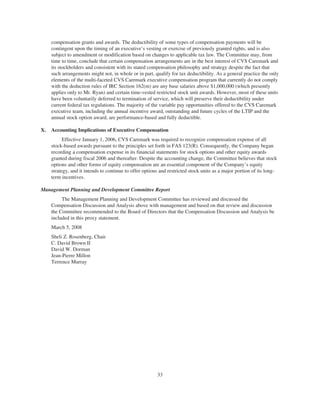
  • 27.
    Ⅲ to encourageexecutive retention; and Ⅲ to promote meaningful levels of Company stock ownership by executives. The Committee has developed a multi-faceted integrated long-term incentive approach to achieve these strategic objectives. The key elements of this approach are an annual stock option grant, which serves to align the interests of executives with those of CVS Caremark’s stockholders; an annual restricted stock unit award, which vests contingent upon significant continued employment with the Company; and the LTIP, which rewards multi-year financial success and is paid equally in cash and Company common stock. The Committee believes that this three-pillar structure properly balances both the incentive required to drive achievement of the four strategic objectives noted above as well as the amount and timing of the rewards delivered for successful achievement of those objectives. All three of these long-term incentive compensation elements are delivered under the provisions of the stockholder-approved 1997 ICP. To determine the overall opportunity and appropriate proportions of the components, the Committee considered a variety of factors, including competitive market positioning against comparable executives in CVS Caremark’s peer group, potential economic value realized, timing of vesting, and taxation. All of these factors were considered within the context of the challenges presented by the strategic, financial and operating goals established for CVS Caremark by the full Board for both 2007 and the longer-term. In the first quarter of 2007, the Committee reviewed survey data compiled and analyzed by the external compensation consultant on total compensation packages and the value of long-term incentive awards at organizations within the Company’s peer group. The Committee also considered, except in the case of the award to the CEO, the recommendations of the CEO for each of the executive officers. In conjunction with the external market review, the Committee considered the potential effectiveness of the retentive value of the outstanding equity and other arrangements currently in place for the executive team to determine whether additional awards to secure continued employment with the Company were warranted. The Committee considered the impact of the equity component of the long-term compensation programs on shares outstanding and the calculation of the Company’s “burn rate”, or share utilization for compensation purposes. Each of the three components of the CVS Caremark long-term executive compensation structure has a separate and distinct impact on the Company’s outstanding shares. The Committee considered these impacts, both individually and in the aggregate, in its determination of the appropriate relative levels of each component within the overall award opportunity. Restricted stock units dilute the outstanding shares when they vest regardless of the market price of the Company’s common stock. Since stock options become dilutive only if they are “in the money,” and their accounting cost is lower than that of the restricted stock units, each option is considered by the Committee to have potentially less of an impact on earnings per share. To determine the overall impact of the awards and anticipate share utilization, after consultation with its external compensation consultant, consistent with the practices of at least one institutional shareholder advisory service, and considering the Company’s accounting cost for options, the Committee assumed that one restricted stock unit equals four stock options. The Committee established the vesting periods for restricted stock unit and stock option grants with the objective of maximizing executive retention and providing a competitively designed equity program. It also reaffirmed the three-year performance cycle of the LTIP as the appropriate interval to establish and measure achievement of a long-term financial goal as it is consistent with the Company’s strategic long-term planning cycle. The Committee was also mindful of the need to stagger these vesting and performance cycle dates to ensure the release of various rewards over a period of successive years. In February 2007, the Committee concluded its comprehensive assessment of the competitive landscape, the impact on shares outstanding and the timing and potential economic impact offered by the future vesting of restricted stock unit grants and the vesting and exercise of stock option grants. Several guiding principles emerged from this assessment: (1) each of the three components (stock option grant, restricted stock unit grant, and the LTIP) will have a material role in the delivery of long-term compensation; 24
  • 28.
    (2) the combinationof the target opportunity for the three components will represent the majority of the target total direct compensation opportunity for each executive officer and generally will be at least 60% of the total direct compensation opportunity; (3) each of the three components will be earned independently, i.e., successful achievement of the three-year financial goal established for the LTIP will not trigger or accelerate vesting of the restricted stock unit or stock option grants; conversely, any awards payable under the LTIP will be based solely on results as measured against the relevant performance metric and not affected by any value realized by the restricted stock unit or stock option grants; (4) for the CEO, each component of the target long-term opportunity will have approximately equal weight; (5) the combination of restricted stock units awarded through the annual grant plus the shares delivered through the LTIP will equal approximately one-third (one-half for the CEO) of the total long-term opportunity; and (6) 50% of the LTIP will continue to be paid in cash due to the executives’ needs for current cash to meet tax obligations occasioned on the settlement of restricted stock unit awards, but the target cash component of the long-term incentive compensation component will not exceed 25% of the total target long-term compensation. To determine the target proportions of each long-term compensation component for 2007, the Committee applied the principles described above, incorporated its assessment of competitive positioning and dilutive impact on shares outstanding and determined the following allocations: % of Overall Target Long-Term Opportunity (“LTO”) Executive Total LTIP Stock Option Grant Stock Grant Thomas M. Ryan 36% 32% 32% David B. Rickard 40% 45% 15% Chris W. Bodine 41% 44% 15% Howard A. McLure 41% 44% 15% Larry J. Merlo 41% 44% 15% Douglas A. Sgarro 38% 47% 15% The annual cycle for setting goals, establishing award opportunities, assessing performance and determining final awards for the long-term incentive compensation plans parallels that of the annual incentive plan. As described above, the Committee sets a range of long-term award opportunity for each of the executive officers for each of the three components of long-term compensation: the LTIP, stock options, and restricted stock units. A more detailed overview of each of the three components is presented below. The Committee conducted a final review of the total equity-denominated awards that are included in the target compensation opportunities for the executive officers in the context of the Company’s overall equity compensation program. It reviewed estimates of stock option and restricted stock unit awards to be made to CVS Caremark officers and other employees during the balance of fiscal 2007 against the Company’s desired burn rate of less than 1.5% and the reserve of shares established under the 1997 ICP. The Committee determined that it could make the proposed awards to the executive officers and the projected additional awards to other employees and still remain within the Company’s targeted burn rate. 25
  • 29.
    Following is anoverview and the 2007 results for each of the components of CVS Caremark’s long- term incentive compensation. A. The Long-Term Incentive Plan The LTIP is intended to encourage executives to focus on long-term financial progress with the ultimate objective of enhancing shareholder value, while simultaneously promoting executive retention by requiring an executive to forfeit his or her award if employment terminates under certain circumstances before the end of the performance period. The LTIP, introduced in 2002, consists of overlapping three-year performance cycles, with a new cycle commencing each year. The performance metric used in the LTIP is the compound annual growth rate of earnings per share (“EPS CAGR”). The executives participating in the LTIP are directly accountable to the shareholders for influencing earnings per share. A target EPS is also used as a goal in the Company’s long-term strategic plan. For all cycles, the Committee determines an award opportunity for each participant at the beginning of the cycle. The award opportunity is denominated in dollars, and represents the award that will be earned if actual results over the three-year performance period equal the financial goal established by the Committee at the commencement of the period. The actual award will vary based on performance: if results exceed the goal by 25% or more, the award will increase up to a maximum of 200% of the target award opportunity; if results fall short of the goal by 20% or more, the award is reduced to zero. Payout levels between the minimum and maximum are interpolated. The correlation between actual award and level of performance relative to the goal is formulaically prescribed at the beginning of the cycle; neither the Committee nor any member of management may exercise any discretion to modify the award once results are determined. LTIP awards are delivered 50% in cash and 50% in shares of CVS Caremark common stock. Although the stock is non-forfeitable when earned, effective with the cycle ending in 2007 the executive is prohibited from selling or trading the shares for two years following the grant date, which encourages stock ownership and further reinforces an alignment of executives’ interests with that of stockholders. All LTIP awards, whether cash or stock, must be paid by March 15 of the year following the last year of the performance cycle unless the executive has previously made a deferral election under the CVS Deferred Compensation Plan or the CVS Deferred Stock Plan. The process by which the Committee establishes the LTIP financial goal is similar to and concurrent with that used to determine the annual incentive target. Any permitted exclusions from actual results for purposes of calculating long-term incentive awards generally mirror those established for the annual incentive plan but will also include any specific adjustments pertinent to EPS, as necessary. Once established, the LTIP goal remains constant throughout the three-year performance cycle and is not subject to adjustment or modification. Should an event that qualifies as a permitted exclusion occur, results are adjusted to reflect the impact of that event and documented accordingly upon the conclusion of the cycle. The performance goal for the cycle ending December 31, 2007 was an EPS CAGR of 16.0%. After the application of the permitted exclusions to the calculation of performance results (the same as those described above for the annual incentive plan), the actual result for the period was an EPS CAGR of 18.2%. Based on this level of performance, award payouts were 56% above target. All of the executive officers specified in the Summary Compensation Table except for Messrs. McLure and Spalding participated for the full duration of the cycle. The cash portion of the LTIP award for the cycle ending December 31, 2007 for each executive officer is reported in the Non-Equity Incentive Plan Compensation column of the Summary Compensation Table on page 34. The corresponding stock portion of the LTIP award for the cycle ending December 31, 2007 for each executive officer is reported in the Stock Awards column of the Summary Compensation Table. During or prior to 2007, the Committee has established LTIP cycles with EPS CAGR goals for the three-year periods ending December 31, 2008 and December 31, 2009. The Committee and management believe that disclosure of an EPS growth target over a three-year prospective period would result in competitive harm to the Company, and, accordingly, have not disclosed the specific targets for these cycles. 26
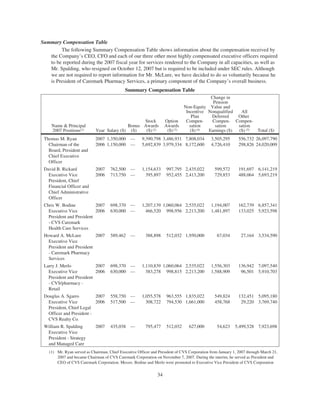
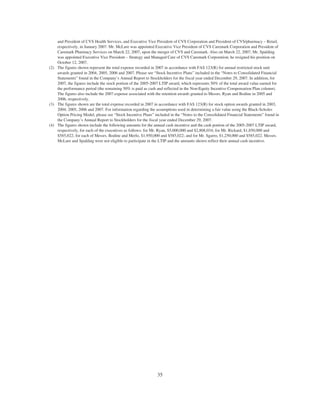
  • 30.
    The Committee believesthat the specific performance targets for these cycles is at least as challenging as the performance targets established for prior LTIP cycles and that the award opportunities established for these cycles have been calibrated accordingly. EPS CAGR targets for all cycles are in excess of 10%, and in the judgment of the Committee and management, will represent significant value creation for shareholders if achieved. B. Stock Option and Restricted Stock Unit Grants In 2007, the Committee continued its general policy of making annual stock option grants to executives and other key employees. For CVS Caremark executive officers and other members of management, stock options comprise a major component of the Company’s long-term incentive program. As in prior years, the Committee awarded stock options to full-time pharmacists and store managers, a critical employee population for CVS Caremark, with the objective of fostering retention with the Company while offering a long-term compensation opportunity that would differentiate CVS Caremark as an employer of choice. In 2007, CVS Caremark granted stock options to three groups: the annual executive grant on April 2, 2007, which awarded 11,482,618 options to 2,126 selected executives and other key employees, including the executive officers; the annual key store employee grant on August 15, 2007, which awarded 1,345,331 options, representing slightly more than 10% of all options granted in 2007, to 10,872 full-time pharmacists and store managers with at least three years of service with the Company; and new hire grants, comprising 117,590 options awarded over the course of 2007 to 16 key new colleagues. As part of the annual executive grant on April 2, 2007, 61 of the executives and key employees received 247,588 restricted stock units. All CVS Caremark stock options are nonqualified stock options granted and administered under the provisions of the 1997 ICP and the 2004 Caremark Rx, Inc. Stock Incentive Plan. Since 2004, the contractual term of all CVS Caremark options has been fixed at seven years. Authority to grant stock options and any other form of equity compensation to CVS Caremark executives and employees is limited to the Committee or a designated individual member of the Committee; no member of management or any other Company employee may authorize any equity compensation or amend the terms and conditions of any previous equity grants. The Committee has consistently approved annual equity grants, including stock options, in the first quarter of each year and has made such awards without regard to the timing of the release of the Company’s financial results for the year or the timing of the release of any other material non-public information. In March 2007, the Board adopted a Stock Option Policy providing that any stock option granted to a recipient will have an exercise price equal to the closing price of the Company’s underlying stock on the date that the option is granted (the “grant date”), with a grant date in a given fiscal year to be established generally based on the Company’s customary and normal grant cycle. When a grant to an existing employee is outside the annual grant cycle, the grant date will not be coordinated with the release of material non-public information that has been or will be disclosed within thirty days on either side of any such grant date. When an executive is hired after a fiscal year has begun, the grant date will be the later of the hire date and the date the Committee approves the award. Total long-term compensation opportunity for each executive officer, including the equity components, is considered and determined early in the year as part of the overall process of establishing performance goals and the correlating compensation framework to support the achievement of those goals. This long- term compensation opportunity is expressed as a target value with a minimum and maximum range, denominated in dollars, for each of the three components of long-term pay. At its January meeting, the Committee reviews current competitive market information supplied by the external compensation consultant and considers peer company performance results to date. In February of each year, CVS Caremark releases its prior year earnings and financial statements; at that time, the Committee assesses the Company’s performance against short- and long-term goals. The CEO presents to the Committee his recommendations for stock option and restricted stock unit awards for the other executive officers, outlining his assessment of each officer’s performance, contribution and anticipated future role within the Company. 27
  • 31.
    In addition, theCommittee members consult with other independent directors to determine the appropriate award for the CEO within the competitive range established earlier. In accordance with the sequence described above, at its meeting on February 12, 2007, the Committee took a number of actions: Ⅲ It approved the value of annual equity awards for each of the executive officers, except for Mr. McLure, as well as the CEO. Awards were at or slightly above target levels, reflecting achievement of the Company’s short-term strategic goals and significant progress toward long- term objectives, particularly the completion of the Eckerd integration while sustaining core business results at or above plan. Concurrent with the approval of awards for executive officers, the Committee approved the total value of options and restricted stock units to be granted to all participants in the annual executive grant, as well as the target, minimum and maximum opportunities and participation rate guidelines for each eligible group of employees. Ⅲ The grant date for annual stock option and restricted stock unit awards was set as the first business day of the Company’s second quarter, which was April 2, 2007. The exercise price for stock option grants was established as the closing price of CVS Caremark common stock on the grant date. Ⅲ The Committee approved the proportion of option value to restricted stock unit value within each equity award. For the executive officers other than the CEO and for CVS Caremark vice presidents and senior vice presidents, that ratio was set at 75% option value and 25% restricted stock unit value. For the CEO, the proportion was equally divided between stock option value and restricted stock unit value. For all other CVS Caremark employees who received annual equity awards, the entire value of the award was delivered in stock options. Mr. McLure’s stock option award was recommended by the CEO and approved by the Committee in March 2007, after the consummation of the merger. Consistent with standing Caremark practice, the value of his 2007 award was delivered fully in stock options. It is the intent of management and the Committee that his future annual equity awards will be comprised of both options and restricted stock units in the same proportion as other executive officers. In July 2007, the grant date and terms and conditions for the pharmacist and store manager stock option grant were finalized. Eligibility in the program was tenure-based with an altered vesting schedule (detailed below) to promote retention. Terms and conditions mirrored those of the executive stock option grant. The Committee established the vesting schedule for the 2007 equity awards as follows: Ⅲ Options granted to executives on April 2, 2007 will vest in three equal installments on each of the first, second and third anniversaries of the grant. Ⅲ Options granted to store managers and pharmacists on August 15, 2007 will vest on the third anniversary of the grant date. Ⅲ Restrictions on 50% of the restricted stock units granted to BPC members will lapse on the third anniversary of the grant. Restrictions on the remaining 50% of the units will lapse on the fifth anniversary of the grant or the executive’s 55th birthday, whichever is later. Ⅲ Restrictions on restricted stock units granted to other CVS Caremark employees will lapse on the fourth anniversary of the grant date. No restricted stock units were granted to pharmacists or store managers. Ⅲ Vesting on options and restricted stock units will be accelerated upon certain termination events. The number of options awarded on April 2, 2007, as part of the executive grant was determined by dividing the dollar value of options approved by the Committee at its February meeting by $9.92, which was the value of each option as of April 2, 2007 calculated under the Black-Scholes pricing model. A similar 28
  • 32.
    process was followedfor the pharmacist and store manager grant in August 2007. The number of restricted stock units awarded as part of the executive grant was determined by dividing the dollar value of restricted stock units approved by the Committee at its February meeting by $34.42, which was the closing price of CVS Caremark common stock on April 2, 2007. The fair market value of the restricted stock units granted on March 22, 2007 to Mr. McLure in connection with his retention agreement (described in Section VIII – Agreements with Executive Officers, below) was $34.31 per unit. The retention award fully vests on the third anniversary of the date of grant. The 2007 expense associated with the stock options and restricted stock units granted to Messrs. Ryan, Rickard, Bodine, McLure, Merlo, Sgarro and Spalding during fiscal 2007 and prior years is shown in the Summary Compensation Table on page 34. Additional information about the 2007 awards, including stock option exercise price, the number of shares subject to each award and the grant date fair value, is shown in the Grants of Plan-Based Awards Table on page 37. 4. Supplemental Executive Retirement Plan CVS Caremark has established and maintains an unfunded Supplemental Executive Retirement Plan for Select Senior Management of the Company (the “SERP”). The SERP is designed to supplement the retirement benefits of selected executive employees. Caremark established and CVS Caremark has maintained an unfunded Special Executive Retirement Plan (the “SRP”) for selected executives, among them Messrs. McLure and Spalding. An overview of the SERP and SRP design and the actuarial present value of the accumulated pension benefits of Messrs. Ryan, Rickard, Bodine, McLure, Merlo, Sgarro and Spalding as of the end of fiscal 2007 are shown in the Pension Benefits Table on page 42. 5. Other Benefits The Company maintains medical and dental insurance, life insurance and short- and long-term disability insurance programs for all of its employees, as well as customary vacation, leave of absence, and other similar policies. Executive officers are eligible to participate in these programs on the same basis and with the same level of financial subsidy by CVS Caremark as the rest of the Company’s salaried employees. Similarly, executive officers except for Mr. McLure may participate in the CVS Future Fund, which is the Company’s qualified defined contribution or 401(k) plan. An eligible CVS Caremark employee may defer up to 85% of his or her total eligible compensation, defined as salary plus annual incentive, to a maximum defined by the Internal Revenue Service; in 2007, that maximum was $15,500. After the first full year of employment, CVS Caremark will match the employee’s deferral dollar-for-dollar up to a maximum equaling 5% of total eligible compensation. CVS Caremark matching cash and ESOP preference stock contributions for executive officers specified in the table who deferred eligible compensation into the Future Fund are a component of the All Other Compensation Table on page 36. Mr. McLure is eligible to participate in Care$ave, the Caremark qualified defined contribution or 401(k) plan, which matches employee deferrals dollar-for-dollar up to 3%, and 50% of the next 2% of deferrals equaling 4% of total eligible compensation. Company contributions for Mr. McLure are also reported in the All Other Compensation Table. CVS Caremark offers other benefits which are available to eligible employees, including executive officers, as follows: A. CVS Deferred Compensation Plan, Caremark Rx, Inc. Deferred Compensation Plan and CVS Deferred Stock Plan Executive officers and selected other senior employees may choose to defer compensation once earned and vested into the CVS Deferred Compensation Plan or the Caremark Rx, Inc. Deferred Compensation Plan (depending on eligibility) and the CVS Deferred Stock Plan, which are available to all non-store U.S. employees who meet the Internal Revenue Code definition of a “highly compensated employee.” Both 29
  • 33.
    deferred compensation plansoffer a variety of investment crediting choices. Each year, the amount of a participant’s deferred compensation account increases or decreases based on the appreciation and/or depreciation in the value of the investment crediting alternatives selected by the participant. Under the CVS Deferred Stock Plan, deferred shares fluctuate in value based on the performance of CVS Caremark stock, further enhancing the Company’s focus on stock ownership. The individual contributions of Messrs. Ryan, Rickard, Bodine, McLure, Merlo and Sgarro during fiscal 2007 to the CVS Deferred Compensation Plan, the Caremark Rx, Inc. Deferred Compensation Plan and the CVS Deferred Stock Plan, including earnings on those contributions, any distributions during 2007 and total account balances as of the end of the fiscal year, are shown in the Nonqualified Deferred Compensation Table on page 44. B. Perquisites and Other Personal Benefits Except for the few items discussed in this section, CVS Caremark generally does not provide perquisites or other personal benefits for its executive officers. The Committee believes that this policy is consistent with the Company’s philosophy to maximize the amount of “at-risk” pay of its executive officers. CVS Caremark also does not provide any additional cash compensation to any of the executive officers to reimburse them for any income tax liability (with the exception of certain circumstances following a change in control) that may arise and become due and payable as a result of their receipt of any cash or equity compensation, benefit or perquisite. CVS Caremark provides an allowance to each of the executive officers to cover the cost of a Company- provided financial planner to assist with personal financial planning and estate planning. These amounts are reported in detail in the All Other Compensation Table on page 36; for 2007, they ranged from $5,000 to $13,736. The Company maintains corporate aircraft that may be used by Company employees to conduct Company business. Pursuant to an executive security program established by the Board upon the Committee’s recommendation, the Committee requires the CEO to use the Company’s aircraft for all travel needs, including personal travel, in order to minimize and more efficiently utilize his travel time, protect the confidentiality of his travel and the Company’s business, and enhance his personal security. Certain other executive officers specified in the tables were also permitted to use the Company’s corporate aircraft for personal travel on a very limited basis during fiscal 2007. The value of the personal use of Company aircraft by the CEO and any other executive officer is treated as income taxable to the executive. The Company provides no reimbursement for this cost nor does it pay the tax or any other expense associated with this cost on behalf of the executive. CVS Caremark also requires that the CEO use a Company-provided car and driver for business-related travel and very limited personal travel. In addition, CVS Caremark provides an allowance to the executive officers to cover the costs of the installation and maintenance of security monitoring systems in their homes. While the Committee believes the security costs described in the preceding two paragraphs are business expenses, disclosure of these costs as personal benefits is required. The value of these items is treated as income taxable to the executives. In addition, Caremark provided a flexible spending allowance to Mr. McLure, which is described under the Nonqualified Deferred Compensation section on page 44, and other benefits comparable to those provided to the executives specified in the tables. The Company provides no reimbursement for these costs nor does it pay the taxes or any other expenses associated with these costs on behalf of the executives. The aggregate incremental cost to the Company of providing these personal benefits to Messrs. Ryan, Rickard, Bodine, McLure, Merlo and Sgarro during fiscal 2007 is shown in the Summary Compensation Table on page 34. VI. CEO Compensation The Company’s 2007 performance ranks in the top third of our peer group for revenue growth, operating income growth, diluted EPS growth, and total shareholder return. The Company also outperformed key annual financial targets established by the Board. Our results for total shareholder return 30
  • 34.
    for one- ,three- and five-year periods exceeded both the S&P 500 and the Dow Jones Industrial Indices. In addition to superior financial results, during 2007 we closed the transformative merger of equals with Caremark, creating the nation’s premier integrated pharmacy services provider, and completed the integration and re-launch of the former Osco and Sav-On stores that the Company acquired in 2006. Based on these results, the Committee made the following compensation decisions for the CEO: Type Target Actual Base Salary $ 1,400,000 $ 1,400,000 Annual Cash Incentive $ 2,800,000 $ 5,000,000 LTIP Cycle III (2005 – 2007) $ 3,600,000 $ 5,616,000 Stock Option Grant $ 3,250,000 $ 4,000,002 Restricted Stock Unit Grant $ 3,250,000 $ 4,000,017 Total Direct Compensation $14,300,000 $20,016,019 VII. Other Compensation Programs and Policies 1. Employee Stock Purchase Plan CVS Caremark encourages all employees, including executive officers, to participate in stock ownership through the Company’s Employee Stock Purchase Plan (the “ESPP”), which has been designed to comply with Section 423 of the Internal Revenue Code. The ESPP, in accordance with Internal Revenue Service guidelines, gives employees the opportunity to purchase shares of the Company’s common stock with up to 15% of their base salary, subject to IRS limits. The Committee and CVS Caremark management believe that the ESPP encourages employees (including executive officers) to increase their ownership in the Company and further aligns their economic interests with those of the Company’s stockholders. Approximately 16,280 employees throughout CVS Caremark participate in the ESPP; almost half of that number are pharmacists. The purchase price at which the Company’s common stock may be acquired under the ESPP is equal to eighty-five percent (85%) of the lesser of (a) the fair market value of the shares on the first day of a six-month offering period or (b) the fair market value of the shares on the last day of the six-month offering period. Participants are required to hold their purchased shares for a minimum of two years following the commencement of the offering period. The ESPP is designed to appeal primarily to non-executive employees and is not intended to be a meaningful element in executive compensation. Nonetheless, certain executive officers do participate in the ESPP and it does support the Company’s philosophy of furthering an executive officer’s ownership stake in the Company. 2. Stock Ownership Guidelines The Committee has long been mindful of the importance of equity ownership by directors and executive management as an effective link to stockholders and, as such, the Board instituted stock ownership guidelines for all directors and members of the Company’s BPC and requires that directors and BPC members achieve compliance with the ownership requirements within five years of becoming a director or BPC member. BPC members must maintain ownership levels equaling or exceeding three times their base salary, except for the CEO, who must maintain ownership levels at least five times his base salary. Shares included in the calculation to assess compliance with the guidelines include shares owned outright, unvested restricted stock and stock units, shares held in the Deferred Stock Plan, shares of ESOP preference stock, and shares purchased through the ESPP. Unexercised stock options do not count toward satisfying the guidelines. The Committee believes that these requirements strongly emphasize its philosophy of equity ownership for the Board and executive management, which in turn reinforces alignment with stockholder interests. The CEO, each of the executive officers specified in the tables, and each of the directors is in compliance with the stock ownership guidelines or is within the five-year period of having 31
  • 35.
    been elected. TheShare Ownership Table on page 13 shows the current stock ownership levels of each director and each executive officer specified in the Summary Compensation Table. VIII. Agreements with Executive Officers CVS Caremark has entered into employment agreements (the “Agreements”) with Messrs. Ryan, Rickard, Bodine, Merlo and Sgarro, which have been previously disclosed. Among other provisions, these Agreements specify payments to be made to the executives in the event of termination under various conditions. Details of payments made to the executives upon various termination scenarios may be found in Payments/(Forfeitures) Under Termination Scenarios, beginning on page 45. In connection with the merger of CVS and Caremark, the Company also entered into a retention agreement with Mr. McLure. In exchange for Mr. McLure’s agreement to the cancellation of his prior Caremark employment agreement and his agreement to restrictive covenants in favor of the Company, the retention agreement establishes the basis of his continued employment and provides him with certain cash and equity-based retention incentives, which are set forth in the compensation tables below. Our executive officers generally have long tenure with the Company and have provided the vision and leadership that have built CVS Caremark into the successful enterprise that it is today. The Committee believes that the interests of stockholders will be best served if the interests of our senior management are aligned with our stockholders. Providing change-in-control benefits should eliminate, or at least reduce, the reluctance of senior management to pursue potential change-in-control transactions that may be in stockholders’ best interests. The security of competitive change-in-control arrangements serves to eliminate distraction caused by uncertainty about personal financial circumstances during a period in which the Company requires focused and thoughtful leadership to ensure a successful outcome. Accordingly, CVS Caremark’s employment agreements provide certain specified “double trigger” severance benefits to the covered executives in the event of their termination under certain circumstances following a change in control. The Committee believes a “double trigger”, rather than a “single trigger”, severance benefit provision is more appropriate as it provides for continuity in management following a change in control. Information regarding the provisions for the treatment of equity awards, the SERP and other benefits can be found in Payments/(Forfeitures) Under Termination Scenarios, beginning on page 45. The tables beginning on page 46 provide details on estimated payments that would be made to the executives whose employment terminates following a change in control. Actual payments made to Mr. Spalding following his resignation on October 12, 2007 are also described in that section. The Committee reviews the severance benefits annually with the assistance of its executive compensation consultant to evaluate both their effectiveness and competitiveness. The review in fiscal 2007 found the current level of benefits to be within competitive norms for design. IX. Compliance with IRC Section 162(m) IRC Section 162(m) generally disallows a tax deduction to public companies for compensation over $1 million paid to a company’s chief executive officer and the three other most highly compensated executive officers at year end, other than the chief financial officer. Qualifying performance-based compensation will not be subject to the deduction limit if certain requirements are met. The Committee’s policy is to generally preserve corporate tax deductions by qualifying as performance-based compensation that is over $1,000,000 and that is paid to executive officers specified in the tables. To this end, the Board adopted and stockholders approved the 1997 ICP and the 2007 Incentive Plan, which permit annual incentive awards and stock options (and certain other awards) to qualify as performance-based compensation not subject to the limitation on deductibility. However, maintaining tax deductibility is but one consideration among many – and is not the most important consideration – in the design of the compensation program for senior executives. The Committee considers the anticipated tax treatment both to the Company and the executive in its review and approval of 32
  • 36.
    compensation grants andawards. The deductibility of some types of compensation payments will be contingent upon the timing of an executive’s vesting or exercise of previously granted rights, and is also subject to amendment or modification based on changes to applicable tax law. The Committee may, from time to time, conclude that certain compensation arrangements are in the best interest of CVS Caremark and its stockholders and consistent with its stated compensation philosophy and strategy despite the fact that such arrangements might not, in whole or in part, qualify for tax deductibility. As a general practice the only elements of the multi-faceted CVS Caremark executive compensation program that currently do not comply with the deduction rules of IRC Section 162(m) are any base salaries above $1,000,000 (which presently applies only to Mr. Ryan) and certain time-vested restricted stock unit awards. However, most of these units have been voluntarily deferred to termination of service, which will preserve their deductibility under current federal tax regulations. The majority of the variable pay opportunities offered to the CVS Caremark executive team, including the annual incentive award, outstanding and future cycles of the LTIP and the annual stock option award, are performance-based and fully deductible. X. Accounting Implications of Executive Compensation Effective January 1, 2006, CVS Caremark was required to recognize compensation expense of all stock-based awards pursuant to the principles set forth in FAS 123(R). Consequently, the Company began recording a compensation expense in its financial statements for stock options and other equity awards granted during fiscal 2006 and thereafter. Despite the accounting change, the Committee believes that stock options and other forms of equity compensation are an essential component of the Company’s equity strategy, and it intends to continue to offer options and restricted stock units as a major portion of its long- term incentives. Management Planning and Development Committee Report The Management Planning and Development Committee has reviewed and discussed the Compensation Discussion and Analysis above with management and based on that review and discussion the Committee recommended to the Board of Directors that the Compensation Discussion and Analysis be included in this proxy statement. March 5, 2008 Sheli Z. Rosenberg, Chair C. David Brown II David W. Dorman Jean-Pierre Millon Terrence Murray 33
  • 37.
    Summary Compensation Table Thefollowing Summary Compensation Table shows information about the compensation received by the Company’s CEO, CFO and each of our three other most highly compensated executive officers required to be reported during the 2007 fiscal year for services rendered to the Company in all capacities, as well as Mr. Spalding, who resigned on October 12, 2007 but is required to be included under SEC rules. Although we are not required to report information for Mr. McLure, we have decided to do so voluntarily because he is President of Caremark Pharmacy Services, a primary component of the Company’s overall business. Summary Compensation Table Name & Principal 2007 Positions(1) Year Salary ($) Bonus ($) Stock Awards ($) (2) Option Awards ($) (3) Non-Equity Incentive Plan Compen- sation ($) (4) Change in Pension Value and Nonqualified Deferred Compen- sation Earnings ($) All Other Compen- sation ($) (5) Total ($) Thomas M. Ryan Chairman of the Board, President and Chief Executive Officer 2007 2006 1,350,000 1,150,000 — — 9,390,798 5,692,839 3,486,931 3,979,334 7,808,034 8,172,600 3,505,295 4,726,410 556,732 298,826 26,097,790 24,020,009 David B. Rickard Executive Vice President, Chief Financial Officer and Chief Administrative Officer 2007 2006 762,500 713,750 — — 1,154,633 395,897 997,795 952,455 2,435,022 2,413,200 599,572 729,853 191,697 488,064 6,141,219 5,693,219 Chris W. Bodine Executive Vice President and President - CVS Caremark Health Care Services 2007 2006 698,370 630,000 — — 1,207,139 466,520 1,060,064 998,956 2,535,022 2,213,200 1,194,007 1,481,897 162,739 133,025 6,857,341 5,923,598 Howard A. McLure Executive Vice President and President - Caremark Pharmacy Services 2007 589,462 — 388,898 512,032 1,950,000 67,034 27,164 3,534,590 Larry J. Merlo Executive Vice President and President - CVS/pharmacy - Retail 2007 2006 698,370 630,000 — — 1,110,839 383,278 1,060,064 998,815 2,535,022 2,213,200 1,556,303 1,588,909 136,942 96,501 7,097,540 5,910,703 Douglas A. Sgarro Executive Vice President, Chief Legal Officer and President - CVS Realty Co. 2007 2006 558,750 517,500 — — 1,055,578 308,722 963,555 794,530 1,835,022 1,661,000 549,824 458,768 132,451 29,220 5,095,180 3,769,740 William R. Spalding Executive Vice President - Strategy and Managed Care 2007 435,038 — 795,477 512,032 627,000 54,623 5,499,528 7,923,698 (1) Mr. Ryan served as Chairman, Chief Executive Officer and President of CVS Corporation from January 1, 2007 through March 21, 2007 and became Chairman of CVS Caremark Corporation on November 7, 2007. During the interim, he served as President and CEO of CVS Caremark Corporation. Messrs. Bodine and Merlo were promoted to Executive Vice President of CVS Corporation 34
  • 38.
    and President ofCVS Health Services, and Executive Vice President of CVS Corporation and President of CVS/pharmacy – Retail, respectively, in January 2007. Mr. McLure was appointed Executive Vice President of CVS Caremark Corporation and President of Caremark Pharmacy Services on March 22, 2007, upon the merger of CVS and Caremark. Also on March 22, 2007, Mr. Spalding was appointed Executive Vice President – Strategy and Managed Care of CVS Caremark Corporation; he resigned his position on October 12, 2007. (2) The figures shown represent the total expense recorded in 2007 in accordance with FAS 123(R) for annual restricted stock unit awards granted in 2004, 2005, 2006 and 2007. Please see “Stock Incentive Plans” included in the “Notes to Consolidated Financial Statements” found in the Company’s Annual Report to Stockholders for the fiscal year ended December 29, 2007. In addition, for 2007, the figures include the stock portion of the 2005-2007 LTIP award, which represents 50% of the total award value earned for the performance period (the remaining 50% is paid as cash and reflected in the Non-Equity Incentive Compensation Plan column). The figures also include the 2007 expense associated with the retention awards granted to Messrs. Ryan and Bodine in 2005 and 2006, respectively. (3) The figures shown are the total expense recorded in 2007 in accordance with FAS 123(R) for stock option awards granted in 2003, 2004, 2005, 2006 and 2007. For information regarding the assumptions used in determining a fair value using the Black-Scholes Option Pricing Model, please see “Stock Incentive Plans” included in the “Notes to the Consolidated Financial Statements” found in the Company’s Annual Report to Stockholders for the fiscal year ended December 29, 2007. (4) The figures shown include the following amounts for the annual cash incentive and the cash portion of the 2005-2007 LTIP award, respectively, for each of the executives as follows: for Mr. Ryan, $5,000,000 and $2,808,034; for Mr. Rickard, $1,850,000 and $585,022; for each of Messrs. Bodine and Merlo, $1,950,000 and $585,022; and for Mr. Sgarro, $1,250,000 and $585,022. Messrs. McLure and Spalding were not eligible to participate in the LTIP and the amounts shown reflect their annual cash incentive. 35
  • 39.
    (5) Set forthbelow is additional information regarding the amounts disclosed in the “All Other Compensation” column. All Other Compensation – Fiscal Year 2007 Name & Principal 2007 Positions Perquisites & Other Personal Benefits (a) ($) Company Contributions to Defined Contribution Plans (b) ($) Insurance Premiums (c) ($) Other (d) ($) Thomas M. Ryan Chairman of the Board, President and Chief Executive Officer 137,738 391,815 27,179 — David B. Rickard Executive Vice President, Chief Financial Officer and Chief Administrative Officer 41,792 143,456 6,449 — Chris W. Bodine Executive Vice President and President - CVS Caremark Health Care Services 30,326 130,250 2,163 — Howard A. McLure Executive Vice President and President - Caremark Pharmacy Services 19,600 4,800 2,764 — Larry J. Merlo Executive Vice President and President - CVS/pharmacy - Retail 10,000 124,779 2,163 — Douglas A. Sgarro Executive Vice President, Chief Legal Officer and President - CVS Realty Co. 32,477 98,214 1,760 — William R. Spalding Executive Vice President - Strategy and Managed Care 32,541 4,546 5,062 5,457,379 (a) The amounts above reflect the following: for Mr. Ryan, $118,468 associated with personal use of company aircraft, $5,150 associated with personal use of a company car, $12,908 for financial planning services and $1,212 for home security; for Mr. Rickard, $17,817 associated with personal use of company aircraft, $10,000 for financial planning services and $13,975 for home security; for Mr. Bodine, $11,648 associated with personal use of company aircraft, $13,736 for financial planning services and $4,942 for home security; for Mr. McLure, $10,000 for car allowance, $4,600 for club membership and $5,000 for financial planning services; for Mr. Merlo, $10,000 for financial planning services; for Mr. Sgarro, $19,691 associated with personal use of company aircraft and $12,786 for financial planning services; and for Mr. Spalding, $8,000 for car allowance and $24,541 in moving expenses in connection with a relocation that had commenced prior to the merger. The Company does not reimburse its executives for any additional taxes they have incurred or may incur related to these expenses. The Company determines the amount associated with personal use of Company aircraft by the incremental cost to the Company based on the cost of fuel, trip-related maintenance, deadhead flights, crew travel expenses, landing fees, trip-related hangar costs and smaller variable expenses. (b) For 2007, this amount includes the following contributions to the CVS 401(k) and ESOP: 401(k) cash match equal to $5,625 and ESOP preference stock match equal to 30.58 shares, valued at $5,625 (based on an ESOP preference stock price of $183.963 per share) for each of Messrs. Ryan, Rickard, Bodine, Merlo and Sgarro. It also includes Company matching contributions credited to notional accounts in the unfunded Deferred Compensation Plan equal to: for Mr. Ryan, $380,565; for Mr. Rickard, $132,206; for Mr. Bodine, $119,000; for Mr. Merlo, $113,529; and for Mr. Sgarro, $86,964. It includes Company matching contributions after the merger for Messrs. McLure and Spalding in the Care$ave plan equal to $4,800 and $4,546, respectively. (c) Includes imputed income in connection with life insurance programs as follows: for Mr. Ryan, $27,179; for Mr. Rickard, $6,449; for Mr. Bodine, $2,163; for Mr. Merlo, $2,163; and for Mr. Sgarro, $1,760. Also reflects premiums paid for long-term disability insurance for Messrs. McLure and Spalding, as well as post-termination health insurance benefits for Mr. Spalding. (d) Amounts shown for Mr. Spalding reflect the payments to him in connection with the settlement regarding the agreement that he and the Company entered into at the time of the merger of CVS and Caremark and includes an excise tax gross up payment of $2,913,292. This agreement is described in “Payments/(Forfeitures) Under Termination Scenarios” on page 50. 36
  • 40.
    Grants of Plan-BasedAwards This table reflects awards granted under the Company’s annual cash incentive plan for 2007, the 2007 LTIP (for performance years 2007 through 2009), and the annual equity awards for 2007, including stock options and restricted stock units (“RSUs”). The Company does not offer Equity Incentive Plan Awards. Grants of Plan-Based Awards – Fiscal Year 2007 Est. Future Payouts Under Non-Equity Incentive Plan Awards All Other Stock Awards: Number of Shares of Stock or Units (#) All Other Option Awards: Number of Securities Underlying Options (#) Exercise or Base Price of Option Awards ($/Sh) Grant Date Fair Value of Stock and Option Awards ($) Name & Principal 2007 Positions Award Type Date of Committee Action Grant Date Threshold ($) Target ($) Maximum ($) Thomas M. Ryan Chairman of the Board, President and Chief Executive Officer Stock Options 2/12/2007 4/2/2007 403,226 34.42 4,000,002 Annual RSUs 2/12/2007 4/2/2007 116,212 4,000,017 Annual Cash 280,000 2,800,000 5,000,000 LTIP (07-09) 900,000 3,600,000 7,200,000 David B. Rickard Executive Vice President, Chief Financial Officer and Chief Adminis- trative Officer Stock Options 2/12/2007 4/2/2007 136,089 34.42 1,350,003 Annual RSUs 2/12/2007 4/2/2007 13,074 450,007 Annual Cash 96,875 968,750 1,937,500 LTIP (07-09) 250,000 1,000,000 2,000,000 Chris W. Bodine Executive Vice President and President - CVS Caremark Health Care Services Stock Options 2/12/2007 4/2/2007 136,089 34.42 1,350,003 Annual RSUs 2/12/2007 4/2/2007 13,074 450,007 Annual Cash 98,000 980,000 1,960,000 LTIP (07-09) 306,250 1,225,000 2,450,000 Howard A. McLure Executive Vice President and President - Caremark Pharmacy Services Stock Options 3/28/2007 4/2/2007 208,750 34.42 2,070,800 Retention 2/12/2007 3/22/2007 43,720 1,500,033 Annual Cash 102,200 1,022,000 2,044,000 LTIP (07-09) 306,250 1,225,000 2,450,000 Larry J. Merlo Executive Vice President and President - CVS/ pharmacy - Retail Stock Options 2/12/2007 4/2/2007 136,089 34.42 1,350,003 Annual RSUs 2/12/2007 4/2/2007 13,074 450,007 Annual Cash 98,000 980,000 1,960,000 LTIP (07-09) 306,250 1,225,000 2,450,000 Douglas A. Sgarro Executive Vice President, Chief Legal Officer and President - CVS Realty Co. Stock Options 2/12/2007 4/2/2007 136,089 34.42 1,350,003 Annual RSUs 2/12/2007 4/2/2007 13,074 450,007 Annual Cash 62,700 627,000 1,254,000 LTIP (07-09) 225,000 900,000 1,800,000 William R. Spalding Executive Vice President - Strategy and Managed Care Stock Options 3/28/2007 4/2/2007 208,750 34.42 2,070,800 Deferral 2/12/2007 3/22/2007 23,185 795,477 Annual Cash 91,250 912,500 1,825,000 LTIP (07-09) 225,000 900,000 1,800,000 The stock option awards shown above vest in equal installments on the first, second and third anniversaries of the date of grant and expire in seven years from the date of grant. As described earlier, the Company’s policy is to establish the exercise price for stock options as the closing price of the Company’s common stock on the grant date. Annual RSU grants vest 50% on the third anniversary of the grant and 50% on the fifth anniversary of the grant or on the executive’s 55th birthday, whichever is later. If earned, portions of the LTIP award shown will be reported in the Non-Equity Incentive Plan Compensation column and in the Stock Awards column of the Summary Compensation Table for the relevant year. The retention stock award granted to Mr. McLure fully vests on the third anniversary of the grant date. All of the grants of plan-based awards to Mr. Spalding, except the stock award that was part of the agreement he and the Company entered into at the time of the merger of CVS and Caremark, expired upon his resignation. 37
  • 41.
    Outstanding Equity Awardsat Fiscal Year-End This table reflects stock option and restricted stock awards granted to the executive officers specified in the table under the Company’s 1997 ICP that were outstanding as of December 29, 2007. Outstanding Equity Awards at 2007 Fiscal Year-End Stock Option Awards Stock Awards Name & Principal 2007 Positions Grant Date Number of Securities Underlying Unexercised Options (#) Exercisable Number of Securities Underlying Unexercised Options (#) Unexercisable Option Exercise Price ($) Option Expiration Date Number of Shares or Units of Stock that Have Not Vested (#) Market Value of Shares or Units of Stock that Have Not Vested ($) (1) Grant Date Thomas M. Ryan Chairman of the Board, President and Chief Executive Officer 3/12/1998 1,200,000 —(2) 18.66 03/12/2008 75,000(8) 3,000,000 1/8/2004 3/10/1999 300,000 —(3) 25.00 03/10/2009 250,000(8) 10,000,000 1/5/2005 1/3/2000 400,000 —(3) 19.28 01/03/2010 405,112(9) 16,204,480 8/5/2005 3/7/2001 500,000 —(3) 30.26 03/07/2011 133,177(8) 5,327,080 4/3/2006 1/2/2002 1,012,124 —(4) 14.96 01/02/2012 116,212(8) 4,648,480 4/2/2007 1/9/2003 900,000 —(3) 12.56 01/09/2013 1/8/2004 400,000 —(5) 17.67 01/08/2011 1/5/2005 266,666 133,334(5) 22.45 01/05/2012 4/3/2006 163,918 327,843(5) 30.04 04/03/2013 4/2/2007 — 403,226(5) 34.42 04/02/2014 David B. Rickard Executive Vice President, Chief Financial Officer and Chief Administrative Officer 9/1/1999 251,520 —(2) 20.88 09/01/2009 15,000(8) 600,000 1/8/2004 1/3/2000 80,000 —(3) 19.28 01/03/2010 30,000(8) 1,200,000 1/5/2005 3/7/2001 100,000 —(3) 30.26 03/07/2011 12,485(8) 499,400 4/3/2006 1/9/2003 160,000 —(3) 12.56 01/09/2013 13,074(8) 522,960 4/2/2007 1/8/2004 100,000 —(5) 17.67 01/08/2011 1/5/2005 66,666 33,334(5) 22.45 01/05/2012 4/3/2006 46,102 92,207(5) 30.04 04/03/2013 4/2/2007 — 136,089(5) 34.42 04/02/2014 Chris W. Bodine Executive Vice President and President - CVS Caremark Health Care Services 1/3/2000 50,000 —(3) 19.28 01/03/2010 15,000(8) 600,000 1/8/2004 3/7/2001 70,000 —(3) 30.26 03/07/2011 30,000(8) 1,200,000 1/5/2005 1/2/2002 42,500 —(3) 14.96 01/02/2012 14,566(8) 582,640 4/3/2006 1/9/2003 80,000 —(3) 12.56 01/09/2013 16,648(10) 665,920 4/3/2006 1/8/2004 100,000 —(5) 17.67 01/08/2011 13,074(8) 522,960 4/2/2007 1/5/2005 66,666 33,334(5) 22.45 01/05/2012 4/3/2006 53,785 107,574(5) 30.04 04/03/2013 4/2/2007 — 136,089(5) 34.42 04/02/2014 Howard A. McLure Executive Vice President and President - Caremark Pharmacy Services 5/10/2004 111,379 —(6) 17.08 05/10/2014 43,720(11) 1,748,800 3/22/2007 3/1/2005 374,879 —(6) 20.23 03/01/2015 6/27/2005 260,459 —(6) 23.23 06/27/2015 3/1/2006 234,212 —(6) 27.12 03/01/2016 4/2/2007 — 208,750(5) 34.42 04/02/2014 Larry J. Merlo Executive Vice President and President - CVS/pharmacy - Retail 3/10/1999 50,000 —(3) 25.00 03/10/2009 15,000(8) 600,000 1/8/2004 1/3/2000 80,000 —(3) 19.28 01/03/2010 30,000(8) 1,200,000 1/5/2005 3/7/2001 100,000 —(3) 30.26 03/07/2011 14,566(8) 582,640 4/3/2006 1/2/2002 189,644 —(4) 14.96 01/02/2012 13,074(8) 522,960 4/2/2007 1/9/2003 160,000 —(3) 12.56 01/09/2013 1/8/2004 100,000 —(5) 17.67 01/08/2011 1/5/2005 66,666 33,334(5) 22.45 01/05/2012 4/3/2006 53,785 107,574(5) 30.04 04/03/2013 4/2/2007 — 136,089(5) 34.42 04/02/2014 Douglas A. Sgarro Executive Vice President, Chief Legal Officer and President - CVS Realty Co. 3/10/1999 40,000 —(3) 25.00 03/10/2009 12,000(8) 480,000 1/8/2004 1/3/2000 60,000 —(3) 19.28 01/03/2010 30,000(8) 1,200,000 1/5/2005 3/7/2001 70,000 —(3) 30.26 03/07/2011 13,317(8) 532,680 4/3/2006 1/2/2002 51,226 —(7) 14.96 01/02/2012 13,074(8) 522,960 4/2/2007 1/9/2003 110,000 —(3) 12.56 01/09/2013 1/8/2004 70,000 —(5) 17.67 01/08/2011 1/5/2005 53,333 26,667(5) 22.45 01/05/2012 4/3/2006 49,176 98,355(5) 30.04 04/03/2013 4/2/2007 — 136,089(5) 34.42 04/02/2014 William R. Spalding (12) Executive Vice President - Strategy and Managed Care — — — — 38
  • 42.
    (1) The valueof the restricted stock units is based on $40.00, which was the closing price of the Company’s stock on December 28, 2007, the last trading day of our fiscal year. (2) Stock options vested in one-third increments on each of the third, fourth and fifth anniversaries of the date of grant. (3) 50% of these stock options vested on the second anniversary of the date of grant; 25% of the remaining stock options vested on each of the third and fourth anniversaries of the date of grant. (4) The vesting schedule for Mr. Ryan’s stock options was as follows: 50% on the second anniversary of the date of grant and 25% on each of the third and fourth anniversaries of the date of grant with respect to 900,000 options and in one-third increments on each of the first, second and third anniversariesof the date of grant with respect to 112,124 options. For Mr. Merlo, 50% on the second anniversary of the date of grant and 25% on each of the third and fourth anniversaries of the date of grant with respect to 150,000 options and in one-third increments on each of the first, second and third anniversaries of the date of grant with respect to 39,644 stock options. (5) The stock options vest in equal one-third increments on each of the first, second and third anniversaries of the date of grant. (6) The stock options were granted by Caremark prior to the merger and vested upon the merger with CVS. These stock options previously had a 5-year vesting schedule. (7) The vesting schedule for Mr. Sgarro’s stock options was as follows: options on 27,500 of 51,226 shares vested on fourth anniversary of the grant date and options on the remaining 23,726 shares vested in equal one-third increments on each of the first, second and third anniversaries of the date of grant. (8) Restricted stock units vest 50% on the third anniversary of the grant date and 50% on the later of the fifth anniversary of the grant date or the executive’s 55th birthday. (9) Restricted stock units granted as a retention award on August 5, 2005, all of which vest on January 1, 2010. Also includes restricted stock units attributable to dividend equivalent crediting in accordance with the terms of the grant. (10) Restricted stock units granted as a retention award on April 3, 2006, all of which vest on the fifth anniversary of the date of grant. (11) Restricted stock units granted as a retention award on March 22, 2007, all of which vest on the third anniversary of the date of grant. (12) Mr. Spalding resigned as of October 12, 2007 and had no outstanding equity awards as of December 29, 2007. 39
  • 43.
    Option Exercises andStock Vested The table below reflects information for the fiscal year ended December 29, 2007 concerning options exercised and vesting of previously granted restricted stock units for each of the executive officers specified in the table. Each of the executives deferred settlement of the restricted stock units except Mr. Spalding, who was issued shares upon the vesting of his stock units. Option Exercises and Stock Vested – Fiscal Year 2007 Name & Principal 2007 Positions Option Awards Stock Awards Number of Shares Acquired on Exercise (#) Value Realized on Exercise ($) Number of Shares Acquired on Vesting (#) Value Realized on Vesting ($) Thomas M. Ryan Chairman of the Board, President and Chief Executive Officer 391,320 7,504,689 75,000 2,334,750 David B. Rickard Executive Vice President, Chief Financial Officer and Chief Administrative Officer 197,652 4,453,001 15,000 466,950 Chris W. Bodine Executive Vice President and President - CVS Caremark Health Care Services 94,912 1,787,764 15,000 466,950 Howard A. McLure President Executive Vice President and President - Caremark Pharmacy Services 610,000 15,814,757 — — Larry J. Merlo Executive Vice President and President - CVS/pharmacy - Retail 330,440 6,254,608 15,000 466,950 Douglas A. Sgarro Executive Vice President, Chief Legal Officer and President - CVS Realty Co. 140,460 2,968,667 12,000 373,560 William R. Spalding Executive Vice President - Strategy and Managed Care 1,171,156 18,686,250 23,185 925,082 The options exercised by Mr. Ryan were due to expire on February 27, 2008 under the terms of the stock option agreement. Mr. Merlo exercised his stock options pursuant to a 10b5-1 selling plan previously entered into, and these options were due to expire on February 27, 2008 and March 12, 2008. Mr. Bodine exercised 17,400 stock options that were due to expire on February 27, 2008. The shares acquired by Mr. Spalding were in connection with the exercise of stock options previously awarded to him by Caremark and the settlement of his deferral account described in “Payments/(Forfeitures) Under Termination Scenarios” on page 50. 40
  • 44.
    Pension Benefits The Companyhas established and maintains an unfunded Supplemental Executive Retirement Plan for Select Senior Management of the Company (the “SERP”). As the Company does not have a qualified defined benefit plan, the SERP is designed to supplement the retirement benefits of selected executives. Under the SERP’s benefit formula, executives selected for participation (including each of the executive officers specified in the table and certain other executives) will receive an annual benefit commencing on the later of age 55 or retirement, equal to 1.6% of a three-year average of final compensation (as defined in the SERP) for each year of service up to 30 years, with no offset for any amounts provided by the Company’s qualified plans, Social Security or other retirement benefits. As part of a retention agreement entered into with Mr. Ryan in August 2005, the 30-year limit on service will be removed for Mr. Ryan if he remains employed with the Company through December 31, 2009, or if he terminates earlier by reason of death or disability or is terminated by the Company without cause. Final compensation for purposes of the SERP’s benefit formula is the average of the executive’s three highest years of annual salary and annual cash bonus during the last ten years of service. The estimated credited years of benefit service for Messrs. Ryan, Rickard, Bodine, Merlo, and Sgarro as of the measurement date of December 31, 2007 were 30, 8, 21, 29 years, and 10 years, respectively. Benefits under the SERP’s benefit formula are payable in annual installments for the life of the executive, unless the executive has made an advance election in accordance with plan and IRS rules, to have the benefit paid in the form of a lump sum or joint and survivor annuity of equivalent actuarial value. As of the measurement date, no executive has made an election to receive his benefit on account of termination of employment in the form of a lump sum. No benefits are payable to an eligible executive until he or she terminates employment. After termination of employment, SERP benefits are payable (i) immediately, if the executive is age 55 or older at the time of termination, regardless of years of service, or (ii) upon reaching age 55, if the executive is younger than 55 at the time of termination and five or more years of Company service were completed prior to termination. As of the measurement date, only Messrs. Ryan and Rickard are eligible for an immediate annuity benefit. The accumulated values for the Pension Table and Summary Compensation Table are based on the benefit accrued as of the measurement date payable as a single life annuity commencing on the earliest unreduced retirement age (55) using assumptions which include a 6.25% discount rate as of December 31, 2007. Annual benefits accrued as of the measurement date and payable as a single life annuity at the earliest unreduced retirement age are: for Mr. Ryan, $2,427,033; for Mr. Rickard, $150,088; for Mr. Bodine, $708,633; for Mr. Merlo, $951,667; and for Mr. Sgarro, $259,214. Each of the executives is fully vested in his accrued benefit. The accrued benefit for Mr. Ryan reflects his waiver of his rights to $100,967 of that benefit, and the accrued benefit for Mr. Rickard reflects his waiver of his rights to $161,465 of that benefit. For further information regarding pension assumptions, please see the Notes to the Consolidated Financial Statements in our Annual Report to Stockholders for the fiscal year ended December 29, 2007. In the event an executive elects to receive a lump sum, the present value of accumulated SERP benefits as of the measurement date, based on the SERP’s assumptions for determining lump sums, would be: for Mr. Ryan, $43,084,690; for Mr. Rickard, $2,264,077; for Mr. Bodine, $11,771,811; for Mr. Merlo, $16,042,251; and for Mr. Sgarro, $3,858,400. Mr. McLure participates in the Caremark Rx, Inc. Special Retirement Plan (the “SRP”). The SRP was effective January 1, 2006. The SRP benefit (payable at age 60) is equal to 2.5% of the participant’s final average compensation multiplied by years of credited service. No more than 20 years of credited service can be counted in the pension formula. Final average compensation is the average of the base salary paid during the 36-month period prior to termination of employment. Years of credited service includes the number of full twelve-month periods during which the participant was employed by the company or one of its subsidiaries. SRP benefits are paid on a monthly basis over a 10-year period. The monthly benefit accrued as of the measurement date and payable as a single life annuity at the earliest unreduced retirement age is $14,427. The estimated credited years of benefit service for Mr. McLure as of the measurement date of December 31, 2007 was 10 years. 41
  • 45.
    A participant isfully vested in his SRP benefit at age 60, or at age 58 with 15 years of credited service. Benefits that commence prior to age 60 are reduced by 0.5% for each full month that benefits commence prior to age 60. For purposes of calculating benefits under the SRP, Mr. McLure received one additional year of credited service. The December 31, 2007 present values for the Pension Benefits Table and the Summary Compensation Table are calculated using a 6.25% discount rate and the SRP’s normal retirement age of 60. Pension Benefits Table – Fiscal Year 2007 Name & Principal 2007 Positions Plan Name Number of Years of Credited Service (#) Present Value of Accumulated Benefit ($) Payments During Last Fiscal Year ($) Thomas M. Ryan Chairman of the Board, President and Chief Executive Officer Supplemental Executive Retirement Plan for Select Senior Management 30 25,782,372 — David B. Rickard Executive Vice President, Chief Financial Officer and Chief Administrative Officer Supplemental Executive Retirement Plan for Select Senior Management 8 1,675,282 — Chris W. Bodine Executive Vice President and President - CVS Caremark Health Care Services Supplemental Executive Retirement Plan for Select Senior Management 21 7,595,837 — Howard A. McLure Executive Vice President and President - Caremark Pharmacy Services Caremark Rx, Inc. Special Retirement Plan (SRP) 10 742,852 — Larry J. Merlo Executive Vice President and President - CVS/pharmacy - Retail Supplemental Executive Retirement Plan for Select Senior Management 29 10,514,017 — Douglas A. Sgarro Executive Vice President, Chief Legal Officer and President - CVS Realty Co. Supplemental Executive Retirement Plan for Select Senior Management 10 2,202,801 — William R. Spalding Executive Vice President - Strategy and Managed Care Caremark Rx, Inc. Special Retirement Plan (SRP) 9 636,914 — 42
  • 46.
    Nonqualified Deferred Compensation Executiveofficers and selected other senior employees may participate in the CVS Deferred Compensation Plan and the CVS Deferred Stock Plan, which are available to all non-store U.S. employees who meet the plan’s definition of a “highly compensated employee.” The Deferred Compensation Plan allows eligible participants to defer payment of a portion of their salary and all or a portion of their annual incentive (and in the case of executive officers, all or a portion of the LTIP cash award) as part of their personal retirement or financial planning. To qualify for participation in the Deferred Compensation Plan, an eligible employee must have deferred the maximum amount permitted into the CVS 401(k) Plan, the Future Fund. For 2007, that maximum amount was $15,500 per year. The Company provides a dollar-for-dollar match for base salary and annual cash incentive deferrals into the Future Fund and the Deferred Compensation Plan, up to a combined maximum of 5% of eligible compensation. The investment crediting options for the Deferred Compensation Plan mirror those offered for the Future Fund. Each year, the amount of a participant’s deferred compensation account increases or decreases based on the appreciation and/or depreciation in the value of the investment crediting alternatives selected by the participant. There are no vesting requirements on deferred amounts or earnings on deferred amounts. Executive officers and other highly-compensated Company employees are eligible to participate in the CVS Deferred Stock Plan, in which they may elect to defer settlement of restricted stock units beyond the scheduled vesting date. Dividend equivalents are reinvested during the deferral period. Of the 5 executive officers specified in the table who participate in the Plan, Messrs. Ryan and Merlo have utilized the Deferred Stock Plan the most extensively, choosing to defer substantial portions of their equity-based compensation. Executive officers are not permitted to defer proceeds of stock option exercises. Except for Messrs. McLure and Spalding, amounts shown in the table below, for “Cash” and “Stock” are deferred pursuant to the CVS Deferred Compensation Plan and the CVS Deferred Stock Compensation Plan, respectively, and also include $3,528,229 due from the Company upon the death of the executive under an unfunded “death benefit only” life insurance arrangement for each executive. Amounts shown for Messrs. McLure and Spalding are deferred pursuant to Caremark’s capital accumulation plan, under which executives were provided a flexible spending allowance to purchase specified benefits. Any remaining balance from the allowance was deferred for a defined time period and credited to the executive’s account in the capital accumulation plan as if in a choice of investment options. Each year’s flexible spending allowance was subject to a non-competition agreement that, if violated, resulted in forfeiture of all covered allowances. In addition, the amount shown for Mr. McLure includes $1,691,581 due from the Company, which represents a pre-retirement death benefit under an unfunded “death benefit only” life insurance arrangement for Mr. McLure. In addition, the amounts shown for Mr. McLure reflect the balance as of December 29, 2007 in his deferral account, which is more fully described following the table. 43
  • 47.
    Nonqualified Deferred Compensation– Fiscal Year 2007 Name & 2007 Principal Positions Type Executive Contributions in Last FY ($) (1) Registrant Contributions in Last FY ($) (2) Aggregate Earnings in Last FY ($) (3) Aggregate Withdrawals/ Distributions ($) (4) Aggregate Balance at Last FYE ($) (5) Thomas M. Ryan Chairman of the Board, President and Chief Executive Officer Cash 1,996,804 380,565 411,222 2,935,768 9,327,831 Stock 4,021,046 — 11,562,344 5,639,417 50,235,456 David B. Rickard (6) Executive Vice President, Chief Financial Officer and Chief Administrative Officer Cash 2,182,873 132,206 873,238 — 15,203,075 Stock 773,526 — 657,941 9,075 2,909,859 Chris W. Bodine Executive Vice President and President - CVS Caremark Health Care Services Cash 114,792 119,000 251,670 — 5,513,184 Stock 773,526 — 2,174,308 9,075 9,447,780 Howard A. McLure Executive Vice President and President - Caremark Pharmacy Services Cash — — 85,839 — 4,407,844 Stock — — 138,061 — 943,591 Larry J. Merlo Executive Vice President and President - CVS/pharmacy - Retail Cash 104,375 113,529 33,188 — 3,958,165 Stock 773,526 — 3,394,193 928,599 14,705,473 Douglas A. Sgarro Executive Vice President, Chief Legal Officer and President - CVS Realty Co. Cash 262,500 86,964 169,005 — 5,054,825 Stock 629,029 — 334,394 5,432,555 1,572,049 William R. Spalding Executive Vice President - Strategy and Managed Care Cash — — 69,312 128,868 10,772 Stock — — — — — (1) The cash contributions are included in amounts shown in the Non-Equity Compensation Plan column of the Summary Compensation Table. The stock contributions represent deferred settlement of restricted stock units granted in prior years which vested in 2007. In addition, the following percentages represent amounts (exclusive of earnings) previously reported in the Summary Compensation Table for this year and last year for each of the executives’ cash and stock accounts: for Mr. Ryan, 100% and 73%; for Mr. Rickard, 100% and 72%; for Mr. Bodine, 100% and 75%; for Mr. Merlo, 100% and 75%; and for Mr. Sgarro, 100% and 87%. Messrs. McLure and Spalding did not contribute to the Deferred Compensation Plan. 44
  • 48.
    (2) All amountsshown are also disclosed in the Summary Compensation Table under All Other Compensation. (3) All of the stock earnings shown are attributable to dividend equivalents and an increase in the Company’s common stock price. (4) For Mr. Ryan, the cash distribution is from the 2003 LTIP. For Messrs. Ryan and Merlo, stock distributions include amounts from the 2003 and 2005 LTIP. For Mr. Sgarro, stock distributions include amounts from 1997 and 1998 awards under the Partnership Equity Program, 1998 and 2000 retention awards, a 1999 performance-based restricted stock award, and 2001, 2003 and 2004 LTIP. All amounts distributed from the Deferred Stock Plan include cash dividend payments. (5) The following percentages represent amounts (exclusive of earnings) previously reported in the Summary Compensation Table for this year and last year for each of the executives’ cash and stock accounts: for Mr. Ryan, 47% and 8%; for Mr. Rickard, 19% and 27%; for Mr. Bodine, 7% and 8%; for Mr. Merlo, 9% and 5%; and for Mr. Sgarro, 7% and 40%. Messrs. McLure and Spalding did not contribute to the Deferred Compensation Plan. (6) Included in this balance is Mr. Rickard’s cash retention amount of $350,000 which will not be paid to him unless he remains employed until December 20, 2010, or, if earlier, upon his death, termination without cause or constructive termination without cause. Mr. McLure had an employment agreement with Caremark and agreed to take a position with the combined company after the completion of the merger. He entered into an agreement with CVS (on behalf of the combined company), which superseded his Caremark agreement upon consummation of the merger and established the basic terms and conditions of his employment thereafter. Pursuant to the agreement with the Company, which was disclosed in the joint proxy statement filed by CVS and Caremark on December 19, 2006 in connection with the merger, the Company established a deferral account for Mr. McLure that was credited with the amount of all severance benefits that he would have been paid under his existing Caremark employment agreement following the change in control. The total value of the deferral account was comprised of 75% cash and 25% restricted stock units, based on the value of the Company’s common stock on the date of the completion of the merger. During the three-year deferral period, the Company will credit interest earned on the cash portion of the deferral account based on the treasury interest rate and will credit dividend equivalents on the restricted stock unit portion of the deferral account when dividends are paid on the Company’s common stock. Any restricted stock units in the deferral account will be settled in properly registered shares of the Company’s common stock. Mr. McLure is fully vested in his deferral account because he was entitled to receive these benefits upon the change in control of Caremark. These benefits will be distributed to him in a lump sum as soon as practicable after the third anniversary of the completion of the merger or such later date selected by Mr. McLure, but will be distributed earlier upon his death or any termination of employment. Payments/(Forfeitures) Under Termination Scenarios The tables below show the amounts that would be received or forfeited by each specified executive officer under various termination scenarios, assuming (i) that the termination occurred on December 29, 2007 and (ii) that amounts that have been paid or are payable in all events, such as the non-equity incentive amounts and the stock portions of the LTIP earned with respect to fiscal year 2007 and disclosed in the Stock Award and Non-Equity Incentive Plan Compensation columns of the Summary Compensation Table on page 34, the amounts in the nonqualified deferred compensation plans discussed beginning on page 43 and the amounts payable under the pension plans discussed beginning on page 41, are not included in the tables below, nor is any amount for stock options that are vested and exercisable as of December 29, 2007. With respect to the tables below: Ⅲ Messrs. Ryan, Rickard, Bodine, McLure, Merlo, and Sgarro are not retirement eligible as of December 29, 2007. Ⅲ The amounts paid as base salary upon Voluntary Termination reflect the Company’s option to continue to pay 50% of the executive’s salary for 18 months in consideration for compliance with a non-compete provision. 45
  • 49.
    Ⅲ The OptionValue is determined by multiplying the number of unvested options outstanding as of December 29, 2007 by the difference between the exercise price and the closing price on December 28, 2007 ($40.00), the last trading day of the Company’s fiscal year. Generally, the grant agreements provide for the following post-termination exercise periods, but in no case will the post-termination exercise period be longer than the original option term: Ⅲ In the case of termination due to death, during the one-year period following termination Ⅲ In the case of constructive termination without cause prior to a change in control, during the severance period Ⅲ In the case of constructive termination without cause after a change in control, during the remainder of the option term Ⅲ In the cases of termination for cause or voluntary termination, generally there is no post- termination exercise period, except in the case of voluntary termination, options granted prior to December 31, 2005 may be exercised for a period of 90 days following termination. Ⅲ The value of the restricted stock units is determined by multiplying the number of restricted stock units as of December 29, 2007 by the closing price on December 28, 2007 ($40.00), the last trading day of the Company’s fiscal year. Ⅲ Other than Mr. Ryan, an executive will be paid a benefit under the SERP based on an assumed 30 years of credited service with the Company if he is terminated following a change in control. His termination benefit will be paid as a lump sum following the change in control unless he has elected an annuity benefit prior to the change in control. The amounts shown the tables for “termination without cause post-change in control” represents the lump sum value of the incremental benefit attributable to the additional credited service granted due to the change in control, based on the plan’s assumptions. Ⅲ The Value of LTIP Cycles assumes pro rated payments are made for outstanding Long-Term Incentive Plan Cycle V (two-thirds; years 2006 – 2008) and Cycle VI (one-third; years 2007 – 2009). Ⅲ Additional assumptions for the Excise Tax Gross-Up Calculation are as follows: Ⅲ Marginal federal, Rhode Island and FICA tax rates of 35%, 8% and 1.45%, respectively Ⅲ December 2007 short-, mid- and long-term AFR of 4.61%, 4.91% and 5.60%, respectively Ⅲ Stock options are rolled over into acquirer options and are valued in accordance with revenue procedure 2003-68 and Q & A 24(c) of IRC 280G. This calculation is an estimate for proxy disclosure only. Payments on a change in control may differ based on factors such as transaction price, timing of employment termination and payments, methodology for valuing stock options, changes in compensation and reasonable compensation analyses. In the event of a covered termination prior to a change in control of the Company, Mr. Ryan would receive a cash severance payment equal to three times the sum of his annual base salary plus his current annual cash incentive at target. In the event of his covered termination following a change in control, he would receive a cash severance payment equal to three times the sum of his annual base salary plus the greater of the average of the last three years’ annual bonuses or his target bonus. 46
  • 50.
    The value ofthe restricted stock units for Mr. Ryan also includes the value of a special one-time award of 400,000 restricted stock unit retention award granted in August 2005. Under the terms of his Retention Agreement, Mr. Ryan would immediately vest in any additional credited service he has earned in excess of 30 years for purposes of his SERP benefit in the case of his termination due to death or constructive termination without cause. The figure shown is the present value of the incremental annuity benefit that is attributable to the additional service that would be earned pursuant to his Retention Agreement, based on the SERP benefit assumptions. Payments/(Forfeitures) Under Termination Scenarios Thomas M. Ryan Chairman of the Board, President and Chief Executive Officer Death Termination for Cause Voluntary Termination Termination w/o Cause or Constructive Termination w/o Cause Prior to CIC Termination w/o Cause or Constructive Termination w/o Cause After CIC Severance Value Base Salary $ 0 $ 0 $ 1,050,000 $ 4,200,000 $ 4,200,000 Bonus $ 0 $ 0 $ 0 $ 8,400,000 $12,300,000 Immed. Vesting of Equity Value of Options $ 7,857,635 ($7,857,635) ($7,857,635) $ 7,857,635 $ 7,857,635 Value of Restricted Stock Units $39,180,040 ($39,180,040) ($39,180,040) $39,180,040 $39,180,040 Value of LTIP Cycles $ 3,600,000 ($3,600,000) ($3,600,000) $ 3,600,000 $ 3,600,000 Benefits & Other Health Insurance $ 0 $ 0 $ 0 $ 16,014 $ 16,014 SERP $ 2,025,582 ($4,981,353) ($4,981,353) $ 4,981,353 $ 4,981,353 Excise Tax Gross-Up N/A N/A N/A N/A $14,955,610 Total $52,663,257 ($55,619,028) ($54,569,028) $68,235,042 $87,090,652 In the event of their covered termination prior to a change in control of the Company, each of Messrs. Rickard, Bodine, Merlo and Sgarro would receive a cash severance payment equal to two times the sum of his annual base salary plus his current annual cash incentive at target. In the event of a covered termination following a change in control, the executive would receive a cash severance payment equal to three times the sum of his annual base salary plus his annual target cash incentive. Mr. McLure would receive a cash severance payment equal to one and one-half times the sum of his annual base salary plus his annual target cash incentive in the event of his covered termination following a change in control. 47
  • 51.
    Payments/(Forfeitures) Under TerminationScenarios (cont.) David B. Rickard Executive Vice President, Chief Financial Officer and Chief Administrative Officer Death Termination for Cause Voluntary Termination Termination w/o Cause or Constructive Termination w/o Cause Prior to CIC Termination w/o Cause or Constructive Termination w/o Cause After CIC Severance Value Base Salary $ 0 $ 0 $ 581,250 $1,550,000 $ 2,325,000 Bonus $ 0 $ 0 $ 0 $1,937,500 $ 2,906,250 Immed. Vesting of Equity Value of Options $2,263,398 ($2,263,398) ($2,263,398) $2,263,398 $ 2,263,398 Value of Restricted Stock Units $2,822,360 ($2,822,360) ($2,822,360) $2,822,360 $ 2,822,360 Value of LTIP Cycles $ 933,333 ($933,333) ($933,333) $ 933,333 $ 933,333 Benefits & Other Health Insurance $ 0 $ 0 $ 0 $ 11,132 $ 16,698 SERP $ 0 $ 0 $ 0 $ 0 $12,226,197 Settlement of Cash Retention Award $ 350,000 ($350,000) ($350,000) $ 350,000 $ 350,000 Excise Tax Gross-Up N/A N/A N/A N/A $10,037,900 Total $6,369,091 ($6,369,091) ($5,787,841) $9,867,723 $33,881,136 Chris W. Bodine Executive Vice President and President - CVS Caremark Health Care Services Death Termination for Cause Voluntary Termination Termination w/o Cause or Constructive Termination w/o Cause Prior to CIC Termination w/o Cause or Constructive Termination w/o Cause After CIC Severance Value Base Salary $ 0 $ 0 $ 525,000 $ 1,400,000 $ 2,100,000 Bonus $ 0 $ 0 $ 0 $ 1,960,000 $ 2,940,000 Immed. Vesting of Equity Value of Options $2,416,530 ($2,416,530) ($2,416,530) $ 2,416,530 $ 2,416,530 Value of Restricted Stock Units $3,571,520 ($3,571,520) ($3,571,520) $ 3,571,520 $ 3,571,520 Value of LTIP Cycles $1,008,333 ($1,008,333) ($1,008,333) $ 1,008,333 $ 1,008,333 Benefits & Other Health Insurance $ 0 $ 0 $ 0 $ 16,337 $ 24,506 SERP $ 0 $ 0 $ 0 $ 0 $ 4,715,317 Excise Tax Gross-Up N/A N/A N/A N/A $ 5,635,514 Total $6,996,383 ($6,996,383) ($6,471,383) $10,372,720 $22,411,720 48
  • 52.
    Payments/(Forfeitures) Under TerminationScenarios (cont.) Howard A. McLure Executive Vice President and President - Caremark Pharmacy Services Death Termination for Cause Voluntary Termination Termination w/o Cause or Constructive Termination w/o Cause Prior to CIC Termination w/o Cause or Constructive Termination w/o Cause After CIC Severance Value Base Salary $ 0 $ 0 $ 0 $ 0 $1,095,000 Bonus $ 0 $ 0 $ 0 $ 0 $1,533,000 Immed. Vesting of Equity Value of Options $1,164,825 ($1,164,825) ($1,164,825) ($1,164,825) $1,164,825 Value of Restricted Stock Units $1,748,800 ($1,748,800) ($1,748,800) $ 1,748,800 $1,748,800 Value of LTIP Cycles $ 408,333 ($408,333) ($408,333) $ 408,333 $ 408,333 Benefits & Other Health Insurance $ 0 $ 0 $ 0 $ 39,853 $ 29,890 SERP $ 0 $ 0 $ 0 $ 0 $ 0 Excise Tax Gross-Up N/A N/A N/A N/A $ 0 Total $3,321,958 ($3,321,958) ($3,321,958) $ 1,032,161 $5,979,848 Larry J. Merlo Executive Vice President and President - CVS/pharmacy - Retail Death Termination for Cause Voluntary Termination Termination w/o Cause or Constructive Termination w/o Cause Prior to CIC Termination w/o Cause or Constructive Termination w/o Cause After CIC Severance Value Base Salary $ 0 $ 0 $ 525,000 $1,400,000 $ 2,100,000 Bonus $ 0 $ 0 $ 0 $1,960,000 $ 2,940,000 Immed. Vesting of Equity Value of Options $2,416,530 ($2,416,530) ($2,416,530) $2,416,530 $ 2,416,530 Value of Restricted Stock Units $2,905,600 ($2,905,600) ($2,905,600) $2,905,600 $ 2,905,600 Value of LTIP Cycles $1,008,333 ($1,008,333) ($1,008,333) $1,008,333 $ 1,008,333 Benefits & Other Health Insurance $ 0 $ 0 $ 0 $ 16,203 $ 24,304 SERP $ 0 $ 0 $ 0 $ 0 $ 553,179 Excise Tax Gross-Up N/A N/A N/A N/A $ 0 Total $6,330,463 ($6,330,463) ($5,805,463) $9,706,666 $11,947,946 49
  • 53.
    Payments/(Forfeitures) Under TerminationScenarios (cont.) Douglas A. Sgarro Executive Vice President, Chief Legal Officer and President - CVS Realty Co. Death Termination for Cause Voluntary Termination Termination w/o Cause or Constructive Termination w/o Cause Prior to CIC Termination w/o Cause or Constructive Termination w/o Cause After CIC Severance Value Base Salary $ 0 $ 0 $ 427,500 $1,140,000 $ 1,710,000 Bonus $ 0 $ 0 $ 0 $1,254,000 $ 1,881,000 Immed. Vesting of Equity Value of Options $2,207,623 ($2,207,623) ($2,207,623) $2,207,623 $ 2,207,623 Value of Restricted Stock Units $2,735,640 ($2,735,640) ($2,735,640) $2,735,640 $ 2,735,640 Value of LTIP Cycles $ 833,333 ($833,333) ($833,333) $ 833,333 $ 833,333 Benefits & Other Health Insurance $ 0 $ 0 $ 0 $ 15,881 $ 23,822 SERP $ 0 $ 0 $ 0 $ 0 $ 7,347,028 Excise Tax Gross-Up N/A N/A N/A N/A $ 6,988,620 Total $5,776,597 ($5,776,597) ($5,349,097) $8,186,478 $23,727,067 At the time of the merger, Mr. Spalding had an employment agreement with Caremark and agreed to take a position with the combined company after the completion of the merger. He entered into an agreement with CVS, which superseded his Caremark agreement upon completion of the merger and established the basic terms and conditions of his employment thereafter. Pursuant to his agreement with the Company, which was disclosed in the joint proxy statement filed by CVS and Caremark on December 19, 2006 in connection with merger, the Company established a deferral account for Mr. Spalding to be credited with the amount of all severance benefits that he would have been paid under his existing Caremark employment agreement if he had been terminated without “cause” (as defined in his Caremark employment agreement) following the change in control. The deferral account was subject to vesting provisions or such earlier vesting upon the occurrence of specific events, as defined in the agreement. Mr. Spalding was paid the balance of his deferral account, including an excise tax gross up of $2,913,292 in accordance with his agreement and as disclosed in the Summary Compensation Table, in a lump sum after his resignation on October 12, 2007. In settlement of his deferral account, Mr. Spalding is also entitled to two years’ continuation of his medical and dental benefits, subject to his payment of the employee portion of the required premium contributions. The employer portion of the required premium contributions is included in the All Other Compensation Table column of the Summary Compensation Table on page 34. 50
  • 54.
    ITEM 1: ELECTIONOF DIRECTORS Our Board of Directors has nominated 12 directors for election at the annual meeting. Each nominee is currently serving as one of our directors. If you re-elect them, they will hold office until the next annual meeting or until their successors have been elected and qualified. Each director is elected by a majority of the votes cast with respect to that director’s election (at a meeting for the election of directors at which a quorum is present) by the holders of shares of common stock and ESOP preference stock present in person or by proxy at the meeting and entitled to vote, voting as a single class. Abstentions and broker non-votes are not counted as votes cast with respect to the election of directors. In accordance with the Company’s by-laws, each nominee who is a current director has submitted an irrevocable resignation, which resignation becomes effective upon (i) that person not receiving a majority of the votes cast in an election that is not a contested election, and (ii) acceptance by the Board of that resignation in accordance with the policies and procedures adopted by the Board for that purpose. The Board, acting on the recommendation of its Nominating and Corporate Governance Committee, will no later than at its first regularly scheduled meeting following certification of the stockholder vote, determine whether to accept the resignation of the unsuccessful incumbent. Absent a determination by the Board that a compelling reason exists for concluding that it is in the best interests of the Company for an unsuccessful incumbent to remain as a director, the Board will accept that person’s resignation. Biographies of our Board Nominees Edwin M. Banks Director since March 2007 Age 45 Mr. Banks is the Founder and Managing Director of Washington Corner Capital Management, LLC, a credit- based investment platform. From 1988 through 2006, Mr. Banks served as Senior Portfolio Manager for W. R. Huff Asset Management Company, an investment management firm. He is also a director of Virgin Media (formerly NTL, Incorporated), a communications services company, and CKX, Inc., an entertainment management company. Mr. Banks previously served on the board of Caremark Rx, Inc. from May 2000 until the closing of the CVS/Caremark merger, when he became a director of CVS Caremark Corporation. C. David Brown II Director since March 2007 Age 56 Mr. Brown has been Chairman of Broad and Cassel, a Florida law firm, since March 2000. From 1989 until March 2000, he was Managing Partner of the Orlando office of the firm. He is also a director of Rayonier, Inc., a real estate development, timberland management and cellulose production company. Mr. Brown previously served on the board of Caremark Rx, Inc. from March 2001 until the closing of the CVS/Caremark merger, when he became a director of CVS Caremark Corporation. David W. Dorman Director since March 2006 Age 54 Mr. Dorman is a Managing Director and Senior Advisor with Warburg Pincus LLC, a global private equity firm. From November 2005 until January 2006, Mr. Dorman served as President and a director of AT&T Inc., a telecommunications company (formerly known as SBC Communications). From November 2002 until November 2005, Mr. Dorman was Chairman of the Board and Chief Executive Officer of AT&T Corporation. Mr. Dorman is also a director of Motorola, Inc., a communications products company, and Yum! Brands, Inc., a quick service restaurant company. Kristen Gibney Williams Director since March 2007 Age 59 Ms. Gibney Williams retired from Caremark International, Inc. in January 1997. She was previously an executive of Caremark’s Prescription Benefits Management Division, including service as General Manager and as President from 1986 until June 1993 and as Corporate Vice President from June 1993 until her retirement. 51
  • 55.
    Caremark Rx, Inc.acquired Caremark International Inc. in September 1996. Ms. Gibney Williams previously served on the board of Caremark Rx, Inc. from February 1999 until the closing of the CVS/Caremark merger, when she became a director of CVS Caremark Corporation. Marian L. Heard Director since September 1999 Age 67 Ms. Heard has been President and Chief Executive Officer of Oxen Hill Partners, specialists in leadership development programs, since August 2004. From February 1992 until July 2004, Ms. Heard was President and Chief Executive Officer of the United Way of Massachusetts Bay and Chief Executive Officer of United Way of New England, each a social service agency. Ms. Heard is a director of Sovereign Bancorp, a financial services institution, and BioSphere Medical, Inc., a medical products company. William H. Joyce Director since April 1994 Age 72 Dr. Joyce is the retired former Chairman of the Board and Chief Executive Officer of Nalco Company, a leading provider of integrated water treatment and process improvement services, chemicals and equipment programs for industrial and institutional applications. He served in those roles at Nalco from November 2003 to December 30, 2007. From May 2001 to October 2003, Dr. Joyce was Chairman and Chief Executive Officer of Hercules, Incorporated, a global manufacturer of chemical specialties. Dr. Joyce is a director of El Paso Corporation, a natural gas company. Jean-Pierre Millon Director since March 2007 Age 57 Mr. Millon is the retired former President and Chief Executive Officer of PCS Health Systems, Inc. (“PCS”). Mr. Millon joined PCS in 1995, where he served as President and Chief Executive Officer from June 1996 until his retirement in September 2000. Prior to joining PCS, Mr. Millon served as an executive and held several leadership positions with Eli Lilly and Company, the former parent company of PCS. He also serves as a director of Cypress Biosciences, Inc., a biotechnology company, and InfuSystems Holdings, Inc. (formerly HAPC, Inc.), a healthcare services company that provides pumps, supplies and support to oncology practices and clinics. Mr. Millon previously served on the board of Caremark Rx, Inc. from March 2004 and as a director of PCS beginning in October 2000. He became a director of CVS Caremark Corporation upon the closing of the CVS/ Caremark merger. Terrence Murray Director since October 1996 Age 68 Mr. Murray is the retired former Chairman of FleetBoston Financial Corporation and its predecessors (“FleetBoston”), a financial services institution. Mr. Murray served as Chief Executive Officer of FleetBoston from May 1982 until his retirement in December 2001. Mr. Murray is currently a director of A.T. Cross Company, a personal accessories company, and ChoicePoint, Inc., a provider of identification and credential verification services. He presently serves as the Company’s lead director. C.A. Lance Piccolo Director since March 2007 Age 67 Mr. Piccolo has been Chief Executive Officer of HealthPic Consultants, Inc., a private consulting company, since September 1996. From 2004 until December 2006, Mr. Piccolo also served as Chairman and CEO of Benchmark Medical, Inc. (now known as Physiotherapy Associates), a leader in outpatient rehabilitation services. From August 1992 until September 1996, he was Chairman of the Board and Chief Executive Officer of Caremark International Inc. Mr. Piccolo also serves as a director of Chemtura Corporation, a polymer and specialty products manufacturer, NovaMed, Inc., an eye care services company, and MedAssets, Inc., a provider of technology-enabled finance-related products and services for hospitals and health systems. Mr. Piccolo previously served as vice chairman of the board of Caremark Rx, Inc. from September 1996 until the closing of the CVS/Caremark merger, when he became a director of CVS Caremark Corporation. Sheli Z. Rosenberg Director since May 1997 Age 66 Ms. Rosenberg has been an Adjunct Professor at Northwestern University’s J. L. Kellogg Graduate School of Business since 2003, and is the former President, Chief Executive Officer and Vice Chairwoman of Equity Group Investments, L.L.C., a privately held real estate investment firm. Ms. Rosenberg was Vice Chairwoman of 52
  • 56.
    Equity Group Investments,a private investment company, from January 2000 to October 2002, and from 1994 to January 2000, she served as President, Chief Executive Officer and a director of Equity Group Investments. Ms. Rosenberg is currently a director of Avis Budget Group, Inc., a vehicle rental company, Equity Lifestyle Properties, Inc., a real estate investment trust, Ventas, Inc., a healthcare real estate investment trust, and Nanosphere, Inc., a molecular diagnostics products company, and a trustee of Equity Residential Properties Trust, a real estate investment trust. Thomas M. Ryan Director since July 1996 Age 55 Mr. Ryan has been Chairman of the Board of CVS Caremark Corporation since November 2007 and President and Chief Executive Officer of CVS Caremark Corporation since May 1998 and was Chairman of CVS Corporation from April 1999 until the closing of the CVS/Caremark merger in March 2007; he has also been President and Chief Executive Officer of CVS Pharmacy, Inc. since 1994. Mr. Ryan is a director of Bank of America Corporation, a financial services company, and Yum! Brands, Inc., a quick service restaurant company. Richard J. Swift Director since September 2006 Age 63 Mr. Swift is the former Chairman of the Board, President and Chief Executive Officer of Foster Wheeler Ltd., an international engineering and construction firm, having served in those positions from April 1994 until his retirement in October 2001. Mr. Swift also served as a member and as Chairman of the Financial Accounting Standards Advisory Council (“FASAC”) from 2002 until his retirement from FASAC in December 2006. Mr. Swift is also a director of the Public Service Enterprise Group, an energy company, Ingersoll-Rand Company, Ltd., a diversified industrial company, Kaman Corporation, a diversified manufacturer and distributor, and Hubbell Incorporated, an electrical and electronic products company. The Board of Directors recommends a vote FOR the election of all nominees. 53
  • 57.
    ITEM 2: RATIFICATIONOF APPOINTMENT OF INDEPENDENT REGISTERED PUBLIC ACCOUNTING FIRM The Audit Committee of the Company’s Board of Directors has appointed Ernst & Young LLP (“Ernst & Young”), an independent registered public accounting firm, to audit the financial statements of the Company for the fiscal year ending January 3, 2009, and recommended to our full Board of Directors that it approve that appointment. We are submitting the appointment by the Committee to you for your ratification. Change in Principal Accounting Firm KPMG LLP (“KPMG”) was previously the principal accountants for the Company. On September 26, 2007, KPMG was dismissed as the Company’s principal accountants. The decision to change accountants was made by the Audit Committee at a meeting held on September 25, 2007, and followed the Audit Committee’s review, as part of its corporate governance practices, of the Company’s independent registered public accounting firm. During the fifty-two week periods ended December 30, 2006 and December 31, 2005, and the subsequent interim period through September 26, 2007, there were no: (1) disagreements with KPMG on any matter of accounting principle or practice, financial statement disclosure, or auditing scope or procedure that, if not resolved to KPMG’s satisfaction, would have caused it to make reference in connection with their opinion to the subject matter of the disagreement, or (2) reportable events as defined in Item 304(a)(1)(v) of Regulation S-K. The audit reports of KPMG on the Company’s consolidated financial statements as of and for the fifty-two week periods ended December 30, 2006 and December 31, 2005 did not contain an adverse opinion or disclaimer of opinion, nor were they qualified or modified as to uncertainty, audit scope, or accounting principles, except as follows: KPMG’s report on the consolidated financial statements of the Company as of and for the fifty-two week periods ended December 30, 2006 and December 31, 2005 contained a separate paragraph stating that “As discussed in Note 1 to the consolidated financial statements, CVS Corporation adopted the provisions of Statement of Financial Accounting Standards No. 123 (revised 2004), “Share-Based Payment”, effective January 1, 2006.” The audit reports of KPMG on management’s assessment of the effectiveness of internal control over financial reporting and the effectiveness of internal control over financial reporting as of December 30, 2006 and December 31, 2005 did not contain an adverse opinion or disclaimer of opinion, nor were they modified or qualified as to uncertainty, audit scope, or accounting principles. The Company furnished a copy of the above disclosures to KPMG and requested that KPMG provide a letter addressed to the SEC stating whether or not it agrees with the statements made above. Such letter was filed as an exhibit to the Current Report on Form 8-K filed by the Company on October 1, 2007. Also on September 25, 2007, the Audit Committee determined to engage Ernst & Young as the Company’s independent registered public accounting firm commencing with audit services for the fiscal quarter ending September 29, 2007. Ernst & Young served as the independent registered public accounting firm for Caremark prior to Caremark’s merger with CVS in March 2007. Other than with respect to Ernst & Young’s role as independent registered public accounting firm for Caremark in the case of clause (i) below, during the fifty-two week periods ended December 30, 2006 and December 31, 2005, and the subsequent interim period through September 26, 2007, neither the Company, nor anyone acting on its behalf, consulted with Ernst & Young with respect to either (i) the application of accounting principles to a specified transaction, either completed or proposed, or the type of audit opinion that might be rendered on the Company’s consolidated financial statements, and no written report or oral advice was provided by Ernst & Young to the Company that Ernst & Young concluded was an important factor considered by the Company in 54
  • 58.
    reaching a decisionas to the accounting, auditing, or financial reporting issue or (ii) any matter that was the subject of either a disagreement as defined in Item 304(a)(1)(iv) of Regulation S-K or a reportable event as described in Item 304(a)(1)(v) of Regulation S-K. Fees of Principal Accounting Firm The following table summarizes the fees paid to (i) Ernst & Young for services rendered during fiscal 2007 and (ii) KPMG for services rendered during fiscal 2007 and fiscal 2006. Ernst & Young KPMG Fiscal Year Ended 12/29/07 Fiscal Year Ended 12/29/07 Fiscal Year Ended 12/30/06 Audit Fees (1) $3,750,000 $3,219,000 $2,811,000 Audit Related Fees (2) $ 905,650 $ 250,000 $ 246,000 Tax Fees (3) $ 626,973 $ 18,000 $ 76,000 All Other Fees — — — (1) Represents the aggregate fees and expenses billed for the audit of our financial statements and the audit of our internal controls over financial reporting for the fiscal year, the reviews of the condensed financial statements included in our quarterly reports on Form 10-Q, and services provided in connection with statutory and regulatory filings for the fiscal year. (2) Represents the aggregate fees billed for audit and other services that are typically performed by auditors, including audits of our employee benefit plans and our charitable foundations, procedures performed and reported on under Statements on Auditing Standards (SAS 70 reports), acquisition assistance and due diligence, and professional services to assist management in planning, organizing and reviewing certain items that will be required to fulfill management’s obligations under Section 404 of the Sarbanes-Oxley Act of 2002. (3) Represents the aggregate fees billed for tax compliance, consulting and related services. Fee Approval Policy All audit services, audit-related services, tax services and other services were pre-approved by the Audit Committee. The Audit Committee has considered whether Ernst & Young’s provision of services is compatible with maintaining Ernst & Young’s independence. The Audit Committee’s audit fee approval policy provides for pre-approval of audit, audit-related and tax services that are specifically described on an annual basis by the Committee and, in addition, individual engagements anticipated to exceed pre-established thresholds must be separately approved. The policy also requires specific approval by the Committee if total fees for audit-related and tax services would exceed total fees for audit services in any fiscal year. The policy authorizes the Committee to delegate to one or more of its members pre-approval authority with respect to permitted services. Representatives of Ernst & Young will be at the annual meeting to answer your questions and will have the opportunity to make a statement if they so desire. If you do not ratify the appointment of Ernst & Young LLP, the Board of Directors will reconsider its appointment. The Board of Directors recommends a vote FOR this proposal. 55
  • 59.
    ITEMS 3 –5: STOCKHOLDER PROPOSALS The Company has received three proposals from its stockholders that are included in this proxy statement. In accordance with SEC rules, we are reprinting each proposal and its supporting statement as they were submitted to us. The Company is not responsible for the contents of the stockholder proposals or supporting statements. Some of the following stockholder proposals or supporting statements contain assertions (including as to governance rankings) that we believe are incorrect or misleading. We have not attempted to refute all of the inaccuracies contained in the proposals. For example, we in fact have a strong corporate governance record. In recognition of this, our Company has consistently received high scores on the RiskMetrics (formerly Institutional Shareholder Services) Corporate Governance Quotient, as of March 1, 2008 outperforming over 75% of all companies on the S&P 500 and over 93% of all companies within our industry group. The Company’s Board of Directors urges a vote AGAINST each of the following stockholder proposals, for the reasons detailed after each proposal and supporting statement. 56
  • 60.
    ITEM 3: STOCKHOLDERPROPOSAL REGARDING SPECIAL SHAREHOLDER MEETINGS On or about November 8, 2007, the Company received the following proposal from Mr. William Steiner, 112 Abbottsford Gate, Piermont, New York 10968, beneficial owner of 10,000 shares of the Company’s stock. In accordance with SEC rules, we are reprinting the proposal and supporting statement (the “William Steiner Proposal”) in this proxy statement as they were submitted to us: “Special Shareholder Meetings RESOLVED, Special Shareholder Meetings, Shareholders ask our board to amend our bylaws and any other appropriate governing documents in order that there is no restriction on the shareholder right to call a special meeting, compared to the standard allowed by applicable law on calling a special meeting. Special meetings allow investors to vote on important matters, such as a takeover offer, that can arise between annual meetings. If shareholders cannot call special meetings, management may become insulated and investor returns may suffer. Shareholders should have the ability to call a special meeting when they think a matter is sufficiently important to merit expeditious consideration. Shareholder control over timing is especially important regarding a major acquisition or restructuring, when events unfold quickly and issues may become moot by the next annual meeting. Fidelity and Vanguard support a shareholder right to call a special meeting. The proxy voting guidelines of many public employee pension funds, including the New York City Employees Retirement System, also favor this right. Eighteen (18) proposals on this topic averaged 56%-support in 2007 – including 74%-support at Honeywell (HON) according to RiskMetrics (formerly Institutional Shareholder Services). The merits of this proposal should also be considered in the context of our company’s overall corporate governance structure and individual director performance. For instance in 2007 the following structure and performance issues were reported: Ⅲ The Corporate Library http://www.thecorporatelibrary.com, an independent investment research firm, rated our company: “D” in Corporate Governance. “Very High Concern” in executive pay. “High Overall Governance Risk Assessment” Ⅲ We had no Independent Chairman – Independent oversight concern. Ⅲ Two directors had non-director links with our company – Independence concern: Mr. Piccolo Ms. Williams Ⅲ Two of our directors held 5 directorships – Over-commitment concern: Mr. Swift Ms. Rosenberg Ⅲ No shareholder right to: 1) Cumulative voting. 2) Act by written consent. 3) Call a special meeting. 57
  • 61.
    Additionally: Ⅲ Three directorswere designated as “Problem Directors” due to their involvement with the FleetBoston board, which approved a major round of executive rewards even as the company was under investigation by regulators for multiple instances of improper activity: Mr. Ryan Mr. Murray Ms. Heard Ⅲ Ms. Heard received 32% withhold votes at our 2007 annual meeting yet served on 2 of our key board committees. Ⅲ Mr. Headrick (no longer on our board) received a 42% withhold votes in 2007 amid criticism over his role as a Caremark director in approving the sale to CVS. Ⅲ Plus these directors served on the following boards rated D by The Corporate Library 1) Mr. Ryan Bank of America (BAC) 2) Ms. Rosenberg Avis Budget (CAR) 3) Mr. Swift Ingersoll-Rand (CEM) 4) Mr. Piccolo Chemtura Corp. (CEM) 5) Mr. Dorman Motorola (MOT) The above concerns shows [sic] there is room for improvement and reinforces the reason to take one step forward now and encourage our board to respond positively to this proposal: Special Shareholder Meetings – Yes on 3” Statement of The Board Recommending a Vote AGAINST the William Steiner Proposal This proposal requests “our board to amend our bylaws and any other appropriate governing documents in order that there is no restriction on the shareholder right to call a special meeting compared to the standard allowed by applicable law on calling a special meeting.” CVS Caremark is strongly committed to good governance practices and is keenly interested in the views and concerns of our stockholders. We believe, however, that the William Steiner Proposal is vague and misleading, in that it is not clear what the proponent is requesting or how the Company would be expected to implement it if it were adopted. The “standard allowed by applicable law” for calling a special meeting, is determined by Section 211(d) of the Delaware General Corporation Law (“DGCL”), which provides that “[s]pecial meetings of the stockholders may be called by the board of directors or by such person or persons as may be authorized by the certificate of incorporation or by the bylaws.” This section of the DGCL does not automatically vest the stockholders with the right to call a special meeting and thus there is no standard to define the content of the right to call a special meeting. Accordingly, the William Steiner Proposal does not specify with any reasonable certainty exactly what the stockholders are voting for or determine what actions or measures the Board should take to implement the William Steiner Proposal. It is possible to read the William Steiner Proposal as saying that stockholders should have an unfettered right to call a special meeting. In that regard, we would observe that calling a special meeting of stockholders is not a matter to be taken lightly. We believe that a special meeting should only be held to cover extraordinary events when fiduciary, strategic, significant transactional or similar considerations dictate that the matter be addressed on an expeditious basis, rather than waiting until the next annual meeting. Organizing and preparing for a special meeting involve significant management commitment of time and focus. The William Steiner Proposal, if intended by the proponent to remove any restrictions on calling a special meeting (and approved by stockholders and adopted by the Board), would allow unfettered ability 58
  • 62.
    of any stockholder(regardless of size or holding period of ownership stake) to call a special meeting at any time and with any frequency, and potentially covering agenda items relevant to particular constituencies as opposed to stockholders generally. We believe that adopting such a standard for calling special meetings would present a real risk of significant cost, management distraction and diversion of management and financial resources to address a possibly unlimited number of special meetings. We therefore believe that such a standard would not be in the best interest of stockholders. We also note that the William Steiner Proposal contains an error, in that it asserts that “Ms. Heard received 32% withhold votes”, when in fact over 92% of the votes cast were in favor of Ms. Heard’s election at our 2007 annual meeting of stockholders. Accordingly, the Board recommends a vote AGAINST the William Steiner Proposal. 59
  • 63.
    ITEM 4: STOCKHOLDERPROPOSAL REGARDING TAX GROSS-UP PAYMENTS On or about November 19, 2007, the Company received the following proposal from The American Federation of State, County and Municipal Employees, AFL-CIO (“AFSCME”), 1625 L Street, N.W., Washington, D.C. 20036, beneficial owners of 2,174 shares of the Company’s stock. In accordance with SEC rules, we are reprinting the proposal and supporting statement (the “AFSCME Proposal”) in this proxy statement as they were submitted to us: “RESOLVED, that stockholders of CVS/Caremark [sic] Corporation (“CVS/Caremark” or the “Company”) urge the compensation committee of the board of directors to adopt a policy that the Company will not make or promise to make to its senior executives any tax gross-up payment (“Gross- up”), except for Gross-ups provide pursuant to a plan, policy or arrangement applicable to management employees of the Company generally, such as a relocation or expatriate tax equalization policy. For purposes of this proposal, a Gross-up is defined as any payment to or on behalf of the senior executive whose amount is calculated by reference to an actual or estimated tax liability of the senior executive. The policy should be implemented in a way that does not violate any existing contractual obligation of the Company or the terms of any compensation or benefit plan currently in effect. Supporting Statement As long-term CVS/Caremark stockholders, we support compensation programs that tie pay closely to performance and that deploy company resources efficiently. In our view, tax gross-ups for senior executives – reimbursing a senior executive for tax liability or making payment to a taxing authority on a senior executive’s behalf – are not consistent with these principles. At CVS/Caremark, Chairman and CEO Lewis Campbell [sic] is entitled to receive $13,841,501 in gross-ups on excise taxes in the event of a termination without cause or constructive termination without cause after a change in control. Because the amount of gross-up payments depends on a variety of external factors such as the tax rate – and not on company performance – tax gross-ups sever the pay/performance link. Moreover, a company may incur a large gross-up obligation in order to enable a senior executive to receive a relatively small amount of compensation. That fact led Paula Todd of compensation consultant Towers Perrin to call gross-ups “an incredibly inefficient use of shareholders’ money.” (“When Shareholders Pay the CEO’s Tax Bill,” Business Week (Mar. 5, 2007)) The amounts involved in tax gross-ups can be sizeable, especially gross-ups relating to excess parachute payment excise taxes, which apply in a change-of-control context. Michael Kesner of Deloitte Consulting has estimated that gross-up payments on executives’ excess golden parachute excise taxes can account for 8% of a merger’s total cost. (Gretchen Morgenson, “The CEO’s Parachute Cost What?” The New York Times (Feb. 4, 2007)) This proposal does not seek to eliminate gross-ups or similar payments that are available broadly to the Company’s management employees. Gross-ups that compensate employees for taxes due on certain relocation payments or to equalize taxation on employees serving in expatriate assignments, for example, which are extended to a large number of employees under similar circumstances, are much smaller and do not raise concerns about fairness and misplaced incentives. We urge stockholders to vote FOR this proposal.” Statement of The Board Recommending a Vote AGAINST the AFSCME Proposal The Company’s Board of Directors unanimously recommends that you vote against the AFSCME Proposal because it is unnecessary and it is not in the best interests of the Company or its stockholders. The Board and its Management Planning and Development Committee (the “Committee”) are committed to designing, implementing and administrating a compensation program for senior executives that aligns with and supports our business strategy while ensuring an appropriate link between pay, 60
  • 64.
    company performance, andresults for stockholders. Any tax gross-up arrangement for a senior executive is subject to review and approval of the Committee. The Committee analyzes the need for a gross-up arrangement and considers the possible alternatives and the costs and benefits of each. The Committee determines on a case-by-case basis whether a tax gross-up is appropriate and in the best interest of the Company and its stockholders. We believe that our executives should pay their own income taxes and we do not have a policy of providing tax gross-ups for income taxes. Tax gross-ups are used to address limited situations where the compensation intended for an executive might be unavoidably impacted by tax rules. In these situations, tax gross-ups are often the only effective way to provide the intended benefit to an executive without paying the executive too much or too little. It is critical that the Committee retain the ability to offer gross-up protections in the limited scenarios where they make sense. Like many companies, CVS Caremark provides certain change in control protections to its executives, and as with many companies, these protections include tax gross-ups to offset the added excise taxes that might apply in a change in control scenario. For example, a large portion of our senior executives’ compensation is in the form of incentive awards which vest over multiple years of service and seek to reward long-term performance. Unless protections were offered, in the event of a change in control it is possible, if not likely, that members of senior management would lose their jobs and forfeit the intended benefits of the awards. Like many companies, CVS Caremark has provided protections for these awards, but applicable tax rules can impose excise taxes when awards vest in connection with a change in control or a termination of employment coincident to a change in control. Thus, for reasons beyond an executive’s control, the executive can be placed in the position of either losing an award or retaining the award but paying a significant excise tax which depletes the intended benefit of the award. The rules for determining the application and amount of the change in control excise tax are arcane and often produce arbitrary results which severely penalize some executives while not affecting other executives at all. We believe that it is appropriate to provide protections that address the inequities produced by the excise tax rules and retain the incentive value of the awards we have granted to our executives. We want to continue to provide our senior executives with incentives tied to the long-term performance of the Company and we want to design these awards so that if the time comes when a change in control might be in the best interest of the Company and its stockholders, our senior management will have all the right incentives, and no unintended disincentives, to remain with the Company through the process with a full focus on the interests of the CVS Caremark and its stockholders. The Board believes that it is essential that the Committee have access to the full range of compensation tools to enable CVS Caremark to compete for the best executive talent available and to retain that talent, both in the ordinary course and during any critical phase of strategic change that the Company might face. The Board believes that the AFSCME Proposal would inappropriately limit the Company’s ability to offer fair and competitive protections to current and prospective senior executives and would therefore be contrary to the best interests of the Company and its stockholders. Accordingly, the Board recommends a vote AGAINST the AFSCME Proposal. 61
  • 65.
    ITEM 5: STOCKHOLDERPROPOSAL REGARDING POLITICAL CONTRIBUTIONS AND EXPENDITURES On or about November 28, 2007, the Company received the following proposal from The Brethren Benefit Trust, Inc. (“Brethren”), 1505 Dundee Avenue, Elgin, IL 60120, beneficial owners of 10,125 shares of the Company’s stock. The Company subsequently received the same proposal from the following stockholders: Catholic Health East (Newtown Square, PA – 44,317 shares); and Catholic Healthcare West (San Francisco, CA – over $2,000 worth of Company stock). In accordance with SEC rules, we are reprinting the proposal and supporting statement (the “Brethren Proposal”) in this proxy statement as they were submitted to us: “Resolved, that the shareholders of CVS Caremark Corporation hereby request that the Company provide a report, updated semi-annually, disclosing the company’s: 1. Policies and procedures for political contributions and expenditures (both direct and indirect) made with corporate funds. 2. Monetary and non-monetary political contributions and expenditures not deductible under section 162 (e)(1)(B) of the Internal Revenue Code, including but not limited to contributions to or expenditures on behalf of political candidates, political parties, political committees and other political entities organized and operating under 26 USC Sec. 527 of the Internal Revenue Code and any portion of any dues or similar payments made to any tax exempt organization that is used for an expenditure or contribution if made directly by the corporation would not be deductible under section 162 (e)(1)(B) of the Internal Revenue Code. The report shall include the following: a. An accounting of company funds that are used for political contributions or expenditures as described above; b. Identification of the person or persons in the company who participated in making the decisions to make the political contribution or expenditure; and c. The internal guidelines or policies, if any, governing the company’s political contributions and expenditures. The report shall be presented to the board of directors’ audit committee or other relevant oversight committee and posted on the company’s website to reduce costs. Supporting Statement As long-term shareholders of CVS Caremark Corporation, we support transparency and accountability in corporate spending on political activities. These activities include direct and indirect political contributions to candidates, political parties or political organizations; independent expenditures; or electioneering communications on behalf of a federal, state or local candidate. CVS Caremark Corporation contributed at least $6 million in corporate funds since the 2002 election cycle. (CQ’s PoliticalMoneyLine: http://moneyline.cq.com/pm1/home.do and National Institute on Money in State Politics: http://www.followthemoney.org/index.phtml.) However, its payments to trade associations used for political activities are un-disclosed. Disclosure is in the best interest of the company’s shareholders. Absent a system of accountability, company assets can be used for policy objectives that are not shared by and may be inimical to the interests of company and its shareholders. Trade Associations engage in political activity that may support or conflict with the company’s positions on important issues like universal access to healthcare, biomedical research and women’s health choices. The recently enacted Honest Leadership and Open Government Act requires greater disclosure of trade association political and lobbying activity including the reporting of all contributions bundled by a 62
  • 66.
    trade association’s politicalaction committee and the listing of all companies who contribute more than $5,000 in any quarterly period in support of a trade association’s lobbying activity. Company disclosure will help assure that trade associations are meeting their legal obligation in reporting political and lobbying activity and that those activities are consistent with the interests of the company as an association member. Relying on publicly available data does not provide a complete picture of political expenditures. CVS Caremark Corporation’s Board and shareholders need complete disclosure to evaluate the political use of corporate assets.” Statement of The Board Recommending a Vote AGAINST the Brethren Proposal The Board of Directors has considered the Brethren Proposal and while it supports the transparency and accountability objectives, believes that its adoption is unnecessary and would not be in the best interests of the Company or our stockholders. CVS Caremark seeks to be an effective participant in the political process by making prudent political contributions consistent with federal, state and local laws. It is CVS Caremark policy that the CEO and the Board are exclusively responsible for determining the Company’s political interests and, subject to compliance with applicable laws and with the advice of counsel, deciding how to further those interests. This proposal is unnecessary because CVS Caremark’s business is subject to extensive regulation at the federal, state and local levels and we comply with all disclosure requirements of applicable law. CVS Caremark believes it has a responsibility to its clients, shareholders, and employees to be engaged in the political process to both protect and promote our shared interests. Corporate contributions by the Company are prohibited at the federal level and CVS Caremark does not make any at that level. Political contributions to federal candidates, political party committees, and political action committees are made by the Company’s federal political action committee (“CVS-FPAC”), funded by voluntary contributions. The activities of CVS-FPAC are subject to comprehensive regulation by the federal government, including detailed disclosure requirements. CVS-FPAC files monthly reports of receipts and disbursements with the Federal Election Commission (the “FEC”), as well as pre-election and post-election FEC reports. All political contributions over $200 are shown in the public information made available to the FEC. Under the Lobbying Disclosure Act of 1995, CVS Caremark submits to Congress semi-annual reports, which are publicly available. At the state level, the Company’s political contributions are also subject to regulation. Although some states have not banned corporate contributions to candidates or political parties, all states require that such contributions be disclosed either by the recipient or by the donor. Any information regarding the corporate contributions made by CVS Caremark to state candidates or political parties is also publicly available. CVS Caremark provides an opportunity for its employees to participate in the political process by joining the Company’s voluntary employee political action committee (“CVS-EPAC”). CVS-EPAC allows employees to pool their financial resources to support federal, state and local candidates, political party committees and political action committees. The political contributions made by CVS-EPAC are funded entirely by the voluntary contributions of our employees. No corporate funds are used. CVS-EPAC complies in the same manner as CVS-FPAC with all of the reporting requirements under applicable law. As a result of the disclosure mandated by law, the Board has concluded that ample disclosure exists regarding our political contributions to alleviate the concerns cited in this proposal. The Company believes this proposal is duplicative and unnecessary, as a comprehensive system of reporting and accountability for political contributions already exists. Furthermore, the Company is involved in a number of legislative initiatives that could significantly affect its business and operations. Parties with adverse interests also participate in the political process for their own business reasons and therefore any unilateral expanded disclosure by CVS Caremark could benefit these parties to the detriment of the Company and its stockholders. Accordingly, the Board recommends a vote AGAINST the Brethren Proposal. 63
  • 67.
    ITEM 6: OTHERMATTERS We do not know of any matters to be acted upon at the meeting other than those discussed in this proxy statement. If any other matter is presented, your proxy will vote on the matter in his or her best judgment. Section 16(a) Beneficial Ownership Reporting Compliance Section 16(a) of the 1934 Act requires our executive officers and directors and any persons who own more than 10% of our common stock (“reporting persons”) to file reports of ownership and changes in ownership on Forms 3, 4 and 5 with the SEC. These reporting persons are required by SEC regulation to furnish us with copies of all Forms 3, 4 and 5 that they file with the SEC, though as a practical matter the Company assists its directors and executive officers by monitoring transactions and completing and filing such forms on their behalf. Based on a review of such forms filed with the SEC and written representations from our reporting persons, CVS Caremark believes that all forms were filed in a timely manner during fiscal 2007. Stockholder Proposals and Other Business for our Annual Meeting in 2009 If you want to submit a proposal for possible inclusion in our proxy statement for the 2009 annual meeting of stockholders, you must ensure your proposal is received by us on or before November 28, 2008 and is otherwise in compliance with the requirements of our by-laws and SEC rules. In addition, if a stockholder would like to present business at an annual meeting of stockholders that is not to be included in the Company’s proxy statement, the stockholder must provide notice to the Company as provided in its by-laws. Such notice must be addressed to the Corporate Secretary of the Company and must arrive at the Company in a timely manner, between 60 and 90 days prior to the anniversary of our last annual meeting, which would be between February 7 and March 8, 2009. Under our by-laws, any stockholder notice for presenting business at a meeting must include, among other things (i) the name and address, as they appear in the Company’s books, of the stockholder giving the notice, (ii) the class and number of shares of the Company that are beneficially owned by the stockholder, (iii) a brief description of the business to be brought before the meeting and the reasons for conducting such business at the meeting, and (iv) any material interest of the stockholder in such business. Thomas M. Ryan Chairman of the Board, President and Chief Executive Officer March 28, 2008 64
  • 68.
    Exhibit A CVS CaremarkCorporation Nominating and Corporate Governance Committee Director Qualification Criteria In recognition of the fact that the selection of qualified directors is complex and crucial to the long- term success of the Company, the Nominating and Corporate Governance Committee has established the following guidelines for the identification and evaluation of candidates for membership on the Company’s Board of Directors. Candidates should be distinguished individuals who are prominent in their fields or otherwise possess exemplary qualities that will enable them to effectively function as directors of the Company. While the Nominating and Corporate Governance Committee does not believe it appropriate at this time to establish any specific minimum qualifications for candidates, the Nominating and Corporate Governance Committee shall focus on the following qualities in identifying and evaluating candidates for Board membership: • Background, experience and skills • Character, reputation and personal integrity • Judgment • Independence • Diversity • Commitment to the Company and service on the Board • Any other factor or factors that the Nominating and Corporate Governance Committee may determine to be relevant and appropriate Recognizing that the overall composition of the Board is essential to the effective functioning of the Board, the Nominating and Corporate Governance Committee shall make these determinations in the context of the existing composition of the Board so as to achieve an appropriate mix of backgrounds, skills, diversity and qualities. In making its determinations, the Nominating and Corporate Governance Committee shall take into account all applicable legal, regulatory and stock exchange requirements concerning the composition of the Board and its committees. The Nominating and Corporate Governance Committee shall review these guidelines from time to time as appropriate (and in any event at least annually) and modify them as it deems appropriate. A-1
  • 69.
    Exhibit B CVS CaremarkCorporation Categorical Standards to Assist in Independence Determinations Our Board has adopted the following categorical standards to assist in making director independence determinations. Any relationship or set of facts that falls within the following standards or relationships will not, in itself, preclude a determination of independence: (1) Charitable donations or pledges. Charitable donations or pledges made to a charitable organization of which a director (or a member of his or her immediate family) is an executive officer or otherwise made at the behest of the director where the amounts donated or pledged for any calendar year do not exceed either $120,000 or 2% of the consolidated gross revenues of the charitable organization. (2) Commercial banking or investment banking relationships. A situation in which a director or an immediate family member of a director is an employee of a commercial or investment bank that has relationships or dealings with or provides services to the Company that do not cross the bright-line tests referred to in paragraph (4) below. (3) Ordinary course commercial relationships. A situation in which a director (or a member of his or her immediate family) is a director, officer, employee or significant stockholder of an entity with which the Company has ordinary course business dealings that do not cross the bright-line tests referred to in paragraph (4) below and where the director (or immediate family member) is not directly responsible for or involved in the entity’s business dealings with the Company. (4) NYSE Listed-Company Bright-Line Tests. Any relationship or set of facts that falls within the standards permitted by the bright-line tests set forth in Section 303A.02(b)(i)-(v) of the NYSE’s Listed Company Manual, which are summarized below. (For example: an arrangement whereby a director’s son received a one-time payment of $50,000 for consulting work to the Company in the past year would fall within the range of payment permitted by Section 303A.02(b)(ii) and would not preclude an independence determination for that director). NYSE Bright-Line Tests For Director Independence The following summarizes the standards set forth in Section 303A.02(b)(i)-(v) of the NYSE’s Listed Company Manual (excluding, for sake of brevity, the related Commentary): (i) A director who is an employee, or whose immediate family member is an executive officer, of the company is not independent until three years after the end of such employment relationship. (ii) A director who receives, or whose immediate family member receives, more than $100,000 in any 12-month period in direct compensation from the listed company, other than director and committee fees and pension or other forms of deferred compensation for prior service (provided such compensation is not contingent in any way on continued service), is not independent until three years after he or she ceases to receive more than $100,000 in any 12-month period in such compensation. (iii) A director who is, or whose immediate family member is, a current partner of a firm that is the company’s internal or external auditor, or a director who is a current employee of such a firm, or if a director’s immediate family member is a current employee of such firm and participates in the firm’s audit, assurance or tax compliance practice, or a director who was, or whose immediate family member was, within the last three years (but is no longer) a partner or employee of such firm and personally worked on the listed company’s audit within that time. B-1
  • 70.
    (iv) A directorwho is, or whose immediate family member is, or in the last three years has been, employed as an executive officer of another company where any of the listed company’s executives at the same time serve or served on that company’s compensation committee. (v) A director who is an executive officer or an employee, or whose immediate family member is an executive officer, of a company that makes payments to, or receives payments from, the listed company for property or services in an amount which, in any single fiscal year, exceeds the greater of $1 million, or 2% of such other company’s consolidated gross revenues, is not “independent” until three years after falling below such threshold. B-2