By: Jay Francis P. Yra
What is 'Globalization'
• Globalization implies the opening of local and
nationalistic perspectives to a broader outlook of an
interconnected and interdependent world with free
transfer of capital, goods, and services across national
frontiers.
• Globalization is the tendency of investment funds and
businesses to move beyond domestic and national
markets to other markets around the globe, thereby
increasing the interconnection of the world. Globalization
has had the effect of markedly increasing international
trade and cultural exchange
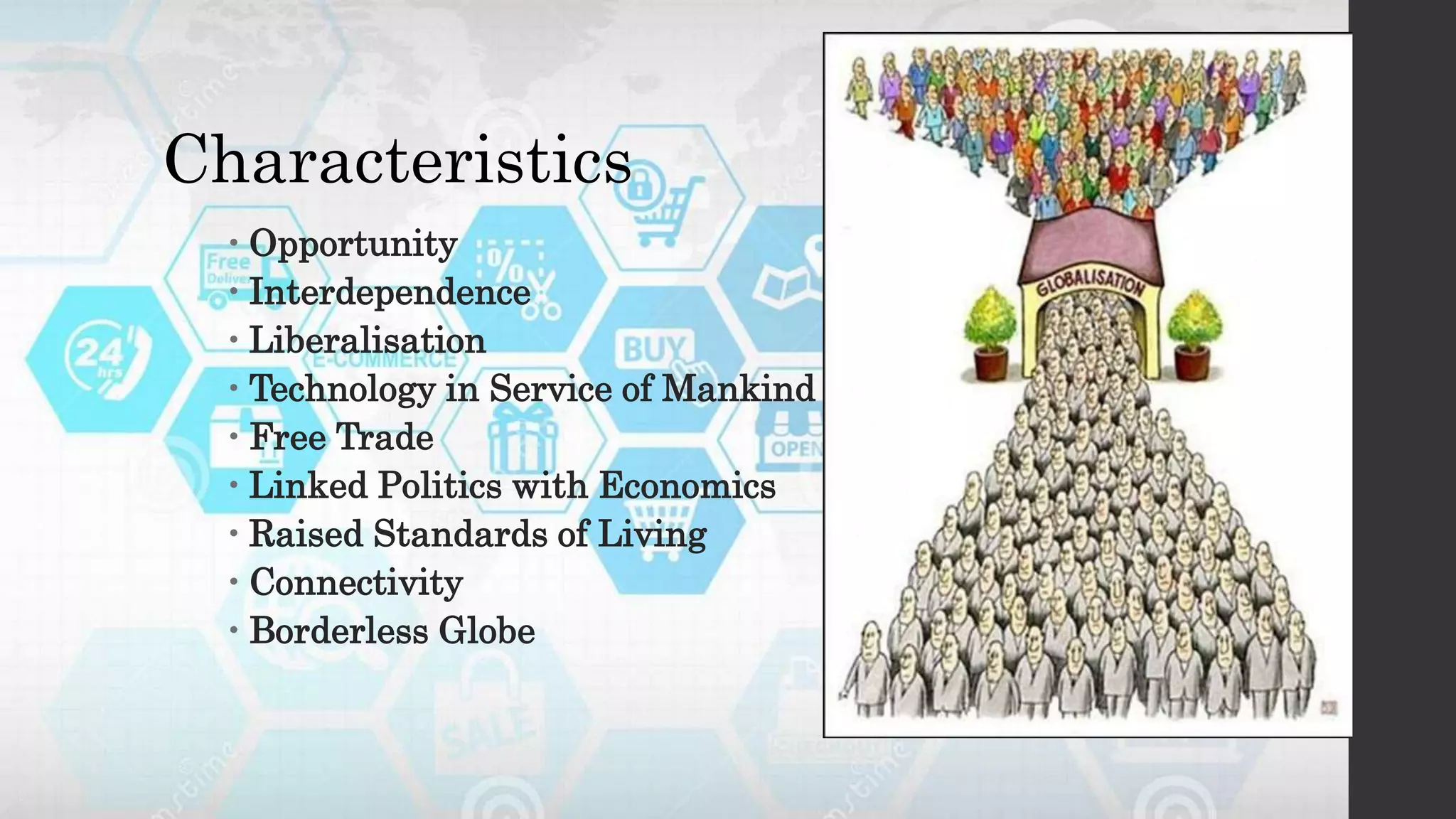
Characteristics
 Opportunity
 Interdependence
 Liberalisation
 Technology in Service of Mankind
 Free Trade
 Linked Politics with Economics
 Raised Standards of Living
 Connectivity
 Borderless Globe
Importance
Globalization allows countries to benefit from
economic synergy and collaborate in handling political,
social and economic challenges. A broader marketplace
allows producers to fetch more for their goods, and a global
supply network gives public and private entities more
buying options. Globalization also increases opportunities
for companies to expand operations in foreign markets.
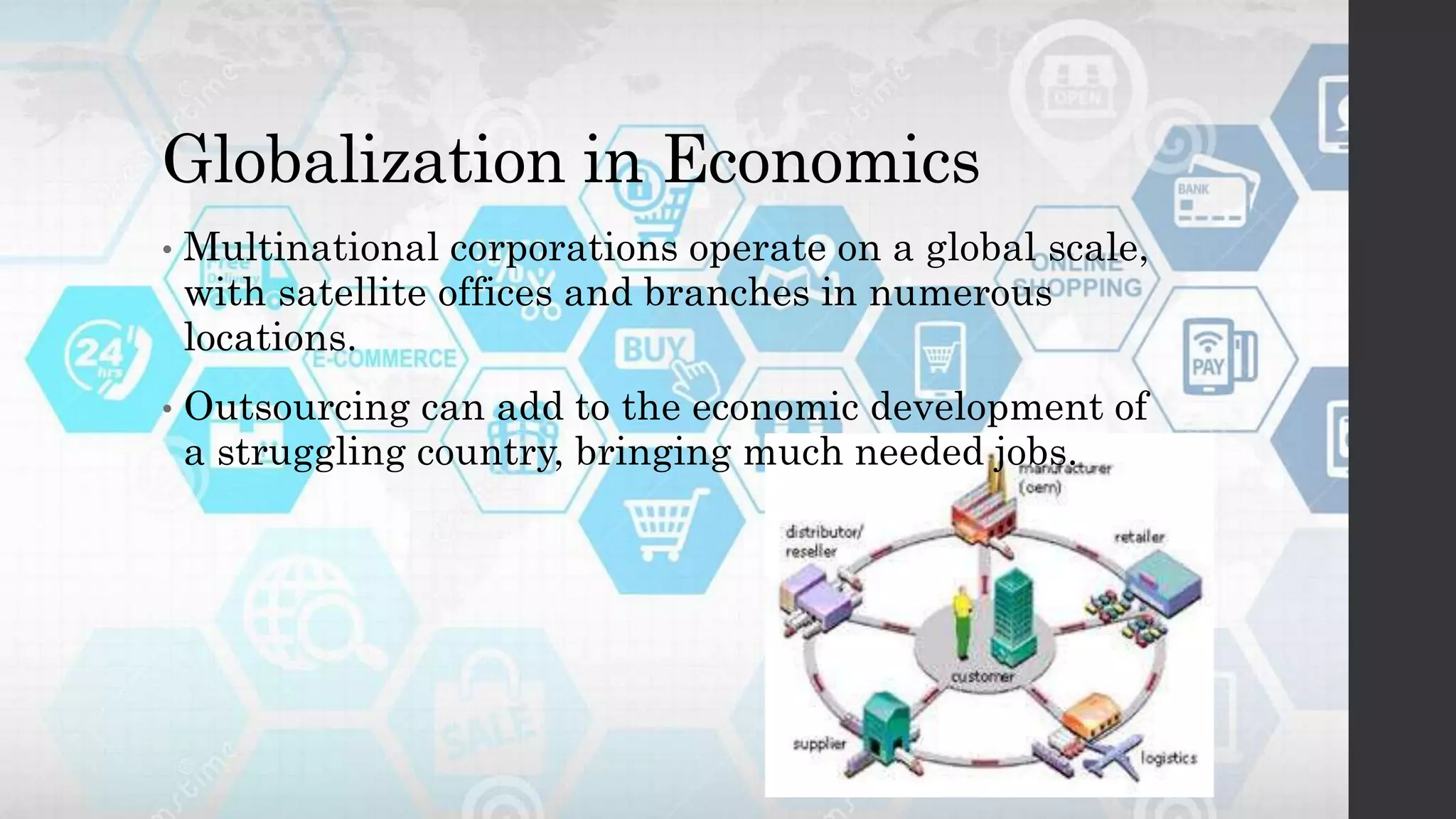
Globalization in Economics
• Multinational corporations operate on a global scale,
with satellite offices and branches in numerous
locations.
• Outsourcing can add to the economic development of
a struggling country, bringing much needed jobs.
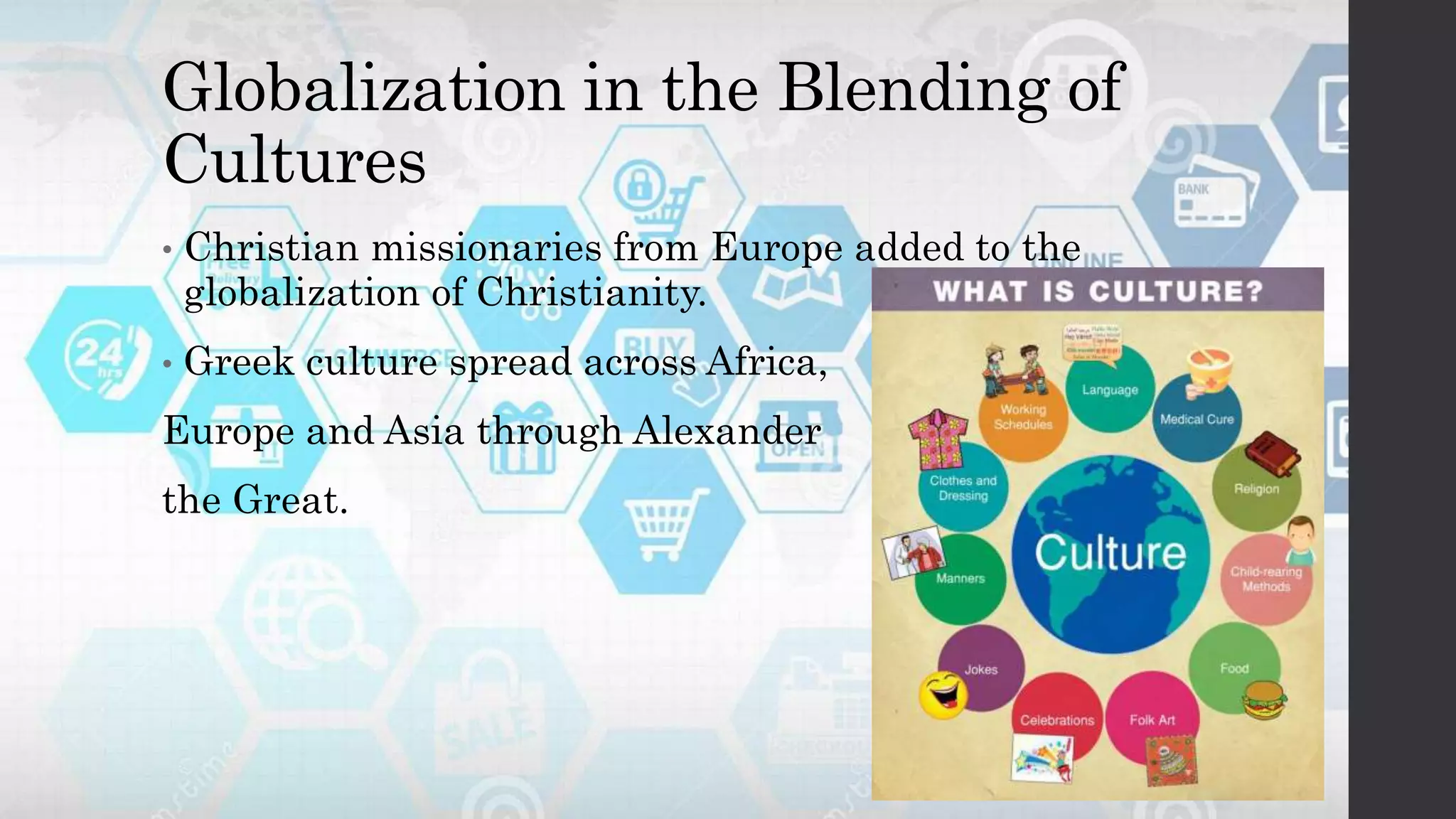
Globalization in the Blending of
Cultures
• Christian missionaries from Europe added to the
globalization of Christianity.
• Greek culture spread across Africa,
Europe and Asia through Alexander
the Great.
Globalization in Technology
• Internet is a major contributor to globalization, not
only technologically but in other areas as well, like in
cultural exchanges of the arts.
• Cells phones connect people all over the world like
never before. Around 60 percent of all people in the
world use cell phones.
Impact of globalization on world
economy
 More efficient markets Efficient markets should be what
every economy strives for. Essentially, the sign of an
efficient market is where there is an equilibrium between
what buyers are willing to pay for a good or service and
what sellers are willing to sell for a good or service.
 Increased competition Anytime that you have multiple
producers competing for a hold of the economy, that’s a
good sign for consumers, as the quality of goods and
services often goes up as a result.
 Stabilized security When your economy depends largely
on another country’s economy, it is hard to imagine either
one of the countries attacking the other. In a weird sort of
way, globalization helped heighten world security.
What is E-commerce
• E-commerce refers to the purchase and sale of goods
and/or services via electronic channels such as the
internet.
• Electronic commerce (ecommerce) is a type of
business model, or segment of a larger business
model, that enables a firm or individual to conduct
business over an electronic network, typically the
internet.
Categories of e-commerce
• As with traditional commerce, there are four
principal categories of e-commerce: B2B, B2C,
C2B and C2C.
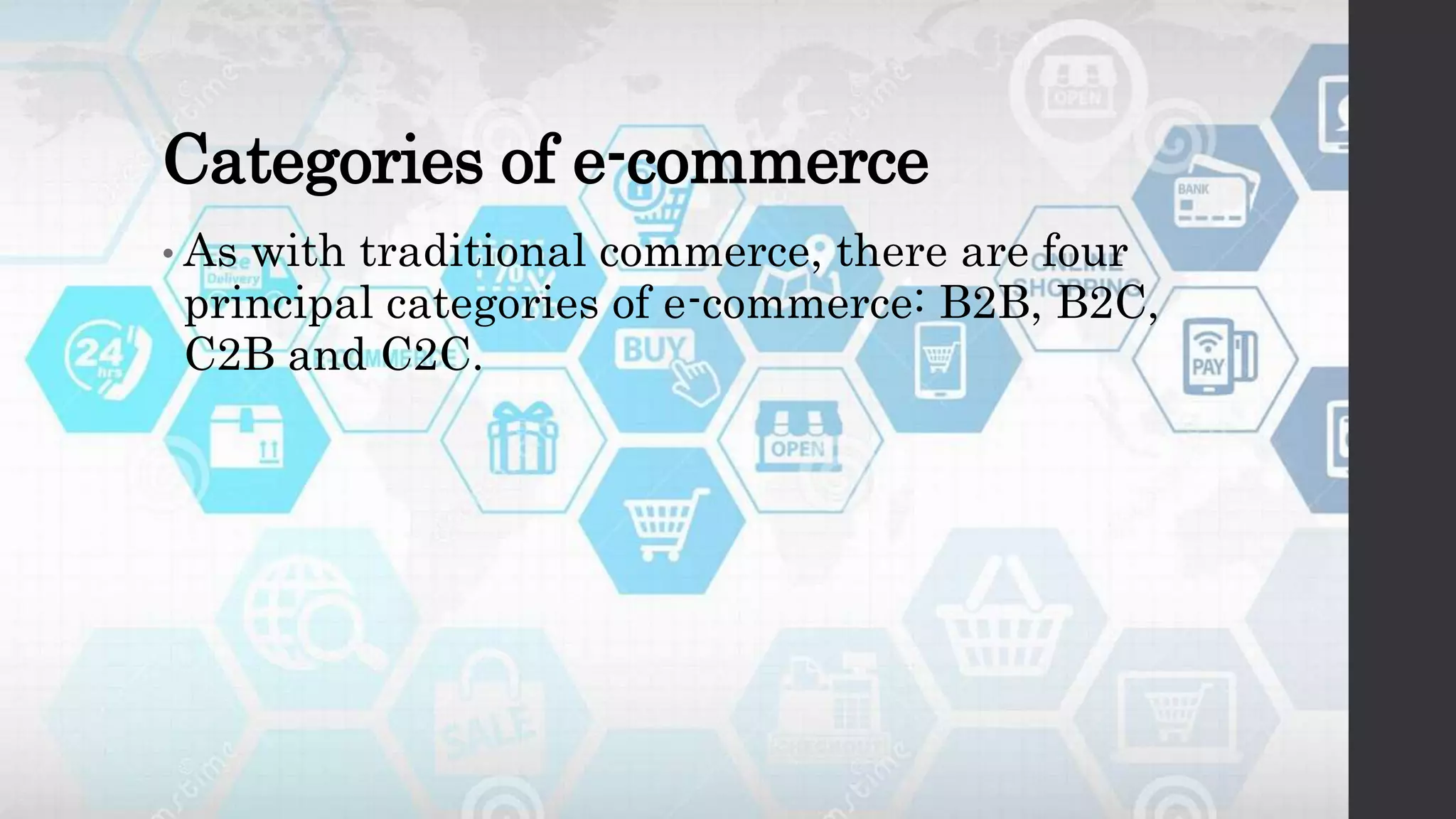
• B2B (business to business) – This involves companies
doing business with each other. One example is
manufacturers selling to distributors and wholesalers
selling to retailers.
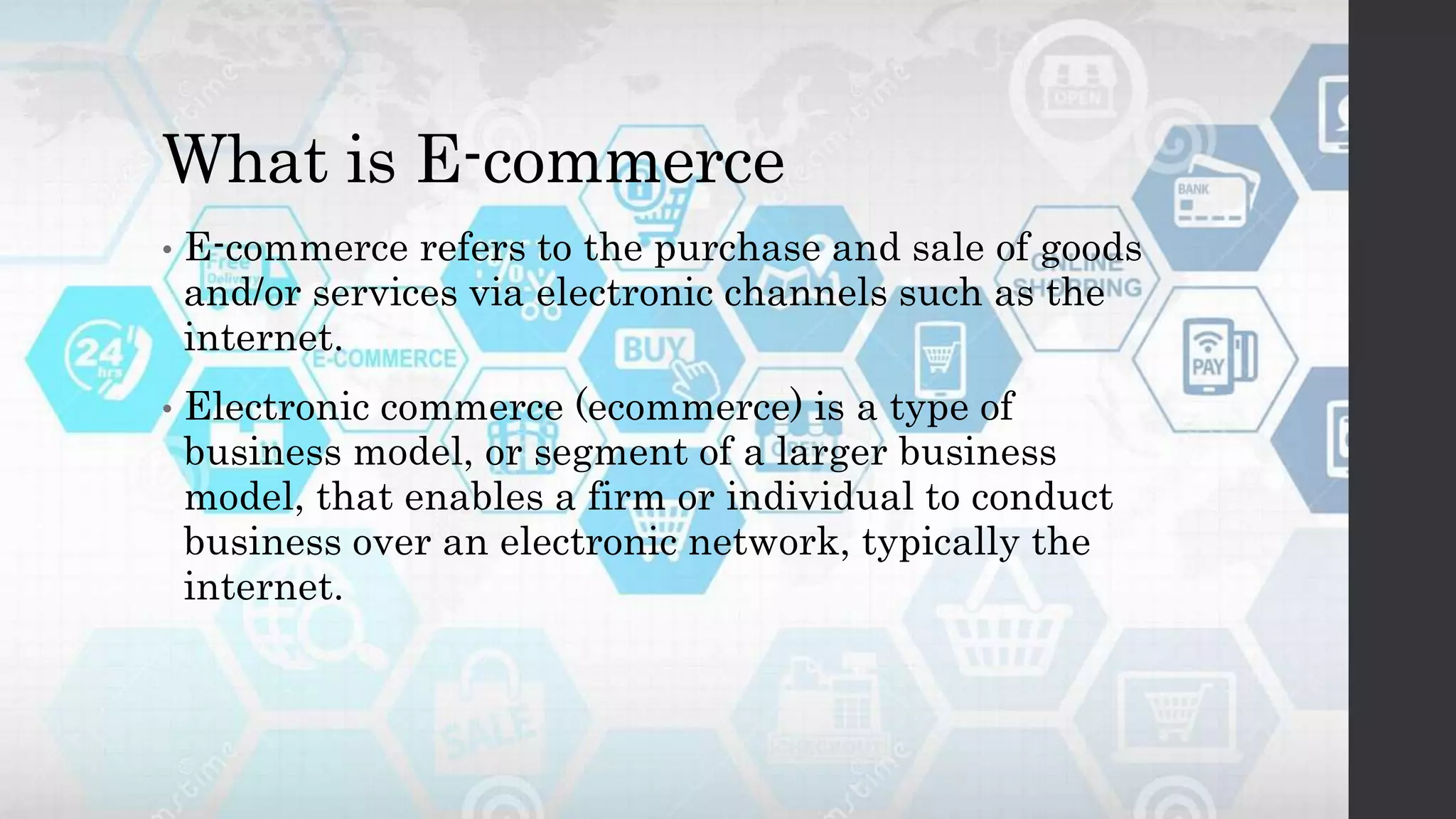
• B2C (business to consumer) – B2C consists of businesses
selling to the public through shopping cart software,
without needing any human interaction. This is what
most people think of when they hear "e-commerce." An
example of this is Amazon.
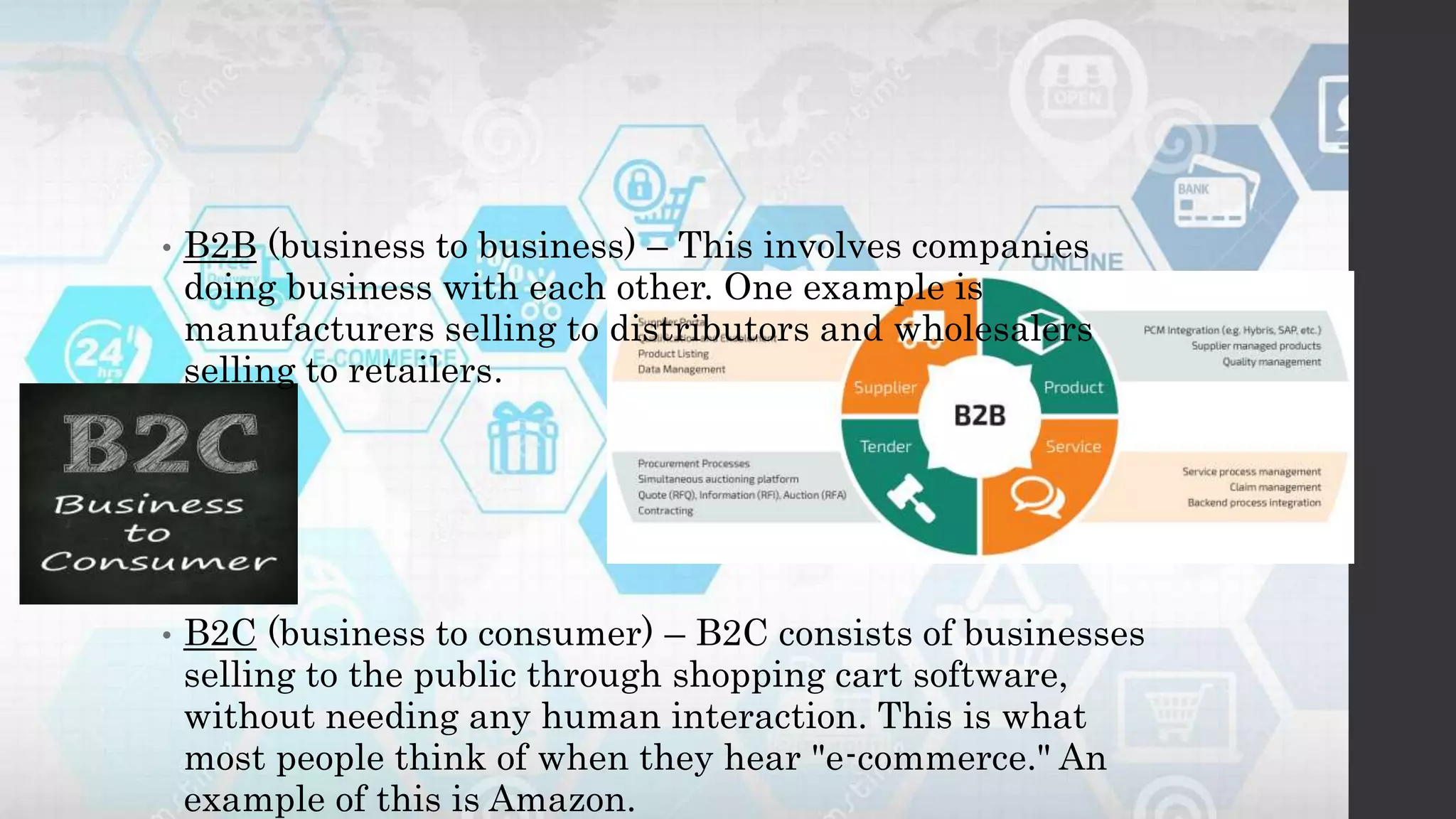
• C2B (consumer to business) – In C2B e-commerce,
consumers post a project with a set budget online, and
companies bid on the project. The consumer reviews the
bids and selects the company. Elance is an example of
this.
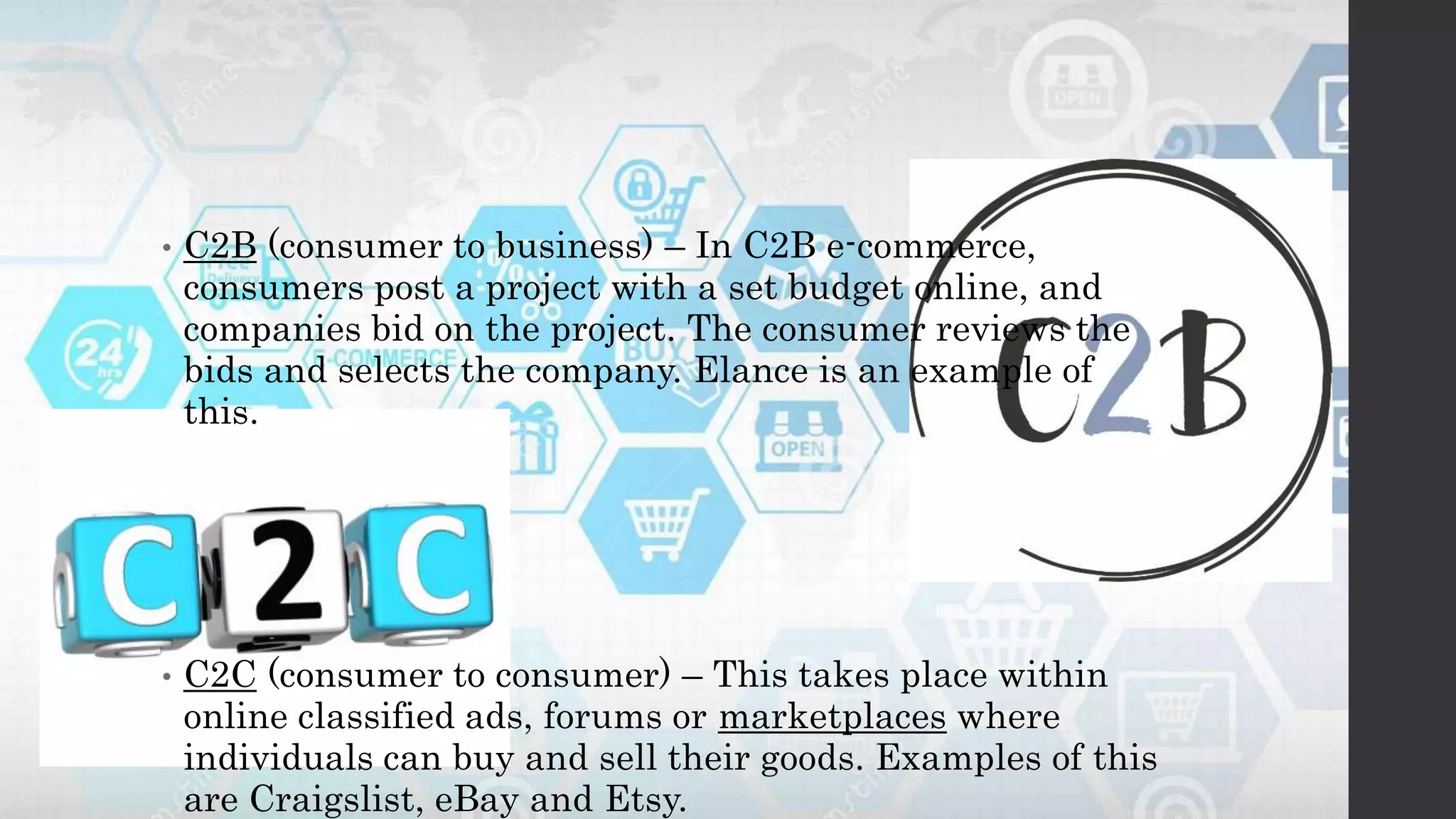
• C2C (consumer to consumer) – This takes place within
online classified ads, forums or marketplaces where
individuals can buy and sell their goods. Examples of this
are Craigslist, eBay and Etsy.
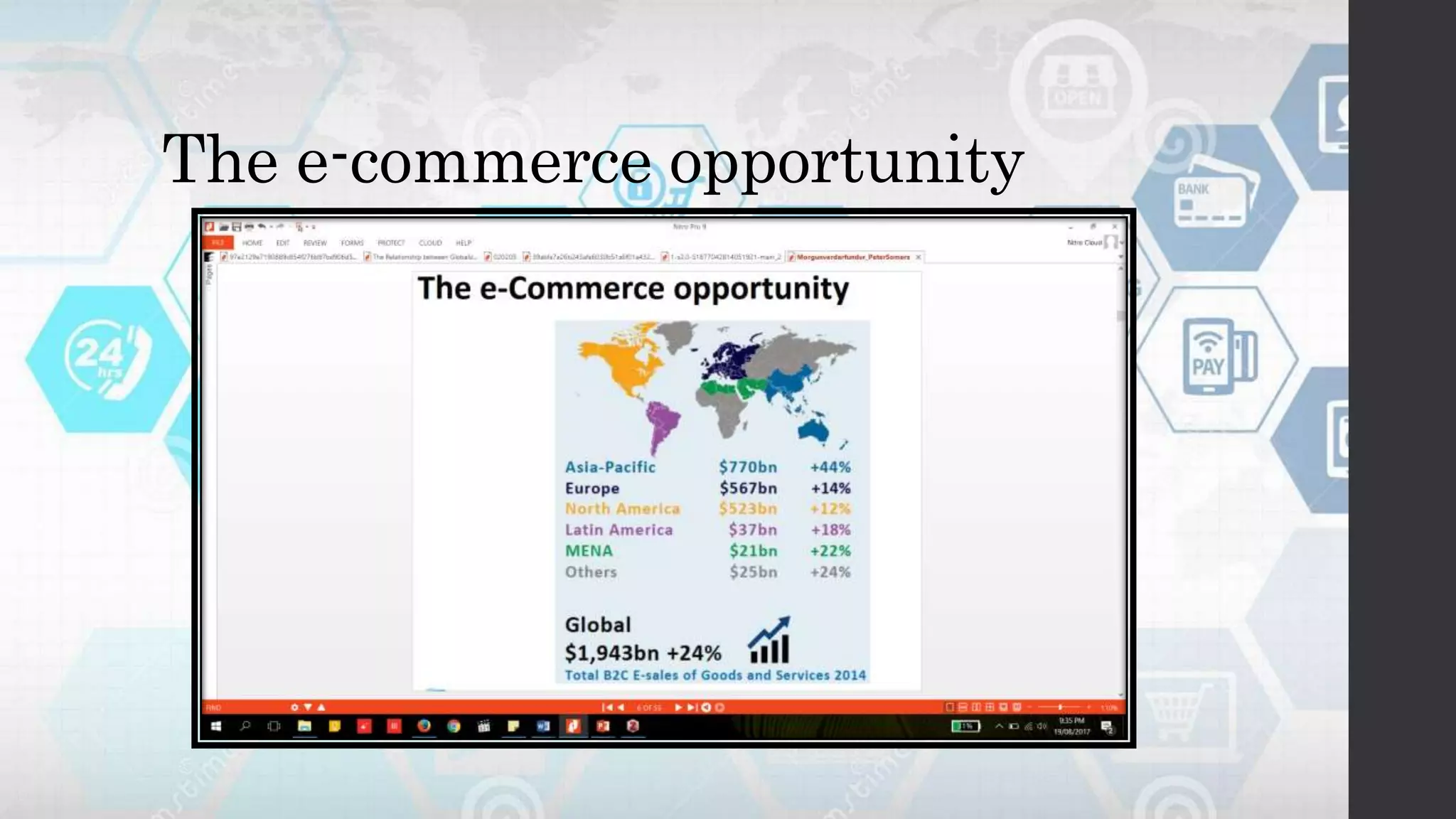
The e-commerce opportunity
Technology and e-commerce trends
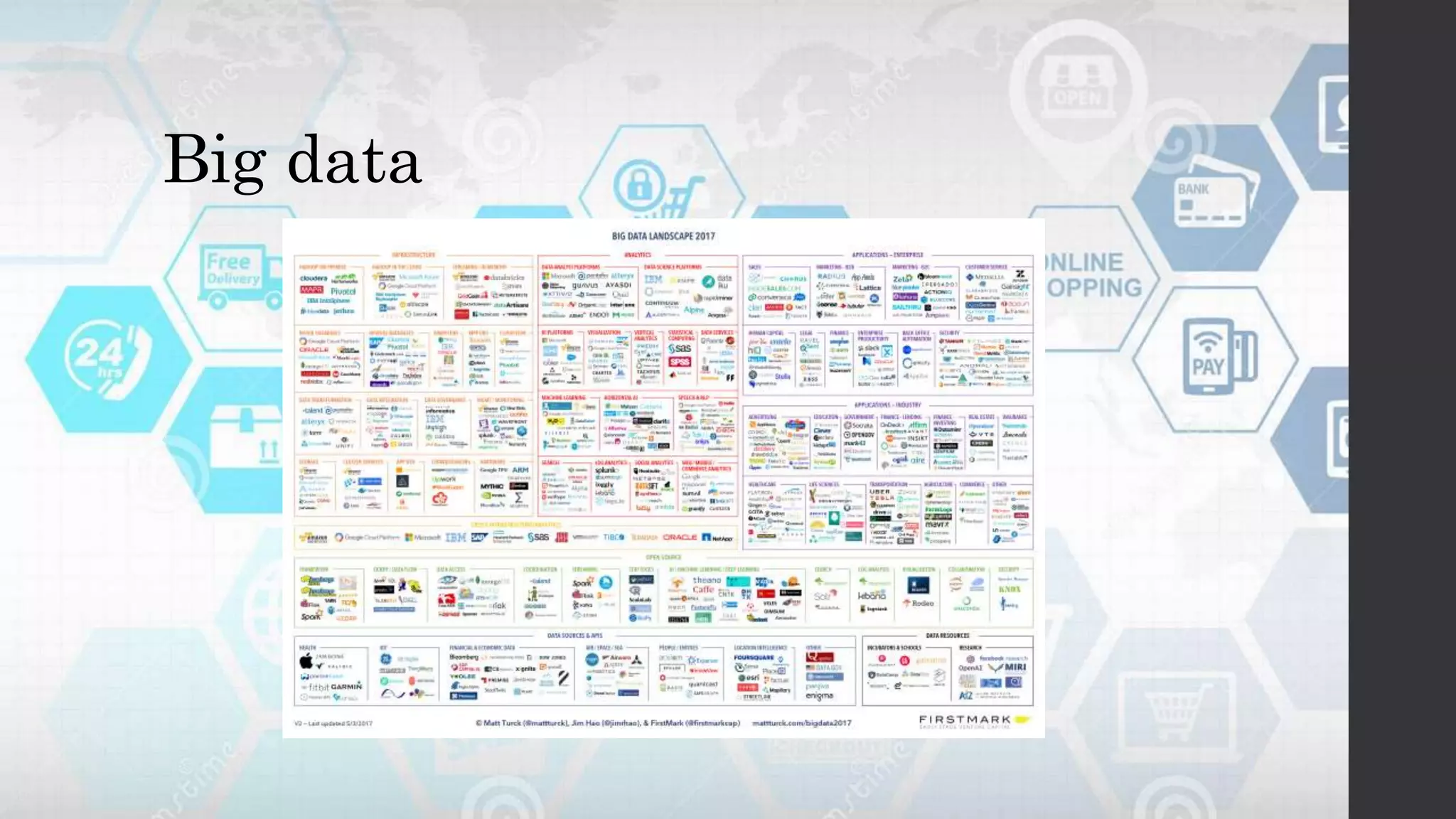
 Big data
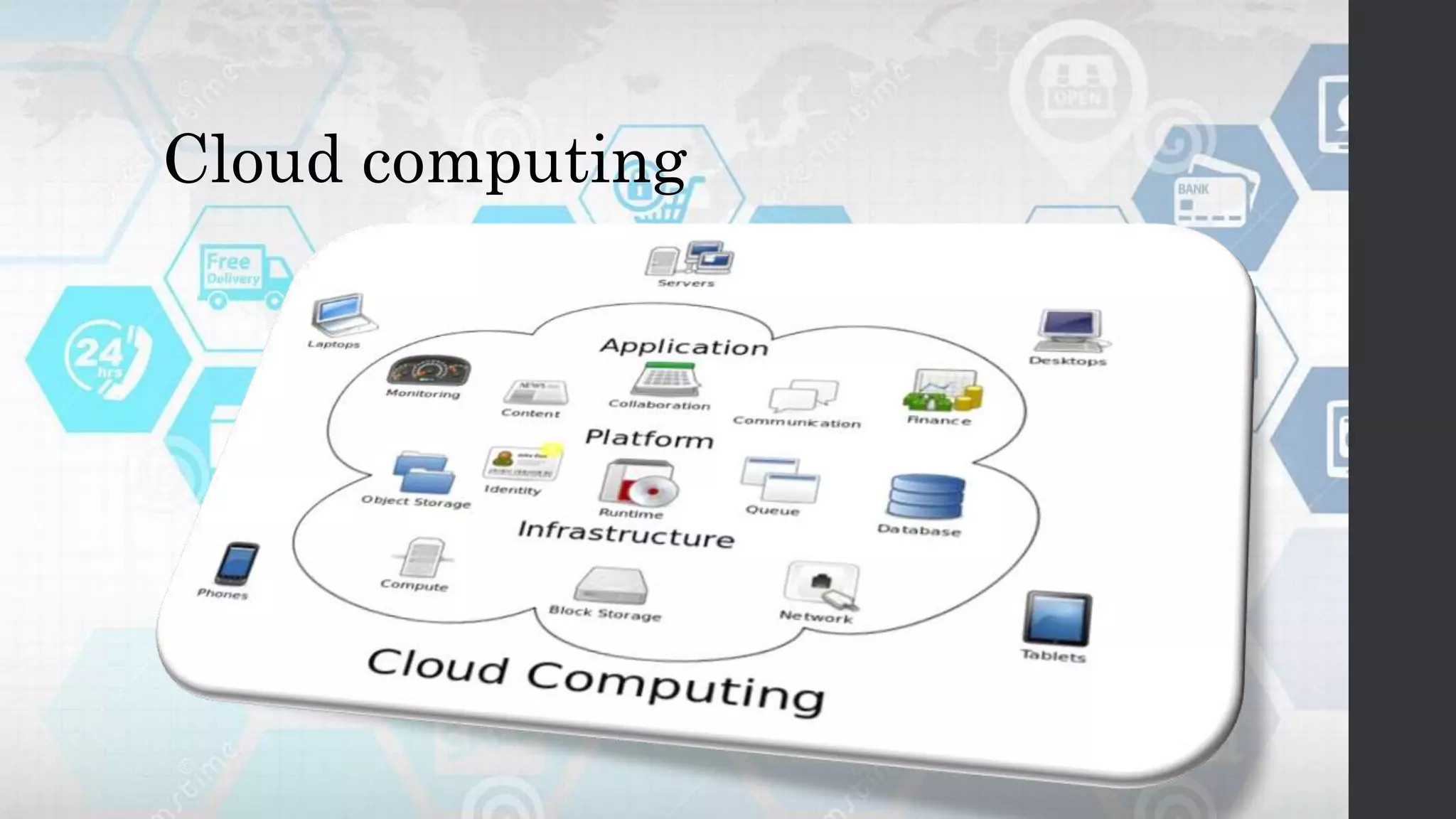
 Cloud computing
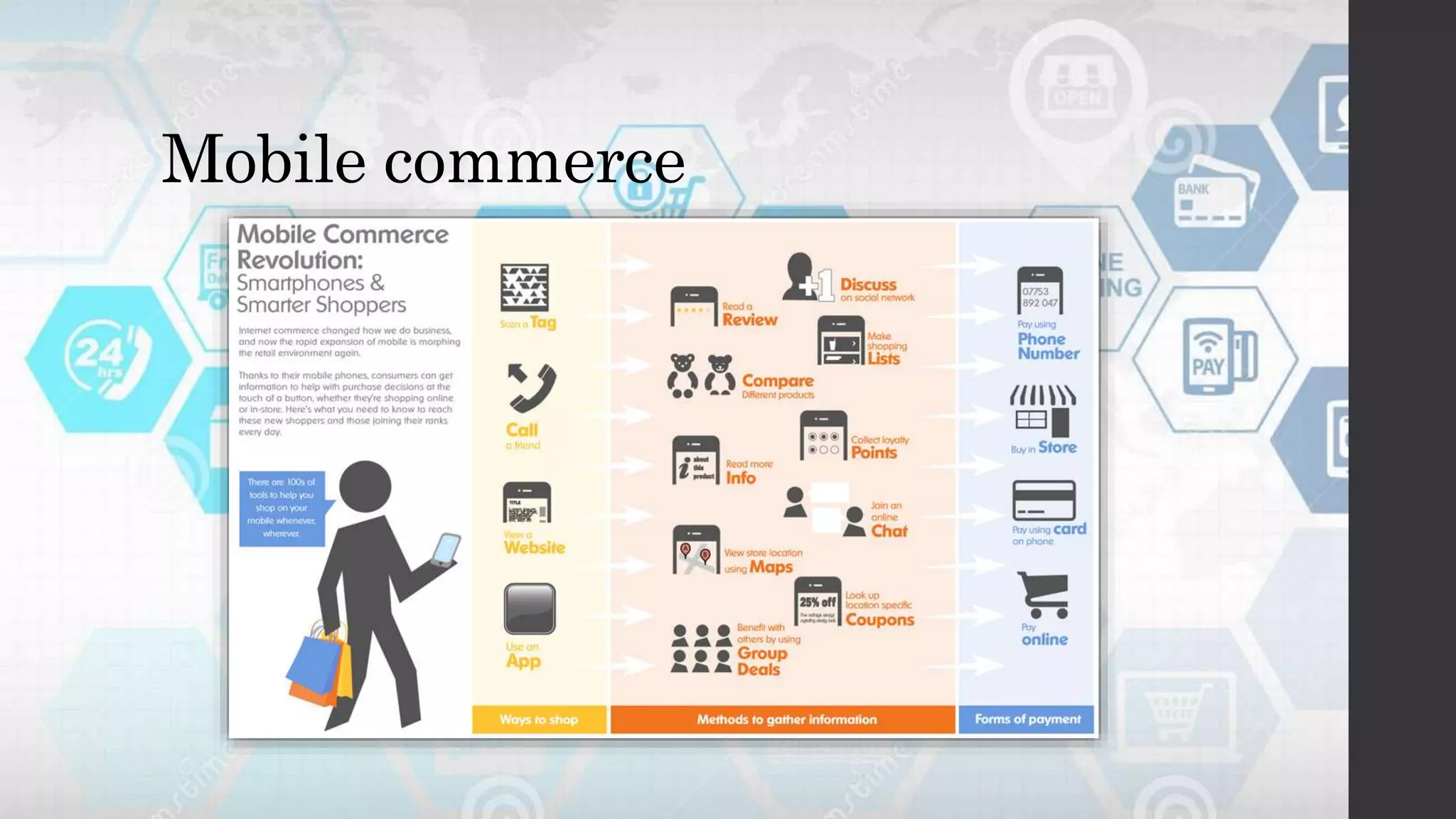
 Mobile commerce in Europe
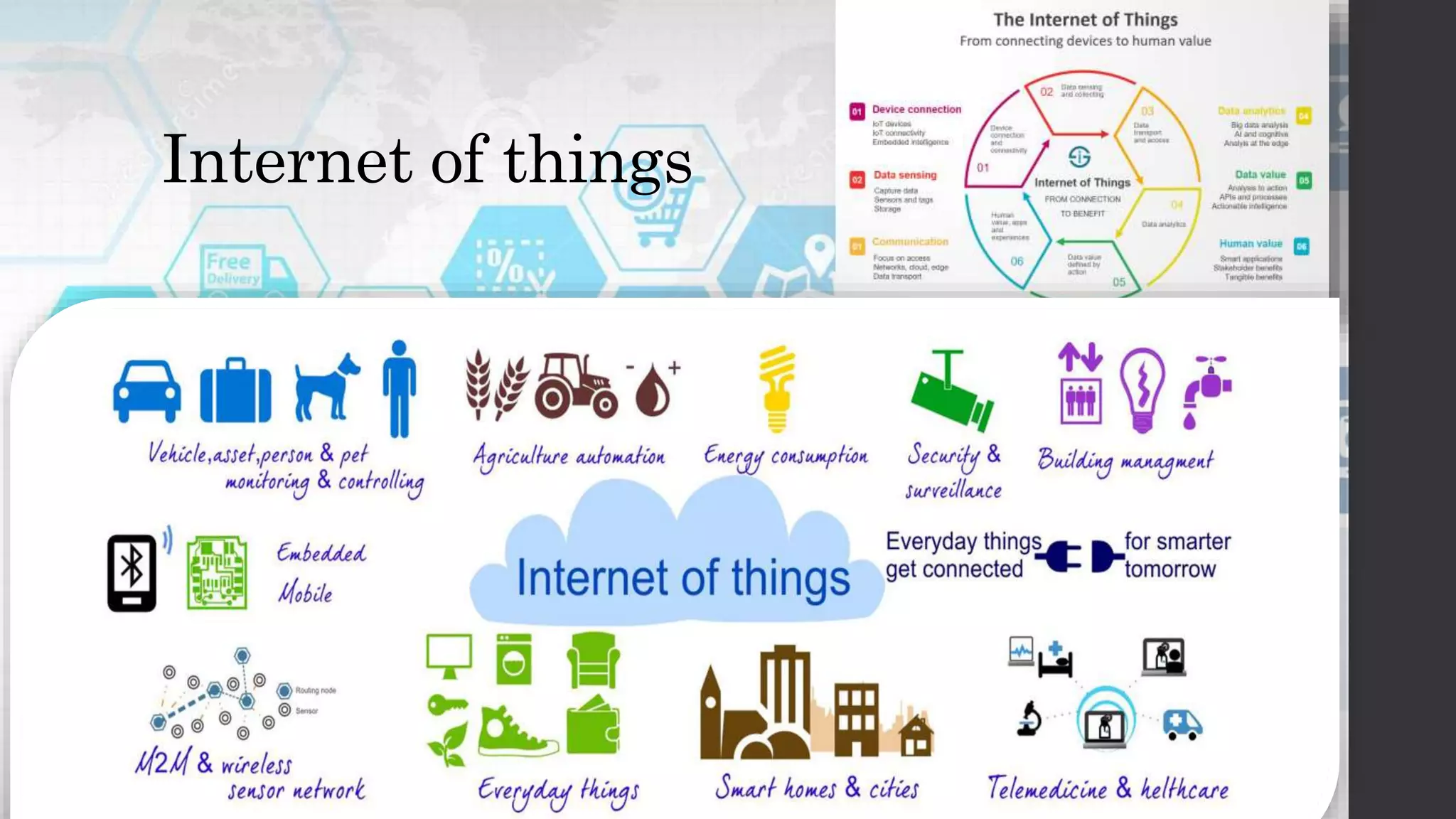
 Internet of things
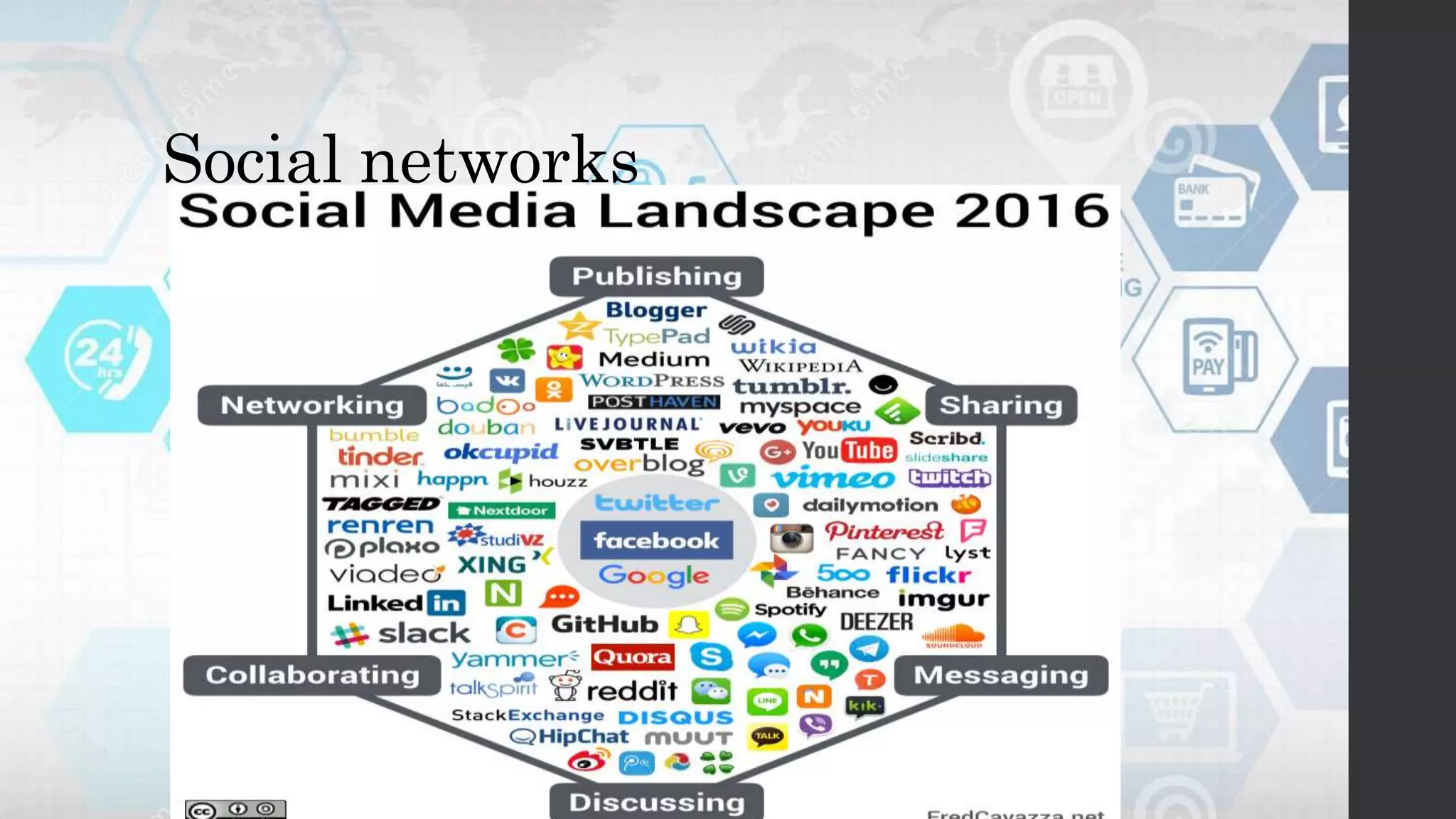
 Social networks
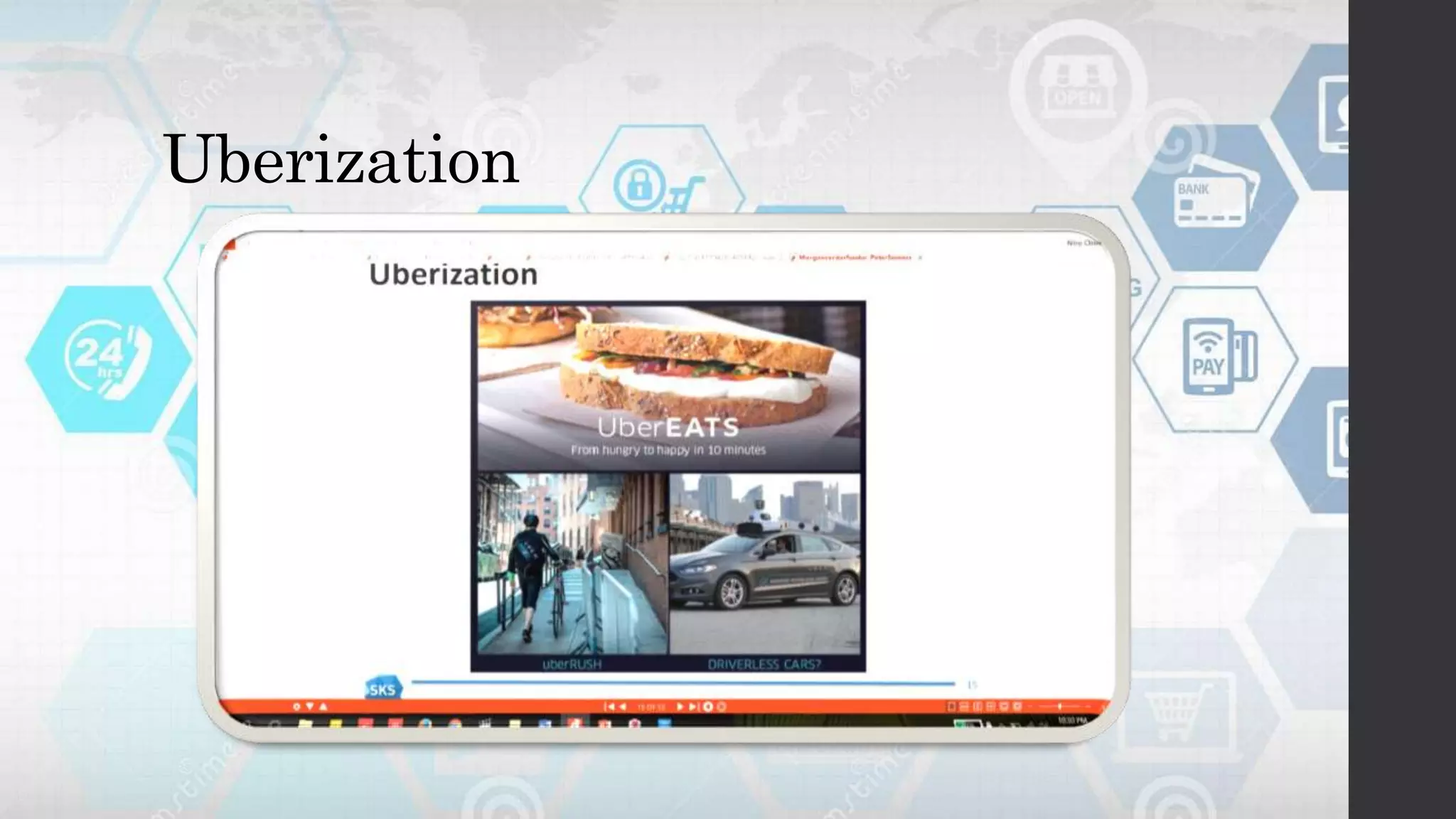
 Uberization
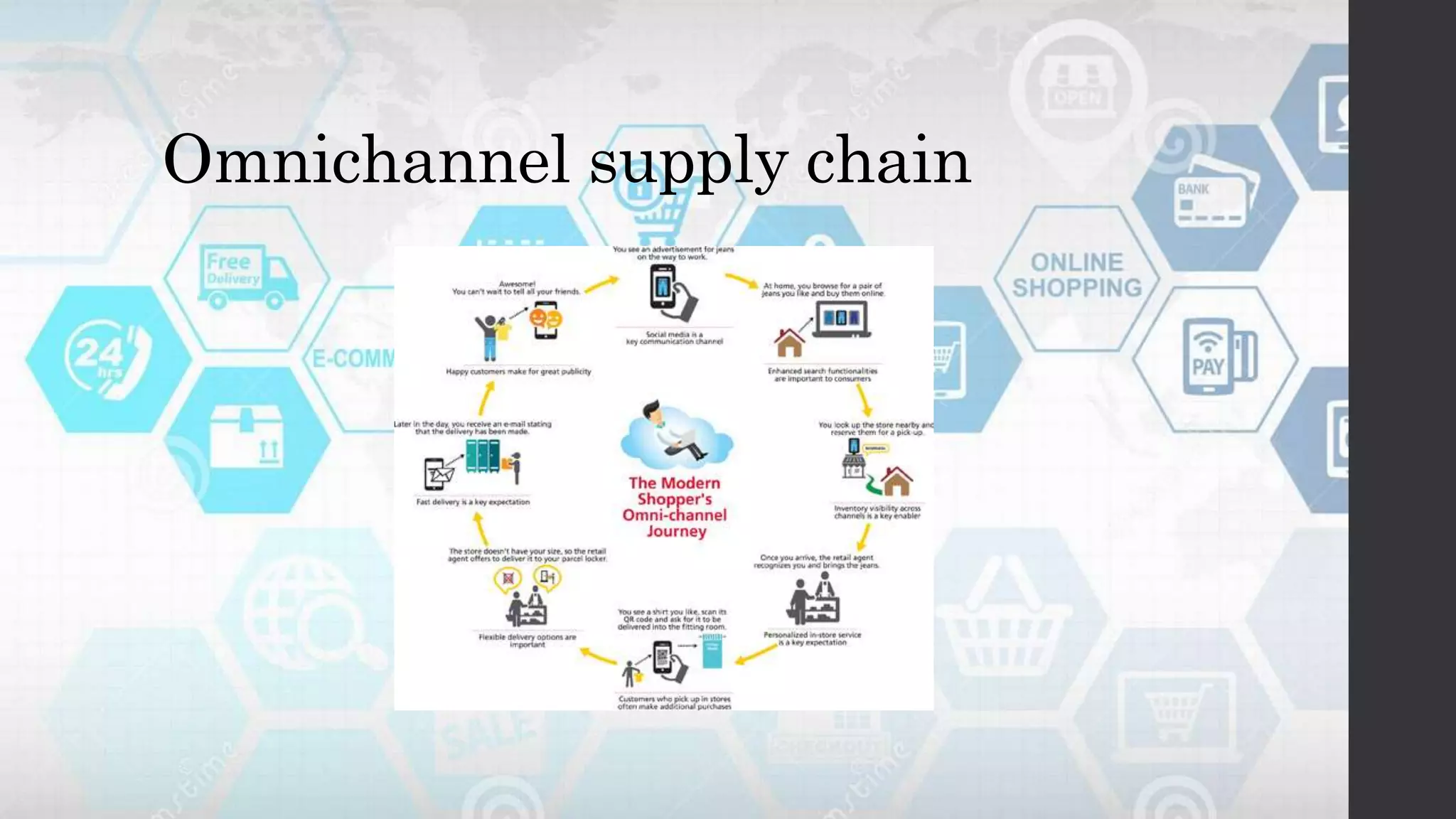
 Omnichannel supply chain
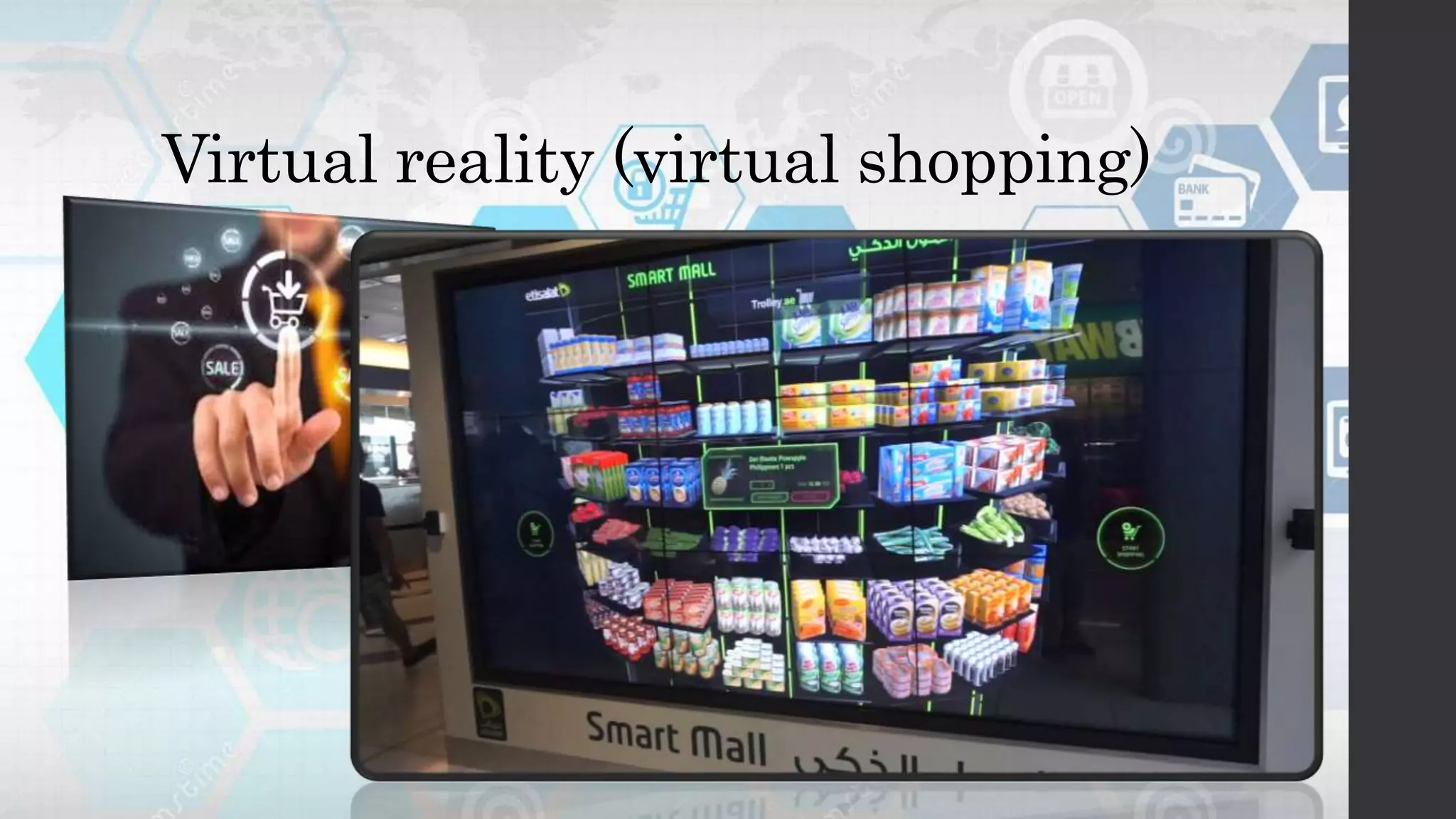
 Virtual reality (virtual shopping)
Big data
Cloud computing
Mobile commerce
Internet of things
Social networks
Uberization
Omnichannel supply chain
Virtual reality (virtual shopping)
Effects of ecommerce on
globalization
• Globalization supported the global economy by the decline in administrative
barriers to trade, sharp falls in the costs of transportation and communication,
fragmentation of production processes and the development in information and
communication technology. Telecommunications and transport links flourished by
the globalization created a new way of accessing to the new markets through e-
commerce.
• In this context the way globalization affect e-commerce and the opposite situation
co me into agenda. In a broadsense e-commerce concept, affecting employment
patterns, productivity and industry structure, is much broader than it's perceived
and relationship between globalization and e-commerce is complicated.
• Telecommunications and technological substructure of the countries are directly
benefited from the globalization process.
• In this regards developed countries which are into globalization process way
before have solid infrastructure of telecommunications and technology. As a result
for these countries e-commerce is more effective on globalization than the
opposite case.
Digital divide
Developing country
• Social equality. ICTs have the potential to dispel
disadvantages that may be associated with cultural
barriers. For example, ICTs may be used to improve
gender equality in education.
• Social mobility which refers to the upward movement in
status of individuals or groups based on wealth,
occupation, education, or some other social variable in a
society where one status is not dictated or decreed by
birth of origin. Advancements in ICTs are capable of
bestowing advantages in education, job-training, health-
care as well as social networking and quality of life that
they could make a difference between upward social
mobility and a declining standard of living.
• Economic equality. Bridging the digital divide has
implications in terms of fostering economic equality,
educational potential, and earning potential.
• e-democracy. ICTs can be a powerful tool for increasing
transparency and facilitating information and
communication processes among stakeholders.
• Economic Growth and Innovations. Long-term economic
growth has often been associated With technological
progress.
References:
• “E-Commerce and E-Business/E-Commerce in Developing Countries -
Wikibooks, Open Books for an Open World.” Accessed August 18, 2017.
https://en.wikibooks.org/wiki/E-Commerce_and_E-Business/E-
Commerce_in_Developing_Countries.
• “Examples of Globalization.” YourDictionary. Accessed August 19, 2017.
http://examples.yourdictionary.com/examples-of-globalization.html.
• Fontinelle, Amy. “Electronic Commerce - Ecommerce.” Investopedia,
November 17, 2003. http://www.investopedia.com/terms/e/ecommerce.asp.
• “Globalization And The Impacts Of E Commerce.” UKEssays. Accessed
August 18, 2017. https://www.ukessays.com/essays/information-
technology/globalization-and-the-impacts-of-e-commerce-information-
technology-essay.php.
• “Impact of eCommerce in Today’s Business World.” SynAxiom, April 5, 2014.
http://www.synaxiom.com/impact-of-ecommerce-in-todays-business-world/.
• Khatri, Prof Jagdish. “Ten Basic Characteristics of Globalization,” January
6, 2015. https://www.linkedin.com/pulse/ten-basic-characteristics-
globalization-prof-jagdish-khatri.
• Kraemer, Kenneth L., Jennifer Gibbs, and Jason Dedrick. “Impacts of
Globalization on E-Commerce Use and Firm Performance: A Cross-Country
Investigation.” The Information Society 21 (n.d.): 323–40.
• Media 208.489.0123, Tribute. “The Evolution of E-Commerce.” Accessed
August 16, 2017. https://www.tributemedia.com/blog/the-evolution-of-
ecommerce.
• Staff, Investopedia. “Globalization.” Investopedia, November 20, 2003.
http://www.investopedia.com/terms/g/globalization.asp.
• “The Economic Impact of E-Commerce – CSCMP’s Supply Chain Quarterly.”
Accessed August 18, 2017.
http://www.supplychainquarterly.com/columns/scq201102monetarymatters/.
• “The History Of Ecommerce: How Did It All Begin?” Miva Blog, October 26,
2011. https://www.miva.com/blog/the-history-of-ecommerce-how-did-it-all-
begin/.
• “The Impact of the Internet on Business.” Accessed August 18, 2017.
http://crab.rutgers.edu/~goertzel/economistnetbusiness.htm.
• Aydın, Erdal, and Burcu Kılınç Savrul. “The Relationship between
Globalization and E-Commerce: Turkish Case.” Procedia - Social and
Behavioral Sciences, 10th International Strategic Management Conference
2014, 150 (September 15, 2014): 1267–76. doi:10.1016/j.sbspro.2014.09.143.
• Rivera, reas, B2B Staff Writer August 16, and 2017 07:45 am EST. “What Is
E-Commerce?” Business News Daily. Accessed August 18, 2017.
http://www.businessnewsdaily.com/4872-what-is-e-commerce.html.

Effects of e commerce to globalization

  • 1.
  • 2.
    What is 'Globalization' •Globalization implies the opening of local and nationalistic perspectives to a broader outlook of an interconnected and interdependent world with free transfer of capital, goods, and services across national frontiers. • Globalization is the tendency of investment funds and businesses to move beyond domestic and national markets to other markets around the globe, thereby increasing the interconnection of the world. Globalization has had the effect of markedly increasing international trade and cultural exchange
  • 3.
    Characteristics  Opportunity  Interdependence Liberalisation  Technology in Service of Mankind  Free Trade  Linked Politics with Economics  Raised Standards of Living  Connectivity  Borderless Globe
  • 4.
    Importance Globalization allows countriesto benefit from economic synergy and collaborate in handling political, social and economic challenges. A broader marketplace allows producers to fetch more for their goods, and a global supply network gives public and private entities more buying options. Globalization also increases opportunities for companies to expand operations in foreign markets.
  • 5.
    Globalization in Economics •Multinational corporations operate on a global scale, with satellite offices and branches in numerous locations. • Outsourcing can add to the economic development of a struggling country, bringing much needed jobs.
  • 6.
    Globalization in theBlending of Cultures • Christian missionaries from Europe added to the globalization of Christianity. • Greek culture spread across Africa, Europe and Asia through Alexander the Great.
  • 7.
    Globalization in Technology •Internet is a major contributor to globalization, not only technologically but in other areas as well, like in cultural exchanges of the arts. • Cells phones connect people all over the world like never before. Around 60 percent of all people in the world use cell phones.
  • 8.
    Impact of globalizationon world economy  More efficient markets Efficient markets should be what every economy strives for. Essentially, the sign of an efficient market is where there is an equilibrium between what buyers are willing to pay for a good or service and what sellers are willing to sell for a good or service.  Increased competition Anytime that you have multiple producers competing for a hold of the economy, that’s a good sign for consumers, as the quality of goods and services often goes up as a result.  Stabilized security When your economy depends largely on another country’s economy, it is hard to imagine either one of the countries attacking the other. In a weird sort of way, globalization helped heighten world security.
  • 9.
    What is E-commerce •E-commerce refers to the purchase and sale of goods and/or services via electronic channels such as the internet. • Electronic commerce (ecommerce) is a type of business model, or segment of a larger business model, that enables a firm or individual to conduct business over an electronic network, typically the internet.
  • 10.
    Categories of e-commerce •As with traditional commerce, there are four principal categories of e-commerce: B2B, B2C, C2B and C2C.
  • 11.
    • B2B (businessto business) – This involves companies doing business with each other. One example is manufacturers selling to distributors and wholesalers selling to retailers. • B2C (business to consumer) – B2C consists of businesses selling to the public through shopping cart software, without needing any human interaction. This is what most people think of when they hear "e-commerce." An example of this is Amazon.
  • 12.
    • C2B (consumerto business) – In C2B e-commerce, consumers post a project with a set budget online, and companies bid on the project. The consumer reviews the bids and selects the company. Elance is an example of this. • C2C (consumer to consumer) – This takes place within online classified ads, forums or marketplaces where individuals can buy and sell their goods. Examples of this are Craigslist, eBay and Etsy.
  • 13.
  • 16.
    Technology and e-commercetrends  Big data  Cloud computing  Mobile commerce in Europe  Internet of things  Social networks  Uberization  Omnichannel supply chain  Virtual reality (virtual shopping)
  • 17.
  • 18.
  • 19.
  • 20.
  • 21.
  • 22.
  • 23.
  • 24.
  • 25.
    Effects of ecommerceon globalization • Globalization supported the global economy by the decline in administrative barriers to trade, sharp falls in the costs of transportation and communication, fragmentation of production processes and the development in information and communication technology. Telecommunications and transport links flourished by the globalization created a new way of accessing to the new markets through e- commerce. • In this context the way globalization affect e-commerce and the opposite situation co me into agenda. In a broadsense e-commerce concept, affecting employment patterns, productivity and industry structure, is much broader than it's perceived and relationship between globalization and e-commerce is complicated. • Telecommunications and technological substructure of the countries are directly benefited from the globalization process. • In this regards developed countries which are into globalization process way before have solid infrastructure of telecommunications and technology. As a result for these countries e-commerce is more effective on globalization than the opposite case.
  • 26.
    Digital divide Developing country •Social equality. ICTs have the potential to dispel disadvantages that may be associated with cultural barriers. For example, ICTs may be used to improve gender equality in education. • Social mobility which refers to the upward movement in status of individuals or groups based on wealth, occupation, education, or some other social variable in a society where one status is not dictated or decreed by birth of origin. Advancements in ICTs are capable of bestowing advantages in education, job-training, health- care as well as social networking and quality of life that they could make a difference between upward social mobility and a declining standard of living.
  • 27.
    • Economic equality.Bridging the digital divide has implications in terms of fostering economic equality, educational potential, and earning potential. • e-democracy. ICTs can be a powerful tool for increasing transparency and facilitating information and communication processes among stakeholders. • Economic Growth and Innovations. Long-term economic growth has often been associated With technological progress.
  • 28.
    References: • “E-Commerce andE-Business/E-Commerce in Developing Countries - Wikibooks, Open Books for an Open World.” Accessed August 18, 2017. https://en.wikibooks.org/wiki/E-Commerce_and_E-Business/E- Commerce_in_Developing_Countries. • “Examples of Globalization.” YourDictionary. Accessed August 19, 2017. http://examples.yourdictionary.com/examples-of-globalization.html. • Fontinelle, Amy. “Electronic Commerce - Ecommerce.” Investopedia, November 17, 2003. http://www.investopedia.com/terms/e/ecommerce.asp. • “Globalization And The Impacts Of E Commerce.” UKEssays. Accessed August 18, 2017. https://www.ukessays.com/essays/information- technology/globalization-and-the-impacts-of-e-commerce-information- technology-essay.php. • “Impact of eCommerce in Today’s Business World.” SynAxiom, April 5, 2014. http://www.synaxiom.com/impact-of-ecommerce-in-todays-business-world/.
  • 29.
    • Khatri, ProfJagdish. “Ten Basic Characteristics of Globalization,” January 6, 2015. https://www.linkedin.com/pulse/ten-basic-characteristics- globalization-prof-jagdish-khatri. • Kraemer, Kenneth L., Jennifer Gibbs, and Jason Dedrick. “Impacts of Globalization on E-Commerce Use and Firm Performance: A Cross-Country Investigation.” The Information Society 21 (n.d.): 323–40. • Media 208.489.0123, Tribute. “The Evolution of E-Commerce.” Accessed August 16, 2017. https://www.tributemedia.com/blog/the-evolution-of- ecommerce. • Staff, Investopedia. “Globalization.” Investopedia, November 20, 2003. http://www.investopedia.com/terms/g/globalization.asp. • “The Economic Impact of E-Commerce – CSCMP’s Supply Chain Quarterly.” Accessed August 18, 2017. http://www.supplychainquarterly.com/columns/scq201102monetarymatters/.
  • 30.
    • “The HistoryOf Ecommerce: How Did It All Begin?” Miva Blog, October 26, 2011. https://www.miva.com/blog/the-history-of-ecommerce-how-did-it-all- begin/. • “The Impact of the Internet on Business.” Accessed August 18, 2017. http://crab.rutgers.edu/~goertzel/economistnetbusiness.htm. • Aydın, Erdal, and Burcu Kılınç Savrul. “The Relationship between Globalization and E-Commerce: Turkish Case.” Procedia - Social and Behavioral Sciences, 10th International Strategic Management Conference 2014, 150 (September 15, 2014): 1267–76. doi:10.1016/j.sbspro.2014.09.143. • Rivera, reas, B2B Staff Writer August 16, and 2017 07:45 am EST. “What Is E-Commerce?” Business News Daily. Accessed August 18, 2017. http://www.businessnewsdaily.com/4872-what-is-e-commerce.html.