Ask for feedback like you mean
it


X&Y Partners
November 2012
www.thisisxy.com


                            Cátia Carias
                            catia.carias@thisisxy.com
                            +44 (20) 3239 5245
Ask for feedback like you mean it


 “
                Feedback has been coined as a buzzword. It is
                undeserved: asking for help and actually listening
                to the resulting opinions is uncomfortable but
                very useful.

There are sentences that stick to your mind, like gum. In my case, one of these is
about feedback. It all goes back to the days of my MBA. At the end of a group project
that had gone wrong from the start, we decided to organize a round of feedback to
understand what had happened. One of my colleagues didn’t hold anything back: she
told the rest of us, eyes in eyes, where we had failed and how we should improve.
She finalized by saying that “feedback is a gift that I give you, you can decide to
accept or reject it”.

Feedback is a tricky thing. We know that we should ask for it, but sometimes we
don’t. We know that we should take it into consideration, but we rarely do. Taking
feedback into account usually means putting more work into something we already
dedicated a lot of time, effort and care to. It forces us to reopen a task we had
assumed was already closed. This article from Harvard Business Review
recommends to “think carefully and consciously about whether we really want
feedback, and why” and “when we do ask for feedback, be prepared to seriously
consider it”.

With this is mind, a few months ago we decided to ask for feedback about X&Y’s
rebranding. This is what we learned in the process:


                                                                                 2
1. Get the timing right

Ask for feedback too early in the process and you’ll have nothing concrete to ask
feedback about. Wait too long and you will not be able to take feedback into account.
In our case, we decided to have two feedback rounds: a first one, small and limited to
discussing a few key objectives and ideas, and a broader session, once we had a
draft version of our new positioning, brand, website and content.

2. Leverage your network

Chances are that you know a lot of smart people: friends, colleagues, clients,
suppliers, business partners. These people care about you and are likely familiar with
the issue at hands. Feedback is an opportunity to get free advice from talented
individuals.

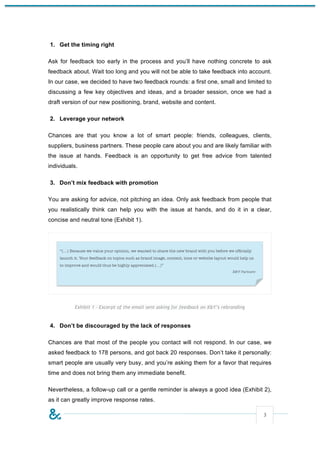
3. Don’t mix feedback with promotion

You are asking for advice, not pitching an idea. Only ask feedback from people that
you realistically think can help you with the issue at hands, and do it in a clear,
concise and neutral tone (Exhibit 1).


          Exhibit 1 – Excerpt of the email sent asking for feedback on X&Y’s rebranding


4. Don’t be discouraged by the lack of responses

Chances are that most of the people you contact will not respond. In our case, we
asked feedback to 178 persons, and got back 20 responses. Don’t take it personally:
smart people are usually very busy, and you’re asking them for a favor that requires
time and does not bring them any immediate benefit.

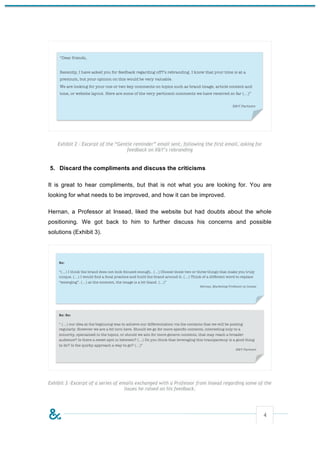
Nevertheless, a follow-up call or a gentle reminder is always a good idea (Exhibit 2),
as it can greatly improve response rates.

                                                                                          3
Exhibit 2 – Excerpt of the “Gentle reminder” email sent, following the first email, asking for
                                    feedback on X&Y’s rebranding


5. Discard the compliments and discuss the criticisms

It is great to hear compliments, but that is not what you are looking for. You are
looking for what needs to be improved, and how it can be improved.

Hernan, a Professor at Insead, liked the website but had doubts about the whole
positioning. We got back to him to further discuss his concerns and possible
solutions (Exhibit 3).


Exhibit 3 –Excerpt of a series of emails exchanged with a Professor from Insead regarding some of the
                                    issues he raised on his feedback.


                                                                                                     4
6. Don’t be defensive

Criticisms are hard to hear, and you will feel an urge to defend your ideas. Don’t do it:
you should be looking for refreshing perspectives and alternative solutions, not trying
to convince everybody that you are right.

Kevin, an alumnus from Insead, and Rui, an Associate at Deutsche Bank, thought
that we were not adequately leveraging our experience. They were right: our original
idea of forgoing a traditional reference list in favor of articles that showcased our
knowhow was not working, and the addition of a reference list and more detailed
profiles proved to be very beneficial.

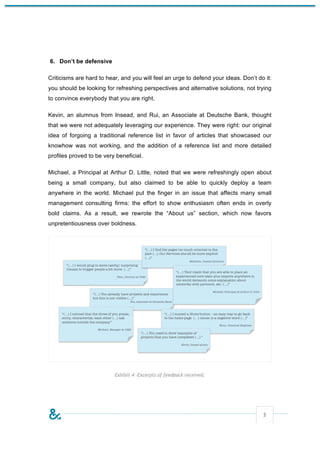
Michael, a Principal at Arthur D. Little, noted that we were refreshingly open about
being a small company, but also claimed to be able to quickly deploy a team
anywhere in the world. Michael put the finger in an issue that affects many small
management consulting firms: the effort to show enthusiasm often ends in overly
bold claims. As a result, we rewrote the “About us” section, which now favors
unpretentiousness over boldness.


                          Exhibit 4 –Excerpts of feedback received.


                                                                                     5
7. Don’t try to please everybody

Not trying to please everybody is as important as not being defensive. Taking every
piece of feedback into account will likely distort your original idea into something that
is no longer your idea.

For instance, we received several criticisms regarding our “Straight answers for
emerging issues” motto. Hernan, a Professor at Insead, said that the word
“emerging” was vague and over-used. Theo, a Director from DSM, added that “it did
not ring a bell”. Despite understanding were these arguments come from, and even
agreeing with them to some extent, we still believed that this catchphrase accurately
summarized what we wanted to achieve with the rebranding, so we decided to keep
it.


 8. Say thank you and return the favor

Feedback can indeed be an amazing gift. It goes without saying that, besides
thanking your contributors for the time and effort they dedicated to help you, you
should be attentive to opportunities to return the favor.


                                                                                     6
7

Ask for feedback like you mean it

  • 1.
    Ask for feedbacklike you mean it X&Y Partners November 2012 www.thisisxy.com Cátia Carias catia.carias@thisisxy.com +44 (20) 3239 5245
  • 2.
    Ask for feedbacklike you mean it “ Feedback has been coined as a buzzword. It is undeserved: asking for help and actually listening to the resulting opinions is uncomfortable but very useful. There are sentences that stick to your mind, like gum. In my case, one of these is about feedback. It all goes back to the days of my MBA. At the end of a group project that had gone wrong from the start, we decided to organize a round of feedback to understand what had happened. One of my colleagues didn’t hold anything back: she told the rest of us, eyes in eyes, where we had failed and how we should improve. She finalized by saying that “feedback is a gift that I give you, you can decide to accept or reject it”. Feedback is a tricky thing. We know that we should ask for it, but sometimes we don’t. We know that we should take it into consideration, but we rarely do. Taking feedback into account usually means putting more work into something we already dedicated a lot of time, effort and care to. It forces us to reopen a task we had assumed was already closed. This article from Harvard Business Review recommends to “think carefully and consciously about whether we really want feedback, and why” and “when we do ask for feedback, be prepared to seriously consider it”. With this is mind, a few months ago we decided to ask for feedback about X&Y’s rebranding. This is what we learned in the process: 2
  • 3.
    1. Get thetiming right Ask for feedback too early in the process and you’ll have nothing concrete to ask feedback about. Wait too long and you will not be able to take feedback into account. In our case, we decided to have two feedback rounds: a first one, small and limited to discussing a few key objectives and ideas, and a broader session, once we had a draft version of our new positioning, brand, website and content. 2. Leverage your network Chances are that you know a lot of smart people: friends, colleagues, clients, suppliers, business partners. These people care about you and are likely familiar with the issue at hands. Feedback is an opportunity to get free advice from talented individuals. 3. Don’t mix feedback with promotion You are asking for advice, not pitching an idea. Only ask feedback from people that you realistically think can help you with the issue at hands, and do it in a clear, concise and neutral tone (Exhibit 1). Exhibit 1 – Excerpt of the email sent asking for feedback on X&Y’s rebranding 4. Don’t be discouraged by the lack of responses Chances are that most of the people you contact will not respond. In our case, we asked feedback to 178 persons, and got back 20 responses. Don’t take it personally: smart people are usually very busy, and you’re asking them for a favor that requires time and does not bring them any immediate benefit. Nevertheless, a follow-up call or a gentle reminder is always a good idea (Exhibit 2), as it can greatly improve response rates. 3
  • 4.
    Exhibit 2 –Excerpt of the “Gentle reminder” email sent, following the first email, asking for feedback on X&Y’s rebranding 5. Discard the compliments and discuss the criticisms It is great to hear compliments, but that is not what you are looking for. You are looking for what needs to be improved, and how it can be improved. Hernan, a Professor at Insead, liked the website but had doubts about the whole positioning. We got back to him to further discuss his concerns and possible solutions (Exhibit 3). Exhibit 3 –Excerpt of a series of emails exchanged with a Professor from Insead regarding some of the issues he raised on his feedback. 4
  • 5.
    6. Don’t bedefensive Criticisms are hard to hear, and you will feel an urge to defend your ideas. Don’t do it: you should be looking for refreshing perspectives and alternative solutions, not trying to convince everybody that you are right. Kevin, an alumnus from Insead, and Rui, an Associate at Deutsche Bank, thought that we were not adequately leveraging our experience. They were right: our original idea of forgoing a traditional reference list in favor of articles that showcased our knowhow was not working, and the addition of a reference list and more detailed profiles proved to be very beneficial. Michael, a Principal at Arthur D. Little, noted that we were refreshingly open about being a small company, but also claimed to be able to quickly deploy a team anywhere in the world. Michael put the finger in an issue that affects many small management consulting firms: the effort to show enthusiasm often ends in overly bold claims. As a result, we rewrote the “About us” section, which now favors unpretentiousness over boldness. Exhibit 4 –Excerpts of feedback received. 5
  • 6.
    7. Don’t tryto please everybody Not trying to please everybody is as important as not being defensive. Taking every piece of feedback into account will likely distort your original idea into something that is no longer your idea. For instance, we received several criticisms regarding our “Straight answers for emerging issues” motto. Hernan, a Professor at Insead, said that the word “emerging” was vague and over-used. Theo, a Director from DSM, added that “it did not ring a bell”. Despite understanding were these arguments come from, and even agreeing with them to some extent, we still believed that this catchphrase accurately summarized what we wanted to achieve with the rebranding, so we decided to keep it. 8. Say thank you and return the favor Feedback can indeed be an amazing gift. It goes without saying that, besides thanking your contributors for the time and effort they dedicated to help you, you should be attentive to opportunities to return the favor. 6
  • 7.