Should you buy an electric car?


X&Y Partners
October 2012
www.thisisxy.com


                                  Catarina Veiga
                                  catarina.veiga@thisisxy.com
                                  +44 (20) 3239 5245
Should you buy an electric car?


 “
             Yes, but probably not just yet. The latest iterations
             of the venerable internal combustion engine are
             still competitive, both from an environmental and
             an economical standpoint.


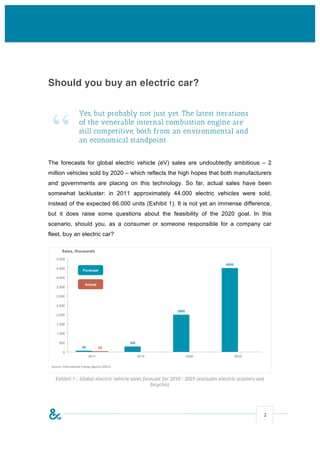
The forecasts for global electric vehicle (eV) sales are undoubtedly ambitious – 2
million vehicles sold by 2020 – which reflects the high hopes that both manufacturers
and governments are placing on this technology. So far, actual sales have been
somewhat lackluster: in 2011 approximately 44.000 electric vehicles were sold,
instead of the expected 66.000 units (Exhibit 1). It is not yet an immense difference,
but it does raise some questions about the feasibility of the 2020 goal. In this
scenario, should you, as a consumer or someone responsible for a company car
fleet, buy an electric car?


   Exhibit 1 – Global electric vehicle sales forecast for 2010 – 2025 (excludes electric scooters and
                                                bicycles)


                                                                                                    2
Most industry analysts agree that, with the advent of cheaper and more reliable
batteries (currently the main issue for this type of vehicles), the market will take off. It
is however not clear when this will happen, as the technological roadmap for the next
few years is still relatively uncertain.

So, given time, most of us will probably be driving electric cars. But what about right
now? When is an electric vehicle an immediate viable option? That was exactly the
question that one of our clients, a leading European fleet management company,
asked us.

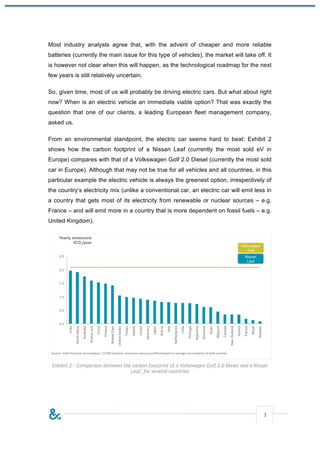
From an environmental standpoint, the electric car seems hard to beat: Exhibit 2
shows how the carbon footprint of a Nissan Leaf (currently the most sold eV in
Europe) compares with that of a Volkswagen Golf 2.0 Diesel (currently the most sold
car in Europe). Although that may not be true for all vehicles and all countries, in this
particular example the electric vehicle is always the greenest option, irrespectively of
the country’s electricity mix (unlike a conventional car, an electric car will emit less in
a country that gets most of its electricity from renewable or nuclear sources – e.g.
France – and will emit more in a country that is more dependent on fossil fuels – e.g.
United Kingdom).


 Exhibit 2 – Comparison between the carbon footprint of a Volkswagen Golf 2.0 Diesel and a Nissan
                                   Leaf, for several countries


                                                                                               3
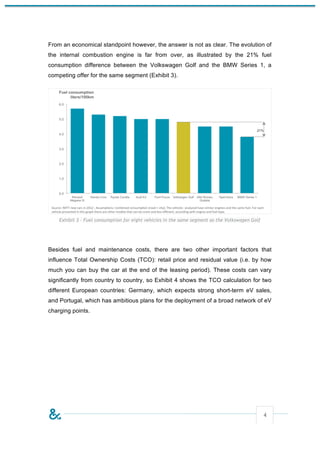
From an economical standpoint however, the answer is not as clear. The evolution of
the internal combustion engine is far from over, as illustrated by the 21% fuel
consumption difference between the Volkswagen Golf and the BMW Series 1, a
competing offer for the same segment (Exhibit 3).


    Exhibit 3 – Fuel consumption for eight vehicles in the same segment as the Volkswagen Golf


Besides fuel and maintenance costs, there are two other important factors that
influence Total Ownership Costs (TCO): retail price and residual value (i.e. by how
much you can buy the car at the end of the leasing period). These costs can vary
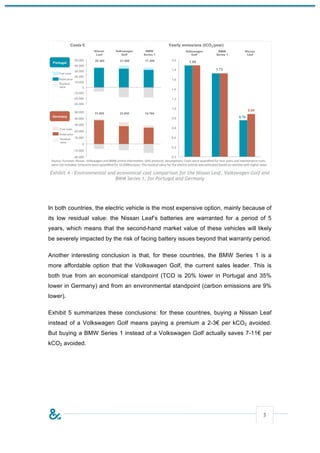
significantly from country to country, so Exhibit 4 shows the TCO calculation for two
different European countries: Germany, which expects strong short-term eV sales,
and Portugal, which has ambitious plans for the deployment of a broad network of eV
charging points.


                                                                                                 4
Exhibit 4 – Environmental and economical cost comparison for the Nissan Leaf, Volkswagen Golf and
                             BWM Series 1, for Portugal and Germany


In both countries, the electric vehicle is the most expensive option, mainly because of
its low residual value: the Nissan Leaf’s batteries are warranted for a period of 5
years, which means that the second-hand market value of these vehicles will likely
be severely impacted by the risk of facing battery issues beyond that warranty period.

Another interesting conclusion is that, for these countries, the BMW Series 1 is a
more affordable option that the Volkswagen Golf, the current sales leader. This is
both true from an economical standpoint (TCO is 20% lower in Portugal and 35%
lower in Germany) and from an environmental standpoint (carbon emissions are 9%
lower).

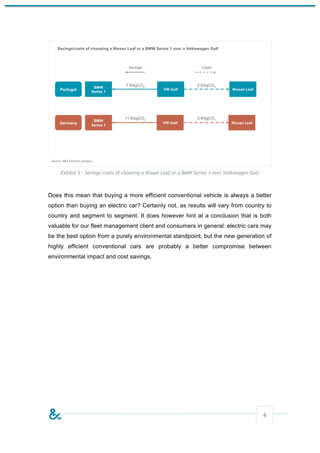
Exhibit 5 summarizes these conclusions: for these countries, buying a Nissan Leaf
instead of a Volkswagen Golf means paying a premium a 2-3€ per kCO2 avoided.
But buying a BMW Series 1 instead of a Volkswagen Golf actually saves 7-11€ per
kCO2 avoided.


                                                                                              5
Exhibit 5 – Savings/costs of choosing a Nissan Leaf or a BMW Series 1 over Volkswagen Golf


Does this mean that buying a more efficient conventional vehicle is always a better
option than buying an electric car? Certainly not, as results will vary from country to
country and segment to segment. It does however hint at a conclusion that is both
valuable for our fleet management client and consumers in general: electric cars may
be the best option from a purely environmental standpoint, but the new generation of
highly efficient conventional cars are probably a better compromise between
environmental impact and cost savings.


                                                                                                 6
7

Should you buy an electric car?

  • 1.
    Should you buyan electric car? X&Y Partners October 2012 www.thisisxy.com Catarina Veiga catarina.veiga@thisisxy.com +44 (20) 3239 5245
  • 2.
    Should you buyan electric car? “ Yes, but probably not just yet. The latest iterations of the venerable internal combustion engine are still competitive, both from an environmental and an economical standpoint. The forecasts for global electric vehicle (eV) sales are undoubtedly ambitious – 2 million vehicles sold by 2020 – which reflects the high hopes that both manufacturers and governments are placing on this technology. So far, actual sales have been somewhat lackluster: in 2011 approximately 44.000 electric vehicles were sold, instead of the expected 66.000 units (Exhibit 1). It is not yet an immense difference, but it does raise some questions about the feasibility of the 2020 goal. In this scenario, should you, as a consumer or someone responsible for a company car fleet, buy an electric car? Exhibit 1 – Global electric vehicle sales forecast for 2010 – 2025 (excludes electric scooters and bicycles) 2
  • 3.
    Most industry analystsagree that, with the advent of cheaper and more reliable batteries (currently the main issue for this type of vehicles), the market will take off. It is however not clear when this will happen, as the technological roadmap for the next few years is still relatively uncertain. So, given time, most of us will probably be driving electric cars. But what about right now? When is an electric vehicle an immediate viable option? That was exactly the question that one of our clients, a leading European fleet management company, asked us. From an environmental standpoint, the electric car seems hard to beat: Exhibit 2 shows how the carbon footprint of a Nissan Leaf (currently the most sold eV in Europe) compares with that of a Volkswagen Golf 2.0 Diesel (currently the most sold car in Europe). Although that may not be true for all vehicles and all countries, in this particular example the electric vehicle is always the greenest option, irrespectively of the country’s electricity mix (unlike a conventional car, an electric car will emit less in a country that gets most of its electricity from renewable or nuclear sources – e.g. France – and will emit more in a country that is more dependent on fossil fuels – e.g. United Kingdom). Exhibit 2 – Comparison between the carbon footprint of a Volkswagen Golf 2.0 Diesel and a Nissan Leaf, for several countries 3
  • 4.
    From an economicalstandpoint however, the answer is not as clear. The evolution of the internal combustion engine is far from over, as illustrated by the 21% fuel consumption difference between the Volkswagen Golf and the BMW Series 1, a competing offer for the same segment (Exhibit 3). Exhibit 3 – Fuel consumption for eight vehicles in the same segment as the Volkswagen Golf Besides fuel and maintenance costs, there are two other important factors that influence Total Ownership Costs (TCO): retail price and residual value (i.e. by how much you can buy the car at the end of the leasing period). These costs can vary significantly from country to country, so Exhibit 4 shows the TCO calculation for two different European countries: Germany, which expects strong short-term eV sales, and Portugal, which has ambitious plans for the deployment of a broad network of eV charging points. 4
  • 5.
    Exhibit 4 –Environmental and economical cost comparison for the Nissan Leaf, Volkswagen Golf and BWM Series 1, for Portugal and Germany In both countries, the electric vehicle is the most expensive option, mainly because of its low residual value: the Nissan Leaf’s batteries are warranted for a period of 5 years, which means that the second-hand market value of these vehicles will likely be severely impacted by the risk of facing battery issues beyond that warranty period. Another interesting conclusion is that, for these countries, the BMW Series 1 is a more affordable option that the Volkswagen Golf, the current sales leader. This is both true from an economical standpoint (TCO is 20% lower in Portugal and 35% lower in Germany) and from an environmental standpoint (carbon emissions are 9% lower). Exhibit 5 summarizes these conclusions: for these countries, buying a Nissan Leaf instead of a Volkswagen Golf means paying a premium a 2-3€ per kCO2 avoided. But buying a BMW Series 1 instead of a Volkswagen Golf actually saves 7-11€ per kCO2 avoided. 5
  • 6.
    Exhibit 5 –Savings/costs of choosing a Nissan Leaf or a BMW Series 1 over Volkswagen Golf Does this mean that buying a more efficient conventional vehicle is always a better option than buying an electric car? Certainly not, as results will vary from country to country and segment to segment. It does however hint at a conclusion that is both valuable for our fleet management client and consumers in general: electric cars may be the best option from a purely environmental standpoint, but the new generation of highly efficient conventional cars are probably a better compromise between environmental impact and cost savings. 6
  • 7.