
1 Introduction to C
2 C Fundamentals
3 Formatted Input/Output
4 Expression
5 Selection Statement
6 Loops
7 Basic Types
8 Arrays
9 Functions
10 Pointers
11 Pointers and Arrays
Introduction to C
1 C is a low-level language
---suitable language for systems programming
2 C is a small language
---relies on a “library” of standard functions
3 C is a permissive language
---it assumes that you know what you’re doing, so it allows you a wider degree
of latitude than many languages. It doesn’t mandate the detailed error-
checking found in other language
Introduction to C
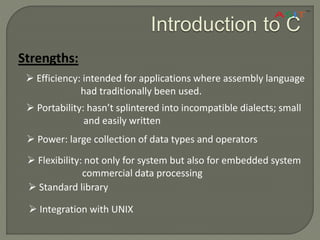
Strengths:
 Efficiency: intended for applications where assembly language
had traditionally been used.
 Portability: hasn’t splintered into incompatible dialects; small
and easily written
 Power: large collection of data types and operators
 Flexibility: not only for system but also for embedded system
commercial data processing
 Standard library
 Integration with UNIX
C Fundamentals
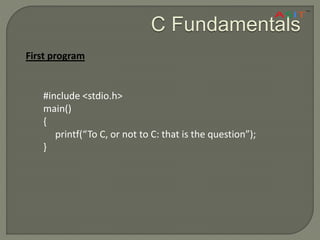
First program
#include <stdio.h>
main()
{
printf(“To C, or not to C: that is the question”);
}
C Fundamentals
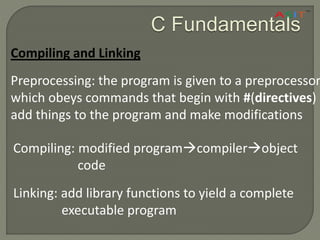
Compiling and Linking
Preprocessing: the program is given to a preprocessor,
which obeys commands that begin with #(directives)
add things to the program and make modifications
Compiling: modified programcompilerobject
code
Linking: add library functions to yield a complete
executable program
C Fundamentals
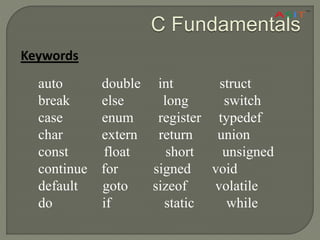
Keywords
auto double int struct
break else long switch
case enum register typedef
char extern return union
const float short unsigned
continue for signed void
default goto sizeof volatile
do if static while
Tokens in C
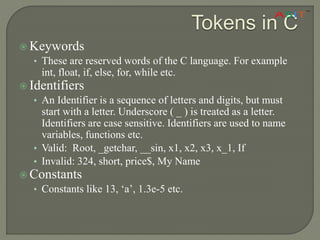
 Keywords
• These are reserved words of the C language. For example
int, float, if, else, for, while etc.
 Identifiers
• An Identifier is a sequence of letters and digits, but must
start with a letter. Underscore ( _ ) is treated as a letter.
Identifiers are case sensitive. Identifiers are used to name
variables, functions etc.
• Valid: Root, _getchar, __sin, x1, x2, x3, x_1, If
• Invalid: 324, short, price$, My Name
 Constants
• Constants like 13, ‘a’, 1.3e-5 etc.
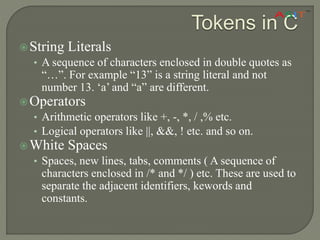
String Literals
• A sequence of characters enclosed in double quotes as
“…”. For example “13” is a string literal and not
number 13. ‘a’ and “a” are different.
Operators
• Arithmetic operators like +, -, *, / ,% etc.
• Logical operators like ||, &&, ! etc. and so on.
White Spaces
• Spaces, new lines, tabs, comments ( A sequence of
characters enclosed in /* and */ ) etc. These are used to
separate the adjacent identifiers, kewords and
constants.
Tokens in C
Basic Data Types
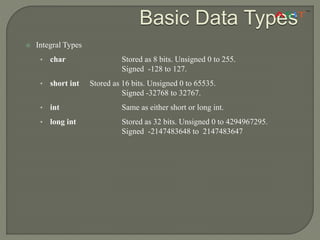
 Integral Types
• char Stored as 8 bits. Unsigned 0 to 255.
Signed -128 to 127.
• short int Stored as 16 bits. Unsigned 0 to 65535.
Signed -32768 to 32767.
• int Same as either short or long int.
• long int Stored as 32 bits. Unsigned 0 to 4294967295.
Signed -2147483648 to 2147483647
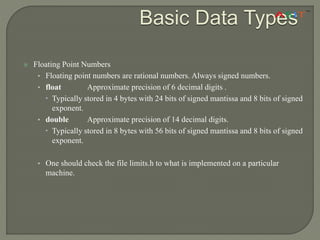
 Floating Point Numbers
• Floating point numbers are rational numbers. Always signed numbers.
• float Approximate precision of 6 decimal digits .
 Typically stored in 4 bytes with 24 bits of signed mantissa and 8 bits of signed
exponent.
• double Approximate precision of 14 decimal digits.
 Typically stored in 8 bytes with 56 bits of signed mantissa and 8 bits of signed
exponent.
• One should check the file limits.h to what is implemented on a particular
machine.
Basic Data Types
Constants
 Character and string constants
• ‘c’ , a single character in single quotes are stored as char.
Some special character are represented as two characters in single
quotes.
‘n’ = newline, ‘t’= tab, ‘’ = backlash, ‘”’ = double quotes.
Char constants also can be written in terms of their ASCII code.
‘060’ = ‘0’ (Decimal code is 48).
• A sequence of characters enclosed in double quotes is called a string
constant or string literal. For example
“Charu”
“A”
“3/9”
“x = 5”
Declarations
 Declaring a Variable
• Each variable used must be declared.
• A form of a declaration statement is
data-type var1, var2,…;
• Declaration announces the data type of a variable and allocates
appropriate memory location. No initial value (like 0 for integers)
should be assumed.
• It is possible to assign an initial value to a variable in the declaration
itself.
data-type var = expression;
• Examples
int sum = 0;
char newLine = ‘n’;
float epsilon = 1.0e-6;
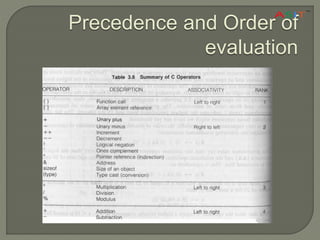
Precedence and Order of
evaluation
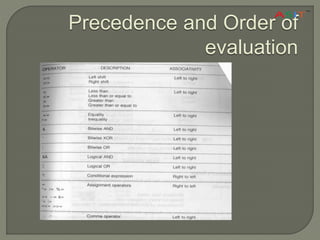
Precedence and Order of
evaluation
Operators
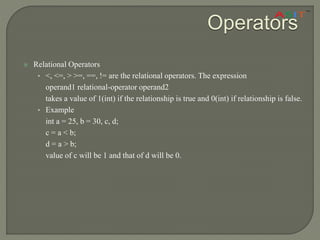
 Relational Operators
• <, <=, > >=, ==, != are the relational operators. The expression
operand1 relational-operator operand2
takes a value of 1(int) if the relationship is true and 0(int) if relationship is false.
• Example
int a = 25, b = 30, c, d;
c = a < b;
d = a > b;
value of c will be 1 and that of d will be 0.
Operators
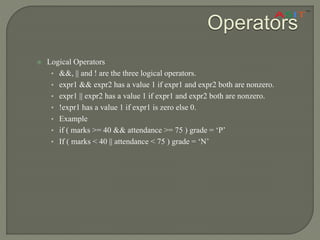
 Logical Operators
• &&, || and ! are the three logical operators.
• expr1 && expr2 has a value 1 if expr1 and expr2 both are nonzero.
• expr1 || expr2 has a value 1 if expr1 and expr2 both are nonzero.
• !expr1 has a value 1 if expr1 is zero else 0.
• Example
• if ( marks >= 40 && attendance >= 75 ) grade = ‘P’
• If ( marks < 40 || attendance < 75 ) grade = ‘N’
Operators
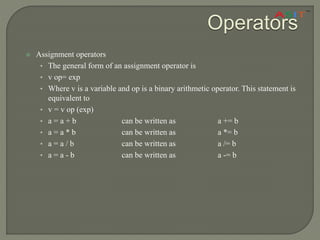
 Assignment operators
• The general form of an assignment operator is
• v op= exp
• Where v is a variable and op is a binary arithmetic operator. This statement is
equivalent to
• v = v op (exp)
• a = a + b can be written as a += b
• a = a * b can be written as a *= b
• a = a / b can be written as a /= b
• a = a - b can be written as a -= b
Operators
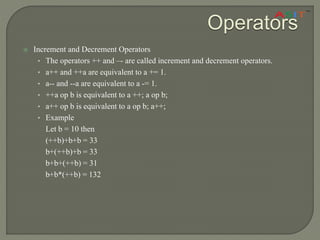
 Increment and Decrement Operators
• The operators ++ and –- are called increment and decrement operators.
• a++ and ++a are equivalent to a += 1.
• a-- and --a are equivalent to a -= 1.
• ++a op b is equivalent to a ++; a op b;
• a++ op b is equivalent to a op b; a++;
• Example
Let b = 10 then
(++b)+b+b = 33
b+(++b)+b = 33
b+b+(++b) = 31
b+b*(++b) = 132
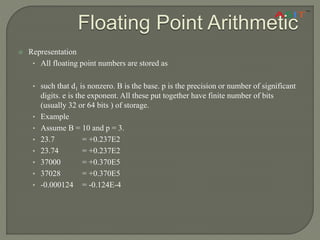
Floating Point Arithmetic
 Representation
• All floating point numbers are stored as
• such that d1 is nonzero. B is the base. p is the precision or number of significant
digits. e is the exponent. All these put together have finite number of bits
(usually 32 or 64 bits ) of storage.
• Example
• Assume B = 10 and p = 3.
• 23.7 = +0.237E2
• 23.74 = +0.237E2
• 37000 = +0.370E5
• 37028 = +0.370E5
• -0.000124 = -0.124E-4
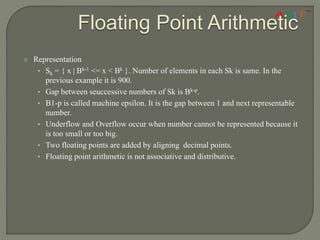
Floating Point Arithmetic
 Representation
• Sk = { x | Bk-1 <= x < Bk }. Number of elements in each Sk is same. In the
previous example it is 900.
• Gap between seuccessive numbers of Sk is Bk-p.
• B1-p is called machine epsilon. It is the gap between 1 and next representable
number.
• Underflow and Overflow occur when number cannot be represented because it
is too small or too big.
• Two floating points are added by aligning decimal points.
• Floating point arithmetic is not associative and distributive.
we provide online and classroom training for
“C” Language
For More Details
www.asit.amcsquare.com
Wise Machines India Pvt Ltd
#360, Sri Sai Padma Arcade,
Varthur Main Road,
Ramagondanahalli,
Whitefiled ,Bangalore – 560066.
We also having Branches in Hyderabad & Chennai

Learn C LANGUAGE at ASIT

  • 2.
    1 Introduction toC 2 C Fundamentals 3 Formatted Input/Output 4 Expression 5 Selection Statement 6 Loops 7 Basic Types 8 Arrays 9 Functions 10 Pointers 11 Pointers and Arrays
  • 3.
    Introduction to C 1C is a low-level language ---suitable language for systems programming 2 C is a small language ---relies on a “library” of standard functions 3 C is a permissive language ---it assumes that you know what you’re doing, so it allows you a wider degree of latitude than many languages. It doesn’t mandate the detailed error- checking found in other language
  • 4.
    Introduction to C Strengths: Efficiency: intended for applications where assembly language had traditionally been used.  Portability: hasn’t splintered into incompatible dialects; small and easily written  Power: large collection of data types and operators  Flexibility: not only for system but also for embedded system commercial data processing  Standard library  Integration with UNIX
  • 5.
    C Fundamentals First program #include<stdio.h> main() { printf(“To C, or not to C: that is the question”); }
  • 6.
    C Fundamentals Compiling andLinking Preprocessing: the program is given to a preprocessor, which obeys commands that begin with #(directives) add things to the program and make modifications Compiling: modified programcompilerobject code Linking: add library functions to yield a complete executable program
  • 7.
    C Fundamentals Keywords auto doubleint struct break else long switch case enum register typedef char extern return union const float short unsigned continue for signed void default goto sizeof volatile do if static while
  • 8.
    Tokens in C Keywords • These are reserved words of the C language. For example int, float, if, else, for, while etc.  Identifiers • An Identifier is a sequence of letters and digits, but must start with a letter. Underscore ( _ ) is treated as a letter. Identifiers are case sensitive. Identifiers are used to name variables, functions etc. • Valid: Root, _getchar, __sin, x1, x2, x3, x_1, If • Invalid: 324, short, price$, My Name  Constants • Constants like 13, ‘a’, 1.3e-5 etc.
  • 9.
    String Literals • Asequence of characters enclosed in double quotes as “…”. For example “13” is a string literal and not number 13. ‘a’ and “a” are different. Operators • Arithmetic operators like +, -, *, / ,% etc. • Logical operators like ||, &&, ! etc. and so on. White Spaces • Spaces, new lines, tabs, comments ( A sequence of characters enclosed in /* and */ ) etc. These are used to separate the adjacent identifiers, kewords and constants. Tokens in C
  • 10.
    Basic Data Types Integral Types • char Stored as 8 bits. Unsigned 0 to 255. Signed -128 to 127. • short int Stored as 16 bits. Unsigned 0 to 65535. Signed -32768 to 32767. • int Same as either short or long int. • long int Stored as 32 bits. Unsigned 0 to 4294967295. Signed -2147483648 to 2147483647
  • 11.
     Floating PointNumbers • Floating point numbers are rational numbers. Always signed numbers. • float Approximate precision of 6 decimal digits .  Typically stored in 4 bytes with 24 bits of signed mantissa and 8 bits of signed exponent. • double Approximate precision of 14 decimal digits.  Typically stored in 8 bytes with 56 bits of signed mantissa and 8 bits of signed exponent. • One should check the file limits.h to what is implemented on a particular machine. Basic Data Types
  • 12.
    Constants  Character andstring constants • ‘c’ , a single character in single quotes are stored as char. Some special character are represented as two characters in single quotes. ‘n’ = newline, ‘t’= tab, ‘’ = backlash, ‘”’ = double quotes. Char constants also can be written in terms of their ASCII code. ‘060’ = ‘0’ (Decimal code is 48). • A sequence of characters enclosed in double quotes is called a string constant or string literal. For example “Charu” “A” “3/9” “x = 5”
  • 13.
    Declarations  Declaring aVariable • Each variable used must be declared. • A form of a declaration statement is data-type var1, var2,…; • Declaration announces the data type of a variable and allocates appropriate memory location. No initial value (like 0 for integers) should be assumed. • It is possible to assign an initial value to a variable in the declaration itself. data-type var = expression; • Examples int sum = 0; char newLine = ‘n’; float epsilon = 1.0e-6;
  • 14.
    Precedence and Orderof evaluation
  • 15.
    Precedence and Orderof evaluation
  • 16.
    Operators  Relational Operators •<, <=, > >=, ==, != are the relational operators. The expression operand1 relational-operator operand2 takes a value of 1(int) if the relationship is true and 0(int) if relationship is false. • Example int a = 25, b = 30, c, d; c = a < b; d = a > b; value of c will be 1 and that of d will be 0.
  • 17.
    Operators  Logical Operators •&&, || and ! are the three logical operators. • expr1 && expr2 has a value 1 if expr1 and expr2 both are nonzero. • expr1 || expr2 has a value 1 if expr1 and expr2 both are nonzero. • !expr1 has a value 1 if expr1 is zero else 0. • Example • if ( marks >= 40 && attendance >= 75 ) grade = ‘P’ • If ( marks < 40 || attendance < 75 ) grade = ‘N’
  • 18.
    Operators  Assignment operators •The general form of an assignment operator is • v op= exp • Where v is a variable and op is a binary arithmetic operator. This statement is equivalent to • v = v op (exp) • a = a + b can be written as a += b • a = a * b can be written as a *= b • a = a / b can be written as a /= b • a = a - b can be written as a -= b
  • 19.
    Operators  Increment andDecrement Operators • The operators ++ and –- are called increment and decrement operators. • a++ and ++a are equivalent to a += 1. • a-- and --a are equivalent to a -= 1. • ++a op b is equivalent to a ++; a op b; • a++ op b is equivalent to a op b; a++; • Example Let b = 10 then (++b)+b+b = 33 b+(++b)+b = 33 b+b+(++b) = 31 b+b*(++b) = 132
  • 20.
    Floating Point Arithmetic Representation • All floating point numbers are stored as • such that d1 is nonzero. B is the base. p is the precision or number of significant digits. e is the exponent. All these put together have finite number of bits (usually 32 or 64 bits ) of storage. • Example • Assume B = 10 and p = 3. • 23.7 = +0.237E2 • 23.74 = +0.237E2 • 37000 = +0.370E5 • 37028 = +0.370E5 • -0.000124 = -0.124E-4
  • 21.
    Floating Point Arithmetic Representation • Sk = { x | Bk-1 <= x < Bk }. Number of elements in each Sk is same. In the previous example it is 900. • Gap between seuccessive numbers of Sk is Bk-p. • B1-p is called machine epsilon. It is the gap between 1 and next representable number. • Underflow and Overflow occur when number cannot be represented because it is too small or too big. • Two floating points are added by aligning decimal points. • Floating point arithmetic is not associative and distributive.
  • 22.
    we provide onlineand classroom training for “C” Language For More Details www.asit.amcsquare.com Wise Machines India Pvt Ltd #360, Sri Sai Padma Arcade, Varthur Main Road, Ramagondanahalli, Whitefiled ,Bangalore – 560066. We also having Branches in Hyderabad & Chennai