
ASHOKA
Creating a New Framework for
  Social Change in Pakistan
      7th February 2013
Ashoka and Social Entrepreneurship: A Story of
                   Success

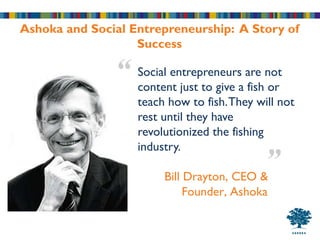
                   Social entrepreneurs are not
                   content just to give a fish or
                   teach how to fish. They will not
                   rest until they have
                   revolutionized the fishing
                   industry.

                        Bill Drayton, CEO &
                             Founder, Ashoka
Ashoka and Social Entrepreneurship: A Story of
                    Success
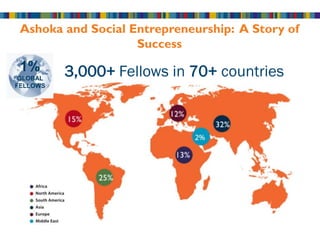
 1%       3,000+ Fellows in 70+ countries
 GLOBAL
FELLOWS
Ashoka and Pakistan
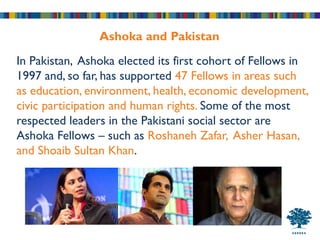
In Pakistan, Ashoka elected its first cohort of Fellows in
1997 and, so far, has supported 47 Fellows in areas such
as education, environment, health, economic development,
civic participation and human rights. Some of the most
respected leaders in the Pakistani social sector are
Ashoka Fellows – such as Roshaneh Zafar, Asher Hasan,
and Shoaib Sultan Khan.
Pakistan Now
Now, with an estimated population of over 187 million
and a citizen sector in need of support, Pakistan is at a
stage where strategic investments in social
entrepreneurship can shape a positive future for its
citizens and the region.

Social entrepreneurship has a crucial role to play in
realizing Pakistan’s needs – advancing youth leadership
and economic development.
Ashoka wants to tap in to this potential in order to
create a new framework for social change in Pakistan.
Pakistan Now
The EPG study showed that there is a need to re-engage
entrepreneurs in Pakistan and to upgrade and support
the strengthening of the skill-sets of the youth.

The study showed that a fifth of global young
entrepreneurs see a gap in the market that they think
they can fill and a fifth also feel that their knowledge and
skills are best suited to being an entrepreneur.
What is needed
The world is changing at a rapidly accelerating pace and new
challenges are being globalized (because of the phenomenon of
globalization as a whole, which means that problems in Pakistan and
the Middle East affect global social and business markets).

What is needed is a hybrid:
• Social enterprises and not for profit organizations.
• Social enterprises and financially sustainable/for profit
organizations.
• Not only inclusive businesses or businesses with a social heart.
What is needed
The new models are not only new in terms of their focus and
expertise, ie:
• Renewable energy
• New financial models
• Mobile banking

Their implementation also involves a new approach:
• Combining the social sector with the business sector.
• Involving the poor and marginalized (in capital and in knowledge),
a process which increases their participation and brings them many
benefits, thus upgrading or improving their situation.
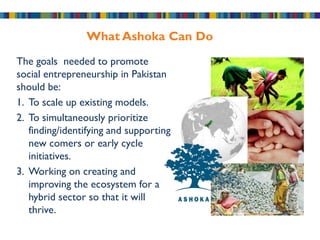
What Ashoka Can Do
The goals needed to promote
social entrepreneurship in Pakistan
should be:
1. To scale up existing models.
2. To simultaneously prioritize
   finding/identifying and supporting
   new comers or early cycle
   initiatives.
3. Working on creating and
   improving the ecosystem for a
   hybrid sector so that it will
   thrive.
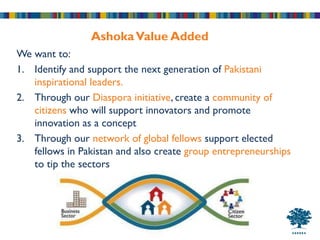
Ashoka Value Added
We want to:
1. Identify and support the next generation of Pakistani
   inspirational leaders.
2. Through our Diaspora initiative, create a community of
   citizens who will support innovators and promote
   innovation as a concept
3. Through our network of global fellows support elected
   fellows in Pakistan and also create group entrepreneurships
   to tip the sectors
How to Engage Diaspora Business Leaders and
   the Corporate Sector with Social Change?
Engage a group of diaspora business leaders and companies to mentor, support
and co-develop groundbreaking initiatives with Ashoka in Pakistan.

Examples:
• Skills: Ashoka has developed a range of strategic partnerships with companies
such as McKinsey & Co, Intel, Google and Hogan Lovells, offering Fellows
essential services to their development.
• Strategy: the Ashoka Support Network members (ASN) is a network of
business people who personally engage with the Ashoka Fellows on a regular
basis through sounding boards or coaching sessions, helping them to define and
implement the development strategy of their ventures.
• Ecosystem: Ashoka and its community establish partnerships with companies
that want to play a role in local development and co-create initiatives to support
innovations impacting the social sector.
Additional Annexes
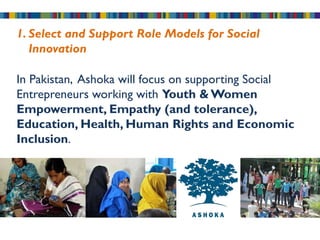
1. Select and Support Role Models for Social
   Innovation

In Pakistan, Ashoka will focus on supporting Social
Entrepreneurs working with Youth & Women
Empowerment, Empathy (and tolerance),
Education, Health, Human Rights and Economic
Inclusion.
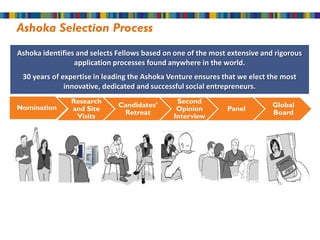
Ashoka Selection Process
Ashoka identifies and selects Fellows based on one of the most extensive and rigorous
                 application processes found anywhere in the world.
 30 years of expertise in leading the Ashoka Venture ensures that we elect the most
              innovative, dedicated and successful social entrepreneurs.
                Research                       Second
Nomination                    Candidates’                                   Global
                and Site                       Opinion        Panel
                               Retreat                                      Board
                 Visits                       Interview
Some of the most respected leaders in the Pakistani social
sector today are Ashoka Fellows - such as:

Roshaneh Zafar who pioneered the development of a women-centered and women-managed initiative that
combines a micro-level lending and savings operation with related training and support activities at the
community level. Her organization, Kashf Foundation was the first microfinance institute in Pakistan to
achieve financial self-sufficiency and demonstrate the business case for investing in women’s economic
empowerment.

Asher Hasan has founded Naya Javeen to finance low-cost, private health insurance for the working poor
in Pakistan by sharing costs across the well-to-do corporate executive and the informal domestic worker of the
corporate executive who is the end beneficiary of the health plan. Asher’s team negotiates exclusive pooled-
risk agreements with insurance underwriters and leverages the underwriters’ existing nationwide networks of
quality, inpatient/ER-trauma healthcare delivery systems.

Raziq Fahim launched the College of Youth Activism and Development (CYAD) to empower youth to
channel their feelings of anger and frustration in to peace and community building in some of the most
politically turbulent areas of Pakistan. After identifying at-risk youths between the ages of 15 and 26, Raziq
comprehensively addresses the problems they face. He gives them the option to help build ventures for the
benefit of their communities, and provides them with learning opportunities they need to become leaders and
mentors for other at-risk youth.
2. Develop Collaborations and Communities of Social
   Entrepreneurs

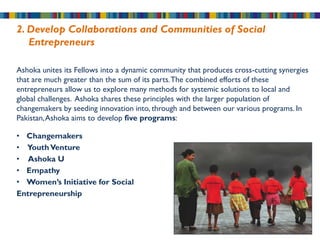
Ashoka unites its Fellows into a dynamic community that produces cross-cutting synergies
that are much greater than the sum of its parts. The combined efforts of these
entrepreneurs allow us to explore many methods for systemic solutions to local and
global challenges. Ashoka shares these principles with the larger population of
changemakers by seeding innovation into, through and between our various programs. In
Pakistan, Ashoka aims to develop five programs:

• Changemakers
• Youth Venture
• Ashoka U
• Empathy
• Women’s Initiative for Social
Entrepreneurship
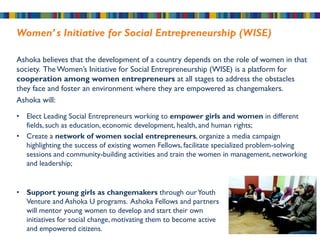
Women’ s Initiative for Social Entrepreneurship (WISE)

Ashoka believes that the development of a country depends on the role of women in that
society. The Women’s Initiative for Social Entrepreneurship (WISE) is a platform for
cooperation among women entrepreneurs at all stages to address the obstacles
they face and foster an environment where they are empowered as changemakers.
Ashoka will:

• Elect Leading Social Entrepreneurs working to empower girls and women in different
  fields, such as education, economic development, health, and human rights;
• Create a network of women social entrepreneurs, organize a media campaign
  highlighting the success of existing women Fellows, facilitate specialized problem-solving
  sessions and community-building activities and train the women in management, networking
  and leadership;


• Support young girls as changemakers through our Youth
  Venture and Ashoka U programs. Ashoka Fellows and partners
  will mentor young women to develop and start their own
  initiatives for social change, motivating them to become active
  and empowered citizens.
3. Ashoka Cohort of Partners
Examples:
Mark Cheng (ASN member) has more than 15 years of experience in finance, having worked at
Deutsche Bank and AMBAC Assurance. In 2007, he joined Ashoka as an ASN member and has
assisted many Fellows in raising investment for social causes, in areas including micro-finance,
renewable energy, conservation, healthcare and education. Mark is a now the Director of Ashoka UK
and continues to work as an advisor for Fellows expanding their work into multiple countries. He
also serves as Board Member and Trustee for several social enterprises, including two set up by
Ashoka Fellows.

McKinsey & Company: Ashoka and McKinsey & Co. share offices and expertise in several
countries. McKinsey consultants provide pro bono management services to Ashoka Fellows,
strengthening institutional capacity and training them to write business plans, make effective
presentations, and market their work.

Intel: Ashoka and Intel recently joined forces to sponsor, showcase and spread the most important
technology based innovations and learning of Ashoka fellows and changemakers related to women’s
and girls’ issues. Intel employees will further engage by partnering with Ashoka Fellows and our
network through voting in Changemakers competitions, connecting with ICT-focused Ashoka Fellows
as possible volunteers, and eventually through engagement with our Fellows through the Ashoka Hub
online communities.
Contacts:

Iman Bibars, Ashoka’s Vice President & Regional Director for the Arab World ibibars@ashoka.org

Maria Clara Pinheiro, Global Diaspora & Expansion mpinheiro@ashoka.org

Mark Cheng, UK Country Director mcheng@ashoka.org

Ashoka Dr Iman Bibars

  • 1.
    ASHOKA Creating a NewFramework for Social Change in Pakistan 7th February 2013
  • 2.
    Ashoka and SocialEntrepreneurship: A Story of Success Social entrepreneurs are not content just to give a fish or teach how to fish. They will not rest until they have revolutionized the fishing industry. Bill Drayton, CEO & Founder, Ashoka
  • 3.
    Ashoka and SocialEntrepreneurship: A Story of Success 1% 3,000+ Fellows in 70+ countries GLOBAL FELLOWS
  • 4.
    Ashoka and Pakistan InPakistan, Ashoka elected its first cohort of Fellows in 1997 and, so far, has supported 47 Fellows in areas such as education, environment, health, economic development, civic participation and human rights. Some of the most respected leaders in the Pakistani social sector are Ashoka Fellows – such as Roshaneh Zafar, Asher Hasan, and Shoaib Sultan Khan.
  • 5.
    Pakistan Now Now, withan estimated population of over 187 million and a citizen sector in need of support, Pakistan is at a stage where strategic investments in social entrepreneurship can shape a positive future for its citizens and the region. Social entrepreneurship has a crucial role to play in realizing Pakistan’s needs – advancing youth leadership and economic development. Ashoka wants to tap in to this potential in order to create a new framework for social change in Pakistan.
  • 6.
    Pakistan Now The EPGstudy showed that there is a need to re-engage entrepreneurs in Pakistan and to upgrade and support the strengthening of the skill-sets of the youth. The study showed that a fifth of global young entrepreneurs see a gap in the market that they think they can fill and a fifth also feel that their knowledge and skills are best suited to being an entrepreneur.
  • 7.
    What is needed Theworld is changing at a rapidly accelerating pace and new challenges are being globalized (because of the phenomenon of globalization as a whole, which means that problems in Pakistan and the Middle East affect global social and business markets). What is needed is a hybrid: • Social enterprises and not for profit organizations. • Social enterprises and financially sustainable/for profit organizations. • Not only inclusive businesses or businesses with a social heart.
  • 8.
    What is needed Thenew models are not only new in terms of their focus and expertise, ie: • Renewable energy • New financial models • Mobile banking Their implementation also involves a new approach: • Combining the social sector with the business sector. • Involving the poor and marginalized (in capital and in knowledge), a process which increases their participation and brings them many benefits, thus upgrading or improving their situation.
  • 9.
    What Ashoka CanDo The goals needed to promote social entrepreneurship in Pakistan should be: 1. To scale up existing models. 2. To simultaneously prioritize finding/identifying and supporting new comers or early cycle initiatives. 3. Working on creating and improving the ecosystem for a hybrid sector so that it will thrive.
  • 10.
    Ashoka Value Added Wewant to: 1. Identify and support the next generation of Pakistani inspirational leaders. 2. Through our Diaspora initiative, create a community of citizens who will support innovators and promote innovation as a concept 3. Through our network of global fellows support elected fellows in Pakistan and also create group entrepreneurships to tip the sectors
  • 11.
    How to EngageDiaspora Business Leaders and the Corporate Sector with Social Change? Engage a group of diaspora business leaders and companies to mentor, support and co-develop groundbreaking initiatives with Ashoka in Pakistan. Examples: • Skills: Ashoka has developed a range of strategic partnerships with companies such as McKinsey & Co, Intel, Google and Hogan Lovells, offering Fellows essential services to their development. • Strategy: the Ashoka Support Network members (ASN) is a network of business people who personally engage with the Ashoka Fellows on a regular basis through sounding boards or coaching sessions, helping them to define and implement the development strategy of their ventures. • Ecosystem: Ashoka and its community establish partnerships with companies that want to play a role in local development and co-create initiatives to support innovations impacting the social sector.
  • 12.
  • 13.
    1. Select andSupport Role Models for Social Innovation In Pakistan, Ashoka will focus on supporting Social Entrepreneurs working with Youth & Women Empowerment, Empathy (and tolerance), Education, Health, Human Rights and Economic Inclusion.
  • 14.
    Ashoka Selection Process Ashokaidentifies and selects Fellows based on one of the most extensive and rigorous application processes found anywhere in the world. 30 years of expertise in leading the Ashoka Venture ensures that we elect the most innovative, dedicated and successful social entrepreneurs. Research Second Nomination Candidates’ Global and Site Opinion Panel Retreat Board Visits Interview
  • 15.
    Some of themost respected leaders in the Pakistani social sector today are Ashoka Fellows - such as: Roshaneh Zafar who pioneered the development of a women-centered and women-managed initiative that combines a micro-level lending and savings operation with related training and support activities at the community level. Her organization, Kashf Foundation was the first microfinance institute in Pakistan to achieve financial self-sufficiency and demonstrate the business case for investing in women’s economic empowerment. Asher Hasan has founded Naya Javeen to finance low-cost, private health insurance for the working poor in Pakistan by sharing costs across the well-to-do corporate executive and the informal domestic worker of the corporate executive who is the end beneficiary of the health plan. Asher’s team negotiates exclusive pooled- risk agreements with insurance underwriters and leverages the underwriters’ existing nationwide networks of quality, inpatient/ER-trauma healthcare delivery systems. Raziq Fahim launched the College of Youth Activism and Development (CYAD) to empower youth to channel their feelings of anger and frustration in to peace and community building in some of the most politically turbulent areas of Pakistan. After identifying at-risk youths between the ages of 15 and 26, Raziq comprehensively addresses the problems they face. He gives them the option to help build ventures for the benefit of their communities, and provides them with learning opportunities they need to become leaders and mentors for other at-risk youth.
  • 16.
    2. Develop Collaborationsand Communities of Social Entrepreneurs Ashoka unites its Fellows into a dynamic community that produces cross-cutting synergies that are much greater than the sum of its parts. The combined efforts of these entrepreneurs allow us to explore many methods for systemic solutions to local and global challenges. Ashoka shares these principles with the larger population of changemakers by seeding innovation into, through and between our various programs. In Pakistan, Ashoka aims to develop five programs: • Changemakers • Youth Venture • Ashoka U • Empathy • Women’s Initiative for Social Entrepreneurship
  • 17.
    Women’ s Initiativefor Social Entrepreneurship (WISE) Ashoka believes that the development of a country depends on the role of women in that society. The Women’s Initiative for Social Entrepreneurship (WISE) is a platform for cooperation among women entrepreneurs at all stages to address the obstacles they face and foster an environment where they are empowered as changemakers. Ashoka will: • Elect Leading Social Entrepreneurs working to empower girls and women in different fields, such as education, economic development, health, and human rights; • Create a network of women social entrepreneurs, organize a media campaign highlighting the success of existing women Fellows, facilitate specialized problem-solving sessions and community-building activities and train the women in management, networking and leadership; • Support young girls as changemakers through our Youth Venture and Ashoka U programs. Ashoka Fellows and partners will mentor young women to develop and start their own initiatives for social change, motivating them to become active and empowered citizens.
  • 18.
    3. Ashoka Cohortof Partners Examples: Mark Cheng (ASN member) has more than 15 years of experience in finance, having worked at Deutsche Bank and AMBAC Assurance. In 2007, he joined Ashoka as an ASN member and has assisted many Fellows in raising investment for social causes, in areas including micro-finance, renewable energy, conservation, healthcare and education. Mark is a now the Director of Ashoka UK and continues to work as an advisor for Fellows expanding their work into multiple countries. He also serves as Board Member and Trustee for several social enterprises, including two set up by Ashoka Fellows. McKinsey & Company: Ashoka and McKinsey & Co. share offices and expertise in several countries. McKinsey consultants provide pro bono management services to Ashoka Fellows, strengthening institutional capacity and training them to write business plans, make effective presentations, and market their work. Intel: Ashoka and Intel recently joined forces to sponsor, showcase and spread the most important technology based innovations and learning of Ashoka fellows and changemakers related to women’s and girls’ issues. Intel employees will further engage by partnering with Ashoka Fellows and our network through voting in Changemakers competitions, connecting with ICT-focused Ashoka Fellows as possible volunteers, and eventually through engagement with our Fellows through the Ashoka Hub online communities.
  • 19.
    Contacts: Iman Bibars, Ashoka’sVice President & Regional Director for the Arab World ibibars@ashoka.org Maria Clara Pinheiro, Global Diaspora & Expansion mpinheiro@ashoka.org Mark Cheng, UK Country Director mcheng@ashoka.org