APRIL/MAY 2018 ASIA PACIFIC FOOD INDUSTRY
FEATURES
68
PRIMARILY used for the packaging of high-acid products
such as juices, PET bottles are regularly gaining traction in
the dairy and dairy alternatives market. It is also especially
used for new products in high value-added market segments.
This evolution in packaging goes along with extended shelf-
life requirements—for chilled as well as ambient stored
products—and calls for careful implementation as UHT milk
and milk-based drinks are characterised by a low acidity
levels and an extreme sensitivity.
Serac, a supplier of aseptic packaging lines for UHT
milk in bottles, explains why manufacturers should take
advantage of PET bottles and what key points they must
consider to properly implement their project.
COMBINE EXTENDED SHELF-LIFE AND ATTRACTIVE
PACKAGING TO GROW MARKET SHARES
Extending the shelf-life of products offers manufacturers the
possibility to widen their market and target new distribution
channels. It is also an economic and environmental benefit
for both retailers and consumers since it contributes to
reducing food waste. Ambient stored products are economic
and environmental champions: avoiding refrigeration during
transportation and storage significantly reduces both logistic
costs and environmental footprint.
Likewise, aseptic packaging without preservatives offers a
higher level of safety. This explains why some manufacturers
decide to use this process even if not absolutely necessary.
Consumer security and brand image cannot be put at risk.
On the packaging side, the USPs of plastic bottles are no
longer relevant. The appeal created by original shapes and
high-quality designs associated with usability benefits make
bottles the preferred packaging for premium market segments.
ASEPTICPACKAGINGOF
LOW-ACIDPRODUCTS
FABIENNE CHERIAUX-HUET, MARKETING
MANAGER OF SERAC, HIGHLIGHTS
HOW MANUFACTURERS CAN SEIZE
OPPORTUNITIES OFFERED BY THE ON-SITE
MANUFACTURING OF PET BOTTLES.
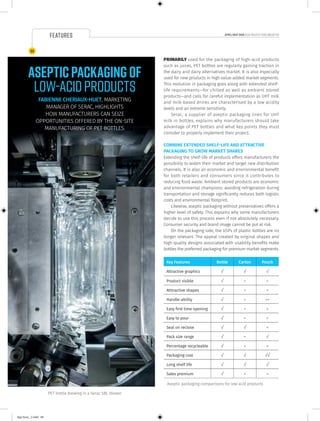
Key Features Bottle Carton Pouch
Attractive graphics √ √ √
Product visible √ × ×
Atttractive shapes √ × ×
Handle-ability √ × ××
Easy first time opening √ × ×
Easy to pour √ × ×
Seal on reclose √ √ ×
Pack size range √ × √
Percentage recycleable √ × ×
Packaging cost √ √ √√
Long shelf life √ √ √
Sales premium √ × ×
Aseptic packaging comparisons for low acid products
4pp Serac_2.indd 68
PET bottle blowing in a Serac SBL blower
ASIA PACIFIC FOOD INDUSTRY APRIL/MAY 2018
FEATURES
6969
Bottles are particularly sought after for ambient stored
dairy products in small and medium portions, perfectly
adapted for consumption on-the-go. This market segment
should further develop with PET bottles since flip-top caps
are now available in 38 mm diameter suitable for dry aseptic
packaging. Thus, aseptic packaging in PET bottles must be
considered a real opportunity to enter or create new market
segments in milks, plant-based drinks, flavoured milks, teas
and coffees with milk.
CONSIDER THE SPECIFIC REQUIREMENTS
OF LOW-ACID PRODUCTS
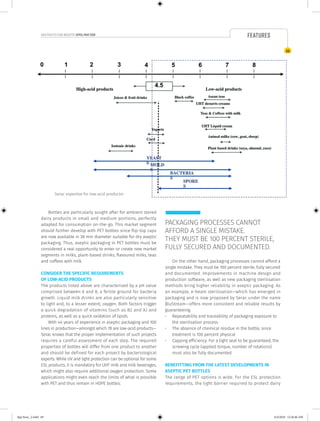
The products listed above are characterised by a pH value
comprised between 6 and 8, a fertile ground for bacteria
growth. Liquid milk drinks are also particularly sensitive
to light and, to a lesser extent, oxygen. Both factors trigger
a quick degradation of vitamins (such as B2 and A) and
proteins, as well as a quick oxidation of lipids.
With 44 years of experience in aseptic packaging and 100
lines in production—amongst which 78 are low-acid products—
Serac knows that the proper implementation of such projects
requires a careful assessment of each step. The required
properties of bottles will differ from one product to another
and should be defined for each project by bacteriological
experts. While UV and light protection can be optional for some
ESL products, it is mandatory for UHT milk and milk beverages,
which might also require additional oxygen protection. Some
applications might even reach the limits of what is possible
with PET and thus remain in HDPE bottles.
On the other hand, packaging processes cannot afford a
single mistake. They must be 100 percent sterile, fully secured
and documented. Improvements in machine design and
production software, as well as new packaging sterilisation
methods bring higher reliability in aseptic packaging. As
an example, e-beam sterilisation—which has emerged in
packaging and is now proposed by Serac under the name
βluStream—offers more consistent and reliable results by
guaranteeing:
•	 Repeatability and traceability of packaging exposure to
the sterilisation process
•	 The absence of chemical residue in the bottle, since
treatment is 100 percent physical
•	 Capping efficiency. For a tight seal to be guaranteed, the
screwing cycle (applied torque, number of rotations)
must also be fully documented.
BENEFITTING FROM THE LATEST DEVELOPMENTS IN
ASEPTIC PET BOTTLES
The range of PET options is wide. For the ESL protection
requirements, the light barrier required to protect dairy
Serac expertise for low-acid productsr
PACKAGING PROCESSES CANNOT
AFFORD A SINGLE MISTAKE.
THEY MUST BE 100 PERCENT STERILE,
FULLY SECURED AND DOCUMENTED.
4pp Serac_2.indd 69 6/4/2018 12:26:46 AM
APRIL/MAY 2018 ASIA PACIFIC FOOD INDUSTRY
FEATURES
70
products can be achieved with plastic or aluminised sleeves.
For higher ones, PET can be multi-layered or enriched with
opacifier such as TiO2. The current trend is to develop
monolayer PET preforms with a low content of (or even
without) TiO2 to improve recyclability. Such preforms now
display the same barrier performance as multi-layered ones.
PET stretch blow moulding is also evolving toward greater
performance, thus pushing the boundaries of creativity
in bottle shapes while always using less raw materials. As
an example, Serac took up the challenge of blowing a 50 g
capacity fruit-shaped PET flask from a 2.3 g preform. With
nearly half of the mass concentrated in the neck, the flask
required an expansion rate of 16 (4 times in both length and
width), which is extreme in this industry. Such results are only
achievable by precise controlling of the heating process and
allowing maximum time for heating and blowing.
Serac has also recently developed a preferential heating
system where heat is not evenly distributed on the preform
but concentrated on two sides. Preferential heating is used to
produce oval bottles (of width:length ratio higher than 2) and
complex-shaped containers. New sterilisation technologies
such as βluStream also have a positive impact on bottle
weight reduction since they do not require any heating.
CONSIDER ON-SITE BOTTLE MANUFACTURING
Any project will also have to consider the question of bottle
manufacturing: will it be done on-site or sub-contracted?
On-site manufacturing provides many benefits, be
they environmental (reduction of transported volumes),
economical (no bottle scratched or distorted during
transport, reduced storage facilities) or organisational
(simple production of different packaging shapes or sizes
through easy mold changeover). On-site manufacturing is
also the solution that offers the highest level of guarantee
against contamination of the bottles.
These benefits are still increased using PET and single
block blow-fill-cap units. PET implies a lower investment,
less equipment (storage tank, neck trimmer and heat sealer
can be precluded) and a lower level of plastic processing
skills than HDPE. Serac’s Aseptic Combox allows the
reduction of operating costs with energy savings as a result
of the absence of conveyors, thus increasing production
yields with the avoidance of production starts and stops
potentially associated with accumulation systems. It also
allows manufacturers to seize all opportunities by saving on
bottle weight, thanks to a patented transfer system which
ensures that bottles will move along the process without
ever touching each other (no risk of damage). Finally,
Serac’s Aseptic Combox has been designed to save up to
25 percent on packaging line footprint and shorten
changeover as well as maintenance operations, thus
reducing downtime to a minimum.
PROPERLY ASSESS PRODUCTION VOLUMES
On new market segments or areas, sales volume is
uncertain—it can skyrocket very quickly or, on the contrary,
increase slowly over time. Choosing the right production
equipment is needed to bridge the balance between
investment cost and production capacity.
In this particular case, overall equipment efficiency (OEE)
and versatility can make the difference in ROI. They can allow,
for example, a medium work-rate solution which will be used
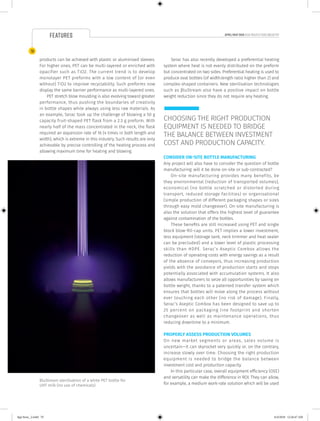
BluStream sterilisation of a white PET bottle for
UHT milk (no use of chemicals)
CHOOSING THE RIGHT PRODUCTION
EQUIPMENT IS NEEDED TO BRIDGE
THE BALANCE BETWEEN INVESTMENT
COST AND PRODUCTION CAPACITY.
4pp Serac_2.indd 70 6/4/2018 12:26:47 AM
ASIA PACIFIC FOOD INDUSTRY APRIL/MAY 2018
FEATURES
7171
first to test different concepts in different markets before
focusing on the most successful ones with enough available
production capacity.
BANK ON FLEXIBILITY TO COVER DIFFERENT
MARKET SEGMENTS
Flexibility is one of the key points to commercial success.
Being able to supply a wide variety of products allows
manufacturers to target different market segments or
enhance their brand’s visibility on the shelves. It also allows
manufacturers to offer a solution for bottles suited to every
occasion. Therefore, having the possibility to blow bottles
ranging from 50 ml to several litres on the same machine
enables a manufacturer to cover both individual and family
needs. All bottles have the same neck diameter; a neck
transfer system is almost a must in order to benefit from
maximum flexibility. And, of course, the filling and capping
unit must adjust quickly and easily to the blowing output.
Using the same equipment for different sizes and
shorter series makes format changeover critical. It must be
as short as possible, which is not that simple in an aseptic
environment. This is why, in Serac’s Aseptic Combox, the
blower is located outside the sterile zone. Changing the mold
presents no risk of contamination and requires less than 10
minutes by a single operator. The same system is used for
changeovers at the exit of the filling machine.
With its Aseptic Combox solution, Serac offers a complete
blow-fill-cap unit that meets all safety requirements for ESL
and UHT dairy products. The solution has been designed to
meet low to medium output needs of niche and emerging
markets, as well as those of mid-sized dairy product
manufacturers.
Based on the SAS 5 filling machine, the Aseptic Combox
benefits from Serac’s extensive know-how in the field of
aseptic filling and will soon be proposed with a chemical and
ENQUIRY No. 0383 Enquire at page 79 or log on to
apfoodonline.com/contact
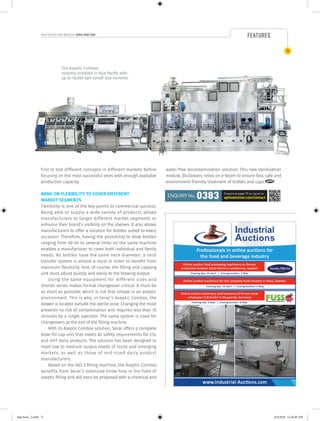
The Aseptic Combox:
recently installed in Asia Pacific with
up to 18,000 bph (small size formats)
water-free decontamination solution. This new sterilisation
module, βluStream, relies on e-beam to ensure fast, safe and
environment-friendly treatment of bottles and caps. 
4pp Serac_2.indd 71 6/4/2018 12:26:49 AM

Aseptic packaging low_acid_products_apfi

  • 1.
    APRIL/MAY 2018 ASIAPACIFIC FOOD INDUSTRY FEATURES 68 PRIMARILY used for the packaging of high-acid products such as juices, PET bottles are regularly gaining traction in the dairy and dairy alternatives market. It is also especially used for new products in high value-added market segments. This evolution in packaging goes along with extended shelf- life requirements—for chilled as well as ambient stored products—and calls for careful implementation as UHT milk and milk-based drinks are characterised by a low acidity levels and an extreme sensitivity. Serac, a supplier of aseptic packaging lines for UHT milk in bottles, explains why manufacturers should take advantage of PET bottles and what key points they must consider to properly implement their project. COMBINE EXTENDED SHELF-LIFE AND ATTRACTIVE PACKAGING TO GROW MARKET SHARES Extending the shelf-life of products offers manufacturers the possibility to widen their market and target new distribution channels. It is also an economic and environmental benefit for both retailers and consumers since it contributes to reducing food waste. Ambient stored products are economic and environmental champions: avoiding refrigeration during transportation and storage significantly reduces both logistic costs and environmental footprint. Likewise, aseptic packaging without preservatives offers a higher level of safety. This explains why some manufacturers decide to use this process even if not absolutely necessary. Consumer security and brand image cannot be put at risk. On the packaging side, the USPs of plastic bottles are no longer relevant. The appeal created by original shapes and high-quality designs associated with usability benefits make bottles the preferred packaging for premium market segments. ASEPTICPACKAGINGOF LOW-ACIDPRODUCTS FABIENNE CHERIAUX-HUET, MARKETING MANAGER OF SERAC, HIGHLIGHTS HOW MANUFACTURERS CAN SEIZE OPPORTUNITIES OFFERED BY THE ON-SITE MANUFACTURING OF PET BOTTLES. Key Features Bottle Carton Pouch Attractive graphics √ √ √ Product visible √ × × Atttractive shapes √ × × Handle-ability √ × ×× Easy first time opening √ × × Easy to pour √ × × Seal on reclose √ √ × Pack size range √ × √ Percentage recycleable √ × × Packaging cost √ √ √√ Long shelf life √ √ √ Sales premium √ × × Aseptic packaging comparisons for low acid products 4pp Serac_2.indd 68 PET bottle blowing in a Serac SBL blower
  • 2.
    ASIA PACIFIC FOODINDUSTRY APRIL/MAY 2018 FEATURES 6969 Bottles are particularly sought after for ambient stored dairy products in small and medium portions, perfectly adapted for consumption on-the-go. This market segment should further develop with PET bottles since flip-top caps are now available in 38 mm diameter suitable for dry aseptic packaging. Thus, aseptic packaging in PET bottles must be considered a real opportunity to enter or create new market segments in milks, plant-based drinks, flavoured milks, teas and coffees with milk. CONSIDER THE SPECIFIC REQUIREMENTS OF LOW-ACID PRODUCTS The products listed above are characterised by a pH value comprised between 6 and 8, a fertile ground for bacteria growth. Liquid milk drinks are also particularly sensitive to light and, to a lesser extent, oxygen. Both factors trigger a quick degradation of vitamins (such as B2 and A) and proteins, as well as a quick oxidation of lipids. With 44 years of experience in aseptic packaging and 100 lines in production—amongst which 78 are low-acid products— Serac knows that the proper implementation of such projects requires a careful assessment of each step. The required properties of bottles will differ from one product to another and should be defined for each project by bacteriological experts. While UV and light protection can be optional for some ESL products, it is mandatory for UHT milk and milk beverages, which might also require additional oxygen protection. Some applications might even reach the limits of what is possible with PET and thus remain in HDPE bottles. On the other hand, packaging processes cannot afford a single mistake. They must be 100 percent sterile, fully secured and documented. Improvements in machine design and production software, as well as new packaging sterilisation methods bring higher reliability in aseptic packaging. As an example, e-beam sterilisation—which has emerged in packaging and is now proposed by Serac under the name βluStream—offers more consistent and reliable results by guaranteeing: • Repeatability and traceability of packaging exposure to the sterilisation process • The absence of chemical residue in the bottle, since treatment is 100 percent physical • Capping efficiency. For a tight seal to be guaranteed, the screwing cycle (applied torque, number of rotations) must also be fully documented. BENEFITTING FROM THE LATEST DEVELOPMENTS IN ASEPTIC PET BOTTLES The range of PET options is wide. For the ESL protection requirements, the light barrier required to protect dairy Serac expertise for low-acid productsr PACKAGING PROCESSES CANNOT AFFORD A SINGLE MISTAKE. THEY MUST BE 100 PERCENT STERILE, FULLY SECURED AND DOCUMENTED. 4pp Serac_2.indd 69 6/4/2018 12:26:46 AM
  • 3.
    APRIL/MAY 2018 ASIAPACIFIC FOOD INDUSTRY FEATURES 70 products can be achieved with plastic or aluminised sleeves. For higher ones, PET can be multi-layered or enriched with opacifier such as TiO2. The current trend is to develop monolayer PET preforms with a low content of (or even without) TiO2 to improve recyclability. Such preforms now display the same barrier performance as multi-layered ones. PET stretch blow moulding is also evolving toward greater performance, thus pushing the boundaries of creativity in bottle shapes while always using less raw materials. As an example, Serac took up the challenge of blowing a 50 g capacity fruit-shaped PET flask from a 2.3 g preform. With nearly half of the mass concentrated in the neck, the flask required an expansion rate of 16 (4 times in both length and width), which is extreme in this industry. Such results are only achievable by precise controlling of the heating process and allowing maximum time for heating and blowing. Serac has also recently developed a preferential heating system where heat is not evenly distributed on the preform but concentrated on two sides. Preferential heating is used to produce oval bottles (of width:length ratio higher than 2) and complex-shaped containers. New sterilisation technologies such as βluStream also have a positive impact on bottle weight reduction since they do not require any heating. CONSIDER ON-SITE BOTTLE MANUFACTURING Any project will also have to consider the question of bottle manufacturing: will it be done on-site or sub-contracted? On-site manufacturing provides many benefits, be they environmental (reduction of transported volumes), economical (no bottle scratched or distorted during transport, reduced storage facilities) or organisational (simple production of different packaging shapes or sizes through easy mold changeover). On-site manufacturing is also the solution that offers the highest level of guarantee against contamination of the bottles. These benefits are still increased using PET and single block blow-fill-cap units. PET implies a lower investment, less equipment (storage tank, neck trimmer and heat sealer can be precluded) and a lower level of plastic processing skills than HDPE. Serac’s Aseptic Combox allows the reduction of operating costs with energy savings as a result of the absence of conveyors, thus increasing production yields with the avoidance of production starts and stops potentially associated with accumulation systems. It also allows manufacturers to seize all opportunities by saving on bottle weight, thanks to a patented transfer system which ensures that bottles will move along the process without ever touching each other (no risk of damage). Finally, Serac’s Aseptic Combox has been designed to save up to 25 percent on packaging line footprint and shorten changeover as well as maintenance operations, thus reducing downtime to a minimum. PROPERLY ASSESS PRODUCTION VOLUMES On new market segments or areas, sales volume is uncertain—it can skyrocket very quickly or, on the contrary, increase slowly over time. Choosing the right production equipment is needed to bridge the balance between investment cost and production capacity. In this particular case, overall equipment efficiency (OEE) and versatility can make the difference in ROI. They can allow, for example, a medium work-rate solution which will be used BluStream sterilisation of a white PET bottle for UHT milk (no use of chemicals) CHOOSING THE RIGHT PRODUCTION EQUIPMENT IS NEEDED TO BRIDGE THE BALANCE BETWEEN INVESTMENT COST AND PRODUCTION CAPACITY. 4pp Serac_2.indd 70 6/4/2018 12:26:47 AM
  • 4.
    ASIA PACIFIC FOODINDUSTRY APRIL/MAY 2018 FEATURES 7171 first to test different concepts in different markets before focusing on the most successful ones with enough available production capacity. BANK ON FLEXIBILITY TO COVER DIFFERENT MARKET SEGMENTS Flexibility is one of the key points to commercial success. Being able to supply a wide variety of products allows manufacturers to target different market segments or enhance their brand’s visibility on the shelves. It also allows manufacturers to offer a solution for bottles suited to every occasion. Therefore, having the possibility to blow bottles ranging from 50 ml to several litres on the same machine enables a manufacturer to cover both individual and family needs. All bottles have the same neck diameter; a neck transfer system is almost a must in order to benefit from maximum flexibility. And, of course, the filling and capping unit must adjust quickly and easily to the blowing output. Using the same equipment for different sizes and shorter series makes format changeover critical. It must be as short as possible, which is not that simple in an aseptic environment. This is why, in Serac’s Aseptic Combox, the blower is located outside the sterile zone. Changing the mold presents no risk of contamination and requires less than 10 minutes by a single operator. The same system is used for changeovers at the exit of the filling machine. With its Aseptic Combox solution, Serac offers a complete blow-fill-cap unit that meets all safety requirements for ESL and UHT dairy products. The solution has been designed to meet low to medium output needs of niche and emerging markets, as well as those of mid-sized dairy product manufacturers. Based on the SAS 5 filling machine, the Aseptic Combox benefits from Serac’s extensive know-how in the field of aseptic filling and will soon be proposed with a chemical and ENQUIRY No. 0383 Enquire at page 79 or log on to apfoodonline.com/contact The Aseptic Combox: recently installed in Asia Pacific with up to 18,000 bph (small size formats) water-free decontamination solution. This new sterilisation module, βluStream, relies on e-beam to ensure fast, safe and environment-friendly treatment of bottles and caps.  4pp Serac_2.indd 71 6/4/2018 12:26:49 AM