Wednesday 16 March 6, 9.00am – 4.30pm
Summit Parkview Hotel, Yangon, Myanmar
Corruption in Myanmar -
What do the surveys say?
Vicky Bowman, Director, Myanmar Centre for
Responsible Business
ASEAN-CSR Network/MCRB
Training Workshop on Anti-Corruption
16 March 2016, Yangon
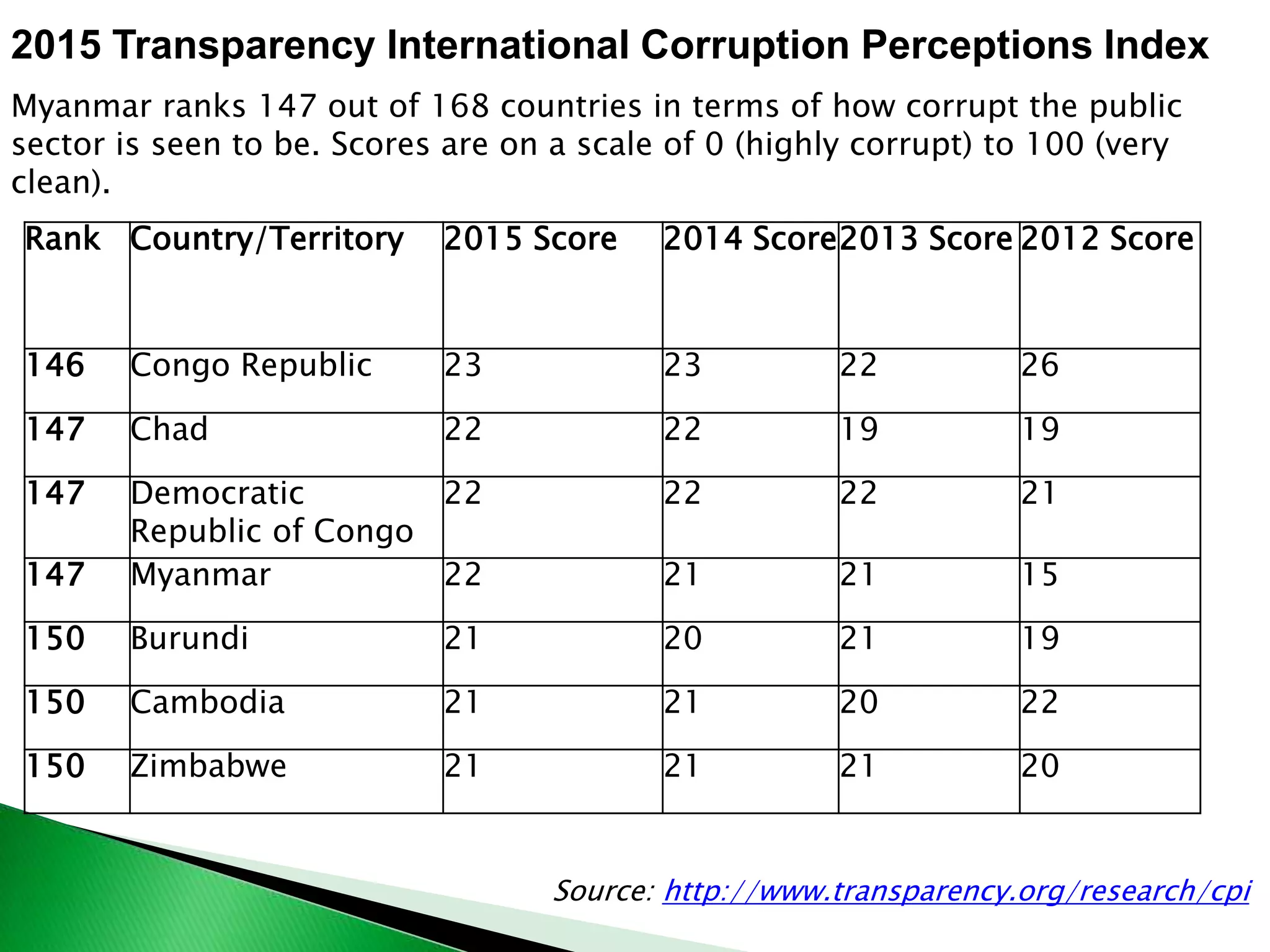
Rank Country/Territory 2015 Score 2014 Score2013 Score 2012 Score
146 Congo Republic 23 23 22 26
147 Chad 22 22 19 19
147 Democratic
Republic of Congo
22 22 22 21
147 Myanmar 22 21 21 15
150 Burundi 21 20 21 19
150 Cambodia 21 21 20 22
150 Zimbabwe 21 21 21 20
2015 Transparency International Corruption Perceptions Index
Myanmar ranks 147 out of 168 countries in terms of how corrupt the public
sector is seen to be. Scores are on a scale of 0 (highly corrupt) to 100 (very
clean).
Source: http://www.transparency.org/research/cpi
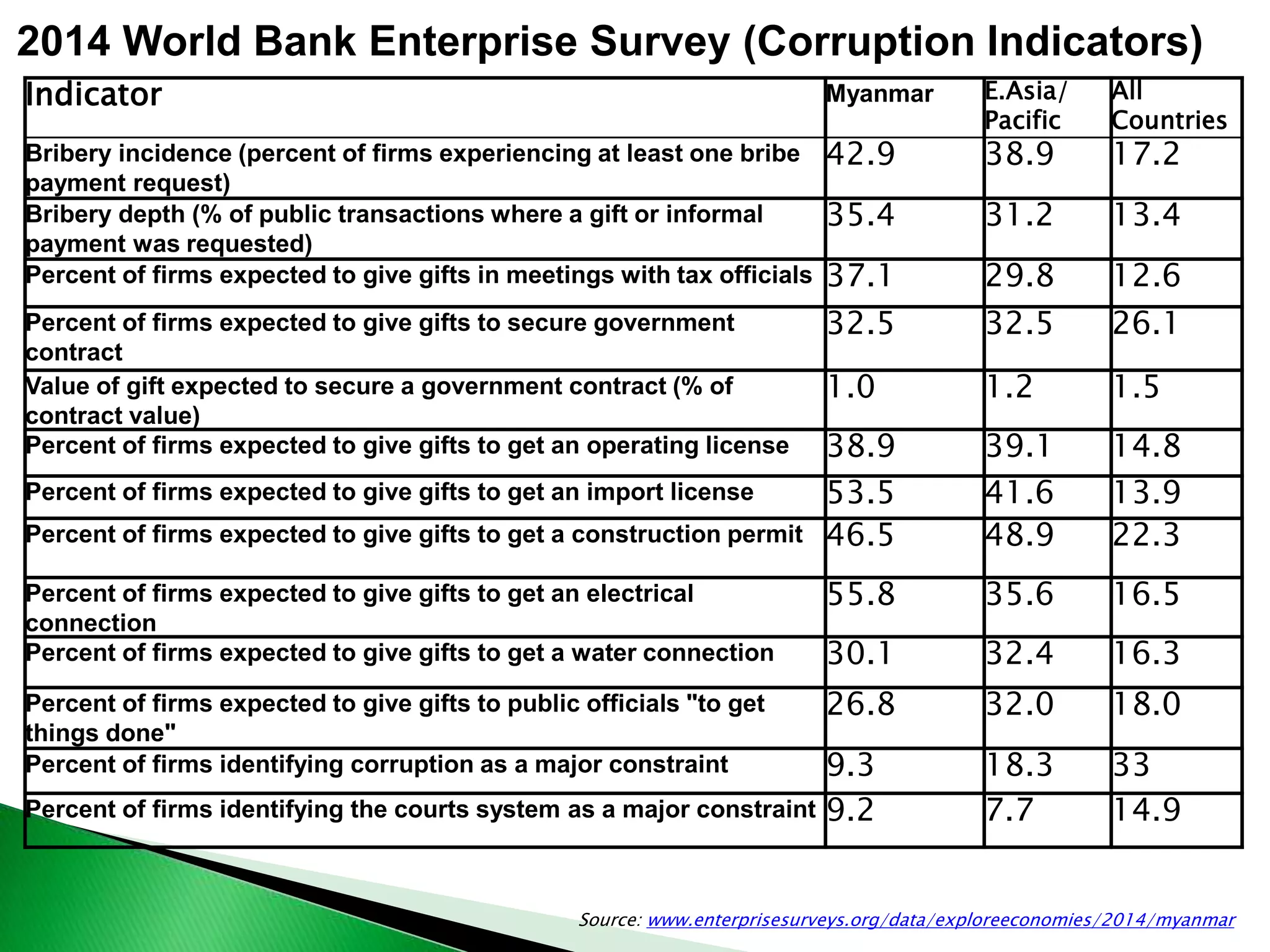
Indicator Myanmar E.Asia/
Pacific
All
Countries
Bribery incidence (percent of firms experiencing at least one bribe
payment request)
42.9 38.9 17.2
Bribery depth (% of public transactions where a gift or informal
payment was requested)
35.4 31.2 13.4
Percent of firms expected to give gifts in meetings with tax officials 37.1 29.8 12.6
Percent of firms expected to give gifts to secure government
contract
32.5 32.5 26.1
Value of gift expected to secure a government contract (% of
contract value)
1.0 1.2 1.5
Percent of firms expected to give gifts to get an operating license 38.9 39.1 14.8
Percent of firms expected to give gifts to get an import license 53.5 41.6 13.9
Percent of firms expected to give gifts to get a construction permit 46.5 48.9 22.3
Percent of firms expected to give gifts to get an electrical
connection
55.8 35.6 16.5
Percent of firms expected to give gifts to get a water connection 30.1 32.4 16.3
Percent of firms expected to give gifts to public officials "to get
things done"
26.8 32.0 18.0
Percent of firms identifying corruption as a major constraint 9.3 18.3 33
Percent of firms identifying the courts system as a major constraint 9.2 7.7 14.9
2014 World Bank Enterprise Survey (Corruption Indicators)
Source: www.enterprisesurveys.org/data/exploreeconomies/2014/myanmar
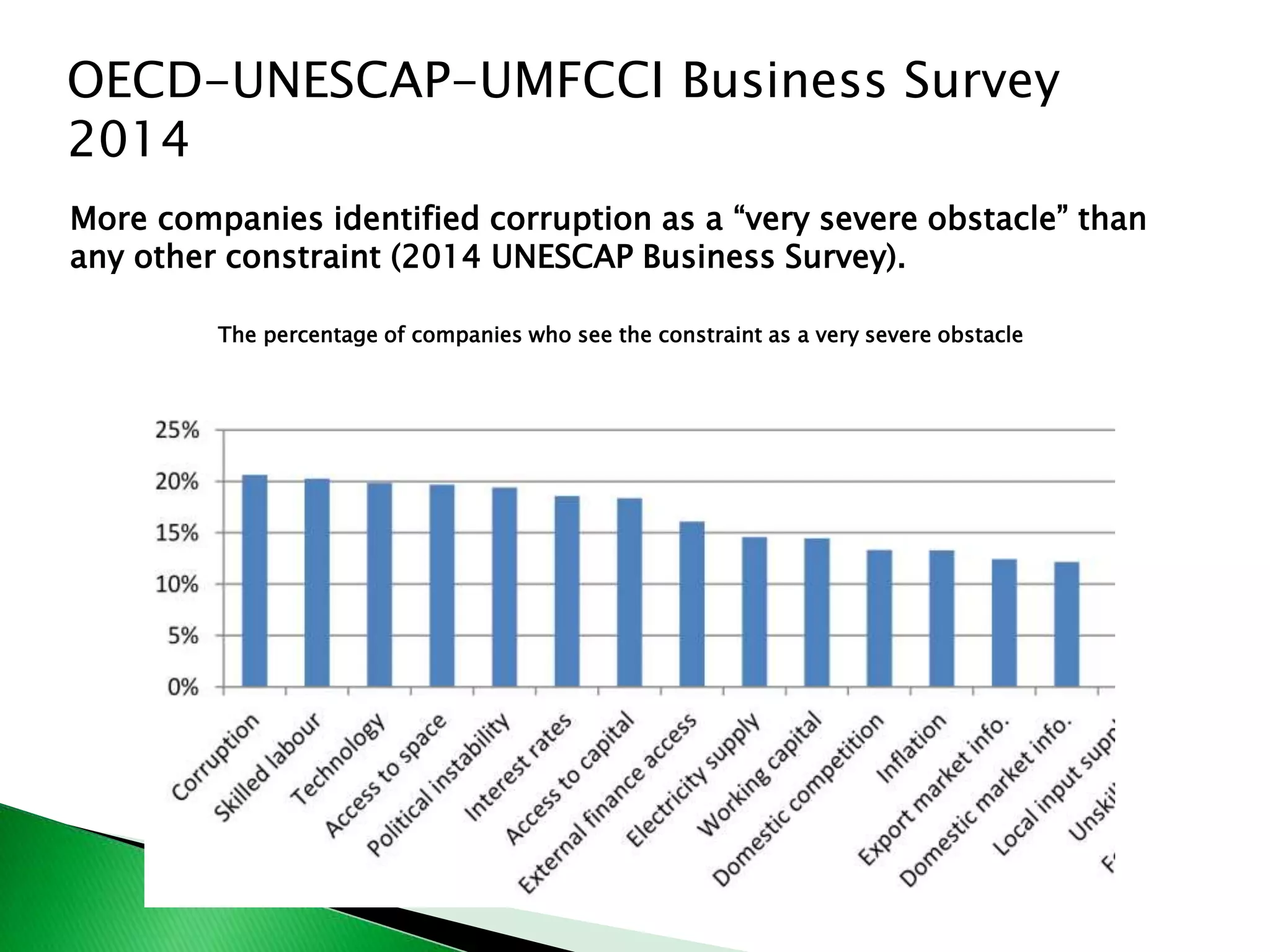
More companies identified corruption as a “very severe obstacle” than
any other constraint (2014 UNESCAP Business Survey).
The percentage of companies who see the constraint as a very severe obstacle
OECD-UNESCAP-UMFCCI Business Survey
2014
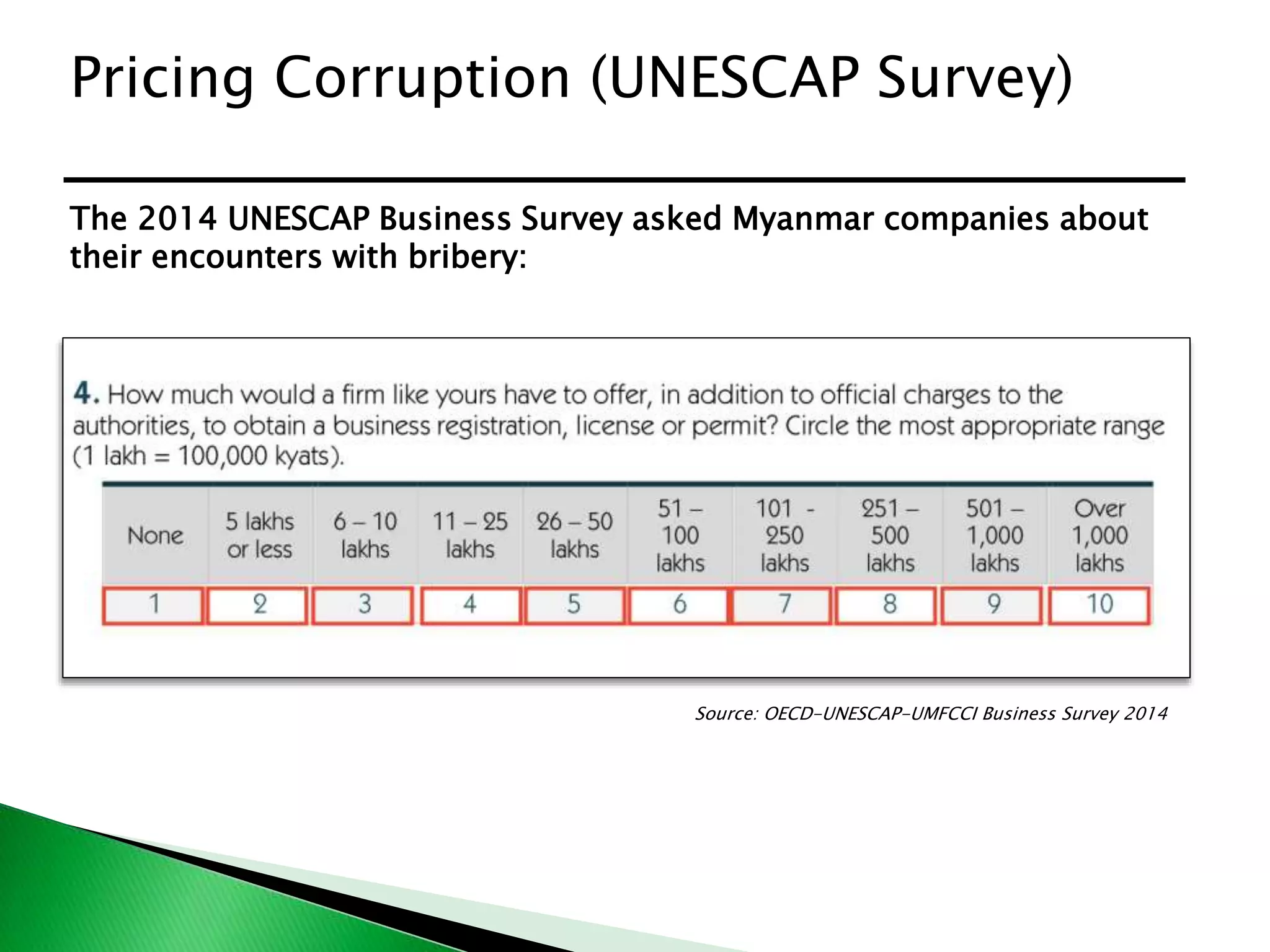
Pricing Corruption (UNESCAP Survey)
The 2014 UNESCAP Business Survey asked Myanmar companies about
their encounters with bribery:
Source: OECD-UNESCAP-UMFCCI Business Survey 2014
Pricing Corruption (UNESCAP Survey)
The UNESCAP data was used to perform an econometric analysis of
corruption in Myanmar, with the following findings:
• Firms with higher ‘ability to pay’ (based on sales revenue and employee growth) are more
likely to pay bribes.
• Firms with lower ‘refusal power’ (i.e needing bureaucratic permissions to export and
import) are more likely to find corruption to be an obstacle.
• However, there is no evidence that bribes act as ‘efficiency grease’ by allowing firms to
circumvent red tape. In fact, firms that pay bribes report greater bureaucratic hassle
compared to firms that do not.
• Small firms are 5% more likely to pay bribes compared to Micro firms, while Medium firms
are 14% more likely to pay bribes.
• Firms in the Extractive industries are almost 20% more likely to pay bribes compared to
firms in Agriculture, while firms in wholesale and retail trade are 9% less likely to pay
bribes.
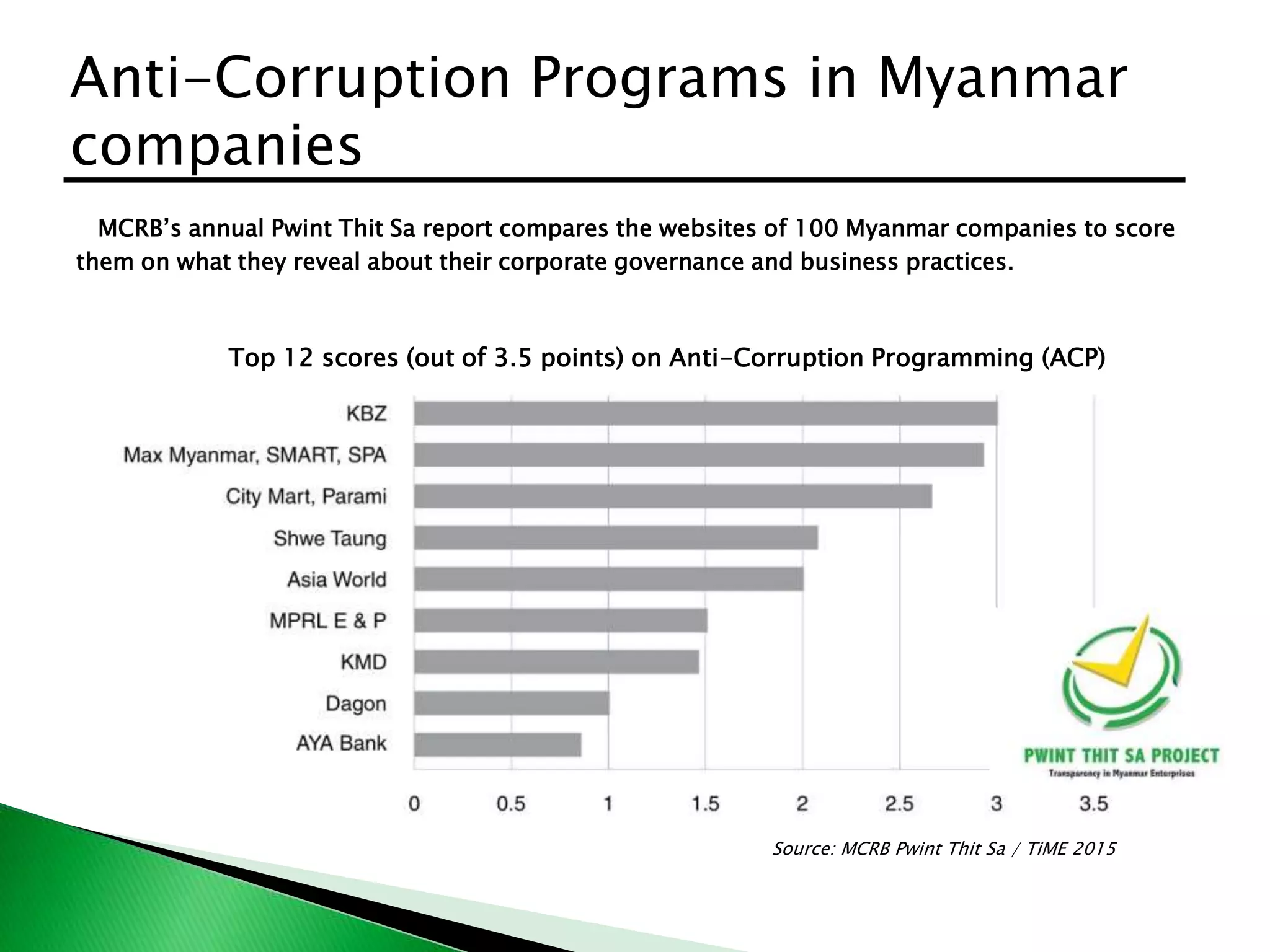
MCRB’s annual Pwint Thit Sa report compares the websites of 100 Myanmar companies to score
them on what they reveal about their corporate governance and business practices.
Anti-Corruption Programs in Myanmar
companies
Top 12 scores (out of 3.5 points) on Anti-Corruption Programming (ACP)
Source: MCRB Pwint Thit Sa / TiME 2015
 Mini Pwint Thit Sa
 Inviting medium-sized
enterprises to volunteer to have
their website benchmarked
against the 35 questions.
 3rd Pwint Thit Sa report (to be
published in July 2016)
 MCRB will repeat workshops with
companies on good practice:
 Anti-corruption programmes (16
March)
 Human rights policies
 Reporting
 Grievance mechanisms
www.mcrb.org.mm
myanmar.responsible.business

ASEAN CSR Network: Making the Change in Myanmar

  • 1.
    Wednesday 16 March6, 9.00am – 4.30pm Summit Parkview Hotel, Yangon, Myanmar
  • 2.
    Corruption in Myanmar- What do the surveys say? Vicky Bowman, Director, Myanmar Centre for Responsible Business ASEAN-CSR Network/MCRB Training Workshop on Anti-Corruption 16 March 2016, Yangon
  • 3.
    Rank Country/Territory 2015Score 2014 Score2013 Score 2012 Score 146 Congo Republic 23 23 22 26 147 Chad 22 22 19 19 147 Democratic Republic of Congo 22 22 22 21 147 Myanmar 22 21 21 15 150 Burundi 21 20 21 19 150 Cambodia 21 21 20 22 150 Zimbabwe 21 21 21 20 2015 Transparency International Corruption Perceptions Index Myanmar ranks 147 out of 168 countries in terms of how corrupt the public sector is seen to be. Scores are on a scale of 0 (highly corrupt) to 100 (very clean). Source: http://www.transparency.org/research/cpi
  • 4.
    Indicator Myanmar E.Asia/ Pacific All Countries Briberyincidence (percent of firms experiencing at least one bribe payment request) 42.9 38.9 17.2 Bribery depth (% of public transactions where a gift or informal payment was requested) 35.4 31.2 13.4 Percent of firms expected to give gifts in meetings with tax officials 37.1 29.8 12.6 Percent of firms expected to give gifts to secure government contract 32.5 32.5 26.1 Value of gift expected to secure a government contract (% of contract value) 1.0 1.2 1.5 Percent of firms expected to give gifts to get an operating license 38.9 39.1 14.8 Percent of firms expected to give gifts to get an import license 53.5 41.6 13.9 Percent of firms expected to give gifts to get a construction permit 46.5 48.9 22.3 Percent of firms expected to give gifts to get an electrical connection 55.8 35.6 16.5 Percent of firms expected to give gifts to get a water connection 30.1 32.4 16.3 Percent of firms expected to give gifts to public officials "to get things done" 26.8 32.0 18.0 Percent of firms identifying corruption as a major constraint 9.3 18.3 33 Percent of firms identifying the courts system as a major constraint 9.2 7.7 14.9 2014 World Bank Enterprise Survey (Corruption Indicators) Source: www.enterprisesurveys.org/data/exploreeconomies/2014/myanmar
  • 5.
    More companies identifiedcorruption as a “very severe obstacle” than any other constraint (2014 UNESCAP Business Survey). The percentage of companies who see the constraint as a very severe obstacle OECD-UNESCAP-UMFCCI Business Survey 2014
  • 6.
    Pricing Corruption (UNESCAPSurvey) The 2014 UNESCAP Business Survey asked Myanmar companies about their encounters with bribery: Source: OECD-UNESCAP-UMFCCI Business Survey 2014
  • 7.
    Pricing Corruption (UNESCAPSurvey) The UNESCAP data was used to perform an econometric analysis of corruption in Myanmar, with the following findings: • Firms with higher ‘ability to pay’ (based on sales revenue and employee growth) are more likely to pay bribes. • Firms with lower ‘refusal power’ (i.e needing bureaucratic permissions to export and import) are more likely to find corruption to be an obstacle. • However, there is no evidence that bribes act as ‘efficiency grease’ by allowing firms to circumvent red tape. In fact, firms that pay bribes report greater bureaucratic hassle compared to firms that do not. • Small firms are 5% more likely to pay bribes compared to Micro firms, while Medium firms are 14% more likely to pay bribes. • Firms in the Extractive industries are almost 20% more likely to pay bribes compared to firms in Agriculture, while firms in wholesale and retail trade are 9% less likely to pay bribes.
  • 8.
    MCRB’s annual PwintThit Sa report compares the websites of 100 Myanmar companies to score them on what they reveal about their corporate governance and business practices. Anti-Corruption Programs in Myanmar companies Top 12 scores (out of 3.5 points) on Anti-Corruption Programming (ACP) Source: MCRB Pwint Thit Sa / TiME 2015
  • 9.
     Mini PwintThit Sa  Inviting medium-sized enterprises to volunteer to have their website benchmarked against the 35 questions.  3rd Pwint Thit Sa report (to be published in July 2016)  MCRB will repeat workshops with companies on good practice:  Anti-corruption programmes (16 March)  Human rights policies  Reporting  Grievance mechanisms
  • 10.