D. ASEAN COUNTRIE’S POLICIES
ON LANGUAGE INSTRUCTION
Prepared by:
Zarate, Bernard F.
and
Garunay, Carmina P.
III-BSE ENGLISH-B
SUMMARY
- ASEAN was establish in 1967 in Bangkok, Thailand.
- five members: Indonesia, Malaysia, Philippines, Singapore, and
Thailand. Brunei, Vietnam, Laos, Myanmar, and Cambodia were later
added to the group of nations as it continued to grow.
- ENGLISH is the De facto language of ASEAN since 20009.
Association of Southeast Asian Nation (ASEAN)
2
ABOUT ASEAN
ASEAN ON LANGUAGE
• Become de jure with the signing of ASEAN character in 2009.
• Article 34 of the character roads “ the working language of ASEAN shall be
English”.
ENGLISH as the LANUAGE OF ASEAN
Possible reasons:
- Relatively “neutral status”
- Drive for modernization
- Participate in globalization
3
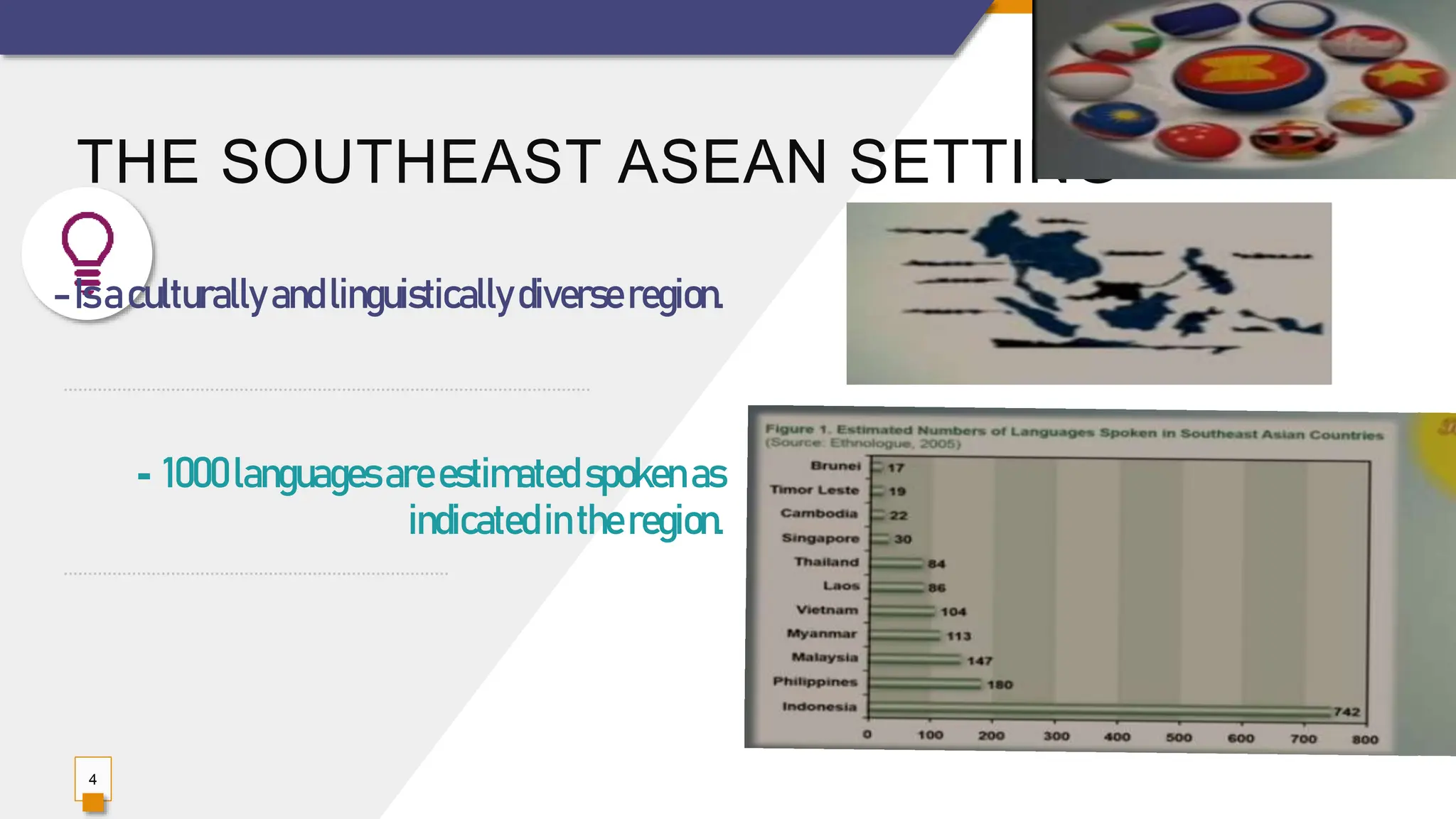
THE SOUTHEAST ASEAN SETTING
- 1000languagesareestimated spokenas
indicatedintheregion.
4
-Isaculturallyandlinguisticallydiverse region.
LANGUAGE IN EDUCATIONAL POLICIES
IN LANGUAGE ASIA:
5
ASEAN
1. BRUNEI
2. MALAYSIA
3. INDONESIA
4.
CAMBODIA
5. SINGAPORE
Let's continue 👉---------
>
Government policy and subsequent practice
moreover, overlook the use of all local
languages, including the de facto colloquial
national language, Brunei Malay.
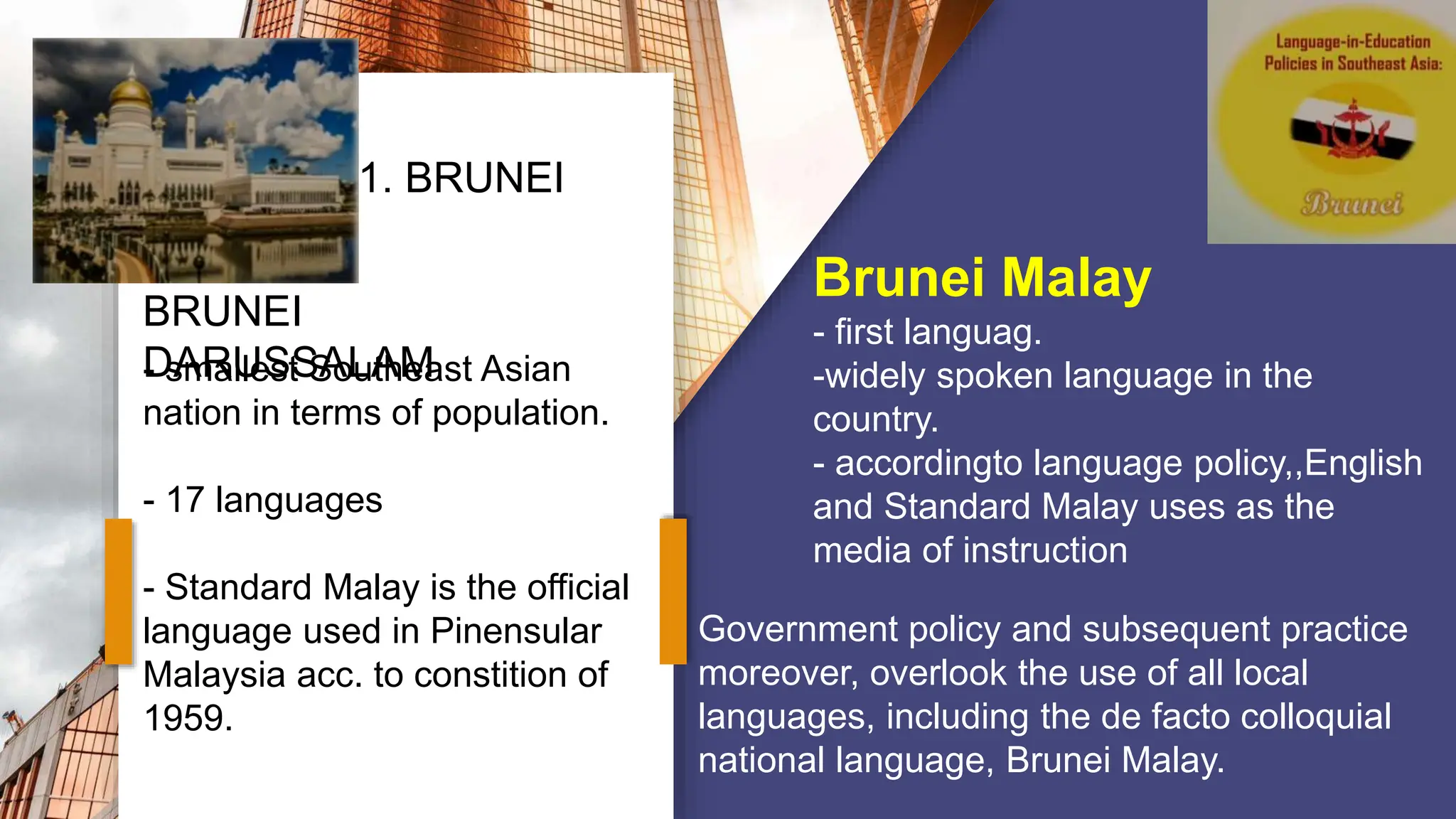
BRUNEI
DARUSSALAM
1. BRUNEI
- smallest Southeast Asian
nation in terms of population.
- 17 languages
- Standard Malay is the official
language used in Pinensular
Malaysia acc. to constition of
1959.
Brunei Malay
- first languag.
-widely spoken language in the
country.
- accordingto language policy,,English
and Standard Malay uses as the
media of instruction
7
2. MALAYSIA
- 134 languages are spoken
- Standard Malay (Bahasa Malaysia) is the official and national
language acc. to constition of 1959.
- national primary school use standard Malay as the main language
of instruction
- national type primary school uses another language such as
Mandarin Chinese, Tamil, or an alternative Indian language as the
main LOI.
8
- with 707 spoken languages.
- the constitution of 1945 stipulates Indonesia (Bahasa Indonesia) as the official language,
also a language of instruction and literacy at all levels of education.
- estimated 10-20% speaks Indonesian as their first language but up to 70% of Indonesian
use it as secondary language
- law no.20 of 2003 states that another mother tongue than Indonesian can be use in the
early stages of education.
3. INDONESIA
9
4. CAMBODIA
- 27 languages are spoken
- The constitutionof 1993 -Khmer- official language
- education law of 2007, gave local authoritiees the right to choose
the language of instruction in certain minority areas.
5. SINGAPORE
- Lewis et. al (2006), list 24 languages
- the constitutionof 1965 stimulates four official languages;
Malay, Mandarin, Tamil, Chinese, and English .
- the constitutionalso guarantees the use, teaching and learning
of other languages.
LET'S LOOK FOR
OTHER 5 ASEAN
COUNTRIES....
to be continued by Mr. Zarate
ENGLISH
IS
THE
SOLE
OF
INSTRUCTION
IN
EDUCATION
PHILIPPINES
12
• The language is considered as second language
of the country.
• The English policy in the Philippines can be
perceived to be successful as far as I can
remember with the second language literacy rate
of 93% among the population.
• Mother Tongue – Based Multilingual Education
(MTB-MLE) is the government’s banner program
for education as a salient part of the
implementation of the K to 12 Basic Education
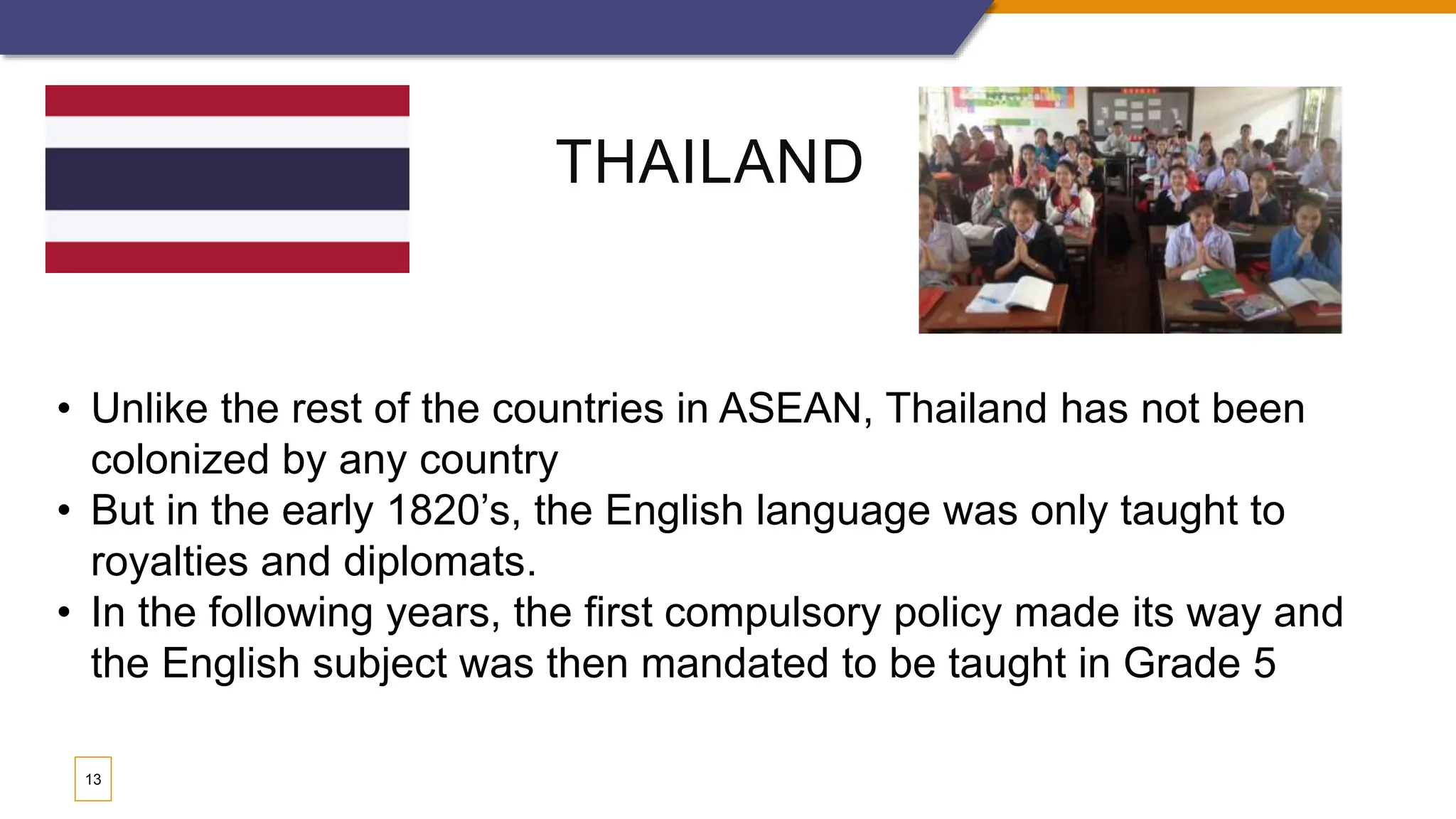
THAILAND
13
• Unlike the rest of the countries in ASEAN, Thailand has not been
colonized by any country
• But in the early 1820’s, the English language was only taught to
royalties and diplomats.
• In the following years, the first compulsory policy made its way and
the English subject was then mandated to be taught in Grade 5
VIETNAM
14
• English language was introduced in Vietnam in the 1990s in primary
schools.
• English is a one of the many subjects that has national examinations and
students need to pass this in order to enter Secondary School Education.
• The education sector of the country instructed in 1996 that English will be
compulsory at Grade 3 throughout the country.
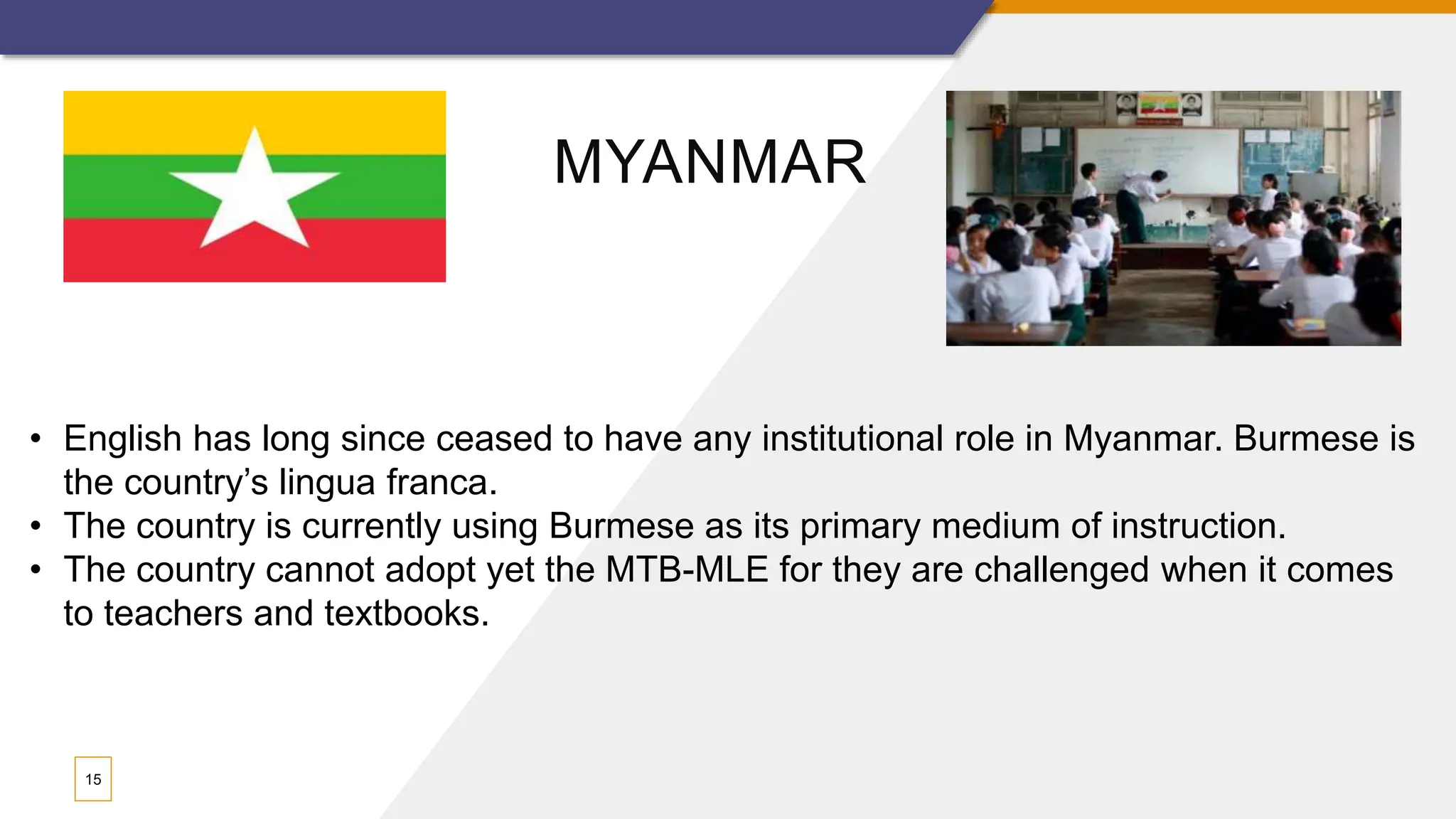
MYANMAR
15
• English has long since ceased to have any institutional role in Myanmar. Burmese is
the country’s lingua franca.
• The country is currently using Burmese as its primary medium of instruction.
• The country cannot adopt yet the MTB-MLE for they are challenged when it comes
to teachers and textbooks.
LAOS
16
• Laos is also considered as monolingual wherein all subjects across level
are taught in Lao language.
• Laos remains to be one of the poorest countries with limited roads and
infrastructure, sources of electricity and educational system.
• The “general education” system in Lao PDR is organized in three levels:
primary (grades 1-5), lower secondary (grades 6-8), and upper secondary
(grades 9-11) .
Thank you
for
listening
Have a good day everyone !
ENGLISH
IS
THE
SOLE
OF
INSTRUCTION
IN
EDUCATION

ASEAN COUNTRIES AND POLICIES ON LANGUAGE INSTRUCTION.COMPLETE.pptx

  • 1.
    D. ASEAN COUNTRIE’SPOLICIES ON LANGUAGE INSTRUCTION Prepared by: Zarate, Bernard F. and Garunay, Carmina P. III-BSE ENGLISH-B
  • 2.
    SUMMARY - ASEAN wasestablish in 1967 in Bangkok, Thailand. - five members: Indonesia, Malaysia, Philippines, Singapore, and Thailand. Brunei, Vietnam, Laos, Myanmar, and Cambodia were later added to the group of nations as it continued to grow. - ENGLISH is the De facto language of ASEAN since 20009. Association of Southeast Asian Nation (ASEAN) 2 ABOUT ASEAN
  • 3.
    ASEAN ON LANGUAGE •Become de jure with the signing of ASEAN character in 2009. • Article 34 of the character roads “ the working language of ASEAN shall be English”. ENGLISH as the LANUAGE OF ASEAN Possible reasons: - Relatively “neutral status” - Drive for modernization - Participate in globalization 3
  • 4.
    THE SOUTHEAST ASEANSETTING - 1000languagesareestimated spokenas indicatedintheregion. 4 -Isaculturallyandlinguisticallydiverse region.
  • 5.
    LANGUAGE IN EDUCATIONALPOLICIES IN LANGUAGE ASIA: 5 ASEAN 1. BRUNEI 2. MALAYSIA 3. INDONESIA 4. CAMBODIA 5. SINGAPORE Let's continue 👉--------- >
  • 6.
    Government policy andsubsequent practice moreover, overlook the use of all local languages, including the de facto colloquial national language, Brunei Malay. BRUNEI DARUSSALAM 1. BRUNEI - smallest Southeast Asian nation in terms of population. - 17 languages - Standard Malay is the official language used in Pinensular Malaysia acc. to constition of 1959. Brunei Malay - first languag. -widely spoken language in the country. - accordingto language policy,,English and Standard Malay uses as the media of instruction
  • 7.
    7 2. MALAYSIA - 134languages are spoken - Standard Malay (Bahasa Malaysia) is the official and national language acc. to constition of 1959. - national primary school use standard Malay as the main language of instruction - national type primary school uses another language such as Mandarin Chinese, Tamil, or an alternative Indian language as the main LOI.
  • 8.
    8 - with 707spoken languages. - the constitution of 1945 stipulates Indonesia (Bahasa Indonesia) as the official language, also a language of instruction and literacy at all levels of education. - estimated 10-20% speaks Indonesian as their first language but up to 70% of Indonesian use it as secondary language - law no.20 of 2003 states that another mother tongue than Indonesian can be use in the early stages of education. 3. INDONESIA
  • 9.
    9 4. CAMBODIA - 27languages are spoken - The constitutionof 1993 -Khmer- official language - education law of 2007, gave local authoritiees the right to choose the language of instruction in certain minority areas.
  • 10.
    5. SINGAPORE - Lewiset. al (2006), list 24 languages - the constitutionof 1965 stimulates four official languages; Malay, Mandarin, Tamil, Chinese, and English . - the constitutionalso guarantees the use, teaching and learning of other languages.
  • 11.
    LET'S LOOK FOR OTHER5 ASEAN COUNTRIES.... to be continued by Mr. Zarate ENGLISH IS THE SOLE OF INSTRUCTION IN EDUCATION
  • 12.
    PHILIPPINES 12 • The languageis considered as second language of the country. • The English policy in the Philippines can be perceived to be successful as far as I can remember with the second language literacy rate of 93% among the population. • Mother Tongue – Based Multilingual Education (MTB-MLE) is the government’s banner program for education as a salient part of the implementation of the K to 12 Basic Education
  • 13.
    THAILAND 13 • Unlike therest of the countries in ASEAN, Thailand has not been colonized by any country • But in the early 1820’s, the English language was only taught to royalties and diplomats. • In the following years, the first compulsory policy made its way and the English subject was then mandated to be taught in Grade 5
  • 14.
    VIETNAM 14 • English languagewas introduced in Vietnam in the 1990s in primary schools. • English is a one of the many subjects that has national examinations and students need to pass this in order to enter Secondary School Education. • The education sector of the country instructed in 1996 that English will be compulsory at Grade 3 throughout the country.
  • 15.
    MYANMAR 15 • English haslong since ceased to have any institutional role in Myanmar. Burmese is the country’s lingua franca. • The country is currently using Burmese as its primary medium of instruction. • The country cannot adopt yet the MTB-MLE for they are challenged when it comes to teachers and textbooks.
  • 16.
    LAOS 16 • Laos isalso considered as monolingual wherein all subjects across level are taught in Lao language. • Laos remains to be one of the poorest countries with limited roads and infrastructure, sources of electricity and educational system. • The “general education” system in Lao PDR is organized in three levels: primary (grades 1-5), lower secondary (grades 6-8), and upper secondary (grades 9-11) .
  • 17.
    Thank you for listening Have agood day everyone ! ENGLISH IS THE SOLE OF INSTRUCTION IN EDUCATION