EVOLUTION OF .NET FRAMEWORK
Presented By –
Prateek Upadhyay (BETN1CS15075)
Tushar Raj
(BETN1CS15113)
Utkarsh Ratna (BETN1CS15115)
Vikram Chaudhary (BETN1CS15120)
Nilanshu Srivastava (BETN3CS16D02)
INTRODUCTION
• .NET Framework is a software development framework developed
by Microsoft which supports many languages like C#, Visual Basic,
F# etc.
• .NET Framework includes a large class library called Framework
Class Library which provides language interoperability.
• .NET Framework uses an environment known as Common
Language Runtime to execute the programs written in different
languages.
• Common Language Runtime is also known as CLR which converts
code into MSIL (Microsoft Intermediate Language) i.e. Machine
level language. CLR also provides services like security, memory
management, exception handling etc.
HISTORY
• Microsoft started development of .NET framework in late 1990s.
• Originally under the Next Generation Windows Services and by late
2000, the first beta version of .NET Framework were released.
• So many changes have come to .NET Framework in different versions.
• The first version of .NET Framework was released on 13 February
2002, bringing managed code to Windows NT 4.0, 98, 2000, ME and
XP.
• We are trying to cover basic details of different versions of .NET
Framework and features that are included in every version.
HISTORY(CONTD.)
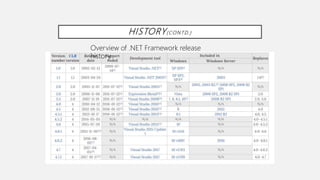
Overview of .NET Framework release
history
• The first version of the .NET
Framework was released on 13
February 2002 for Windows 98,
ME, NT 4.0, 2000, and XP.
• Mainstream support for this
version ended on 10 July 2007,
with the exception of Windows XP
Media Center and Tablet PC
editions.
• .NET Framework 1.0 is supported
on Windows 98, ME, NT 4.0,
2000, XP, and Server 2003.
• DLL libraries.
• Support for object oriented web
app development.
KEY FEATURES
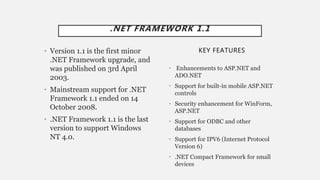
.NET FRAMEWORK 1.0
• Version 1.1 is the first minor
.NET Framework upgrade, and
was published on 3rd April
2003.
• Mainstream support for .NET
Framework 1.1 ended on 14
October 2008.
• .NET Framework 1.1 is the last
version to support Windows
NT 4.0.
• Enhancements to ASP.NET and
ADO.NET
• Support for built-in mobile ASP.NET
controls
• Security enhancement for WinForm,
ASP.NET
• Support for ODBC and other
databases
• Support for IPV6 (Internet Protocol
Version 6)
• .NET Compact Framework for small
devices
KEY FEATURES
.NET FRAMEWORK 1.1
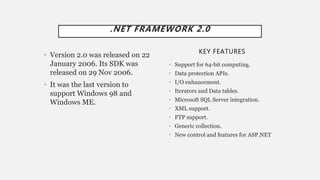
• Version 2.0 was released on 22
January 2006. Its SDK was
released on 29 Nov 2006.
• It was the last version to
support Windows 98 and
Windows ME.
• Support for 64-bit computing.
• Data protection APIs.
• I/O enhancement.
• Iterators and Data tables.
• Microsoft SQL Server integration.
• XML support.
• FTP support.
• Generic collection.
• New control and features for ASP.NET
KEY FEATURES
.NET FRAMEWORK 2.0
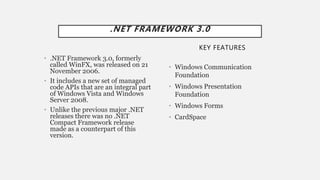
• .NET Framework 3.0, formerly
called WinFX, was released on 21
November 2006.
• It includes a new set of managed
code APIs that are an integral part
of Windows Vista and Windows
Server 2008.
• Unlike the previous major .NET
releases there was no .NET
Compact Framework release
made as a counterpart of this
version.
• Windows Communication
Foundation
• Windows Presentation
Foundation
• Windows Forms
• CardSpace
KEY FEATURES
.NET FRAMEWORK 3.0
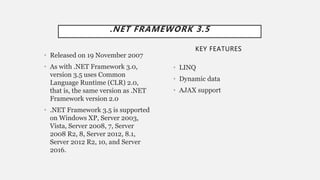
• Released on 19 November 2007
• As with .NET Framework 3.0,
version 3.5 uses Common
Language Runtime (CLR) 2.0,
that is, the same version as .NET
Framework version 2.0
• .NET Framework 3.5 is supported
on Windows XP, Server 2003,
Vista, Server 2008, 7, Server
2008 R2, 8, Server 2012, 8.1,
Server 2012 R2, 10, and Server
2016.
KEY FEATURES
.NET FRAMEWORK 3.5
• LINQ
• Dynamic data
• AJAX support
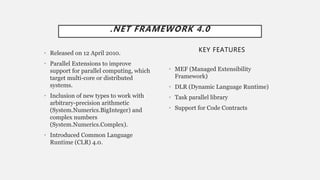
• Released on 12 April 2010.
• Parallel Extensions to improve
support for parallel computing, which
target multi-core or distributed
systems.
• Inclusion of new types to work with
arbitrary-precision arithmetic
(System.Numerics.BigInteger) and
complex numbers
(System.Numerics.Complex).
• Introduced Common Language
Runtime (CLR) 4.0.
• MEF (Managed Extensibility
Framework)
• DLR (Dynamic Language Runtime)
• Task parallel library
• Support for Code Contracts
KEY FEATURES
.NET FRAMEWORK 4.0
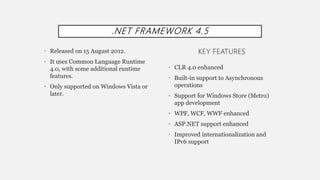
• Released on 15 August 2012.
• It uses Common Language Runtime
4.0, with some additional runtime
features.
• Only supported on Windows Vista or
later.
• CLR 4.0 enhanced
• Built-in support to Asynchronous
operations
• Support for Windows Store (Metro)
app development
• WPF, WCF, WWF enhanced
• ASP.NET support enhanced
• Improved internationalization and
IPv6 support
.NET FRAMEWORK 4.5
KEY FEATURES
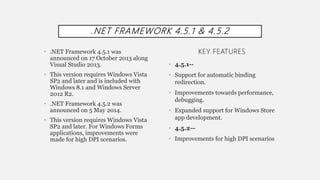
• .NET Framework 4.5.1 was
announced on 17 October 2013 along
Visual Studio 2013.
• This version requires Windows Vista
SP2 and later and is included with
Windows 8.1 and Windows Server
2012 R2.
• .NET Framework 4.5.2 was
announced on 5 May 2014.
• This version requires Windows Vista
SP2 and later. For Windows Forms
applications, improvements were
made for high DPI scenarios.
• 4.5.1--
• Support for automatic binding
redirection.
• Improvements towards performance,
debugging.
• Expanded support for Windows Store
app development.
• 4.5.2—
• Improvements for high DPI scenarios
.NET FRAMEWORK 4.5.1 & 4.5.2
KEY FEATURES
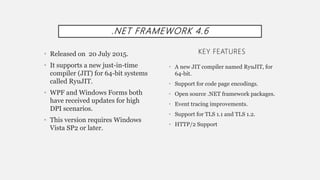
• Released on 20 July 2015.
• It supports a new just-in-time
compiler (JIT) for 64-bit systems
called RyuJIT.
• WPF and Windows Forms both
have received updates for high
DPI scenarios.
• This version requires Windows
Vista SP2 or later.
• A new JIT compiler named RyuJIT, for
64-bit.
• Support for code page encodings.
• Open source .NET framework packages.
• Event tracing improvements.
• Support for TLS 1.1 and TLS 1.2.
• HTTP/2 Support
.NET FRAMEWORK 4.6
KEY FEATURES
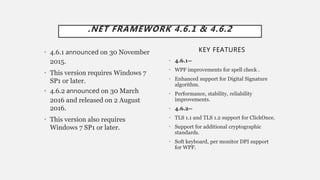
• 4.6.1 announced on 30 November
2015.
• This version requires Windows 7
SP1 or later.
• 4.6.2 announced on 30 March
2016 and released on 2 August
2016.
• This version also requires
Windows 7 SP1 or later.
• 4.6.1--
• WPF improvements for spell check .
• Enhanced support for Digital Signature
algorithm.
• Performance, stability, reliability
improvements.
• 4.6.2--
• TLS 1.1 and TLS 1.2 support for ClickOnce.
• Support for additional cryptographic
standards.
• Soft keyboard, per monitor DPI support
for WPF.
.NET FRAMEWORK 4.6.1 & 4.6.2
KEY FEATURES
.NET FRAMEWORK 4.7 & 4.7.1
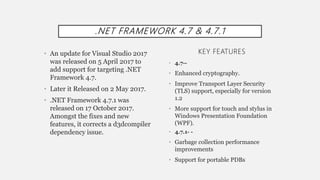
• An update for Visual Studio 2017
was released on 5 April 2017 to
add support for targeting .NET
Framework 4.7.
• Later it Released on 2 May 2017.
• .NET Framework 4.7.1 was
released on 17 October 2017.
Amongst the fixes and new
features, it corrects a d3dcompiler
dependency issue.
• 4.7--
• Enhanced cryptography.
• Improve Transport Layer Security
(TLS) support, especially for version
1.2
• More support for touch and stylus in
Windows Presentation Foundation
(WPF).
• 4.7.1- -
• Garbage collection performance
improvements
• Support for portable PDBs
KEY FEATURES
• These are the different versions of .NET Framework
with features included in every new version. We have
used MSDN and other sites as a reference to make this
article better.
CONCLUSION
Thank
You

Evolution of .net frame work

  • 1.
    EVOLUTION OF .NETFRAMEWORK Presented By – Prateek Upadhyay (BETN1CS15075) Tushar Raj (BETN1CS15113) Utkarsh Ratna (BETN1CS15115) Vikram Chaudhary (BETN1CS15120) Nilanshu Srivastava (BETN3CS16D02)
  • 2.
    INTRODUCTION • .NET Frameworkis a software development framework developed by Microsoft which supports many languages like C#, Visual Basic, F# etc. • .NET Framework includes a large class library called Framework Class Library which provides language interoperability. • .NET Framework uses an environment known as Common Language Runtime to execute the programs written in different languages. • Common Language Runtime is also known as CLR which converts code into MSIL (Microsoft Intermediate Language) i.e. Machine level language. CLR also provides services like security, memory management, exception handling etc.
  • 3.
    HISTORY • Microsoft starteddevelopment of .NET framework in late 1990s. • Originally under the Next Generation Windows Services and by late 2000, the first beta version of .NET Framework were released. • So many changes have come to .NET Framework in different versions. • The first version of .NET Framework was released on 13 February 2002, bringing managed code to Windows NT 4.0, 98, 2000, ME and XP. • We are trying to cover basic details of different versions of .NET Framework and features that are included in every version.
  • 4.
    HISTORY(CONTD.) Overview of .NETFramework release history
  • 5.
    • The firstversion of the .NET Framework was released on 13 February 2002 for Windows 98, ME, NT 4.0, 2000, and XP. • Mainstream support for this version ended on 10 July 2007, with the exception of Windows XP Media Center and Tablet PC editions. • .NET Framework 1.0 is supported on Windows 98, ME, NT 4.0, 2000, XP, and Server 2003. • DLL libraries. • Support for object oriented web app development. KEY FEATURES .NET FRAMEWORK 1.0
  • 6.
    • Version 1.1is the first minor .NET Framework upgrade, and was published on 3rd April 2003. • Mainstream support for .NET Framework 1.1 ended on 14 October 2008. • .NET Framework 1.1 is the last version to support Windows NT 4.0. • Enhancements to ASP.NET and ADO.NET • Support for built-in mobile ASP.NET controls • Security enhancement for WinForm, ASP.NET • Support for ODBC and other databases • Support for IPV6 (Internet Protocol Version 6) • .NET Compact Framework for small devices KEY FEATURES .NET FRAMEWORK 1.1
  • 7.
    • Version 2.0was released on 22 January 2006. Its SDK was released on 29 Nov 2006. • It was the last version to support Windows 98 and Windows ME. • Support for 64-bit computing. • Data protection APIs. • I/O enhancement. • Iterators and Data tables. • Microsoft SQL Server integration. • XML support. • FTP support. • Generic collection. • New control and features for ASP.NET KEY FEATURES .NET FRAMEWORK 2.0
  • 8.
    • .NET Framework3.0, formerly called WinFX, was released on 21 November 2006. • It includes a new set of managed code APIs that are an integral part of Windows Vista and Windows Server 2008. • Unlike the previous major .NET releases there was no .NET Compact Framework release made as a counterpart of this version. • Windows Communication Foundation • Windows Presentation Foundation • Windows Forms • CardSpace KEY FEATURES .NET FRAMEWORK 3.0
  • 9.
    • Released on19 November 2007 • As with .NET Framework 3.0, version 3.5 uses Common Language Runtime (CLR) 2.0, that is, the same version as .NET Framework version 2.0 • .NET Framework 3.5 is supported on Windows XP, Server 2003, Vista, Server 2008, 7, Server 2008 R2, 8, Server 2012, 8.1, Server 2012 R2, 10, and Server 2016. KEY FEATURES .NET FRAMEWORK 3.5 • LINQ • Dynamic data • AJAX support
  • 10.
    • Released on12 April 2010. • Parallel Extensions to improve support for parallel computing, which target multi-core or distributed systems. • Inclusion of new types to work with arbitrary-precision arithmetic (System.Numerics.BigInteger) and complex numbers (System.Numerics.Complex). • Introduced Common Language Runtime (CLR) 4.0. • MEF (Managed Extensibility Framework) • DLR (Dynamic Language Runtime) • Task parallel library • Support for Code Contracts KEY FEATURES .NET FRAMEWORK 4.0
  • 11.
    • Released on15 August 2012. • It uses Common Language Runtime 4.0, with some additional runtime features. • Only supported on Windows Vista or later. • CLR 4.0 enhanced • Built-in support to Asynchronous operations • Support for Windows Store (Metro) app development • WPF, WCF, WWF enhanced • ASP.NET support enhanced • Improved internationalization and IPv6 support .NET FRAMEWORK 4.5 KEY FEATURES
  • 12.
    • .NET Framework4.5.1 was announced on 17 October 2013 along Visual Studio 2013. • This version requires Windows Vista SP2 and later and is included with Windows 8.1 and Windows Server 2012 R2. • .NET Framework 4.5.2 was announced on 5 May 2014. • This version requires Windows Vista SP2 and later. For Windows Forms applications, improvements were made for high DPI scenarios. • 4.5.1-- • Support for automatic binding redirection. • Improvements towards performance, debugging. • Expanded support for Windows Store app development. • 4.5.2— • Improvements for high DPI scenarios .NET FRAMEWORK 4.5.1 & 4.5.2 KEY FEATURES
  • 13.
    • Released on20 July 2015. • It supports a new just-in-time compiler (JIT) for 64-bit systems called RyuJIT. • WPF and Windows Forms both have received updates for high DPI scenarios. • This version requires Windows Vista SP2 or later. • A new JIT compiler named RyuJIT, for 64-bit. • Support for code page encodings. • Open source .NET framework packages. • Event tracing improvements. • Support for TLS 1.1 and TLS 1.2. • HTTP/2 Support .NET FRAMEWORK 4.6 KEY FEATURES
  • 14.
    • 4.6.1 announcedon 30 November 2015. • This version requires Windows 7 SP1 or later. • 4.6.2 announced on 30 March 2016 and released on 2 August 2016. • This version also requires Windows 7 SP1 or later. • 4.6.1-- • WPF improvements for spell check . • Enhanced support for Digital Signature algorithm. • Performance, stability, reliability improvements. • 4.6.2-- • TLS 1.1 and TLS 1.2 support for ClickOnce. • Support for additional cryptographic standards. • Soft keyboard, per monitor DPI support for WPF. .NET FRAMEWORK 4.6.1 & 4.6.2 KEY FEATURES
  • 15.
    .NET FRAMEWORK 4.7& 4.7.1 • An update for Visual Studio 2017 was released on 5 April 2017 to add support for targeting .NET Framework 4.7. • Later it Released on 2 May 2017. • .NET Framework 4.7.1 was released on 17 October 2017. Amongst the fixes and new features, it corrects a d3dcompiler dependency issue. • 4.7-- • Enhanced cryptography. • Improve Transport Layer Security (TLS) support, especially for version 1.2 • More support for touch and stylus in Windows Presentation Foundation (WPF). • 4.7.1- - • Garbage collection performance improvements • Support for portable PDBs KEY FEATURES
  • 16.
    • These arethe different versions of .NET Framework with features included in every new version. We have used MSDN and other sites as a reference to make this article better. CONCLUSION
  • 17.