The Microsoft .NET Framework by jeyasri 10mss016 Sreejha 10mss033 Vijaykumar 10mss039
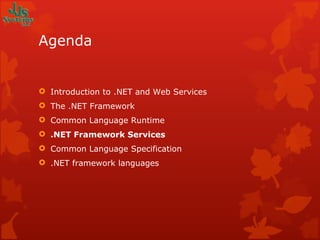
Agenda Introduction to .NET The .NET Framework Common Language Runtime .NET Framework Services Common Language Specification .NET  framework languages
How Did We Get to .NET? The Evolution of Web Applications First generation of Web applications -non-interactive content (HTML static content) Second generation of Web applications - scalable back-end and a richer User Interface. (DCOM, ASP, CGI, Cold Fusion, dynamic content) Third generation of Web applications (.NET) - using Web protocols and XML to allow better integration between services on the Web
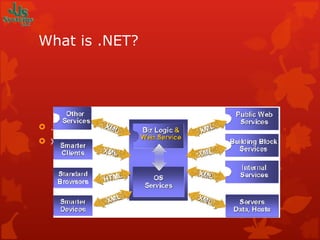
What is .NET? .NET is Microsoft’s entry into the Web services arena XML based
Why the Move to .NET? DCOM works fine on an Intranet, however: DCOM does not go through firewalls Requires too many open TCP/IP ports Requires Stateful connections Platform dependent Portals provide services however: Non-standard interfaces Hard to integrate with other applications Not designed to use outside the scope of the portal
XML Format XML is a tagged mark-up representation of data XML consists of a header section, a schema section, and a data section The header section defines the XML form itself The schema section defines the format of the data contained in the XML document The data section provides the mapped data C:\SicCodes.XML
SOAP  Simple Object Access Protocol Internet becomes integration fabric Broad industry support IBM, Iona, Ariba, Compaq, Lotus, Commerce-One, HP, SAP, others Submitted to W3C:  http://www.w3.org/TR/SOAP/   XML-based integration for web services
Agenda Introduction to .NET and Web Services The .NET Framework Common Language Runtime .NET Framework Services Common Language Specification .NET framework languages
What Is the .NET Framework? A collection of technologies that Unite isolated Web applications Make information available anytime, anywhere Simplify development and deployment How does .NET achieve the above? Web Services ADO.NET Datasets and XML support throughout the platform  Rich tools, runtime services and XCOPY Deployment
.NET Framework definition: The .NET Framework is a software technology that provides extensive libraries, pre-implemented solutions and a managed run-time environment. Eonfusion is built on the .NET Framework. The .NET Framework delivers more controls, improved start-up performance, AJAX support, and powerful new graphics features for client development.   It is designed to make significant improvements in code-reuse, code-specialization, resource management, multi-language development, security, deployment and administration.
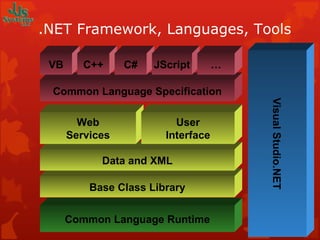
.NET Framework, Languages, Tools Base Class Library Common Language Specification Common Language Runtime Data and XML VB C++ C# Visual Studio.NET Web Services JScript … User Interface
Agenda Introduction to .NET and Web Services The .NET Framework Common Language Runtime .NET Framework Services Common Language Specification .NET framework languages
 
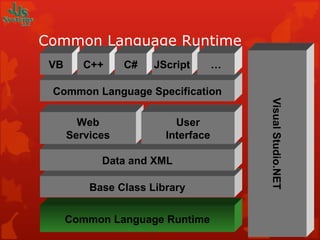
Common Language Runtime Base Class Library Common Language Specification Common Language Runtime Data and XML VB C++ C# Visual Studio.NET Web Services JScript … User Interface
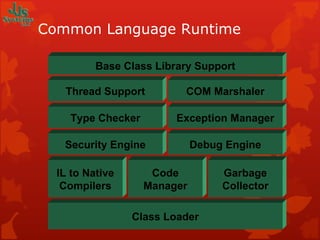
The .NET Common Language Runtime Manages running code Threading Memory management Multi-language Inheritance, Errors, Debugging Fine-grained evidence-based security Code access security Role-based security Integrated with underlying OS “ No-touch” deployment
Common Language Runtime Class Loader Base Class Library Support IL to Native Compilers Code Manager Garbage Collector Security Engine Debug Engine Type Checker Exception Manager Thread Support COM Marshaler
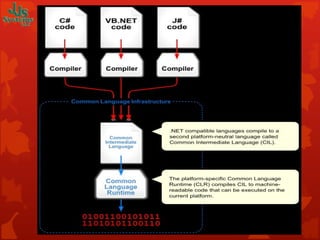
It is a special run time environment that provides the underlying infrastructure for Microsoft's .NET framework. This runtime is where the source code of an application is compiled into an intermediate language called CIL , originally known as MSIL (Microsoft Intermediate Language). When the program is then run, the CIL code is translated into the native code of the operating system using a just-in-time (JIT) compiler.[citation needed] This intermediate language is used to keep the environment platform-neutral and as a result, supports all .NET languages such as C# or VB.NET
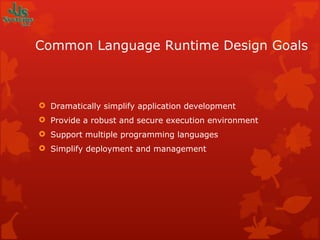
Common Language Runtime Design Goals Dramatically simplify application development Provide a robust and secure execution environment Support multiple programming languages Simplify deployment and management
Agenda Introduction to .NET and Web Services The .NET Framework Common Language Runtime .NET Framework Services Common Language Specification .NET framework languages
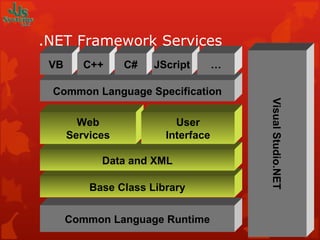
.NET Framework Services Base Class Library Common Language Specification Common Language Runtime Data and XML VB C++ C# Visual Studio.NET Web Services JScript … User Interface
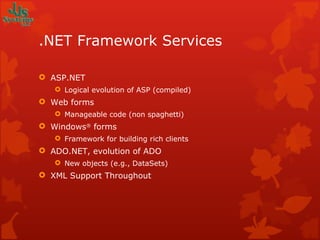
.NET Framework Services ASP.NET Logical evolution of ASP (compiled) Web forms Manageable code (non spaghetti) Windows ®  forms Framework for building rich clients ADO.NET, evolution of ADO New objects (e.g., DataSets) XML Support Throughout
Some .NET Base Class Libraries System  System.Data System.Xml System.Web Globalization Diagnostics Configuration Collections Resources Reflection Net IO Threading Text ServiceProcess Security Design ADO SQLTypes SQL XPath XSLT Runtime InteropServices Remoting Serialization Serialization Configuration SessionState Caching Security Services Description Discovery Protocols UI HtmlControls WebControls  System.Drawing Imaging Drawing2D Text Printing System.WinForms Design ComponentModel
Agenda Introduction to .NET and Web Services The .NET Framework Common Language Runtime .NET Framework Services Common Language Specification .NETframework languages
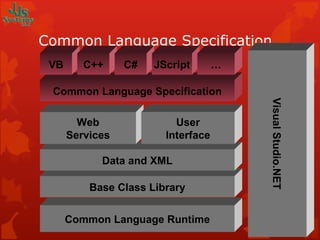
Common Language Specification Base Class Library Common Language Specification Common Language Runtime Data and XML VB C++ C# Visual Studio.NET Web Services JScript … User Interface
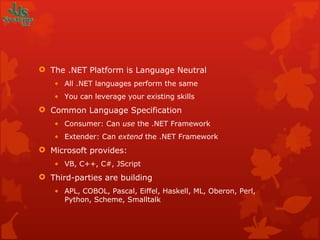
The .NET Platform is Language Neutral All .NET languages perform the same You can leverage your existing skills Common Language Specification Consumer: Can  use  the .NET Framework Extender: Can  extend  the .NET Framework Microsoft provides: VB, C++, C#, JScript Third-parties are building APL, COBOL, Pascal, Eiffel, Haskell, ML, Oberon, Perl, Python, Scheme, Smalltalk
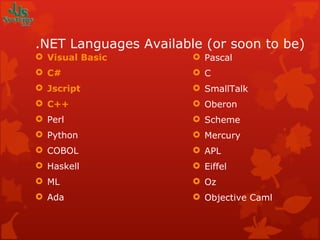
.NET Languages Available (or soon to be) Visual Basic C# Jscript C++ Perl Python COBOL Haskell ML Ada Pascal C SmallTalk Oberon Scheme Mercury APL Eiffel Oz Objective Caml
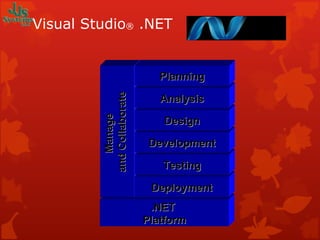
Visual Studio ®  .NET .NET  Platform Manage  and Collaborate Deployment Testing Development Design Analysis Planning
Agenda Introduction to .NET and Web Services The .NET Framework Common Language Runtime .NET Framework Services Common Language Specification . NET framework languages
.NET Framework languages .NET Framework is designed for cross-language compatibility.  Cross-language compatibility means .NET components can interact with each other irrespective of the languages they are written in. This cross-language compatibility is possible due to common language runtime.  the output of the compiler is not an executable file but a file that contains a special type of code called the Microsoft Intermediate Language (MSIL).
Contd…. Thus, any code compiled by a .NET complier can interoperate with the .NET Framework. all .NET applications are converted to IL before execution all primitive data types are represented as .NET types. This means that, a VB Integer and a C# int are both represented in IL code as System.
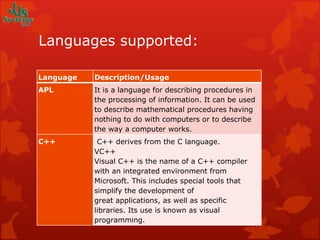
Languages supported: Language Description/Usage APL It is a language for describing procedures in the processing of information. It can be used to describe mathematical procedures having nothing to do with computers or to describe the way a computer works. C++ C++ derives from the C language.  VC++ Visual C++ is the name of a C++ compiler with an integrated environment from Microsoft. This includes special tools that simplify the development of great applications, as well as specific libraries. Its use is known as visual programming.
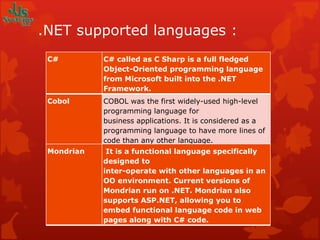
.NET supported languages : C# C# called as C Sharp is a full fledged Object-Oriented programming language from Microsoft built into the .NET Framework. Cobol COBOL was the first widely-used high-level programming language for business applications. It is considered as a programming language to have more lines of code than any other language. Mondrian It is a functional language specifically designed to  inter-operate with other languages in an OO environment. Current versions of Mondrian run on .NET. Mondrian also supports ASP.NET, allowing you to embed functional language code in web pages along with C# code.
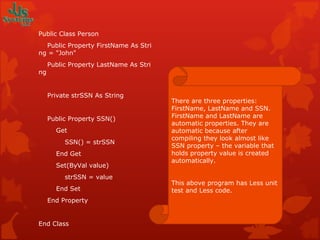
Public Class Person      Public Property FirstName As String = "John"      Public Property LastName As String        Private strSSN As String         Public Property SSN()          Get              SSN() = strSSN          End Get          Set(ByVal value)              strSSN = value          End Set      End Property   End Class There are three properties: FirstName, LastName and SSN. FirstName and LastName are automatic properties. They are automatic because after compiling they look almost like SSN property – the variable that holds property value is created automatically. This above program has Less unit test and Less code.
Resources for .NET http://www.w3.org/TR/SOAP/   - W3C standards for SOAP implementation http://www.uddi.org  – UDDI standards for web services implementation http://www.microsoft.com/net  - Microsoft .NET home http://msdn.microsoft.com/net -   Microsoft .NET developers home http://msdn.microsoft.com/xml  - Microsoft XML developers home http://msdn.microsoft.com/webservices  – Microsoft Web Services developers home http://www.gotdotnet.com  – Developers .NET resource
Thank you

Net framework

  • 1.
    The Microsoft .NETFramework by jeyasri 10mss016 Sreejha 10mss033 Vijaykumar 10mss039
  • 2.
    Agenda Introduction to.NET The .NET Framework Common Language Runtime .NET Framework Services Common Language Specification .NET framework languages
  • 3.
    How Did WeGet to .NET? The Evolution of Web Applications First generation of Web applications -non-interactive content (HTML static content) Second generation of Web applications - scalable back-end and a richer User Interface. (DCOM, ASP, CGI, Cold Fusion, dynamic content) Third generation of Web applications (.NET) - using Web protocols and XML to allow better integration between services on the Web
  • 4.
    What is .NET?.NET is Microsoft’s entry into the Web services arena XML based
  • 5.
    Why the Moveto .NET? DCOM works fine on an Intranet, however: DCOM does not go through firewalls Requires too many open TCP/IP ports Requires Stateful connections Platform dependent Portals provide services however: Non-standard interfaces Hard to integrate with other applications Not designed to use outside the scope of the portal
  • 6.
    XML Format XMLis a tagged mark-up representation of data XML consists of a header section, a schema section, and a data section The header section defines the XML form itself The schema section defines the format of the data contained in the XML document The data section provides the mapped data C:\SicCodes.XML
  • 7.
    SOAP SimpleObject Access Protocol Internet becomes integration fabric Broad industry support IBM, Iona, Ariba, Compaq, Lotus, Commerce-One, HP, SAP, others Submitted to W3C: http://www.w3.org/TR/SOAP/ XML-based integration for web services
  • 8.
    Agenda Introduction to.NET and Web Services The .NET Framework Common Language Runtime .NET Framework Services Common Language Specification .NET framework languages
  • 9.
    What Is the.NET Framework? A collection of technologies that Unite isolated Web applications Make information available anytime, anywhere Simplify development and deployment How does .NET achieve the above? Web Services ADO.NET Datasets and XML support throughout the platform Rich tools, runtime services and XCOPY Deployment
  • 10.
    .NET Framework definition:The .NET Framework is a software technology that provides extensive libraries, pre-implemented solutions and a managed run-time environment. Eonfusion is built on the .NET Framework. The .NET Framework delivers more controls, improved start-up performance, AJAX support, and powerful new graphics features for client development.   It is designed to make significant improvements in code-reuse, code-specialization, resource management, multi-language development, security, deployment and administration.
  • 11.
    .NET Framework, Languages,Tools Base Class Library Common Language Specification Common Language Runtime Data and XML VB C++ C# Visual Studio.NET Web Services JScript … User Interface
  • 12.
    Agenda Introduction to.NET and Web Services The .NET Framework Common Language Runtime .NET Framework Services Common Language Specification .NET framework languages
  • 13.
  • 14.
    Common Language RuntimeBase Class Library Common Language Specification Common Language Runtime Data and XML VB C++ C# Visual Studio.NET Web Services JScript … User Interface
  • 15.
    The .NET CommonLanguage Runtime Manages running code Threading Memory management Multi-language Inheritance, Errors, Debugging Fine-grained evidence-based security Code access security Role-based security Integrated with underlying OS “ No-touch” deployment
  • 16.
    Common Language RuntimeClass Loader Base Class Library Support IL to Native Compilers Code Manager Garbage Collector Security Engine Debug Engine Type Checker Exception Manager Thread Support COM Marshaler
  • 17.
    It is aspecial run time environment that provides the underlying infrastructure for Microsoft's .NET framework. This runtime is where the source code of an application is compiled into an intermediate language called CIL , originally known as MSIL (Microsoft Intermediate Language). When the program is then run, the CIL code is translated into the native code of the operating system using a just-in-time (JIT) compiler.[citation needed] This intermediate language is used to keep the environment platform-neutral and as a result, supports all .NET languages such as C# or VB.NET
  • 18.
    Common Language RuntimeDesign Goals Dramatically simplify application development Provide a robust and secure execution environment Support multiple programming languages Simplify deployment and management
  • 19.
    Agenda Introduction to.NET and Web Services The .NET Framework Common Language Runtime .NET Framework Services Common Language Specification .NET framework languages
  • 20.
    .NET Framework ServicesBase Class Library Common Language Specification Common Language Runtime Data and XML VB C++ C# Visual Studio.NET Web Services JScript … User Interface
  • 21.
    .NET Framework ServicesASP.NET Logical evolution of ASP (compiled) Web forms Manageable code (non spaghetti) Windows ® forms Framework for building rich clients ADO.NET, evolution of ADO New objects (e.g., DataSets) XML Support Throughout
  • 22.
    Some .NET BaseClass Libraries System System.Data System.Xml System.Web Globalization Diagnostics Configuration Collections Resources Reflection Net IO Threading Text ServiceProcess Security Design ADO SQLTypes SQL XPath XSLT Runtime InteropServices Remoting Serialization Serialization Configuration SessionState Caching Security Services Description Discovery Protocols UI HtmlControls WebControls System.Drawing Imaging Drawing2D Text Printing System.WinForms Design ComponentModel
  • 23.
    Agenda Introduction to.NET and Web Services The .NET Framework Common Language Runtime .NET Framework Services Common Language Specification .NETframework languages
  • 24.
    Common Language SpecificationBase Class Library Common Language Specification Common Language Runtime Data and XML VB C++ C# Visual Studio.NET Web Services JScript … User Interface
  • 25.
    The .NET Platformis Language Neutral All .NET languages perform the same You can leverage your existing skills Common Language Specification Consumer: Can use the .NET Framework Extender: Can extend the .NET Framework Microsoft provides: VB, C++, C#, JScript Third-parties are building APL, COBOL, Pascal, Eiffel, Haskell, ML, Oberon, Perl, Python, Scheme, Smalltalk
  • 26.
    .NET Languages Available(or soon to be) Visual Basic C# Jscript C++ Perl Python COBOL Haskell ML Ada Pascal C SmallTalk Oberon Scheme Mercury APL Eiffel Oz Objective Caml
  • 27.
    Visual Studio ® .NET .NET Platform Manage and Collaborate Deployment Testing Development Design Analysis Planning
  • 28.
    Agenda Introduction to.NET and Web Services The .NET Framework Common Language Runtime .NET Framework Services Common Language Specification . NET framework languages
  • 29.
    .NET Framework languages.NET Framework is designed for cross-language compatibility.  Cross-language compatibility means .NET components can interact with each other irrespective of the languages they are written in. This cross-language compatibility is possible due to common language runtime. the output of the compiler is not an executable file but a file that contains a special type of code called the Microsoft Intermediate Language (MSIL).
  • 30.
    Contd…. Thus, any codecompiled by a .NET complier can interoperate with the .NET Framework. all .NET applications are converted to IL before execution all primitive data types are represented as .NET types. This means that, a VB Integer and a C# int are both represented in IL code as System.
  • 31.
    Languages supported: LanguageDescription/Usage APL It is a language for describing procedures in the processing of information. It can be used to describe mathematical procedures having nothing to do with computers or to describe the way a computer works. C++ C++ derives from the C language.  VC++ Visual C++ is the name of a C++ compiler with an integrated environment from Microsoft. This includes special tools that simplify the development of great applications, as well as specific libraries. Its use is known as visual programming.
  • 32.
    .NET supported languages: C# C# called as C Sharp is a full fledged Object-Oriented programming language from Microsoft built into the .NET Framework. Cobol COBOL was the first widely-used high-level programming language for business applications. It is considered as a programming language to have more lines of code than any other language. Mondrian It is a functional language specifically designed to  inter-operate with other languages in an OO environment. Current versions of Mondrian run on .NET. Mondrian also supports ASP.NET, allowing you to embed functional language code in web pages along with C# code.
  • 33.
    Public Class Person      Public Property FirstName As String = "John"     Public Property LastName As String        Private strSSN As String        Public Property SSN()          Get             SSN() = strSSN          End Get          Set(ByVal value)             strSSN = value          End Set      End Property   End Class There are three properties: FirstName, LastName and SSN. FirstName and LastName are automatic properties. They are automatic because after compiling they look almost like SSN property – the variable that holds property value is created automatically. This above program has Less unit test and Less code.
  • 34.
    Resources for .NEThttp://www.w3.org/TR/SOAP/ - W3C standards for SOAP implementation http://www.uddi.org – UDDI standards for web services implementation http://www.microsoft.com/net - Microsoft .NET home http://msdn.microsoft.com/net - Microsoft .NET developers home http://msdn.microsoft.com/xml - Microsoft XML developers home http://msdn.microsoft.com/webservices – Microsoft Web Services developers home http://www.gotdotnet.com – Developers .NET resource
  • 35.