BY:-   ARUN PAL
FACULTY:-   Mr. SATISH
The  Microsoft.NET Framework is a software
framework .

   Supports C++ , C# , and J#.

Itincludes a large library of coded solutions to
common programming problems,and

 Virtual machine that manages the execution of
programs written specifically for the framework.

The  .NET    Framework   is   an   integral   Windows
component.
VERSIONS OF .NET
FRAMEWORK
.NET FRAMEWORK 1.0
   First release of the .NET Framework on 13-February-
    2002.

   Available for Windows 98, Me, NT 4.0, 2000, and XP.
.NET FRAMEWORK 1.1
   This is the first major .NET Framework upgrade.

   As a software development kit, and was published on 3
    April 2003.

   Included as part of the Windows                   operating
    system, shipping with Windows Server 2003.
.NET FRAMEWORK 2.0
   Published on 22 January 2006.

   Released with Visual Studio 2005, Microsoft SQL Server
    2005, and BizTalk 2006.

   Included as part of Visual Studio 2005 and Microsoft
    SQL Server 2005.
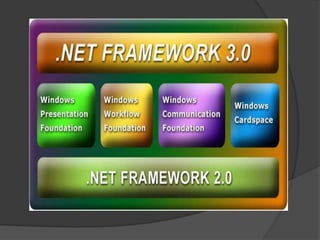
.NET FRAMEWORK 3.0
   Released on 21 November 2006.

   Includes a new set of managed code APIs that are an
    integral part of Windows Vista and Windows Server
    2008 operating systems.
.NETFRAMEWORK3.0 CONSISTSOF FOUR MAJOR NEW COMPONENTS:

    WINDOWS PRESENTATION FOUNDATION

     A new user interface subsystem and API based on XML and vector
     graphics,

     Uses 3D computer graphics hardware and Direct3D technologies.

    WINDOWS COMMUNICATION FOUNDATION

     Service-oriented messaging system which allows programs to
     interoperate locally or remotely similar to web services.

    Windows Workflow Foundation
     Allows for building of task automation and integrated transactions
     using workflows.

    WINDOWSCARDSPACE,
     Stores a person's digital identities and provides a unified interface for
     choosing the identity for a particular transaction.
.NET FRAMEWORK 3.5
   Released on 19 November 2007.

   Not included with Windows Server 2008.

   As with .NET Framework 3.0, version 3.5 uses the
    CLR of version 2.0.
    .NET FRAMEWORK CLIENT PROFILE
   Smaller than the full framework(28 MB) and only
    installs components that are the most relevant to
    desktop applications.
.NET FRAMEWORK 4.0
   New Visual Basic and C# language features, such as
    statement lambdas, implicit line continuations, dynamic
    dispatch, named parameters, and optional parameters.

   Full support for IronPython, IronRuby, and F#.

   Support for a subset of the .NET Framework and ASP.NET
    with the "Server Core" variant of Windows Server 2008 R2.

   Support for Code Contracts.

   Inclusion of the Oslo modelling platform, along with the M
    programming language.
.NET
             FRAMEWORK
ADVANTAGES
 CONSISTENT PROGRAMMING MODEL


   Different programming languages to do a task

    for example, accessing data with a VB .NET and a C# .NET
    looks very similar .

   DIRECT SUPPORT FOR SECURITY

   Develops an application that resides on a local machine and
    uses local resources is easy.

   Simplified Development Efforts

    ASP.NET and the .NET Framework simplify development by
    separating the application logic and presentation logic making it easier
    to maintain the code.
OBJECTIVES OF .NET
FRAMEWORK
  Consistent object-oriented programming environment       whether
     object code is stored and executed locally, executed locally but
     Internet-distributed, or executed remotely.

    Code-execution environment that minimizes software deployment
     and versioning conflicts.

    Code-execution environment that promotes safe execution of
     code.

    Code-execution environment that eliminates the performance
     problems of scripted or interpreted environments.

    To make the developer experience consistent across widely
     varying types of applications,
USES OF .NET
FRAMEWORK
 We can use the .NET FRAMEWORK to
  develop the following types of applications
  and services:
 Console applications.
 GUI applications.
 ASP.NET applications.
 XML web services.
 Windows services.
TWO MAIN COMPONENTS OF .NET
FRAMEWORK
 COMMON LANGUAGE RUNTIME
   Virtual machine component                                       .

   All .NET programs execute under the supervision of the CLR.

   Guaranteeing certain properties and behaviors in the areas of
    memory management, security, and exception handling.

   BASE CLASS LIBRARY
   Part of Framework Class Library (FCL).

   Library of functionality available to all languages using the .NET
    Framework.

   Provides classes which encapsulate a number of common
    functions, including file reading and writing,          graphic
    rendering, database interaction and XML document manipulation.
DESIGN FEATURES OF .NET
FRAMEWORK
     INTEROPERABILITY

      provides means to access functionality that is
      implemented in programs that execute outside
      the.NET environment.

     SIMPLIFIED DEPLOYMENT


      Includes design features and tools that help
      manage the installation of computer software.
   SECURITY
    The design is meant to address some of the
    vulnerabilities, such as buffer overflows, that have
    been exploited by malicious software. So .NET
    provides a common security model for all
    applications.

   PORTABILITY
    .NET Framework allows it to theoretically be
    platform agnostic, and thus cross-platform
    compatible.
-Thank You

.Net framework

  • 1.
    BY:- ARUN PAL FACULTY:- Mr. SATISH
  • 2.
    The Microsoft.NETFramework is a software framework .  Supports C++ , C# , and J#. Itincludes a large library of coded solutions to common programming problems,and  Virtual machine that manages the execution of programs written specifically for the framework. The .NET Framework is an integral Windows component.
  • 3.
    VERSIONS OF .NET FRAMEWORK .NETFRAMEWORK 1.0  First release of the .NET Framework on 13-February- 2002.  Available for Windows 98, Me, NT 4.0, 2000, and XP. .NET FRAMEWORK 1.1  This is the first major .NET Framework upgrade.  As a software development kit, and was published on 3 April 2003.  Included as part of the Windows operating system, shipping with Windows Server 2003.
  • 4.
    .NET FRAMEWORK 2.0  Published on 22 January 2006.  Released with Visual Studio 2005, Microsoft SQL Server 2005, and BizTalk 2006.  Included as part of Visual Studio 2005 and Microsoft SQL Server 2005. .NET FRAMEWORK 3.0  Released on 21 November 2006.  Includes a new set of managed code APIs that are an integral part of Windows Vista and Windows Server 2008 operating systems.
  • 6.
    .NETFRAMEWORK3.0 CONSISTSOF FOURMAJOR NEW COMPONENTS:  WINDOWS PRESENTATION FOUNDATION A new user interface subsystem and API based on XML and vector graphics, Uses 3D computer graphics hardware and Direct3D technologies.  WINDOWS COMMUNICATION FOUNDATION Service-oriented messaging system which allows programs to interoperate locally or remotely similar to web services.  Windows Workflow Foundation Allows for building of task automation and integrated transactions using workflows.  WINDOWSCARDSPACE, Stores a person's digital identities and provides a unified interface for choosing the identity for a particular transaction.
  • 7.
    .NET FRAMEWORK 3.5  Released on 19 November 2007.  Not included with Windows Server 2008.  As with .NET Framework 3.0, version 3.5 uses the CLR of version 2.0. .NET FRAMEWORK CLIENT PROFILE  Smaller than the full framework(28 MB) and only installs components that are the most relevant to desktop applications.
  • 8.
    .NET FRAMEWORK 4.0  New Visual Basic and C# language features, such as statement lambdas, implicit line continuations, dynamic dispatch, named parameters, and optional parameters.  Full support for IronPython, IronRuby, and F#.  Support for a subset of the .NET Framework and ASP.NET with the "Server Core" variant of Windows Server 2008 R2.  Support for Code Contracts.  Inclusion of the Oslo modelling platform, along with the M programming language.
  • 9.
    .NET FRAMEWORK ADVANTAGES  CONSISTENT PROGRAMMING MODEL  Different programming languages to do a task  for example, accessing data with a VB .NET and a C# .NET looks very similar .  DIRECT SUPPORT FOR SECURITY  Develops an application that resides on a local machine and uses local resources is easy.  Simplified Development Efforts  ASP.NET and the .NET Framework simplify development by separating the application logic and presentation logic making it easier to maintain the code.
  • 10.
    OBJECTIVES OF .NET FRAMEWORK  Consistent object-oriented programming environment whether object code is stored and executed locally, executed locally but Internet-distributed, or executed remotely.  Code-execution environment that minimizes software deployment and versioning conflicts.  Code-execution environment that promotes safe execution of code.  Code-execution environment that eliminates the performance problems of scripted or interpreted environments.  To make the developer experience consistent across widely varying types of applications,
  • 11.
    USES OF .NET FRAMEWORK We can use the .NET FRAMEWORK to develop the following types of applications and services:  Console applications.  GUI applications.  ASP.NET applications.  XML web services.  Windows services.
  • 12.
    TWO MAIN COMPONENTSOF .NET FRAMEWORK  COMMON LANGUAGE RUNTIME  Virtual machine component .  All .NET programs execute under the supervision of the CLR.  Guaranteeing certain properties and behaviors in the areas of memory management, security, and exception handling.  BASE CLASS LIBRARY  Part of Framework Class Library (FCL).  Library of functionality available to all languages using the .NET Framework.  Provides classes which encapsulate a number of common functions, including file reading and writing, graphic rendering, database interaction and XML document manipulation.
  • 13.
    DESIGN FEATURES OF.NET FRAMEWORK  INTEROPERABILITY provides means to access functionality that is implemented in programs that execute outside the.NET environment.  SIMPLIFIED DEPLOYMENT Includes design features and tools that help manage the installation of computer software.
  • 14.
    SECURITY The design is meant to address some of the vulnerabilities, such as buffer overflows, that have been exploited by malicious software. So .NET provides a common security model for all applications.  PORTABILITY .NET Framework allows it to theoretically be platform agnostic, and thus cross-platform compatible.
  • 15.