TV Drama and Representation

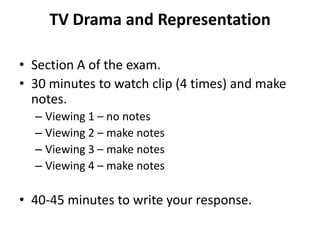
• Section A of the exam.
• 30 minutes to watch clip (4 times) and make
  notes.
  – Viewing 1 – no notes
  – Viewing 2 – make notes
  – Viewing 3 – make notes
  – Viewing 4 – make notes

• 40-45 minutes to write your response.
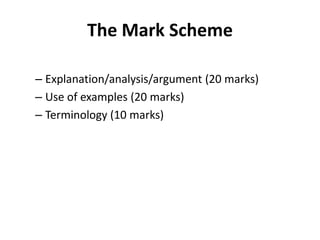
The Mark Scheme

– Explanation/analysis/argument (20 marks)
– Use of examples (20 marks)
– Terminology (10 marks)
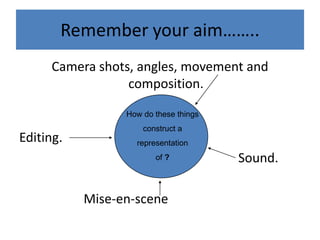
Remember your aim……..
     Camera shots, angles, movement and
                 composition.

                 How do these things
                     construct a
Editing.           representation
                        of ?           Sound.

           Mise-en-scene
Possible Approaches
• You could structure your note around the micro
  concepts (Camera, Editing, Mise en Scene, Sound)
  to ensure you cover lots of detailed examples.
• Alternatively you could pick three or four key
  points in the clip and structure your detailed
  analysis around how the micro features are used
  in those sections of drama.

• How do the micro contribute to macro (the
  three macro being narrative, genre and
  representation).
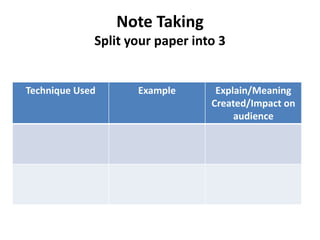
Note Taking
             Split your paper into 3


Technique Used      Example       Explain/Meaning
                                 Created/Impact on
                                      audience
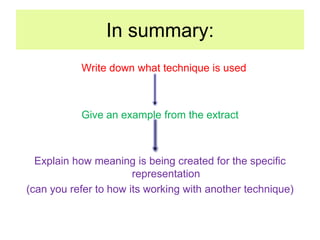
In summary:
           Write down what technique is used


           Give an example from the extract


  Explain how meaning is being created for the specific
                       representation
(can you refer to how its working with another technique)
Additional Learning
• Todorov Narrative theory
   – Disequilibrium – the period of instability and
     insecurity in a film’s narrative.
     Equilibrium – a state of peace and calm, which
     often exists at the beginning of a film’s narrative.
• Enigma – the question or mystery that is posed
  within a film’s narrative.
• Iconography – the objects within a film that are used
  to evoke particular meanings
Other keywords you should mention
                include…
• Realism – do the different techniques used work to make the piece
  realistic?
• Verisimilitude – the construction of a believable world.
• Stereotypes – how we expect people and places to be
• Protagonist – is the main character (the central or primary personal
  figure), around whom the events of the narrative's plot revolve and
  with whom the audience is intended to most identify. Is also known
  as the hero
• Antagonist - opponent, competitor, enemy, rival; is a character,
  group of characters, or institution, that represents the opposition
  against which the protagonist must contend. In other words, 'A
  person, or a group of people who oppose the main character, or the
  main characters. Is also known as the villain
Camera angle, shot, movement and
              composition
•   Angle – high, low,
•   Framing – inside, outside
•   Focus – deep, shallow
•   Movement – tilt, pan, track
•   Shot distance – ECU, CUM, MS, LS
Editing
• An important factor is the way that the editing of the sequence grants or
  witholds narrative information from the audience in order to encourage
  identification or rejection of particular characters/representations.
• How are screen time, p.o.v. or reaction shots distributed? How hierarchies
  are established, leading to certain representations being privileged where
  others are marginalised?
• Does editing frequently shifted the viewer's relationship to dominant
  views of gender in different scenes?
• Shot/reverse shot can be used to reinforce relationships - sometimes by
  exaggerating opposition
• Jump cuts can connote disorder
• Eyeline match can provide insight to a character's private thoughts, though
  mainly through camera and mise en scene, actually.
• Pace of editing can imply character qualities - fast pace suggests energy,
  for example.
Sound
• Sound is typically about narrative, genre and the
  audience's emotional response to a scene. Then
  there's editing, which for me is primarily about
  narrative.
• Choice of music can imply character qualities -
  fast pace suggests energy, for example (as with
  editing)
• Crescendo implies a build-up of power or
  emotion, be it in dialogue or non-diegetic music.
Mise en Scene
•   Costume (and everything about a character's appearance including height, hair colour, makeup etc)
•   Body Language
•   Props
•   Location
•   Set Design
•   Lighting

•   Remember that everything you see has connotations - that is, messages or values which are
    communicated beyond the literal object being shown. For example, if a character wears glasses it
    carries connotations of intelligence, cleverness, or possible geekiness. Even colours have
    connotations - at its simplest level, black=evil and white=good.
•   You are looking for connotations which have something to do with gender, or age, or disability etc…

•   How does the content/mise en scene suggest a representation?
•   Is this a stereotypical view?
Additional Support
1.    Interpreting the question…How is the representation of age constructed in this extract?“
2.    What do I expect? Once you have read the questions, when you find out what representation you are
      being questioned on; consider society's expectations of … and consider this when watching the extract
      for the first time…..Is the extract challenging/subverting dominant ideologies/stereotypes?

3.    The importance of Binary Oppositions (Levi-Srauss) - There can be no Drama without conflict, and
      those conflicts are usually between two opposite things: male vs female, young vs old, rich vs poor etc.
      These are called binary oppositions (BINARY = two things).
      Ask yourself: which characters in the extract seem to be the main participants in this conflict?
      This will help you to avoid spending too much time writing about minor characters. You should also be
      able to compare one character to another
4.    Practise note-taking
5.    Ensure you understanding technical codes/knowing media language
6.    Relate technical codes to representation
7.    Backing up points with examples
8.    Keep it readable – leave a gap between paragraphs
9.    Write it in the time
10.   Have a system for your notes
11.   Be selective from the text- richest moments
12.   Know your terms- media language
13.   Constant reference to representation
14.   Don’t generalise – there are lots of CU’s…be specific with your use of examples from the extract
15.   Not every one of the above technical areas will feature in equal measure in any given extract; the
      examiners will bear this in mind
How to Revise
• http://blackpoolmedia.wordpress.com/category/repres
  entation/
• Watch any 5 min extract from TV Dramas you like and
  particularly ones you don’t
   – Identify terminology
   – Identify comments to make on all 4 areas
• Choose an area of representation and practise,
  practise, practise......
• Practise your terminology here -
  http://quizlet.com/2302961/textual-analysis-flash-
  cards/

Revision Section A

  • 2.
    TV Drama andRepresentation • Section A of the exam. • 30 minutes to watch clip (4 times) and make notes. – Viewing 1 – no notes – Viewing 2 – make notes – Viewing 3 – make notes – Viewing 4 – make notes • 40-45 minutes to write your response.
  • 3.
    The Mark Scheme –Explanation/analysis/argument (20 marks) – Use of examples (20 marks) – Terminology (10 marks)
  • 4.
    Remember your aim…….. Camera shots, angles, movement and composition. How do these things construct a Editing. representation of ? Sound. Mise-en-scene
  • 5.
    Possible Approaches • Youcould structure your note around the micro concepts (Camera, Editing, Mise en Scene, Sound) to ensure you cover lots of detailed examples. • Alternatively you could pick three or four key points in the clip and structure your detailed analysis around how the micro features are used in those sections of drama. • How do the micro contribute to macro (the three macro being narrative, genre and representation).
  • 6.
    Note Taking Split your paper into 3 Technique Used Example Explain/Meaning Created/Impact on audience
  • 7.
    In summary: Write down what technique is used Give an example from the extract Explain how meaning is being created for the specific representation (can you refer to how its working with another technique)
  • 8.
    Additional Learning • TodorovNarrative theory – Disequilibrium – the period of instability and insecurity in a film’s narrative. Equilibrium – a state of peace and calm, which often exists at the beginning of a film’s narrative. • Enigma – the question or mystery that is posed within a film’s narrative. • Iconography – the objects within a film that are used to evoke particular meanings
  • 9.
    Other keywords youshould mention include… • Realism – do the different techniques used work to make the piece realistic? • Verisimilitude – the construction of a believable world. • Stereotypes – how we expect people and places to be • Protagonist – is the main character (the central or primary personal figure), around whom the events of the narrative's plot revolve and with whom the audience is intended to most identify. Is also known as the hero • Antagonist - opponent, competitor, enemy, rival; is a character, group of characters, or institution, that represents the opposition against which the protagonist must contend. In other words, 'A person, or a group of people who oppose the main character, or the main characters. Is also known as the villain
  • 10.
    Camera angle, shot,movement and composition • Angle – high, low, • Framing – inside, outside • Focus – deep, shallow • Movement – tilt, pan, track • Shot distance – ECU, CUM, MS, LS
  • 11.
    Editing • An importantfactor is the way that the editing of the sequence grants or witholds narrative information from the audience in order to encourage identification or rejection of particular characters/representations. • How are screen time, p.o.v. or reaction shots distributed? How hierarchies are established, leading to certain representations being privileged where others are marginalised? • Does editing frequently shifted the viewer's relationship to dominant views of gender in different scenes? • Shot/reverse shot can be used to reinforce relationships - sometimes by exaggerating opposition • Jump cuts can connote disorder • Eyeline match can provide insight to a character's private thoughts, though mainly through camera and mise en scene, actually. • Pace of editing can imply character qualities - fast pace suggests energy, for example.
  • 12.
    Sound • Sound istypically about narrative, genre and the audience's emotional response to a scene. Then there's editing, which for me is primarily about narrative. • Choice of music can imply character qualities - fast pace suggests energy, for example (as with editing) • Crescendo implies a build-up of power or emotion, be it in dialogue or non-diegetic music.
  • 13.
    Mise en Scene • Costume (and everything about a character's appearance including height, hair colour, makeup etc) • Body Language • Props • Location • Set Design • Lighting • Remember that everything you see has connotations - that is, messages or values which are communicated beyond the literal object being shown. For example, if a character wears glasses it carries connotations of intelligence, cleverness, or possible geekiness. Even colours have connotations - at its simplest level, black=evil and white=good. • You are looking for connotations which have something to do with gender, or age, or disability etc… • How does the content/mise en scene suggest a representation? • Is this a stereotypical view?
  • 14.
    Additional Support 1. Interpreting the question…How is the representation of age constructed in this extract?“ 2. What do I expect? Once you have read the questions, when you find out what representation you are being questioned on; consider society's expectations of … and consider this when watching the extract for the first time…..Is the extract challenging/subverting dominant ideologies/stereotypes? 3. The importance of Binary Oppositions (Levi-Srauss) - There can be no Drama without conflict, and those conflicts are usually between two opposite things: male vs female, young vs old, rich vs poor etc. These are called binary oppositions (BINARY = two things). Ask yourself: which characters in the extract seem to be the main participants in this conflict? This will help you to avoid spending too much time writing about minor characters. You should also be able to compare one character to another 4. Practise note-taking 5. Ensure you understanding technical codes/knowing media language 6. Relate technical codes to representation 7. Backing up points with examples 8. Keep it readable – leave a gap between paragraphs 9. Write it in the time 10. Have a system for your notes 11. Be selective from the text- richest moments 12. Know your terms- media language 13. Constant reference to representation 14. Don’t generalise – there are lots of CU’s…be specific with your use of examples from the extract 15. Not every one of the above technical areas will feature in equal measure in any given extract; the examiners will bear this in mind
  • 15.
    How to Revise •http://blackpoolmedia.wordpress.com/category/repres entation/ • Watch any 5 min extract from TV Dramas you like and particularly ones you don’t – Identify terminology – Identify comments to make on all 4 areas • Choose an area of representation and practise, practise, practise...... • Practise your terminology here - http://quizlet.com/2302961/textual-analysis-flash- cards/