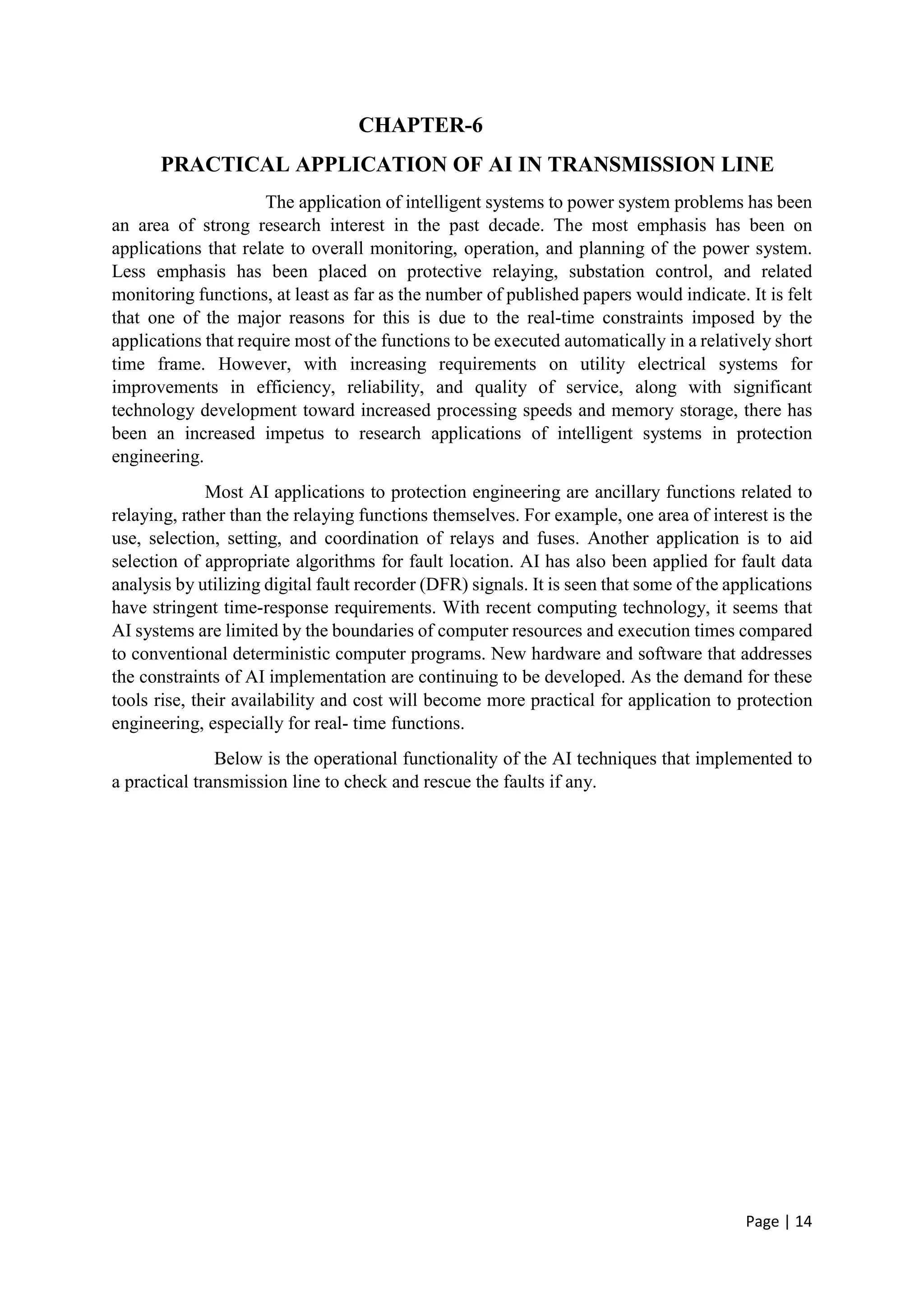
INDEX
S.NO CHAPTER NAME Page no
1 INTRODUCTION 01
2 NEED FOR AI IN POWER SYSTEMS 03
2.1 AI Techniques used in power systems 03
3 EXPERT SYSTEM 04
3.1 How Expert system can be used in power systems 05
3.2 An Expert system in power systems 06
4 ARTIFICIAL NUERAL NETWORKS 07
4.1 How ANNS can be used in power systems 08
5 FUZZY LOGIC 10
5.1 How Fuzzy logic cab be used in power systems 11
5.2 Engineering applications of fuzzy logic 13
6 PRACTIAL APPLICATION OF AI IN TRANSMISSION 14
LINE
7 COMPARISION OF AI TECNIQUES IN POWER SYSTEMS 16
PROTECTION
8 CURRENT APPLICATION OF AI IN POWER SYSTEMS 17
9 CONCLUSION 18
10 REFERENCES 19
LIST OF FIGURES
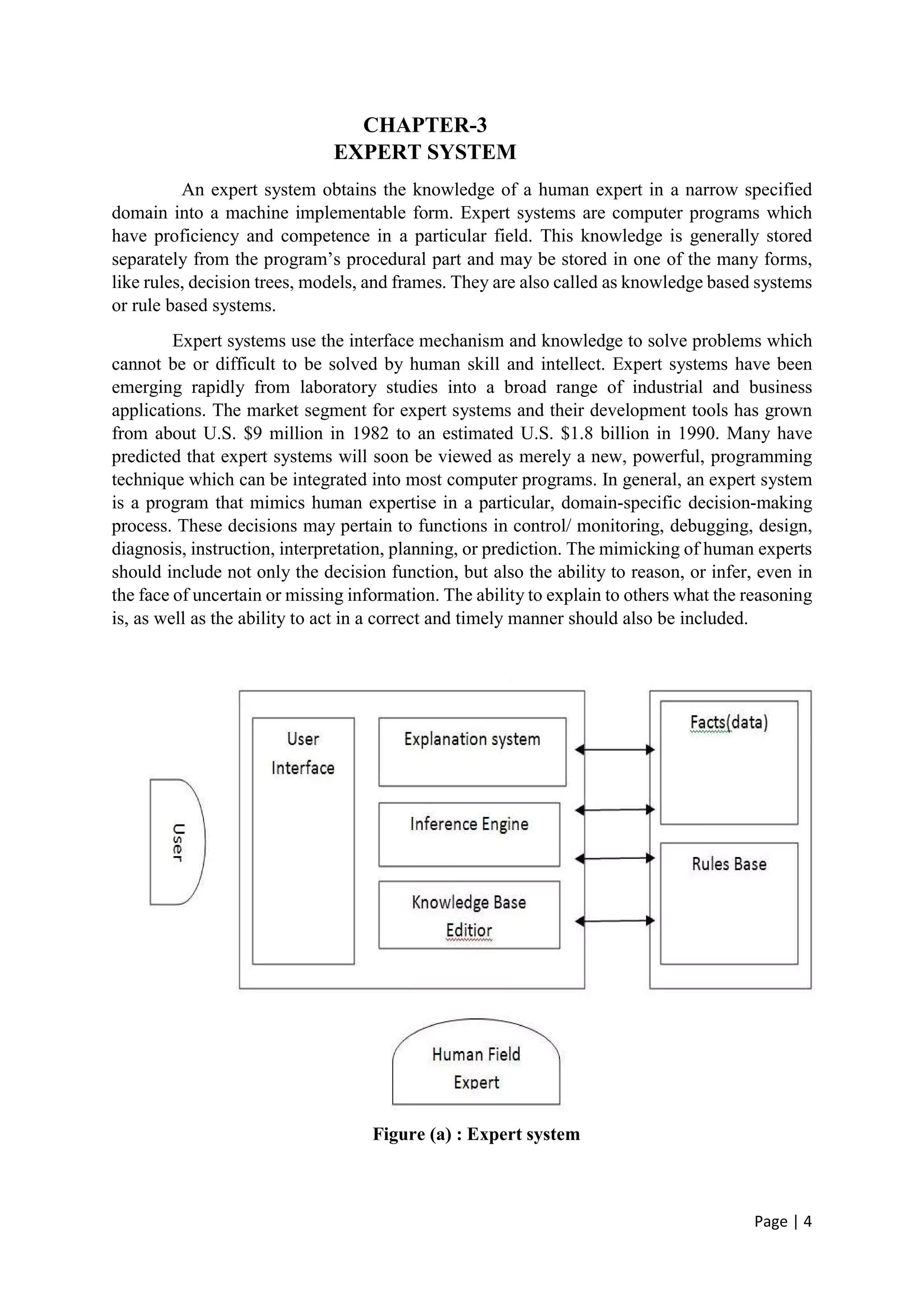
Figure (a) : Expert system
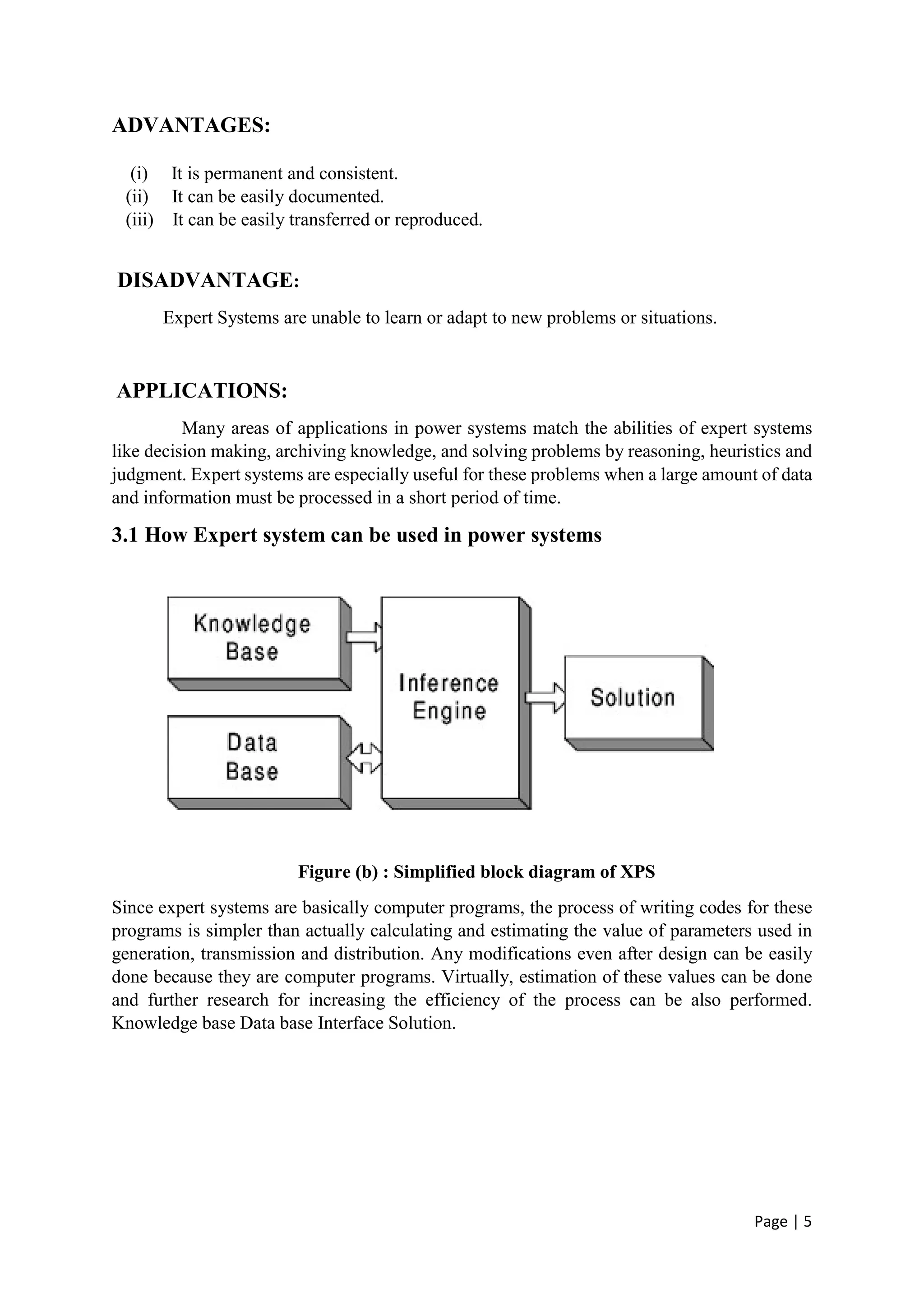
Figure (b) : Simplified block diagram of XPS
Figure (c) : Architecture of a feedforward ANN
Figure (d) : The basic configuration of a Neural Network based Relay (NNR)
for power transformers
Figure (e) : Block diagram of Fuzzy controller
Figure (f) : Fuzzy logic
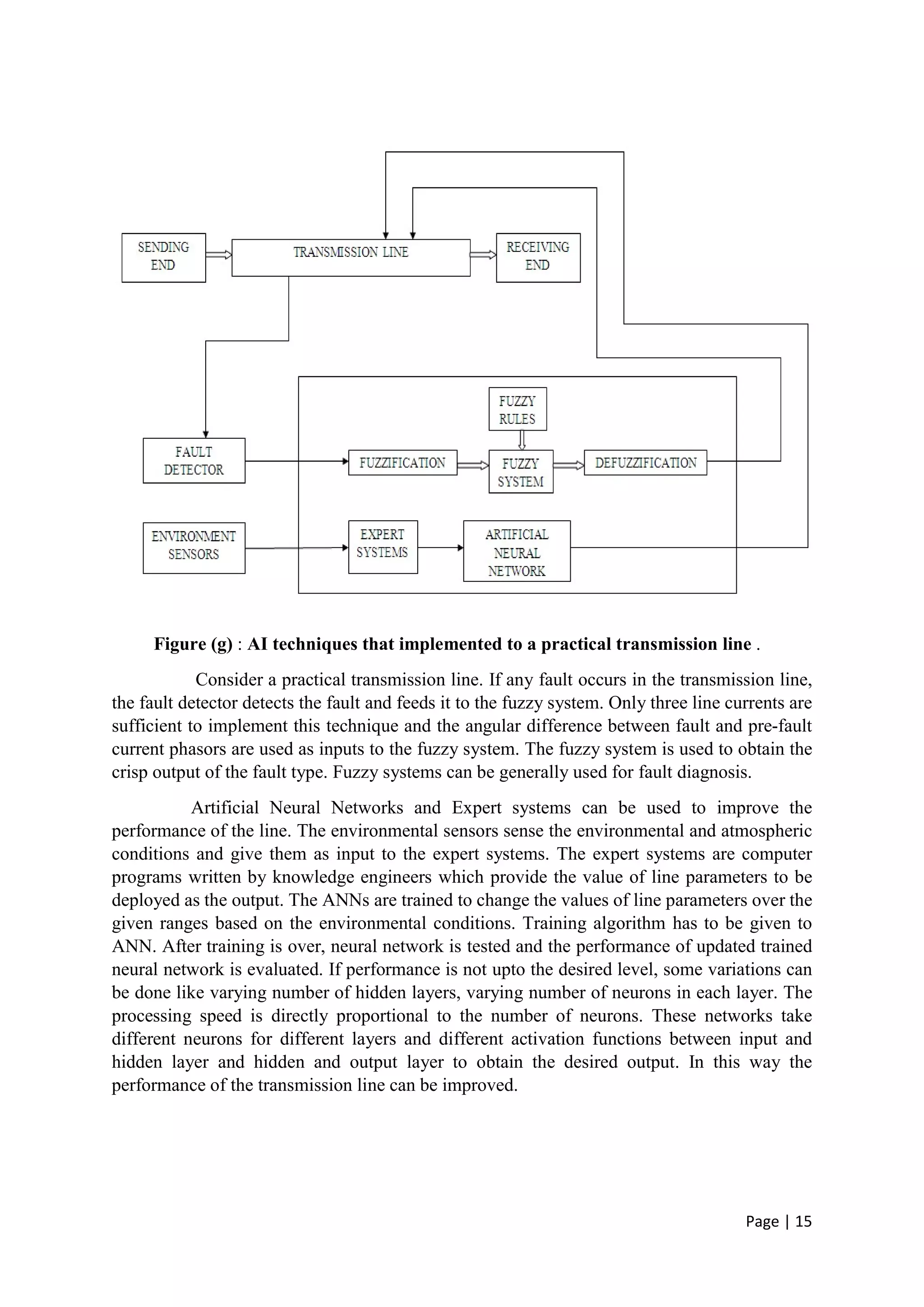
Figure (g) : AI techniques that implemented to a practical transmission line
ABSTRACT
A continuous and reliable supply of electricity is necessary for the functioning of
today’s modern and advanced society. Since the early to mid1980s, most of the effort in power
systems analysis has turned away from the methodology of formal mathematical modelling
which came from the areas of operations research, control theory and numerical analysis to the
less rigorous and less tedious techniques of artificial intelligence (AI). Power systems keep on
increasing on the basis of geographical regions, assets additions, and introduction of new
technologies in generation, transmission and distribution of electricity. AI techniques have
become popular for solving different problems in power systems like control, planning,
scheduling, forecast, etc. These techniques can deal with difficult tasks faced by applications
in modern large power systems with even more interconnections installed to meet increasing
load demand. The application of these techniques has been successful in many areas of power
system engineering.
Artificial intelligence emerged as a computer science discipline in the mid1950s.
Since then, it has produced a number of powerful tools, many of which are of practical use in
engineering to solve difficult problems normally requiring human intelligence. Three of these
tools will be reviewed in this paper. They are: fuzzy logic, neural networks and genetic
algorithms.
Artificial intelligence is the science of automating intelligent behaviours currently
achievable by humans. Power system has grown tremendously over a few decades. As the size
and complexity of the power system consisting of generators, transmission lines, power
transformers, distribution transformers etc. increases the possibility of inviting faults. The
acquisition of data, the processing of those data for use by the operator, and control of remote
devices are the fundamental building blocks of all modern utility control systems. Manual
calculations, technical analysis and conclusions initially adopted the power system design,
operation and control. As the power system grew it become more complex due to the technical
advancements, variety and dynamic requirements.
Page | 1
CHAPTER-1
INTRODUCTION
An electric power system is a network of electrical components used to supply,
transmit and use electric power. Power systems engineering is a subdivision of electrical
engineering that deals with the generation, transmission, distribution and utilisation of electric
power and the electrical devices connected to such systems like generators, motors and
transformers.
Commonly, artificial intelligence is known to be the intelligence exhibited by
machines and software, for example, robots and computer programs. The term is generally used
to the project of developing systems equipped with the intellectual processes features and
characteristics of humans, like the ability to think, reason, find the meaning, generalize,
distinguish, learn from past experience or rectify their mistakes. Artificial general intelligence
(AGI) is the intelligence of a hypothetical machine or computer which can accomplish any
intellectual assignment successfully which a human being can accomplish.
It is claimed that artificial intelligence is playing an increasing role in the research
of management science and operational research areas. Intelligence is commonly considered
as the ability to collect knowledge and reason about knowledge to solve complex problems. In
the near Future intelligent machines will replace human capabilities in many areas. Artificial
intelligence is the study and developments of intelligent machines and software that can reason,
learn, gather knowledge, communicate, manipulate and perceive the objects. John McCarthy
coined the term in 1956 as branch of computer science concerned with making computers
behave like humans. It is the study of the computation that makes it possible to perceive reason
and act.
Artificial intelligence is different from psychology because it emphasis on
computation and is different from computer science because of its emphasis on perception,
reasoning and action. It makes machines smarter and more useful. It works with the help of
artificial neurons (artificial neural network) and scientific theorems (if then statements and
logics). AI technologies have matured to the point in offering real practical benefits in many
of their applications. Major Artificial Intelligence areas are Expert Systems, Natural Language
Processing, Speech Understanding, Robotics and Sensory Systems, Computer Vision and
Scene Recognition, Intelligent Computer- Aided Instruction, Neural Computing. From these
Expert System is a rapidly growing technology which is having a huge impact on various fields
of life. The various techniques applied in artificial intelligence are Neural Network, Fuzzy
Logic, Evolutionary Computing, and Hybrid Artificial Intelligence.
Transmission lines are vital part of the electrical power system and are defined as
conductor or conductors designed to transmit electrical energy from generating centre to the
Page | 2
load centre. When faults occur in the power system, they usually provide significant changes
in the system quantities like over-current, over or under voltage, power factor, impedance,
frequency and power or current direction. Mostly 80-90% of the fault occurs on transmission
line and rest on substation equipments and bus-bars combined. The key challenge to the
protection of transmission line lies in reliably detecting and isolating faults compromising the
security of the power system. And, if any fault or disturbances are generated in transmission
lines & not detected, located & eliminated quickly, it may cause instability in the power system.
The microprocessor technology brings unquestionable improvements of the
protection relays- criteria signals are estimated in a shorter time; input signals are filtered-out
more precisely; it is easy to apply sophisticated corrections; the hardware is standardized and
may communicate with other protection and control systems; relays are capable of self
monitoring. All this, however, did not make a major breakthrough in power system protection
as far as security, dependability and speed of operation are considered. The key reason behind
this is that the principles used by digital relays blindly reproduce the criteria known for decades.
The relaying task, however, may be approached as a pattern recognition problem -
by monitoring its inputs, the relay classifies on-going transients between internal faults and all
the other conditions. Or, the protective relaying may be considered as a decision making
problem - the relay should decide whether to trip or retrain itself from tripping. This observation
directly leads to AI application in power system protection . Practically, it includes the artificial
neural network approach (pattern recognition), as well as the expert system and fuzzy logic
methods (decision making).
Thus, a well coordinated protection system must be provided to detect & isolate
various types of faults rapidly so that damage & disruption caused to power system is
minimized. And, the time required in determining the fault point along the transmission line
affects the quality of power to be delivered. For this purpose, the protective relays operates
after a fault has occurred and helps to minimize the period of trouble and limit the outage time,
damage and related problems.
Page | 3
CHAPTER-2
NEED FOR AI IN POWER SYSTEMS
Power system analysis by conventional techniques becomes more difficult because of:
(i) Complex, versatile and large amount of information which is used in calculation, diagnosis
and learning.
(ii) Increase in the computational time period and accuracy due to extensive and vast system
data Handling.
The modern power system operates close to the limits due to the ever increasing
energy consumption and the extension of currently existing electrical transmission networks
and lines. This situation requires a less conservative power system operation and control
operation which is possible only by continuously checking the system states in a much more
detail manner than it was necessary. Sophisticated computer tools are now the primary tools in
solving the difficult problems that arise in the areas of power system planning, operation,
diagnosis and design. Among these computer tools, Artificial Intelligence has grown
predominantly in recent years and has been applied to various areas of power systems.
2.1 AI Techniques used in power systems
The major families of AI techniques are considered to be applied in modern power
system are:
 Expert System Techniques (XPSs),
 Artificial Neural Networks (ANNs),
 Fuzzy Logic systems (FL).
Page | 4
CHAPTER-3
EXPERT SYSTEM
An expert system obtains the knowledge of a human expert in a narrow specified
domain into a machine implementable form. Expert systems are computer programs which
have proficiency and competence in a particular field. This knowledge is generally stored
separately from the program’s procedural part and may be stored in one of the many forms,
like rules, decision trees, models, and frames. They are also called as knowledge based systems
or rule based systems.
Expert systems use the interface mechanism and knowledge to solve problems which
cannot be or difficult to be solved by human skill and intellect. Expert systems have been
emerging rapidly from laboratory studies into a broad range of industrial and business
applications. The market segment for expert systems and their development tools has grown
from about U.S. $9 million in 1982 to an estimated U.S. $1.8 billion in 1990. Many have
predicted that expert systems will soon be viewed as merely a new, powerful, programming
technique which can be integrated into most computer programs. In general, an expert system
is a program that mimics human expertise in a particular, domain-specific decision-making
process. These decisions may pertain to functions in control/ monitoring, debugging, design,
diagnosis, instruction, interpretation, planning, or prediction. The mimicking of human experts
should include not only the decision function, but also the ability to reason, or infer, even in
the face of uncertain or missing information. The ability to explain to others what the reasoning
is, as well as the ability to act in a correct and timely manner should also be included.
Figure (a) : Expert system
Page | 5
ADVANTAGES:
(i) It is permanent and consistent.
(ii) It can be easily documented.
(iii) It can be easily transferred or reproduced.
DISADVANTAGE:
Expert Systems are unable to learn or adapt to new problems or situations.
APPLICATIONS:
Many areas of applications in power systems match the abilities of expert systems
like decision making, archiving knowledge, and solving problems by reasoning, heuristics and
judgment. Expert systems are especially useful for these problems when a large amount of data
and information must be processed in a short period of time.
3.1 How Expert system can be used in power systems
Figure (b) : Simplified block diagram of XPS
Since expert systems are basically computer programs, the process of writing codes for these
programs is simpler than actually calculating and estimating the value of parameters used in
generation, transmission and distribution. Any modifications even after design can be easily
done because they are computer programs. Virtually, estimation of these values can be done
and further research for increasing the efficiency of the process can be also performed.
Knowledge base Data base Interface Solution.
Page | 6
3.2 An Expert system in power system protection
The first expert systems included a few heuristic rules based on the expert's
experience. In such systems, the knowledge takes the form of so called production rules written
using the If... then... syntax (knowledge base). The system includes also the facts which
generally describe the domain and the state of the problem to be solved (data base). A generic
inference engine uses the facts and the rules to deduce new facts which allow the firing of other
rules. The knowledge base is a collection of domain-specific knowledge and the inference
system is the logic component for processing the knowledge base to solve the problem. This
process continues until the base of facts is saturated and a conclusion has been reached.
To guide the reasoning and to be more efficient, these systems may incorporate
some strategies known as meta knowledge. Rule based systems represent still the majority of
the existing expert systems. There are few applications of XPS to power system protection
reported, but all of them solve the off-line tasks such as settings coordination, post-fault
analysis and fault diagnosis . As yet there is no application reported of the XPS technique
employed as a decision making tool in an on-line operating protective relay. The basic reason
for this is that there is no extensive rule base that describes the reasoning process applicable to
protective relaying. Instead, only a few rules or criteria are collected.
Page | 7
CHAPTER-4
ARTIFICIAL NEURAL NETWORKS
Artificial Neural Networks are biologically inspired systems which convert a set of
inputs into a set of outputs by a network of neurons, where each neuron produces one output
as a function of inputs. A fundamental neuron can be considered as a processor which makes a
simple non linear operation of its inputs producing a single output. The understanding of the
working of neurons and the pattern of their interconnection can be used to construct computers
for solving real world problems of classification of patterns and pattern recognition They are
classified by their architecture: number of layers and topology: connectivity pattern, feed
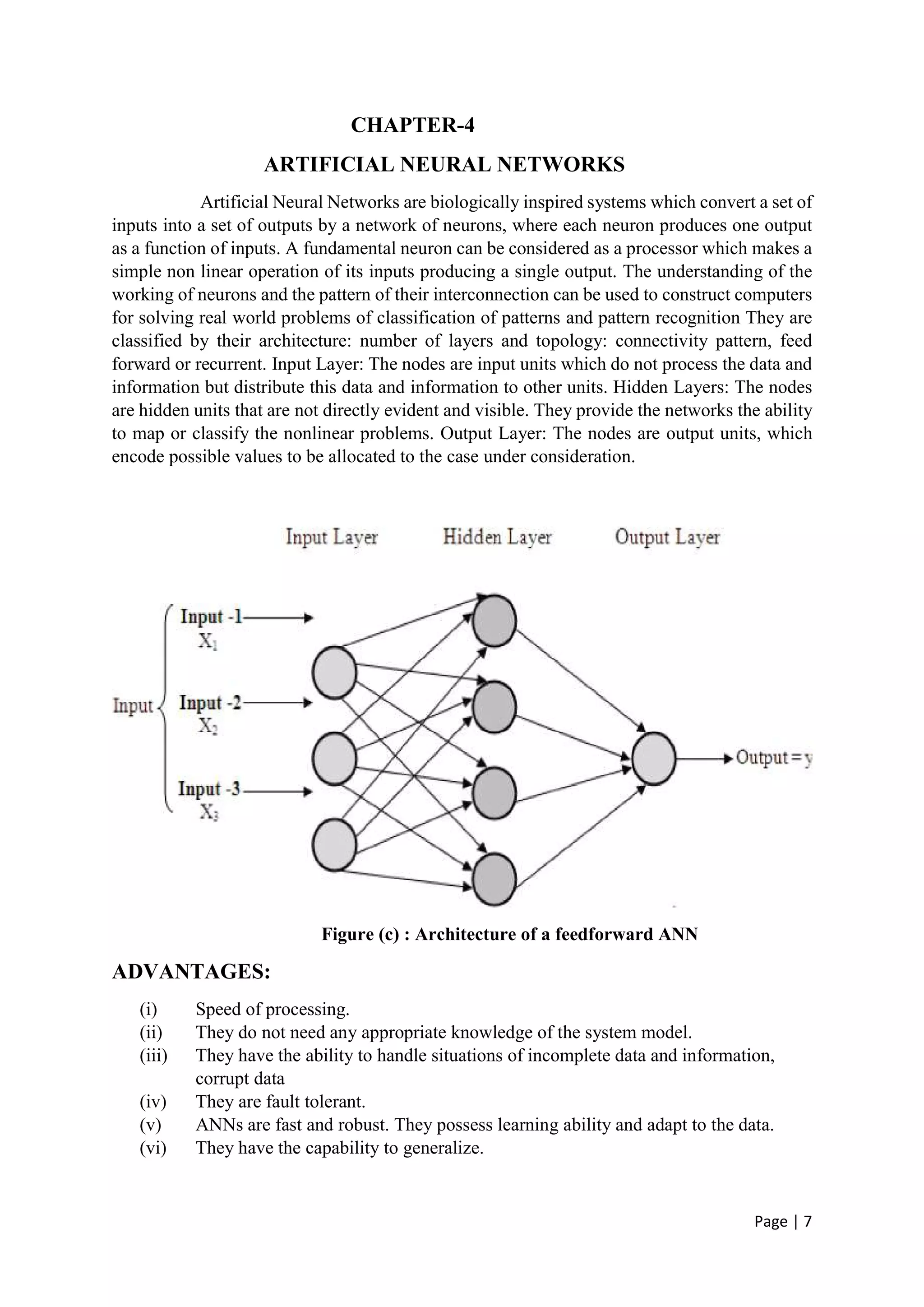
forward or recurrent. Input Layer: The nodes are input units which do not process the data and
information but distribute this data and information to other units. Hidden Layers: The nodes
are hidden units that are not directly evident and visible. They provide the networks the ability
to map or classify the nonlinear problems. Output Layer: The nodes are output units, which
encode possible values to be allocated to the case under consideration.
Figure (c) : Architecture of a feedforward ANN
ADVANTAGES:
(i) Speed of processing.
(ii) They do not need any appropriate knowledge of the system model.
(iii) They have the ability to handle situations of incomplete data and information,
corrupt data
(iv) They are fault tolerant.
(v) ANNs are fast and robust. They possess learning ability and adapt to the data.
(vi) They have the capability to generalize.
Page | 8
DISADVANTAGES:
(i) Large dimensionality.
(ii) Results are always generated even if the input data are unreasonable.
(iii) They are not scalable i.e. once an ANN is trained to do certain task, it is difficult to
tend for other tasks without retraining the neural network.
4.1 How ANNS can be used in power systems
As ANNs operate on biological instincts and perform biological evaluation of real
world problems, the problems in generation, transmission and distribution of electricity can be
fed to the ANNs so that a suitable solution can be obtained. Given the constraints of a practical
transmission and distribution system, the exact values of parameters can be determined.
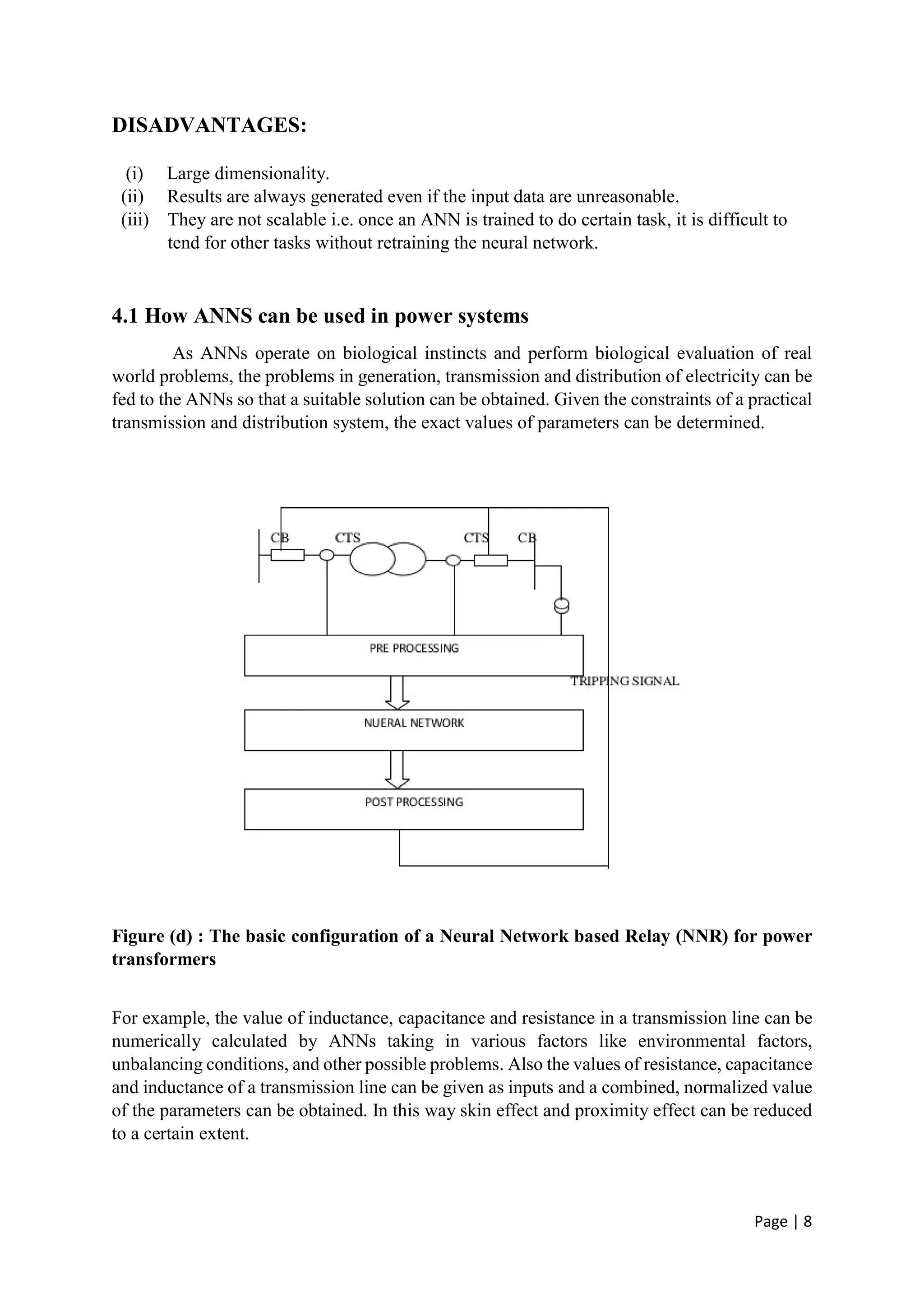
Figure (d) : The basic configuration of a Neural Network based Relay (NNR) for power
transformers
For example, the value of inductance, capacitance and resistance in a transmission line can be
numerically calculated by ANNs taking in various factors like environmental factors,
unbalancing conditions, and other possible problems. Also the values of resistance, capacitance
and inductance of a transmission line can be given as inputs and a combined, normalized value
of the parameters can be obtained. In this way skin effect and proximity effect can be reduced
to a certain extent.
Page | 9
The ANNs are very different from expert systems since they do not need a knowledge base to
work. Instead, they have to be trained with numerous actual cases. An ANN is a set of
elementary neurons which are connected together in different architectures organized in layers
what is biologically inspired . An elementary neuron can be seen like a processor which makes
a simple non linear operation of its inputs producing its single output. A weight (synapse) is
attached to each neuron and the training enables adjusting of different weights according to the
training set. The ANN techniques are attractive because they do not require tedious knowledge
acquisition, representation and writing stages and, therefore, can be successfully applied for
tasks not fully described in advance. The ANN are not programmed or supported by a
knowledge base as are Expert Systems. Instead they learn a response based on given inputs and
a required output by adjusting the node weights and biases accordingly. The speed of
processing, allowing real time applications, is also an advantage.
Since ANNs can provide excellent pattern recognition, they are proposed by many researchers
to perform different tasks in power system relaying for signal processing and decisionmaking.
The common application of the ANN technique assumes:
 The ANN is fed either with non-processed samples of the input signals, or by features of
those signals extracted using certain measuring algorithms (or by a combination).
 The sliding data widow consisting of the recent and a few historical samples of the signals,
is fed to the ANN.
 The output from the ANN encodes the output decision such as tripping command, type of
fault, direction of fault, etc.
 The training patterns exposed to the ANN cover the most important operating conditions
both internal faults and other disturbances. Typically, only the selected window positions are
used for training.
 Additional pre- and post-processing may be applied.
The most widespread application of ANNs is in pattern classification and associative memory
where they can learn to distinguish between classes of inputs and, therefore, they can be
successively used for decision making and phenomena classification. A major problem with
ANNs is that no exact guide exists for the choice to the number of hidden layers and neurons
per hidden layer. On the other hand, the ability to generalize is one of the main advantage of
using ANNs.
Page | 10
CHAPTER-5
FUZZY LOGIC
Fuzzy logic or Fuzzy systems are logical systems for standardisation and
formalisation of approximate reasoning. It is similar to human decision making with an ability
to produce exact and accurate solutions from certain or even approximate information and data.
The reasoning in fuzzy logic is similar to human reasoning. Fuzzy logic is the way like which
human brain works, and we can use this technology in machines so that they can perform
somewhat like humans. Fuzzification provides superior expressive power, higher generality
and an improved capability to model complex problems at low or moderate solution cost.
Fuzzy logic allows a particular level of ambiguity throughout an analysis. Because
this ambiguity can specify available information and minimise problem complexity, fuzzy
logic is useful in many applications. For power systems, fuzzy logic is suitable for applications
in many areas where the available information involves uncertainty. For example, a problem
might involve logical reasoning, but can be applied to numerical, other than symbolic inputs
and outputs. Fuzzy logic provide the conversions from numerical to symbolic inputs, and back
again for the outputs.
FUZZY LOGIC CONTROLLER:
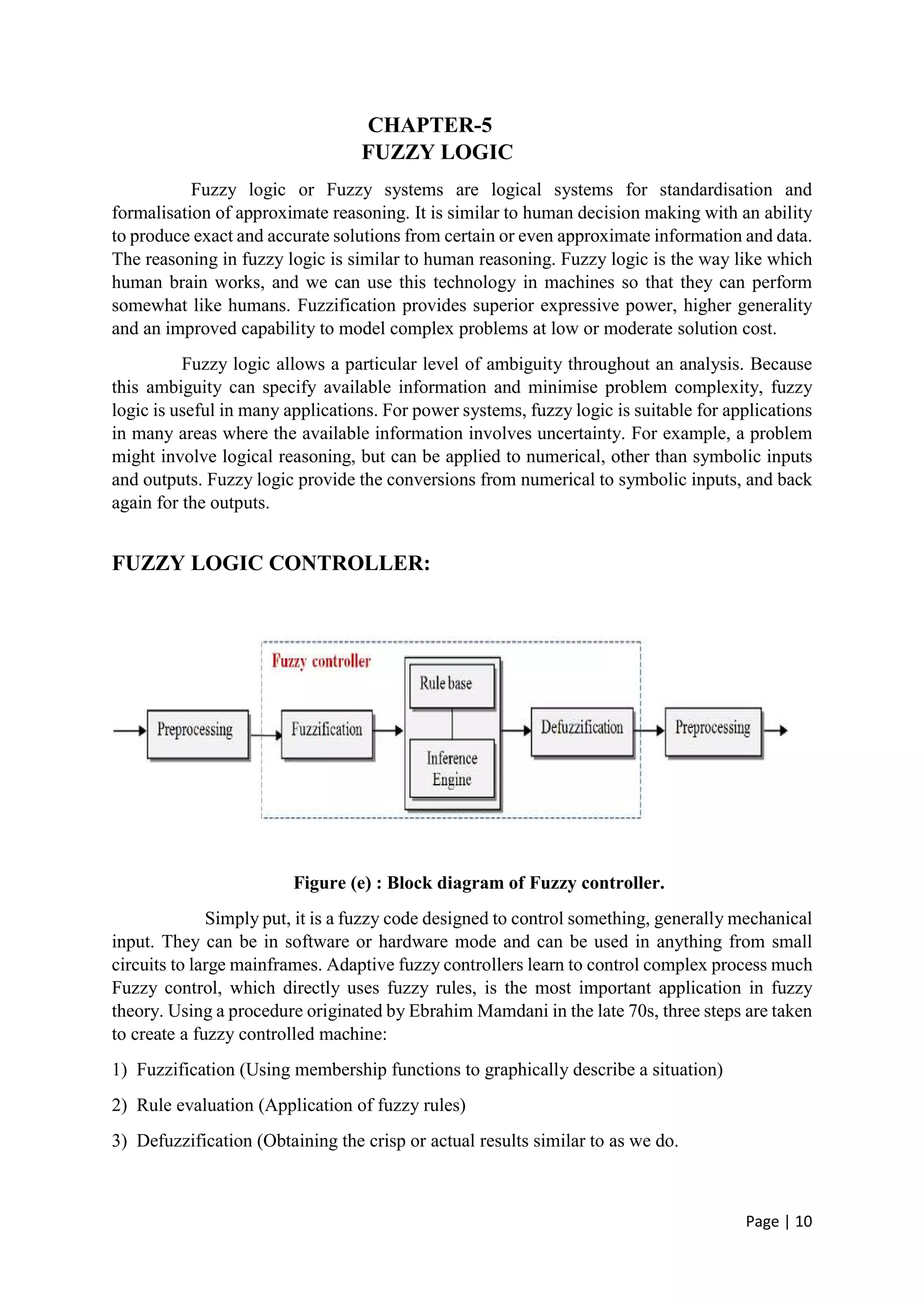
Figure (e) : Block diagram of Fuzzy controller.
Simply put, it is a fuzzy code designed to control something, generally mechanical
input. They can be in software or hardware mode and can be used in anything from small
circuits to large mainframes. Adaptive fuzzy controllers learn to control complex process much
Fuzzy control, which directly uses fuzzy rules, is the most important application in fuzzy
theory. Using a procedure originated by Ebrahim Mamdani in the late 70s, three steps are taken
to create a fuzzy controlled machine:
1) Fuzzification (Using membership functions to graphically describe a situation)
2) Rule evaluation (Application of fuzzy rules)
3) Defuzzification (Obtaining the crisp or actual results similar to as we do.
Page | 11
TERMS USED IN FUZZY LOGIC
Degree of Membership - The degree of membership is the placement in the transition
from 0 to 1 of conditions within a fuzzy set. If a particular building's placement on the scale is
a rating of .7 in its position in newness among new buildings, then we say its degree of
membership in new buildings is .7. Fuzzy Variable - Words like red, blue, etc., are fuzzy and
can have many shades and tints. They are just human opinions, not based on precise
measurement in angstroms. These words are fuzzy variables. Linguistic Variable - Linguistic
means relating to language, in our case plain language words. Fuzzy Algorithm - An algorithm
is a procedure, such as the steps in a computer program. A fuzzy algorithm, then, is a procedure,
usually a computer program, made up of statements relating linguistic variables. An example
for a fuzzy logic system is provided at the end of the paper.
APPLICATIONS:
(i) Stability analysis and enhancement
(ii) Power system control
(iii) Fault diagnosis
(iv) Security assessment
(v) Load forecasting
(vi) Reactive power planning and its control
(vii) State estimation
REACTIVE POWER AND VOLTAGE CONTROL
Main types of voltage problems are:
(i) Planning of system reactive power demands and control facilities.
(ii) Installation of reactive power control resources.
(iii) The operation of existing voltage resources and control device.
For reactive power control with the objective of enhancing the voltage profile of power system,
fuzzy logic has been applied. The voltage deviation and controlling variables are converted
into fuzzy set or fuzzy system notations to construct the relations between voltage deviation
and controlling ability of the controlling device. The main control variables are generator
excitation, transformer taps and VAR compensators. A fuzzy system is formed to select these
control variables and their movement.
5.1 How Fuzzy logic can be used in power systems:
Fuzzy logic can be used for designing the physical components of power systems.
They can be used in anything from small circuits to large mainframes. They can be used to
increase the efficiency of the components used in power systems. As most of the data used in
power system analysis are approximate values and assumptions, fuzzy logic can be of great use
to derive a stable, exact and ambiguity-free output.
Page | 12
FUZZY LOGIC BASED DISTANCE PROTECTION SOLUTION
PROCEDURE
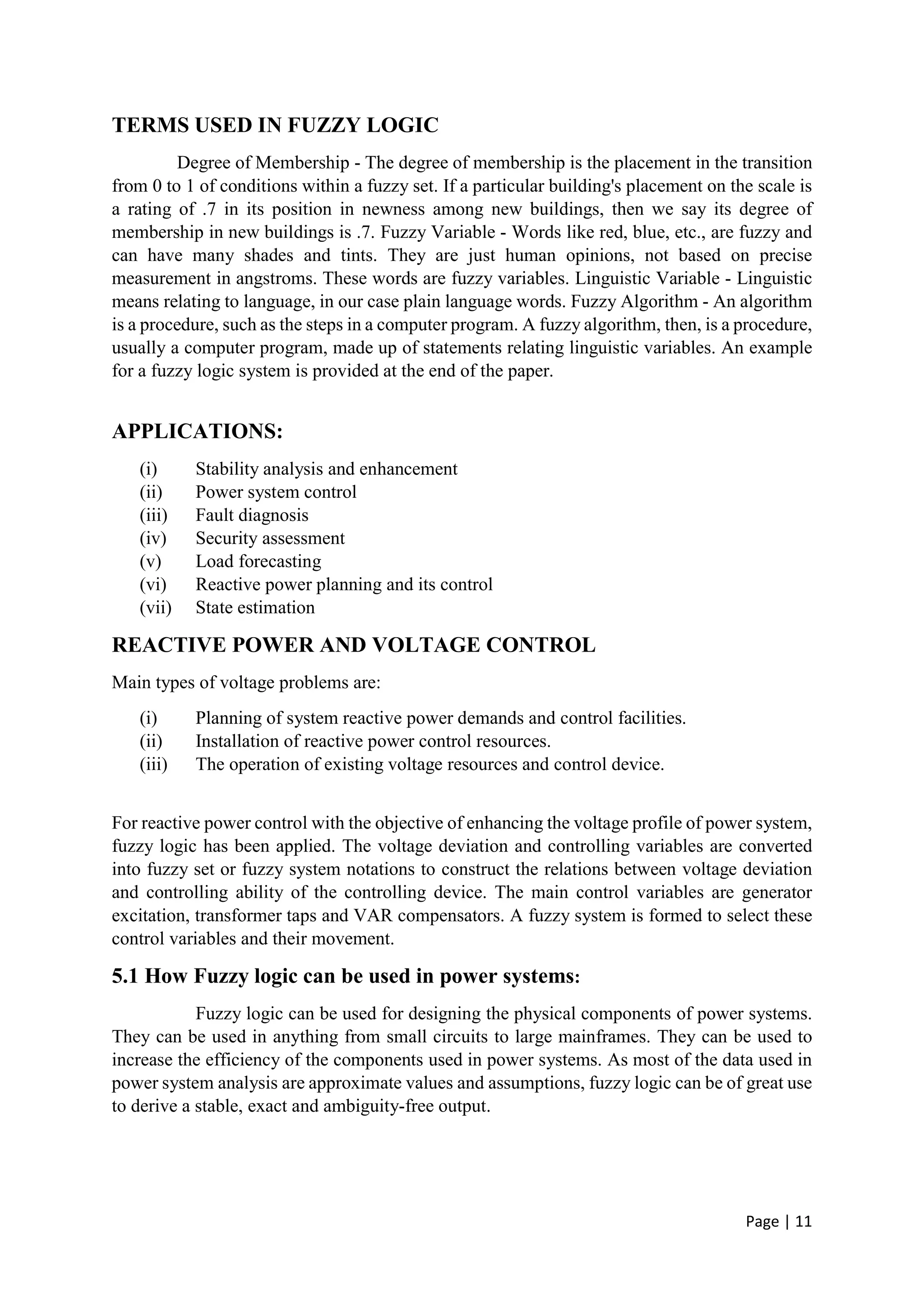
Below is a series of steps showing the solution procedure followed in designing our scheme.
Step 1: Choose appropriate input variables: Impedance Z in this case.
Step II: Convert the input variables to fuzzy sets (Fuzzification).
Step III: Determine the fuzzy matrix (knowledge base) and draw the membership functions
(for our design, MATLAB code are used).
Step IV: Design the fuzzy inference – decision making (Rule base) and simulate with
appropriate program (like MATLAB).
Step V: Devise an appropriate transformation of fuzzy trip actions into crisp trip actions
(defuzzification).
Figure (f) : Fuzzy logic
Page | 13
5.2 Engineering applications of fuzzy logic
Fuzzy logic potentially has many applications in engineering where the domain knowledge is
usually imprecise. Notable successes have been achieved in the area of process and machine
control although other sectors have also benefited from this tool.
Recent examples of engineering applications include:
 Controlling the height of the arc in a welding process
 Controlling the rolling motion of an aircraft
 Controlling a multi-fingered robot hand
 Analyzing the chemical composition of minerals
 Determining the optimal formation of manufacturing cells
 Classifying discharge pulses in electrical discharge machining.
 Fuzzy systems can be generally used for fault diagnosis.
Fuzzy logic is not the wave of the future. It is now! There are already hundreds of
millions of dollars of successful, fuzzy logic based commercial products, everything from self-
focusing cameras to washing machines that adjust themselves according to how dirty the
clothes are, automobile engine controls, anti-lock braking systems, color film developing
systems, subway control systems and computer programs trading successfully in the financial
markets.
Fuzzy logic can be used for designing the physical components of power systems.
They can be used in anything from small circuits to large mainframes. They can be used to
increase the efficiency of the components used in power systems. As most of the data used in
power system analysis are approximate values and assumptions, fuzzy logic can be of great use
to derive a stable, exact and ambiguity-free output.
Page | 14
CHAPTER-6
PRACTICAL APPLICATION OF AI IN TRANSMISSION LINE
The application of intelligent systems to power system problems has been
an area of strong research interest in the past decade. The most emphasis has been on
applications that relate to overall monitoring, operation, and planning of the power system.
Less emphasis has been placed on protective relaying, substation control, and related
monitoring functions, at least as far as the number of published papers would indicate. It is felt
that one of the major reasons for this is due to the real-time constraints imposed by the
applications that require most of the functions to be executed automatically in a relatively short
time frame. However, with increasing requirements on utility electrical systems for
improvements in efficiency, reliability, and quality of service, along with significant
technology development toward increased processing speeds and memory storage, there has
been an increased impetus to research applications of intelligent systems in protection
engineering.
Most AI applications to protection engineering are ancillary functions related to
relaying, rather than the relaying functions themselves. For example, one area of interest is the
use, selection, setting, and coordination of relays and fuses. Another application is to aid
selection of appropriate algorithms for fault location. AI has also been applied for fault data
analysis by utilizing digital fault recorder (DFR) signals. It is seen that some of the applications
have stringent time-response requirements. With recent computing technology, it seems that
AI systems are limited by the boundaries of computer resources and execution times compared
to conventional deterministic computer programs. New hardware and software that addresses
the constraints of AI implementation are continuing to be developed. As the demand for these
tools rise, their availability and cost will become more practical for application to protection
engineering, especially for real- time functions.
Below is the operational functionality of the AI techniques that implemented to
a practical transmission line to check and rescue the faults if any.
Page | 15
Figure (g) : AI techniques that implemented to a practical transmission line .
Consider a practical transmission line. If any fault occurs in the transmission line,
the fault detector detects the fault and feeds it to the fuzzy system. Only three line currents are
sufficient to implement this technique and the angular difference between fault and pre-fault
current phasors are used as inputs to the fuzzy system. The fuzzy system is used to obtain the
crisp output of the fault type. Fuzzy systems can be generally used for fault diagnosis.
Artificial Neural Networks and Expert systems can be used to improve the
performance of the line. The environmental sensors sense the environmental and atmospheric
conditions and give them as input to the expert systems. The expert systems are computer
programs written by knowledge engineers which provide the value of line parameters to be
deployed as the output. The ANNs are trained to change the values of line parameters over the
given ranges based on the environmental conditions. Training algorithm has to be given to
ANN. After training is over, neural network is tested and the performance of updated trained
neural network is evaluated. If performance is not upto the desired level, some variations can
be done like varying number of hidden layers, varying number of neurons in each layer. The
processing speed is directly proportional to the number of neurons. These networks take
different neurons for different layers and different activation functions between input and
hidden layer and hidden and output layer to obtain the desired output. In this way the
performance of the transmission line can be improved.
Page | 16
CHAPTER-7
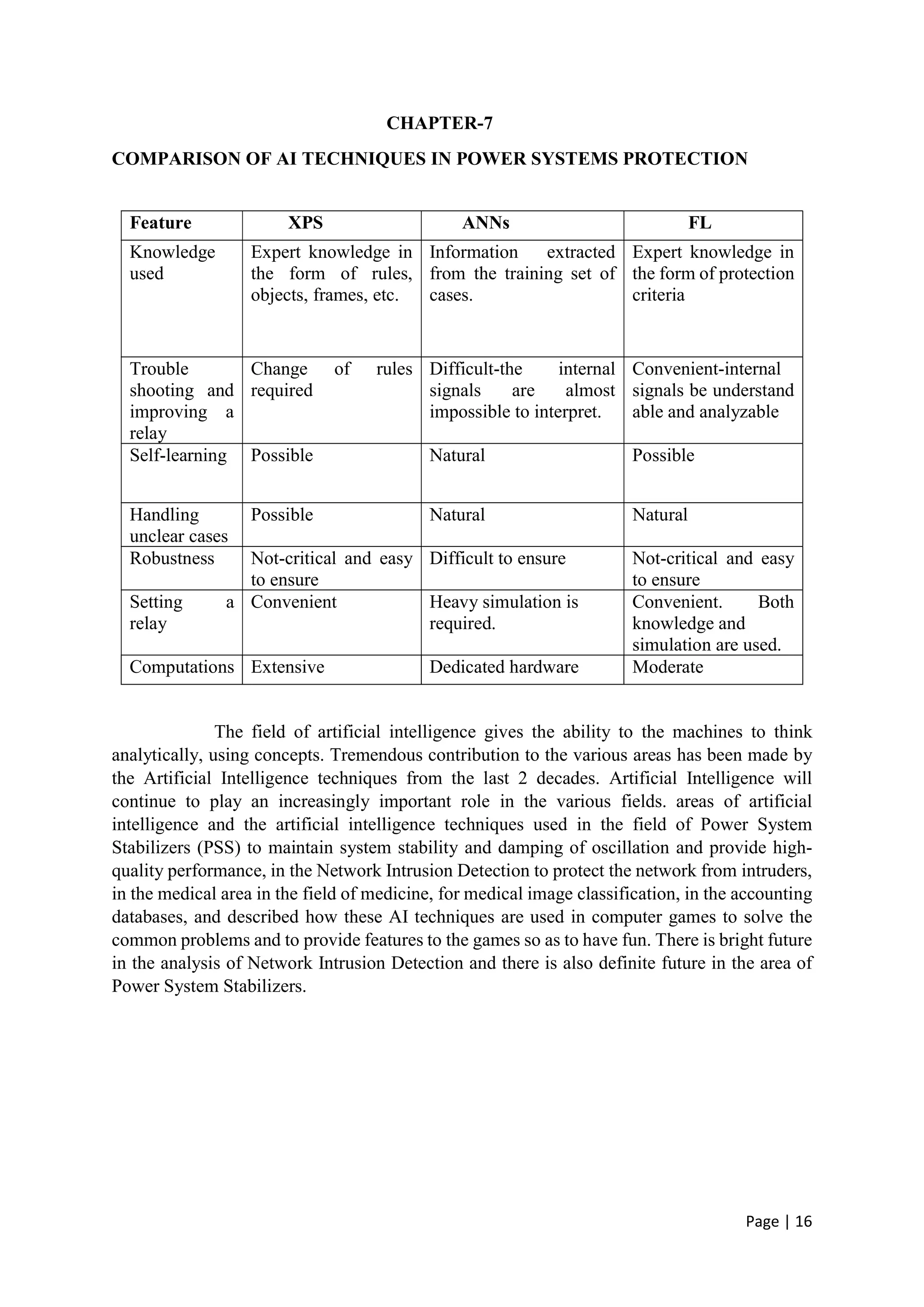
COMPARISON OF AI TECHNIQUES IN POWER SYSTEMS PROTECTION
The field of artificial intelligence gives the ability to the machines to think
analytically, using concepts. Tremendous contribution to the various areas has been made by
the Artificial Intelligence techniques from the last 2 decades. Artificial Intelligence will
continue to play an increasingly important role in the various fields. areas of artificial
intelligence and the artificial intelligence techniques used in the field of Power System
Stabilizers (PSS) to maintain system stability and damping of oscillation and provide high-
quality performance, in the Network Intrusion Detection to protect the network from intruders,
in the medical area in the field of medicine, for medical image classification, in the accounting
databases, and described how these AI techniques are used in computer games to solve the
common problems and to provide features to the games so as to have fun. There is bright future
in the analysis of Network Intrusion Detection and there is also definite future in the area of
Power System Stabilizers.
Feature XPS ANNs FL
Knowledge
used
Expert knowledge in
the form of rules,
objects, frames, etc.
Information extracted
from the training set of
cases.
Expert knowledge in
the form of protection
criteria
Trouble
shooting and
improving a
relay
Change of rules
required
Difficult-the internal
signals are almost
impossible to interpret.
Convenient-internal
signals be understand
able and analyzable
Self-learning Possible Natural Possible
Handling
unclear cases
Possible Natural Natural
Robustness Not-critical and easy
to ensure
Difficult to ensure Not-critical and easy
to ensure
Setting a
relay
Convenient Heavy simulation is
required.
Convenient. Both
knowledge and
simulation are used.
Computations Extensive Dedicated hardware Moderate
Page | 17
CHAPTER-8
CURRENT APPLICATION OF AI IN POWER SYSTEMS
Several problems in power systems cannot be solved by conventional techniques
are based on several requirements which may not feasible all the time. In these situations,
artificial intelligence techniques are the obvious and the only option.
Areas of application of AI in power systems are:
 Operation of power system like unit commitment, hydro-thermal coordination, economic
dispatch, congestion management, maintenance scheduling, state estimation, load and power
flow.
 Planning of power system like generation expansion planning, power system reliability,
transmission expansion planning, reactive power planning.
 Control of power system like voltage control, stability control, power flow control, load
frequency control.
 Control of power plants like fuel cell power plant control, thermal power plant control.
 Control of network like location, sizing and control of FACTS devices.
 Electricity markets like strategies for bidding, analysis of electricity markets.
 Automation of power system like management, fault diagnosis, network security.
 Applications of distribution system like planning and operation of distribution system,
demand side response and demand side management, operation and control of smart grids,
network reconfiguration.
 Applications of distributed generation like distributed generation planning, solar photovoltaic
power plant control and renewable energy resources.
 Forecasting application like short term and long term load forecasting, electricity market
forecasting, solar power forecasting, wind power forecasting.
An artificial intelligence base distance Transmission protection scheme for tripping
the line circuit breaker in an event that a fault occurs. It is a strategy that replaces a conventional
relay with a fuzzy relay. The approach was effective in implementing a simple fuzzy procedure
(5 rules) to solve a problem that requires rigorous mathematical operations, when the
conventional approach is used. Only the impedance of the line to fault is sufficient to implement
this technique. The system simulation shows that the proposed approach is able to make
tripping decisions and serve as logic for the breaker, which acts on this logic to protect the line,
by way of isolating a faulty section.
Page | 18
CONCLUSION
Over the past 40 years, artificial intelligence has produced a number of powerful
tools. The five of those tools, namely fuzzy logic, neural networks and genetic algorithms.
Applications of the tools in engineering have become more widespread due to the power and
affordability of present-day computers. It is anticipated that many new engineering applications
will emerge and that, for demanding tasks, greater use will be made of hybrid tools combining
the strengths of two or more of the tools reviewed. Other technological developments in
artificial intelligence that will have an impact in engineering include data mining, or the
extraction of information and knowledge from large databases and multi-agent systems, or
distributed self-organizing systems employing entities that function autonomously in an
unpredictable environment concurrently with other entities and processes.
The most recent techniques which are used for distance protection of transmission
line. Neural network is considered to be a fast, robust and accurate technique. But, fuzzy logic
systems are subjective and heuristic and are simpler than the wavelet transform or the neural
network based techniques. Better performance is obtained with GA as compared to
conventional techniques. But, most of the available tools for fault detection and classification
are not efficient and are not investigated for real time implementation. So, for this there is a
need for new algorithms that have high efficiency and suitable for real time usage. All these
techniques have their own features and researches are still going on to obtain lesser operating
time of relay at high speed.
The main feature of power system design and planning is reliability, which was
conventionally evaluated using deterministic methods. Moreover, conventional techniques
don’t fulfill the probabilistic essence of power systems. This leads to increase in operating and
maintenance costs. Plenty of research is performed to utilize the current interest AI for power
system applications. A lot of research is yet to be performed to perceive full advantages of this
upcoming technology for improving the efficiency of electricity market investment, distributed
control and monitoring, efficient system analysis, particularly power systems which use
renewable energy resources for operation.
Page | 19
REFERENCES
• Warwick k, Ekwue A. and Aggarwal R.(ed). Artificial intelligence techniques in power
systems. The institution of Electrical Engineers, London, 1997.
• International Journal of Engineering Intelligent Systems, The special issue on AI applications
to power system protection, edited by M.M. Saha and B. Kasztenny, vol.5,No.4,December
1997, pp.185-93.
• Artificial Intelligence in Power systems by R. Pasupathi Nath, V. Nishanth Balaji IOSR
Journal of Computer Engineering (IOSR-JCE) E-ISSN:2278-0661, p-ISSN: 2278-8727.

Artificial intelligence in power systems

  • 1.
    INDEX S.NO CHAPTER NAMEPage no 1 INTRODUCTION 01 2 NEED FOR AI IN POWER SYSTEMS 03 2.1 AI Techniques used in power systems 03 3 EXPERT SYSTEM 04 3.1 How Expert system can be used in power systems 05 3.2 An Expert system in power systems 06 4 ARTIFICIAL NUERAL NETWORKS 07 4.1 How ANNS can be used in power systems 08 5 FUZZY LOGIC 10 5.1 How Fuzzy logic cab be used in power systems 11 5.2 Engineering applications of fuzzy logic 13 6 PRACTIAL APPLICATION OF AI IN TRANSMISSION 14 LINE 7 COMPARISION OF AI TECNIQUES IN POWER SYSTEMS 16 PROTECTION 8 CURRENT APPLICATION OF AI IN POWER SYSTEMS 17 9 CONCLUSION 18 10 REFERENCES 19
  • 2.
    LIST OF FIGURES Figure(a) : Expert system Figure (b) : Simplified block diagram of XPS Figure (c) : Architecture of a feedforward ANN Figure (d) : The basic configuration of a Neural Network based Relay (NNR) for power transformers Figure (e) : Block diagram of Fuzzy controller Figure (f) : Fuzzy logic Figure (g) : AI techniques that implemented to a practical transmission line
  • 3.
    ABSTRACT A continuous andreliable supply of electricity is necessary for the functioning of today’s modern and advanced society. Since the early to mid1980s, most of the effort in power systems analysis has turned away from the methodology of formal mathematical modelling which came from the areas of operations research, control theory and numerical analysis to the less rigorous and less tedious techniques of artificial intelligence (AI). Power systems keep on increasing on the basis of geographical regions, assets additions, and introduction of new technologies in generation, transmission and distribution of electricity. AI techniques have become popular for solving different problems in power systems like control, planning, scheduling, forecast, etc. These techniques can deal with difficult tasks faced by applications in modern large power systems with even more interconnections installed to meet increasing load demand. The application of these techniques has been successful in many areas of power system engineering. Artificial intelligence emerged as a computer science discipline in the mid1950s. Since then, it has produced a number of powerful tools, many of which are of practical use in engineering to solve difficult problems normally requiring human intelligence. Three of these tools will be reviewed in this paper. They are: fuzzy logic, neural networks and genetic algorithms. Artificial intelligence is the science of automating intelligent behaviours currently achievable by humans. Power system has grown tremendously over a few decades. As the size and complexity of the power system consisting of generators, transmission lines, power transformers, distribution transformers etc. increases the possibility of inviting faults. The acquisition of data, the processing of those data for use by the operator, and control of remote devices are the fundamental building blocks of all modern utility control systems. Manual calculations, technical analysis and conclusions initially adopted the power system design, operation and control. As the power system grew it become more complex due to the technical advancements, variety and dynamic requirements.
  • 4.
    Page | 1 CHAPTER-1 INTRODUCTION Anelectric power system is a network of electrical components used to supply, transmit and use electric power. Power systems engineering is a subdivision of electrical engineering that deals with the generation, transmission, distribution and utilisation of electric power and the electrical devices connected to such systems like generators, motors and transformers. Commonly, artificial intelligence is known to be the intelligence exhibited by machines and software, for example, robots and computer programs. The term is generally used to the project of developing systems equipped with the intellectual processes features and characteristics of humans, like the ability to think, reason, find the meaning, generalize, distinguish, learn from past experience or rectify their mistakes. Artificial general intelligence (AGI) is the intelligence of a hypothetical machine or computer which can accomplish any intellectual assignment successfully which a human being can accomplish. It is claimed that artificial intelligence is playing an increasing role in the research of management science and operational research areas. Intelligence is commonly considered as the ability to collect knowledge and reason about knowledge to solve complex problems. In the near Future intelligent machines will replace human capabilities in many areas. Artificial intelligence is the study and developments of intelligent machines and software that can reason, learn, gather knowledge, communicate, manipulate and perceive the objects. John McCarthy coined the term in 1956 as branch of computer science concerned with making computers behave like humans. It is the study of the computation that makes it possible to perceive reason and act. Artificial intelligence is different from psychology because it emphasis on computation and is different from computer science because of its emphasis on perception, reasoning and action. It makes machines smarter and more useful. It works with the help of artificial neurons (artificial neural network) and scientific theorems (if then statements and logics). AI technologies have matured to the point in offering real practical benefits in many of their applications. Major Artificial Intelligence areas are Expert Systems, Natural Language Processing, Speech Understanding, Robotics and Sensory Systems, Computer Vision and Scene Recognition, Intelligent Computer- Aided Instruction, Neural Computing. From these Expert System is a rapidly growing technology which is having a huge impact on various fields of life. The various techniques applied in artificial intelligence are Neural Network, Fuzzy Logic, Evolutionary Computing, and Hybrid Artificial Intelligence. Transmission lines are vital part of the electrical power system and are defined as conductor or conductors designed to transmit electrical energy from generating centre to the
  • 5.
    Page | 2 loadcentre. When faults occur in the power system, they usually provide significant changes in the system quantities like over-current, over or under voltage, power factor, impedance, frequency and power or current direction. Mostly 80-90% of the fault occurs on transmission line and rest on substation equipments and bus-bars combined. The key challenge to the protection of transmission line lies in reliably detecting and isolating faults compromising the security of the power system. And, if any fault or disturbances are generated in transmission lines & not detected, located & eliminated quickly, it may cause instability in the power system. The microprocessor technology brings unquestionable improvements of the protection relays- criteria signals are estimated in a shorter time; input signals are filtered-out more precisely; it is easy to apply sophisticated corrections; the hardware is standardized and may communicate with other protection and control systems; relays are capable of self monitoring. All this, however, did not make a major breakthrough in power system protection as far as security, dependability and speed of operation are considered. The key reason behind this is that the principles used by digital relays blindly reproduce the criteria known for decades. The relaying task, however, may be approached as a pattern recognition problem - by monitoring its inputs, the relay classifies on-going transients between internal faults and all the other conditions. Or, the protective relaying may be considered as a decision making problem - the relay should decide whether to trip or retrain itself from tripping. This observation directly leads to AI application in power system protection . Practically, it includes the artificial neural network approach (pattern recognition), as well as the expert system and fuzzy logic methods (decision making). Thus, a well coordinated protection system must be provided to detect & isolate various types of faults rapidly so that damage & disruption caused to power system is minimized. And, the time required in determining the fault point along the transmission line affects the quality of power to be delivered. For this purpose, the protective relays operates after a fault has occurred and helps to minimize the period of trouble and limit the outage time, damage and related problems.
  • 6.
    Page | 3 CHAPTER-2 NEEDFOR AI IN POWER SYSTEMS Power system analysis by conventional techniques becomes more difficult because of: (i) Complex, versatile and large amount of information which is used in calculation, diagnosis and learning. (ii) Increase in the computational time period and accuracy due to extensive and vast system data Handling. The modern power system operates close to the limits due to the ever increasing energy consumption and the extension of currently existing electrical transmission networks and lines. This situation requires a less conservative power system operation and control operation which is possible only by continuously checking the system states in a much more detail manner than it was necessary. Sophisticated computer tools are now the primary tools in solving the difficult problems that arise in the areas of power system planning, operation, diagnosis and design. Among these computer tools, Artificial Intelligence has grown predominantly in recent years and has been applied to various areas of power systems. 2.1 AI Techniques used in power systems The major families of AI techniques are considered to be applied in modern power system are:  Expert System Techniques (XPSs),  Artificial Neural Networks (ANNs),  Fuzzy Logic systems (FL).
  • 7.
    Page | 4 CHAPTER-3 EXPERTSYSTEM An expert system obtains the knowledge of a human expert in a narrow specified domain into a machine implementable form. Expert systems are computer programs which have proficiency and competence in a particular field. This knowledge is generally stored separately from the program’s procedural part and may be stored in one of the many forms, like rules, decision trees, models, and frames. They are also called as knowledge based systems or rule based systems. Expert systems use the interface mechanism and knowledge to solve problems which cannot be or difficult to be solved by human skill and intellect. Expert systems have been emerging rapidly from laboratory studies into a broad range of industrial and business applications. The market segment for expert systems and their development tools has grown from about U.S. $9 million in 1982 to an estimated U.S. $1.8 billion in 1990. Many have predicted that expert systems will soon be viewed as merely a new, powerful, programming technique which can be integrated into most computer programs. In general, an expert system is a program that mimics human expertise in a particular, domain-specific decision-making process. These decisions may pertain to functions in control/ monitoring, debugging, design, diagnosis, instruction, interpretation, planning, or prediction. The mimicking of human experts should include not only the decision function, but also the ability to reason, or infer, even in the face of uncertain or missing information. The ability to explain to others what the reasoning is, as well as the ability to act in a correct and timely manner should also be included. Figure (a) : Expert system
  • 8.
    Page | 5 ADVANTAGES: (i)It is permanent and consistent. (ii) It can be easily documented. (iii) It can be easily transferred or reproduced. DISADVANTAGE: Expert Systems are unable to learn or adapt to new problems or situations. APPLICATIONS: Many areas of applications in power systems match the abilities of expert systems like decision making, archiving knowledge, and solving problems by reasoning, heuristics and judgment. Expert systems are especially useful for these problems when a large amount of data and information must be processed in a short period of time. 3.1 How Expert system can be used in power systems Figure (b) : Simplified block diagram of XPS Since expert systems are basically computer programs, the process of writing codes for these programs is simpler than actually calculating and estimating the value of parameters used in generation, transmission and distribution. Any modifications even after design can be easily done because they are computer programs. Virtually, estimation of these values can be done and further research for increasing the efficiency of the process can be also performed. Knowledge base Data base Interface Solution.
  • 9.
    Page | 6 3.2An Expert system in power system protection The first expert systems included a few heuristic rules based on the expert's experience. In such systems, the knowledge takes the form of so called production rules written using the If... then... syntax (knowledge base). The system includes also the facts which generally describe the domain and the state of the problem to be solved (data base). A generic inference engine uses the facts and the rules to deduce new facts which allow the firing of other rules. The knowledge base is a collection of domain-specific knowledge and the inference system is the logic component for processing the knowledge base to solve the problem. This process continues until the base of facts is saturated and a conclusion has been reached. To guide the reasoning and to be more efficient, these systems may incorporate some strategies known as meta knowledge. Rule based systems represent still the majority of the existing expert systems. There are few applications of XPS to power system protection reported, but all of them solve the off-line tasks such as settings coordination, post-fault analysis and fault diagnosis . As yet there is no application reported of the XPS technique employed as a decision making tool in an on-line operating protective relay. The basic reason for this is that there is no extensive rule base that describes the reasoning process applicable to protective relaying. Instead, only a few rules or criteria are collected.
  • 10.
    Page | 7 CHAPTER-4 ARTIFICIALNEURAL NETWORKS Artificial Neural Networks are biologically inspired systems which convert a set of inputs into a set of outputs by a network of neurons, where each neuron produces one output as a function of inputs. A fundamental neuron can be considered as a processor which makes a simple non linear operation of its inputs producing a single output. The understanding of the working of neurons and the pattern of their interconnection can be used to construct computers for solving real world problems of classification of patterns and pattern recognition They are classified by their architecture: number of layers and topology: connectivity pattern, feed forward or recurrent. Input Layer: The nodes are input units which do not process the data and information but distribute this data and information to other units. Hidden Layers: The nodes are hidden units that are not directly evident and visible. They provide the networks the ability to map or classify the nonlinear problems. Output Layer: The nodes are output units, which encode possible values to be allocated to the case under consideration. Figure (c) : Architecture of a feedforward ANN ADVANTAGES: (i) Speed of processing. (ii) They do not need any appropriate knowledge of the system model. (iii) They have the ability to handle situations of incomplete data and information, corrupt data (iv) They are fault tolerant. (v) ANNs are fast and robust. They possess learning ability and adapt to the data. (vi) They have the capability to generalize.
  • 11.
    Page | 8 DISADVANTAGES: (i)Large dimensionality. (ii) Results are always generated even if the input data are unreasonable. (iii) They are not scalable i.e. once an ANN is trained to do certain task, it is difficult to tend for other tasks without retraining the neural network. 4.1 How ANNS can be used in power systems As ANNs operate on biological instincts and perform biological evaluation of real world problems, the problems in generation, transmission and distribution of electricity can be fed to the ANNs so that a suitable solution can be obtained. Given the constraints of a practical transmission and distribution system, the exact values of parameters can be determined. Figure (d) : The basic configuration of a Neural Network based Relay (NNR) for power transformers For example, the value of inductance, capacitance and resistance in a transmission line can be numerically calculated by ANNs taking in various factors like environmental factors, unbalancing conditions, and other possible problems. Also the values of resistance, capacitance and inductance of a transmission line can be given as inputs and a combined, normalized value of the parameters can be obtained. In this way skin effect and proximity effect can be reduced to a certain extent.
  • 12.
    Page | 9 TheANNs are very different from expert systems since they do not need a knowledge base to work. Instead, they have to be trained with numerous actual cases. An ANN is a set of elementary neurons which are connected together in different architectures organized in layers what is biologically inspired . An elementary neuron can be seen like a processor which makes a simple non linear operation of its inputs producing its single output. A weight (synapse) is attached to each neuron and the training enables adjusting of different weights according to the training set. The ANN techniques are attractive because they do not require tedious knowledge acquisition, representation and writing stages and, therefore, can be successfully applied for tasks not fully described in advance. The ANN are not programmed or supported by a knowledge base as are Expert Systems. Instead they learn a response based on given inputs and a required output by adjusting the node weights and biases accordingly. The speed of processing, allowing real time applications, is also an advantage. Since ANNs can provide excellent pattern recognition, they are proposed by many researchers to perform different tasks in power system relaying for signal processing and decisionmaking. The common application of the ANN technique assumes:  The ANN is fed either with non-processed samples of the input signals, or by features of those signals extracted using certain measuring algorithms (or by a combination).  The sliding data widow consisting of the recent and a few historical samples of the signals, is fed to the ANN.  The output from the ANN encodes the output decision such as tripping command, type of fault, direction of fault, etc.  The training patterns exposed to the ANN cover the most important operating conditions both internal faults and other disturbances. Typically, only the selected window positions are used for training.  Additional pre- and post-processing may be applied. The most widespread application of ANNs is in pattern classification and associative memory where they can learn to distinguish between classes of inputs and, therefore, they can be successively used for decision making and phenomena classification. A major problem with ANNs is that no exact guide exists for the choice to the number of hidden layers and neurons per hidden layer. On the other hand, the ability to generalize is one of the main advantage of using ANNs.
  • 13.
    Page | 10 CHAPTER-5 FUZZYLOGIC Fuzzy logic or Fuzzy systems are logical systems for standardisation and formalisation of approximate reasoning. It is similar to human decision making with an ability to produce exact and accurate solutions from certain or even approximate information and data. The reasoning in fuzzy logic is similar to human reasoning. Fuzzy logic is the way like which human brain works, and we can use this technology in machines so that they can perform somewhat like humans. Fuzzification provides superior expressive power, higher generality and an improved capability to model complex problems at low or moderate solution cost. Fuzzy logic allows a particular level of ambiguity throughout an analysis. Because this ambiguity can specify available information and minimise problem complexity, fuzzy logic is useful in many applications. For power systems, fuzzy logic is suitable for applications in many areas where the available information involves uncertainty. For example, a problem might involve logical reasoning, but can be applied to numerical, other than symbolic inputs and outputs. Fuzzy logic provide the conversions from numerical to symbolic inputs, and back again for the outputs. FUZZY LOGIC CONTROLLER: Figure (e) : Block diagram of Fuzzy controller. Simply put, it is a fuzzy code designed to control something, generally mechanical input. They can be in software or hardware mode and can be used in anything from small circuits to large mainframes. Adaptive fuzzy controllers learn to control complex process much Fuzzy control, which directly uses fuzzy rules, is the most important application in fuzzy theory. Using a procedure originated by Ebrahim Mamdani in the late 70s, three steps are taken to create a fuzzy controlled machine: 1) Fuzzification (Using membership functions to graphically describe a situation) 2) Rule evaluation (Application of fuzzy rules) 3) Defuzzification (Obtaining the crisp or actual results similar to as we do.
  • 14.
    Page | 11 TERMSUSED IN FUZZY LOGIC Degree of Membership - The degree of membership is the placement in the transition from 0 to 1 of conditions within a fuzzy set. If a particular building's placement on the scale is a rating of .7 in its position in newness among new buildings, then we say its degree of membership in new buildings is .7. Fuzzy Variable - Words like red, blue, etc., are fuzzy and can have many shades and tints. They are just human opinions, not based on precise measurement in angstroms. These words are fuzzy variables. Linguistic Variable - Linguistic means relating to language, in our case plain language words. Fuzzy Algorithm - An algorithm is a procedure, such as the steps in a computer program. A fuzzy algorithm, then, is a procedure, usually a computer program, made up of statements relating linguistic variables. An example for a fuzzy logic system is provided at the end of the paper. APPLICATIONS: (i) Stability analysis and enhancement (ii) Power system control (iii) Fault diagnosis (iv) Security assessment (v) Load forecasting (vi) Reactive power planning and its control (vii) State estimation REACTIVE POWER AND VOLTAGE CONTROL Main types of voltage problems are: (i) Planning of system reactive power demands and control facilities. (ii) Installation of reactive power control resources. (iii) The operation of existing voltage resources and control device. For reactive power control with the objective of enhancing the voltage profile of power system, fuzzy logic has been applied. The voltage deviation and controlling variables are converted into fuzzy set or fuzzy system notations to construct the relations between voltage deviation and controlling ability of the controlling device. The main control variables are generator excitation, transformer taps and VAR compensators. A fuzzy system is formed to select these control variables and their movement. 5.1 How Fuzzy logic can be used in power systems: Fuzzy logic can be used for designing the physical components of power systems. They can be used in anything from small circuits to large mainframes. They can be used to increase the efficiency of the components used in power systems. As most of the data used in power system analysis are approximate values and assumptions, fuzzy logic can be of great use to derive a stable, exact and ambiguity-free output.
  • 15.
    Page | 12 FUZZYLOGIC BASED DISTANCE PROTECTION SOLUTION PROCEDURE Below is a series of steps showing the solution procedure followed in designing our scheme. Step 1: Choose appropriate input variables: Impedance Z in this case. Step II: Convert the input variables to fuzzy sets (Fuzzification). Step III: Determine the fuzzy matrix (knowledge base) and draw the membership functions (for our design, MATLAB code are used). Step IV: Design the fuzzy inference – decision making (Rule base) and simulate with appropriate program (like MATLAB). Step V: Devise an appropriate transformation of fuzzy trip actions into crisp trip actions (defuzzification). Figure (f) : Fuzzy logic
  • 16.
    Page | 13 5.2Engineering applications of fuzzy logic Fuzzy logic potentially has many applications in engineering where the domain knowledge is usually imprecise. Notable successes have been achieved in the area of process and machine control although other sectors have also benefited from this tool. Recent examples of engineering applications include:  Controlling the height of the arc in a welding process  Controlling the rolling motion of an aircraft  Controlling a multi-fingered robot hand  Analyzing the chemical composition of minerals  Determining the optimal formation of manufacturing cells  Classifying discharge pulses in electrical discharge machining.  Fuzzy systems can be generally used for fault diagnosis. Fuzzy logic is not the wave of the future. It is now! There are already hundreds of millions of dollars of successful, fuzzy logic based commercial products, everything from self- focusing cameras to washing machines that adjust themselves according to how dirty the clothes are, automobile engine controls, anti-lock braking systems, color film developing systems, subway control systems and computer programs trading successfully in the financial markets. Fuzzy logic can be used for designing the physical components of power systems. They can be used in anything from small circuits to large mainframes. They can be used to increase the efficiency of the components used in power systems. As most of the data used in power system analysis are approximate values and assumptions, fuzzy logic can be of great use to derive a stable, exact and ambiguity-free output.
  • 17.
    Page | 14 CHAPTER-6 PRACTICALAPPLICATION OF AI IN TRANSMISSION LINE The application of intelligent systems to power system problems has been an area of strong research interest in the past decade. The most emphasis has been on applications that relate to overall monitoring, operation, and planning of the power system. Less emphasis has been placed on protective relaying, substation control, and related monitoring functions, at least as far as the number of published papers would indicate. It is felt that one of the major reasons for this is due to the real-time constraints imposed by the applications that require most of the functions to be executed automatically in a relatively short time frame. However, with increasing requirements on utility electrical systems for improvements in efficiency, reliability, and quality of service, along with significant technology development toward increased processing speeds and memory storage, there has been an increased impetus to research applications of intelligent systems in protection engineering. Most AI applications to protection engineering are ancillary functions related to relaying, rather than the relaying functions themselves. For example, one area of interest is the use, selection, setting, and coordination of relays and fuses. Another application is to aid selection of appropriate algorithms for fault location. AI has also been applied for fault data analysis by utilizing digital fault recorder (DFR) signals. It is seen that some of the applications have stringent time-response requirements. With recent computing technology, it seems that AI systems are limited by the boundaries of computer resources and execution times compared to conventional deterministic computer programs. New hardware and software that addresses the constraints of AI implementation are continuing to be developed. As the demand for these tools rise, their availability and cost will become more practical for application to protection engineering, especially for real- time functions. Below is the operational functionality of the AI techniques that implemented to a practical transmission line to check and rescue the faults if any.
  • 18.
    Page | 15 Figure(g) : AI techniques that implemented to a practical transmission line . Consider a practical transmission line. If any fault occurs in the transmission line, the fault detector detects the fault and feeds it to the fuzzy system. Only three line currents are sufficient to implement this technique and the angular difference between fault and pre-fault current phasors are used as inputs to the fuzzy system. The fuzzy system is used to obtain the crisp output of the fault type. Fuzzy systems can be generally used for fault diagnosis. Artificial Neural Networks and Expert systems can be used to improve the performance of the line. The environmental sensors sense the environmental and atmospheric conditions and give them as input to the expert systems. The expert systems are computer programs written by knowledge engineers which provide the value of line parameters to be deployed as the output. The ANNs are trained to change the values of line parameters over the given ranges based on the environmental conditions. Training algorithm has to be given to ANN. After training is over, neural network is tested and the performance of updated trained neural network is evaluated. If performance is not upto the desired level, some variations can be done like varying number of hidden layers, varying number of neurons in each layer. The processing speed is directly proportional to the number of neurons. These networks take different neurons for different layers and different activation functions between input and hidden layer and hidden and output layer to obtain the desired output. In this way the performance of the transmission line can be improved.
  • 19.
    Page | 16 CHAPTER-7 COMPARISONOF AI TECHNIQUES IN POWER SYSTEMS PROTECTION The field of artificial intelligence gives the ability to the machines to think analytically, using concepts. Tremendous contribution to the various areas has been made by the Artificial Intelligence techniques from the last 2 decades. Artificial Intelligence will continue to play an increasingly important role in the various fields. areas of artificial intelligence and the artificial intelligence techniques used in the field of Power System Stabilizers (PSS) to maintain system stability and damping of oscillation and provide high- quality performance, in the Network Intrusion Detection to protect the network from intruders, in the medical area in the field of medicine, for medical image classification, in the accounting databases, and described how these AI techniques are used in computer games to solve the common problems and to provide features to the games so as to have fun. There is bright future in the analysis of Network Intrusion Detection and there is also definite future in the area of Power System Stabilizers. Feature XPS ANNs FL Knowledge used Expert knowledge in the form of rules, objects, frames, etc. Information extracted from the training set of cases. Expert knowledge in the form of protection criteria Trouble shooting and improving a relay Change of rules required Difficult-the internal signals are almost impossible to interpret. Convenient-internal signals be understand able and analyzable Self-learning Possible Natural Possible Handling unclear cases Possible Natural Natural Robustness Not-critical and easy to ensure Difficult to ensure Not-critical and easy to ensure Setting a relay Convenient Heavy simulation is required. Convenient. Both knowledge and simulation are used. Computations Extensive Dedicated hardware Moderate
  • 20.
    Page | 17 CHAPTER-8 CURRENTAPPLICATION OF AI IN POWER SYSTEMS Several problems in power systems cannot be solved by conventional techniques are based on several requirements which may not feasible all the time. In these situations, artificial intelligence techniques are the obvious and the only option. Areas of application of AI in power systems are:  Operation of power system like unit commitment, hydro-thermal coordination, economic dispatch, congestion management, maintenance scheduling, state estimation, load and power flow.  Planning of power system like generation expansion planning, power system reliability, transmission expansion planning, reactive power planning.  Control of power system like voltage control, stability control, power flow control, load frequency control.  Control of power plants like fuel cell power plant control, thermal power plant control.  Control of network like location, sizing and control of FACTS devices.  Electricity markets like strategies for bidding, analysis of electricity markets.  Automation of power system like management, fault diagnosis, network security.  Applications of distribution system like planning and operation of distribution system, demand side response and demand side management, operation and control of smart grids, network reconfiguration.  Applications of distributed generation like distributed generation planning, solar photovoltaic power plant control and renewable energy resources.  Forecasting application like short term and long term load forecasting, electricity market forecasting, solar power forecasting, wind power forecasting. An artificial intelligence base distance Transmission protection scheme for tripping the line circuit breaker in an event that a fault occurs. It is a strategy that replaces a conventional relay with a fuzzy relay. The approach was effective in implementing a simple fuzzy procedure (5 rules) to solve a problem that requires rigorous mathematical operations, when the conventional approach is used. Only the impedance of the line to fault is sufficient to implement this technique. The system simulation shows that the proposed approach is able to make tripping decisions and serve as logic for the breaker, which acts on this logic to protect the line, by way of isolating a faulty section.
  • 21.
    Page | 18 CONCLUSION Overthe past 40 years, artificial intelligence has produced a number of powerful tools. The five of those tools, namely fuzzy logic, neural networks and genetic algorithms. Applications of the tools in engineering have become more widespread due to the power and affordability of present-day computers. It is anticipated that many new engineering applications will emerge and that, for demanding tasks, greater use will be made of hybrid tools combining the strengths of two or more of the tools reviewed. Other technological developments in artificial intelligence that will have an impact in engineering include data mining, or the extraction of information and knowledge from large databases and multi-agent systems, or distributed self-organizing systems employing entities that function autonomously in an unpredictable environment concurrently with other entities and processes. The most recent techniques which are used for distance protection of transmission line. Neural network is considered to be a fast, robust and accurate technique. But, fuzzy logic systems are subjective and heuristic and are simpler than the wavelet transform or the neural network based techniques. Better performance is obtained with GA as compared to conventional techniques. But, most of the available tools for fault detection and classification are not efficient and are not investigated for real time implementation. So, for this there is a need for new algorithms that have high efficiency and suitable for real time usage. All these techniques have their own features and researches are still going on to obtain lesser operating time of relay at high speed. The main feature of power system design and planning is reliability, which was conventionally evaluated using deterministic methods. Moreover, conventional techniques don’t fulfill the probabilistic essence of power systems. This leads to increase in operating and maintenance costs. Plenty of research is performed to utilize the current interest AI for power system applications. A lot of research is yet to be performed to perceive full advantages of this upcoming technology for improving the efficiency of electricity market investment, distributed control and monitoring, efficient system analysis, particularly power systems which use renewable energy resources for operation.
  • 22.
    Page | 19 REFERENCES •Warwick k, Ekwue A. and Aggarwal R.(ed). Artificial intelligence techniques in power systems. The institution of Electrical Engineers, London, 1997. • International Journal of Engineering Intelligent Systems, The special issue on AI applications to power system protection, edited by M.M. Saha and B. Kasztenny, vol.5,No.4,December 1997, pp.185-93. • Artificial Intelligence in Power systems by R. Pasupathi Nath, V. Nishanth Balaji IOSR Journal of Computer Engineering (IOSR-JCE) E-ISSN:2278-0661, p-ISSN: 2278-8727.