Dr.B.Krithika M.D; DNB; MBA
ARTIFICIAL INTELLIGENCE
IN
BIOCHEMISTRY
A tool for progress
or
a path to fear ?
What is artificial
intelligence ?
Computational models
to perform tasks that
would usually require
human intelligence
How is it different from
automation in my lab ?
Rule based ,repetitive and
programmed to follow only
specified instructions
Where do I
fit in this
??
How do I
compete
with a bot
??
This is what we
need as a
VISION
ARTIFICIAL GENERAL
INTELLIGENCE
ARTIFICIAL SUPER
INTELLIGENCE
Full mimicracy of
Human reasoning ,
learning and decision
making
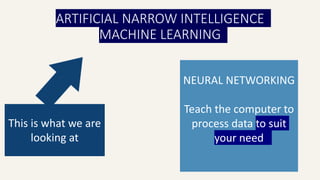
ARTIFICIAL NARROW INTELLIGENCE
MACHINE LEARNING
This is what we are
looking at
NEURAL NETWORKING
Teach the computer to
process data to suit
your need
NEURAL NETWORKING IN BIOCHEMICAL
ANALYSIS
Pattern
recognition
Identify complex
patterns and
correlate within
large dataset
Predictive analysis
Predict Biochemical
properties and
behaviors
Optimisation
strategies
Analyse and
enhance efficiency
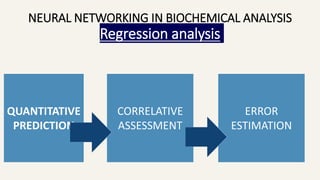
NEURAL NETWORKING IN BIOCHEMICAL ANALYSIS
Regression analysis
QUANTITATIVE
PREDICTION
CORRELATIVE
ASSESSMENT
ERROR
ESTIMATION
WHY ARE WE ESSENTIAL IN AI ?
DATA is the key !
• DATA flow is huge
• Hidden data ?
• Machine related or
method related data ?
SUBJECT MATTER EXPERTS
METHOD DEVELOPMENT AND
EVALUATION
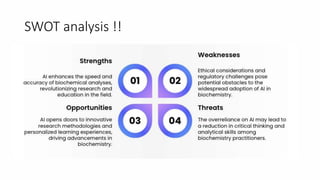
SWOT analysis !!
THANK YOU
THIS PICTURE WAS
GENERATED USING
AI on my commands
as an INPUT

Artificial Intelligence in Biochemistry.pptx

Editor's Notes

  • #3 Automation in clinical labs uses mechanical or electronic devices to automatically perform tasks, while artificial intelligence (AI) uses technology to simulate human intelligence and problem-solving. Automation is rule-based and follows predetermined instructions, while AI can learn from data and make decisions based on that data