Adjuncts in the
IVF laboratory:
Current evidence
Prof. Aboubakr
Elnashar
Benha university
Hospital, Egypt
ABOUBAKR ELNASHAR
CONTENTS
1.Sperm DNA fragmentation
2.Advanced sperm selection techniques
1.IMSI
2.pICSI
3.Advanced embryo selection techniques
1.TL
2.PGS
3.Mitochondrial DNA load measurement
4.Pro implantation techniques
1.AH
2.Embryo Glue and adherece compounds
ABOUBAKR ELNASHAR
1. SPERM DNA FRAGMENTATION
Many clinics
offer all their patients SDF test
The assays include
1. TUNEL
2. Comet
3. SCD assay
4. SCSA and
5. 8-OHdG test
(Shamsi et al., 2011).
 Differences between assays
Type of DNA damage being measured
Sensitivity
(Smith et al., 2013).
No particular assay has greater diagnostic value than
any other. ABOUBAKR ELNASHAR
Purpose of such an assay
 To indicate which treatments may be
contraindicated for, or beneficial to, patients.
 For example, the purpose of the assay is to
determine whether antioxidant therapy is
appropriate for the male: measurement of 8-OHdG
(Muratori et al., 2015).
**8hydroxy2'deoxy guanosine (8OHdG)
marker of Oxidative DNA damage
in the asthenozoospermic men higher than normozoospermic
ABOUBAKR ELNASHAR
Evidence:
1. Osman et al. (2015)
Men with low SDF had a higher LBR than those
with high SDF
Evidence was not sufficient to support this when
ICSI was used.
2. Simon et al. (2016)
modest but statistically significant association of
SDF with CPR following IVF and/or ICSI.
data varied depending on the assay used.
3. Cissen et al. (2016)
current tests have limited capacity to predict
either the chance of conception after ART or which
treatment method to choose
insufficient evidence to recommend SDF testingABOUBAKR ELNASHAR
4. ASRM, Pfeifer et al., 2014.
Methods for assessing SDF do not reliably predict
treatment outcomes
Cannot be recommended routinely for clinical
use
5. Cochrane SR, Showell et al., 2014.
low-quality evidence suggests that antioxidant
therapy in the male might increase CPR and LBR
in patients, where the spermatozoa are suffering
from oxidative stress
accurate assessment of 8-OHdG levels could be
of value in selecting a valid patient population.
ABOUBAKR ELNASHAR
2. ADVANCED SPERM SELECTION TECHNIQUES
Standard semen analysis
a crude assessment of male reproductive potential
does not evaluate the functional capacity of sperm
Advanced sperm selection methods
to improve fertilisation rates, even when ICSI is
performed.
Fertilisation of oocytes by sperms of high DNA
integrity or genetic competence:
improve embryo quality and pregnancy outcomes.
ABOUBAKR ELNASHAR
Advanced sperm selection techniques
1. Intracytoplasmic morphologically selected sperm
injection (IMSI)
2. Physiological intracytoplasmic sperm injection
(pICSI)
3. Sperm surface charge selection
4. Non-apoptotic sperm selection
5. Sperm birefringence
6. Hyaluronic acid binding.
Of these, only
IMSI
pICSI have been assessed through RCTs.
ABOUBAKR ELNASHAR
1. IMSI
Evidence:
Cochrane reviews:
(Teixeira et al., 2013; McDowell et al., 2014).
failed to find any improvement in CPRs when
these methods are compared with standard ICSI
ABOUBAKR ELNASHAR
2. pICSI
 Worrilow et al., 2013
12% rise in CPRs which is clinically significant
Significant reduction of pregnancy loss
Evidence
still in the formative stage
limited experience
no serious additional risk
It may be sensible to recommend pICSI in indicated
cases and after careful counselling.
ABOUBAKR ELNASHAR
Does the selection of sperm for ICSI based on their ability to
bind to hyaluronan improve CPR,IR and (pregnancy loss rate)
PLR
(Worrilow et al., 2013)
In couples where ≤ 65% of sperm bound hyaluronan,
the selection of hyaluronan-bound (HB) sperm for ICSI led to a
statistically significant reduction in PLR.
HB sperm demonstrate enhanced developmental parameters
which have been associated with successful fertilization and
embryogenesis. Sperm selected for ICSI using a liquid source
of hyaluronan achieved an improvement in IR.
ABOUBAKR ELNASHAR
3. ADVANCED EMBRYO SELECTION TECHNIQUES
Conventional morphological selection of embryos
limited value in predicting the developmental
competency of embryos
(Alpha Scientists in Reproductive and Embryology, 2011)
affected by the timing of the assessment
observer dependent
(Arce et al., 2006).
Apparently embryos with good morphology may not
necessarily be genetically competent and vice versa
(Alfarawati et al., 2011).
A more dynamic assessment of embryos and selection
of euploid embryos:
transferring the most competent embryo to maximise
IVF success.
ABOUBAKR ELNASHAR
1. Time-lapse imaging
Taking pictures over time and reviewing them as a film
Human embryos were filmed using TL technology
during their first 3 days of development
(Eriksson et al. 1981).
TL imaging
describe the first events during fertilization: providing
insight into how diverse and dynamic early embryonic
development can be.
(Payne et al., 1997)
The latest prediction model
still requires extensive prospective testing and
validation.
(Petersen et al., 2016)
ABOUBAKR ELNASHAR
Proposed benefits
‘not missing important events during culture
quality control
teaching applications
more information to the patient
of course, an increase in LBR.
ABOUBAKR ELNASHAR
Evidence:
1. Rubio et al. (2014)
9.7% increase in CPR compared to traditional
culture and morphology assessments alone.
2. Cochrane review, Armstrong et al., 2015
insufficient evidence of differences in live birth,
miscarriage, stillbirth or clinical pregnancy to
choose between [TL imaging] and conventional
incubation
ABOUBAKR ELNASHAR
TL imaging
 serves so many other functions in the laboratory
that its introduction will not be held back.
It may be unthinkable in 5–10 years to still only be
observing embryos by manually taking them out and
looking at them.
a tool which confers a number of practical benefits to
the IVF laboratory.
The future challenge to find the best role in the IVF
laboratory and to reduce implementation and
consumable costs.
(Armstrong et al., 2014).
ABOUBAKR ELNASHAR
2. Preimplantation genetic screening
In the 1990s:
Several studies demonstrated that cleavage stage
embryos showed a high level of aneuploidy
(Coonen et al., 1994; Munné et al., 1995)
selection against these aneuploid embryos would
improve LBRs.
It was surprising that not only were meiotic
abnormalities originating in the oocyte found, but also
abnormalities occurring postzygotically.
As a consequence, many embryos were mosaics,
containing both normal and aneuploid cells, or
several different lines of aneuploid cells.
ABOUBAKR ELNASHAR
PGS at day3
by biopsying one cell at Day 3
performing FISH for five chromosomes.
Evidence:
11 RCTs
PGS was shown not to increase CPR or LBR
in some cases, to decrease LBR
(Harper et al., 2010; Geraedts and Sermon, 2016).
PGS at Day 3 was not effective because
1. limited accuracy of FISH
2. limited number of cells available for biopsy
3. at Day 3, cleavage stage embryos are at a peak of
chromosomal abnormality/mosaicism.
ABOUBAKR ELNASHAR
Comprehensive chromosome screening of Day 5
biopsied trophectoderm cells
PGS is now actively marketed as
increasing implantation rates: decreasing
time to pregnancy
recurrent miscarriages
repeated implantation failure
(Sermon et al., 2016).
ABOUBAKR ELNASHAR
Evidence: 3 RCT
1. Yang et al. (2012)
included a small sample size of 45 young
good prognosis patients.
2. Scott et al. (2013)
72 good prognosis patients
between the ages of 21 and 42 y
Randomized quite late, i.e. if they had at least 2
blastocysts available for analysis.
 PGS increased implantation and delivery rates
fundamental methodological flaw in the study’s
failure to account for the difference between the
unit of randomization (patients) and unit of analysis
(individual embryos).
ABOUBAKR ELNASHAR
3. Forman et al., 2013
89 patients
compare PGS and SET with the transfer of two
embryos
The same methodological problem encountered
by the Scott trial
The wide confidence interval for pregnancy did
not demonstrate a beneficial effect.
ABOUBAKR ELNASHAR
Currently
2 larger RCTs are underway and the results are
expected soon.
The ESTEEM study
 patients of advanced maternal age
analyses of polar bodies using array-CGH
STAR study
 recruits all IVF patients
next generation sequencing on blastocyst
biopsies.
Although these studies may serve to provide stronger
evidence supporting PGS, the current RCTs do not
provide sufficiently robust evidence to consider PGS as
a proven and beneficial treatment.
ABOUBAKR ELNASHAR
3. Mitochondrial DNA load measurement
Rationale:
Metaphase II oocytes contain ~105 mitochondrial
DNA (mtDNA) copies
since no replication of the mtDNA occurs until the
blastocyst stage of embryonic development, the
mtDNA molecules are divided over the cleaving cells
(Fragouli and Wells, 2015).
An association between higher mtDNA level and
lower implantation potential in blastocysts
(Diez-Juan et al., 2015; Fragouli et al., 2015)
pointing to disturbed energy provision and metabolic
stress in embryos with a higher mtDNA content.
ABOUBAKR ELNASHAR
Relationship between aneuploidy of the blastocyst and
a higher mtDNA load.
euploid embryos that implanted after transfer had a
mtDNA load below a data-derived threshold: embryos
that failed to implant, or that were aneuploid, showed a
wide range of mtDNA load.
This range overlapped with the implanting embryos at
the low end, but the level of mtDNA at the high end was
much higher in the non-implanting embryos.
A threshold embryonic mtDNA load above which all
embryos failed to implant could therefore be identified.
ABOUBAKR ELNASHAR
Diez-Juan et al.
52% of the embryos below the identified threshold
implanted compared to an implantation rate across
the whole study population of 47%
Fragouli et al
these figures were 59% versus 38% respectively.
 MitoScore
marketed by the group of Diez and is currently tested
in RCT
MitogradeTM
marketed by Reprogenetics and is being tested in
RCT
ABOUBAKR ELNASHAR
Evidence:
Currently, there is no evidence that selection through
mtDNA load measurement increases LBR.
Application of the technique should therefore strictly
be limited to participation in either one of RCTs, and
this should clearly communicated to the patient.
ABOUBAKR ELNASHAR
4. PRO-IMPLANTATION PROCEDURES
1. Embryo glue and adherence compounds
Fibrin sealants
to reduce ectopic pregnancy rate and increase LBRs
(Feichtinger et al., 1990, 1992)
Never demonstrated reliable significant improvement
in clinical outcomes
ABOUBAKR ELNASHAR
ET medium enriched with the glycoprotein hyaluronan
(HA).
HA is naturally present in the female reproductive
tract and endometrium
forms a viscous solution
enhance the ET process and prohibit embryo
expulsion
(Bontekoe et al., 2014).
ABOUBAKR ELNASHAR
Evidence:
1. Cochrane SR, Bontekoe et al., 2014
moderate quality evidence for an improvement in
CPR and LBR
increase in multiple pregnancy rate
2. Fancsovits et al., 2015
not show a benefit in implantation rate, CPR or
LBR, but found a higher birthweight
Before robust conclusions can be drawn, however,
further RCTs are needed to evaluate the efficacy of HA
as an adherence compound during ET with respect to
eSET and the possibility of reducing the multiple
pregnancy rate.
ABOUBAKR ELNASHAR
2. Assisted hatching
Cohen et al. (1990)
making a breach in the zona pellucida may help
implantation in some patients.
AH
usually performed on Day 3, 5 or 6 of embryo
development
using a non-contact laser, but mechanical or acidic
solutions have also been used
(Balaban et al., 2002).
ABOUBAKR ELNASHAR
Clinics use AH for patients of
1. advanced maternal age
2. Smokers
3. patients with a raised FSH
4. when transferring embryos that have been
cryopreserved.
ABOUBAKR ELNASHAR
Evidence:
3 meta-analyses
significant increase in CPR
no evidence for a difference in LBR.
1. Martins et al. (2011)
significant difference in CPR using
frozen thawed embryos in unselected
women
patients with repeated IVF failure
no evidence of benefit for subgroups of either
older women or those with a good prognosis.
ABOUBAKR ELNASHAR
2. Cochrane review by Carney et al. (2012)
no evidence of difference between the LBR in the
AH and control groups.
3. Li et al. (2016)
significant increase in CPR and multiple
pregnancy rate
LBR, there was no evidence of difference
between the AH and control groups.
NICE guidelines (2013)
AH is not recommended because it has not been
shown to improve pregnancy rates
ABOUBAKR ELNASHAR
CONCLUSION
IVF clinicians and scientists must recognize that
appropriately powered, well-designed, peer-reviewed
RCTs, with a LBR outcome measure which goes on to
report on child health, are the gold standard of EBM
Those advocating and recommending unproven
procedures to their patients must
fully inform the patient of the evidence for
its safety
effectiveness
Orally
in writing
to ensure that people considering treatment
using adjunct therapies are in a position to
make an informed decision.ABOUBAKR ELNASHAR
It is also important that all procedures performed,
including the adjunct treatments, are well-documented
and followed up.
Regulators and professional bodies also have a role to
play in ensuring that only suitable practices are used in
the clinic
ABOUBAKR ELNASHAR
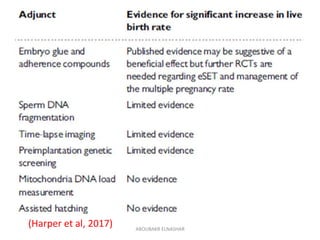
(Harper et al, 2017) ABOUBAKR ELNASHAR

Adjuncts in IVF laboratory: Current evidence

  • 1.
    Adjuncts in the IVFlaboratory: Current evidence Prof. Aboubakr Elnashar Benha university Hospital, Egypt ABOUBAKR ELNASHAR
  • 2.
    CONTENTS 1.Sperm DNA fragmentation 2.Advancedsperm selection techniques 1.IMSI 2.pICSI 3.Advanced embryo selection techniques 1.TL 2.PGS 3.Mitochondrial DNA load measurement 4.Pro implantation techniques 1.AH 2.Embryo Glue and adherece compounds ABOUBAKR ELNASHAR
  • 3.
    1. SPERM DNAFRAGMENTATION Many clinics offer all their patients SDF test The assays include 1. TUNEL 2. Comet 3. SCD assay 4. SCSA and 5. 8-OHdG test (Shamsi et al., 2011).  Differences between assays Type of DNA damage being measured Sensitivity (Smith et al., 2013). No particular assay has greater diagnostic value than any other. ABOUBAKR ELNASHAR
  • 4.
    Purpose of suchan assay  To indicate which treatments may be contraindicated for, or beneficial to, patients.  For example, the purpose of the assay is to determine whether antioxidant therapy is appropriate for the male: measurement of 8-OHdG (Muratori et al., 2015). **8hydroxy2'deoxy guanosine (8OHdG) marker of Oxidative DNA damage in the asthenozoospermic men higher than normozoospermic ABOUBAKR ELNASHAR
  • 5.
    Evidence: 1. Osman etal. (2015) Men with low SDF had a higher LBR than those with high SDF Evidence was not sufficient to support this when ICSI was used. 2. Simon et al. (2016) modest but statistically significant association of SDF with CPR following IVF and/or ICSI. data varied depending on the assay used. 3. Cissen et al. (2016) current tests have limited capacity to predict either the chance of conception after ART or which treatment method to choose insufficient evidence to recommend SDF testingABOUBAKR ELNASHAR
  • 6.
    4. ASRM, Pfeiferet al., 2014. Methods for assessing SDF do not reliably predict treatment outcomes Cannot be recommended routinely for clinical use 5. Cochrane SR, Showell et al., 2014. low-quality evidence suggests that antioxidant therapy in the male might increase CPR and LBR in patients, where the spermatozoa are suffering from oxidative stress accurate assessment of 8-OHdG levels could be of value in selecting a valid patient population. ABOUBAKR ELNASHAR
  • 7.
    2. ADVANCED SPERMSELECTION TECHNIQUES Standard semen analysis a crude assessment of male reproductive potential does not evaluate the functional capacity of sperm Advanced sperm selection methods to improve fertilisation rates, even when ICSI is performed. Fertilisation of oocytes by sperms of high DNA integrity or genetic competence: improve embryo quality and pregnancy outcomes. ABOUBAKR ELNASHAR
  • 8.
    Advanced sperm selectiontechniques 1. Intracytoplasmic morphologically selected sperm injection (IMSI) 2. Physiological intracytoplasmic sperm injection (pICSI) 3. Sperm surface charge selection 4. Non-apoptotic sperm selection 5. Sperm birefringence 6. Hyaluronic acid binding. Of these, only IMSI pICSI have been assessed through RCTs. ABOUBAKR ELNASHAR
  • 9.
    1. IMSI Evidence: Cochrane reviews: (Teixeiraet al., 2013; McDowell et al., 2014). failed to find any improvement in CPRs when these methods are compared with standard ICSI ABOUBAKR ELNASHAR
  • 10.
    2. pICSI  Worrilowet al., 2013 12% rise in CPRs which is clinically significant Significant reduction of pregnancy loss Evidence still in the formative stage limited experience no serious additional risk It may be sensible to recommend pICSI in indicated cases and after careful counselling. ABOUBAKR ELNASHAR
  • 11.
    Does the selectionof sperm for ICSI based on their ability to bind to hyaluronan improve CPR,IR and (pregnancy loss rate) PLR (Worrilow et al., 2013) In couples where ≤ 65% of sperm bound hyaluronan, the selection of hyaluronan-bound (HB) sperm for ICSI led to a statistically significant reduction in PLR. HB sperm demonstrate enhanced developmental parameters which have been associated with successful fertilization and embryogenesis. Sperm selected for ICSI using a liquid source of hyaluronan achieved an improvement in IR. ABOUBAKR ELNASHAR
  • 12.
    3. ADVANCED EMBRYOSELECTION TECHNIQUES Conventional morphological selection of embryos limited value in predicting the developmental competency of embryos (Alpha Scientists in Reproductive and Embryology, 2011) affected by the timing of the assessment observer dependent (Arce et al., 2006). Apparently embryos with good morphology may not necessarily be genetically competent and vice versa (Alfarawati et al., 2011). A more dynamic assessment of embryos and selection of euploid embryos: transferring the most competent embryo to maximise IVF success. ABOUBAKR ELNASHAR
  • 13.
    1. Time-lapse imaging Takingpictures over time and reviewing them as a film Human embryos were filmed using TL technology during their first 3 days of development (Eriksson et al. 1981). TL imaging describe the first events during fertilization: providing insight into how diverse and dynamic early embryonic development can be. (Payne et al., 1997) The latest prediction model still requires extensive prospective testing and validation. (Petersen et al., 2016) ABOUBAKR ELNASHAR
  • 14.
    Proposed benefits ‘not missingimportant events during culture quality control teaching applications more information to the patient of course, an increase in LBR. ABOUBAKR ELNASHAR
  • 15.
    Evidence: 1. Rubio etal. (2014) 9.7% increase in CPR compared to traditional culture and morphology assessments alone. 2. Cochrane review, Armstrong et al., 2015 insufficient evidence of differences in live birth, miscarriage, stillbirth or clinical pregnancy to choose between [TL imaging] and conventional incubation ABOUBAKR ELNASHAR
  • 16.
    TL imaging  servesso many other functions in the laboratory that its introduction will not be held back. It may be unthinkable in 5–10 years to still only be observing embryos by manually taking them out and looking at them. a tool which confers a number of practical benefits to the IVF laboratory. The future challenge to find the best role in the IVF laboratory and to reduce implementation and consumable costs. (Armstrong et al., 2014). ABOUBAKR ELNASHAR
  • 17.
    2. Preimplantation geneticscreening In the 1990s: Several studies demonstrated that cleavage stage embryos showed a high level of aneuploidy (Coonen et al., 1994; Munné et al., 1995) selection against these aneuploid embryos would improve LBRs. It was surprising that not only were meiotic abnormalities originating in the oocyte found, but also abnormalities occurring postzygotically. As a consequence, many embryos were mosaics, containing both normal and aneuploid cells, or several different lines of aneuploid cells. ABOUBAKR ELNASHAR
  • 18.
    PGS at day3 bybiopsying one cell at Day 3 performing FISH for five chromosomes. Evidence: 11 RCTs PGS was shown not to increase CPR or LBR in some cases, to decrease LBR (Harper et al., 2010; Geraedts and Sermon, 2016). PGS at Day 3 was not effective because 1. limited accuracy of FISH 2. limited number of cells available for biopsy 3. at Day 3, cleavage stage embryos are at a peak of chromosomal abnormality/mosaicism. ABOUBAKR ELNASHAR
  • 19.
    Comprehensive chromosome screeningof Day 5 biopsied trophectoderm cells PGS is now actively marketed as increasing implantation rates: decreasing time to pregnancy recurrent miscarriages repeated implantation failure (Sermon et al., 2016). ABOUBAKR ELNASHAR
  • 20.
    Evidence: 3 RCT 1.Yang et al. (2012) included a small sample size of 45 young good prognosis patients. 2. Scott et al. (2013) 72 good prognosis patients between the ages of 21 and 42 y Randomized quite late, i.e. if they had at least 2 blastocysts available for analysis.  PGS increased implantation and delivery rates fundamental methodological flaw in the study’s failure to account for the difference between the unit of randomization (patients) and unit of analysis (individual embryos). ABOUBAKR ELNASHAR
  • 21.
    3. Forman etal., 2013 89 patients compare PGS and SET with the transfer of two embryos The same methodological problem encountered by the Scott trial The wide confidence interval for pregnancy did not demonstrate a beneficial effect. ABOUBAKR ELNASHAR
  • 22.
    Currently 2 larger RCTsare underway and the results are expected soon. The ESTEEM study  patients of advanced maternal age analyses of polar bodies using array-CGH STAR study  recruits all IVF patients next generation sequencing on blastocyst biopsies. Although these studies may serve to provide stronger evidence supporting PGS, the current RCTs do not provide sufficiently robust evidence to consider PGS as a proven and beneficial treatment. ABOUBAKR ELNASHAR
  • 23.
    3. Mitochondrial DNAload measurement Rationale: Metaphase II oocytes contain ~105 mitochondrial DNA (mtDNA) copies since no replication of the mtDNA occurs until the blastocyst stage of embryonic development, the mtDNA molecules are divided over the cleaving cells (Fragouli and Wells, 2015). An association between higher mtDNA level and lower implantation potential in blastocysts (Diez-Juan et al., 2015; Fragouli et al., 2015) pointing to disturbed energy provision and metabolic stress in embryos with a higher mtDNA content. ABOUBAKR ELNASHAR
  • 24.
    Relationship between aneuploidyof the blastocyst and a higher mtDNA load. euploid embryos that implanted after transfer had a mtDNA load below a data-derived threshold: embryos that failed to implant, or that were aneuploid, showed a wide range of mtDNA load. This range overlapped with the implanting embryos at the low end, but the level of mtDNA at the high end was much higher in the non-implanting embryos. A threshold embryonic mtDNA load above which all embryos failed to implant could therefore be identified. ABOUBAKR ELNASHAR
  • 25.
    Diez-Juan et al. 52%of the embryos below the identified threshold implanted compared to an implantation rate across the whole study population of 47% Fragouli et al these figures were 59% versus 38% respectively.  MitoScore marketed by the group of Diez and is currently tested in RCT MitogradeTM marketed by Reprogenetics and is being tested in RCT ABOUBAKR ELNASHAR
  • 26.
    Evidence: Currently, there isno evidence that selection through mtDNA load measurement increases LBR. Application of the technique should therefore strictly be limited to participation in either one of RCTs, and this should clearly communicated to the patient. ABOUBAKR ELNASHAR
  • 27.
    4. PRO-IMPLANTATION PROCEDURES 1.Embryo glue and adherence compounds Fibrin sealants to reduce ectopic pregnancy rate and increase LBRs (Feichtinger et al., 1990, 1992) Never demonstrated reliable significant improvement in clinical outcomes ABOUBAKR ELNASHAR
  • 28.
    ET medium enrichedwith the glycoprotein hyaluronan (HA). HA is naturally present in the female reproductive tract and endometrium forms a viscous solution enhance the ET process and prohibit embryo expulsion (Bontekoe et al., 2014). ABOUBAKR ELNASHAR
  • 29.
    Evidence: 1. Cochrane SR,Bontekoe et al., 2014 moderate quality evidence for an improvement in CPR and LBR increase in multiple pregnancy rate 2. Fancsovits et al., 2015 not show a benefit in implantation rate, CPR or LBR, but found a higher birthweight Before robust conclusions can be drawn, however, further RCTs are needed to evaluate the efficacy of HA as an adherence compound during ET with respect to eSET and the possibility of reducing the multiple pregnancy rate. ABOUBAKR ELNASHAR
  • 30.
    2. Assisted hatching Cohenet al. (1990) making a breach in the zona pellucida may help implantation in some patients. AH usually performed on Day 3, 5 or 6 of embryo development using a non-contact laser, but mechanical or acidic solutions have also been used (Balaban et al., 2002). ABOUBAKR ELNASHAR
  • 31.
    Clinics use AHfor patients of 1. advanced maternal age 2. Smokers 3. patients with a raised FSH 4. when transferring embryos that have been cryopreserved. ABOUBAKR ELNASHAR
  • 32.
    Evidence: 3 meta-analyses significant increasein CPR no evidence for a difference in LBR. 1. Martins et al. (2011) significant difference in CPR using frozen thawed embryos in unselected women patients with repeated IVF failure no evidence of benefit for subgroups of either older women or those with a good prognosis. ABOUBAKR ELNASHAR
  • 33.
    2. Cochrane reviewby Carney et al. (2012) no evidence of difference between the LBR in the AH and control groups. 3. Li et al. (2016) significant increase in CPR and multiple pregnancy rate LBR, there was no evidence of difference between the AH and control groups. NICE guidelines (2013) AH is not recommended because it has not been shown to improve pregnancy rates ABOUBAKR ELNASHAR
  • 34.
    CONCLUSION IVF clinicians andscientists must recognize that appropriately powered, well-designed, peer-reviewed RCTs, with a LBR outcome measure which goes on to report on child health, are the gold standard of EBM Those advocating and recommending unproven procedures to their patients must fully inform the patient of the evidence for its safety effectiveness Orally in writing to ensure that people considering treatment using adjunct therapies are in a position to make an informed decision.ABOUBAKR ELNASHAR
  • 35.
    It is alsoimportant that all procedures performed, including the adjunct treatments, are well-documented and followed up. Regulators and professional bodies also have a role to play in ensuring that only suitable practices are used in the clinic ABOUBAKR ELNASHAR
  • 36.
    (Harper et al,2017) ABOUBAKR ELNASHAR