Artificial Intelligence
(AI) Tutorial
A complete introduction
to AI concepts, types,
applications, and future
trends.
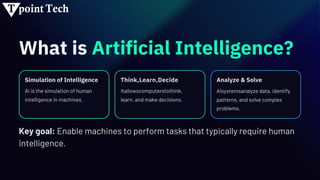
What is Artificial Intelligence?
Simulation of Intelligence Think,Learn,Decide Analyze & Solve
AI is the simulation of human
intelligence in machines.
Itallowscomputerstothink,
learn, and make decisions.
AIsystemsanalyze data, identify
patterns, and solve complex
problems.
Key goal: Enable machines to perform tasks that typically require human
intelligence.
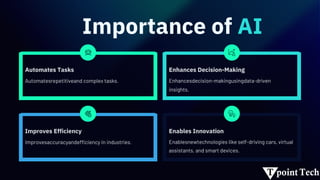
Importance of AI
Automates Tasks
Improves Efficiency Enables Innovation
Enhances Decision-Making
Automatesrepetitiveand complex tasks.
Improvesaccuracyandefficiency in industries.
Enhancesdecision-makingusingdata-driven
insights.
Enablesnewtechnologies like self-driving cars, virtual
assistants, and smart devices.
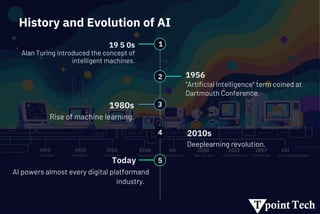
History and Evolution of AI
1
2
3
4
5
Today
1980s
Rise of machine learning.
19 5 0s
Alan Turing introduced the concept of
intelligent machines.
1956
"Artificial Intelligence" term coined at
Dartmouth Conference.
2010s
AI powers almost every digital platformand
industry.
Deeplearning revolution.
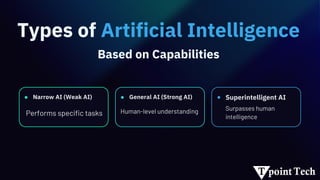
Types of Artificial Intelligence
Based on Capabilities
Narrow AI (Weak AI) General AI (Strong AI) Superintelligent AI
Performs specific tasks Human-level understanding Surpasses human
intelligence
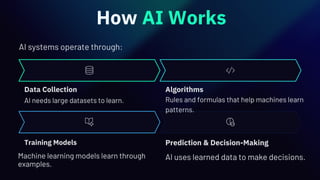
How AI Works
AI systems operate through:
Data Collection
Training Models
Algorithms
Prediction & Decision-Making
AI needs large datasets to learn.
Machine learning models learn through
examples.
AI uses learned data to make decisions.
Rules and formulas that help machines learn
patterns.
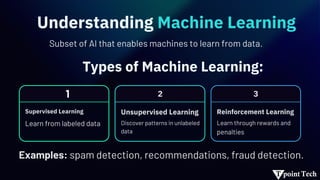
Understanding Machine Learning
Subset of AI that enables machines to learn from data.
Types of Machine Learning:
2 3
Supervised Learning Unsupervised Learning Reinforcement Learning
Learn from labeled data Discover patterns in unlabeled
data
Examples: spam detection, recommendations, fraud detection.
Learn through rewards and
penalties
1
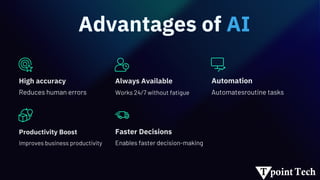
Advantages of AI
High accuracy
Productivity Boost Faster Decisions
Always Available Automation
Reduces human errors
Improves business productivity
Works 24/7 without fatigue
Enables faster decision-making
Automatesroutine tasks
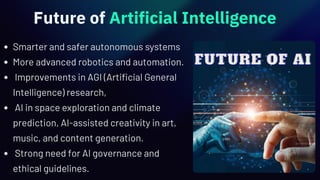
Future of Artificial Intelligence
Smarter and safer autonomous systems
More advanced robotics and automation.
Improvements in AGI (Artificial General
Intelligence) research,
AI in space exploration and climate
prediction, AI-assisted creativity in art,
music, and content generation.
Strong need for AI governance and
ethical guidelines.
Conclusion
Transforming Industries Essential Knowledge Intelligent Future
With responsible development, AI
can create a more efficient and
intelligent world.
AI is transforming every industry. UnderstandingAIconcepts is
essential for future careers.

Artificial Intelligence (AI) Tutorial.pdf

  • 1.
    Artificial Intelligence (AI) Tutorial Acomplete introduction to AI concepts, types, applications, and future trends.
  • 2.
    What is ArtificialIntelligence? Simulation of Intelligence Think,Learn,Decide Analyze & Solve AI is the simulation of human intelligence in machines. Itallowscomputerstothink, learn, and make decisions. AIsystemsanalyze data, identify patterns, and solve complex problems. Key goal: Enable machines to perform tasks that typically require human intelligence.
  • 3.
    Importance of AI AutomatesTasks Improves Efficiency Enables Innovation Enhances Decision-Making Automatesrepetitiveand complex tasks. Improvesaccuracyandefficiency in industries. Enhancesdecision-makingusingdata-driven insights. Enablesnewtechnologies like self-driving cars, virtual assistants, and smart devices.
  • 4.
    History and Evolutionof AI 1 2 3 4 5 Today 1980s Rise of machine learning. 19 5 0s Alan Turing introduced the concept of intelligent machines. 1956 "Artificial Intelligence" term coined at Dartmouth Conference. 2010s AI powers almost every digital platformand industry. Deeplearning revolution.
  • 5.
    Types of ArtificialIntelligence Based on Capabilities Narrow AI (Weak AI) General AI (Strong AI) Superintelligent AI Performs specific tasks Human-level understanding Surpasses human intelligence
  • 6.
    How AI Works AIsystems operate through: Data Collection Training Models Algorithms Prediction & Decision-Making AI needs large datasets to learn. Machine learning models learn through examples. AI uses learned data to make decisions. Rules and formulas that help machines learn patterns.
  • 7.
    Understanding Machine Learning Subsetof AI that enables machines to learn from data. Types of Machine Learning: 2 3 Supervised Learning Unsupervised Learning Reinforcement Learning Learn from labeled data Discover patterns in unlabeled data Examples: spam detection, recommendations, fraud detection. Learn through rewards and penalties 1
  • 8.
    Advantages of AI Highaccuracy Productivity Boost Faster Decisions Always Available Automation Reduces human errors Improves business productivity Works 24/7 without fatigue Enables faster decision-making Automatesroutine tasks
  • 9.
    Future of ArtificialIntelligence Smarter and safer autonomous systems More advanced robotics and automation. Improvements in AGI (Artificial General Intelligence) research, AI in space exploration and climate prediction, AI-assisted creativity in art, music, and content generation. Strong need for AI governance and ethical guidelines.
  • 10.
    Conclusion Transforming Industries EssentialKnowledge Intelligent Future With responsible development, AI can create a more efficient and intelligent world. AI is transforming every industry. UnderstandingAIconcepts is essential for future careers.