Learn C Programming
Language
The C programming language is a powerful and high-level language renowned for its
efficiency and versatility. It forms the foundation for many modern programming
languages and is extensively utilized in system programming, embedded systems, and
application development. Mastering C can provide a solid base for understanding
advanced programming concepts.
Contact Information
📍 G-13, 2nd Floor, Sector-3, Noida, Uttar Pradesh, 201301, India
📧 Email: hr@tpointtech.com
📞 Phone: +91-9599086977
Introduction to C Programming Language
C is well-known for its performance and close interaction with hardware, making it an excellent choice for system programming. It has also
influenced many modern programming languages.
1
What is C?
C is a general-purpose programming
language created in the early 1970s.
History
Developed by Dennis Ritchie at Bell Labs,
C evolved from the B language.
2
Features of C
C offers low-level memory access and a
rich set of operators.
3
Setting Up Environment
Installing a Compiler
You need a C compiler like GCC, Clang,
or Microsoft Visual C++. Install it
following documentation instructions.
1
2
3
Code Editors and IDEs
Use Visual Studio Code, Code::Blocks, or
Eclipse for enhanced coding features.
Writing Your First Program
Start with a simple 'Hello, World!' program
to understand C syntax and compilation.
Basic Syntax and Data Types
C Syntax Rules
C syntax consists of various elements like
keywords, identifiers, and operators.
Keywords are reserved words that have
special meaning in C, while identifiers are
names given to variables and functions.
Data Types
C has several basic data types, such as int,
float, char, and double. Choosing the right
data type is crucial as it determines the
type of value a variable can hold and
memory allocation.
Variables and Constants
Understand how to declare and initialize
variables, as well as the concept of
constants which are fixed values that
cannot be changed once defined in the
program.
Control Structures
Conditional Statements
C provides control structures like if, else, and switch statements for decision-making.
Looping Mechanisms
Use loops like for, while, and do-while for repetitive tasks, simplifying the code.
Break and Continue
Break exits a loop immediately, while continue skips to the next iteration, controlling
loop execution.
Understanding Functions in Programming
Defining Functions
Functions are blocks of code that
perform specific tasks. Learn to define
functions, pass parameters, and
return values, enhancing modularity.
1
2
3
Standard Library Functions
C has a rich collection of standard library
functions for mathematics, string
manipulation, and input/output
operations.
Scope and Lifetime
Understand local and global variables and
their impact on program execution for
effective data management.
Pointers and Memory Management
Understanding Pointers
Pointers are variables that store memory addresses.
Dynamic Memory Allocation
Use functions like malloc(), calloc(), and free() to manage memory dynamically.
Pointer Arithmetic
Learn how to perform arithmetic operations on pointers.
File Handling in C
File handling in C is essential for creating applications that require persistent data storage. This involves various operations like opening, reading,
writing, and closing files, utilizing file pointers efficiently, and implementing error handling to ensure smooth operations.
File Operations
C allows you to work with files through
standard library functions.
File Pointers
Understand the use of file pointers for
accessing files.
Error Handling
Implement error checking to ensure
successful file operations.
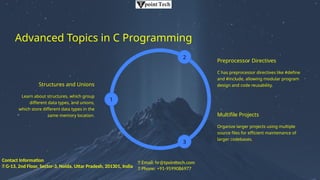
Advanced Topics in C Programming
Structures and Unions
Learn about structures, which group
different data types, and unions,
which store different data types in the
same memory location.
1
2
Preprocessor Directives
C has preprocessor directives like #define
and #include, allowing modular program
design and code reusability.
3
Multifile Projects
Organize larger projects using multiple
source files for efficient maintenance of
larger codebases.
📧 Email: hr@tpointtech.com
📞 Phone: +91-9599086977
Contact Information
📍 G-13, 2nd Floor, Sector-3, Noida, Uttar Pradesh, 201301, India

Learn C Programming Language. pptx

  • 1.
    Learn C Programming Language TheC programming language is a powerful and high-level language renowned for its efficiency and versatility. It forms the foundation for many modern programming languages and is extensively utilized in system programming, embedded systems, and application development. Mastering C can provide a solid base for understanding advanced programming concepts. Contact Information 📍 G-13, 2nd Floor, Sector-3, Noida, Uttar Pradesh, 201301, India 📧 Email: hr@tpointtech.com 📞 Phone: +91-9599086977
  • 2.
    Introduction to CProgramming Language C is well-known for its performance and close interaction with hardware, making it an excellent choice for system programming. It has also influenced many modern programming languages. 1 What is C? C is a general-purpose programming language created in the early 1970s. History Developed by Dennis Ritchie at Bell Labs, C evolved from the B language. 2 Features of C C offers low-level memory access and a rich set of operators. 3
  • 3.
    Setting Up Environment Installinga Compiler You need a C compiler like GCC, Clang, or Microsoft Visual C++. Install it following documentation instructions. 1 2 3 Code Editors and IDEs Use Visual Studio Code, Code::Blocks, or Eclipse for enhanced coding features. Writing Your First Program Start with a simple 'Hello, World!' program to understand C syntax and compilation.
  • 4.
    Basic Syntax andData Types C Syntax Rules C syntax consists of various elements like keywords, identifiers, and operators. Keywords are reserved words that have special meaning in C, while identifiers are names given to variables and functions. Data Types C has several basic data types, such as int, float, char, and double. Choosing the right data type is crucial as it determines the type of value a variable can hold and memory allocation. Variables and Constants Understand how to declare and initialize variables, as well as the concept of constants which are fixed values that cannot be changed once defined in the program.
  • 5.
    Control Structures Conditional Statements Cprovides control structures like if, else, and switch statements for decision-making. Looping Mechanisms Use loops like for, while, and do-while for repetitive tasks, simplifying the code. Break and Continue Break exits a loop immediately, while continue skips to the next iteration, controlling loop execution.
  • 6.
    Understanding Functions inProgramming Defining Functions Functions are blocks of code that perform specific tasks. Learn to define functions, pass parameters, and return values, enhancing modularity. 1 2 3 Standard Library Functions C has a rich collection of standard library functions for mathematics, string manipulation, and input/output operations. Scope and Lifetime Understand local and global variables and their impact on program execution for effective data management.
  • 7.
    Pointers and MemoryManagement Understanding Pointers Pointers are variables that store memory addresses. Dynamic Memory Allocation Use functions like malloc(), calloc(), and free() to manage memory dynamically. Pointer Arithmetic Learn how to perform arithmetic operations on pointers.
  • 8.
    File Handling inC File handling in C is essential for creating applications that require persistent data storage. This involves various operations like opening, reading, writing, and closing files, utilizing file pointers efficiently, and implementing error handling to ensure smooth operations. File Operations C allows you to work with files through standard library functions. File Pointers Understand the use of file pointers for accessing files. Error Handling Implement error checking to ensure successful file operations.
  • 9.
    Advanced Topics inC Programming Structures and Unions Learn about structures, which group different data types, and unions, which store different data types in the same memory location. 1 2 Preprocessor Directives C has preprocessor directives like #define and #include, allowing modular program design and code reusability. 3 Multifile Projects Organize larger projects using multiple source files for efficient maintenance of larger codebases. 📧 Email: hr@tpointtech.com 📞 Phone: +91-9599086977 Contact Information 📍 G-13, 2nd Floor, Sector-3, Noida, Uttar Pradesh, 201301, India