Introduction to
Artificial Intelligence
Artificial intelligence (AI) is the simulation of human intelligence
processes by computers. AI systems are designed to perform
tasks that typically require human intelligence, such as learning,
problem-solving, and decision-making.
Mr.S.ANGURAJA
Defining AI: What is it?
Machine Learning
AI systems learn from data,
improving their performance over
time without explicit
programming. Examples include
image recognition, natural
language processing, and
predictive analytics.
Deep Learning
A subset of machine learning that
uses artificial neural networks with
multiple layers to process complex
data, enabling AI systems to
perform tasks like object
detection, speech recognition, and
machine translation.
Cognitive Computing
AI systems designed to mimic human cognitive abilities, such as reasoning,
problem-solving, and decision-making. Cognitive computing systems are
used in fields such as healthcare, finance, and customer service.
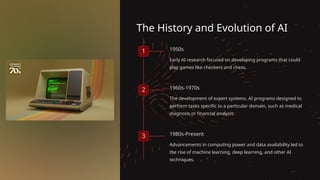
The History and Evolution of AI
1 1950s
Early AI research focused on developing programs that could
play games like checkers and chess.
2 1960s-1970s
The development of expert systems, AI programs designed to
perform tasks specific to a particular domain, such as medical
diagnosis or financial analysis.
3 1980s-Present
Advancements in computing power and data availability led to
the rise of machine learning, deep learning, and other AI
techniques.
AI Techniques and Algorithms
Supervised Learning
AI systems learn from labeled
data, where the input and output
are known. Examples include
classification and regression
algorithms.
Unsupervised Learning
AI systems learn from unlabeled
data, identifying patterns and
structures within the data.
Examples include clustering and
dimensionality reduction
algorithms.
Reinforcement Learning
AI systems learn through trial and
error, receiving rewards for
correct actions and penalties for
incorrect actions. Examples
include game playing and robotics
applications.
Applications of AI
1 Healthcare
AI is used for disease
diagnosis, drug
discovery, and
personalized treatment
plans.
2 Finance
AI is used for fraud
detection, risk
assessment, and
investment
management.
3 Transportation
AI is used for self-
driving cars, traffic
optimization, and
logistics management.
4 Manufacturing
AI is used for predictive
maintenance, quality
control, and production
optimization.
Challenges and Limitations of AI
Data Bias
AI systems can inherit biases from the data they are trained on,
leading to unfair or discriminatory outcomes.
Lack of Transparency
The decision-making processes of AI systems can be opaque,
making it difficult to understand how they reach their
conclusions.
Ethical Concerns
AI systems raise ethical questions about privacy, accountability,
and the potential displacement of human jobs.
The Future of AI
Increased Automation AI will continue to automate tasks across industries,
leading to greater efficiency and productivity.
Personalized Experiences AI will personalize products, services, and experiences,
tailoring them to individual preferences and needs.
Advancements in Healthcare AI will revolutionize healthcare, enabling earlier disease
detection, more effective treatments, and personalized
medicine.
Ethical Considerations in AI
Fairness and Bias
Ensuring AI systems are fair
and unbiased, addressing
potential discrimination and
inequality.
Data Privacy and Security
Protecting user data and
ensuring responsible data
collection and usage.
Transparency and
Explainability
Making AI systems more
transparent and
understandable, allowing
users to understand how
decisions are made.
Accountability and
Responsibility
Establishing clear lines of
accountability for the actions
and decisions of AI systems.

Introduction-to-Artificial-Intelligence.pptx

  • 1.
    Introduction to Artificial Intelligence Artificialintelligence (AI) is the simulation of human intelligence processes by computers. AI systems are designed to perform tasks that typically require human intelligence, such as learning, problem-solving, and decision-making. Mr.S.ANGURAJA
  • 2.
    Defining AI: Whatis it? Machine Learning AI systems learn from data, improving their performance over time without explicit programming. Examples include image recognition, natural language processing, and predictive analytics. Deep Learning A subset of machine learning that uses artificial neural networks with multiple layers to process complex data, enabling AI systems to perform tasks like object detection, speech recognition, and machine translation. Cognitive Computing AI systems designed to mimic human cognitive abilities, such as reasoning, problem-solving, and decision-making. Cognitive computing systems are used in fields such as healthcare, finance, and customer service.
  • 3.
    The History andEvolution of AI 1 1950s Early AI research focused on developing programs that could play games like checkers and chess. 2 1960s-1970s The development of expert systems, AI programs designed to perform tasks specific to a particular domain, such as medical diagnosis or financial analysis. 3 1980s-Present Advancements in computing power and data availability led to the rise of machine learning, deep learning, and other AI techniques.
  • 4.
    AI Techniques andAlgorithms Supervised Learning AI systems learn from labeled data, where the input and output are known. Examples include classification and regression algorithms. Unsupervised Learning AI systems learn from unlabeled data, identifying patterns and structures within the data. Examples include clustering and dimensionality reduction algorithms. Reinforcement Learning AI systems learn through trial and error, receiving rewards for correct actions and penalties for incorrect actions. Examples include game playing and robotics applications.
  • 5.
    Applications of AI 1Healthcare AI is used for disease diagnosis, drug discovery, and personalized treatment plans. 2 Finance AI is used for fraud detection, risk assessment, and investment management. 3 Transportation AI is used for self- driving cars, traffic optimization, and logistics management. 4 Manufacturing AI is used for predictive maintenance, quality control, and production optimization.
  • 6.
    Challenges and Limitationsof AI Data Bias AI systems can inherit biases from the data they are trained on, leading to unfair or discriminatory outcomes. Lack of Transparency The decision-making processes of AI systems can be opaque, making it difficult to understand how they reach their conclusions. Ethical Concerns AI systems raise ethical questions about privacy, accountability, and the potential displacement of human jobs.
  • 7.
    The Future ofAI Increased Automation AI will continue to automate tasks across industries, leading to greater efficiency and productivity. Personalized Experiences AI will personalize products, services, and experiences, tailoring them to individual preferences and needs. Advancements in Healthcare AI will revolutionize healthcare, enabling earlier disease detection, more effective treatments, and personalized medicine.
  • 8.
    Ethical Considerations inAI Fairness and Bias Ensuring AI systems are fair and unbiased, addressing potential discrimination and inequality. Data Privacy and Security Protecting user data and ensuring responsible data collection and usage. Transparency and Explainability Making AI systems more transparent and understandable, allowing users to understand how decisions are made. Accountability and Responsibility Establishing clear lines of accountability for the actions and decisions of AI systems.