What is ArtificialIntelligence?
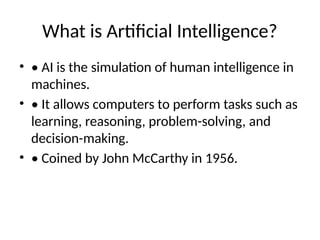
• • AI is the simulation of human intelligence in
machines.
• • It allows computers to perform tasks such as
learning, reasoning, problem-solving, and
decision-making.
• • Coined by John McCarthy in 1956.
3.
Types of AI
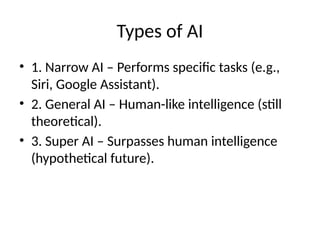
•1. Narrow AI – Performs specific tasks (e.g.,
Siri, Google Assistant).
• 2. General AI – Human-like intelligence (still
theoretical).
• 3. Super AI – Surpasses human intelligence
(hypothetical future).
4.
Branches of AI
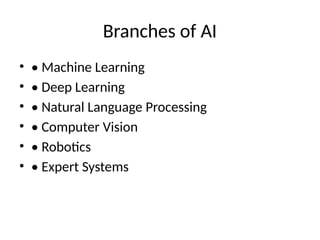
•• Machine Learning
• • Deep Learning
• • Natural Language Processing
• • Computer Vision
• • Robotics
• • Expert Systems
5.
Applications of AI
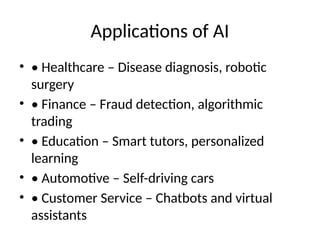
•• Healthcare – Disease diagnosis, robotic
surgery
• • Finance – Fraud detection, algorithmic
trading
• • Education – Smart tutors, personalized
learning
• • Automotive – Self-driving cars
• • Customer Service – Chatbots and virtual
assistants
6.
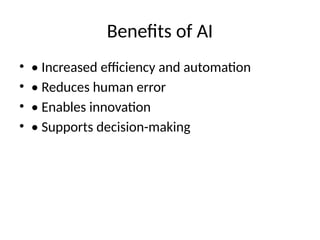
Benefits of AI
•• Increased efficiency and automation
• • Reduces human error
• • Enables innovation
• • Supports decision-making
7.
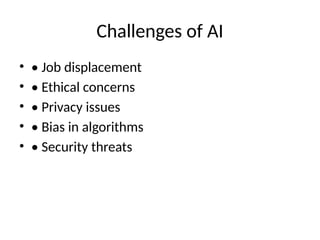
Challenges of AI
•• Job displacement
• • Ethical concerns
• • Privacy issues
• • Bias in algorithms
• • Security threats
8.
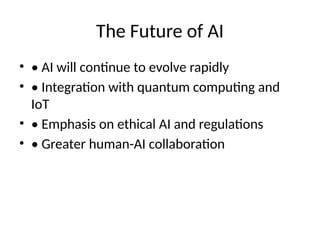
The Future ofAI
• • AI will continue to evolve rapidly
• • Integration with quantum computing and
IoT
• • Emphasis on ethical AI and regulations
• • Greater human-AI collaboration
9.
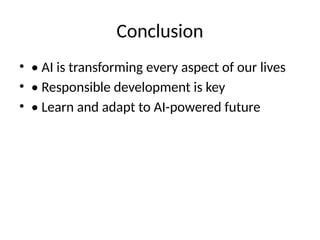
Conclusion
• • AIis transforming every aspect of our lives
• • Responsible development is key
• • Learn and adapt to AI-powered future
![Introduction to Artificial
Intelligence
• Understanding the Future of Intelligent
Machines
• Presented by: [Your Name]
• Date: [Date]](https://image.slidesharecdn.com/artificialintelligencepresentation-250407174306-6dc93236/85/Artificial_Intelligence_Presentation-pptx-1-320.jpg)
![Introduction to Artificial
Intelligence
• Understanding the Future of Intelligent
Machines
• Presented by: [Your Name]
• Date: [Date]](https://image.slidesharecdn.com/artificialintelligencepresentation-250407174306-6dc93236/75/Artificial_Intelligence_Presentation-pptx-1-2048.jpg)