
Artificial Intelligence (AI) in
Entertainment
DR. A. PRABAHARAN
PROFESSOR & RESEARCH DIRECTOR
PUBLIC ACTION
www.indopraba.blogspot.com
1
AI in Entertainment
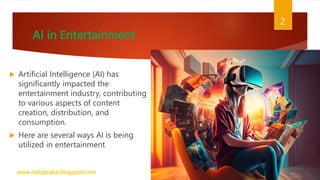
 Artificial Intelligence (AI) has
significantly impacted the
entertainment industry, contributing
to various aspects of content
creation, distribution, and
consumption.
 Here are several ways AI is being
utilized in entertainment
www.indopraba.blogspot.com
2
Content Creation
www.indopraba.blogspot.com
3
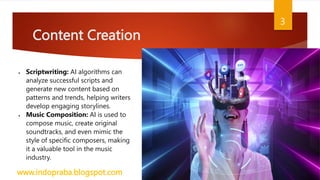
 Scriptwriting: AI algorithms can
analyze successful scripts and
generate new content based on
patterns and trends, helping writers
develop engaging storylines.
 Music Composition: AI is used to
compose music, create original
soundtracks, and even mimic the
style of specific composers, making
it a valuable tool in the music
industry.
Film and Video Production:
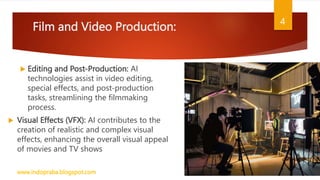
 Editing and Post-Production: AI
technologies assist in video editing,
special effects, and post-production
tasks, streamlining the filmmaking
process.
 Visual Effects (VFX): AI contributes to the
creation of realistic and complex visual
effects, enhancing the overall visual appeal
of movies and TV shows
www.indopraba.blogspot.com
4
Personalized Content Recommendations
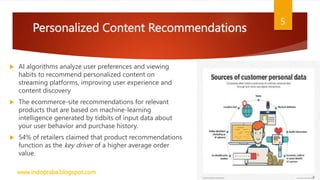
 AI algorithms analyze user preferences and viewing
habits to recommend personalized content on
streaming platforms, improving user experience and
content discovery
 The ecommerce-site recommendations for relevant
products that are based on machine-learning
intelligence generated by tidbits of input data about
your user behavior and purchase history.
 54% of retailers claimed that product recommendations
function as the key driver of a higher average order
value.
www.indopraba.blogspot.com
5
Gaming
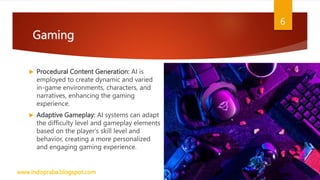
 Procedural Content Generation: AI is
employed to create dynamic and varied
in-game environments, characters, and
narratives, enhancing the gaming
experience.
 Adaptive Gameplay: AI systems can adapt
the difficulty level and gameplay elements
based on the player's skill level and
behavior, creating a more personalized
and engaging gaming experience.
www.indopraba.blogspot.com
6
Virtual and Augmented Reality (VR/AR)
www.indopraba.blogspot.com
7
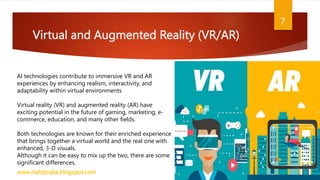
AI technologies contribute to immersive VR and AR
experiences by enhancing realism, interactivity, and
adaptability within virtual environments
Virtual reality (VR) and augmented reality (AR) have
exciting potential in the future of gaming, marketing, e-
commerce, education, and many other fields.
Both technologies are known for their enriched experience
that brings together a virtual world and the real one with
enhanced, 3-D visuals.
Although it can be easy to mix up the two, there are some
significant differences.
Voice and Speech Recognition
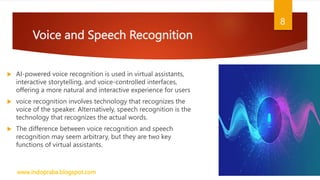
 AI-powered voice recognition is used in virtual assistants,
interactive storytelling, and voice-controlled interfaces,
offering a more natural and interactive experience for users
 voice recognition involves technology that recognizes the
voice of the speaker. Alternatively, speech recognition is the
technology that recognizes the actual words.
 The difference between voice recognition and speech
recognition may seem arbitrary, but they are two key
functions of virtual assistants.
www.indopraba.blogspot.com
8
Live Performances
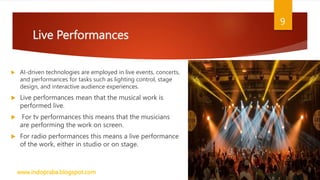
 AI-driven technologies are employed in live events, concerts,
and performances for tasks such as lighting control, stage
design, and interactive audience experiences.
 Live performances mean that the musical work is
performed live.
 For tv performances this means that the musicians
are performing the work on screen.
 For radio performances this means a live performance
of the work, either in studio or on stage.
www.indopraba.blogspot.com
9
Content Moderation
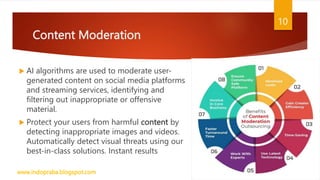
 AI algorithms are used to moderate user-
generated content on social media platforms
and streaming services, identifying and
filtering out inappropriate or offensive
material.
 Protect your users from harmful content by
detecting inappropriate images and videos.
Automatically detect visual threats using our
best-in-class solutions. Instant results
www.indopraba.blogspot.com
10
Marketing and Audience Engagement
 AI is utilized for data analysis to understand audience
behavior, preferences, and trends, helping
entertainment companies tailor their marketing
strategies for maximum impact
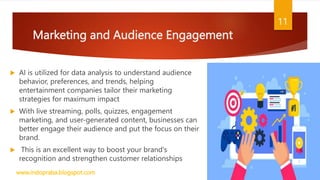
 With live streaming, polls, quizzes, engagement
marketing, and user-generated content, businesses can
better engage their audience and put the focus on their
brand.
 This is an excellent way to boost your brand's
recognition and strengthen customer relationships
www.indopraba.blogspot.com
11
Deepfakes and Digital Avatars
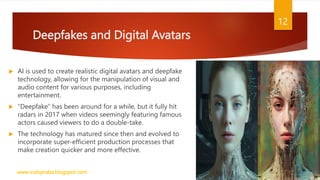
 AI is used to create realistic digital avatars and deepfake
technology, allowing for the manipulation of visual and
audio content for various purposes, including
entertainment.
 “Deepfake” has been around for a while, but it fully hit
radars in 2017 when videos seemingly featuring famous
actors caused viewers to do a double-take.
 The technology has matured since then and evolved to
incorporate super-efficient production processes that
make creation quicker and more effective.
www.indopraba.blogspot.com
12
Conclusion
 While AI continues to transform the entertainment
industry, it also raises ethical considerations, such
as data privacy, job displacement, and the
responsible use of AI in creative processes.
 Balancing technological advancements with ethical
considerations remains an ongoing challenge in
the entertainment landscape.
www.indopraba.blogspot.com
13
www.indopraba.blogspot.com

Artificial Intelligence (AI) in Entertainment.pptx

  • 1.
    Artificial Intelligence (AI)in Entertainment DR. A. PRABAHARAN PROFESSOR & RESEARCH DIRECTOR PUBLIC ACTION www.indopraba.blogspot.com 1
  • 2.
    AI in Entertainment Artificial Intelligence (AI) has significantly impacted the entertainment industry, contributing to various aspects of content creation, distribution, and consumption.  Here are several ways AI is being utilized in entertainment www.indopraba.blogspot.com 2
  • 3.
    Content Creation www.indopraba.blogspot.com 3  Scriptwriting:AI algorithms can analyze successful scripts and generate new content based on patterns and trends, helping writers develop engaging storylines.  Music Composition: AI is used to compose music, create original soundtracks, and even mimic the style of specific composers, making it a valuable tool in the music industry.
  • 4.
    Film and VideoProduction:  Editing and Post-Production: AI technologies assist in video editing, special effects, and post-production tasks, streamlining the filmmaking process.  Visual Effects (VFX): AI contributes to the creation of realistic and complex visual effects, enhancing the overall visual appeal of movies and TV shows www.indopraba.blogspot.com 4
  • 5.
    Personalized Content Recommendations AI algorithms analyze user preferences and viewing habits to recommend personalized content on streaming platforms, improving user experience and content discovery  The ecommerce-site recommendations for relevant products that are based on machine-learning intelligence generated by tidbits of input data about your user behavior and purchase history.  54% of retailers claimed that product recommendations function as the key driver of a higher average order value. www.indopraba.blogspot.com 5
  • 6.
    Gaming  Procedural ContentGeneration: AI is employed to create dynamic and varied in-game environments, characters, and narratives, enhancing the gaming experience.  Adaptive Gameplay: AI systems can adapt the difficulty level and gameplay elements based on the player's skill level and behavior, creating a more personalized and engaging gaming experience. www.indopraba.blogspot.com 6
  • 7.
    Virtual and AugmentedReality (VR/AR) www.indopraba.blogspot.com 7 AI technologies contribute to immersive VR and AR experiences by enhancing realism, interactivity, and adaptability within virtual environments Virtual reality (VR) and augmented reality (AR) have exciting potential in the future of gaming, marketing, e- commerce, education, and many other fields. Both technologies are known for their enriched experience that brings together a virtual world and the real one with enhanced, 3-D visuals. Although it can be easy to mix up the two, there are some significant differences.
  • 8.
    Voice and SpeechRecognition  AI-powered voice recognition is used in virtual assistants, interactive storytelling, and voice-controlled interfaces, offering a more natural and interactive experience for users  voice recognition involves technology that recognizes the voice of the speaker. Alternatively, speech recognition is the technology that recognizes the actual words.  The difference between voice recognition and speech recognition may seem arbitrary, but they are two key functions of virtual assistants. www.indopraba.blogspot.com 8
  • 9.
    Live Performances  AI-driventechnologies are employed in live events, concerts, and performances for tasks such as lighting control, stage design, and interactive audience experiences.  Live performances mean that the musical work is performed live.  For tv performances this means that the musicians are performing the work on screen.  For radio performances this means a live performance of the work, either in studio or on stage. www.indopraba.blogspot.com 9
  • 10.
    Content Moderation  AIalgorithms are used to moderate user- generated content on social media platforms and streaming services, identifying and filtering out inappropriate or offensive material.  Protect your users from harmful content by detecting inappropriate images and videos. Automatically detect visual threats using our best-in-class solutions. Instant results www.indopraba.blogspot.com 10
  • 11.
    Marketing and AudienceEngagement  AI is utilized for data analysis to understand audience behavior, preferences, and trends, helping entertainment companies tailor their marketing strategies for maximum impact  With live streaming, polls, quizzes, engagement marketing, and user-generated content, businesses can better engage their audience and put the focus on their brand.  This is an excellent way to boost your brand's recognition and strengthen customer relationships www.indopraba.blogspot.com 11
  • 12.
    Deepfakes and DigitalAvatars  AI is used to create realistic digital avatars and deepfake technology, allowing for the manipulation of visual and audio content for various purposes, including entertainment.  “Deepfake” has been around for a while, but it fully hit radars in 2017 when videos seemingly featuring famous actors caused viewers to do a double-take.  The technology has matured since then and evolved to incorporate super-efficient production processes that make creation quicker and more effective. www.indopraba.blogspot.com 12
  • 13.
    Conclusion  While AIcontinues to transform the entertainment industry, it also raises ethical considerations, such as data privacy, job displacement, and the responsible use of AI in creative processes.  Balancing technological advancements with ethical considerations remains an ongoing challenge in the entertainment landscape. www.indopraba.blogspot.com 13
  • 14.