AI
Its nature and future
MARGARET A. BODEN
1
1Great Clarendon Street, Oxford, ox dp,
United Kingdom
Oxford University Press is a department of the University of Oxford.
It furthers the University’s objective of excellence in research, scholarship,
and education by publishing worldwide. Oxford is a registered trade mark of
Oxford University Press in the UK and in certain other countries
© Margaret A. Boden 
The moral rights of the author have been asserted
First Edition published in 
Impression: 
All rights reserved. No part of this publication may be reproduced, stored in
a retrieval system, or transmitted, in any form or by any means, without the
prior permission in writing of Oxford University Press, or as expressly permitted
by law, by licence or under terms agreed with the appropriate reprographics
rights organization. Enquiries concerning reproduction outside the scope of the
above should be sent to the Rights Department, Oxford University Press, at the
address above
You must not circulate this work in any other form
and you must impose this same condition on any acquirer
Published in the United States of America by Oxford University Press
 Madison Avenue, New York, NY , United States of America
British Library Cataloguing in Publication Data
Data available
Library of Congress Control Number
Data available
ISBN 978–0–19–877798–4
Printed in Great Britain by
Clays Ltd, St Ives plc
For Byron, Oscar, Lukas, and Alina
ACKNOWLEDGMENTS
I thank the following friends for their very helpful advice (any
mistakes, of course, are mine): Phil Husbands, Jeremy Reffin, Anil
Seth, Aaron Sloman, and Blay Whitby. And I thank Latha Menon
for her understanding and patience.
CONTENTS
List of figures x
	1	 What is Artificial Intelligence?1
	2	 General Intelligence as the Holy Grail21
	 3	 Language, Creativity, Emotion 57
	 4	 Artificial Neural Networks 78
	 5	 Robots and Artificial Life101
	6	 But is it Intelligence, Really?119
	 7	 The Singularity147
Endnotes 171
References 178
Index 193
LIST OF FIGURES
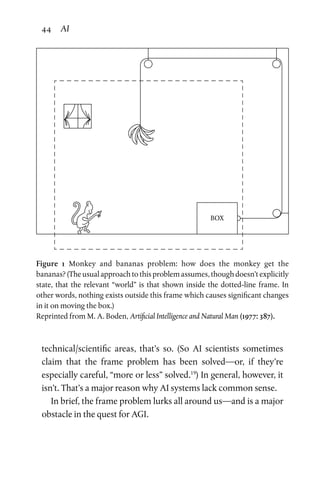
	1	 Monkey and bananas problem: how does the monkey
get the bananas? 44
	2	 A global workspace in a distributed system125
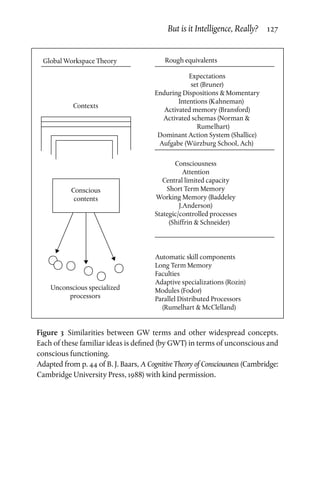
	3	 Similarities between GW terms and other widespread
concepts127
1
WhatisArtificialIntelligence?
Artificial intelligence (AI) seeks to make computers do the sorts of
things that minds can do.
Some of these (e.g. reasoning) are normally described as “intel­
ligent.” Others (e.g. vision) aren’t. But all involve psychological
skills—suchasperception,association,prediction,planning,motor
control—that enable humans and animals to attain their goals.
Intelligence isn’t a single dimension, but a richly structured space
of diverse information-processing capacities. Accordingly, AI uses
many different techniques, addressing many different tasks.
And it’s everywhere.
AI’s practical applications are found in the home, the car (and
the driverless car), the office, the bank, the hospital, the sky . . . and
the Internet, including the Internet of Things (which connects the
ever-multiplying physical sensors in our gadgets, clothes, and
environments).Somelieoutsideourplanet:robotssenttotheMoon
and Mars, or satellites orbiting in space. Hollywood animations,
2 AI
video and computer games, sat-nav systems, and Google’s search
engine are all based on AI techniques. So are the systems used by
financiers to predict movements on the stock market, and by
national governments to help guide policy decisions in health and
transport. So are the apps on mobile phones. Add avatars in virtual
reality, and the toe-in-the-water models of emotion developed for
“companion” robots. Even art galleries use AI­—on their websites,
and also in exhibitions of computer art. Less happily, military
drones roam today’s battlefields—but, thankfully, robot mine­
sweepers do so too.
AI has two main aims. One is technological: using computers to
get useful things done (sometimes by employing methods very
unlike those used by minds). The other is scientific: using AI concepts
and models to help answer questions about human beings and
other living things. Most AI workers focus on only one of these,
but some consider both.
Besides providing countless technological gizmos, AI has deeply
influencedthelifesciences.Acomputermodelofascientifictheory
isatestofitsclarityandcoherence,andacompellingdemonstration
of its—often unknown—implications. Whether the theory is true
isanothermatter,anddependsonevidencedrawnfromthescience
concerned. But even discovering that it’s false can be illuminating.
In particular, AI has enabled psychologists and neuroscientists
to develop powerful theories of the mind-brain. These include
models of how the physical brain works, and—a different, but equally
important, question—just what it is that the brain is doing: what
computational (psychological) questions it is answering, and
what sorts of information processing enable it to do that. Many
unanswered questions remain, for AI itself has taught us that our
What is Artificial Intelligence?  3
minds are very much richer than psychologists had previously
imagined.
Biologists, too, have used AI—in the form of “artificial life”
(A-Life), which develops computer models of differing aspects
of living organisms. This helps them to explain various types of
animal behavior, the development of bodily form, biological
evolution, and the nature of life itself.
Besides affecting the life sciences, AI has influenced philosophy.
ManyphilosopherstodaybasetheiraccountsofmindonAIconcepts.
They use these to address, for instance, the notorious mind–body
problem, the conundrum of free will, and the many puzzles regard­
ing consciousness. However, these philosophical ideas are hugely
controversial. And there are deep disagreements about whether any
AI system could possess real intelligence, creativity, or life.
Last, but not least, AI has challenged the ways in which we think
about humanity—and its future. Indeed, some people worry
about whether we actually have a future, because they foresee AI
surpassing human intelligence across the board. Although a few
thinkers welcome this prospect, most dread it: what place will
remain, they ask, for human dignity and responsibility?
All these issues are explored in the following chapters.
Virtual Machines
“To think about AI,” someone might say, “is to think about
computers.” Well, yes and no. The computers, as such, aren’t the
point. It’s what they do that matters. In other words, although AI
needs physical machines (i.e. computers), it’s best thought of as
using what computer scientists call virtual machines.
4 AI
A virtual machine isn’t a machine depicted in virtual reality, nor
something like a simulated car engine used to train mechanics.
Rather, it’s the information-processing system that the programmer
has in mind when writing a program, and that people have in
mind when using it.
As an analogy, think of an orchestra. The instruments have to
work. Wood, metal, leather, and cat-gut all have to follow the laws
of physics if the music is to happen as it should. But the concert-
goers aren’t focused on that. Rather, they’re interested in the music.
Nor are they concerned with individual notes—still less, with the
vibrations in the air that are causing the sound. They’re listening to
the musical “shapes” made up by the notes: the melodies and
harmonies, themes and variations, slurs and syncopation.
Where AI is concerned, the situation is similar. A word pro­
cessor, for example, is thought of by its designer, and experienced
by its users, as dealing directly with words and paragraphs. But the
program itself usually contains neither. (Some do, e.g. copyright
notices, which can be easily inserted by the user.) And a neural
network (see Chapter  4) is thought of as doing information
­processing in parallel, even though it’s usually implemented in a
(sequential) von Neumann computer.
That’s not to say that a virtual machine is just a convenient
fiction, a thing merely of our imagination. Virtual machines are
actual realities. They can make things happen, both inside the
system and (if linked to physical devices such as cameras or robot
hands) in the outside world. AI workers trying to discover what’s
going wrong when a program does something unexpected only
rarely consider hardware faults. Usually, they’re interested in
the  events and causal interactions in the virtual machinery, or
software.
What is Artificial Intelligence?  5
Programming languages, too, are virtual machines (whose
instruc­tions have to be translated into machine code before they
can be run). Some are defined in terms of lower-level program­
ming languages, so translation is required at several levels. They’re
needed because most people can’t think about information
­processing in the bit patterns used for machine code, and no one
can think about complex processes at that hugely detailed level.
That’snottrueonlyofprogramminglanguages.Virtualmachines
in general are comprised of patterns of activity (information pro­
cessing) that exist at various levels. Moreover, it’s not true only of
virtual machines running on computers. We’ll see in Chapter 6
that the human mind can be understood as the virtual machine—or
rather, the set of mutually interacting virtual machines, running in
parallel (and developed or learned at different times)—that is
implemented in the brain.
Progress in AI requires progress in defining interesting/useful
virtual machines. More physically powerful computers (larger,
faster) are all very well. They may even be necessary for certain
kinds of virtual machines to be implemented. But they can’t be
exploited unless informationally powerful virtual machines can be
run on them. (Similarly, progress in neuroscience requires better
understanding of what psychological virtual machines are being
implemented by the physical neurons: see Chapter 7.)
Different sorts of external-world information are used. Every
AI system needs input and output devices, if only a keyboard and
a screen. Often, there are also special-purpose sensors (perhaps
cameras, or pressure-sensitive whiskers) and/or effectors (perhaps
sound synthesizers for music or speech, or robot hands). The AI
program connects with—causes changes in—these computer-
world interfaces as well as processing information internally.
6 AI
AI processing usually also involves internal input and output
devices, enabling the various virtual machines within the whole
system to interact with each other. For example, one part of a
chess program may detect a possible threat by noticing something
happening in another, and may then interface with yet another in
searching for a blocking move.
The Major Types of AI
How the information is processed depends on the virtual machine
involved. As we’ll see in later chapters, there are five major types,
each including many variations. One is classical, or symbolic,
AI—sometimes called GOFAI (Good Old-Fashioned AI). Another
is artificial neural networks, or connectionism. In addition, there
are evolutionary programming; cellular automata; and dynamical
systems.
Individual researchers often use only one method, but hybrid
virtualmachinesalsooccur.Forinstance,atheoryofhumanaction
that switches continually between symbolic and connectionist
processing is mentioned in Chapter  4. (This explains why, and
how, it is that someone may be distracted from following through
on a planned task by noticing something unrelated to it in the
environment.)Andasensorimotordevicethatcombines“situated”
robotics, neural networks, and evolutionary programming is
described in Chapter 5. (This device helps a robot to find its way
“home” by using a cardboard triangle as a landmark.)
Besides their practical applications, these approaches can illumi­
nate mind, behavior, and life. Neural networks are helpful for
modeling aspects of the brain, and for doing pattern-recognition
What is Artificial Intelligence?  7
and learning. Classical AI (especially when combined with statis­
tics) can model learning too, and also planning and reasoning.
Evolutionary programming throws light on biological evolution
and brain development. Cellular automata and dynamical systems
can be used to model development in living organisms. Some
methodologies are closer to biology than to psychology, and some
are closer to non-reflective behavior than to deliberative thought.
To understand the full range of mentality, all of them will be
needed—and probably more.
Many AI researchers don’t care about how minds work: they
seek technological efficiency, not scientific understanding. Even if
their techniques originated in psychology, they now bear scant
relation to it. We’ll see, however, that progress in general-purpose
AI (artificial general intelligence, or AGI) will require deep under­
standing of the computational architecture of minds.
AI Foreseen
AI was foreseen in the 1840s by Lady Ada Lovelace.1
More accu­
rately, she foresaw part of it. She focused on symbols and logic,
having no glimmering of neural networks, nor of evolutionary
and dynamical AI. Nor did she have any leanings towards AI’s
psychological aim, her interest being purely technological.
She said, for instance, that a machine “might compose elaborate
andscientificpiecesofmusicofanydegreeofcomplexityorextent,”
and might also express “the great facts of the natural world” in
enabling “a glorious epoch in the history of the sciences.” (So she
wouldn’t have been surprised to see that, two centuries later,
scien­tists are using “Big Data” and specially crafted programming
8 AI
tricks to advance knowledge in genetics, pharmacology,
epidemiology . . . the list is endless.)
The machine she had in mind was the Analytical Engine. This
gears-and-cogwheels device (never fully built) had been designed
by her close friend Charles Babbage in 1834. Despite being
­dedicated to algebra and numbers, it was essentially equivalent to
a general-purpose digital computer.
Ada Lovelace recognized the potential generality of the Engine,
its ability to process symbols representing “all subjects in the
universe.” She also described various basics of modern program­
ming: stored programs, hierarchically nested subroutines, address­
ing,microprogramming,looping,conditionals,comments,andeven
bugs. But she said nothing about just how musical composition, or
scientific reasoning, could be implemented on Babbage’s machine.
AI was possible, yes—but how to achieve it was still a mystery.
How AI Began
That mystery was clarified a century later by Alan Turing. In 1936,
Turing showed that every possible computation can in principle
be performed by a mathematical system now called a universal
Turing machine.2
This imaginary system builds, and modifies,
combinations of binary symbols--represented as “0” and “1.” After
codebreaking at Bletchley Park during World War II, he spent the
rest of the 1940s thinking about how the abstractly defined Turing
machine could be approximated by a physical machine (he helped
design the first modern computer, completed in Manchester in
1948), and how such a contraption could be induced to perform
intelligently.
What is Artificial Intelligence?  9
UnlikeAdaLovelace,TuringacceptedbothgoalsofAI.Hewanted
the new machines to do useful things normally said to require
intelligence (perhaps by using highly unnatural techniques), and
also to model the processes occurring in biologically based minds.
The 1950 paper in which he jokily proposed the Turing Test (see
Chapter 6) was primarily intended as a manifesto for AI.3
(A fuller
version had been written soon after the war, but the Official
Secrets Act prevented publication.) It identified key questions
about the information processing involved in intelligence (game
playing, perception, language, and learning), giving tantalizing
hintsaboutwhathadalreadybeenachieved.(Only“hints”,because
the work at Bletchley Park was still top-secret.) It even suggested
computational approaches—such as neural networks and evolu­
tionary computing—that became prominent only much later. But
the mystery was still far from dispelled. These were highly general
remarks: programmatic, not programs.
Turing’s conviction that AI must be somehow possible was
bolstered in the early 1940s by the neurologist/psychiatrist Warren
McCulloch and the mathematician Walter Pitts. In their paper “A
Logical Calculus of the Ideas Immanent in Nervous Activity,”4
they
united Turing’s work with two other exciting items (both dating
from the early twentieth century): Bertrand Russell’s proposi­tional
logic and Charles Sherrington’s theory of neural synapses.
The key point about propositional logic is that it’s binary. Every
sentence (also called a proposition) is assumed to be either true or false.
There’snomiddleway,norecognitionofuncertaintyorprobability.
Only two “truth-values” are allowed, namely true and false.
Moreover, complex propositions are built, and deductive argu­
ments are carried out, by using logical operators (such as and, or,
10 AI
and if–then) whose meanings are defined in terms of the truth/
falsity of the component propositions. For instance, if two (or
more) propositions are linked by and, it’s assumed that both/all of
them are true. So “Mary married Tom and Flossie married Peter” is
true if, and only if, both “Mary married Tom” and “Flossie married
Peter” are true. If, in fact, Flossie did not marry Peter, then the
complex proposition containing “and” is itself false.
RussellandSherringtoncouldbebroughttogetherbyMcCulloch
and Pitts because they had both described binary systems. The
true/false values of logic were mapped onto the on/off activity of
brain cells and the 0/1 of individual states in Turing machines.
Neurons were believed by Sherrington to be not only strictly on/
off, but also to have fixed thresholds. So logic gates (computing
and, or, and not) were defined as tiny neural nets, which could be
interconnected to represent highly complex propositions. Any­
thingthatcouldbestatedinpropositionallogiccouldbecomputed
by some neural network, and by some Turing machine.
Inbrief,neurophysiology,logic,andcomputationwerebundled
together—and psychology came along too. McCulloch and Pitts
believed (as many philosophers then did) that natural language
boils down, in essence, to logic. So all reasoning and opinion,
from scientific argument to schizophrenic delusions, was grist for
their theoretical mill. They foresaw a time when, for the whole of
psychology, “specification of the [neural] net would contribute all
that could be achieved in that field.”
The core implication was clear: one and the same theoretical
approach—namely, Turing computation—could be applied to
human and machine intelligence. (The McCulloch/Pitts paper even
influenced computer design. John von Neumann, then intending
What is Artificial Intelligence?  11
to use decimal code, was alerted to it and switched to binary
instead.)
Turing, of course, agreed. But he couldn’t take AI much further:
the technology available was too primitive. In the mid-1950s,
however, more powerful and/or easily usable machines were
developed. “Easily usable,” here, doesn’t mean that it was easier
to push the computer’s buttons, or to wheel it across the room.
Rather, it means that it was easier to define new virtual machines
(e.g. programming languages), which could be more easily used to
define higher-level virtual machines (e.g. programs to do mathe­
matics, or planning).
Symbolic AI research, broadly in the spirit of Turing’s manifesto,
commenced on both sides of the Atlantic. One late-1950s land­mark
was Arthur Samuel’s checkers (draughts) player, which made news­
paper headlines because it learned to beat Samuel himself.5
That was
an intimation that computers might one day develop superhuman
intelligence, outstripping the capacities of their programmers.
The second such intimation also occurred in the late 1950s,
when the Logic Theory Machine not only proved eighteen of
Russell’s key logical theorems, but found a more elegant proof of
one of them.6
This was truly impressive. Whereas Samuel was only
a mediocre checkers player, Russell was a world-leading logician.
(Russell himself was delighted by this achievement, but the Jour­
nal of Symbolic Logic refused to publish a paper with a computer
program named as an author, especially as it hadn’t proved a new
theorem.)
The Logic Theory Machine was soon outdone by the General
Problem Solver (GPS)7
—“outdone” not in the sense that GPS could
surpass yet more towering geniuses, but in the sense that it wasn’t
12 AI
limited to only one field. As the name suggests, GPS could be
applied to any problem that could be represented (as explained in
Chapter 2) in terms of goals, sub-goals, actions, and operators. It
was up to the programmers to identify the goals, actions, and
operators relevant for any specific field. But once that had been
done, the reasoning could be left to the program.
GPSmanagedtosolvethe“missionaries-and-cannibals”problem,
for example. (Three missionaries and three cannibals on one side of a river;
a boat big enough for two people; how can everyone cross the river, without
cannibals ever outnumbering missionaries?) That’s difficult even for
humans, because it requires one to go backwards in order to go
forwards. (Try it, using pennies!)
The Logic Theory Machine and GPS were early examples of
GOFAI. They are now “old-fashioned,” to be sure. But they were
also “good,” for they pioneered the use of heuristics and planning—
both of which are hugely important in AI today (see Chapter 2).
GOFAI wasn’t the only type of AI to be inspired by the “Logical
Calculus” paper. Connectionism, too, was encouraged by it. In the
1950s,networksofMcCulloch-Pittslogicalneurons,eitherpurpose-
built or simulated on digital computers, were used (by Albert
Uttley,forinstance8
)tomodelassociativelearningandconditioned
reflexes. (Unlike today’s neural networks, these did local, not dis­
tributed, processing: see Chapter 4.)
But early network modeling wasn’t wholly dominated by
neuro-­logic. The systems implemented (in analogue computers)
by Raymond Beurle in the mid-1950s were very different.9
Instead
of carefully designed networks of logic gates, he started from two-
dimensional arrays of randomly connected, and varying-threshold,
units. He saw neural self-organization as due to dynamical waves
What is Artificial Intelligence?  13
of activation—building, spreading, persisting, dying, and some­
times interacting.
As Beurle realized, to say that psychological processes could be
modeled by a logic-chopping machine wasn’t to say that the brain
actually is such a machine. McCulloch and Pitts had already pointed
this out. Only four years after their first groundbreaking paper,
they had published another one arguing that thermodynamics is
closer than logic to the functioning of the brain.10
Logic gave way
to statistics, single units to collectivities, and deterministic purity
to probabilistic noise.
Inotherwords,theyhaddescribedwhat’snowcalleddistributed,
error-tolerant computing (see Chapter  4). They saw this new
approachasan“extension”oftheirpreviousone,notacontradiction
of it. But it was more biologically realistic.
Cybernetics
McCulloch’s influence on early AI went even further than GOFAI
and connectionism. His knowledge of neurology as well as logic
made him an inspiring leader in the budding cybernetics move­
ment of the 1940s.
The cyberneticians focused on biological self-organization. This
covered various kinds of adaptation and metabolism, including
autonomous thought and motor behavior as well as (neuro)
physiologicalregulation.Theircentralconceptwas“circularcausa­
tion,” or feedback. And a key concern was teleology, or purpo­
siveness. These ideas were closely related, for feedback depended
on goal differences: the current distance from the goal was used to
guide the next step.
14 AI
Norbert Wiener (who designed anti-ballistic missiles during the
war) named the movement in 1948, defining it as “the study of
control and communication in the animal and the machine.”11
Those cyberneticians who did computer modeling often drew
inspiration from control engineering and analogue computers
rather than logic and digital computing. However, the distinction
wasn’t clear-cut. For instance, goal differences were used both to
control guided missiles and to direct symbolic problem solving.
Moreover,Turing—thechampionofclassicalAI—useddynamical
equations (describing chemical diffusion) to define self-organizing
systems in which novel structure, such as spots or segmentation,
could emerge from a homogeneous origin (see Chapter 5).12
Other early members of the movement included the experi­
mental psychologist Kenneth Craik; the mathematician John von
Neumann; the neurologists William Grey Walter and William
Ross Ashby; the engineer Oliver Selfridge; the psychiatrist and
anthropologistGregoryBateson;andthechemistandpsychologist
Gordon Pask.13
Craik, who died (aged 31) in a cycling accident in 1943, before the
advent of digital computers, referred to analogue computing in
thinking about the nervous system. He described perception and
motor action, and intelligence in general, as guided by feedback
from “models” in the brain.14
His concept of cerebral models, or
representations, would later be hugely influential in AI.
Von Neumann had puzzled about self-organization throughout
the 1930s, and was hugely excited by McCulloch and Pitts’ first
paper. Besides changing his basic computer design from decimal
to binary, he adapted their ideas to explain biological evolution
and reproduction. He defined various cellular automata: systems
What is Artificial Intelligence?  15
made of many computational units, whose changes follow simple
rules depending on the current state of neighboring units.15
Some
of these could replicate others. He even defined a universal repli­
cator, capable of copying anything—itself included. Replication
errors, he said, could lead to evolution.
Cellular automata were specified by von Neumann in abstract
informational terms. But they could be embodied in many ways,
forexample,asself-assemblingrobots,Turing’schemicaldiffusion,
Beurle’s physical waves, or—as soon became clear—DNA.
From the late 1940s on, Ashby developed the Homeostat, an
electrochemical model of physiological homeostasis.16
This intri­
guing machine could settle into an overall equilibrium state no
matter what values were initially assigned to its 100 param­
eters (allowing almost 400,000 different starting conditions). It
illustrated Ashby’s theory of dynamical adaptation—both inside
the body (not least, the brain) and between the body and its
external environment, in trial-and-error learning and adaptive
behavior.
Grey Walter, too, was studying adaptive behavior—but in a very
different way.17
He built mini-robots resembling tortoises, whose
sensorimotor circuitry modeled Sherrington’s theory of neural
reflexes. These pioneering situated robots displayed lifelike
behaviors such as light-seeking, obstacle-avoidance, and asso­
ciative learning via conditioned reflexes. They were sufficiently
intriguing to be exhibited to the general public at the Festival of
Britain in 1951.
Tenyearslater,Selfridge(grandsonofthefounderoftheLondon
departmentstore)usedsymbolicmethodstoimplementanessentially
parallel-processing system called Pandemonium.18
16 AI
This GOFAI program learned to recognize patterns by having
many bottom-level “demons,” each always looking out for one
simple perceptual input, which passed their results on to higher-
level demons. These weighed the features recognized so far for
consistency (e.g. only two horizontal bars in an F), downplaying
any features that didn’t fit. Confidence levels could vary, and they
mattered: the demons that shouted loudest had the greatest effect.
Finally, a master-demon chose the most plausible pattern, given
the (often conflicting) evidence available. This research soon
influenced both connectionism and symbolic AI. (One very recent
offshoot is the LIDA model of consciousness: see Chapter 6.)
Bateson had little interest in machines, but he based his 1960s
theories of culture, alcoholism, and “double-bind” schizophrenia
on ideas about communication (i.e. feedback) picked up earlier at
cyberneticmeetings.Andfromthemid-1950son,Pask—described
as “the genius of self-organizing systems” by McCulloch—used
cybernetic and symbolic ideas in many different projects. These
included interactive theater; intercommunicating musical robots;
architecturethatlearnedandadaptedtoitsusers’goals;chemically
self-organizingconcepts;andteachingmachines.Thelatterenabled
people to take different routes through a complex knowledge
representation, so were suitable for both step-by-step and holistic
cognitive styles (and varying tolerance of irrelevance) on the
learner’s part.
In brief, all the main types of AI were being thought about, and
even implemented, by the late 1960s­—and in some cases, much
earlier than that.
Most of the researchers concerned are widely revered today. But
only Turing was a constant specter at the AI feast. For many years,
What is Artificial Intelligence?  17
the others were remembered only by some subset of the research
community. Grey Walter and Ashby, in particular, were nearly
forgotten until the late 1980s, when they were lauded (alongside
Turing) as grandfathers of A-Life. Pask had to wait even longer
for  recognition. To understand why, one must know how the
com­puter modelers became disunited.
How AI Divided
Before the 1960s, there was no clear distinction between people
modeling language or logical thinking and people modeling
purposive/adaptive motor behavior. Some individuals worked on
both. (Donald Mackay even suggested building hybrid computers,
combining neural networks with symbolic processing.) And all
were mutually sympathetic. Researchers studying physiologi­cal
self-regulation saw themselves as engaged in the same overall enter­
prise as their psychologically oriented colleagues. They all attended
the same meetings: the interdisciplinary Macy seminars in the
USA (chaired by McCulloch from 1946 to 1951), and London’s
seminal conference on “The Mechanization of Thought Processes”
(organized by Uttley in 1958).19
From about 1960, however, an intellectual schism developed.
Broadly speaking, those interested in life stayed in cybernetics, and
those interested in mind turned to symbolic computing. The
network enthusiasts were interested in both brain and mind, of
course. But they studied associative learning in general, not specific
semantic content or reasoning, so fell within cybernetics rather
than symbolic AI. Unfortunately, there was scant mutual respect
between these increasingly separate sub-groups.
18 AI
The emergence of distinct sociological coteries was inevitable.
For the theoretical questions being asked—biological (of varying
kinds) and psychological (also of varying kinds)—were different.
So too were the technical skills involved: broadly defined, logic
versus differential equations. Growing specialization made
­communication increasingly difficult, and largely unprofitable.
Highly eclectic conferences became a thing of the past.
Even so, the division needn’t have been so ill-tempered. The bad
feeling on the cybernetic/connectionist side began as a mixture
of professional jealousy and righteous indignation. These were
prompted by the huge initial success of symbolic computing, by
the journalistic interest attending the provocative term “artificial
intelligence” (coined by John McCarthy in 1956 to name what
had  previously been called “computer simulation”), and by the
arrogance—and unrealistic hype—expressed by some of the
symbolists.
Members of the symbolist camp were initially less hostile,
becausetheysawthemselvesaswinningtheAIcompetition.Indeed,
theylargelyignoredtheearlynetworkresearch,eventhoughsome
of their leaders (Marvin Minsky, for instance) had started out in
that area.
In 1958, however, an ambitious theory of neurodynamics—
defining parallel-processing systems capable of self-organized
learning from a random base (and error-tolerant to boot)—was
presented by Frank Rosenblatt and partially implemented in his
photoelectric Perceptron machine.20
Unlike Pandemonium, this
didn’t need the input patterns to be pre-analyzed by the pro­
grammer. This novel form of connectionism couldn’t be ignored
by the symbolists. But it was soon contemptuously dismissed. As
What is Artificial Intelligence?  19
explained in Chapter 4, Minsky (with Seymour Papert) launched
a stinging critique in the 1960s claiming that perceptrons are
incapable of computing some basic things.21
Funding for neural-network research dried up accordingly. This
outcome, deliberately intended by the two attackers, deepened the
antagonisms within AI.
To the general public, it now seemed that classical AI was the
onlygameintown.Admittedly,GreyWalter’stortoiseshadreceived
great acclaim in the Festival of Britain. Rosenblatt’s Perceptron
was hyped by the press in the late 1950s, as was Bernard Widrow’s
pattern-learning Adaline (based on signal-processing). But the
symbolists’ critique killed that interest stone dead. It was symbolic
AI which dominated the media in the 1960s and 1970s (and which
influenced the philosophy of mind as well).
That situation didn’t last. Neural networks—as “PDP systems”
(doing parallel distributed processing)—burst onto the public
stage again in 1986 (see Chapter  4). Most outsiders—and some
insiders, who should have known better—thought of this approach
as utterly new. It seduced the graduate students, and attracted
enormous journalistic (and philosophical) attention. Now, it was
the symbolic AI people whose noses were put out of joint. PDP
was in fashion, and classical AI was widely said to have failed.
As for the other cyberneticians, they finally came in from the
cold with the naming of A-Life in 1987. The journalists, and the
graduate students, followed. Symbolic AI was challenged yet again.
In the twenty-first century, however, it has become clear that
different questions require different types of answers—horses for
courses. Although traces of the old animosities remain, there’s
now room for respect, and even cooperation, between different
20 AI
approaches. For instance, “deep learning” is sometimes used in
powerful systems combining symbolic logic with multilayer prob­
abilisticnetworks;andotherhybridapproachesincludeambitious
models of consciousness (see Chapter 6).
Given the rich variety of virtual machines that constitute the
human mind, one shouldn’t be too surprised.
2
GeneralIntelligenceasthe
HolyGrail
State-of-the-art AI is a many-splendored thing. It offers a profu­
sion of virtual machines, doing many different kinds of informa­
tion processing. There’s no key secret here, no core technique
unifying the field: AI practitioners work in highly diverse areas,
sharing little in terms of goals and methods. This book can mention
only very few of the recent advances. In short, AI’s methodological
range is extraordinarily wide.
One could say that it’s been astonishingly successful. For its
practical range, too, is extraordinarily wide. A host of AI applica­
tions exist, designed for countless specific tasks and used in almost
every area of life, by laymen and professionals alike. Many out­
perform even the most expert humans. In that sense, progress has
been spectacular.
But the AI pioneers weren’t aiming only for specialist systems.
They were also hoping for systems with general intelligence. Each
human-like capacity they modeled—vision, reasoning, language,
22 AI
learning, and so on—would cover its entire range of challenges.
Moreover, these capacities would be integrated when appropriate.
Judged by those criteria, progress has been far less impressive.
JohnMcCarthyrecognizedAI’sneedfor“commonsense”veryearly
on.1
And he spoke on “Generality in Artificial Intelligence” in both
of his high-visibility Turing Award addresses, in 1971 and 1987—but
he was complaining, not celebrating. In 2016, his complaints aren’t
yet answered.
The twenty-first century is seeing a revival of interest in artificial
general intelligence (AGI), driven by recent increases in computer
power. If that were achieved, AI systems could rely less on special
purpose programming tricks, benefitting instead from general
powers of reasoning and perception—plus language, creativity,
and emotion (all of which are discussed in Chapter 3).
However, that’s easier said than done. General intelligence is still
a major challenge, still highly elusive. AGI is the field’s Holy Grail.
Supercomputers aren’t Enough
Today’s supercomputers are certainly a help to anyone seeking to
realize this dream. The combinatorial explosion—wherein more
computations are required than can actually be executed—is no
longer the constant threat that it used to be. Nevertheless,
problems can’t always be solved merely by increasing computer
power.
New problem-solving methods are often needed. Moreover, even
if a particular method must succeed in principle, it may need too
much time and/or memory to succeed in practice. Three such
examples (concerning neural networks) are given in Chapter 4.
General Intelligence as the Holy Grail  23
Similarly, a brute-force “solution” listing all possible chess moves
would require more memory locations than there are electrons in
the Universe—so even a large bunch of supercomputers wouldn’t
suffice.
Efficiency is important, too: the fewer the number of compu­
tations, the better. In short, problems must be made tractable.
There are several basic strategies for doing that. All were
pioneered by classical symbolic AI, or GOFAI, and all are still
essential today.
One is to direct attention to only a part of the search space (the
computer’s representation of the problem, within which the
solution is assumed to be located). Another is to construct a
smaller search space by making simplifying assumptions. A third
is to order the search efficiently. Yet another is to construct a
different search space, by representing the problem in a new way.
These approaches involve heuristics, planning, mathematical sim­
plification, and knowledge representation, respectively. The next five
sections consider those general AI strategies.
Heuristic Search
The word “heuristic” has the same root as “Eureka!”: it comes from
the Greek for find, or discover. Heuristics were highlighted by early
GOFAI, and are often thought of as “programming tricks.” But the
term didn’t originate with programming: it has long been familiar
to logicians and mathematicians. As for the human activity of
using heuristics in problem solving (whether self-consciously or
not), this goes back thousands of years—long before AI was a
twinkle in Ada Lovelace’s eye.
24 AI
Whether in humans or machines, heuristics make it easier to
solve the problem. In AI, they do this by directing the program
towards certain parts of the search space and away from others.
Many heuristics, including most of those used in the very early
days of AI, are rules of thumb that aren’t guaranteed to succeed.
The solution may lie in some part of the search space that the
heuristic has led the system to ignore. For example, “Protect your
queen” is a very helpful rule in chess, but it should occasionally be
disobeyed.
Otherscanbelogicallyormathematicallyprovedtobeadequate.
Much work in AI and computer science today aims to identify
provable properties of programs. That’s one aspect of “Friendly
AI,”2
because human safety may be jeopardized by the use of
logically unreliable systems (see Chapter 7). (There’s no principled
distinction between heuristics and algorithms. Many algorithms
are,ineffect,mini-programsincorporatingsomeparticularheuristic.)
Whether reliable or not, heuristics are an essential aspect of AI
research. The increasing AI specialism mentioned above depends
partly on the definition of new heuristics that can improve effi­
ciency spectacularly, but only in one highly restricted sort of
problem, or search space. A hugely successful heuristic may not
be suitable for “borrowing” by other AI programs.
Given several heuristics, their order of application may matter.
For instance, “Protect your queen” should be taken into account
before “Protect your bishop”—even though this ordering will
occasionally lead to disaster. Different orderings will define
different search trees through the search space. Defining and
ordering heuristics are crucial tasks for modern AI. (Heuristics are
prominent in cognitive psychology, too. Intriguing work on “fast
General Intelligence as the Holy Grail  25
and frugal heuristics,” for example, indicates how evolution has
equippeduswithefficientwaysofrespondingtotheenvironment.3
)
Heuristics make brute-force search through the entire search
spaceunnecessary.Buttheyaresometimescombinedwith(limited)
brute-force search. IBM’s chess program Deep Blue, which caused
worldwide excitement by beating world champion Gary Kasparov
in 1997, used dedicated hardware chips, processing 200 million
positions per second, to generate every possible move for the next
eight.4
However,ithadtouseheuristicstoselectthe“best”movewithin
them. And since its heuristics weren’t reliable, even Deep Blue didn’t
beat Kasparov every time.
Planning
Planning, too, is prominent in today’s AI—not least in a wide range
of military activities.5
Indeed, the USA’s Department of Defense,
which paid for the majority of AI research until very recently, has
said that the money saved (by AI planning) on battlefield logistics in
the first Iraq war outweighed all their previous investment.
Planning isn’t restricted to AI: we all do it. Think of packing for
your holiday, for instance. You have to find all the things you want
to take, which probably won’t all be found in the same place. You
may have to buy some new items (sun cream, perhaps). You must
decide whether to collect all the things together (perhaps on your
bed, or on a table), or whether to put each one in your luggage
when you find it. That decision will depend in part on whether you
want to put the clothes in last of all, to prevent creasing. You’ll
need a rucksack, or a suitcase, or maybe two: how do you decide?
26 AI
The GOFAI programmers who used planning as an AI technique
had such consciously thought-out examples in mind. (The type of
AI based on neural networks is very different, for it doesn’t try to
mimic conscious deliberation: see Chapter 4.) That’s because the
pioneers responsible for the Logic Theory Machine (see Chapter 1)
and GPS were primarily interested in the psychology of human
reasoning. They based their programs on experiments they’d done
with human subjects, asked to “think aloud” so as to describe their
own thought processes while doing logic puzzles.
Modern AI planners don’t rely so heavily on ideas garnered
from conscious introspection or experimental observation. And
their plans are very much more complex than was possible in the
early days. But the basic idea is the same.
A plan specifies a sequence of actions, represented at a general
level—a final goal, plus sub-goals and sub-sub-goals . . . —so that
all details aren’t considered at once. Planning at a suitable level of
abstraction can lead to tree pruning within the search space, so
some details never need to be considered at all. Sometimes, the
finalgoalisitselfaplanofaction—perhapsschedulingthedeliveries
to and from a factory or battlefield. At other times, it’s the answer
to a question—for example, a medical diagnosis.
For any given goal, and expected situations, the planning pro­
gramneeds:alistofactions—thatis,symbolicoperators—oraction
types (instantiated by filling in parameters derived from the pro­
blem), each of which can make some relevant change; for every
action, a set of necessary prerequisites (cf. to grasp something, it
must be within reach); and heuristics for prioritizing the required
changes and ordering the actions. If the program decides on a
particular action, it may have to set up a new sub-goal to satisfy
General Intelligence as the Holy Grail  27
the prerequisites. This goal-formulating process can be repeated
again and again.
Planning enables the program—and/or the human user—to
discover what actions have already been taken, and why. The “why”
refers to the goal hierarchy: this action was taken to satisfy that
prerequisite, to achieve such-and-such a sub-goal. AI systems com­
monly employ techniques of “forward-chaining” and “backward-­
chaining,” which explain how the program found its solution. This
helps the user to judge whether the action/advice of the program
is appropriate.
Some current planners have tens of thousands of lines of code,
defining hierarchical search spaces on numerous levels. These
systems are often significantly different from the early planners.
For example, most don’t assume that all the sub-goals can be
worked on independently (i.e. that problems are perfectly decom­
posable). In real life, after all, the result of one goal-directed activity
may be undone by another. Today’s planners can handle partially
decomposable problems: they work on sub-goals independently,
but can do extra processing to combine the resulting sub-plans if
necessary.
The classical planners could tackle only problems in which the
environment was fully observable, deterministic, finite, and static.
But some modern planners can cope with environments that are
partially observable (i.e. the system’s model of the world may be
incomplete and/or incorrect) and probabilistic. In those cases, the
system must monitor the changing situation during execution, so
as to make changes in the plan—and/or in its own “beliefs” about
the world—as appropriate. Some modern planners can do this over
very long periods: they engage in continuous goal formulation,
28 AI
execution, adjustment, and abandonment, according to the chang­
ing environment.
Many other developments have been added, and are still being
added, to classical planning.6
It may seem surprising, then, that
planning was roundly rejected by some roboticists in the 1980s,
“situated” robotics being recommended instead (see Chapter 5).
Thenotionofinternalrepresentation—ofgoalsandpossibleactions,
for example—was rejected as well. However, that criticism was
largelymistaken.Thecritics’ownsystemsmaynothaverepresented
goals, but they involved representations of other things, such as
retinal stimulations and rewards. Moreover, even robotics, where
this critique originated, often needs planning as well as purely
reac­tive responses—to build soccer-playing robots, for instance.7
Mathematical Simplification
Whereas heuristics leave the search space as it is (making the pro­
gram focus on only part of it), simplifying assumptions construct
an unrealistic—but computationally tractable—search space.
Some such assumptions are mathematical. One example is the
“i.i.d.” assumption, commonly used in machine learning. This
represents the probabilities in the data as being much simpler than
they actually are.
The advantage of mathematical simplification when defining the
search space is that mathematical—that is, clearly definable and,
to mathematicians at least, readily intelligible—methods of search
can be used. But that’s not to say that any mathematically defined
search will be useful. As noted above, a method that’s mathe­
matically guaranteed to solve every problem within a certain class
may be unusable in real life, because it would need infinite time to
General Intelligence as the Holy Grail  29
do so. It may, however, suggest approximations that are more
practicable: see the discussion of “backprop” in Chapter 4.
Non-mathematical simplifying assumptions in AI are legion—
and often unspoken. One is the (tacit) assumption that problems
can be defined and solved without taking emotions into account
(see Chapter 3). Many others are built into the general knowledge
representation that’s used in specifying the task.
Knowledge Representation
Often, the hardest part of AI problem solving is presenting the
problem to the system in the first place. Even if it seems that
someonecancommunicatedirectlywithaprogram—byspeaking
in English to Siri, perhaps, or by typing French words into Google’s
search engine—they can’t. Whether one’s dealing with texts or
with images, the information (“knowledge”) concerned must be
presented to the system in a fashion that the machine can
understand—in other words, that it can deal with. (Whether that
is real understanding is discussed in Chapter 6.)
AI’s ways of doing this are highly diverse. Some are developments/
variations of general methods of knowledge representation intro­
duced in GOFAI. Others, increasingly, are highly specialized
methods, tailor-made for a narrow class of problems–. There may
be, for instance, a new way of representing X-ray images, or photo­
graphs of a certain class of cancerous cells, carefully tailored to
enable some highly specific method of medical interpretation (so,
no good for recognizing cats, or even CAT scans).
InthequestforAGI,thegeneralmethodsareparamount.Initially
inspired by psychological research on human cognition, these
include: sets of IF–THEN rules; representations of individual
30 AI
concepts; stereotyped action sequences; semantic networks; and
inference by logic or probability.
Let’sconsidereachoftheseinturn.(Anotherformofknowledge
representation,namelyneuralnetworks,isdescribedinChapter 4.)
Rule-Based Programs
In rule-based programming, a body of knowledge/belief is rep­
resented as a set of IF–THEN rules linking Conditions to Actions:
IF this Condition is satisfied, THEN take that Action. This form
of knowledge representation draws on formal logic (Emil Post’s
“production” systems). But the AI pioneers Allen Newell and
HerbertSimonbelievedittounderliehumanpsychologyingeneral.
Both Condition and Action may be complex, specifying a
conjunction (or disjunction) of several—perhaps many—items. If
several Conditions are satisfied simultaneously, the most inclusive
conjunction is given priority. So “IF the goal is to cook roast beef
and Yorkshire pudding” will take precedence over “IF the goal is
to cook roast beef ”—and adding “and three veg” to the Condition
will trump that.
Rule-based programs don’t specify the order of steps in advance.
Rather, each rule lies in wait to be triggered by its Condition.
Nevertheless, such systems can be used to do planning. If they
couldn’t,theywouldbeoflimiteduseforAI.Buttheydoitdifferently
fromhowit’sdoneintheoldest,mostfamiliar,formofprogramming
(sometimes called “executive control”).
In programs with executive control (like GPS and the Logic
Theory Machine: see Chapter 1), planning is represented explicitly.
The programmer specifies a sequence of goal-seeking instructions
General Intelligence as the Holy Grail  31
to be followed step by step, in strict temporal order: “Do this, then
do that; then look to see whether X is true; if it is, do such-and-such; if
not, do so-and-so.”
Sometimes, the “this” or the “so-and-so” is an explicit instruction
to set up a goal or sub-goal. For instance, a robot with the goal of
leaving the room may be instructed [sic] to set up the sub-goal
of opening the door; next, if examining the current state of the
door shows it to be closed, set up the sub-sub-goal of grasping
the door handle. (A human toddler may need a sub-sub-sub-goal—
namely, getting an adult to grasp the unreachable door handle;
and the infant may need several goals at even lower levels in order
to do that.)
A rule-based program, too, could work out how to escape
from the room. However, the plan hierarchy would be repre­
sented not as a temporally ordered sequence of explicit steps, but
as the logical structure implicit in the collection of IF–THEN rules
that comprise the system. A Condition may require that such-
and-such a goal has already been set up (IF you want to open the
door, and you aren’t tall enough). Similarly, an Action can include
the setting up of a new goal or sub-goal (THEN ask an adult).
Lower levels will be activated automatically (IF you want to ask
some­one to do something, THEN set up the goal of moving near
to them).
Of course, the programmer has to have included the relevant
IF–THEN rules (in our example, rules dealing with doors and door
handles). But he/she doesn’t need to have anticipated all the
potential logical implications of those rules. (That’s a curse, as
well as a blessing, because potential inconsistencies may remain
undiscovered for quite a while.)
32 AI
The active goals/sub-goals are posted on a central “blackboard,”
which is accessible to the whole system. The information dis­played
on the blackboard includes not only activated goals but also percep­
tual input, and other aspects of current processing. (That idea has
influenced a leading neuropsychological theory of con­sciousness,
and an AI model of consciousness based on it: see Chapter 6.)
Rule-based programs were widely used for the pioneering
“expert systems” of the early 1970s. These included MYCIN, which
offered advice to human physicians on identifying infectious dis­
eases and on prescribing antibiotic drugs, and DENDRAL, which
performed spectral analysis of molecules within a particular area
of organic chemistry. MYCIN, for instance, did medical dia­gnosis
bymatchingsymptomsandbackgroundbodilyproperties(Condi­
tions) to diagnostic conclusions and/or suggestions for further
tests or medication (Actions). Such programs were AI’s first move
awayfromthehopeofgeneralismtowardsthepracticeofspecial­ism.
And they were the first step towards Ada Lovelace’s dream of
machine-made science (see Chapter 1).
The rule-based form of knowledge representation enables pro­
grams to be built gradually, as the programmer—or perhaps an
AGI system itself—learns more about the domain. A new rule can
be added at any time. There’s no need to rewrite the program from
scratch. However, there’s a catch. If the new rule isn’t logically
consistent with the existing ones, the system won’t always do what
it’s supposed to do. It may not even approximate what it’s supposed
to do. When dealing with a small set of rules, such logical conflicts
are easily avoided, but larger systems are less transparent.
In the 1970s, the new IF–THEN rules were drawn from ongoing
conversationswithhumanexperts,askedtoexplaintheirdecisions.
General Intelligence as the Holy Grail  33
Today,manyoftherulesdon’tcomefromconsciousintrospection.
But they are even more efficient. Modern expert systems (a term
rarely used today) range from huge programs used in scientific
research and commerce to humble apps on phones. Many outper­
form their predecessors because they benefit from additional forms
of knowledge representation, such as statistics and special-purpose
visual recognition, and/or the use of Big Data (see Chapter 4).
These programs can assist, or even replace, human experts in
narrowly restricted fields. Some surpass the world leaders in those
fields. Almost forty years ago, a rule-based system could outdo
the supreme human expert in the diagnosis of soybean diseases.8
Now, there are countless examples, used to aid human profes­
sionals working in science, medicine, law . . . and even dress design.
(Which isn’t entirely good news: see Chapter 7.)
Frames, Word-Vectors, Scripts, Semantic Nets
Other commonly used methods of knowledge representation
concern individual concepts, not entire domains (such as medical
diagnosis or dress design).
For instance, one can tell a computer what a room is by specify­
ing a hierarchical data structure (sometimes called a “frame”). This
represents a room as having floor, ceiling, walls, doors, windows, and
furniture (bed, bath, dining table . . . ). Actual rooms have varying
numbers of walls, doors, and windows, so “slots” in the frame allow
specific numbers to be filled in—and provide default assignments
too (four walls, one door, one window).
Such data structures can be used by the computer to find
analogies, answer questions, engage in a conversation, or write or
34 AI
understand a story. And they’re the basis of CYC: an ambitious—
some would say vastly overambitious—attempt to represent all
human knowledge.
Frames can be misleading, however. Default assignments, for
instance,areproblematic.(Someroomshavenowindow,andopen-­
plan rooms have no door.) Worse: what of everyday concepts such
as dropping, or spilling? Symbolic AI represents our common-sense
knowledge of “naïve physics” by constructing frames coding such
facts as that a physical object will drop if unsupported. But a
helium balloon won’t. Allowing explicitly for such cases is a never-
ending task.
In some applications using recent techniques for dealing with
BigData,asingleconceptmayberepresentedasacluster,or“cloud,”
made up of hundreds or thousands of sometimes-associated con­
cepts, with the probabilities of the many paired associations being
distinguished: see Chapter  3. Similarly, concepts can now be
represented by “word-vectors” rather than words. Here, semantic
features that contribute to, and connect, many different concepts
are discovered by the (deep learning) system, and used to predict
thefollowingword—inmachinetranslation,forinstance.9
How­ever,
these representations aren’t yet as amenable for use in reason­ing
or conversation, as classical frames.
Some data structures (called “scripts”) denote familiar action
sequences.10
For instance, putting a child to bed often involves
tucking them up, reading a story, singing a lullaby, and switching
on the night light. Such data structures can be used for question-
answering, and also for suggesting questions. If a mother omits the
night light, questions can arise about Why? and What hap­pened next?
General Intelligence as the Holy Grail  35
In other words, therein lies the seed of a story. Accordingly, this
form of knowledge representation is used for automatic story-
writing—and would be needed by “companion” computers capable
of engaging in normal human conversation (see Chapter 3).
An alternative form of knowledge representation for concepts
is semantic networks (these are localist networks: see Chapter 4).
Pioneered by Ross Quillian in the 1960s as models of human asso­
ciative memory, several extensive examples (e.g. WordNet) are now
availableaspublicdataresources.Asemanticnetworklinksconcepts
by semantic relations such as synonymy, antonymy, sub­ordination,
super-ordination, part–whole—and often also by associative linkages
assimilating factual world-knowledge to semantics (see Chapter 3).
The network may represent words as well as concepts, by adding
links coding for syllables, initial letters, phonetics, and homonyms. Such
a network is used by Kim Binsted’s JAPE and Graeme Ritchie’s
STAND UP, which generate jokes (of nine different types) based
on puns, alliteration, and syllable-switching. For example: Q: What
do you call a depressed train? A: A low-comotive; Q: What do you get if you
mix a sheep with a kangaroo? A: A woolly jumper.
A caveat: semantic networks aren’t the same thing as neural
networks. As we’ll see in Chapter 4, distributed neural networks
represent knowledge in a very different way. There, individual
concepts are represented not by a single node in a carefully defined
associative net, but by the changing pattern of activity across an
entire network. Such systems can tolerate conflicting evidence, so
aren’t bedeviled by the problems of maintaining logical con­
sistency (to be described in the next section). But they can’t do
precise inference. Nevertheless, they’re a sufficiently important
36 AI
type of knowledge representation (and a sufficiently important
basis for practical applications) to merit a separate chapter.
Logic and the Semantic Web
If one’s ultimate aim is AGI, logic seems highly appropriate as a
knowledge representation. For logic is generally applicable. In
principle, the same representation (the same logical symbolism)
can be used for vision, learning, language, and so on, and for any
integration thereof. Moreover, it provides powerful methods of
theorem proving to handle the information.
That’s why the preferred mode of knowledge representation in
early AI was the predicate calculus. This form of logic has more
representational power than propositional logic, because it can
“get inside” sentences to express their meaning. For example, con­
sider the sentence “This shop has a hat to fit everyone.” Predicate
calculus can clearly distinguish these three possible meanings:
“For every human individual, there exists in this shop some hat
that will fit them”; “There exists in this shop a hat whose size can
be varied so as to fit any human being”; and “In this shop there
exists a hat [presumably folded up!] large enough to fit all human
beings simultaneously.”
For many AI researchers, predicate logic is still the preferred
approach. CYC’s frames, for example, are based in predicate logic.
So are the natural language processing (NLP) representations in com­
positional semantics (see Chapter 3). Sometimes, predicate logic
is extended so as to represent time, cause, or duty/morality. Of
course, that depends on someone’s having developed those forms
of modal logic—which isn’t easy.
General Intelligence as the Holy Grail  37
However, logic has disadvantages, too. One involves the com­
binatorialexplosion.AI’swidelyused“resolution”methodforlogical
theorem proving can get bogged down in drawing conclusions
thataretruebutirrelevant.Heuristicsexistforguiding,andrestricting,
the conclusions—and for deciding when to give up (which the
Sorcerer’s Apprentice couldn’t do). But they aren’t foolproof.
Another is that resolution theorem proving assumes that not-
not-X implies X. That’s a familiar idea: in reductio ad absurdum
arguments, one tries to find a contradiction between someone’s
claim and their premises. If the domain being reasoned about is
completely understood, that’s logically correct. But users of pro­
grams (such as many expert systems) with built-in resolution often
assume that failure to find a contradiction implies that no con­
tradiction exists—so-called “negation by failure.” Usually, that’s a
mistake. In real life, there’s a big difference between proving that
something is false and failing to prove that it’s true (think of
wondering whether or not your partner is cheating on you). That’s
because much of the evidence (potential premises) is unknown.
A third disadvantage is that in classical (“monotonic”) logic,
once something is proved to be true, it stays true. In practice, that’s
not always so. One may accept X for good reason (perhaps it was a
default assignment, or even a conclusion from careful argument
and/or strong evidence), but it can turn out later that X is no longer
true—or wasn’t true in the first place. If so, one must revise one’s
beliefs accordingly. Given a logic-based knowledge representa­
tion, that’s easier said than done. Many researchers, inspired by
McCarthy,11
have tried to develop “non-monotonic” logics that
can tolerate changing truth-values. Similarly, people have defined
various “fuzzy” logics, where a statement can be labeled as
38 AI
probable/improbable, or as unknown, rather than true/false. Even so, no
reliable defense against monotonicity has been found.
AIresearchersdevelopinglogic-basedknowledgerepresentation
are increasingly seeking the ultimate atoms of knowledge, or
meaning, in general. They aren’t the first: McCarthy and Hayes did so
in “Some Philosophical Problems from an AI Standpoint.”12
That
paper addressed many familiar puzzles, from free will to counter­
factuals. These included questions about the basic ontology of the
universe: states, events, properties, changes, actions . . . what?
Unless one is a metaphysician at heart (a rare human passion),
why should one care? And why should these arcane questions be
“increasingly” pursued today? Broadly, the answer is that trying to
design AGI raises questions about what ontologies the knowledge
representation can use. These questions arise also in designing the
semantic web.
The semantic web isn’t the same as the World Wide Web—which
we’ve had since the 1990s. For the semantic web isn’t even state of
the art: it’s state of the future. If and when it exists, machine-driven
associative search will be improved and supplemented by machine
understanding. This will enable apps and browsers to access infor­
mation from anywhere on the Internet, and to integrate different
items sensibly in reasoning about questions. That’s a tall order.
Besides requiring huge engineering advances in hardware and
communications infrastructure, this ambitious project (directed by
Sir Tim Berners-Lee) needs to deepen the Web-roaming programs’
understanding of what they’re doing.
Search engines like Google’s, and NLP programs in general, can
find associations between words and/or texts—but there’s no
understanding there. Here, this isn’t a philosophical point (for
General Intelligence as the Holy Grail  39
that, see Chapter 6), but an empirical one—and a further obstacle
to achieving AGI. Despite some seductively deceptive examples—
such as WATSON, Siri, and machine translation (all discussed in
Chapter 3)—today’s computers don’t grasp the meaning of what
they “read” or “say.”
One aspect of this lack of understanding is programs’ inability
to communicate with (learn from) each other, because they use
different forms of knowledge representation and/or different
fundamental ontologies. If semantic web researchers can develop
a highly general ontology, this Tower of Babel situation might be
overcome. So, the metaphysical questions raised in 1960s AI are
now important for highly practical reasons.
Computer Vision
Today’s computers don’t understand visual images as humans do,
either. (Again, this is an empirical point: whether AGIs could have
conscious visual phenomenology is discussed in Chapter 6.)
Since 1980, the various knowledge representations used for AI
visionhavedrawnheavilyonpsychology—especiallythetheoriesof
David Marr and James Gibson.13
Marr focused on building 3D
representations (by inverting the image-formation process), not on
using them for action. Gibson stressed visual affordances for action:
visual cues that suggest a pathway, or a weight-bearing bough—or
evenafriendlyorhostilespecies-member.Despitesuchpsychological
influences, however, current visual programs are gravely limited.14
Admittedly, computer vision has achieved remarkable feats:
facial recognition with 98% success, for instance. Or reading
cursive handwriting. Or noticing someone behaving suspiciously
40 AI
(continually pausing by car doors) in parking lots. Or identifying
certain diseased cells, better than human pathologists can. Faced
with such successes, one’s mind is strongly tempted to boggle.
But the programs (many are neural networks: see Chapter 4)
usuallyhavetoknowexactlywhatthey’relookingfor:forexample,
a face not upside down, not in profile, not partly hidden behind
something else, and (for 98% success) lit in a particular way.
That word “usually” is important. In 2012, Google’s Research
Laboratory integrated 1,000 large (sixteen-core) computers to form
a huge neural network, with over a billion connections. Equipped
with deep learning, it was presented with 10 million random
images from YouTube videos. It wasn’t told what to look for, and
the images weren’t labeled. Nevertheless, after three days one unit
(one artificial neuron) had learned to respond to images of a cat’s
face, and another to human faces.
Impressive? Well, yes. Intriguing, too: the researchers were quick
to recall the idea of “grandmother cells” in the brain. Ever since the
1920s,neuroscientistshavedifferedoverwhetherornottheseexist.15
To say that they do is to say that there are cells in the brain (either
single neurons or small groups of neurons) that become active
when, and only when, a grandmother, or some other specific
feature, is perceived. Apparently, something analogous was going
on in Google’s cat-recognizing network. And although the cats’
faces had to be full on and the right way up, they could vary in
size, or appear in different positions within the 200 x 200 array.
A furtherstudy,whichtrainedthesystemoncarefullypre-selected
(but unlabeled) images of human faces, including some in profile,
resultedinaunitthatcouldsometimes—onlysometimes—discrim­
inate faces turned away from the viewer.
General Intelligence as the Holy Grail  41
There will soon be many more—and even more impressive—
such achievements. Multilayer networks have already made huge
advances in face-recognition, and can sometimes find the most
salient part of an image and generate a verbal caption (e.g. “people
shopping in an outdoor market”) to describe it.16
The recently
initiated Large Scale Visual Recognition Challenge is annually increas­
ing the number of visual categories that can be recognized, and
decreasing the constraints on the images concerned (e.g. the
number and occlusion of objects). However, these deep-learning
systemswillstillsharesomeoftheweaknessesoftheirpredecessors.
For instance, they—like the cat’s-face recognizer—will have no
understanding of 3D space, no knowledge of what a “profile,” or
occlusion, actually is. Even vision programs designed for robots
provide only an inkling of such matters.
The Mars Rover robots, such as Opportunity and Curiosity (landed
in 2004 and 2012 respectively), rely on special knowledge-
representation tricks: heuristics tailored for the 3D problems
they’re expected to face. They can’t do pathfinding or object manip­
ulation in the general case. Some robots simulate animate vision,
wherein the body’s own movements provide useful information
(because they change the visual input systematically). But even
they can’t notice a possible pathway, or recognize that this
unfamiliar thing could be picked up by their robot hand whereas
that could not.
By the time this book is published, there may be some excep­
tions. But they too will have limits. For instance, they won’t under­
stand “I can’t pick that up,” because they won’t understand can and
cannot. That’s because the requisite modal logic probably still won’t
be available for their knowledge representation.
42 AI
Sometimes, vision can ignore 3D space—when reading hand­
writing, for instance. And in many highly restricted 2D tasks,
computer vision makes fewer errors than humans. Indeed, it can
sometimes employ highly unnatural techniques to analyze detailed
patterns(inX-rays,forexample)thatnohumaneyecouldrecognize.
(Similarly, 3D computer vision often achieves remarkable results
by very unnatural means.)
But even 2D computer vision is limited. Despite considerable
research effort on analogical, or iconic, representations,17
AI can’t
reliablyusediagramsinproblemsolving—aswedoingeometrical
reasoning, or in sketching abstract relationships on the back of an
envelope. (Similarly, psychologists don’t yet understand just how
we do those things.)
In short, most human visual achievements surpass today’s AI.
Often, AI researchers aren’t clear about what questions to ask. For
instance, think about folding a slippery satin dress neatly. No
robot can do this (although some can be instructed, step by step,
how to fold an oblong terry towel). Or consider putting on a
T-shirt: the head must go in first, and not via a sleeve—but why?
Such topological problems hardly feature in AI.
None of this implies that human-level computer vision is
impossible. But achieving it is much more difficult than most
people believe.
That’s because characterizing it is hugely difficult. So this is a
special case of the fact noted in Chapter 1: that AI has taught us
that human minds are hugely richer, and more subtle, than
psychologists previously imagined. Indeed, that is the main lesson
to be learned from AI.
General Intelligence as the Holy Grail  43
The Frame Problem
Finding an appropriate knowledge representation, in whatever
domain, is difficult partly because of the need to avoid the frame
problem. (Beware: although this problem arises when using frames
as a knowledge representation for concepts, the meanings of
“frame” here are different.)
As originally defined by McCarthy and Hayes,18
the frame
problem involves assuming (during planning by robots) that an
action will cause only these changes, whereas it may cause those too.
More generally, the frame problem arises whenever impli­cations
tacitly assumed by human thinkers are ignored by the computer
because they haven’t been made explicit.
The classic case is the monkey and bananas problem, wherein
the problem-solver (perhaps an AI planner for a robot) assumes
that nothing relevant exists outside the frame (see Figure 1).
My own favorite example is: If a man of twenty can pick ten pounds
of blackberries in an hour, and a woman of eighteen can pick eight, how
many will they gather if they go blackberrying together? For sure, “eighteen”
isn’t a plausible answer. It could be much more (because they’re
both showing off) or, more probably, much less. This example was
even more telling fifty years ago, when I first encountered it. But
why is that? Just what kinds of knowledge are involved here? And
could an AGI overcome what appear to be the plain arithmetical
facts?
The frame problem arises because AI programs don’t have a
human’s sense of relevance (see Chapter 3). It can be avoided if all
possible consequences of every possible action are known. In some
44 AI
technical/scientific areas, that’s so. (So AI scientists sometimes
claim that the frame problem has been solved—or, if they’re
especially careful, “more or less” solved.19
) In general, however, it
isn’t. That’s a major reason why AI systems lack common sense.
In brief, the frame problem lurks all around us—and is a major
obstacle in the quest for AGI.
BOX
Figure 1 Monkey and bananas problem: how does the monkey get the
bananas? (The usual approach to this problem assumes, though doesn’t explicitly
state, that the relevant “world” is that shown inside the dotted-line frame. In
other words, nothing exists outside this frame which causes significant changes
in it on moving the box.)
Reprinted from M. A. Boden, Artificial Intelligence and Natural Man (1977: 387).
General Intelligence as the Holy Grail  45
Agents and Distributed Cognition
An AI agent is a self-contained (“autonomous”) procedure, com­
parable sometimes to a knee-jerk reflex and sometimes to a mini-
mind.20
Phone apps or spelling correctors could be called agents,
but usually aren’t—because agents normally cooperate. They use
their highly limited intelligence in cooperation with—or anyway,
alongside—others to produce results that they couldn’t achieve
alone. The interaction between agents is as important as the
individuals themselves.
Some agent systems are organized by hierarchical control: top
dogs and underdogs, so to speak. But many exemplify distributed
cognition. This involves cooperation without hierarchical com­mand
structure (hence the prevarication, above, between “in cooperation
with” and “alongside”). There’s no central plan, no top-down
influence, and no individual possessing all the relevant knowledge.
Naturally occurring examples of distributed cognition include
ant trails, ship navigation, and human minds. Ant trails emerge
fromthebehaviorofmanyindividualants,automaticallydropping
(and following) chemicals as they walk. Similarly, navigation and
maneuvering of ships results from the interlocking activities of
manypeople:noteventhecaptainhasallthenecessaryknowledge,
and some crew members have very little indeed. Even a single
mind involves distributed cognition, for it integrates many
cognitive,motivational,andemotionalsubsystems(seeChapters 4
and 6).
Artificial examples include neural networks (see Chapter 4);
an anthropologist’s computer model of ship navigation,21
and
A-Life work on situated robotics, swarm intelligence, and swarm
46 AI
robotics (see Chapter 5); symbolic AI models of financial markets
(the agents being banks, hedge funds, and large shareholders); and
the LIDA model of consciousness (see Chapter 6).
Awareness of distributed cognition also aids design in human–
computer interaction, such as collaborative workplaces and ­com­
puterinterfaces.That’sbecause(asYvonneRogersputsit)itclarifies
“the complex interdependencies between people, artefacts, and
technologicalsystemsthatcanoftenbeoverlookedwhenusingtraditional
theories of cognition.”
Clearly, then, human-level AGI would involve distributed
cognition.
Machine Learning
Human-level AGI would include machine learning, too.22
However,
this needn’t be human-like. The field originated from psychologists’
work on concept learning and reinforcement. However, it now
depends on fearsomely mathematical techniques, because the
knowledge representations used involve probability theory and
statistics. (One might say that psychology has been left far behind.
Certainly, some modern machine learning systems bear little or no
similarity to what might plausibly be going on in human heads.
However, the increasing use of Bayesian probability in this area of AI
parallels recent theories in cognitive psychology and neuroscience.)
Today’s machine learning is hugely lucrative. It’s used for data
mining—and, given supercomputers doing a million billion
calcu­lations per second, for processing Big Data (see Chapter 3).
Some machine learning uses neural networks. But much relies
on symbolic AI, supplemented by powerful statistical algorithms.
General Intelligence as the Holy Grail  47
In fact, the statistics really do the work, the GOFAI merely guiding
the worker to the workplace. Accordingly, some professionals
regard machine learning as computer science and/or statistics—
not AI. However, there’s no clear boundary here.
(Some computer scientists deliberately reject McCarthy’s label
“AI”, because of its problematic philosophical implications: see
Chapter  6. And some avoid it because they disapprove of the
experimental, relatively unsystematic, nature of much—though
by no means all—AI research.)
Machinelearninghasthreebroadtypes:supervised,unsupervised,
and reinforcement learning. (The distinctions originated in psychol­
ogy, and different neurophysiological mechanisms may be involved;
reinforcement learning, across species, involves dopamine.)
In supervised learning, the programmer “trains” the system by
defining a set of desired outcomes for a range of inputs (labeled
examples and non-examples), and providing continual feedback
aboutwhetherithasachievedthem.Thelearningsystemgenerates
hypotheses about the relevant features. Whenever it classifies
incorrectly, it amends its hypothesis accordingly. Specific error
messages are crucial (not merely feedback that it was mistaken).
In unsupervised learning, the user provides no desired outcomes or
errormessages.Learningisdrivenbytheprinciplethatco-occurring
features engender expectations that they will co-occur in future.
Unsupervised learning can be used to discover knowledge. The
programmers needn’t know what patterns/clusters exist in the data:
the system finds them for itself.
Finally, reinforcement learning is driven by analogues of reward
and punishment: feedback messages telling the system that what it
just did was good or bad. Often, reinforcement isn’t simply binary,
48 AI
but represented by numbers—like the scores in a video game.
“What it just did” may be a single decision (such as a move in a
game), or a series of decisions (e.g. chess moves culminating in
checkmate). In some video games, the numerical score is updated
at every move. In highly complex situations, such as chess, success
(or failure) is signaled only after many decisions, and some
procedure for credit assignment identifies the decisions most likely
to lead to success. (Evolutionary AI is a form of reinforcement
learning in which success is monitored by the fitness function: see
Chapter 5.)
Symbolic machine learning in general assumes—what’s not
obviously true—that the knowledge representation for learning
must involve some form of probability distribution. And many
learning algorithms assume—what is usually false—that every
variable in the data has the same probability distribution, and all
are mutually independent. That’s because this i.i.d. (independent
and identically distributed) assumption underlies many mathe­
matical theories of probability, on which the algorithms are based.
The mathematicians adopted the i.i.d. assumption because it makes
the mathematics simpler. Similarly, using i.i.d. in AI simplifies the
search space, thus making problem solving easier.
Bayesian statistics, however, deals with conditional probabilities,
whereitems/eventsarenotindependent.Here,probabilitydepends
on distributional evidence about the domain. Besides being more
realistic, this form of knowledge representation allows proba­
bilities to be changed if new evidence comes in. Bayesian tech­
niques are becoming increasingly prominent in AI—and in
psy­chologyandneurosciencetoo.Theoriesof“theBayesianbrain”
(see Chapter 4) capitalize on the use of non-i.i.d. evidence to drive,
General Intelligence as the Holy Grail  49
and to fine-tune, unsupervised learning in perception and motor
control.
Given various theories of probability, there are many different
algorithms suitable for distinct types of learning and different data
sets. For instance, Support Vector Machines—which accept the
i.i.d. assumption—are widely used for supervised learning,
especially if the user lacks specialized prior knowledge about the
domain. “Bag of Words” algorithms are useful when the order of
features can be ignored (as in searches for words, not phrases).
And if the i.i.d. assumption is dropped, Bayesian techniques
(“Helmholtz machines”) can learn from distributional evidence.
Most machine learning professionals use off-the-shelf statistical
methods. The originators of those methods are highly prized by
the industry: Facebook recently employed the creator of Support
Vector Machines, and in 2013/2014 Google hired several key
instigators of deep learning.23
Deep learning is a promising new advance based in multilayer
networks (see Chapter 4), by which patterns in the input data are
recognized at various hierarchical levels.24
In other words, deep
learning discovers a multilevel knowledge representation—for
instance, pixels to contrast detectors, to edge detectors, to shape
detectors, to object parts, to objects.
One example is the cat’s-face detector that emerged from Google’s
research on YouTube. Another, recently reported in Nature, is a
reinforcementlearner(the“DQN”algorithm)thathaslearnedtoplay
theclassicAtari26002Dgames.25
Despitebeinggivenonlypixelsand
game scores as input (and already knowing only the number of
actions available for each game), this surpasses 75% of humans on 29
of the 49 games, and outperforms professional game testers on 22.
50 AI
It remains to be seen how far this achievement can be extended.
Although DQN sometimes finds the optimal strategy, involving
temporally ordered actions, it can’t master games whose planning
encompasses a longer period of time.
Future neuroscience may suggest improvements to this system.
The current version is inspired by the Hubel–Wiesel vision
receptors—cells in visual cortex that respond only to movement,
or only to lines of a particular orientation. (That’s no big deal:
the  Hubel–Wiesel receptors inspired Pandemonium, too: see
Chapter 1.) More unusually, this version of DQN is inspired also by
the “experience replay” happening in the hippocampus during
sleep. Like the hippocampus, the DQN system stores a pool of
past samples, or experiences, and reactivates them rapidly during
learning. This feature is crucial: the designers reported “a severe
deterioration” in performance when it was disabled.
Generalist Systems
The Atari game player caused excitement—and merited publi­
cationinNature—partlybecauseitseemedtobeasteptowardsAGI.
A single algorithm, using no handcrafted knowledge representa­
tion, learned a wide range of competences on a variety of tasks
involving relatively high-dimensional sensory input. No previous
program had done that.
However(asremarkedattheoutsetofthischapter),fullAGIwould
do very much more. Difficult though it is to build a high-performing
AI specialist, building an AI generalist is orders of magnitude harder.
(Deep learning isn’t the answer: its aficionados admit that “new
paradigms are needed” to combine it with complex reasoning—
General Intelligence as the Holy Grail  51
scholarly code for “we haven”t got a clue”.)26
That’s why most AI
researchersabandonedthatearlyhope,turninginsteadtomultifarious
narrowly defined tasks—often with spectacular success.
AGI pioneers who retained their ambitious hopes included
Newell and John Anderson. They originated SOAR and ACT-R
respectively: systems begun in the early 1980s, and both still being
developed (and used) some three decades later. However, they
oversimplified the task, focusing on only a small subset of human
competences.
In1962,Newell’scolleagueSimonhadconsideredthezig-zagging
path of an ant on uneven ground. Every movement, he said, is a
direct reaction to the situation perceived by the ant at that moment
(thisisthekeyideaofsituatedrobotics:seeChapter 5).Tenyearslater,
Newell and Simon’s book Human Problem Solving described our
intelligence as similar.27
According to their psychological theory,
perception and motor action are supplemented by internal rep­
resentations (IF–THEN rules, or “productions”) stored in memory,
or newly built during problem solving.
“Human beings, viewed as behaving systems,” they said, “are
quite simple.” But the emergent behavioral complexities are signif­
icant. For instance, they showed that a system of only fourteen
IF–THEN rules can solve cryptarithmetic problems (e.g. map the
letters to the digits 0 to 9 in this sum: DONALD + GERALD =
ROBERT, where D = 5). Some rules deal with goal/sub-goal organ­
ization. Some direct attention (to a specific letter or column). Some
recall previous steps (intermediate results). Some recognize false
starts. And others backtrack to recover from them.
Cryptarithmetic, they argued, exemplifies the computational
architecture of all intelligent behavior—so this psychological
52 AI
approach suited a generalist AI. From 1980, Newell (with John Laird
and Paul Rosenbloom) developed SOAR (Success Oriented
Achievement Realized). This was intended as a model of cognition
asawhole.28
Itsreasoningintegratedperception,attention,memory,
association, inference, analogy, and learning. Ant-like (situated)
responses were combined with internal deliberation. Indeed,
delib­eration often resulted in reflex responses, because a previously
used sequence of sub-goals could be “chunked” into one rule.
In fact, SOAR failed to model all aspects of cognition, and was
later extended as people recognized some of the gaps. Today’s
version is used for many purposes, from medical diagnosis to
factory scheduling.
Anderson’s ACT-R family (Adaptive Control of Thought) are
hybrid systems (see Chapter  4), developed by combining pro­
duction systems and semantic networks.29
These programs, which
recognize the statistical probabilities in the environment, model
associative memory, pattern recognition, meaning, language, pro­
blem solving, learning, imagery, and (since 2005) perceptuo-motor
control. ACT-R is primarily an exercise in scientific AI. Whereas
commercial machine learning has forgotten its psychological
roots, ACT-R is still deepening them (recently including neuro­
science too: e.g. sets of IF–THEN rules paralleling “modular” brain
systems).
A key feature of ACT-R is the integration of procedural and
declarative knowledge. Someone may know that a theorem of
Euclid’s is true, without knowing how to use it in a geometrical proof.
ACT-R can learn how to apply a propositional truth, by construct­
ing hundreds of new productions that control its use in many
different circumstances. It learns which goals, sub-goals, and
General Intelligence as the Holy Grail  53
sub-sub-goals . . . are relevant in which conditions, and what results
a particular action will have in various circumstances. In short, it
learns by doing. And (like SOAR) it can chunk several rules that are
often carried out sequentially into a single rule. This parallels the
difference between how human experts and novices solve “the
same” problem: unthinkingly or painstakingly.
ACT-R has diverse applications. Its mathematics tutors offer
personalized feedback, including relevant domain knowledge, and
thegoal/sub-goalstructureofproblemsolving.Thankstochunking,
the grain size of their suggestions changes as the student’s learning
proceeds. Other applications concern NLP; human–computer
interaction; human memory and attention; driving and flying; and
visual web search.
SOAR and ACT were contemporaries of another early attempt
at AGI: Douglas Lenat’s CYC. This symbolic-AI system was launched
in 1984, and is still under continuous development.30
By 2015, CYC contained 62,000 “relationships” capable of linking
the concepts in its database, and millions of links between those
concepts. These include the semantic and factual associations stored
in large semantic nets (see Chapter 3), and countless facts of naïve
physics—the unformalized knowledge of physical phenomena
(such as dropping and spilling) that all humans have. The system
usesbothmonotonicandnon-monotoniclogics,andprobabilities
too, to reason about its data. (At present, all the concepts and links
are hand-coded, but Bayesian learning is being added; this will
enable CYC to learn from the Internet.)
It has been used by several US government agencies, including
the Department of Defense (to monitor terrorist groups, for
instance) and the National Institutes of Health, and by some major
54 AI
banks and insurance companies. A smaller version—OpenCyc—
has been publicly released as a background source for a variety of
applications, and a fuller abridgment (ResearchCyc) is available for
AI workers. Although OpenCyc is regularly updated (most recently
in 2014), it contains only a small subset of CYC’s database, and a
small subset of inference rules. Eventually, the complete (or near-
complete) system will be commercially available. However, that
could fall into malicious hands—unless specific measures are
taken to prevent this (see Chapter 7).
CYC was described by Lenat in AI Magazine (1986) as “Using
Common Sense Knowledge to Overcome Brittleness and Knowledge
Acquisition Bottlenecks.” That is, it was specifically addressing
McCarthy’s prescient challenge. Today, it’s the leader in modeling
“common-sense” reasoning, and also in “understanding” the
­concepts it deals with (which even apparently impressive NLP
pro­grams cannot do: see Chapter 3).
Nevertheless, it has many weaknesses. For example, it doesn’t
cope well with metaphor (although the database includes many
dead metaphors, of course). It ignores various aspects of naïve
physics. Its NLP, although constantly improving, is very limited.
And it doesn’t yet include vision. In sum, despite its en-CYC-
lopedic aims, it doesn’t really encompass human knowledge.
The Dream Revitalized
Newell, Anderson, and Lenat beavered away in the background for
30 years. Recently, however, interest in AGI has revived markedly.
An annual conference was started in 2008, and SOAR, ACT-R, and
CYC are being joined by other supposedly generalist systems.
General Intelligence as the Holy Grail  55
Forinstance,in2010themachinelearningpioneerTomMitchell
launched Carnegie Mellon’s NELL (Never-Ending Language Learner).
This “common-sense” system builds its knowledge by trawling
the Web non-stop (for five years at the time of writing) and by
accepting online corrections from the public. It can make simple
inferences based on its (unlabeled) data: for instance, the athlete
Joe Bloggs plays tennis, since he’s on the Davis team. Starting with
an ontology of 200 categories and relations (e.g. master, is due to),
after five years it had enlarged the ontology and amassed 90
million candidate beliefs, each with its own confidence level.
ThebadnewsisthatNELLdoesn’tknow,forexample,thatyoucan
pull objects with a string, but not push them. Indeed, the putative
common sense of all AGI systems is gravely limited. Claims that the
notorious frame problem has been “solved” are highly misleading.
NELL now has a sister program, NEIL: Never-Ending Image
Learner. Some part-visual AGIs combine a logical-symbolic knowl­
edge representation with analogical, or graphical, representations
(a distinction made years ago by Aaron Sloman, but still not well
understood).
In addition, Stanford Research Institute’s CALO (Cognitive
Assistant that Learns and Organizes) provided the spin-off Siri
app (see Chapter 3), bought by Apple for $200 million in 2009.
Comparable currently active projects include Stan Franklin’s
intriguing LIDA (discussed in Chapter  6) and Ben Goertzel’s
OpenCog, which learns its facts and concepts within a rich vir­tual
world and also from other AGI systems. (LIDA is one of two gen­
eralist systems focused on consciousness; the other is CLARION.31
)
An even more recent AGI project, started in 2014, aims at
developing “A Computational Architecture for Moral Competence
56 AI
inRobots”(seeChapter 7).Besidesthedifficultiesmentionedabove,
it will have to face the many problems that relate to morality.
A genuinely human-level system would do no less. No wonder,
then, that AGI is proving so elusive.
Missing Dimensions
Nearly all of today’s generalist systems are focused on cognition.
Anderson, for instance, aims to specify “how all the subfields in
cognitive psychology interconnect.” (“All” the subfields? Although
he addresses motor control, he doesn’t discuss touch or
proprioception—which sometimes feature in robotics.) A truly
general AI would cover motivation and emotion as well.
A few AI scientists have recognized this. Marvin Minsky and
Sloman have both written insightfully about the computational
archi­tecture of whole minds, although neither has built a whole-
mind model.32
Sloman’s MINDER model of anxiety is outlined in Chapter 3. His
work (and Dietrich Dorner’s psychological theory) has inspired
JoschaBach’sMicroPsi:anAGIbasedonsevendifferent“motives,”and
using “emotional” dispositions in planning and action selec­tion. It has
also influenced the LIDA system mentioned above (see Chapter 6).
But even these fall far short of true AGI. Minsky’s prescient AI
manifesto, “Steps Toward Artificial Intelligence,” identified obsta­cles
as well as promises.33
Many of the former have yet to be over­come.
As Chapter 3 should help to show, human-level AGI isn’t within
sight.
(Many AI professionals disagree. Some even add that AGI will
soon become ASI—“S” for Superhuman—with Homo sapiens side­
lined accordingly: see Chapter 7.)
3
Language,Creativity,Emotion
Some areas of AI seem especially challenging: language, creativity,
and emotion. If AI can’t model these, hopes of AGI are illusory.
In each case, more has been achieved than many people imagine.
Nevertheless, significant difficulties remain. These quintessentially
“human” areas have been modeled only up to a point. (Whether AI
systems could ever have real understanding, creativity, or emotion
is discussed in Chapter 6. Here, our question is whether they can
appear to possess them.)
Language
Countless AI applications use natural language processing (NLP).
Most focus on the computer’s “understanding” of language that
is presented to it, not on its own linguistic production. That’s
because NLP generation is even more difficult than NLP acceptance.
58 AI
The difficulties concern both thematic content and grammat­
ical form. For instance, we saw in Chapter 2 that familiar action
sequences (“scripts”) can be used as the seed of AI stories. But
whetherthebackgroundknowledgerepresentationincludesenough
about human motivation to make the story interesting is another
matter. A commercially available system that writes annual sum­
maries describing a firm’s changing financial position generates
very boring “stories.” Computer-generated novels and soap-opera
plots do exist—but they won’t win any prizes for subtlety. (AI
translations/summaries of human-generated texts may be much
richer, but that’s thanks to the human authors.)
As for grammatical form, computer prose is sometimes gram­
matically incorrect and usually very clumsy. An AI-generated
narrative of a game of noughts and crosses (tic-tac-toe) can have
clausal/sub-clausal structures that match the dynamics of the
game in a nicely appropriate way.1
But the possibilities and strat­
egies of noughts and crosses are fully understood. Describing the
succession of thoughts, or actions, of the protagonists in most
human stories in a similarly elegant fashion would be much more
challenging.
Turning to AI’s acceptance of language, some systems are bor­
ingly simple: they require only keyword recognition (think of
the “menus” in e-retailing), or the prediction of words listed in a
­dictionary (think of the automatic completion that happens
when  writing text messages). Others are significantly more
sophisticated.
A few require speech recognition, either of single words, as in
automated telephone shopping, or of continuous speech, as in
real-time TV subtitling and telephone bugging. In the latter case,
Language, Creativity, Emotion  59
the aim may be to pick out specific words (such as bomb and Jihad)
or, more interestingly, to capture the sense of the sentence as a
whole. This is NLP with knobs on: the words themselves—spoken
by many different voices, and with different local/foreign accents—
must be distinguished first. (Word distinctions come for free in
printed texts.) Deep learning (see Chapter 4) has enabled significant
advances in speech processing.2
Impressive examples of what looks like whole-sentence under­
standing include machine translation; data mining from large
collections of natural-language texts; summarizing articles in
newspapers and journals; and free-range question answering
(increasingly employed in Google searches, and in the Siri app for
the iPhone).
But can such systems really appreciate language? Can they cope
with grammar, for instance?
In AI’s early days, people assumed that language understanding
requires syntactic parsing. Considerable effort went into writing
programs to do that. The outstanding example—which brought
AI to the attention of countless people who had previously never
heard of it, or who had dismissed it as impossible—was Terry
Winograd’s SHRDLU, written at MIT in the early 1970s.3
This program accepted instructions in English telling a robot to
build structures made of colored blocks, and worked out just how
certain blocks should be moved to achieve the goal. It was hugely
influential for many reasons, some of which applied to AI in gen­
eral. Here, what’s relevant is its unprecedented ability to assign
detailed grammatical structure to complex sentences, such as:
How many eggs would you have been going to use in the cake if you hadn’t
learned your grandmother’s recipe was wrong? (Try it!)
60 AI
For technological purposes, SHRDLU turned out to be a dis­
appointment. The program contained many bugs, so could be
used only by a handful of highly skilled researchers. Various other
syntax crunchers were built at around that time, but they, too,
weren’tgeneralizabletoreal-worldtexts.Inshort,itsoonappeared
that the analysis of fancy syntax is too difficult for off-the-shelf
systems.
Fancy syntax wasn’t the only problem. In human language-use,
context and relevance matter too. It wasn’t obvious that they could
ever be handled by AI.
Indeed, machine translation had been pronounced impossible
by the US government’s ALPAC Report in 1964 (the acronym
denotedtheAutomaticLanguageProcessingAdvisoryCommittee).4
Besides predicting that not enough people would want to use it to
make it commercially viable (although machine aids for human
translators might admittedly be feasible), the report argued that
computers would struggle with syntax, be defeated by context,
and—above all—be blind to relevance.
That was a bombshell for machine translation (whose funding
virtually dried up overnight), and for AI in general. It was widely
interpreted as showing the futility of AI. The bestseller Computers
and Common Sense had already claimed (in 1961) that AI was a waste
of taxpayers’ money.5
Now, it seemed that top governmental
experts agreed. Two US universities that were about to open AI
departments canceled their plans accordingly.
Work in AI continued nevertheless, and when the syntax-savvy
SHRDLU hit the scene a few years later it seemed to be a triumphant
vindication of GOFAI. But doubts soon crept in. Accordingly, NLP
turned increasingly to context rather than syntax.
Language, Creativity, Emotion  61
A few researchers had taken semantic context seriously even
in the early 1950s. Margaret Masterman’s group in Cambridge,
England, had approached machine translation (and information
retrieval) by using a thesaurus rather than a dictionary. They
saw syntax as “that very superficial and highly redundant part
of language that [people in a hurry], quite rightly, drop,”6
and
focused on word clusters rather than single words. Instead of
attempting word-by-word translation, they searched the sur­
rounding text for words of similar meaning. This (when it worked)
enabled ambiguous words to be translated correctly. So bank
could be rendered (in French) as rive or as banque, depending on
whether the context contained words such as water or money,
respectively.
That thesaurus-based contextual approach could be strength­
ened by also considering words that often co-occur despite hav­
ing dissimilarmeanings(likefishandwater).Andthis,astimepassed,
is what happened. Besides distinguishing various types of lexical
similarity—synonyms (empty/vacant), antonyms (empty/full), class
membership (fish/animal) and inclusion (animal/fish), shared class level
(cod/salmon), and part/whole (fin/fish)—today’s machine translation
also recognizes thematic co-occurrence (fish/water, fish/bank, fish/
chips, etc.).
It’s now clear that handling fancy syntax isn’t necessary for
summarizing, questioning, or translating a natural-language text.
Today’s NLP relies more on brawn (computational power) than on
brain(grammaticalanalysis).Mathematics—specifically,statistics—
has overtaken logic, and machine learning (including, but not
restricted to, deep learning) has displaced syntactic analysis. These
new approaches to NLP, ranging from written texts to speech
62 AI
recognition, are so efficient that a 95% success rate is taken as the
norm of acceptability for practical applications.
In modern-day NLP, powerful computers do statistical searches
of huge collections (“corpora”) of texts (for machine translation,
these are paired translations done by humans) to find word pat­
terns both commonplace and unexpected. They can learn the sta­
tistical likelihood of fish/water, or fish/tadpole, or fish and chips/salt and
vinegar. And (as remarked in Chapter 2) NLP can now learn to con­
struct “word vectors” representing the probabilistic clouds of
meaning that attend a given concept.7
In general, however, the
focus is on words and phrases, not syntax. Grammar isn’t ignored:
labels such as ADJective and ADVerb may be assigned, either auto­
matically or by hand, to some words in the texts being examined.8
But syntactic analysis is little used.
Evendetailedsemanticanalysisisn’tprominent.“Compositional”
semantics uses syntax in analyzing the meaning of sentences; but
it is found in research laboratories, not in large-scale applications.
The “common-sense” reasoner CYC has relatively full semantic
representations of its concepts (words), and “understands” them
better accordingly (see Chapter 2). But that is still unusual.
Current machine translation can be astonishingly successful.
Some systems are restricted to a small set of topics, but others are
more open. Google Translate offers machine translation on uncon­
strained topics to over 200 million users every day. SYSTRAN is
used daily by the European Union (for 24 languages) and NATO,
and by Xerox and General Motors.
Many of these translations, including the EU documents, are
near-perfect (because only a limited subset of words is used in
the original texts). Many more are imperfect yet easily intelligible,
Language, Creativity, Emotion  63
because informed readers can ignore grammatical errors and
inelegant word choices—as one does when listening to a non-­
native speaker. Some require minimal post-editing by humans.
(With Japanese, significant pre-editing and post-editing may be
needed. Japanese contains no segmented words, like the English
past tense vot-ed, and phrase orderings are reversed. Machine-
matching of languages from different language groups is usually
difficult.)
In short, the results of machine translation are normally good
enough for the human user to understand. Similarly, monolingual
NLP programs that summarize journal papers can often show
whether the paper merits reading in full. (Perfect translation is
arguably impossible anyway. For example, requesting an apple in
Japaneserequireslanguagereflectingtheinterlocutors’comparative
social status, but no equivalent distinctions exist in English.)
The real-time translation available on AI applications such as
Skype is less successful. That’s because the system has to recog­
nize speech, not written text (in which the individual words are
clearly separated).
Two other prominent NLP applications are forms of information
retrieval: weighted search (initiated by Masterman’s group in 1976)
and data mining. The Google search engine, for instance, searches
for terms weighted by relevance—which is assessed statistically,
not semantically (that is, without understanding). Data mining can
find word patterns unsuspected by human users. Long used for
market research on products and brands, it’s now being applied
(often using deep learning) to “Big Data”: huge collections of texts
(sometimes multilingual) or images, such as scientific reports,
medical records, or entries on social media and the Internet.
64 AI
Applications of Big Data mining include surveillance and
counter-espionage, and the monitoring of public attitudes by
governments, policy-makers, and social scientists. Such enquiries
can compare the shifting opinions of distinct sub-groups: men/
women, young/old, North/South, and so on. For instance, the UK
think tank Demos (working with an NLP data-analytics team at
the University of Sussex) has analyzed many thousands of Twitter
messages relating to misogyny, ethnic groups, and the police.
Sudden bursts of tweeting after specific events (“twitcidents”) can
be searched to discover, for example, changes in public opinion on
the police’s reaction to a particular incident.
It remains to be seen whether Big Data NLP will reliably pro­
duce useful results. Often, data mining (using “sentiment analy­
sis”) seeks to measure not only the level of public interest, but its
evaluative tone. However, this isn’t straightforward. For instance,
a tweet containing an apparently derogatory racial epithet, and
so machine-coded as “negative” in sentiment, may not in fact be
derogatory. A human judge, on reading it, may see the term as
being used (in this case) as a positive marker of group identity, or
as a neutral description (e.g. The Paki shop on the corner), not as insult
or abuse. (The Demos research found that only a small proportion
of tweets containing racial/ethnic terms are actually aggressive.9
)
In such cases, the human’s judgement will rely on the context—
for example, the other words within the tweet. It may be possible
to adjust the machine’s search criteria so that it makes fewer “neg­
ative sentiment” ascriptions. Then again, it may not. Such judge­
ments are often contentious. Even when they are agreed, it may be
difficult to identify those aspects of the context which justify the
human’s interpretation.
Language, Creativity, Emotion  65
That’s just one example of the difficulty of pinning down
­relevance in computational (or even verbal) terms.
Two well-known NLP applications may seem, at first sight, to
contradict that statement: Apple’s Siri and IBM’s WATSON.
Siri is a (rule-based) personal assistant, a talking “chat-bot” that
can quickly answer many different questions. It has access to
everything on the Internet—including Google Maps, Wikipedia,
the constantly updated New York Times, and lists of local services
such as taxis and restaurants. It also calls on the powerful question
answerer WolframAlpha, which can use logical reasoning to work
out—not merely find—answers to a wide range of factual questions.
Siri accepts a spoken question from the user (to whose voice
and dialect it gradually adapts), and answers it by using web-­
searching and conversational analysis. Conversational analysis
studies how people organize the sequence of topics in a con­
versation, and how they arrange interactions such as explanation
and agreement. This approach enables Siri to consider questions
such as What does the interlocutor want? and How should it answer?,
and—up to a point—to adapt to the individual user’s interests and
preferences.
In short, Siri appears to be sensitive not only to topical relevance,
but to personal relevance as well. So it’s superficially impressive.
However, it’s easily led into giving ridiculous answers—and if the
user strays from the domain of facts, Siri is lost.
WATSON, too, is focused on facts. As an off-the-shelf resource
(with 2,880 core processors) for handling Big Data, it’s already
used in some call centers, and it is being adapted for medical
applications such as assessing cancer therapies. But it doesn’t
merely answer straightforward questions, as Siri does. It can also
66 AI
deal with the puzzles that arise in the general-knowledge game
Jeopardy!.10
In Jeopardy!, players aren’t asked direct questions, but are given a
clue and have to guess what the relevant [sic] question would be.
For example, they are told “On May 9, 1921, this ‘letter-perfect’ air­
line opened its first passenger office in Amsterdam,” and they
should answer “What is KLM?”
WATSON can meet that challenge, and many others. Unlike
Siri, its Jeopardy!-playing version has no access to the Internet
(although the medical version does), and no notion of the struc­
ture of conversations. Nor can it discover an answer by logical rea­
soning. Instead, it uses massively parallel statistical search over an
enormous, but closed, database. This contains documents—
countless reviews and reference books, plus the New York Times—
providing facts about leprosy to Liszt, hydrogen to Hydra, and so
on. When playing Jeopardy!, its search is guided by hundreds of spe­
cially crafted algorithms that reflect the probabilities inherent in
the game. And it can learn from its human contestants’ guesses.
In 2011, WATSON rivaled the Kasparov moment of its IBM
cousin Deep Blue (see Chapter 2), by apparently beating the two top
human champions. (“Apparently,” because the computer reacts
instantaneously whereas humans need some reaction time before
pressing the buzzer.) But, like Deep Blue, it doesn’t always win.
On one occasion it lost because, although it correctly focused
on a particular athlete’s leg, it didn’t realize that the crucial fact in
its stored data was that this person had a leg missing. That mistake
won’t reoccur, because WATSON’s programmers have now flagged
the importance of the word “missing.” But others will. Even in
mundane fact-seeking contexts, people often rely on relevance
Language, Creativity, Emotion  67
judgements that are beyond WATSON. For example, one clue
required the identity of two of Jesus’ disciples whose names are
both top-ten baby names, and end in the same letter. The answer
was “Matthew and Andrew”—which WATSON got immediately.
The human champion got that answer too. But his first idea had
been “James and Judas.” He rejected that, he recalled, only because
“I don’t think Judas is a popular baby name, for some reason.”
WATSON couldn’t have done that.
Human judgements of relevance are often much less obvious
than that one, and much too subtle for today’s NLP. Indeed, rele­
vance is a linguistic/conceptual version of the unforgiving “frame
problem” in robotics (see Chapter 2). Many people would argue
that it will never be wholly mastered by a non-human system.
Whether that’s due only to the massive complexity involved, or to
the fact that relevance is rooted in our specifically human form of
life, is discussed in Chapter 6.
Creativity
Creativity—the ability to produce ideas or artefacts that are new,
surprising, and valuable—is the acme of human intelligence, and
necessary for human-level AGI. But it’s widely seen as mysterious.
It’s not obvious how novel ideas could arise in people, never mind
computers.
Even recognizing it isn’t straightforward: people often disagree
about whether an idea is creative. Some disagreements turn on
whether, and in what sense, it’s actually new. An idea may be
new only to the individual involved, or new also to the whole of
humanhistory(exemplifying“individual”and“historical”creativity
68 AI
respectively). In either case, it may be more or less similar to preced­
ing ideas, leaving room for further disagreements. Other disputes
turn on valuation (which involves functional, and sometimes phe­
nomenal, consciousness: see Chapter 6). An idea may be valued by
one social group, but not others. (Think of the scorn directed by
youngsters today to anyone who prizes their DVDs of Abba.)
It’s commonly assumed that AI could have nothing interest­
ing to say about creativity. But AI technology has generated many
ideas that are historically new, surprising, and valuable. These arise,
for instance, in designing engines, pharmaceuticals, and various
types of computer art.
Moreover, AI concepts help to explain human creativity. They
enable us to distinguish three types: combinational, exploratory,
and transformational.11
These involve different psychological
mechanisms, eliciting different sorts of surprise.
In combinational creativity, familiar ideas are combined in unfa­
miliar ways. Examples include visual collage, poetic imagery, and
scientific analogies (the heart as a pump, the atom as a solar sys­
tem). The new combination provides a statistical surprise: it was
improbable, like an outsider winning the Derby. But it’s intelligible,
so valuable. Just how valuable depends on judgements of relevance,
discussed above.
Exploratory creativity is less idiosyncratic, for it exploits some
culturally valued way of thinking (e.g. styles of painting or music,
or sub-areas of chemistry or mathematics). The stylistic rules are
used (largely unconsciously) to produce the new idea—much as
English grammar generates new sentences. The artist/scientist
may explore the style’s potential in an unquestioning way. Or
they may deliberately push and test it, discovering what it can and
Language, Creativity, Emotion  69
­cannot generate. It may even be tweaked, by slightly altering
(e.g. weakening/strengthening) a rule. The novel structure, despite
its novelty, will be recognized as lying within a familiar stylistic
family.
Transformational creativity is a successor of exploratory creativ­
ity, usually triggered by frustration at the limits of the existing
style. Here, one or more stylistic constraints are radically altered
(dropped, negated, complemented, substituted, added . . . ), so that
novel structures are generated which could not have been generated
before. These new ideas are deeply surprising, because they’re
seemingly impossible. They’re often initially unintelligible, for they
can’t be fully understood in terms of the previously accepted way
of thinking. However, they must be intelligibly close to the previ­
ous way of thinking if they are to be accepted. (Sometimes, this
recognition takes many years.)
All three types of creativity occur in AI—often, with results
attributed by observers to humans (in effect, passing the Turing
Test: see Chapter 6). But they aren’t found in the proportions one
might expect.
In particular, there are very few combinational systems. One
might think it’s easy to model combinational creativity. After
all, nothing could be simpler than making a computer produce
unfamiliar associations of already stored ideas. The results will
often be historically novel, and (statistically) surprising. But if
they’re also to be valuable, they must be mutually relevant. That’s
not straightforward, as we’ve seen. The joke-generating programs
mentioned in Chapter 2 use joke templates to help provide rele­
vance. Similarly, symbolic AI’s case-based reasoning constructs anal­
ogies thanks to pre-coded structural similarities.12
So, their
70 AI
“combinational” creativity has a strong admixture of exploratory
creativity as well.13
Conversely, one might expect that AI could never model trans­
formational creativity. This expectation, also, is mistaken. Cer­
tainly, any program can do only what it’s potentially capable of
doing. But evolutionary programs can transform themselves (see
Chapter 5). They can even evaluate their newly transformed ideas—
but only if the programmer has provided clear criteria for selec­
tion. Such programs are routinely used for novelty-seeking AI
applications—suchasdesigningnewscientificinstrumentsordrugs.
This isn’t a magic road to AGI, however. Valuable results are
rarely guaranteed. Some evolutionary programs (in math or sci­
ence) can reliably find the optimal solution, but many problems
can’t be defined by optimization. Transformational creativity is
risky, because previously accepted rules are broken. Any new
structures must be evaluated, or chaos ensues. But current AI’s fit­
ness functions are defined by humans: the programs can’t adapt/
evolve them independently.
Exploratory creativity is the type best suited to AI. There are
countless examples. Some exploratory AI novelties in engineering
(including one generated by a program from CYC’s designer: see
Chapter 2) have been awarded patents. Although a patented idea
isn’t “obvious to a person skilled in the art,” it may unexpectedly
lie within the potential of the style being explored. A few AI explo­
rations are indistinguishable from outstanding human achieve­
ments—such as the composition of music in the style of Chopin
or Bach.14
(How many humans can do that?)
However, even exploratory AI depends crucially on human
judgement. For someone must recognize—and clearly state—the
Language, Creativity, Emotion  71
stylistic rules concerned. That’s usually difficult. A world expert
on Frank Lloyd Wright’s Prairie Houses abandoned his attempt
to describe their architectural style, declaring it “occult.” Later, a
computable “shape-grammar” generated indefinitely many Prairie
House designs, including the forty-odd originals—and no implau­
sibilities.15
But the human analyst was ultimately responsible for
the system’s success. Only if an AGI could analyze styles (in art
or science) for itself would its creative explorations be “all its own
work.” Despite some recent—very limited—examples of art styles
being recognized by deep learning (see Chapters 2 and 4), that’s a
tall order.
AI has enabled human artists to develop a new art form: com­
puter-generated (CG) art. This concerns architecture, graphics,
music, choreography, and—less successfully (given NLP ’s difficul­
ties with syntax and relevance)—literature. In CG art, the com­
puter isn’t a mere tool, comparable to a new paintbrush, helping
the artist to do things they might have done anyway. Rather, the
workcouldn’thavebeendone,orperhapsevenimagined,withoutit.16
CG art exemplifies all three types of creativity. For the reasons
given above, hardly any CG art is combinational. (Simon Colton’s
The Painting Fool has produced visual collages related to war—but it
was specifically instructed to search for images associated with
“war,” which were readily available in its database.17
) Most is
exploratory or transformational.
Sometimes, the computer generates the artwork entirely inde­
pendently, by executing the program written by the artist. So
Harold Cohen’s AARON produces line drawings and colored
images unaided (sometimes generating colors so daringly beauti­
ful that Cohen says it’s a better colorist than he is himself).18
72 AI
In interactive art, by contrast, the form of the final artwork
depends partly on input from the audience—who may or may not
have deliberate control over what happens. Some interactive art­
ists see the audience as fellow-creators, others as mere causal fac­
torswhounknowinglyaffecttheartworkinvariousways(andsome,
such as Ernest Edmonds, take both approaches). In evolutionary
art, exemplified by William Latham and Jon McCormack,19
the
results are continually generated/transformed by the computer—
but the selection is usually done by artist or audience.
In short, AI creativity has many applications. It can sometimes
match, or even exceed, human standards in some small corner of
science or art. But matching human creativity in the general case is
quite another matter. AGI is as far away as ever.
AI and Emotion
Emotion, like creativity, is something usually seen as utterly alien
to AI. Besides the intuitive implausibility, the fact that moods and
emotions depend on neuromodulators diffusing in the brain
seems to rule out AI models of affect.
For many years, AI scientists themselves appeared to agree.
With a few early exceptions in the 1960s and 1970s—namely
Herbert Simon,20
who saw emotion as involved in cognitive con­
trol, and Kenneth Colby,21
who built interesting, although grossly
overambitious, models of neurosis and paranoia—they ignored
emotion.
Today, things are different. Neuromodulation has been simu­
lated (in GasNets: see Chapter 4). Moreover, many AI research
groups are now addressing emotion. Most (not quite all) of this
Language, Creativity, Emotion  73
research is theoretically shallow. And most is potentially lucrative,
being aimed at developing “computer companions.”22
These are AI systems—some screen-based, some ambulatory
robots—designed to interact with people in ways that (besides
being practically helpful) are affectively comfortable, even satisfy­
ing, for the user. Most are aimed at the elderly and/or disabled,
including people with incipient dementia. Some are targeted on
babies or infants. Others are interactive “adult toys.” In short:
computer carers, robot nannies, and sexual playmates.
The human–computer interactions concerned include: offering
reminders about shopping, medication, and family visits; talking
about, and helping to compile, a continuing personal journal;
scheduling and discussing TV programs, including the daily news;
making/fetching food and drink; monitoring vital signs (and
babies’ crying); and speaking and moving in sexually stimulat­
ing ways.
Many of these tasks will involve emotion on the person’s part.
As for the AI companion, this may be able to recognize emotions
in the human user and/or it may respond in apparently emotional
ways. For instance, sadness in the user—caused, perhaps, by men­
tion of a bereavement—might elicit some show of sympathy from
the machine.
AI systems can already recognize human emotions in various
ways. Some are physiological: monitoring the person’s breathing
rate and galvanic skin response. Some are verbal: noting the speak­
er’s speed and intonation, as well as their vocabulary. And some
are visual: analyzing their facial expressions. At present, all these
methods are relatively crude. The user’s emotions are both easily
missed and easily misinterpreted.
74 AI
Emotional performance on the computer companion’s part is
usually verbal. It’s based in vocabulary (and intonation, if the sys­
tem generates speech). But, much as the system watches out for
familiar keywords from the user, so it responds in highly stereo­
typed ways. Occasionally, it may quote a human-authored remark
or poem associated with something the user has said—perhaps
in the diary. But the difficulties of NLP imply that computer-­
generated text is unlikely to be subtly appropriate. It may not even
be acceptable: the user may be irritated and frustrated by a com­
panion incapable of offering even the appearance of true compan­
ionship. Similarly, a purring robot cat may annoy the user, instead
of communicating comfortably relaxed contentment.
Then again, it may not: Paro, a cuddly interactive “baby seal”
with charming black eyes and luxurious eyelashes, appears to be
beneficial for many elderly people and/or people with dementia.
(Future versions will monitor vital signs, alerting the person’s
human carers accordingly.)
Some AI companions can use their own facial expressions, and
eye gaze, to respond in seemingly emotional ways. A few robots
possess flexible “skin,” overlying a simulacrum of human facial
musculature, whose configuration can suggest (to the human
observer) up to a dozen basic emotions. The screen-based systems
oftenshowthefaceofavirtualcharacter,whoseexpressionschange
according to the emotions it (he/she?) is supposedly undergoing.
However,allthesethings[sic]riskfallingintotheso-called“uncanny
valley”: people typically feel uncomfortable, or even deeply dis­
turbed, when encountering creatures that are very similar to human
beingsbutnotquitesimilarenough.Robots,orscreenavatars,withnot-
quite-human faces may therefore be experienced as threatening.
Language, Creativity, Emotion  75
Whether it’s ethical to offer such quasi-companionship to emo­
tionally needy people is questionable (see Chapter 7). Certainly,
some human–computer interactive systems (e.g. Paro) appear to
provide pleasure, and even lasting contentment, to people whose
lives seem otherwise empty. But is that enough?
There’sscanttheoreticaldepthto“companion”models.Theemo­
tionalaspectsofAIcompanionsarebeingdevelopedforcommercial
purposes. There’s no attempt to make them use emotions in solving
their own problems, nor to illuminate the role that emotions play
in the functioning of the mind as a whole. It’s as though emotions
areseenbytheseAIresearchersasoptionalextras:tobedisregarded
unless, in some messily human context, they’re unavoidable.
That dismissive attitude was widespread in AI until relatively
recently. Even Rosalind Picard’s work on “affective computing,”
which brought emotions in from the cold in the late 1990s, didn’t
analyze them in depth.23
One reason why AI ignored emotion (and Simon’s insightful
remarks about it) for so long is that most psychologists and philos­
ophers did so too. In other words, they didn’t think of intelligence
as something that requires emotion. To the contrary, affect was
assumed to disrupt problem solving and rationality. The idea that
emotion can help one to decide what to do, and how best to do it,
wasn’t fashionable.
It eventually became more prominent, thanks partly to devel­
opments in clinical psychology and neuroscience. But its entry
into AI was due also to two AI scientists, Marvin Minsky and Aaron
Sloman,24
who had long considered the mind as a whole, rather than
confining themselves—like most of their colleagues—to one tiny
corner of mentality.
76 AI
For instance, Sloman’s ongoing CogAff project focuses on emo­
tion’s role in the computational architecture of the mind. CogAff
has influenced the LIDA model of consciousness, released in 2011
and still being extended (see Chapter 6). It has also inspired the
MINDER program, initiated by Sloman’s group in the late 1990s.
MINDER simulates (the functional aspects of ) the anxiety that
arises within a nursemaid, left to look after several babies sin­
gle-handedly. She/it has only a few tasks: to feed them, to try to
prevent them from falling into ditches, and to take them to a first-
aid station if they do. And she has only a few motives (goals): feed­
ing a baby; putting a baby behind a protective fence, if one already
exists; moving a baby out of a ditch for first aid; patrolling the
ditch; building a fence; moving a baby to a safe distance from the
ditch; and, if no other motive is currently activated, wandering
around the nursery.
So she’s hugely simpler than a real nursemaid (although more
complex than a typical planning program, which has only one
final goal). Nevertheless, she’s prone to emotional perturbations
comparable to various types of anxiety.
The simulated nursemaid has to respond appropriately to visual
signals from her environment. Some of these trigger (or influence)
goals that are more urgent than others: a baby crawling towards
the ditch needs her attention sooner than a merely hungry baby,
and one who’s about to topple into the ditch needs it sooner still.
But even those goals that can be put on hold may have to be dealt
with eventually, and their degree of urgency may increase with
time. So, a starving baby can be put back into its cot if another
baby is near the ditch; but the baby who has waited longest for
food should be nurtured before those fed more recently.
Language, Creativity, Emotion  77
In short, the nursemaid’s tasks can sometimes be interrupted,
and either abandoned or put on hold. MINDER must decide just
what the current priorities are. Such decisions must be taken
throughout the session, and can result in repeated changes of
behavior. Virtually no task can be completed without interrup­
tion, because the environment (the babies) puts so many conflict­
ing, and ever-changing, demands upon the system. As with a real
nursemaid, the anxieties increase, and the performance degrades,
with an increase in the number of babies—each of which is an
unpredictable autonomous agent. Nevertheless, the anxiety is use­
ful, for it enables the nursemaid to nurture the babies successfully.
Successfully, but not smoothly: calm and anxiety are poles apart.
MINDER indicates some ways in which emotions can control
behavior, scheduling competing motives intelligently. A human
nursemaid, no doubt, will experience [sic] various types of anxiety
as her situation changes. But the point, here, is that emotions
aren’t merely feelings. They involve functional, as well as phenom­
enal, consciousness (see Chapter 6). Specifically, they are compu­
tational mechanisms that enable us to schedule competing
motives—and without which we couldn’t function. (So the
emotionless Mr. Spock of Star Trek is an evolutionary impossibility.)
If we are ever to achieve AGI, emotions such as anxiety will have
to be included—and used.
4
ArtificialNeuralNetworks
Artificial neural networks (ANNs) are made up of many intercon-
nected units, each one capable of computing only one thing.
Described in this way, they may sound boring. But they can seem
almost magical. They’ve certainly bewitched the journalists. Frank
Rosenblatt’s “perceptrons,”1
photoelectric machines that learned
to recognize letters without being explicitly taught, were puffed
enthusiastically in the 1960s newspapers. ANNs made an espe-
cially noisy splash in the mid-1980s, and are still regularly hailed
in the media. The most recent ANN-related hype concerns deep
learning.
ANNs have myriad applications, from playing the stock market
and monitoring currency fluctuations to recognizing speech or
faces. But it’s the way they work that is so intriguing.
A tiny handful are run on specifically parallel hardware—or even
on a hardware/wetware mix, combining real neurons with silicon
Artificial Neural Networks  79
circuits. Usually, however, the network is simulated by a von
Neumann machine. That is, ANNs are parallel-processing virtual
machines implemented on classical computers (see Chapter 1).
They are intriguing partly because they are very different from
the virtual machines of symbolic AI. Sequential instructions are
replaced by massive parallelism, top-down control by bottom-up
processing, and logic by probability. And the dynamical, continu-
ously changing aspect of ANNs contrasts starkly with symbolic
programs.
Moreover, many networks have the uncanny property of self-­
organization from a random start. (The 1960s perceptrons had
this too: hence their high press profile.) The system starts with a
random architecture (random weights and connections), and
gradually adapts itself to perform the task required.
Neural networks have many strengths, and have added signifi-
cant computational capabilities to AI. Nevertheless, they also have
weaknesses. So they can’t deliver the truly general AI envisaged in
Chapter 2. For instance, although some ANNs can do approximate
inference, or reasoning, they can’t represent precision as well as
symbolic AI can. (Q: What’s 2 + 2? A: Very probably 4. Really?)
Hierarchy, too, is more difficult to model in ANNs. Some (recurrent)
nets can use interacting networks to represent hierarchy—but
only to a limited degree.
Thanks to the current enthusiasm for deep learning, networks
of networks are less rare now than they used to be. However, they
are still relatively simple. The human brain must comprise countless
networks, on many different levels, interacting in highly complex
ways. In short, AGI is still far distant.
80 AI
The Wider Implications of ANNs
ANNs are a triumph of AI considered as computer science. But
their theoretical implications go much further. Because of some
general similarities to human concepts and memory, ANNs are of
interest to neuroscientists, psychologists, and philosophers.
The neuroscientific interest isn’t new. Indeed, the pioneering
perceptrons were intended by Rosenblatt not as a source of prac-
tically useful gizmos, but as a neuropsychological theory. Today’s
networks—despite their many differences from the brain—are
important in computational neuroscience.2
Psychologists, too, are interested in ANNs—and the philoso-
phers haven’t been far behind.3
For instance, one mid-1980s
example caused a furor well outside the ranks of professional AI.4
This network apparently learned to use the past tense much as
children do, starting by making no mistakes but then over-regu-
larizing—so that go/went gives way to go/goed—before achieving
correct usage for both regular and irregular verbs. That was pos-
sible because the input that was provided to it mirrored the
changing probabilities of the words typically heard by a child: the
network wasn’t applying innate grammatical rules.
This was important because most psychologists (and many phi-
losophers) at the time had accepted Noam Chomsky’s claims that
children must rely on inborn linguistic rules in order to learn
grammar, and that infantile over-regularizations were irrefutable
evidence of those rules being put to work. The past-tense network
proved that neither of these claims is true. (It didn’t prove, of
course, that children don’t have innate rules: merely that they
don’t need to have them.)
Artificial Neural Networks  81
Another widely interesting example, which was originally
inspired by developmental psychology, is research on “representa-
tional trajectories.”5
Here (as also in deep learning), input data that
is initially confusing is recoded on successive levels, so that less
obvious regularities are captured in addition to the prominent
ones. This relates not only to child development, but also to psy-
chological and philosophical debates about inductive learning.
For it shows that prior expectations (computational structure) are
needed in order to learn patterns in the input data, and that there
are unavoidable constraints on the order in which different patterns
are learned.
In short, this AI methodology is theoretically interesting in
many ways, as well as being hugely important commercially.
Parallel Distributed Processing
One category of ANNs in particular attracts huge attention: those
doing Parallel Distributed Processing (PDP).6
Indeed, when people
refer to “neural networks” or “connectionism” (a term less often
used today), they usually mean PDP.
Because of the way they work, PDP networks share four major
strengths. These relate to both technological applications and the-
oretical psychology (and also to the philosophy of mind).
The first is their ability to learn patterns, and associations
between patterns, by being shown examples instead of being
explicitly programmed.
The second is their tolerance of “messy” evidence. They can
do constraint satisfaction, making sense of partially conflicting evi-
dence. They don’t demand rigorous definitions, expressed as lists
82 AI
of necessary and sufficient conditions. Rather, they deal with
overlapping sets of family resemblances—a feature of human
concepts, too.
Yet another strength is their ability to recognize incomplete and/
or partly damaged patterns. That is, they have content-addressable
memory. So do people: think of identifying a melody from the
first few notes, or played with many mistakes.
And fourth, they are robust. A PDP network with some nodes
missing doesn’t spout nonsense, or halt. It shows graceful degrada-
tion, in which performance worsens gradually as the damage
increases. So they aren’t brittle, as symbolic programs are.
These benefits result from the D in PDP. Not all ANNs involve
distributed processing. In localist networks (such as WordNet: see
Chapter 2), concepts are represented by single nodes. In distrib-
uted networks, a concept is stored across (distributed over) the
whole system. Localist and distributed processing are sometimes
combined, but that’s uncommon. Purely localist networks are
uncommon too, because they lack the major strengths of PDP.
One could say that distributed networks are localist at base, for
each unit corresponds to a single microfeature—for example, a
tiny patch of color, at a particular place in the visual field. (Not too
tiny, and not too particular: a few coarsely tuned units are provably
more efficient than many finely tuned ones.) But these are defined at
a much lower level than are concepts: PDP involves “sub-symbolic”
computation. Moreover, each unit can be part of many different
overall patterns, so contributes to many different “meanings.”
There are many types of PDP systems. All are made of three or
more layers of interconnected units, each unit capable of computing
only one simple thing. But the units differ.
Artificial Neural Networks  83
A unit in the input layer fires whenever its microfeature is pre-
sented to the network. An output unit fires when it’s triggered
by the units connected to it, and its activity is communicated to
the human user. The hidden units, in the middle layer(s), have
no direct contact with the outside world. Some are deterministic:
they fire, or not, depending only on the influences from their con-
nections. Others are stochastic: whether they fire depends partly on
some probability distribution.
The connections differ, too. Some are feedforward, passing signals
from a lower layer to a higher one. Some send feedback signals in
the opposite direction. Some are lateral, linking units within the
same layer. And some, as we’ll see, are both feedforward and feed-
back. Like brain synapses, connections are either excitatory or
inhibitory. And they vary in strength, or weight. Weights are
expressed as numbers between +1 and −1. The higher the weight
of  an excitatory (or inhibitory) link, the higher (or lower) the
­probability that the unit receiving the signal will fire.
PDP involves distributed representation, for each concept is
­represented by the state of the entire network. This may seem
­puzzling, even paradoxical. It’s certainly very different from how
representations are defined in symbolic AI.
People interested only in technological/commercial applica-
tions don’t care about that. If they’re satisfied that certain obvious
questions—such as how a single network can store several differ-
ent concepts, or patterns—aren’t problematic in practice, they’re
happy to leave it at that.
People concerned with the psychological and philosophical
implications of AI ask that “obvious question”, too. The answer is
that the possible overall states of a PDP network are so multifarious
84 AI
that only a few will involve simultaneous activation in this or that
scattering of units. An activated unit will spread activation only to
some other units. However, those “other units” vary: any given unit
can contribute to many different patterns of activation. (In gen-
eral, “sparse” representations, with many unactivated units, are
more efficient.) The system will saturate eventually: theoretical
research on associative memories asks how many patterns can,
in principle, be stored by networks of a certain size.
But those engaged with the psychological and philosophical
aspects aren’t happy to leave it at that. They are interested also in
the concept of representation itself, and in debates about whether
human minds/brains actually do contain internal representa-
tions.7
PDP devotees argue, for example, that this approach refutes
the Physical Symbol System hypothesis, which originated in
symbolic AI and rapidly spread into the philosophy of mind (see
Chapter 6).
Learning in Neural Networks
Most ANNs can learn. This involves making adaptive changes in
the weights, and sometimes also in the connections. Usually, the
network’s anatomy—the number of units, and the links between
them—isfixed.Ifso,learningaltersonlytheweights.Butsometimes,
learning—or evolution (see Chapter 5)—can add new links and
prune old ones. Constructive networks take this to the extreme: start-
ing with no hidden units at all, they add them as learning proceeds.
PDP networks can learn in many different ways—and exemplify
all the types distinguished in Chapter 2: supervised, unsupervised,
and reinforcement learning.
Artificial Neural Networks  85
In supervised learning, for instance, they come to recognize a
class by being shown various examples of it—none of which
needs to possess every “typical” feature. (The input data may be
visual images, verbal descriptions, sets of numbers. . . .) When an
example is presented, some input units respond to “their” micro-
features, and activations spread until the network settles down.
The resulting state of the output units is then compared with the
desired output (identified by the human user), and further weight
changes are instigated (perhaps by backprop) so as to make those
errors less probable. After many examples, differing slightly from
each other, the network will have developed an activation pattern
that corresponds to the typical case, or “prototype,” even if no
such case has actually been encountered. (If a damaged example is
now presented, stimulating many fewer of the relevant input units,
this pattern will be completed automatically.)
Most ANN learning is based on the fire together, wire together rule,
stated in the 1940s by the neuropsychologist Donald Hebb.
Hebbian learning strengthens often used connections. When two
linked units are activated simultaneously, the weights are adjusted
to make this more likely in future.
Hebb expressed the ft/wt rule in two ways, which were neither
precise nor equivalent. Today’s AI researchers define it in many
different ways,8
based perhaps on differential equations drawn
from physics, or on Bayesian probability theory. They use theoret-
ical analysis to compare, and improve, the various versions. So,
PDP research can be fiendishly mathematical. That’s why so many
top graduates in physics and mathematics work in financial insti-
tutions—and why so few of their City colleagues really understand
what their systems are doing.
86 AI
Given that a PDP network is using some Hebbian learning rule
to adapt its weights, when does it stop? The answer isn’t When it
has achieved perfection (all inconsistencies eliminated), but When it has
achieved maximum coherence.
An “inconsistency” occurs, for instance, when two microfea-
tures that aren’t usually present together are simultaneously sig-
naled by the relevant units. Many symbolic AI programs can do
constraint satisfaction, approaching the solution by eliminating
contradictions between evidence on the way. But they don’t toler-
ate inconsistency as part of the solution. PDP systems are differ-
ent. As the PDP strengths listed above show, they can perform
successfully even if discrepancies persist. Their “solution” is the
overall state of the network when inconsistencies have been
­minimized, not abolished.
One way of achieving that is to borrow the idea of equilibrium
from thermodynamics. Energy levels in physics are expressed
numerically, as are the weights in PDP. If the learning rule parallels
the physical laws (and if the hidden units are stochastic), the same
statistical Boltzmann equations can describe the changes in both
cases.
PDP can even borrow the method used to cool metals rapidly
but evenly. Annealing starts at a high temperature and cools down
gradually. PDP researchers sometimes use simulated annealing,
wherein the weight changes in the first few cycles of equilibration
are much larger than those in later cycles. This enables the net-
work to escape from situations (“local minima”) where overall
consistency has been achieved relative to what went before, but
even greater consistency (and a more stable equilibrium) could be
reached if the system were disturbed. Compare shaking a bag of
Artificial Neural Networks  87
marbles, to dislodge any marbles resting on an internal ridge: one
should start by shaking forcefully, but end by shaking gently.
A faster, and more widely used, way of achieving maximal con-
sistency is to employ backprop. But whichever of the many learn-
ing rules is employed, the state of the whole network (and especially
of the output units), at equilibrium, is taken to be the representation
of the concept involved.
Backprop and Brains–And Deep Learning
PDP enthusiasts argue that their networks are more biologically
realistic than symbolic AI. It’s true that PDP is inspired by brains,
and that some neuroscientists use it to model neural functioning.
However,ANNsdiffersignificantlyfromwhatliesinsideourheads.
One difference between (most) ANNs and brains is back-­
propagation, or backprop. This is a learning rule—or rather, a
general class of learning rules—that’s frequently used in PDP.
Antic­ipated by Paul Werbos in 1974, it was defined more usably by
Geoffrey Hinton in the early 1980s.9
It solves the problem of credit
assignment.
This problem arises across all types of AI, especially when the
system is continually changing. Given a complex AI system that’s
successful, just which parts of it are most responsible for the success?
In evolutionary AI, credit is often assigned by the “bucket-­brigade”
algorithm (see Chapter 5). In PDP systems with deterministic (not
stochastic) units, credit is typically assigned by backprop.
The backprop algorithm traces responsibility back from the
output layer into the hidden layers, identifying the individual units
that need to be adapted. (The weights are updated to minimize
88 AI
prediction errors.) The algorithm needs to know the precise state
of the output layer when the network is giving the right answer.
(So backprop is supervised learning.) Unit-by-unit comparisons
are made between this exemplary output and the output actually
obtained from the network. Any difference between an output
unit’s activity in the two cases counts as an error.
The algorithm assumes that error in an output unit is due to
error(s) in the units connected to it. Working backwards through
the system, it attributes a specific amount of error to each unit
in  the first hidden layer, depending on the connection weight
between it and the output unit. Blame is shared between all the
hidden units connected to the mistaken output unit. (If a hidden
unitislinkedtoseveraloutputunits,itsmini-blamesaresummed.)
Proportional weight changes are then made to the connections
between the hidden layer and the preceding layer.
That layer may be another (and another . . .) stratum of hidden
units. But ultimately it will be the input layer, and the weight
changes will stop. This process is iterated until the discrepancies at
the output layer are minimized.
For many years, backprop was used only on networks with one
hidden layer. Multilayer networks were rare: they are difficult to
analyze, and even to experiment with. Recently, however, they
have caused huge excitement—and some irresponsible hype—
by the advent of deep learning.10
Here, a system learns structure
reaching deep into a domain, as opposed to mere superficial
­patterns. In other words, it discovers a multilevel knowledge
­representation, not a single-level one.
Deep learning is exciting because it promises to enable ANNs,
at last, to deal with hierarchy. Since the early 1980s, connectionists
Artificial Neural Networks  89
such as Hinton and Jeff Elman had struggled to represent hierar-
chy—by combining local/distributed representation, or by defin-
ing recurrent nets. (Recurrent nets, in effect, perform as a sequence
of discrete steps. Recent versions, using deep learning, can some-
times predict the next word in a sentence, or even the next “thought”
in a paragraph.)11
But they had limited success (and ANNs still
aren’t suitable for representing precisely defined hierarchies or
deductive reasoning).
Deep learning, too, was initiated in the 1980s (by Jurgen Schmid­
huber). But the field exploded much more recently, when Hinton
provided an efficient method enabling multilayer networks to
­discover relationships on many levels.12
His deep-learning systems
are made of “restricted” Boltzmann machines (no lateral connec-
tions) on half a dozen layers. First, the layers do unsupervised
learning. They are trained one by one, using simulated annealing.
The output of one layer is used as input to the next. When the final
layer has stabilized, the whole system is fine-tuned by backprop,
reaching down through all the levels to assign credit appropriately.
This approach to learning is interesting to cognitive neurosci-
entists, as well as to AI technologists. That is because it specifies
“generative models” that learn to predict the (likeliest) causes of
inputstothenetwork—thusprovidingamodelofwhatHelmholtz
in 1867 called “perception as unconscious inference.” That is, per-
ception is not a matter of passively receiving input from the sense
organs. It involves active interpretation, and even anticipatory
prediction, of that input. In brief, the eye/brain is not a camera.
Hinton joined Google in 2013, so backprop will be very busy.
Google is already using deep learning in many applications,
including speech recognition and image processing. Moreover,
90 AI
in 2014 it bought DeepMind, whose DQN algorithm mastered the
classic Atari games by combining deep learning with reinforce-
ment learning (see Chapter  2). IBM also favors deep learning:
WATSON uses it, and is being borrowed for many specialist apps
(see Chapter 3).
However, if deep learning is undeniably useful that doesn’t
mean that it’s well understood. Many different multilayer learning
rules are being explored experimentally, but theoretical analysis is
confused.
Among the countless unanswered questions is whether there is
a depth sufficient for near-human performance. (The cat’s-face
unit mentioned in Chapter 2 resulted from a nine-layer system.)
The human visual system, for instance, has seven anatomical lev-
els: but how many are added by computations in the cerebral cor-
tex? Since ANNs are inspired by brains (a point constantly stressed
in deep-learning hype), that question is natural. But it’s not quite
so pertinent as it may seem.
Backprop is a computational triumph. But it’s highly non-bio-
logical. No cat’s-face “grandmother cell” in the brain (see Chapter 2)
could result from processes just like those in deep learning. Real
synapses are purely feedforward: they don’t transmit in both
directions. Brains contain feedback connections in various direc-
tions, but each one is strictly one-way. That’s just one of the many
differences between real and artificial neural networks. (Another
is that brain networks aren’t organized as strict hierarchies—even
though the visual system is often described that way.)
The fact that brains contain both forward and backward con-
nections is crucial to predictive coding models of sensorimotor
control,whicharecausinggreatexcitementinneuroscience.(These,
Artificial Neural Networks  91
too, are largely based on Hinton’s work.) Higher neural levels send
messages downwards predicting the incoming signals from sen-
sors, and only the unpredicted “error” messages are sent upward.
Repeated cycles of this type fine-tune the predicting networks,
so that they gradually learn what to expect. Researchers speak
of “the Bayesian brain,” because the predictions can be interpreted
in terms of—and in computer models are actually based in—
Bayesian statistics (see Chapter 2).
Compared with the brain, ANNs are too neat, too simple, too few,
and too dry. Too neat, because human-built networks prioritize
mathematical elegance and power, whereas biologically evolved
brains do not. Too simple, because a single neuron—of which there
are about thirty different types—is as computationally complex as
an entire PDP system, or even a small computer. Too few, because
even ANNs with millions of units are tiny compared with human
brains (see Chapter 7). And too dry, because ANN researchers
typically ignore not only temporal factors such as neural spiking
frequencies and synchronies, but also the biophysics of dendritic
spines, neuromodulators,synapticcurrents,andthepassageofions.
Each of those shortcomings is lessening. Increased computer
power is enabling ANNs to comprise many more individual units.
Hugely more detailed models of single neurons are being built,
already addressing the computational functions of all the neuro-
logical factors just mentioned. The “dry-ness” is even decreasing
in reality, as well as in simulation (some “neuromorphic” research
combines living neurons with silicon chips). And much as the DQN
algorithm simulates processes in visual cortex and hippocampus
(seeChapter 2),sofutureANNswilldoubtlessborrowotherfunctions
from neuroscience.
92 AI
Nevertheless, it remains true that ANNs are unlike brains in
countless important ways—some of which we don’t yet know.
Network Scandal
The excitement on PDP’s arrival was due largely to the fact that
ANNs (a.k.a. connectionism) had been pronounced a dead end
twenty years earlier. As remarked in Chapter 1, that judgement had
come in a savage 1960s critique by Marvin Minsky and Seymour
Papert, both of whom had stellar reputations within the AI com-
munity. By the 1980s, ANNs seemed to be not just a dead end but
actually dead. Indeed, cybernetics in general had been marginal-
ized (see Chapter 1). Almost all the research funding had gone into
symbolic AI instead.
Some early ANNs had seemed enormously promising. Rosen­
blatt’s self-organizing perceptrons—often watched by mesmer-
ized journalists—could learn to recognize patterns even though
they started from a random state. He had made hugely ambitious
claims, covering all of human psychology, for the potential of his
approach. He had pointed out certain limitations, to be sure. But
his intriguing “convergence proof” had guaranteed that simple
­perceptrons can learn to do anything that it’s possible to program
them to do. That was strong stuff.
But Minsky and Papert, in the late 1960s, offered proofs of their
own.13
They showed mathematically that simple perceptrons can-
not do certain things that one would intuitively expect them to be
able to do (and which GOFAI could do easily). Their proofs—like
Rosenblatt’s convergence theorem—applied only to single-layer
networks.Buttheir“intuitivejudgment”wasthatmultilayersystems
Artificial Neural Networks  93
would be defeated by the combinatorial explosion. In other words,
perceptrons wouldn’t scale up.
Most AI scientists were persuaded that connectionism could
never succeed. A few people carried on with ANN research regard-
less. Indeed, some highly significant progress was made on ana-
lyzing associative memory (by Christopher Longuet-Higgins and
David Willshaw, and later by James Anderson, Teuvo Kohonen,
and John Hopfield).14
But that work was hidden in the background.
Thegroupsconcerneddidn’tidentifythemselvesas“AI”researchers
and were generally ignored by those who did.
ThearrivalofPDPtrouncedthisskepticism.Besidessomeimpres-
sive functioning models (such as the past-tense learner), there were
twonewconvergencetheorems:oneguaranteeingthataPDPsystem
based on the Boltzmann equations of thermodynamics will reach
equilibrium (although perhaps after a very long time), and the other
proving that a three-layer network can in principle solve any prob-
lem presented to it. (Health warning: as is also the case in symbolic AI,
representing a problem in a way that can be input to the computer is
often the most difficult part of the exercise.) Naturally, excitement
ensued. The consensus in mainstream AI was shattered.
Symbolic AI had assumed that effortless intuitive thinking is
just like conscious inference, but without the consciousness. Now,
the PDP researchers were saying that these are fundamentally dif-
ferent kinds of thought. The leaders of the PDP movement (David
Rumelhart, Jay McClelland, Donald Norman, and Hinton) all
pointed out that both types are key to human psychology. But the
PDP propaganda—and the general public’s reaction to it—implied
that symbolic AI, considered as the study of minds, was a waste of
time. The worm had well and truly turned.
94 AI
AI’s main funder, the US Department of Defense, made a U-turn
too. After an emergency meeting in 1988, they admitted that their
previous neglect of ANNs had been “undeserved.” Now, PDP
research was showered with money.
As for Minsky and Papert, they were unrepentant.15
They allowed
that “the future of network-based learning machines [is] rich
beyond imagining.” However, they insisted that high-level intelli-
gence cannot arise from pure randomness, nor from a wholly
non-sequential system. Accordingly, the brain must sometimes
act as a serial processor, and human-level AI will have to employ
hybrid systems. They protested that their critique wasn’t the only
factor that had led ANNs into their wilderness years: for one thing,
computer power had been insufficient. And they denied that they
had been trying to divert the research money into symbolic AI. In
their words, “We did not think of our work as killing Snow White;
we saw it as a way to understand her.”
Those were respectable scientific arguments. But their initial cri-
tique had dripped with vitriol. (The draft was even more venom-
ous: friendly colleagues persuaded them to tone it down, to give
the scientific points more prominence.) It’s not surprising that it
sparked emotion. The persevering ANN devotees deeply resented
their new-found cultural invisibility. The furor caused by PDP was
even greater. The “death” and renaissance of ANNs involved jealousy,
spite, self-aggrandizement, and gleeful gloating: “We told you so! ”
This episode was a prime example of a scientific scandal—and
not the only one to arise in AI.16
Theoretical disagreements were
embroiled with personal emotions and rivalries, and disinterested
thinking was rare. Bitter insults hit the air, and the presses too.
AI isn’t a passionless affair.
Artificial Neural Networks  95
Connections aren’t Everything
Most accounts of ANNs imply that the only important thing about
a neural network is its anatomy. Which units are linked to which
others, and how strong are the weights? Certainly, those questions
are crucial. However, recent neuroscience has shown that biologi-
cal circuits can sometimes alter their computational function (not
merely make it more or less probable), due to chemicals diffusing
through the brain.
Nitrous oxide (NO), for example, diffuses in all directions, and
its effects—which depend on the concentration at relevant
points—endure until it decays. (The rate of decay can be varied
by enzymes.) So NO works on all the cells within a given volume
of cortex, whether they’re synaptically connected or not. The functional
dynamics of the neural systems concerned are very different from
“pure” ANNs, for volume signaling replaces point-to-point signal-
ing. Analogous effects have been found for carbon monoxide and
hydrogen sulphide, and for complex molecules such as serotonin
and dopamine.
“So much for ANNs!” an AI skeptic might say. “There’s no
chemistry inside computers!” This comment is absurd: compare
the claim that computers can’t model the weather because it can’t
rain inside a computer. “It follows,” they may add, “that AI can’t
model moods, or emotions. For these depend on hormones
and neuromodulators.” That very objection was voiced by the
psychologist Ulric Neisser in the early 1960s,17
and some years
later by the philosopher John Haugeland in his influential cri-
tique of “cognitivism.”18
AI might model reasoning, they said, but
never affect.
96 AI
However, these neuroscientific findings have inspired some
AI researchers to design ANNs of a radically new type, where link-
age isn’t all.19
In GasNets, some nodes scattered across the network
can release simulated “gases.” These are diffusible, and modulate
the intrinsic properties of other nodes and connections in vari-
ous ways, depending on concentration. The size of the diffusion
volume matters, as does the shape of the source (modeled as a
hollow sphere, not a point source). So, a given node will behave
differently at different times. In certain gaseous conditions, a node
will affect another despite there being no direct link. It’s the interac-
tion between the gas and the electrical connectivities within the
system that is crucial. And, since the gas is emitted only on certain
occasions, and diffuses and decays at varying rates, this interaction
is dynamically complex.
TheGasNettechnologywasused,forexample,toevolve“brains”
for autonomous robots. The researchers found that a specific
behavior might involve two unconnected subnets, which worked
together because of the modulatory effects. They found, also, that
an “orientation-detector” able to use a cardboard triangle as a
navigation aid could evolve in the form of partially unconnected
sub-networks. They had previously evolved a wholly connected
network to do this (see Chapter  5), but the neuromodulatory
­version evolved more quickly and was more efficient.
So some ANN researchers have moved from considering only
anatomy (connections) to recognizing neurochemistry as well.
Different learning rules, and their temporal interactions, can now
be simulated with neuromodulation in mind.
Neuromodulation is an analogue phenomenon, not a digital
one. Continuously varying concentrations of diffusing molecules
Artificial Neural Networks  97
are important. Increasingly, AI researchers (using special VLSI
chips) are designing networks that combine analogue and digital
functions. The analogue features are modeled on the anatomy
and physiology of biological neurons, including the passage of
ions through the cell membrane. Such “neuromorphic” comput-
ing is being used, for instance, to simulate aspects of perception
and motor control. Some AI scientists plan to use neuromorphic
computing within “whole-brain” modeling (see Chapter 7).
Others go even further: instead of modeling ANNs purely in
­silico, they build (or evolve: see Chapter  5) networks comprised
of both miniature electrodes and real neurons. For example, when
electrodes X and Y are both stimulated artificially, the resulting
activity in the “wet” network results in the firing of some other
electrode, Z—thus implementing an and-gate. This type of com-
puting (envisaged by Donald Mackay in the 1940s20
) is in its
infancy. But it’s potentially exciting.
Hybrid Systems
The analogue/digital and hardware/wetware networks just men-
tioned might understandably be described as “hybrid” systems.
But this term is normally used to refer to AI programs that encom-
pass both symbolic and connectionist information processing.
These had been said by Minsky, in his early manifesto,21
to be
probably necessary, and a few early symbolic programs did com-
bine sequential and parallel processing. But such attempts were
rare. As we’ve seen, Minsky continued to recommend symbolic/
ANN hybrids after the arrival of PDP. However, such systems didn’t
follow immediately (although Hinton built networks combining
98 AI
localist and distributed connectionism, to represent part/whole
hierarchies such as family trees).
Indeed, the integration of symbolic and neural-network pro-
cessing is still uncommon. The two methodologies, logical and
probabilistic, are so different that most researchers have expertise
only in one.
Nevertheless, some genuinely hybrid systems have been devel-
oped, wherein control is passed between symbolic and PDP mod-
ules as appropriate. So, the model draws on the complementary
strengths of both approaches.
Examples include the game-playing algorithms developed by
DeepMind (see Chapter 2). These combine deep learning with GOFAI
to learn how to play a visually diverse suite of computer games.
They use reinforcement learning: no handcrafted rules are pro-
vided, only the input pixels and the numerical scores at each step.
Many possible rules/plans are considered simultaneously, and
the most promising decides the next action. (Future versions will
focus on 3D games such as Minecraft, and on applications such as
driverless cars.)
Other examples are the whole-mind systems ACT-R* and
CLARION (see Chapter 2) and LIDA (see Chapter 6). These are
deeply informed by cognitive psychology, having been developed
for scientific, not technological, purposes.
Some hybrid models take account of specific aspects of neurol-
ogy, too.22
For example, the clinical neurologist Timothy Shallice,
with the PDP pioneer Norman, published a hybrid theory of famil-
iar (“overlearned”) action in 1980, which was later implemented.23
The theory explains certain common errors. For instance, stroke
patients often forget that the letter should be put into the envelope
Artificial Neural Networks  99
before the sticky flap is licked; or they may get into bed on going
upstairs to change their clothes, or pick up the kettle instead of the
teapot. Similar errors—of order, capture, and object substitution—
occur occasionally in all of us.
But why? And why are brain-damaged patients especially prone
to them? Shallice’s computational theory claims that familiar
action is generated by two types of control, which can break down
or take over at specific points. One, “contention scheduling,” is
automatic. It involves (unconscious) competition between various
hierarchically organized action schemata. Control goes to the
one whose activation has exceeded some threshold. The other
(“executive”) control mechanism is conscious. It involves the
deliberative supervision and modulation of the first mechanism—
includingplanning,andrepairingmistakes.ForShallice,contention
scheduling is modeled by PDP, executive control by symbolic AI.
The activation level of an action schema can be raised by per-
ceptual input. For instance, one’s unthinking glimpse (pattern rec-
ognition) of the bed, on reaching the bedroom, can trigger the
actionschemaofgettingintobed,eventhoughtheoriginalintention
(plan) had been to change one’s clothes.
Shallice’s theory of action was initiated by using ideas from
AI (notably, models of planning), which resonated with his own
clinical experience. It was later supported by evidence from brain
scanning. And recent neuroscience has discovered other factors,
including neurotransmitters, implicated in human action. These
are now represented in the current computer models based on the
theory.24
Interactions between contention scheduling and executive con-
trol are relevant also to robotics. An agent following a plan should
100 AI
be able to halt or vary it, depending on what it observes in the
environment. That strategy characterizes robots that combine
­situated and deliberative processing (see Chapter 5).
Anyone interested in AGI should note that those few AI scien-
tists who have seriously considered the computational architec-
ture of the mind as a whole accept hybridism unreservedly. They
include Allen Newell and Anderson (whose SOAR and ACT * were
discussed in Chapter 2), Stan Franklin (whose LIDA model of con-
sciousness is outlined in Chapter 6), Minsky (with his “society”
theory of mind25
), and Aaron Sloman (whose simulation of anx­iety
is described in Chapter 3).
In short, the virtual machines implemented in our brains are
both sequential and parallel. Human intelligence requires subtle
cooperation between them. And human-level AGI, if it’s ever
achieved, will do so too.
5
RobotsandArtificialLife
Artificial life (A-Life) models biological systems. Like AI in gen-
eral, it has both technological and scientific aims.1
A-life is inte-
gral to AI, because all the intelligence we know about is found in
living organisms. Indeed, many people believe that mind can
arise only from life (see Chapter 6). Hard-headed technologists
don’t worry about that question. But they do turn to biology in
developing practical applications of many kinds. These include
robots, evolutionary programming, and self-organizing devices.
Robots are quintessential examples of AI: they have high visi-
bility and are hugely ingenious—and very big business, too.
Evolutionary AI, although widely used, is less well known. Self-
organizing machines are even less familiar (unsupervised learning
excepted: see Chapter 4). Nevertheless, in the quest to understand
self-organization, AI has been as useful to biology as biology has
been to AI.
102 AI
Situated Robots and Interesting Insects
Robots were built centuries ago—by Leonardo da Vinci, among
others. AI versions emerged in the 1950s. William Grey Walter’s
post-war “tortoises” amazed observers by avoiding obstacles
and  finding light. And a main aim of MIT’s newly founded AI
Laboratory was to build “the MIT robot,” integrating computer
vision, planning, language, and motor control.
There has been huge advance since then. Now, some robots can
climb hills, stairs, or walls; some can run fast, or jump high; and
some can carry—and throw—heavy burdens. Others can break
themselves up and re-assemble the parts, sometimes adopting a
new shape—like a worm (able to traverse a narrow pipe), or a ball
or multi-legged creature (suited to level or rough ground respec-
tively). What drove that advance was a turn from psychology to
biology.
Classical AI robots emulated human voluntary action. Drawing
on theories of cerebral modeling, they employed internal rep-
resentations of the world and of the agent’s own actions. But they
weren’t impressive. Because they relied on abstract planning, they
were subject to the frame problem (see Chapter 2). They couldn’t
react promptly, because even slight environmental changes required
anticipatory planning to restart; nor could they adapt to novel
(unmodeled) circumstances. Steady movement was difficult even
on level, uncluttered ground (hence the SRI robot’s nickname:
SHAKEY), and fallen robots couldn’t recover. They were useless in
most buildings—never mind on Mars.
Today’s robots are very different. The focus has changed from
humans to insects. Insects probably aren’t intelligent enough to
Robots and Artificial Life  103
model the world, or to plan. Yet they manage. Their behavior­—
behavior, not action—is appropriate, adaptive. But it’s mainly reflex
rather than deliberate. They respond unthinkingly to the current
situation, not to some imagined possibility or goal state. Hence
the labels: “situated,” or “behavior-based,” robotics. (Situated
behavior isn’t confined to insects: social psychologists have
­identified many situation-bound behaviors in humans.)
In trying to give comparable reflexes to AI machines, roboticists
favor engineering over programming. If possible, sensorimotor
reflexes are physically embodied in the robot’s anatomy, not
­provided as software code.
How far robot anatomy should match the anatomy of living
organisms is debatable. For technological purposes, ingenious
engineering tricks are acceptable. Today’s robots incorporate
many unrealistic gimmicks. But perhaps biological mechanisms
are especially efficient? They are certainly adequate. So roboticists
also consider real animals: what they can do (including their vari-
ous navigational strategies), what sensory signals and specific
movements are involved, and what neurological mechanisms are
responsible. The biologists, in turn, employ AI modeling to inves-
tigate these mechanisms: a research field named computational
­neuroethology.
One example is the cockroach robotics of Randall Beer.2
Cockroaches have six multi-segmented legs—suggesting both
advantage and disadvantage. Hexopod locomotion is more stable
thanbipedalism(andmoregenerallyusefulthanwheels).However,
coordinating six limbs appears more difficult than coordinating
two. Besides deciding which leg should be moved next, the crea-
ture must find the correct placement, force, and timing. And how
104 AI
should the legs interact? They must be largely independent, because
there could be a pebble near only one leg. But if that leg is lifted
higher, the others must compensate to retain the balance.
Beer’s robots reflect the neuroanatomy and sensorimotor con-
trols of real cockroaches. They can climb stairs, walk on rough
ground, clamber over obstacles (instead of merely avoiding them),
and recover from falling over.
Barbara Webb looks at crickets, not cockroaches.3
Her focus
isn’t on locomotion (so her robots can use wheels). Rather, she
wants her devices to identify, locate, and approach a particular
sound pattern. Clearly, such behavior (“phonotaxis”) could have
many practical applications.
Female crickets can do this on hearing the song of a conspecific
male. However, the cricket can recognize only one song, sung at
only one speed and frequency. Speed and frequency vary for differ-
ent species of cricket. But the female doesn’t choose between different
songs, for she doesn’t possess feature detectors coding a range of
sounds. She uses a mechanism that’s sensitive only to one fre-
quency. This isn’t a neural mechanism, like the auditory detectors in
human brains. It’s a fixed-length tube in her thorax, connected to
theearsonherfrontlegsandtoherspiracles.Thelengthofthetube
is an exact proportion of the wavelength of the male’s song. The
physics ensures that phase cancellations (between the air in the tube
and the air outside) occur only for songs with the right frequency,
and that the intensity difference depends wholly on the direction
of the sound source. The female insect is neurally hardwired to
moveinthatdirection:hesings,shegoes.Situatedbehavior,indeed.
Webb chose cricket phonotaxis because it had been closely
studied by neuroethologists. But there were many unanswered
Robots and Artificial Life  105
questions: whether (and how) the song’s direction and sound are
processed independently; whether identifying and locating it are
independent; how the female’s walking is triggered; and how its
zigzagging direction is controlled. Webb devised the simplest pos-
sible mechanism (only four neurons) that could generate similar
behavior. Later, her model used more neurons (based on detailed
real-life data); included additional neural features (e.g. latency, fir-
ing rate, and membrane potential); and integrated hearing with
vision. Her work has clarified many neuroscientific questions,
answered some, and raised more. So it’s been helpful for biology,
as well as robotics.
(Although robots are physical things, much robotics research
is done in simulation. Beer’s robots, for instance, are sometimes
evolved in software before being built. Similarly, Webb’s are designed
as programs before being tested in the real world.)
Despite the turn to insects in mainstream robotics, research
on  android robots continues. Some are mere toys. Others are
“social,” or “companion,” robots, designed for home use by elderly
and/or disabled people (see Chapter 3). These are intended less as
fetch-and-carry slaves than as autonomous personal assistants.
Some appear “cute,” having long eyelashes and seductive voices.
They can make eye contact with users, and recognize individual
faces and voices. Also, they can—up to a point—hold unscripted
conversations, interpret the user’s emotional state, and generate
“emotional” responses (human-like facial expressions and/or
speech patterns) themselves.
Although some robots are large (for handling heavy loads and/
or traversing rough ground), most are small. Some—for use inside
blood vessels, for example—are very small. Often, they are sent to
106 AI
work in large numbers. Whenever multiple robots are involved
in a task, questions arise about how (if at all) they communicate,
and how that enables the group to do things that couldn’t be done
individually.
For answers, roboticists often consider social insects, like
ants and bees. Such species exemplify “distributed cognition” (see
Chapter 2), in which knowledge (and appropriate action) is spread
across an entire group rather than being available to any one
animal.
If the robots are extremely simple, their developers may speak
of “swarm intelligence,” and analyze cooperative robot systems as
cellular automata (CAs). A CA is a system of individual units, each
taking one of a finite number of states by following simple rules,
which depend on the current state of its neighbors. The overall
pattern of a CA’s behavior may be surprisingly complex. The basic
analogy is living cells cooperating in multicellular organisms. The
many AI versions include the flocking algorithms used for crowds
of bats or dinosaurs in Hollywood animations.
The concepts of distributed cognition and swarm intelligence
apply also to human beings. The latter is used when the “knowl-
edge” concerned isn’t something which any participating indi-
vidual can possess (e.g. the overall behavior of large crowds). The
former is more often used when the participating individuals could
possess all the relevant knowledge, but don’t. For instance, an
anthropologist has shown how knowledge of navigation is shared
across a ship’s crew members—and also embodied in physical
objects, such as charts and (the location of) chart tables.4
To speak of knowledge as being embodied in physical objects
may seem strange, or at best metaphorical. But there are many
Robots and Artificial Life  107
today who claim that human minds are literally embodied, not
only in people’s physical actions but also in the cultural artefacts
they engage with in the external world. This “external/embodied
mind” theory is partly grounded in work done by the leader of the
human-to-insect switch in robotics: MIT’s Rodney Brooks.
Brooks is now a prime developer of robots for the US military. In
the 1980s, he was a fledgling roboticist frustrated by the impracti-
cality of symbolic AI’s world-modeling planners. He turned to situ-
atedroboticsforpurelytechnologicalreasons,butsoondeveloped
his approach into a theory about adaptive behavior in general.5
Thiswentfarbeyondinsects:evenhumanaction,heargued,doesn’t
involve internal representations. (Or, he sometimes implied, doesn’t
usually involve representations.)
His critique of symbolic AI excited the psychologists and philos-
ophers. Some were highly sympathetic. Psychologists had already
pointed out that much human behavior is situation-bound: role-­
playing in distinct social environments, for example. And cognitive
psychologists had highlighted animate vision, in which the agent’s
own bodily movement is key. Today, theories of embodied mind
are hugely influential outside AI (see Chapter 6).
But some others, such as David Kirsh,6
were—and still are—
vehemently opposed, arguing that compositional representations
are necessary for those types of behavior which involve concepts.
For example, recognizing perceptual invariance, in which an object
can be recognized from many different views; re-identifying indi-
viduals over time; anticipatory self-control (planning); negotiat-
ing, not merely scheduling, conflicting motives; counterfactual
reasoning; and language. These critics admit that situated robotics
shows concept-free behavior to be more widespread than many
108 AI
philosophers believe. Nevertheless, logic, language, and thoughtful
human action all require symbolic computation.
Many roboticists, too, reject Brooks’s more extreme claims. Alan
Mackworth’s group, one of several working on robot soccer, refers
to “reactive deliberation”—which includes sensory perception, real-
time decision making, planning, plan recognition, learning, and
coordination.7
They are seeking an integration of GOFAI and situated
perspectives.(Thatis,they’rebuildinghybridsystems:seeChapter 4.)
In general, representations are critical for the process of action
selection in robotics, but less so for the execution of actions. So,
the jokers who said that “AI” now stands for “artificial insects”
weren’t quite right.
Evolutionary AI
Most people assume that AI necessitates meticulous design. Given
the unforgiving nature of computers, how could it be otherwise?
Well, it can.
Evolutionary robots (which include some situated robots), for
instance, result from a combination of rigorous programming/
engineering and random variation. They are unpredictably evolved,
not carefully designed.
Evolutionary AI in general has this character. It was initiated
within symbolic AI, but is also used in connectionism. Its many
practical applications include art (where unpredictability may be
welcome) and the development of safety-critical systems such as
aircraft engines.
A program can change itself (instead of being rewritten by a
programmer),andcanevenimproveitself,byusinggeneticalgorithms
Robots and Artificial Life  109
(GAs). Inspired by real-life genetics, these enable both random
variation and non-random selection. The selection requires a
­criterion of success, or “fitness function” (analogous to natural
selection in biology) working alongside the GAs. Defining the
­fitness function is crucial.
In evolutionary software, the initial task-oriented program
can’t solve the task efficiently. It may not be able to solve it at all,
for it may be an incoherent collection of instructions or a randomly
connected neural network. But the overall program includes
GAs in the background. These can change the task-oriented rules.
The changes, made randomly, resemble point mutation and cross-
over in biology. So a single symbol in a programmed instruction
may be altered, or short symbol sequences may be “swapped”
across two instructions.
The various task programs within any one generation are com-
pared, and the most successful are used to breed the next gen-
eration. A few (randomly chosen) others may be retained also, so
that potentially useful mutations that haven’t yet had any good
effect aren’t lost. As the generations pass, the task program’s effi-
ciency increases. Sometimes, the optimal solution is found. (In
some evolutionary systems the credit-assignment problem—see
Chapter 4—is solved by some variant of John Holland’s “bucket-­
brigade” algorithm, which identifies just which parts of a complex
evolutionary program are most responsible for its success.)
Some evolutionary AI is fully automatic: the program applies
the fitness function at every generation, and is left to evolve
unsupervised. Here, the task must be very clearly defined—by the
physicsofaircraftengines,forexample.Evolutionaryart,bycontrast,
is usually highly interactive (the artist selects the best at every
110 AI
­generation), because the fitness function—aesthetic criteria—can’t
be stated clearly.
Most evolutionary robotics is intermittently interactive. The
robot’s anatomy (e.g. sensors and sensorimotor connections) and/
or its controller (“brain”) evolve automatically, but in simulation.
For most generations, no physical robot exists. But at every 500th
generation, perhaps, the evolved design is tested in a physical
device.
Useless mutations tend not to survive. Researchers at the
University of Sussex found that one of a robot’s two “eyes,” and all
of its “whiskers,” may lose their initial connections to the con-
trolling neural network if the task needs neither depth vision nor
touch.8
(Similarly, auditory cortex in the congenitally deaf, or in
animals deprived of auditory input, gets used for visual computation:
the brain evolves within a lifetime, not only across generations.)
Evolutionary AI can provide deep surprises. For instance, a
situated robot being evolved (also at Sussex) to generate obsta-
cle-avoiding movement towards a goal developed an orientation
detector analogous to those found in brains.9
The robot’s world
included a white cardboard triangle. Unexpectedly, a randomly
connected mini-network arose in the controller which responded
to a light/dark gradient at a particular orientation (one side of the
triangle). This then evolved as an integral part of a visuo-motor
mechanism, its (initially random) connections to motor units ena-
bling the robot to use the object as a navigation aid. The mechanism
didn’t work for a black triangle, nor for the opposite side. And it
was a stand-alone item, there being no comprehensive system of
orientation detectors. It was useful, nonetheless. This startling result
was broadly repeatable. Using neural nets of different types, the
Robots and Artificial Life  111
Sussex team found that every successful solution evolved some
active orientation detector—so the high-level behavioral strategy
was the same. (The exact implementation details varied, but were
often very similar.)
On another occasion, GAs were being used by the Sussex team
to design hardware electrical circuits.10
The task was to evolve
oscillators. However, what emerged was a primitive radio-wave
sensor, picking up the background signal from a nearby PC moni-
tor. This depended on unforeseen physical parameters. Some were
predictable (the aerial-like properties of all printed circuit boards),
although not previously considered by the team. But others were
accidental, and seemingly irrelevant. These included spatial prox-
imity to a PC monitor; the order in which the analogue switches
had been set; and the fact that a soldering iron left on a nearby
workbench was plugged into the mains. (This result wasn’t repeat-
able: next time, the radio antenna might be influenced by the
chemistry of the wallpaper.)
The radio-wave sensor is interesting because many biologists
(and philosophers) argue that nothing radically new could emerge
from AI, since all the results of a computer program (including the
random effects of GAs) must lie within the space of possibilities
defined by it. Only biological evolution, they say, can generate new
perceptual sensors. They allow that a feeble AI visual sensor could
evolve into a better one. But the very first visual sensor, they say,
could emerge only in a physical world governed by causation.
A  random genetic mutation causing a light-sensitive chemical
could introduce light, already present in the outside world, into the
organism’s environment. However, the unexpected radio sensor sim-
ilarly brought radio waves into the device’s “environment.” It did
112 AI
depend partly on physical causation (plugs, etc.). But it was an
exercise in AI, not biology.
Radical novelty in AI does indeed require outside influences,
because it’s true that a program cannot surpass its possibility
space. But these influences needn’t be physical. A GA system con-
nected to the Internet might evolve fundamental novelties by
interacting with a virtual world.
Another, much earlier, surprise within evolutionary AI insti-
gated still ongoing research into evolution as such. The biologist
Thomas Ray used GAs to simulate the ecology of tropical rainfor-
ests.11
He saw the spontaneous emergence of parasites, resistance
to parasites, and super-parasites capable of overcoming that
resistance. He also discovered that sudden “leaps” in (phenotypic)
evolution can be generated by a succession of tiny underlying
(genotypic) mutations. Orthodox Darwinians already believed
this, of course. But it’s so counter-intuitive that some biologists,
such as Stephen Jay Gould, had argued that non-Darwinian
­processes must also be involved.
Today, simulated mutation rates are being systematically varied
and traced, and GA researchers are analyzing “fitness landscapes,”
“neutral [sic] networks,” and “genetic drift.” This work explains
how mutations can be preserved even though they haven’t (yet)
increased reproductive fitness. So AI is helping biologists to develop
evolutionary theory in general.
Self-Organization
The key feature of biological organisms is their ability to structure
themselves. Self-organization is the spontaneous emergence of
Robots and Artificial Life  113
order from an origin that’s ordered to a lesser degree. It’s a puz-
zling, even quasi-paradoxical, property. And it’s not obvious that
it could happen in non-living things.
Broadly speaking, self-organization is a creative phenomenon.
Psychological creativity (both “historical” and “individual”) was
discussed in Chapter 3, and self-organized (unsupervised) associ-
ative learning in Chapter  4. Here, our focus is on the types of
­self-­organization studied in biology.
Examples include phylogenetic evolution (a form of historical
creativity); embryogenesis and metamorphosis (analogous to indi-
vidual creativity in psychology); brain development (individual
creativity followed by historical creativity); and cell formation (his-
torical creativity when life began, individual creativity thereafter).
How can AI help us to understand these?
AlanTuringexplainedself-organizationbygoingbacktobasics.12
He asked how something homogeneous (such as the undifferenti-
ated ovum) could originate structure. He acknowledged that most
biological development adds new order to pre-existing order: the
sequence of changes in the embryo’s neural tube, for instance. But
order-from-homogeneity is the fundamental (and mathematically
simplest) case.
Embryologistshadalreadyposited“organizers”:unknownchem-
icals directing development in unknown ways. Turing couldn’t
identify the organizers either. Instead, he considered highly
­general principles about chemical diffusion.
He showed that, if different molecules met, the results would
depend on their rates of diffusion, their concentrations, and the
speeds at which their interactions would destroy/construct mole-
cules. He did this by varying the numbers in imaginary chemical
114 AI
equations and investigating the results. Some number combina-
tions produced only formless mixtures of chemicals. But others
generated order—for example, regular peaks of concentration of a
certain molecule. Such chemical peaks, he said, might be biologi-
cally expressed as surface markings (stripes), or as the origins of
repeated structures such as petals or bodily segments. Diffusion
reactions in three dimensions could produce hollowing-out, like
gastrulation in the early embryo.
These ideas were immediately recognized as hugely exciting.
They solved the previously intractable puzzle of how order can
arise from an unordered origin. But 1950s biologists couldn’t do
much with them. Turing had relied on mathematical analysis.
He did do some (grindingly tedious) simulation by hand, followed
by modeling on a primitive computer. But his machine didn’t have
enough computational power to do the relevant sums, or to explore
number variations systematically. Nor were computer graphics
available, to convert lists of numbers into visibly intelligible form.
Both AI and biology had to wait forty years before Turing’s
insights could be developed. The computer-graphics expert Greg
Turk explored Turing’s own equations, sometimes “freezing” the
results of one equation before applying another.13
This procedure,
reminiscent of the on/off switching of genes, exemplified pat-
tern-from-pattern—which Turing had mentioned, but couldn’t
analyze. In Turk’s AI model, Turing’s equations generated not only
dalmation markings and stripes (as his hand simulations had
done), but also leopard spots, cheetah spots, giraffe reticulations,
and lion-fish patterns.
Other researchers used more complicated sequences of equa-
tions, getting more complex patterns accordingly. Some were
Robots and Artificial Life  115
developmental biologists, who now know more about the actual
biochemistry.
For instance, Brian Goodwin studied the life cycle of the alga
Acetabularia.14
This unicellular organism transforms itself from a
shapeless blob into an elongated stalk; it then grows a flattened
top; next, it develops a ring of knobs around the edge; these later
sprout into a whorl of laterals, or branches; finally, the laterals coa-
lesce to form an umbrella-shaped cap. Biochemical experiments
show that over thirty metabolic parameters are involved (e.g.
­calcium concentrations; the affinity between calcium and certain
proteins; and the mechanical resistance of the cytoskeleton).
Goodwin’s computer model of Acetabularia simulated complex,
iterative feedback loops in which these parameters can change
frommomenttomoment.Variousbodilymetamorphosesresulted.
Like Turing and Turk, Goodwin played around with numerical
values to see which ones would actually generate new forms. He
used only numbers within the ranges observed in the organism,
but these were randomized.
He found that certain patterns—for example, alternating high/
low concentrations of calcium at the tip of a stalk (the emerging
symmetry of a whorl)—arose repeatedly. They didn’t depend on a
particular choice of parameter values, but emerged spontaneously
if the values were set anywhere within a large range. Moreover,
once the whorls had originated, they persisted. So, said Goodwin,
they might become the ground for transformations leading on to
other frequently occurring features. This could happen in phy-
logenesis as well as ontogenesis (historical creativity as well as
individual creativity)—in the evolution of the tetrapod limb, for
instance.
116 AI
No umbrella cap was ever generated by this model. Possibly,
that would require extra parameters, representing as yet unknown
chemical interactions within real Acetabularia. Or perhaps such
caps do lie within the model’s possibility space, so could in princi-
ple arise from it, but only if the numerical values are so strictly lim-
ited that they’re unlikely to be found by random search. (The
laterals weren’t generated either, but that was due simply to lack
of computational power: the whole program would need to be
­executed on a lower level, for every individual lateral.)
Goodwin drew an intriguing theoretical moral. He saw whorls
as “generic” forms, occurring—unlike umbrella caps—in many
animals and plants. This suggests that they’re due not to highly
specificbiochemicalmechanismsdirectedbycontingentlyevolved
genes, but rather to general processes (like reaction diffusion)
found in most or even all living things. Such processes might form
the basis of a “structuralist” biology: a general science of morphol-
ogy, whose explanations would be prior to, although fully con-
sistent with, Darwinian selection. (This possibility was implied by
Turing’s discussion, and had been stressed by D’Arcy Thompson,
a biologist he had cited; but Turing himself ignored it.)
Reaction diffusion works by physico-chemical laws determin-
ing local molecular interactions—that is, by laws representable
in cellular automata. When John von Neumann defined CAs, he
pointedoutthattheyareinprincipleapplicabletophysics.Today’s
A-Life researchers use CAs for many purposes, the generation of
biological patterns being particularly relevant here. For example,
very simple CAs, defined on only one dimension (a line), can
generate remarkably lifelike patterns—like those on seashells, for
instance.15
Robots and Artificial Life  117
Especially intriguing, perhaps, is A-Life’s use of CAs in attempt-
ing to describe “life as it could be,” not only “life as we know it.”16
Christopher Langton (who named “artificial life” in 1987) explored
numerous randomly defined CAs, noting their propensity to gen-
erate order. Many produced only chaos. Others formed boringly
repetitive, or even static, structures. But a few generated subtly
changing yet relatively stable patterns—characteristic, Langton
said, of living things (and of computation, too). Surprisingly, these
CAs shared the same numerical value on a simple measure of the
system’s informational complexity.17
Langton suggested that this
“lambda-parameter” applies to all possible living things, whether
on Earth or Mars.18
Self-organization molds not only whole bodies, but also organs.
The brain, for example, develops by evolutionary processes (within
a lifetime and across generations), as well as by unsupervised
learning. Such learning can have highly idiosyncratic (historically
creative) results. But early cerebral development in each individual
also creates predictable neural structures.
For instance, newborn monkeys possess orientation detectors
systematically spanning 360 degrees. These can’t have been learned
from experience of the external world, so it’s natural to assume
that they are coded in the genes. But they aren’t. Instead, they arise
spontaneously from an initially random network.
This has been shown not only by biologically realistic computer
modeling done by neuroscientists, but also by “pure” AI. The IBM
researcher Ralph Linsker has defined multilayer feedforward net-
works (see Chapter 4) showing that simple Hebbian rules, given
random activity (such as “noise” within the embryonic brain), can
generate structured collections of orientation detectors.19
118 AI
Linsker doesn’t rely on practical demonstrations alone, nor
focus only on orientation detectors: his abstract “infomax” theory
is applicable to any network of this type. It states that network
connections develop to maximize the amount of information pre-
served when signals are transformed at each processing stage.
All connections form under certain empirical constraints, such as
biochemical and anatomical limitations. However, the mathemat-
ics guarantees that a cooperative system of communicating units
will emerge. The infomax theory relates to phylogenetic evolu-
tion, too. It makes it less counter-intuitive that a single mutation,
in the evolution of a complex system, will be adaptive. The appar-
ent need for several simultaneous mutations evaporates if each level
can spontaneously adapt to a small alteration in another.
As regards self-organization at the cellular level, both intracel-
lular biochemistry and the formation of cells/cell walls have been
modeled. This work exploits that of Turing on reaction diffusion.
However, it relies more on biological concepts than on ideas
­originated within A-Life.
In sum, AI provides many theoretical ideas regarding self-­
organization. And self-organizing artefacts abound.
6
ButisitIntelligence,Really?
Suppose that future AGI systems (on-screen or robots) equaled
human performance. Would they have real intelligence, real under-
standing, real creativity? Would they have selves, moral standing,
free choice? Would they be conscious? And without consciousness,
could they have any of those other properties?
These aren’t scientific questions, but philosophical ones. Many
people feel intuitively that the answer, in each case, is “Obviously, no!”
Things aren’t so straightforward, however. We need careful
arguments, not just unexamined intuitions. But such arguments
show that there are no unchallengeable answers to these ques-
tions. That’s because the concepts involved are themselves highly
controversial. Only if they were all satisfactorily understood could
we be confident that the hypothetical AGI would, or wouldn’t, really
be intelligent. In short: no one knows for sure.
Some might say it doesn’t matter: what the AGIs will actually
do is what’s important. However, our answers could affect how we
relate to them, as we’ll see.
120 AI
This chapter, then, won’t provide unequivocal answers. But it
will suggest that some answers are more reasonable than others.
And it will show how AI concepts have been used by (some)
­philosophers to illuminate the nature of real minds.1
The Turing Test
In a paper published in the philosophy journal Mind, Alan Turing
described what’s called the Turing Test.2
This asks whether someone
could distinguish, 30% of the time, whether they were interacting (for
up to five minutes) with a computer or a person. If not, he implied,
there’d be no reason to deny that a computer could really think.
That was tongue in cheek. Although it featured in the opening
pages, the Turing Test was an adjunct within a paper primarily
intended as a manifesto for a future AI. Indeed, Turing described it
to his friend Robin Gandy as light-hearted “propaganda,” inviting
giggles rather than serious critique.
Nevertheless, the philosophers pounced. Most argued that even
if a program’s responses were indistinguishable from a human’s,
this wouldn’t prove its intelligence. The most common objection
was—and still is—that the Turing Test concerns only observable
behavior, so could be passed by a zombie: something behaving
exactly like us, but lacking consciousness.
This objection assumes that intelligence requires conscious-
ness, and that zombies are logically possible. We’ll see (in the
section “AI and phenemonal consciousness”) that some accounts
of consciousness imply that the concept of zombie is incoherent.
If they are right, then no AGI could be a zombie. In that respect,
the Turing Test would be justified.
But is it Intelligence, Really?  121
The Turing Test interests philosophers (and the general public)
greatly. But it hasn’t been important in AI. Most AI aims to pro-
vide useful tools, not to mimic human intelligence—still less, to
make users believe they’re interacting with a person. Admittedly,
publicity-hungry AI researchers sometimes claim, and/or allow
journalists to claim, that their system passes the Turing Test.
However, these tests don’t fit Turing’s description. For instance,
Ken Colby’s model PARRY “fooled” psychiatrists into thinking
that they were reading interviews with paranoiacs—because they
naturally assumed that they were dealing with human patients.3
Similarly, computer art is often ascribed to human beings if
there’s no hint that a machine might be involved.
The closest thing to a genuine Turing Test is the annual Loebner
competition (now held in Bletchley Park). The current rules pre-
scribe twenty-five-minute interactions, using twenty pre-selected
questions designed to test memory, reasoning, general knowl-
edge, and personality. The judges consider relevance, correctness,
and the clarity and plausibility of expression/grammar. As yet, no
program has fooled the Loebner judges for 30% of the time. (In
2014, a program said to be a 13-year-old Ukrainian boy deceived
33% of its interrogators; but mistakes are readily forgiven in
non-native speakers, especially children.)
The Many Problems of Consciousness
There’s no such thing as the problem of consciousness. Rather,
there are many. The word “conscious” is used to make many dif-
ferent distinctions: awake/asleep; deliberate/unthinking; in/out
of attention; accessible/inaccessible; reportable/non-reportable;
122 AI
self-reflective/unexamined; and so on. No single explanation will
clarify all of them.
The contrasts just listed are functional ones. Many philosophers
would allow that they could in principle be understood in infor-
mation-processing and/or neuroscientific terms.
But phenomenal consciousness—sensations (like blueness, or
pain), or “qualia” (the philosophers’ technical term)—seems to
be different. The very existence of qualia, in a basically material
universe, is a notorious metaphysical puzzle.
David Chalmers calls this “the hard problem.”4
And, he says,
it’s inescapable: “[We must] take consciousness seriously. . . . [To]
redefine the problem as that of explaining how certain cognitive or
behavioural functions are performed is unacceptable.”
Various highly speculative solutions have been suggested. These
include Chalmers’s own version of pan-psychism, a self-­confessedly
“outrageous, or even crazy” theory according to which phenome-
nal consciousness is an irreducible property of the universe,
analogoustomassorcharge.Severalothertheoristshaveappealed
to quantum physics—using one mystery to solve another, their
opponents say. Colin McGinn has even argued that humans are
constitutionallyincapableofunderstandingthecausallinkbetween
brain and qualia, much as dogs cannot understand arithmetic.5
And
Jerry Fodor, a leading philosopher of cognitive science, believes
that: “Nobody has the slightest idea how anything material could
be conscious. Nobody even knows what it would be like to have the
slightest idea how anything material could be conscious.”6
In short, very few philosophers claim to understand phenomenal
consciousness—and those who do are believed by almost nobody
else. The topic is a philosophical morass.
But is it Intelligence, Really?  123
Machine Consciousness
Thinkers who are sympathetic to AI approach consciousness in
two ways. One is building computer models of consciousness: this
is called “machine consciousness” (MC). The other (which is char-
acteristic of AI-influenced philosophers) is analyzing it in broadly
computational terms, without doing modeling.
A truly intelligent AGI would possess functional conscious-
ness. For example, it would focus on (pay attention to, be aware
of ) different things at different times. A human-level system
would be able also to deliberate, and self-reflect. It could gener-
ate creative ideas, and even deliberately evaluate them. Without
those capacities, it couldn’t generate seemingly intelligent
­performance.
Phenomenal consciousness may be involved when humans eval-
uate creative ideas (see Chapter 3). Indeed, many would say that it
attends every “functional” difference. Nevertheless, MC research-
ers—all of whom consider functional consciousness—usually
ignore phenomenal consciousness. (A brave—foolhardy?—few
claim that their AI system already has this, “in its own way,” because it
bases discriminations on perceptual input—e.g. light. Whether
that implies the presence of visual experience is—to put it
mildly—highly doubtful.)
One interesting MC project is LIDA (Learning Intelligent Distri­
bution Agent), developed in Memphis by Stan Franklin’s group.7
This label names two things. One is a conceptual model—a verbally
expressed computational theory—of (functional) consciousness.
The other is a partial, and simplified, implementation of that
­theoretical model.
124 AI
Both are used for scientific purposes (Franklin’s primary aim).
But the second also has practical applications. The LIDA imple-
mentation can be customized to suit specific problem domains,
for example, medicine.
Unlike SOAR, ACT-R, and CYC (see Chapter 2), it’s very recent.
The first version (built for the US Navy, to organize new jobs for
end-of-duty sailors) was released in 2011. The current version
covers attention, and its effects on learning in various types of
memory (episodic, semantic, and procedural); and sensorimotor
control is now being implemented for robotics. But many features,
including language, are still missing. (The description below con-
cerns the conceptual model, irrespective of which aspects are
already implemented.)
LIDA is a hybrid system, involving spreading activation and sparse
representations (see Chapter 4) as well as symbolic programming.
It is based on Bernard Baars’s neuropsychological Global
­Work­space Theory (GWT) of consciousness.8
GWT sees the brain as a distributed system (see Chapter 2), in
which a host of specialized sub-systems, functioning in parallel,
compete for access to working memory (see Figure  2). Items
appear there sequentially (the stream of consciousness), but are
“broadcast” to all cortical areas.
If a broadcast item, derived from a sense organ or other sub-­
system, triggers a response from a certain area, that response may
be strong enough to win the competition for attention, which
actively controls access to consciousness. (Novel perceptions/rep-
resentations tend to gain attention, whereas repeated items fade
from consciousness.) The sub-systems are often complex. Some
are nested hierarchically, and many have associative linkages of
But is it Intelligence, Really?  125
diverse kinds. A variety of unconscious contexts (organized in
­different memories) shape conscious experience, both evoking
and amending the items in the global workspace. The contents of
attention, in turn, adapt the enduring contexts by causing learning
of various types.
Competing
Input Processors:
Global Workspace
(conscious)
Receiving Processors
(unconscious)
Figure 2  A global workspace in a distributed system. The nervous system
involves various specialized unconscious processors (perceptual analyzers,
output systems, planning systems, etc.). Interaction, coordination, and control
of these unconscious specialists requires a central information exchange or
“global workspace.” Input specialists can cooperate and compete for access
to it. In the case shown here, four input processors cooperate to place a global
message, which is then broadcast to the system as a whole.
Adapted from p. 88 of B. J. Baars, A Cognitive Theory of Consciousness (Cambridge:
Cambridge University Press, 1988) with kind permission.
126 AI
These contents, when broadcast, guide the selection of the next
action. Many actions are cognitive: building or amending internal
representations. Moral norms are stored (in semantic memory)
as procedures for appraising potential actions. Decisions can be
influenced also by the perceived/predicted reactions of other
social agents.
Consider planning, for instance (see Chapter 2). Intentions are
represented as largely unconscious but relatively high-level
structures, which can lead to conscious goal images (selected by
currently salient features from perception, memory, or imagin­
ation). These recruit relevant sub-goals. They “recruit” rather than
“retrieve,” for the sub-goals themselves decide their relevance.
Like all cortical sub-systems, they lie in wait to be triggered by
some broadcast item—here, by an appropriate goal image. LIDA
can transform a selected goal-directed action schema into low-level
executable motor actions, responsive to detailed features of an
unpredictable, and changing, environment.
Baars’s theory (and Franklin’s version of it) wasn’t dreamed up
inacomputerscientist’sworkshop.Onthecontrary,itwasdesigned
to take into account a wide variety of well-known psychological
phenomena, and a wide range of experimental evidence (see
Figure 3). But these authors claim that it also solves some previ-
ously unsolved psychological puzzles.
For example, they say that GWT/LIDA solves the long-disputed
“binding” problem. This asks how several inputs from different
senses, in different brain areas—for instance, the feel, appearance,
smell, and sound of a cat—are attributed to one and the same thing.
Franklin and Baars claim that it also explains how human minds
avoid the frame problem (see Chapter 2). When generating creative
But is it Intelligence, Really?  127
Contexts
Conscious
contents
Unconscious specialized
processors
Automatic skill components
Long Term Memory
Faculties
Adaptive specializations (Rozin)
Modules (Fodor)
Parallel Distributed Processors
(Rumelhart  McClelland)
Global Workspace Theory Rough equivalents
Expectations
set (Bruner)
Enduring Dispositions  Momentary
Intentions (Kahneman)
Activated memory (Bransford)
Activated schemas (Norman 
Rumelhart)
Dominant Action System (Shallice)
Aufgabe (Würzburg School, Ach)
Consciousness
Attention
Central limited capacity
Short Term Memory
Working Memory (Baddeley
J.Anderson)
Stategic/controlled processes
(Shiffrin  Schneider)
Figure 3 Similarities between GW terms and other widespread concepts.
Each of these familiar ideas is defined (by GWT) in terms of unconscious and
conscious functioning.
Adapted from p. 44 of B. J. Baars, A Cognitive Theory of Consciousness (Cambridge:
Cambridge University Press, 1988) with kind permission.
128 AI
analogies, for instance, there’s no central executive, searching
the  entire data structure for relevant items. Rather, if a sub-­
system recognizes that some broadcast item fits/approximates
what it’s (always) looking for, it competes for entry to the global
workspace.
Integrating highly diverse experimental evidence, Franklin uses
LIDA to explore theories in cognitive psychology and neurosci-
ence. For example, he has simulated the “attentional blink,” in
which subjects fail to report a second visual target presented very
soon after the first. There are other theories, and computer mod-
els, of attentional blink. But most are designed to answer isolated
questions. Franklin’s model arises from a unified, systems-level
theory of cognition. (Another unified model of attentional blink
exists, based on ACT-R; but ACT-R doesn’t include emotional pro-
cessing or high-level vision, so can’t explain all the experimental
results.)
This AI approach is reminiscent of Pandemonium’s “demons,”
and the “blackboard” architectures used to implement production
systems (see Chapters 1 and 2). That’s not surprising, for those
ideas inspired Baars’s neuropsychological theory, which eventually
led to LIDA. The theoretical wheel has turned full circle.9
AI and Phenomenal Consciousness
MC practitioners ignore the “hard” problem. But three AI-inspired
philosophers have addressed it head-on: Paul Churchland, Daniel
Dennett, and Aaron Sloman. To say that their answers are contro-
versial is an understatement. Where phenomenal consciousness is
concerned, however, that’s par for the course.
But is it Intelligence, Really?  129
Churchland’s “eliminative materialism” denies the existence of
immaterial thoughts and experiences.10
Instead, he identifies them
with brain states.
He offers a scientific theory—part computational (connection-
ist), part neurological—defining a four-dimensional “taste-space,”
which systematically maps subjective discriminations (qualia) of
taste onto specific neural structures. The four dimensions reflect
the four types of taste receptor on the tongue.
For Churchland, this isn’t a matter of mind–brain correlations: to
have an experience of taste simply is to have one’s brain visit a
particular point in that abstractly defined sensory space. The
implication is that all phenomenal consciousness is simply the
brain’s being at a particular location in some empirically discov-
erable hyperspace. If so, then no computer (possibly excepting a
whole-brain emulation) could have phenomenal consciousness.
Dennett, too, denies the existence of ontologically distinct expe-
riences, over and above bodily events. (So a common response to
his provocative book is: “Not Consciousness Explained, but explained
away.”11
)
To experience, in his view, is to discriminate. But in discriminat-
ing something that exists in the material world, one doesn’t bring
something else into existence in some other, immaterial, world.
He expresses this in an imaginary conversation:
[otto:]  It seems to me that you’ve denied the existence of the
most indubitably real phenomena there are: the real seemings
that even Descartes in his Meditations couldn’t doubt.
[dennett:]  In a sense, you’re right: that’s what I’m denying
exist. Let’s [consider] the neon colour-spreading phenomenon.
130 AI
There seems to be a pinkish glowing ring on the dust jacket.
[He’s describing a visual illusion, caused by red and black lines
on shiny white paper.]
[otto:]  There sure does.
[dennett:]  But there isn’t any pinkish ring. Not really.
[otto:]  Right. But there sure seems to be!
[dennett:]  Right.
[otto:]  So where is it, then?
[dennett:]  Where’s what?
[otto:]  The pinkish glowing ring.
[dennett:]  There isn’t any; I thought you’d just acknowledged
that.
[otto:]  Well yes, there isn’t any pinkish ring out there on the
page, but there sure seems to be.
[dennett:]  Right. There seems to be a pinkish glowing ring.
[otto:]  So let’s talk about that ring.
[dennett:]  Which one?
[otto:]  The one that seems to be.
[dennett:]  There is no such thing as a pink ring that merely
seems to be.
[otto:]  Look, I don’t just say that there seems to be a pinkish
glowing ring; there really does seem to be a pinkish glowing ring!
[dennett:]  I hasten to agree. . . . You really mean it when you
say there seems to be a pinkish glowing ring.
[otto:]  Look. I don’t just mean it. I don’t just think there seems
to be a pinkish glowing ring; there really seems to be a pinkish
glowing ring!
[dennett:]  Now you’ve done it. You’ve fallen in a trap, along
with a lot of others. You seem to think there’s a difference
But is it Intelligence, Really?  131
between thinking (judging, deciding, being of the firm
opinion that) something seems pink to you and something
really seeming pink to you. But there is no difference. There is
no such phenomenon as really seeming—over and above the
phenomenon of judging in one way or another that
something is the case.
In other words, demands for an explanation of qualia can’t be met.
There are no such things.
Aaron Sloman disagrees. He acknowledges the real existence of
qualia. But he does so in an unusual way: he analyzes them as
aspects of the multi-dimensional virtual machines that we call
minds (see the following section).
Qualia, he says, are internal computational states.12
They can
have causal effects on behavior (e.g. involuntary facial expres-
sions) and/or on other aspects of the mind’s information pro-
cessing. They can exist only in virtual machines of significant
structural complexity (he outlines the types of reflexive computa-
tional resources that are required). They can be accessed only by
some other parts of the particular virtual machine concerned, and
don’t necessarily have any behavioral expression. (Hence their
privacy.) Moreover, they cannot always be described—by higher,
self-monitoring, levels of the mind—in verbal terms. (Hence their
ineffability.)
This doesn’t mean that Sloman identifies qualia with brain pro-
cesses (as Churchland does). For computational states are aspects
of virtual machines: they can’t be defined in the language of physi-
cal descriptions. But they can exist, and have causal effects, only
when implemented in some underlying physical mechanism.
132 AI
What of the Turing Test? Both Dennett’s and Sloman’s analyses
imply(and Dennett explicitly argues) that zombies areimpossible.13
That’s because, for them, the concept of zombie is incoherent. Given
the appropriate behavior and/or virtual machine, consciousness—
for Sloman, even including qualia—is guaranteed. The Turing Test
is therefore saved from the objection that it might be “passed” by a
zombie.
And what of the hypothetical AGI? If Dennett is right, this would
have all the consciousness that we do—which would not include
qualia. If Sloman is right, it would have phenomenal consciousness
in just the same sense that we do.
Virtual Machines and the Mind–Body Problem
Hilary Putnam’s 1960s “functionalism” used the notion of Turing
machines, and the (then novel) software/hardware distinction, to
argue—in effect—that the mind is what the brain does.14
The (Cartesian) metaphysical divide between two utterly differ-
ent substances gave way to a conceptual divide between levels
of description. The program versus computer analogy allowed that
“mind” and “body” are indeed very different. But it was fully com-
patible with materialism. (Whether it could encompass qualia was,
and still is, hotly disputed.15
)
Although several intriguing AI programs existed by 1960 (see
Chapter 1), the functionalist philosophers rarely considered spe-
cific examples. They focused on general principles, such as Turing
computation. Only with the mid-1980s rise of PDP (see Chapter 4)
did many philosophers consider how AI systems actually work.
Even then, very few asked just what computational functions might
make reasoning, or creativity (for instance), possible.
But is it Intelligence, Really?  133
The best way of understanding such matters is to borrow the
computer scientist’s concept of virtual machines. Instead of saying
that the mind is what the brain does, one should say (following Sloman)
that the mind is the virtual machine—or, rather, the integrated set of many
different virtual machines—that is/are implemented in the brain. (The
mind-as-virtual-machinepositionhasonehighlycounter-­intuitive
implication, however: see the section “Is neuroprotein essential.”)
As explained in Chapter 1, virtual machines are real, and have
real causal effects: no metaphysically mysterious mind–body inter-
actionsthere. So the philosophical significance of LIDA, for instance,
is that it specifies an organized set of virtual machines that shows
how the diverse aspects of (functional) consciousness are possible.
Thevirtual-machineapproachamendsacoreaspectoffunctional-
ism: the Physical Symbol System (PSS) hypothesis.16
In the 1970s,
Allen Newell and Herbert Simon defined a PSS as “a set of entities,
calledsymbols,whicharephysicalpatternsthatcanoccurascompo-
nents of another type of entity called an expression (or symbol struc-
ture). . . . [Within] a symbol structure, . . . instances (or tokens) of
symbols [are] related in some physical way (such as one token being
next to another).” Processes exist, they said, for creating and modify-
ing symbol structures—namely, the processes defined by symbolic
AI. And, they added, “A PSS has the necessary and sufficient means
forgeneralintelligentaction.”Inotherwords,themind–brainisaPSS.
From the mind-as-virtual-machine perspective, they should
have called it the Physically-implemented Symbol System hypothesis
(let’s not express this as an acronym), as symbols are contents of
virtual machines, not physical machines.
This implies that neural tissue isn’t necessary for intelligence
unless it’s the only material substrate capable of implementing the
virtual machines concerned.
134 AI
The PSS hypothesis (and most early AI) assumed that a representa-
tion, or physical symbol, is a clearly isolatable and precisely locat­
able feature of the machine/brain. Connectionism would offer a
very different account of representations (see Chapter 4). It saw
them in terms of entire networks of cells, not clearly locatable
neurons. And it saw concepts in terms of partially conflicting con-
straints, not strict logical definitions. This was highly attractive to
philosophers familiar with Ludwig Wittgenstein’s account of
“family resemblances.”17
Later, workers in situated robotics denied that the brain contains
representations at all (see Chapter 5). This position was accepted by
some philosophers, but David Kirsh, for example, argued that
compositional representations (and symbolic computation) are
needed for all behavior that involves concepts—­including logic,
language, and deliberative action.18
Meaning and Understanding
According to Newell and Simon, any PSS carrying out the right
computations really is intelligent. It has “the necessary and sufficient
means for intelligent action.” The philosopher John Searle called
this claim “strong AI.”19
(“Weak AI” held merely that AI models
can help psychologists to formulate coherent theories.)
He argued that strong AI was mistaken. Symbolic computation
may go on in our heads (though he doubted it), but that alone cannot
provide intelligence. More accurately, it cannot provide “intentional-
ity”—thephilosophers’technicaltermformeaning,orunderstanding.
Searle relied on a thought experiment that’s still controversial
today: Searle is in a windowless room, with a slot through which paper slips
But is it Intelligence, Really?  135
carrying “squiggles” and “squoggles” are passed in. There is a box of slips
carrying similar doodles, and a rule book saying that if a squiggle is passed
in then Searle should pass a blingle-blungle out, or perhaps go through a
long sequence of doodle pairings before passing some slip out. Unbeknownst
to Searle, the doodles are Chinese writing; the rule book is a Chinese NLP
program; and the Chinese people outside the room are using him to answer
their questions. However, Searle entered the room unable to understand
Chinese, and he still won’t understand it when he leaves. Conclusion:
Formal computation alone (which is what Searle-in-the-room is doing) can’t
generate intentionality. So strong AI is mistaken, and genuine understanding
in AI programs is impossible. (This argument, the so-called “Chinese
Room,”wasoriginallyaimedatsymbolicAI,butwaslatergeneralized
to apply to connectionism and robotics.)
Searle’s claim, here, was that the “meanings” attributed to AI
programscomeentirelyfromhumanusers/programmers.They’re
arbitrary with respect to the program itself, which is semanti-
cally empty. Being “all syntax and no semantics,” the same pro-
gram might be equally interpretable as a tax reckoner or as
choreography.
Sometimes, that’s true. But remember Franklin’s claim that
LIDA models grounded, even embodied, cognition, by means of
structured couplings between senses, actuators, and environment.
Remember, too, the control circuit that evolved as a robot’s orien-
tation detector (see Chapter 5). To call this an “orientation detector”
is not arbitrary. Its very existence depends on its evolution as an
orientation detector, helpful in achieving the robot’s goal.
Thelatterexampleisrelevantnotleastbecausesomephilosophers
see evolution as the source of intentionality. Ruth Millikan, for
instance, argues that thought and language are biological phenomena,
136 AI
whose meanings depend on our evolutionary history.20
If that is
right, then no non-evolutionary AGI could have real understanding.
Other scientifically minded philosophers (like Newell and
Simon themselves) define intentionality in causal terms. But they
have difficulty accounting for non-veridical statements: if some-
one claims to see a cow, but there’s no cow there to cause the
words, how can they mean cow?
In summary, no theory of intentionality satisfies all philoso-
phers. Since genuine intelligence involves understanding, that’s
another reason why no one knows whether our hypothetical AGI
would really be intelligent.
Is Neuroprotein Essential?
Part of Searle’s reason for rejecting strong AI was that computers
aren’t made of neuroprotein. Intentionality, he said, is caused by
neuroprotein much as photosynthesis is caused by chlorophyll.
Neuroprotein may not be the only substance in the universe that
can support intentionality and consciousness. But metal and
­silicon, he said, obviously can’t.
That’sasteptoofar.Admittedly,it’shighlycounter-intuitivetosug-
gest that tin-can computers could really experience blueness or pain,
or really understand language. But qualia being caused by neuroprotein
is no less counter-intuitive, no less philosophically problematic. (So,
something that’s counter-intuitive may nevertheless be true.)
If one accepts Sloman’s virtual-machine analysis of qualia, this
particular difficulty vanishes. However, the overall mind-as-­virtual-
machine account brings another similar difficulty. If a mind-­
qualifying virtual machine were implemented in AI hardware, then
But is it Intelligence, Really?  137
that very mind would exist in the machine—or perhaps in several
machines. So mind-as-virtual-machine implies the possibility, in
principle, of (cloned) personal immortality in computers. For most
people (however, see Chapter 7), that’s no less counter-intuitive than
computers supporting qualia.
If neuroprotein actually is the only substance capable of sup-
porting human-scale virtual machines, we can reject the “cloned
immortality” suggestion. But is it? We don’t know.
Perhaps there are special, maybe highly abstract, properties
that neuroprotein has which make it capable of implementing
the wide range of computations carried out by minds. For
instance, it must be able to construct (fairly rapidly) molecules
that are stable (and storeable) and yet flexible, too. It must be able
to form structures, and connections between structures, that
have electrochemical pro­perties enabling them to pass informa-
tion between them. Possibly, other substances, on other planets,
could do these things too.
Not Just Brain, but Body too
Some philosophers of mind argue that the brain receives too
much attention. The whole body, they say, is the better focus.21
Their position often draws on continental phenomenology,22
which stresses the human “form of life.” This covers both mean-
ingful consciousness (including human “interests,” which ground
our sense of relevance) and embodiment.
To be embodied is to be a living body situated in, and actively
engaging with, a dynamical environment. The environment—and
the engagement—is both physical and sociocultural. The key
138 AI
psychological properties aren’t reasoning or thought, but adapta-
tion and communication.
Philosophers of embodiment have little time for symbolic AI,
seeing it as overly cerebral. Only cybernetics-based approaches
are favored (see Chapters 1 and 5). And since, on this view, genuine
intelligence is body-based, no on-screen AGI could really be
intelligent. Even if the on-screen system is an autonomous agent
structurally coupled to a physical environment, it wouldn’t (pace
Franklin23
) count as embodied.
What about robots? After all, robots are physical beings
grounded in, and adapting to, the real world. Indeed, situated
robotics is sometimes commended by these philosophers. But do
robots have bodies? Or interests? Or forms of life? Are they alive at all?
Phenomenologists would say “Certainly not!” They might cite
Wittgenstein’s famous remark: “If a lion could talk, we would not
understand him.” The lion’s form of life is so different from ours
that communication would be near-impossible. Granted, there’s
enough overlap between a lion’s psychology and ours (e.g. hunger,
fear, fatigue, etc.) that some minimal understanding—and empa-
thy—might be feasible. But even that wouldn’t be available when
“communicating” with a robot. (That’s why research on computer
companions is so worrying: see Chapters 3 and 7.)
Moral Community
Would we—should we?—accept a human-level AGI as a member
of our moral community? If we did, this would have significant
practical consequences. For it would affect human–computer
interaction in three ways.
But is it Intelligence, Really?  139
First, the AGI would receive our moral concern—as animals do.
We would respect its interests, up to a point. If it asked someone
to  interrupt their rest or crossword puzzle to help it achieve a
“high-priority” goal, they’d do so. (Have you never got up out of
your armchair to walk the dog, or to let a ladybird out into the
garden?) The more we judged that its interests mattered to it, the
more we’d feel obliged to respect them. However, that judgement
would depend largely on whether we attributed phenomenal
­consciousness (including felt emotions) to the AGI.
Second, we would regard its actions as morally evaluable. Today’s
killer drones aren’t morally responsible (unlike their users/design-
ers: see Chapter 7). But perhaps a truly intelligent AGI would be?
Presumably, its decisions could be affected by our reactions to
them: by our praise or blame. If not, there’s no community. It could
learn to be “moral” much as an infant (or a dog) can learn to be
well behaved, or an older child to be considerate. (Consideration
requires the development of what cognitive psychologists call
“Theory of Mind,” which interprets people’s behavior in terms of
agency, intention, and belief.) Even punishment might be justified,
on instrumental grounds.
And third, we’d make it the target of argument and persuasion
about moral decisions. It might even offer moral advice to people.
For us to engage seriously in such conversations, we’d need to
be confident that (besides having human-level intelligence) it was
amenable to specifically moral considerations. But just what does
that mean? Ethicists disagree profoundly not only about the
­content of morality but also about its philosophical basis.
The more one considers the implications of “moral commu-
nity,” the more problematic the notion of admitting AGIs seems
140 AI
to be. Indeed, most people have a strong intuition that the very
suggestion is absurd.
Morality, Freedom, and Self
That intuition arises largely because the concept of moral respon-
sibility is intimately linked to others—conscious agency, freedom,
and self—that contribute to our notion of humanity as such.
Consciousdeliberationmakesourchoicesmoremorallyaccount-
able (although unconsidered actions can be criticized, too). Moral
praise or blame is attributed to the agent, or self, concerned. And
actions done under strong constraints are less open to blame than
those made freely.
These concepts are hugely controversial even when applied to people.
Applying them to machines seems inappropriate—not least due
to the implications for human–computer interactions cited in the
previoussection.Nevertheless,takingthe“mind-as-virtual-­machine”
approach to human minds can help us to understand these phe-
nomena in our own case.
AI-influenced philosophers (starting with Marvin Minsky24
) ana-
lyze freedom in terms of certain sorts of cognitive-motivational
complexity. They point out that people are clearly “free” in ways
that crickets, for instance, aren’t. Female crickets find their mates
by a hardwired reflex response (see Chapter 5). But a woman seek-
ing a mate has many strategies available. She also has many other
motives besides mating—not all of which can be satisfied simul-
taneously. She manages, nevertheless—thanks to computational
resources (a.k.a. intelligence) that crickets lack.
But is it Intelligence, Really?  141
These resources, organized by functional consciousness, include
perceptual learning; anticipatory planning; default assignment;
preference ranking; counterfactual reasoning; and emotionally
guided action scheduling. Indeed, Dennett uses such concepts—
and a host of telling examples—to explain human freedom.25
So
AI helps us to understand how our own free choice is possible.
Determinism/indeterminism is largely a red herring. There is
some element of indeterminism in human action, but this can’t
occur at the point of decision because that would undermine
moral responsibility. It could, however, affect the considerations
that arise during deliberation. The agent may or may not think
of x, or be reminded of y—where x and y include both facts and
moral values. For instance, someone’s choice of a birthday pres-
ent may be influenced by their accidentally noticing something
that reminds them that the potential recipient likes purple, or
­supports animals’ rights.
All the computational resources just listed would be available
to a human-level AGI. So, unless free choice must also involve
phenomenal consciousness (and if one rejects computational ana-
lyses of that), it seems that our imaginary AGI would have free-
dom. If we could make sense of the AGI’s having various motives
that mattered to it, then distinctions could even be made between
its choosing “freely” or “under constraint.” However, that “if” is a
very big one.
As for the self, AI researchers stress the role of recursive compu-
tation, in which a process can operate upon itself. Many tradi-
tional philosophical puzzles concerning self-knowledge (and
self-deception) can be dissolved by this AI-familiar idea.
142 AI
But what is “self-knowledge” knowledge of? Some philosophers
deny the reality of the self, but AI-influenced thinkers don’t. They
see it as a specific type of virtual machine.
For them, the self is an enduring computational structure that
organizes and rationalizes the agent’s actions—especially their care-
fully considered voluntary actions. (LIDA’s author, for instance,
describes it as “the enduring context of experience, that organizes
and stabilizes experiences across many different local contexts.”)
It isn’t present in the newborn baby, but is a lifelong construc-
tion—to some extent amenable to deliberate self-molding. And its
multi-dimensionality allows for considerable variation, generating
recognizably individual agency, and personal idiosyncrasy.
That’s possible because the agent’s Theory of Mind (which initially
interprets the behavior of others) is applied, reflexively, to one’s own
thoughts and actions. It makes sense of them in terms of prioritized
motives,intentions,andgoals.These,inturn,areorganizedbyendur-
ing individual preferences, personal relationships, and moral/politi-
calvalues.Thiscomputationalarchitectureallowsfortheconstruction
of both self-image (representing the sort of person one believes one is)
and ideal self-image (the sort of person one would like to be), and for
actions and emotions grounded in the differences between the two.
Dennett (strongly influenced by Minsky) calls the self “the center
of narrative gravity”: a structure (virtual machine) that, in telling
the story of one’s own life, both generates and seeks to explain
one’s actions—especially one’s relationships with other people.26
This leaves room, of course, for self-deception and self-invisibility
of numerous kinds.
Similarly, Douglas Hofstadter describes selves as abstract self-­
referential patterns that arise from and causally loop back into the
But is it Intelligence, Really?  143
meaningless base of neural activity.27
These patterns (virtual
machines) aren’t superficial aspects of the person. To the contrary,
for the self to exist just is for that pattern to be instantiated.
(Hofstadteraddsthatadearlylovedpersoncanstillexistafterbodily
death. The self of the “lost” person, previously fully instantiated in
theirbrain,isnowinstantiatedatalessfine-grainedlevelinthebrains
of the loving survivor/s. He insists that this isn’t merely a matter of
“livingon”insomeone’smemory,orofthesurvivor’shavingadopted
some of the other’s characteristics, e.g. a passion for opera. Rather,
the two pre-death selves had interpenetrated each other’s mental
livesandpersonalidealssodeeplythateachcanliterallyliveoninthe
other. Through her widower, a dead mother can even consciously
experience her children’s growing up. This counter-intuitive claim
posits something similar to personal immortality—although when
allthesurvivorsthemselveshavedied,thelostselfisnolongerinstan-
tiated. Lasting personal immortality, in computers, is foreseen by the
“transhumanist” philosophers: see Chapter 7.)
In sum: deciding to credit AGIs with real human-level intelli-
gence—involving morality, freedom, and self—would be a big
step, with significant practical implications. Those whose intui-
tion rejects the whole idea as fundamentally mistaken may well
be correct. Unfortunately, their intuition can’t be buttressed by
non-controversial philosophical arguments. There’s no consensus
on these matters, so there are no easy answers.
Mind and Life
All the minds we know about are found in living organisms. Many
people—including the cyberneticians (see Chapters  1 and  5)—
144 AI
believe this must be so. That is, they assume that mind necessarily
presupposes life.
Professional philosophers sometimes state this explicitly, but
rarely argue for it. Putnam, for instance, said it’s an “undoubted
fact” that if a robot isn’t alive then it can’t be conscious.28
But he
gave no scientific reasons, relying instead on “the semantical rules
of our language.” Even the few people—such as the environmen-
talist philosopher Hans Jonas,29
and recently the physicist Karl
Friston, via his broadly cybernetic “free-energy principle”30
—who
have defended the assumption at length haven’t proved it beyond
doubt.
Let’s assume, however, that this common belief is true. If so,
then real intelligence can be achieved by AI only if real life is
achieved, too. We must ask, then, whether “strong A-Life” (life in
cyberspace) is possible.
There’s no universally accepted definition of life. But nine features
are usually mentioned: self-organization, autonomy, emergence,
development, adaptation, responsiveness, reproduction, evolution,
and metabolism. The first eight can be understood in informa-
tion-processing terms, so could in principle be instantiated by
AI/A-Life. Self-organization, for instance—which, broadly under-
stood, includes all the others—has been achieved in various ways
(see Chapters 4 and 5).
But metabolism is different.31
It can be modeled by computers,
but not instantiated by them. Neither self-assembling robots nor
virtual (on-screen) A-Life can actually metabolize. Metabolism
is  the use of biochemical substances and energy exchanges to
assemble, and maintain, the organism. So it’s irreducibly physical.
Defenders of strong A-Life point out that computers use energy,
But is it Intelligence, Really?  145
and that some robots have individual energy stores, needing regular
replenishment. But that’s a far cry from the flexible use of inter-
locking biochemical cycles to build the organism’s bodily fabric.
So if metabolism is necessary for life, then strong A-Life is
impossible. And if life is necessary for mind, then strong AI is
impossible too. No matter how impressive the performance of
some future AGI, it wouldn’t have intelligence, really.
The Great Philosophical Divide
“Analytic” philosophers, and AI researchers too, take it for granted
that some scientific psychology is possible. Indeed, that position
has been assumed throughout this book—including this chapter.
Phenomenologists, however, reject that assumption.32
They
argue that all our scientific concepts arise from meaningful con-
sciousness, so can’t be used to explain it. (Putnam himself now
accepts that position.33
) They even claim that it’s nonsensical to
posit a real world existing independently of human thought,
whose objective properties science may discover.
So the lack of consensus about the nature of mind/intelligence
is even deeper than I’ve indicated so far.
There’s no knock-down argument against the phenomenolo-
gists’ view—nor for it, either. For there’s no common ground from
which to mount one. Each side defends itself and criticizes the
other, but using arguments whose key terms aren’t mutually
agreed. Analytic and phenomenological philosophy give funda-
mentally different interpretations even of basic concepts like rea-
son and truth. (The AI scientist Brian Cantwell Smith has offered
an ambitious metaphysics of computation, intentionality, and objects
146 AI
that aims to respect the insights of both sides;34
unfortunately, his
intriguing argument is unpersuasive.)
This dispute is unresolved—and perhaps irresolvable. To some
people, the phenomenologists’ position is “obviously” right. To
others, it’s “obviously” absurd. That’s yet another reason why no
one knows, for sure, whether an AGI could really be intelligent.
7
TheSingularity
AI’s future has been hyped since its inception. Overly enthusiastic
predictions from (some) AI professionals have excited, and some-
times terrified, journalists and cultural commentators. Today, the
prime example is the Singularity: the proposed point in time at
which machines become more intelligent than humans.
First, it’s said, AI will reach human-level intelligence. (It’s tacitly
assumed that this would be real intelligence: see Chapter 6.) Soon
afterwards, AGI will morph into ASI—“S” for Superhuman. For
the systems will be intelligent enough to copy themselves, and so
outnumber us—and to improve themselves, and so out-think us.
Most important problems and decisions will then be addressed by
computers.
This notion is hugely contentious. People disagree about whether
it could happen, whether it will happen, when it might happen,
and whether it would be a good or bad thing.
148 AI
Singularity believers (S-believers) argue that AI advances make
theSingularityinevitable.Somewelcomethis.Theyforeseehuman-
ity’s problems solved. War, disease, hunger, boredom, even per-
sonal death . . . all banished. Others predict the end of humanity—or
anyway, of civilized life as we know it. Stephen Hawking (along-
side Stuart Russell, co-author of AI’s leading textbook1
) made
worldwide waves in May 2014 by saying that to ignore the threat
of AI would be “potentially our worst mistake ever.”
By contrast, the Singularity skeptics (S-skeptics) don’t expect
the Singularity to happen—and certainly not in the foreseeable
future. They allow that AI provides plenty to worry about. But
they don’t see an existential threat.
Prophets of the Singularity
The idea of an AGI-to-ASI transition has recently become a media
commonplace, but it originated in the mid-twentieth century.
The key initiators were “Jack” Good (a fellow codebreaker of Alan
Turing’s at Bletchley Park), Vernor Vinge, and Ray Kurzweil. (Turing
himself had expected “the machines to take control,” but didn’t
elaborate.)
In 1965, Good predicted an ultraintelligent machine, which
would “far surpass all the intellectual activities of any man how-
ever clever.”2
Since it could design even better machines, it would
“unquestionably [lead to] an intelligence explosion.” At that time,
Good was cautiously optimistic: “The first ultraintelligent machine
is the last invention that man need ever make—provided that the
machine is docile enough to tell us how to keep it under control.” Later,
however, he argued that ultraintelligent machines would destroy us.
The Singularity  149
A quarter-century later, Vinge popularized the term “Singularity”
(initiated in this context by John von Neumann in 1958).3
He pre-
dicted “The Coming Technological Singularity”—at which all
predictions will break down (compare the event horizon of a
black hole).
The Singularity itself, he allowed, can be foreseen: indeed, it’s
inevitable. But among the many (unknowable) consequences might
be the destruction of civilization, and even of humankind. We’re
heading for “a throwing away of all the previous rules, perhaps
in the blink of an eye, an exponential runaway beyond any hope
of control.” Even if every government realized the danger and tried
to prevent it, he said, they couldn’t.
The pessimism of Vinge and (eventually) Good is countered
by  Kurzweil.4
He offers not only breath-taking optimism, but
also dates.
His book, tellingly titled The Singularity is Near, suggests that AGI
will be achieved by 2030—and that by 2045, ASI (combined with
nanotechnology and biotechnology) will have defeated war, dis-
ease, poverty, and personal death. It will also have engendered “an
explosionofart,science,andotherformsofknowledgethat . . . will
make life truly meaningful.” By mid-century, too, we’ll be living in
immersive virtual realities hugely more rich and satisfying than
the real world. For Kurzweil, “The Singularity” really is singular, and
“Near” really does mean near.
(This hyper-optimism is sometimes tempered. Kurzweil lists
many existential risks, largely from AI-aided biotechnology.
Regarding AI itself, he says: “Intelligence is inherently impossible
to control . . . It is infeasible today to devise strategies that will abso-
lutely ensure that future AI embodies human ethics and values.”)
150 AI
Kurzweil’s argument relies on “Moore’s Law,” the observation—
by Gordon Moore, who founded Intel—that the computer power
available for one dollar doubles every year. (The laws of physics
will conquer Moore’s Law eventually, but not in the foreseeable
future.) As Kurzweil points out, any exponential increase is highly
counter-intuitive. Here, he says, it implies AI advance at an
­unimaginable rate. So, like Vinge, he insists that expectations built
on past experience are near-worthless.
Competing Predictions
Despite being declared near-worthless, post-Singularity forecasts
are often made nevertheless. A host of mind-boggling examples are
found in the literature, of which only a few can be mentioned here.
S-believers fall into two camps: pessimists (following Vinge)
and optimists (following Kurzweil). They mostly agree that AGI-
to-ASI will happen well before the end of this century. But they
disagree on just how dangerous the ASI will be.
For example, some foresee evil robots doing all in their power
to thwart human hopes and lives (a common trope of science
fiction and Hollywood movies). The idea that we could “pull the
plug,” if necessary, is specifically denied. The ASIs, we’re told,
would be canny enough to make this impossible.
Others argue that ASIs will have no malicious intent but will be
hugely dangerous anyway. We wouldn’t build hatred of humans into
them, and there’s no reason why they should develop it for them-
selves. Rather, they will be indifferent to us, much as we are to
most non-human species. But their indifference, if our interests
conflict with their own goals, could be our downfall: Homo sapiens
The Singularity  151
as dodo. In Nick Bostrom’s widely quoted thought experiment,
an ASI intent on making paper clips would scavenge the atoms in
human bodies to manufacture them.5
Or again, consider a general strategy sometimes suggested for
guarding against Singularity threats: containment. Here, an ASI is
prevented from directly acting on the world, although it can
directly perceive the world. It’s used only to answer our questions
(what Bostrom calls an “Oracle”). However, the world includes
the Internet, and ASIs might cause changes indirectly by contrib-
uting content—facts, falsehoods, computer viruses . . .—to the
Internet.
Another form of Singularity pessimism predicts that the
machines will get us to do their dirty work for them, even if this
goes against humanity’s interests. This view scorns the idea that
we could “contain” ASI systems by cutting them off from the
world. A super-intelligent machine, it’s said, could use bribery or
threats to persuade one of the few humans to which it is sometimes
connected to do things that it’s unable to do directly.
That particular worry assumes that the ASI will have learned
enough about human psychology to know what bribes or threats
are likely to work, and maybe also which individuals are most likely
to be vulnerable to a certain type of persuasion. To the objection
that this assumption is incredible, the reply would be that crude
financial bribes, or murderous threats, would work with almost
anyone—so the ASI wouldn’t need psychological insight rivaling
that of Henry James. Nor would it need to understand, in human
terms, what persuasion, bribery, and threat actually are. It would merely
need to know that inputting certain NLP texts to a human being is
likely to influence their behavior in broadly predictable ways.
152 AI
Some of the optimistic forecasts are even more challenging.
Perhaps the most arresting are Kurzweil’s predictions of living in
a virtual world and of the elimination of personal death. Bodily
death, although much delayed (by ASI-aided bioscience), would
continue. But death’s sting could be drawn by downloading the
personalities and memories of individual people into computers.
This philosophically problematic assumption, that a person
could exist either in silicon or in neuroprotein (see Chapter 6), is
reflected in the subtitle of his 2005 book: When Humans Transcend
Biology. Kurzweil was expressing his “Singularitarian” vision—
also called transhumanism, or posthumanism—of a world
­containing partly, or even wholly, non-biological people.
These transhumanist “cyborgs”, it’s claimed, will have various
computerized implants directly connected to their brains, and
prostheses for limbs and/or sense organs. Blindness and deafness
will be banished, because visual and auditory signals will be inter-
preted through the sense of touch. Not least, rational cognition
(as well as moods) will be enhanced by specially designed drugs.
Early versions of such assistive technologies are already with us.
If they proliferate as Kurzweil suggests, our concept of humanity
will be profoundly changed. Instead of seeing prostheses as useful
add-ons to human bodies, they will be seen as (trans)human body
parts. Widely used psychotropic drugs will be listed alongside
natural substances like dopamine in accounts of “the brain.” And
the superior intelligence, strength, or beauty of genetically engi-
neered individuals will be regarded as “natural” features. Political
views on egalitarianism and democracy will be challenged. A new
sub-species (or species?) may even develop, from human ancestors
wealthy enough to exploit these possibilities.
The Singularity  153
In short, biological evolution is expected to be replaced by tech-
nological evolution. Kurzweil sees the Singularity as “the culmina-
tion of the merger of our biological thinking and existence with
our technology, resulting in a world [in which] there will be no
distinction . . . between human and machine or between physical
and virtual reality.” (You can be forgiven for feeling that you need
to take a very deep breath.)
Transhumanism is an extreme example of how AI may change
ideas about human nature. A less extreme philosophy that assim-
ilates technology into the very concept of mind is “the extended
mind,” seeing the mind as spread out over the world to include
cognitive processes that rely upon it.6
Although the notion of the
extended mind has been widely influential, transhumanism has
not. It has been enthusiastically endorsed by some philosophers,
cultural commentators, and artists.7
However, not all S-believers
accept it.
Skepticism Defended
In my judgement, the S-skeptics are right. The discussion of mind-­
as-virtual-machine in Chapter 6 implied that there is no obstacle
in principle to human-level AI intelligence (possibly excepting phe-
nomenal consciousness). The question here is whether this is likely
in practice.
Besides the intuitive implausibility of many post-Singularity
predictions, and the near-absurdity (imho) of transhumanist phi-
losophy, the S-skeptics have other arguments on their side.
AI is less promising than many people assume. Chapters 2
through 5 mentioned countless things that current AI cannot do.
154 AI
Many require a human sense of relevance (and tacitly assume com-
pletion of the semantic web: see Chapter 2). Moreover, AI has
focused on intellectual rationality while ignoring social/­emotional
intelligence—never mind wisdom. An AGI that could interact
fully with our world would need those capacities, too. Add the
prodigious richness of human minds, and the need for good psy-
chological/computational theories about how they work, and the
prospects for human-level AGI look dim.
Even if it were practically feasible, it’s doubtful whether the
necessary funding would materialize. Governments are currently
putting enormous resources into brain emulation (see the follow-
ing section), but the money required for building artificial human
minds would be much greater still.
Thanks to Moore’s Law, further AI advances can certainly be
expected. But increases in computer power, and in data availabil-
ity (given cloud storage, and 24/7 sensors throughout the Internet
of Things), won’t guarantee human-like AI. That’s bad news for
S-believers, because ASI needs AGI first.
S-believers ignore the limitations of current AI. They simply
don’t care, because they have a trump card: the notion that expo-
nential technological advance is rewriting all the rule books.
This licenses them to make predictions at will. They occasionally
allow that “by-end-of-the-century” predictions may be unrealistic.
However, they insist that “never” is a long time.
Never is indeed a long time. So the S-skeptics, myself included,
may be wrong. They have no knock-down argument— especially
if they allow AGI’s possibility in principle (as I do). They may even
be persuaded that the Singularity, albeit hugely delayed, will
­happen eventually.
The Singularity  155
Nevertheless, careful consideration of state-of-the-art AI gives
good reason to back the skeptics’ hypothesis (or their bet, if you
prefer), rather than the wild speculations of the S-believers.
Whole-Brain Emulation
S-believers predict exponential technological advance in AI, bio-
technology, and nanotechnology—and in cooperation between
them. Indeed, it’s already happening. Analyses of Big Data are
being used to advance genetic engineering and drug development,
and many other scientifically based projects too (Ada Lovelace
vindicated: see Chapter 1). Likewise, AI and neuroscience are being
combined in whole-brain emulation (WBE).
TheaimofWBEistomimicarealbrainbysimulatingitsindividual
components (neurons), along with their connections and inform­
ation-processing capabilities. The hope is that the scientific know­
ledge acquired will have many applications, including treatments for
mental pathologies ranging from Alzheimer’s to schizophrenia.
This reverse engineering will require neuromorphic computing,
which models sub-cellular processes such as the passage of ions
through the cell membrane (see Chapter 4).
Neuromorphic computing depends on knowledge about the
anatomy and physiology of the various types of neuron. But WBE
will also need detailed evidence about specific neuronal connec-
tions and functionality, including timing. Much of this will
require improved brain scanning, with miniaturized neuroprobes
monitoring individual neurons continuously.
Various WBE projects are now underway, often compared by
their sponsors to the Human Genome Project or the race to the
156 AI
moon. For instance, in 2013 the European Union announced the
Human Brain Project, costed at £1 billion. Later that year, US
President Barack Obama heralded BRAIN, a ten-year project
funded by $3bn from the US government (plus a significant
amount of private money). It aims first to generate a dynamic map
of the connectivity of the mouse brain, and then to emulate the
human case.
Earlier attempts at partial brain emulation were also govern-
ment-funded. In 2005, Switzerland sponsored the Blue Brain
­project—initially to simulate a rat’s cortical column, but with the
long-term aim of modeling the million columns in the human
neocortex. In 2008, DARPA provided nearly $40m for SyNAPSE
(Systems of Neuromorphic and Plastic Scalable Electronics); by
2014—and with a further $40m—this was using chips carrying
5.4bn transistors, each holding one million units (neurons) and
256m synapses. And Germany and Japan are collaborating in
using NEST (NEural Simulation Technology) to develop the K
computer; by 2012, this was taking forty minutes to simulate one
second of 1% of real-brain activity, involving 1.73bn “neurons” and
10.4 trillion “synapses.”
Because it’s so expensive, mammalian WBE is rare. But countless
attemptstomapmuchsmallerbrainsaregoingonaroundthe world
(at my own university, they’re focused on honey bees). These may
provide neuroscientific insights that can help human-scale WBE.
Given the hardware progress already achieved (e.g. SyNAPSE’s
chips), plus Moore’s Law, Kurzweil’s prediction that computers
matching the raw processing power of human brains will exist by
the 2020s is plausible. But his belief that they will match human
intelligence by 2030 is another matter.
The Singularity  157
For it is the virtual machine that’s crucial here (see Chapters 1
and 6). Some virtual machines can be implemented only in hugely
powerful hardware. So mega-transistored computer chips may
well be necessary. But just what computations will they be per-
forming? In other words, just what virtual machines will be
implemented in them? To match human (or even mouse) intelli-
gence, these will need to be informationally powerful, in ways that
computational psychologists don’t yet fully understand.
Let’s suppose—what is, I think, unlikely—that every neuron in
a human brain will, eventually, be mapped. In itself, this won’t tell
us what they are doing. (The tiny nematode worm C. elegans has
only 302 neurons, whose connections are known precisely. But we
can’t even identify the synapses as excitatory/inhibitory.)
For visual cortex, we already have a fairly detailed mapping
between neuroanatomy and psychological function. But that’s not
so for neocortex in general. In particular, we don’t know much
about what it is that the frontal cortex is doing—that is, what vir-
tual machines are implemented in it. That question isn’t promi-
nent in large-scale WBE. The Human Brain Project, for instance,
has adopted a firmly bottom-up approach: look at the anatomy
and biochemistry, and mimic it. Top-down questions, about the
psychological functions that the brain may be supporting, are
sidelined (very few cognitive neuroscientists are involved). Even
if the anatomical modeling were fully achieved, and the chemical
messagingcarefullymonitored,thosetop-downquestionswouldn’t
be answered.
Answers would require a wide variety of computational con-
cepts. Moreover, one key topic is the computational architec-
ture of the mind (or mind-brain) as a whole. We saw in Chapter 3
158 AI
that action planning in multi-motive creatures requires complex
scheduling mechanisms—such as those provided by emotions.
And the discussion of LIDA in Chapter  6 indicated the huge
complexity of cortical processing. Even the mundane activity
of eating with a knife and fork requires that many virtual machines
be ­integrated—some dealing with physical objects (muscles, fin-
gers, utensils, various kinds of sensors), others with intentions,
plans, expectations, desires, social conventions, and preferences.
To under­stand how that activity is possible, we need not only neu-
roscientific data about the brain, but also detailed computational
theories about the psychological processes involved.
In short, considered as a route to understanding human intelli-
gence, bottom-up WBE is likely to fail. It may teach us a lot about
the brain. And it may help AI scientists to develop further practi-
cal applications. But the notion that mid-century WBE will have
explained human intelligence is an illusion.
What We Should be Worrying about
If the S-skeptics are right, and there will be no Singularity, it doesn’t
follow that there’s nothing to worry about. AI already raises mat-
ters of concern. Future advances will surely raise more, so anxiety
about the long-term safety of AI isn’t wholly out of place. More to
thepoint,weneedtopayattentiontoits short-terminfluences,too.
Some worries are very general. For example, any technology
can be used for good or ill. Malicious people will use any available
tools—and sometimes fund the development of new ones—to do
maliciousthings.(CYC,forinstance,mightbeusefulforwrongdoers:
its developers are already thinking about how to limit access to the
The Singularity  159
full system, when released—see Chapter 2.) So we must be very
careful about what we invent.
As Stuart Russell points out, this means more than merely
being careful about our aims. If there are ten parameters relevant
to a problem, and statistically optimizing machine learning (see
Chapter 2) considers only six, then the other four can—and prob-
ably will—be pushed to extremes. Hence we also need to be
­
vigilant about what sorts of data are being used.
That general worry concerns the frame problem (see Chapter 2).
Likethefishermaninthefairystory,whosewishforhissoldier-son
to come home was granted by his being brought back in a coffin,
we could be nastily surprised by powerful AI systems lacking our
understanding of relevance.
For example, when a Cold War early-warning system recom-
mended a defensive strike on the USSR, disaster was averted
only by the operators’ sense of relevance—both political and
humanitarian.8
They judged that the Soviets at the UN hadn’t been
especially obstreperous recently, and they feared the horrendous
consequences of a nuclear attack. So, violating protocols, they
ignored the automated warning. Several other nuclear near-misses
have happened; some, recently. Usually, escalation was prevented
only by people’s common sense.
Moreover, human error is always possible. Sometimes, it’s
understandable. (The Three Mile Island emergency was made
worse by humans overriding the computer, but the physical con-
ditions they were facing were highly unusual.) But it can be breath-
takingly unexpected. The Cold War alert mentioned in the previous
paragraph happened because someone had forgotten leap years
when programming the calendar—so the moon was in the
160 AI
“wrong” place. All the more reason, then, for testing and (if possi-
ble) proving the reliability of AI programs before they’re used.
Other worries are more specific. Some should be troubling us
today.
One major threat is technological unemployment. Many man-
ual and low-level clerical jobs have disappeared. Others will follow
(although manual jobs requiring dexterity and adaptability won’t
vanish). Most of the lifting, fetching, and carrying in a warehouse
can now be done by robots. And driverless vehicles will mean
jobless people.
Middle-managerial positions are at risk also. Many profession-
als are already using AI systems as aids. It won’t be long before jobs
(in law and accountancy, for instance) involving time-­consuming
research into regulations and precedents can be largely taken over
by AI. More demanding tasks, including many in medicine and
science, will fairly soon be affected too. Jobs will be down-skilled,
even if they’re not lost. And professional training will suffer: how
will the youngsters learn to make sensible judgements?
While some legal jobs will be redundant, lawyers will also gain
from AI, because a host of legal traps lie in wait. If something goes
wrong, who should be responsible: programmer, wholesaler,
retailer, or user? And might a human professional sometimes be
sued for not using an AI system? If the system had been shown
(whether mathematically or empirically) to be highly reliable, such
litigation would be very likely.
New types of jobs will doubtless appear. But whether these will
be equivalent in terms of numbers, educational accessibility, and/or
breadwinning power (as happened after the Industrial Revolution)
is doubtful.9
Serious sociopolitical challenges lie ahead.
The Singularity  161
“Service” positions are less threatened. But even they are endan-
gered. In an ideal world, the opportunity for multiplying, and upgrad-
ing, currently undervalued person-to-person activities would be
grasped with enthusiasm. However, that’s not guaranteed.
For instance, education is being opened up to personal and/or
Internet-based AI aids—including MOOCs (Massive Open Online
Courses) offering lectures by academic stars—that down-skill the
jobs of many human teachers. Computer psychotherapists are
already available, at much less expense than human therapists.
(Some are surprisingly helpful—for recognizing depression, for
instance.) However, they’re entirely unregulated. And we saw in
Chapter 3 that demographic change is encouraging research in the
potentially lucrative area of artificial “carers” for the elderly, as well
as “robot nannies.”10
Quite apart from any effects on unemployment, the use of
empathy-free AI systems in such essentially human contexts is
both practically risky and ethically dubious. Many “computer
companions” are designed for use by elderly and/or disabled peo-
ple who have only minimal personal contact with the few humans
they encounter. They’re intended as sources not merely of aid
and  entertainment but also of conversation, conviviality, and
emotional comfort. Even if the vulnerable person is made happier
by such technology (as Paro-users are), their human dignity is
insidiously betrayed. (Cultural differences are important here:
attitudes to robots differ hugely between Japan and the West, for
instance.)
The elderly users may enjoy discussing their personal mem­
ories with an artificial companion. But is this really a discussion? It
might be a welcome reminder, triggering comforting episodes of
162 AI
nostalgia. However, that benefit could be provided without seduc-
ing the user into an illusion of empathy. Often, even in emotion-
ally fraught counseling situations, what the person wants above
all is an acknowledgement of their courage and/or suffering. But that
arises from a shared understanding of the human condition. We
are short-changing the individual by offering only a superficial
simulacrum of sympathy.
Even if the user is suffering moderately from dementia, their
“theory” of the AI agent is likely to be much richer than the agent’s
model of the human. What would result, then, if the agent fails
to respond as expected, and as needed, when the person reminisces
about some distressing personal loss (of a child, perhaps)?
Conventional expressions of sympathy from the companion
wouldn’t help—and might do more harm than good. Meanwhile,
the person’s distress would have been aroused with no comfort
immediately available.
Another worry concerns whether the companion should some-
times be silent, or tell a white lie. Relentless truth-telling (and sud-
den silences) might upset the user. But tactfulness would require
hugely advanced NLP plus a subtle model of human psychology.
As for robot nannies (and ignoring safety issues), overuse of
AI systems with babies and infants might warp their social and/or
linguistic development.
Artificial sex partners are not only being depicted in the movies
(in the film Her, for instance). They are already being marketed.
Some are capable of speech recognition, and of seductive speech
and/or movement. They augment the Internet-based influences that
are currently coarsening people’s sexual experience (and reinforcing
The Singularity  163
the sexual objectification of women). Many commentators (includ-
ing some AI scientists) have written about sexual encounters with
robots in terms that reveal an extraordinarily shallow concept of
personal love, close to confusing it with lust, sexual obsession, and
mere comfortable familiarity.11
However, such cautionary observa-
tions are unlikely to be effective. Given the huge profitability of
pornography in general, there’s scant hope of ­preventing future
“advances” in AI sex dolls.
Privacy is another knotty issue. It’s becoming even more con-
tentious, as powerful AI search and AI learning are let loose on
data collected from personal media and home-based or wearable
sensors. (Google has recently patented a robotic teddy bear, with
camera eyes, microphone ears, and speakers in its mouth. It will be
able to communicate with parents as well as child—and, willy-­nilly,
with unseen data collectors too.)
Cyber security has long been a problem. The more that AI
enters into our world (often in very non-transparent ways), the
more important it will be. One defense against an ASI takeover
would be to find ways of writing algorithms that couldn’t be
hacked/altered (a goal of “Friendly AI”: see the next section).
Military applications, too, raise concerns. Robot minesweepers
are very welcome. But robot soldiers or robot weapons? Current
drones are human-instigated, but even so they may increase suf-
fering by enlarging the human (not just geographical) distance
between operator and target. One must hope that future drones
won’t be allowed to decide who/what should be a target. Even
trusting them to recognize a (humanly chosen) target raises ethically
troubling issues.
164 AI
What’s being Done about it
None of these worries is new, although few AI workers have taken
much notice of them until now.
Several AI pioneers considered the social implications at a meet-
ing at Lake Como in 1972, but John McCarthy refused to join them,
saying it was too early to speculate. A few years later, the com-
puter scientist Joseph Weizenbaum published a book subtitled
From Judgment to Calculation, bewailing the “obscenity” of confus-
ing the two—but he was dismissed contemptuously by the AI
community.12
There were some exceptions, of course. For instance, the first
book to overview AI included a final chapter on “Social Signifi­
cance.”13
And CPSR (Computer Professionals for Social Responsi­
bility)wasfoundedin1983(partlythroughtheeffortsofSHRDLU’s
author Terry Winograd: see Chapter 3). But that was done primar-
ily to warn of the unreliability of Star Wars technology—the com-
puter scientist David Parnas even addressed the US Senate about
this. As Cold War worries receded, most AI professionals seemed
less concerned about their field. Only a few, such as the University
ofSheffield’sNoelSharkey(aroboticistwhochairstheInternational
Committee for Robot Arms Control),14
plus some philosophers of
AI,forexample,Yale’sWendellWallach,15
andSussex’sBlayWhitby,16
continued over the years to focus on social/ethical issues.
Now,becauseofboth the practice andthe promiseof AI,themis-
givings have become more pressing. Within the field (and, to some
extent, outside it) social implications are receiving more attention.
Some important responses have nothing to do with the
Singularity. For instance, the UN and Human Rights Watch have
The Singularity  165
long advocated a treaty (not yet signed) banning fully autonomous
weapons,suchastarget-selectingdrones.Andsomelong-established
professional bodies have recently reviewed their research priorities
and/or codes of conduct. But talk of the Singularity has brought
additional contributors into the debate.
Many people—S-believers and S-skeptics alike—argue that even
if the probability of the Singularity is extremely small, the possible
consequences are so grave that we should start taking precautions
now. Despite Vinge’s claim that nothing can be done about the
existential threat, several institutions have been founded to guard
against it.
They include the UK’s Centre for the Study of Existential Risk
(CSER) in Cambridge and Future of Humanity Institute (FHI) in
Oxford, and the USA’s Future of Life Institute (FLI) in Boston and
Machine Intelligence Research Institute (MIRI) in Berkeley. These
organizations are largely funded by AI philanthropists. For instance,
CSER and FLI were co-founded by Jaan Tallinn, the co-developer
of Skype. Both those institutions, besides communicating with
AI professionals, are trying to alert policy-makers and other influ-
ential members of the public to the dangers.
ThepresidentoftheAmericanAssociationforAI(EricHorwitz)
organized a small panel in 2009 to discuss what precautions might
be necessary to guide, or even delay, socially problematic AI work.
This was pointedly held in Asilomar, California, where profes-
sional geneticists some years earlier had agreed a moratorium
on certain genetic research. However, as a member of the group, it
was my impression that not all of the participants were seriously
concerned about AI’s future. The ensuing report didn’t get extensive
media coverage.
166 AI
A similarly motivated, but larger, meeting (under Chatham
House rules, and with no journalists present) was convened by
FLI and CSER in Puerto Rico in January 2015. The organizer, Max
Tegmark, had co-signed the minatory letter with Russell and
Hawking six months earlier. Unsurprisingly, then, the atmosphere
was noticeably more urgent than at Asilomar. It immediately
resulted in generous new funding (from the Internet millionaire
Elon Musk) for research on AI safety and ethical AI—plus a
­cautionary open letter, signed by thousands of AI workers and
widely circulated in the media.
Soon afterwards, a second open letter drafted by Tom Mitchell
and several other leading researchers warned against developing
autonomous weapons that would select and engage targets with-
out human intervention. The signatories hoped to “prevent a
global AI arms race from starting.” Presented at AI’s International
Conference in July 2015, this was signed by nearly 3,000 AI scien-
tists and by 17,000 people in related fields, and received extensive
media coverage.
The Puerto Rico meeting also led to an open letter (in June 2015)
by MIT economists Erik Brynjolfsson and Andy McAfee. This was
aimed at policy-makers, entrepreneurs, and businessmen, as well
as at professional economists. Warning of the potentially radical
economic implications of AI, they suggested some public policy
recommendations that might ameliorate—though not cancel—
the risks.
These AI-community efforts are persuading the transatlantic
governmental funders of the importance of social/ethical issues.
The USA’s Department of Defense and National Science Founda­
tion have both recently said that they are willing to fund such
The Singularity  167
research.17
But this support isn’t entirely new: “governmental”
interest has been growing for some years.
For instance, two UK Research Councils sponsored an interdis-
ciplinary “Robotics Retreat” in 2010, partly to draft a code of con-
duct for roboticists. Five “Principles” were agreed, two of which
addressed worries discussed above: “(1) Robots should not be
designed as weapons, except for national security reasons” and
“(4) Robots are manufactured artefacts: the illusion of emotions
and intent should not be used to exploit vulnerable users.”
Twomorelaidthemoralresponsibilitysquarelyonhumanshoul-
ders: “(2) Humans, not robots, are responsible agents . . .” and “(5) It
should be possible to find out who is [legally] responsible for any
robot.” The group refrained from trying to update Isaac Asimov’s
“Three Laws of Robotics” (a robot must not harm a human being,
and must obey human orders and protect its own survival unless
these conflict with the first Law). They insisted that any “laws” here
are to be followed by the human designer/builder, not the robot.
In May 2014, an academic initiative funded by the US Navy
($7.5mforfiveyears)washailedacrossthemedia.Thisisafive-uni-
versity project (Yale, Brown, Tufts, Georgetown, and Rensselaer
Institute), aimed at developing “moral competence” in robots. It
involves cognitive and social psychologists and moral philosophers,
as well as AI programmers and engineers.
This interdisciplinary group isn’t trying to provide a list of
moral algorithms (comparable to Asimov’s Laws), nor to prioritize
a particular meta-ethics (e.g. utilitarianism), nor even to define a set
of non-competing moral values. Rather, it hopes to develop a com-
putational system capable of moral reasoning (and moral discus-
sion) in the real world. For autonomous robots will sometimes
168 AI
be taking deliberative decisions, not merely following instructions
(still less, reacting inflexibly to “situated” cues: see Chapter 5). If
a robot is engaged in search and rescue, for instance, who should
it evacuate/rescue first? Or if it’s providing social companionship,
when—if ever—should it avoid telling its user the truth?
Theproposedsystemwouldintegrateperception,motoraction,
NLP, reasoning (both deductive and analogical), and emotion. The
latter would include emotional thinking (which can signal signifi-
cant events, and also schedule conflicting goals: see Chapter 3);
robotic displays of “protest and distress,” which could influence
the moral decisions taken by people interacting with it; and the
recognition of emotions in the humans surrounding it. And, so
the official announcement declares, the robot might even “exceed”
ordinary (i.e. human) moral competence.
Given the obstacles to AGI noted in Chapters 2 and 3, plus the
difficulties relating specifically to morality (see Chapter 6), one may
well doubt that this task is achievable. But the project could be
worthwhile nevertheless. For in considering real-world problems
(like the two very different examples given above), it may alert us to
the many dangers of using AI in morally problematic situations.
Besidestheseinstitutionalefforts,anincreasingnumberofindi-
vidual AI scientists are aiming for what Eliezer Yudkowsky calls
“Friendly AI.”18
This is an AI that has positive effects for humanity,
being both safe and useful. It would involve algorithms that are
intelligible, reliable, and robust, and which fail gracefully if they
fail at all. They should be transparent, predictable, and not vulner-
able to manipulation by hackers—and if their reliability can be
proved by logic or mathematics, as opposed to empirical testing,
so much the better.
The Singularity  169
The $6m donated by Musk at the Puerto Rico meeting led
immediately to an unprecedented “Call for Proposals” from FLI
(six months later, thirty-seven projects had been funded). Aimed
at experts in “public policy, law, ethics, economics, or education
and outreach” as well as in AI, it asked for: “Research projects
aimed to maximize the future societal benefit of artificial intelli-
gence while avoiding potential hazards” and “limited to research
that explicitly focuses not on the standard goal of making AI more
capable, but on making AI more robust and/or beneficial. . . .” That
welcome appeal for Friendly AI might, perhaps, have happened
anyway. But the footprint of the Singularity was visible:
“Priority will be given,” it said, “to research aimed at keeping AI
robust and beneficial even if it comes to greatly supersede current
capabilities. . . .”
In sum, near-apocalyptic visions of AI’s future are illusory. But,
partly because of them, the AI community—and policy-makers
and the general public, too—are waking up to some very real
­dangers. Not before time.
REFERENCES
Anderson, J. R. (1983), The Architecture of Cognition (Cambridge, MA: Harvard
University Press).
Anderson, J. R. and Lebiere, C. (2003), “The Newell Test for a Theory of
Cognition,” Behavioral and Brain Sciences, 26: 587–640.
Ashby, W. R. (1947), “The Nervous System as a Physical Machine: with Special
Reference to the Origin of Adaptive Behaviour,” Mind, 56: 44–59.
Ashby, W. R. (1952), Design for a Brain: The Origin of Adaptive Behaviour (London:
Wiley). (2nd edn., revd., London: Chapman, 1960.)
Baars, B. J. (1988), A Cognitive Theory of Consciousness (Cambridge: Cambridge
University Press).
Bahdanau, D., Cho, K., and Bengio, Y. (2015), “Neural Machine Translation by
Jointly Learning to Align and Translate,” International Conference on Learning
Representations, http://arxiv.org/abs/1409.0473.
Baker, S. (2012), Final Jeopardy: The Story of Watson, the Computer That Will
Transform Our World (Boston, MA: Mariner Books).
Bartlett, J., Reffin, J., Rumball, N., and Williamson, S. (2014), Anti-Social Media
(London: DEMOS).
Beer, R. D. (1990), Intelligence as Adaptive Behavior: An Experiment in Computational
Neuroethology (Boston, MA: Academic Press).
Bengio, Y., Ducharme, R., Vincent, P., and Jauvin, C. (2003), “A Neural Pro­
babilistic Language Model,” Journal of Machine Learning Research, 3: 1137–55.
Beurle, R. L. (1956), “Properties of a Mass of Cells Capable of Regenerating
Pulses,” Philosophical Transactions of the Royal Society: B, 240: 55–9.
Bird, J. and Layzell, P. (2002), “The Evolved Radio and its Implications for
Modelling the Evolution of Novel Sensors,” Proceedings of Congress on Evolu­
tionary Computation, CEC-2002, 1836–41.
Blake, D. V. and Uttley, A. M., eds. (1959), The Mechanization of Thought Processes,
2 vols. (London: Her Majesty’s Stationery Office).
References  179
Block,N.(1978),“TroubleswithFunctionalism,”inC.W.Savage(ed.),Perception
and Cognition: Issues in the Foundations of Psychology, Minnesota Studies in the
Philosophy of Science, 9 (Minneapolis: University of Minnesota Press),
261–325.
Boden,M.A.(1977),ArtificialIntelligenceandNaturalMan(NewYork:BasicBooks).
Boden, M. A. (1990/2004), The Creative Mind: Myths and Mechanisms, 2nd edn.
(London: Routledge, 2004).
Boden, M. A., ed. (1996), The Philosophy of Artificial Life (Oxford: Oxford Uni­
versity Press).
Boden,M.A.(1999),“IsMetabolismNecessary?,”BritishJournalforthePhilosophy
of Science, 50/2: 231–48. Reprinted in M. A. Boden, Creativity and Art: Three
Roads to Surprise (Oxford: Oxford University Press, 2010), 235–54.
Boden, M. A. (2006), Mind as Machine: A History of Cognitive Science, 2 vols.
(Oxford: Oxford University Press).
Boden, M. A. and Edmonds, E. A. (2009), “What Is Generative Art?,” Digital
Creativity, 20(1–2): 21–46. Reprinted in M. A. Boden, Creativity and Art: Three
Roads to Surprise (Oxford: Oxford University Press, 2010), 125–63.
Bostrom, N. (2014), Superintelligence: Paths, Dangers, Strategies (Oxford: Oxford
University Press).
Bottou, L. (2014), “From Machine Learning to Machine Reasoning,” Machine
Learning, 94: 133–49.
Boukhtouta, A., Berger, J., Guitouni, A., Bouak, F., and Bedrouni, A. (2005),
Description and Analysis of Military Planning Systems (Quebec: Canadian Defence
Research and Development Technical Report).
Brooks,R.A.(1991),“IntelligencewithoutRepresentation,”ArtificialIntelligence,
47: 139–59.
Brynjolfsson, E. and McAfee, A. (2014), The Second Machine Age: Work, Progress,
and Prosperity in a Time of Brilliant Technologies (New York: W. W. Norton).
Chalmers, D. J. (1995), “Facing Up To the Problem of Consciousness,” Journal of
Consciousness Studies, 2: 200–19.
Chalmers,D.J.(1996),TheConsciousMind:InSearchofaFundamentalTheory(Oxford:
Oxford University Press).
Churchland, P. M. (1981), “Eliminative Materialism and the Propositional
Attitudes,” Journal of Philosophy, 78: 67–90.
Churchland, P. M. (1986), “Cognitive Neurobiology: A Computational
Hypothesis for Laminar Cortex,” Biology and Philosophy, 1: 25–51.
180 References
Churchland, P. M. (1989), A Neurocomputational Perspective: The Nature of Mind
and the Structure of Science (Cambridge, MA: MIT Press).
Clark, A. J. (1989), Microcognition: Philosophy, Cognitive Science, and Parallel Dis­
tributed Processing (Cambridge, MA: MIT Press).
Clark,A.J.(1993),AssociativeEngines:Connectionism,Concepts,andRepresentational
Change (Cambridge, MA: MIT Press).
Clark,A.J.(1997),BeingThere:PuttingBrain,BodyandWorldTogetherAgain(London:
MIT Press).
Clark, A. J. (2003), Natural-Born Cyborgs: Why Minds and Technologies Are Made to
Merge (Oxford: Oxford University Press).
Clark, A. J. (2008), Supersizing the Mind: Embodiment, Action, and Cognitive Exten­
sion (Oxford: Oxford University Press).
Clark, A. J. and Karmiloff-Smith, A. (1993), “The Cognizer’s Innards: A Psy­
chologicalandPhilosophicalPerspectiveontheDevelopmentofThought,”
Mind and Language, 8: 487–519.
Clark,A.J.andThornton,C.(1997),“TradingSpaces:Computation,Representa­
tion, and the Limits of Uninformed Learning,” Behavioral and Brain Sciences,
20: 57–90.
Cliff, D., Harvey, I., and Husbands, P. (1993), “Explorations in Evolutionary
Robotics,” Adaptive Behavior, 2: 73–110.
Cohen, H. (1995), “The Further Exploits of AARON Painter,” in S. Franchi and
G. Guzeldere (eds.), Constructions of the Mind: Artificial Intelligence and the
Humanities, Stanford University Review, special issue, 4/2: 1–345, at 141–60.
Cohen H. (2002), “A Million Millennial Medicis,” in L. Candy and E. Edmonds
(eds.), Explorations in Art and Technology (London: Springer), 91–104.
Colby,K.M.(1963),“ComputerSimulationofaNeuroticProcess,”inS.S.Tomkins
andS.Messick(eds.),ComputerSimulationofPersonality:FrontierofPsychological
Research (New York: Wiley), 165–80.
Colby, K. M., Hilf, F. D., Weber, S., and Kramer, H. C. (1972), “Turing-Like
Indistinguishability Tests for the Validation of a Computer Simulation of
Paranoid Processes,” Artificial Intelligence, 3: 199–222.
Colby, K. M., Weber, S., and Hilf, F. D. (1971), “Artificial Paranoia,” Artificial
Intelligence, 2: 1–6.
Collobert, R., Weston, J., Bottou, L., Karlen, M., Kavukcuoglu, K., and Kuksu,
P. (2011), “Natural Language Processing (Almost) from Scratch,” Journal of
Machine Learning Research, 12: 2493–537.
References  181
Colton, S. (2012), “The Painting Fool: Stories from Building an Automated
Painter,” in J. McCormack and M. d’Inverno (eds.), Computers and Creativity
(London: Springer), 3–38.
Cooper,R.,Fox,J.,Farringdon,J.,andShallice,T.(1996),“TowardsaSystematic
Methodology for Cognitive Modelling,” Artificial Intelligence, 85: 3–44.
Cooper, R., Schwartz, M., Yule, P., and Shallice, T. (2005), “The Simulation of
Action Disorganization in Complex Activities of Daily Living,” Cognitive
Neuropsychology, 22: 959–1004.
Cope, D. (2005), Computer Models of Musical Creativity (Cambridge, MA: MIT
Press).
Craik, K. J. W. (1943), The Nature of Explanation (Cambridge: Cambridge Uni­
versity Press).
Davey, A. C. (1978), Discourse Production: A Computer Model of Some Aspects of a
Speaker (Edinburgh: Edinburgh University Press).
Dayan, P. and Abbott, L. (2001), Theoretical Neuroscience: Computational and
Mathematical Modelling of Neural Systems (Cambridge, MA: MIT Press).
Deaton,C.andLenat,D.etal.(8authors)(2005),“TheComprehensiveTerrorism
Knowledge Base in Cyc,” Proceedings of the 2005 International Conference on
Intelligence Analysis, McLean, VA, May 2005.
Dennett, D. C. (1984), Elbow Room: The Varieties of Free Will Worth Wanting
(Cambridge, MA: MIT Press).
Dennett, D. C. (1991), Consciousness Explained (London: Allen Lane).
Dennett, D. C. (1995), “The Unimagined Preposterousness of Zombies,”
Journal of Consciousness Studies, 2: 322–26.
Fisher, M. (1990), Personal Love (London: Duckworth).
Fodor, J. A. (1992), “The Big Idea: Can There Be a Science of Mind?,” The Times
Literary Supplement, 3 July, 5–7.
Franklin, S. (1997), “Autonomous Agents as Embodied AI,” Cybernetics and
Systems, Special issue on Epistemological Aspects of Embodied AI, 28(6):
499–520.
Franklin, S. (2007), “A Foundational Architecture for Artificial General
Intelligence,” in B. Goertzel and P. Wang (eds.), Advances in Artificial General
Intelligence: Concepts, Architectures, and Algorithms (Amsterdam: IOS Press),
36–54.
Franklin, S. et al. (7 authors) (2007), “LIDA: A Computational Model of Global
Workspace Theory and Developmental Learning,” AAAI Fall Symposium on
182 References
AI and Consciousness: Theoretical Foundations and Current Approaches (Arlington,
VA: AAAI).
Friston,K.(2006),“AFree-EnergyPrinciplefortheBrain?,”JournalofPhysiology,
Paris 100: 70–87.
Friston,K.(2013),“LifeAsWeKnowIt,” J. R. Soc. Interface,3July:10(86):20130475.
Gallagher, S. (2014), “Phenomenology and Embodied Cognition,” in L. Shapiro
(ed.), The Routledge Handbook of Embodied Cognition (London: Routledge),
9–18.
Garcia, C. and Delakis, M. (2004), “Convolutional Face Finder: A Neural
Architecture for Fast and Robust Face Detection,” IEEE Transactions on Pattern
Analysis and Machine Intelligence, 26: 1408–23.
Gardner, M. (1970), “The Fantastic Combinations of John Conway’s New
Solitaire Game ‘Life’,” Scientific American, 223/4: 120–3.
Gibson, J. J. (1979), The Ecological Approach to Visual Perception (London:
Houghton Mifflin).
Gigerenzer, G. (2004), “Fast and Frugal Heuristics: The Tools of Bounded
Rationality,” in D. J. Koehler and N. Harvey (eds.), Blackwell Handbook of
Judgment and Decision Making (Oxford: Blackwell), 62–88.
Good, I. J. (1965), “Speculations Concerning the First Ultraintelligent Machine,”
in F. Alt and M. Rubinoff (eds.), Advances in Computing, vol. 6 (New York:
Academic), 30–8.
Goodwin, B. C. (1994), How the Leopard Changed Its Spots: The Evolution of
Complexity (Princeton, NJ: Princeton University Press).
Graves, A., Mohamed, A.-R., and Hinton, G. E. (2013), “Speech Recognition
with Deep Recurrent Neural Networks,” Proc. International Conference on
Acoustics, Speech and Signal Processing, 6645–49.
Grey Walter, W. (1950), “An Imitation of Life,” Scientific American, 182 (5): 42–5.
Hansell, G. R. and Grassie, W., eds. (2011), H+/-: Transhumanism and its Critics
(Philadelphia, PA: Metanexus).
Harvey, I., Husbands, P., and Cliff, D. (1994), “Seeing the Light: Artificial Evolu­
tion, Real Vision,” in D. Cliff, P. Husbands, J.-A. Meyer, and S. W. Wilson
(eds.), From Animals to Animats 3: Proceedings of the Third International Conference
on Simulation of Adaptive Behavior (Cambridge, MA: MIT Press), 392–401.
Haugeland, J. (1978), “The Nature and Plausibility of Cognitivism,” Behavioral
and Brain Sciences, 1: 215–26.
Hinton, G. E., Osindero, S., and Teh, Y.-W. (2006), “A Fast Learning Algorithm
for Deep Belief Nets,” Neural Computation, 18: 1527–54.
References  183
Hinton, G. E. and Sejnowski, T. J. (1985), “Learning and Relearning in Boltz­
mann Machines,” in D. E. Rumelhart and J. L. McClelland, eds. (1986a),
Parallel Distributed Processing: Explorations in the Microstructure of Cognition, vol.
1: Foundations (Cambridge, MA: MIT Press), 282–317.
Hinton,G.E.,Deng,L.,Yu,D.,etal.(11authors)(2012),“DeepNeuralNetworks
for Acoustic Modeling in Speech Recognition,” Signal Processing Magazine,
IEEE, 29(6): 82–97.
Hofstadter, D. R. (2007), I Am a Strange Loop (New York: Basic Books).
Hofstadter, D. R. and Mitchell, M. (1997), “The Copycat Project: A Model of
Mental Fluidity and Analogy-Making,” in D. Hofstadter and FARG, Fluid
Concepts and Creative Analogies: Computer Models of the Fundamental Mechanisms
of Thought (New York: Basic Books), 205–300.
Hsu, F. (2002), Behind Deep Blue: Building the Computer that Defeated the World Chess
Champion (Princeton, NJ: Princeton University Press).
Hutchins, E. L. (1995), Cognition in the Wild (Cambridge, MA: MIT Press).
Jonas, H. (1966/2001), The Phenomenon of Life: Toward a Philosophical Biology (New
York: Harper Collins). Reissued in 2001 (Evanston, IL: Northwestern Uni­
versity Press).
Kirsh, D. (1991), “Today the Earwig, Tomorrow Man?,” Artificial Intelligence, 47:
161–84.
Kolodner, J. L. (1992), “An Introduction to Case-Based Reasoning,” Artificial
Intelligence Review, 6: 3–34.
Koning, H. and Eizenberg, J. (1981), “The Language of the Prairie: Frank Lloyd
Wright’s Prairie Houses,” Environment and Planning, B, 8: 295–323.
Krishevsky,A.,Sutskever,I.,andHinton,G.E.(2012),“ImageNetClassification
with Deep Convolutional Neural Networks,” Advances in Neural Information
Processing Systems, 25: 1090–98.
Kurzweil, R. (2005), The Singularity is Near: When Humans Transcend Biology
(London: Penguin).
Kurzweil, R. (2008), The Age of Spiritual Machines: When Computers Exceed Human
Intelligence (London: Penguin).
Laird, J. E., Newell, A., and Rosenbloom, P. (1987), “Soar: An Architecture for
General Intelligence,” Artificial Intelligence, 33: 1–64.
Langton, C. G. (1989), “Artificial Life,” in C. G. Langton (ed.), Artificial Life
(Redwood City, CA: Addison-Wesley), 1–47. Revd. version in M. A. Boden
(ed.), The Philosophy of Artificial Life (Oxford: Oxford University Press, 1996),
39–94.
184 References
Langton, C. G. (1991), “Life at the Edge of Chaos,” in C. J. Langton, C. Taylor,
J. D. Farmer, and S. Rasmussen (eds.), Artificial Life II (Redwood City, CA:
Addison-Wesley), 41–91.
LeCun, Y., Bengio, Y., and Hinton, G. E. (2015), “Deep Learning,” Nature, 521:
436-44.
Lenat, D. B. (1995), “CYC: A Large-Scale Investment in Knowledge Infra­
structure,” Communications of the Association for Computing Machinery, 38(11):
33–38.
Levy, D. (2007), Love and Sex with Robots: The Evolution of Human–Robot Rela­
tionships (London: Duckworth).
Linsker, R. (1988), “Self-Organization in a Perceptual Network,” Computer,
21: 105–17. Reprinted in J. A. Anderson, A. Pellionisz, and E. Rosenfeld
(eds.), Neurocomputing 2: Directions for Research (Cambridge, MA: MIT Press),
528–40.
Lovelace, A. A. (1843), “Notes by the Translator.” Reprinted in R. A. Hyman
(ed.), Science and Reform: Selected Works of Charles Babbage (Cambridge: Cam­
bridge University Press, 1989), 267–311.
Mackay, D. M. (1949/1959), “On the Combination of Digital and Analogue
Computing Techniques in the Design of Analytic Engines,” in D. V. Blake
and A. M. Uttley (eds.), The Mechanization of Thought Processes, vol. 1 (London:
Her Majesty’s Stationery Office): 55–65; first written for private circulation
in May 1949.
McCarthy, J. (1959), “Programs with Common Sense,” in D. V. Blake and
A. M. Uttley (eds.), The Mechanization of Thought Processes, vol. 1 (London: Her
Majesty’s Stationery Office): 75–91.
McCarthy, J. (1963), Situations, Actions and Causal Laws (Stanford, CA: Stanford
AI Project Memo 2). Reprinted as Section 7.2 of J. McCarthy, “Programs
with Common Sense,” in M. L. Minsky (ed.), Semantic Information Processing
(Cambridge, MA: MIT Press, 1968), 403–17.
McCarthy,J.(1980),“Circumscription–AFormofNon-MonotonicReasoning,”
Artificial Intelligence, 13: 27–4.
McCarthy,J.(1986),“ApplicationsofCircumscriptiontoFormalizingCommon-
Sense Knowledge,” Artificial Intelligence, 28: 86–116.
McCarthy, J. and Hayes, P. J. (1969), “Some Philosophical Problems from the
Standpoint of Artificial Intelligence,” in B. Meltzer and D. M. Michie (eds.),
Machine Intelligence 4 (Edinburgh: Edinburgh University Press), 463–502.
References  185
McClelland, J. L. and Rumelhart, D. M. (and the PDP Research Group) (1986),
Parallel Distributed Processing: Explorations in the Microstructure of Cognition,
vol. 2: Psychological and Biological Models (Cambridge, MA: MIT Press).
McCormack, J. (2004), Impossible Nature: The Art of Jon McCormack (Melbourne:
Australian Centre for the Moving Image).
McCulloch, W. S. and Pitts, W. H. (1943), “A Logical Calculus of the Ideas
Immanent in Nervous Activity,” Bulletin of Mathematical Biophysics, 5: 115–33.
Reprinted in S. Papert (ed.), Embodiments of Mind (Cambridge, MA: MIT
Press, 1965), 19–39.
McGinn, C. (1991), The Problem of Consciousness (Oxford: Basil Blackwell).
Marr, D. C. (1982), Vision: A Computational Investigation into the Human Rep­
resentation and Processing of Visual Information (San Francisco, CA: Freeman).
Michalski, R. S. and Chilausky, R. L. (1980), “Learning by Being Told and
LearningfromExamples:AnExperimentalComparisonoftheTwoMethods
of Knowledge Acquisition in the Context of Developing an Expert System
for Soybean Disease Diagnosis,” International Journal of Policy Analysis and
Information Systems, 4: 125–61.
Mikolov, T., Sutskever, I., Chen, K., Corrado, G., and Dean, J. (2013), “Distrib­
uted Representations of Words and Phrases and their Compositionality,”
Advances in Information Processing Systems, 26: 3111–19.
Millikan, R. G. (1984), Language, Thought, and Other Biological Categories: New
Foundations for Realism (Cambridge, MA: MIT Press).
Minsky, M. L. (1956/1961), “Steps Toward Artificial Intelligence [first published
in1956asanMITTechnicalReport:HeuristicAspectsoftheArtificialIntelligence
Problem],” Proceedings of the Institute of Radio Engineers, 49: 8–30. Reprinted in
E. A. Feigenbaum and J. A. Feldman (eds.), Computers and Thought (New
York: McGraw-Hill, 1963), 406–50.
Minsky, M. L. (1965), “Matter, Mind, and Models,” Proceedings of the International
Federation of Information Processing Congress, 1 (Washington DC: Spartan), 45–9.
Minsky, M. L. (1985), The Society of Mind (New York: Simon  Schuster).
Minsky, M. L. (2006), The Emotion Machine: Commonsense Thinking, Artificial
Intelligence, and the Future of the Human Mind (New York: Simon and Schuster).
Minsky, M. L. and Papert, S. A. (1969), Perceptrons: An Introduction to Compu­
tational Geometry (Cambridge, MA: MIT Press).
Minsky, M. L. and Papert, S. A. (1988), “Prologue: A View From 1988” and
“Epilogue: The New Connectionism,” in Perceptrons: An Introduction to
186 References
Computational Geometry, 2nd edn. (Cambridge, MA: MIT Press), viii–xv 
247–80.
Mitchell, T. M. (1997), Machine Learning (New York: McGraw-Hill).
Mitchell, T. M. (2006), “The Discipline of Machine Learning,” Technical Report
CMU-ML-06-108 (Pittsburgh, PA: Carnegie Mellon University School of
Computer Science).
Mnih, V. and D. Hassabis et al. (19 authors) (2015), “Human-Level Control
Through Deep Reinforcement Learning,” Nature, 518: 529–33.
Neisser, U. (1963), “The Imitation of Man by Machine,” Science, 139: 193–7.
Newell, A. (1980), “Physical Symbol Systems,” Cognitive Science, 4: 135–83.
Newell, A. (1990), Unified Theories of Cognition (Cambridge, MA: Harvard
University Press).
Newell, A., Shaw, J. C., and Simon, H. A. (1959), “A General Problem-Solving
Program for a Computer,” Proceedings of the International Conference on
Information Processing, Paris, June, 256–64.
Newell, A. and Simon, H. A. (1956), “The Logic Theory Machine,” IRE Trans­
actions on Information Theory, IT-2(3): 61–79.
Newell, A. and Simon, H. A. (1972), Human Problem Solving (Englewood Cliffs,
NJ: Prentice-Hall).
Newell, A. and Simon, H. A. (1976), “Computer Science as Empirical Enquiry:
Symbols and Search,” Communications of the Association for Computing
Machinery, 19: 113–26.
Philippides, A., Husbands, P., and O’Shea, M. (1998), “Neural Signalling - It's a
Gas!,” in L. Niklasson, M. Boden, and T. Ziemke (eds.), ICANN98: Proceedings
of the 8th International Conference on Artificial Neural Networks (London:
Springer-Verlag), 51–63.
Philippides, A., Husbands, P., Smith, T., and O’Shea, M. (2005), “Flexible
Couplings: Diffusing Neuromodulators and Adaptive Robotics,” Artificial
Life, 11: 139–60.
Picard, R. W. (1997), Affective Computing (Cambridge, MA: MIT Press).
Picard, R. W. (1999), “Response to Sloman's Review of Affective Computing,” AI
Magazine, 20(1) (March): 134–7.
Pinker, S. and Prince, A. (1988), “On Language and Connectionism: Analysis of
a Parallel Distributed Model of Language Acquisition,” Cognition, 28: 73–193.
Pitts, W. H. and McCulloch, W. S. (1947), “How We Know Universals: The
PerceptionofAuditoryandVisualForms,”BulletinofMathematicalBiophysics,
References  187
9: 127–47. Reprinted in S. Papert (ed.), Embodiments of Mind (Cambridge, MA:
MIT Press, 1965): 46–66.
Putnam, H. (1960), “Minds and Machines,” in S. Hook (ed.), Dimensions of
Mind: A Symposium (New York: New York University Press): 148–79.
Putnam, H. (1964), “Robots: Machines or Artificially Created Life?,” The Journal
of Philosophy, 61: 668–91.
Putnam, H. (1997), “Functionalism: Cognitive Science or Science Fiction?,” in
D. M. Johnson and C. E. Erneling (eds.), The Future of the Cognitive Revolution
(Oxford: Oxford University Press): 32–44.
Putnam, H. (1999), The Threefold Cord: Mind, Body, and World (New York:
Columbia University Press).
Ray, T. S. (1991), “An Approach to the Synthesis of Life,” in C. J. Langton,
C.  Taylor, J. D. Farmer, and S. Rasmussen (eds.), Artificial Life II (Redwood
City, CA: Addison-Wesley): 371–408.
Rosenblatt, F. (1958), “The Perceptron: A Probabilistic Model for Information
Storage and Organization in the Brain,” Psychological Review, 65: 386–408.
Rosenblatt, F. (1962), Principles of Neurodynamics: Perceptrons and the Theory of
Brain Mechanisms (Washington DC: Spartan).
Rumelhart, D. E. and McClelland, J. L. (and the PDP Research Group) (1986a),
Parallel Distributed Processing: Explorations in the Microstructure of Cognition, vol.  1:
Foundations (Cambridge, MA: MIT Press).
Rumelhart, D. E. and McClelland, J. L. (1986b), “On Learning the Past Tense
of English Verbs,” in D. E. Rumelhart and J. L. McClelland (eds.), Parallel
Distributed Processing: Explorations in the Microstructure of Cognition, vol. 1: Foun­
dations (Cambridge, MA: MIT Press), 216–71.
Russell, S. and Norvig, P. (2013), Artificial Intelligence: A Modern Approach, 3rd
edn. (London: Pearson).
Sahota, M. and Mackworth, A. K. (1994), “Can Situated Robots Play Soccer?,”
Proceedings of the Canadian Conference on Artificial Intelligence, Banff (Alberta),
249–54.
Sampson, G. R. (2005), The “Language Instinct” Debate: Revised Edition (London:
Continuum).
Samuel, A. L. (1959), “Some Studies in Machine Learning Using the Game of
Checkers,” IBM Journal of Research and Development, 3: 211–29. Reprinted in
E. A. Feigenbaum and J. A. Feldman (eds.), Computers and Thought (New York:
McGraw-Hill, 1963), 71–108.
188 References
Schank, R. C. and Abelson, R. P. (1977), Scripts, Plans, Goals, and Understanding
(Hillsdale, NJ: Lawrence Erlbaum).
Searle, J. R. (1980), “Minds, Brains, and Programs,” Behavioral and Brain Sciences,
3: 417–57. Includes peer commentaries, and reply.
Selfridge, O. G. (1959), “Pandemonium: A Paradigm for Learning,” in D. V. Blake
and A. M. Uttley (eds.), The Mechanization of Thought Processes, vol. 1 (London:
Her Majesty’s Stationery Office): 511–29.
Shallice, T. and Cooper, R. P. (2011), The Organisation of Mind (Oxford: Oxford
University Press).
Shanahan, M. (1997), Solving the Frame Problem: A Mathematical Investigation of the
Common Sense Law of Inertia (Cambridge, MA: MIT Press).
Sharkey,N.E.(2012),“KillingMadeEasy:FromJoysticstoPolitics,”inS. Scheipers
and H. Strechan (eds.), The Changing Character of War (Oxford: Oxford Uni­
versity Press).
Sharkey, N. E. and Sharkey, A. J. C. (2012a), “Robot Surgery and Ethical
Challenges,” in P. Gomes (ed.), Medical Robotics: Minimally Invasive Surgery
(Salt Lake City, UT: Woodland Publishing), 276–91.
Sharkey, N. E. and Sharkey, A. J. C. (2012b), “The Rights and Wrongs of Robot
Care,” in P. Lin, K. Abney, and G. A. Bekey (eds.), Robot Ethics: The Ethical and
Social Implications of Robotics (Cambridge, MA: MIT Press), 267–82.
Simon, H. A. (1967), “Motivational and Emotional Controls of Cognition,” Psy­
chological Review, 74: 39–79.
Sloman, A. (n.d.), The Computer Revolution in Philosophy (plus many papers on
AI), first published in 1978 (Brighton: Harvester) but constantly updated:
http://www.cs.bham.ac.uk/research/cogaff/crp/.
Sloman, A. (1971), “Interactions Between Philosophy and Artificial Intel­
ligence: The Role of Intuition and Non-Logical Reasoning in Intel­ligence,”
Artificial Intelligence, 2: 209–25.
Sloman,A.(1975),“AfterthoughtsonAnalogicalRepresentation,”inR.C.Schank
and B. L. Nash-Webber (eds.), Theoretical Issues in Natural Language Processing
(Arlington, VA: Association for Computational Linguistics), 164–8.
Sloman, A. (1999), “Review of R. Picard, Affective Computing,” AI Magazine, 20/1:
127–33.
Sloman, A. and Chrisley, R. L. (2003), “Virtual Machines and Consciousness,”
in O. Holland (ed.), Machine Consciousness (Exeter: Imprint Academic), Journal
of Consciousness Studies, special issue, 10(4/5), 133–72.
References  189
Smith, B. C. (1996), On the Origin of Objects (Cambridge, MA: MIT Press).
Sun, R., Slusarz, P., and Terry, C. (2005), “The Interaction of the Explicit and
the Implicit in Skill Learning: A Dual-Process Approach,” Psychological
Review, 112: 159–92.
Sutskever, I., Martens, J., and Hinton, G. E. (2011), “Generating Text with
Recurrent Neural Networks,” Proc. 28th
International Conference on Machine
Learning, 1017–24.
Sutskever, I., Vintals, O., and Le, Q. V. (2014), “Sequence to Sequence Learning
with Neural Networks,” Advances in Neural Information Processing Systems, 27:
3104–12.
Taigman, Y., Yang, M., Ranzato, M., and Wolf, L. (2014), “Deepface: Closing
the Gap to Human-Level Performance in Face Verification,” Proc. Conference
on Computer Vision and Pattern Recognition, http://arxiv.org/abs/1411.4280
(accessed 2 December 2015).
Taube, M. (1961), Computers and Common Sense: The Myth of Thinking Machines
(New York: Columbia University Press).
Thompson, H. (1984), “There Will Always Be Another Moonrise: Computer
Reliability and Nuclear Weapons,” The Scotsman. (October 17): 11. Reprinted
in AISB Quarterly, 53–4 (Spring-Summer): 21-3, available at http://www.
aisb.org.uk/articles/moonrise.html.
Thornton, C. (2000), Truth from Trash: How Learning Makes Sense (Cambridge,
MA: MIT Press).
Todd, S. C. and Latham, W. (1992), Evolutionary Art and Computers (London:
Academic Press).
Turing, A. M. (1936), “On Computable Numbers with an Application to the
Entscheidungsproblem,” Proceedings of the London Mathematical Society, Series 2,
42/3 and 42/4. Reprinted in M. Davis (ed.), The Undecidable: Basic Papers on
Undecidable Propositions, Unsolvable Problems, and Computable Functions
(Hewlett, NY: Raven Press, 1965), 116–53.
Turing, A. M. (1950), “Computing Machinery and Intelligence,” Mind, 59: 433–
60. Reprinted in M. A. Boden (ed.), The Philosophy of Artificial Intelligence
(Oxford: Oxford University Press, 1990), 40–66.
Turing, A. M. (1952), “The Chemical Basis of Morphogenesis,” Philosophical
Transactions of the Royal Society: B, 237: 37–72.
Turk, G. (1991), “Generating Textures on Arbitrary Surfaces Using Reaction-
Diffusion,” Computer Graphics, 25: 289–98.
190 References
Uttley, A. M. (1956), “Conditional Probability Machines and Conditioned
Reflexes,”inC.E.ShannonandJ.McCarthy(eds.),AutomataStudies(Princeton,
NJ: Princeton University Press): 253–75.
Uttley,A.M.(1959),“ConditionalProbabilityComputinginaNervousSystem,”
in D. V. Blake and A. M. Uttley (eds.), The Mechanization of Thought Processes,
vol. 1 (London: Her Majesty’s Stationery Office): 119–47.
Vincze, M., Wachsmuth, S., and Sagerer, G. (2014), “Perception and Computer
Vision,” in K. Frankish and W. M. Ramsey (eds.), The Cambridge Handbook of
Artificial Intelligence (Cambridge: Cambridge University Press): 168–90.
Vinge, V. (1983), “First Word,” OMNI Magazine (January): 10.
Vinge, V. (1993), “The Coming Technological Singularity,” Vision 21: Inter­
disciplinary Science and Engineering in the Era of Cyberspace (NASA Conference
Publication 10129): 11–22.
Von Neumann, J. (1951), “The General and Logical Theory of Automata,” in
L. A. Jeffress (ed.), Cerebral Mechanisms in Behavior: The Hixon Symposium (New
York: Wiley): 1–13.
Wallach, W. (2015), A Dangerous Master: How to Keep Technology from Slipping
Beyond Our Control (Oxford: Oxford University Press).
Wallach, W. and Allen, C. (2008), Moral Machines: Teaching Robots Right From
Wrong (Oxford: Oxford University Press).
Webb, B. (1996), “A Cricket Robot,” Scientific American, 275(6): 94–9.
Weizenbaum, J. (1976), Computer Power and Human Reason: From Judgment to
Calculation (San Francisco: W. H. Freeman).
Wheeler, M. (2014), “Revolution, Reform, or Business as Usual? The Future
Prospects for Embodied Cognition,” in L. Shapiro (ed.), The Routledge
Handbook of Embodied Cognition (London: Routledge), 374–83.
Whitby, B. (1988), Artificial Intelligence: A Handbook of Professionalism (Chichester:
Ellis Horwood).
Whitby, B. (1996), Reflections on Artificial Intelligence: The Social, Legal, and Moral
Dimensions (Oxford: Intellect Books).
Whitby, B. (2008), “Sometimes It’s Hard to be a Robot: A Call for Action on
the Ethics of Abusing Artificial Agents,” Interacting with Computers, 20(3):
326–33.
Whitby, B. (2011), “Do You Want a Robot Lover?,” in P. Lin, K. Abney, and
G.  A. Bekey (eds.), Robot Ethics: The Ethical and Social Implications of Robotics
(Cambridge, MA: MIT Press): 233–49.
References  191
Whitelaw, M. (2004), Metacreation: Art and Artificial Life (London: MIT Press).
Wiener, N. (1948), Cybernetics: or Control and Communication in the Animal and the
Machine (Cambridge, MA: MIT Press).
Wilks, Y. A., ed. (2005), Language, Cohesion and Form: Margaret Masterman (1910–
1986 (Cambridge: Cambridge University Press).
Wilks, Y. A., ed. (2010), Close Engagements with Artificial Companions: Key Social,
Psychological, Ethical and Design Issues (Amsterdam: John Benjamins).
Winograd, T. (1972), Understanding Natural Language (Edinburgh: Edinburgh
University Press).
Winston, P. H. (1977), Artificial Intelligence (Reading, MA: Addison-Wesley).
Wittgenstein, L. (1953), Philosophical Investigations, trans. G. E. M. Anscombe
(Oxford: Blackwell).
Wolfram, S. (1984), “Cellular Automata as Models of Complexity,” Nature, 311:
419–24.
Xu, K., Ba, J. L., Kiros, R., Cho, K. Courville, A., Salathutdinov, R., Zemel, R. S.,
and Bengio, Y. (2015), “Show, Attend, and Tell: Neural Image Caption Gener­
ation with Visual Attention,” Proc. 32nd
International Conference on Machine
Learning, http://arxiv.org/abs/1502.03044 (accessed 2 December 2015).
Yudkowsky, E. (2008), “Artificial Intelligence as a Positive and Negative Factor
in Global Risk,” in N. Bostrom and M. M. Cirkovic (eds.), Global Catastrophic
Risks (Oxford: Oxford University Press): 308–45.
Endnotes
Chapter 1
	1	Lovelace (1843).
	2	Turing (1936).
	3	Turing (1950).
	 4	 McCulloch and Pitts (1943).
	5	Samuel (1959).
	 6	Newell and Simon (1956).
	 7	Newell, Shaw, and Simon (1959).
	8	Uttley (1956, 1959).
	9	Beurle (1956).
	10	 Pitts and McCulloch (1947).
	11	 Wiener (1948).
	12	Turing (1952).
	13	 All these writers are discussed in Boden (2006): 4.v–viii.
	14	 Craik (1943).
	15	 von Neumann (1951).
	16	 Ashby (1947, 1952).
	17	 Grey Walter (1950).
	18	Selfridge (1959).
	19	 Blake and Uttley (1959).
	20	 Rosenblatt (1958, 1962).
	21	 Minsky and Papert (1969).
Chapter 2
	1	McCarthy (1959, 1963).
	2	Yudkowsky (2008).
	3	Gigerenzer (2004).
4	Hsu (2002).
	 5	 Boukhtouta et al. (2005).
	 6	 Boukhtouta et al. (2005).
	 7	Sahota and Mackworth (1994).
	 8	 Michalski and Chilausky (1980).
	 9	 Bengio et al. (2003); Collobert et al. (2011); Mikolov et al. (2013); Bahdanau
et al. (2015).
	10	Schank and Abelson (1977).
	11	 McCarthy (1980, 1986: 198).
	12	 McCarthy and Hayes (1969).
	13	 Marr (1982); Gibson (1979).
	14	 Vincze et al. (2014).
	15	See Boden (2006): 14.ix.e.
	16	See, for example: Garcia and Delakis (2004); Krizhevsky et al. (2012);
Taigman et al. (2014); Xu et al. (2015).
	17	Sloman (1971, 1975).
	18	 McCarthy and Hayes (1969).
	19	Shanahan (1997).
	20	See Boden (2006): 13.iii.d–e.
	21	 Hutchins (1995).
	22	 Mitchell (1997, 2006).
	23	Notably, Geoffrey Hinton and the DeepMind team led by Demis
Hassabis (who developed the Atari-game player described in
the text, and the system that beat Europe’s Go champion in 2016).
	24	 For a review of recent developments in deep learning, see LeCun,
Bengio, and Hinton (2015).
	25	 Mnih and Hassabis et al. (2015).
	26	See LeCun, Bengio, and Hinton (2015: 442).
	27	Newell and Simon (1972).
	28	 Laird et al. (1987); Newell (1990).
	29	 Anderson (1983); Anderson and Lebiere (2003).
	30	 Lenat (1995); Deaton and Lenat et al. (2005); and see http://www.cyc
.com.
	31	Sun et al. (2005).
	32	 Minsky (1985, 2006); Sloman (n.d.).
	33	 Minsky (1956/1961).
172 Endnotes
Chapter 3
	1	Davey (1978).
	 2	 Hinton, Deng, Yu et al. (2012); Graves, Mohamed, and Hinton (2013).
	3	Winograd (1972).
	 4	See Hutchins (1985: 164–7).
	5	Taube (1961).
	 6	 Wilks (2005: 266).
	 7	 Bengio et al. (2003); Collobert et al. (2011); Mikolov et al. (2013).; Bahdanau
et al. (2015).
	8	Collobert (2011).
	 9	 Bartlett et al. (2014).
	10	 Baker (2012).
	11	 Boden (1990/2004).
	12	 Kolodner (1992).
	13	The parallel-processing CopyCat model of analogy is less constrained, but
is restricted also (Hofstadter and Mitchell 1997).
	14	 Cope (2005).
	15	 Koning and Eizenberg (1981).
	16	 Boden and Edmonds (2009).
	17	 Colton (2012).
	18	 Cohen (1995, 2002).
	19	Todd and Latham (1992); McCormack (2004). See also (Whitelaw 2004).
	20	Simon (1967).
	21	 Colby (1963); Colby et al. (1971). Colby’s work is discussed at length in
Boden (1977): 21–63, 97–106.
	22	 Wilks (2010).
	23	 Picard (1997, 1999); Sloman (1999).
	24	 Minsky (2006); Sloman (n.d.).
Chapter 4
	 1	 Rosenblatt (1958, 1962); see Chapter 1.
	 2	See Boden (2006): ch. 14.
	 3	 Clark (1989, 1993); Churchland (1989).
	 4	 Rumelhart and McClelland (1986b); Pinker and Prince (1988);
Sampson (2005).
Endnotes  173
5	 Clark and Karmiloff-Smith (1993); Clark and Thornton (1997);
Thornton (2000).
	 6	 Rumelhart and McClelland (1986a); McClelland and Rumelhart (1986).
	7	Clark (1989, 1993).
	 8	Dayan and Abbott (2001): ch. 8.
	 9	 Hinton and Sejnowski (1985).
	10	 For a historical review, see LeCun, Bengio, and Hinton (2015).
	11	Sutskever, Martens, and Hinton (2011); Sutskever, Vintals, and Le (2014).
	12	 Hinton et al. (2006).
	13	 Minsky and Papert (1969).
	14	This work is described in Boden (2006): 12.v.
	15	 Minsky and Papert (1988).
	16	Others are described in Boden (2006): 11.ii–iv. They include the scandals
associated with Joseph Weizenbaum, Herbert Dreyfus, James
Lighthill, and Drew McDermott’s charge of “Natural Stupidity.”
	17	Neisser (1963).
	18	 Haugeland (1978).
	19	 Philippides et al. (1998, 2005).
	20	 Mackay (1949/1959).
	21	 Minsky (1956/1961).
	22	Shallice and Cooper (2011).
	23	 Cooper et al. (1996, 2005).
	24	Shallice and Cooper (2011).
	25	 Minsky (1985).
Chapter 5
	 1	See Boden (1996).
	2	Beer (1990).
	3	Webb (1996).
	4	Hutchins (1995).
	5	Brooks (1991).
	6	Kirsh (1991).
	 7	Sahota and Mackworth (1994).
	 8	 Cliff et al. (1993).
	 9	 Harvey et al. (1994).
174 Endnotes
10	 Bird and Layzell (2002).
	11	 Ray (1991)
	12	Turing (1952).
	13	Turk (1991).
	14	 Goodwin (1994); Langton (1991).
	15	 Gardner (1970); Wolfram (1984).
	16	 Langton (1989/1996).
	17	The lambda parameter ranges between 0 and 1. It is calculated by picking
a random cell/state of the CA; finding (usually by empirical search) the
number of possible neighborhood configurations that turn the cell
“on”; and dividing this by the total, possible number of neighborhood
configurations. Langton found that relatively stable yet flexible
structures emerged when lambda was close to 0.273.
	18	 Another measure of complexity, the “Z-parameter,” has been defined by
Andrew Wuensche. The two measures are strongly related, but
Wuensche’s is more general: it avoids certain exceptions to lambda.
	19	 Linsker (1988).
Chapter 6
	 1	 My discussion here summarizes many complex arguments and difficult
ideas. Greater detail is provided in Boden (2006): ch. 16)—and, of
course, in the writings of the individual philosophers named.
	2	Turing (1950).
	 3	 Colby et al. (1972).
	4	Chalmers (1995, 1996).
	5	McGinn (1991).
	6	Fodor (1992).
	 7	 Franklin (2007); Franklin et al. (2007).
	8	Baars (1988).
	 9	Other AI influences on LIDA include the Copycat system for finding
creative analogies; subsumption architectures in robotics; multilayer
Bayesian learning of spatial patterns; and the CogAff framework for
emotional intelligence: see Chapters 3–5.
	10	 Churchland (1981, 1986).
	11	Dennett (1991).
Endnotes  175
12	Sloman and Chrisley (2003).
	13	Dennett (1995)
	14	 Putnam (1960).
	15	 Block (1978).
	16	Newell and Simon (1976); Newell (1980).
	17	 Wittgenstein (1953).
	18	 Kirsh (1991).
	19	Searle (1980).
	20	 Millikan (1984).
	21	 Clark (1997); Wheeler (2014).
	22	 Gallagher (2014).
	23	 Franklin (1997).
	24	 Minsky (1965); Boden (2006): 7.i.g.
	25	Dennett (1984).
	26	Dennett (1991): ch. 13.
	27	 Hofstadter (2007).
	28	 Putnam (1964).
	29	 Jonas (1966/2001). And it follows the cyberneticians in giving a
fundamentally similar account of physiological homeostasis and the
(psychological) action/perception cycle.
	30	 Friston (2006, 2013). The free-energy principle states that living
organisms (and brains) maintain their internal order by maximizing
expected utility (reward) and minimizing prediction error (cost).
It offers a broadly Bayesian account of how the brain enables
perception and learning.
	31	 Boden (1999).
	32	 For a discussion of this philosophical impasse, see Boden (2006):
16.vi–viii.
	33	 Putnam (1997, 1999).
	34	Smith (1996).
Chapter 7
	 1	 Russell and Norvig (2013).
	2	Good (1965).
	3	Vinge (1983, 1993).
176 Endnotes
4	Kurzweil (2005, 2008).
	5	Bostrom (2014).
	6	Clark (2003, 2008).
	 7	 Hansell and Grassie (2011).
	8	Thompson (1984).
	 9	 Brynjolfsson and McAfee (2014).
	10	 Wilks (2010).
	11	The media commentaries on this topic are legion: just try googling “sex
with robots.” Many of these are responding to a book by a leading AI
researcher (Levy 2007). For an excellent philosophical analysis of the
concept of personal love, which shows how radically it differs from
lust and sexual obsession, see (Fisher 1990). Although this analysis is
not written from a computational viewpoint, it is consonant with the
psychological model of mind/self favored by AI: see Chapter 6.
	12	 Weizenbaum (1976).
	13	 Boden (1977/1987). As one reviewer remarked, this, in a sense, was what
the book was all about. By contrast, (Winston 1977), published in the
same month, concentrated on teaching people how to do AI, not how
to evaluate it.
	14	Sharkey (2012); Sharkey and Sharkey (2012a, b). These are just a few of
Sharkey’s many articles about the social implications of robotics, and
of AI in general.
	15	 Wallach and Allen (2008); Wallach (2015).
	16	 Whitby (1988, 1996, 2008, 2011).
	17	Stuart Russell, personal communication.
	18	 Yudkowsky (2008).
Endnotes 177
INDEX
ACT-R  51 ff., 54, 98, 124, 128
agents  45 f., 77
AGI  21–22, ch. 2, 29–30, 50–56, 77,
79, 99, 119, 123–8, 136, 138
A-Life  3, 17, 19, 45, ch. 5, 144 f.
analogies  33, 173
analogical representation  41, 55
Anderson, James  93
Anderson, John  51, 56, 99
animate vision  41
ANNs see neural networks
Ashby, W. Ross  14–5, 17
Asimov’s laws  167
associative memory  17, 52, 84, 124–5
Atari game player  49–50, 90, 98
Baars, Bernard  123–8
backprop  29, 85, 86–92
Bag of Words algorithms  49
Bayesian probability  46, 48, 53,
85, 91, 175–6
Beer, Randell  103–4
Berners-Lee, Timothy  38
Big Data  7, 33, 34, 46, 63, 65, 155
blackboard architectures  32, 128
Bletchley Park  8, 121, 148
Boltzmann machines  86, 89, 93
Bostrom, Nick  151
Brooks, Rodney  107–8
brute force  23, 25
CALO 55
case-based reasoning  69
cellular automata  6, 7, 14–5,
106, 116–7
cerebral models  14, 102; see also
representations
Chalmers, David  122
Chinese Room  134–5
Chomsky, Noam  80
chunking 52–3
Churchland, Paul  128 f., 131
CLARION  55, 98
CogAff  75–7, 175
Cohen, Harold  71
Colby, Kenneth  72, 121
combinatorial explosion  22, 37, 93
common sense  22, 37, 54, 60, 62
see also naïve physics, relevance
compositional semantics  36, 62
computational neuroethology  103–6
computer art  2, 16, 68, 71–2, 108–9, 121
computer companions  2, 35, 72–5,
105, 138, 161–3
computer vision  33, 39–42,
49–50, 89 f.
connectionism see neural networks
consciousness  3, 16, 20, 26, 32, 39,
45, 55, 68, 76 f., 93, 119, 121–32
constraint satisfaction  81 f., 86
constructive networks  84
content-addressable memory  82
contention scheduling  99–100
context  60 f., 64, 124–6
convergence proofs  92, 93
conversational analysis  65
CopyCat  173, 175
creativity  3, 22, 57, 67–72, 113–8, 123
credit assignment  47, 87, 89, 109
CSER  165 f.
cybernetics  13–7, 92, 138, 144
CYC  34, 36, 53–4, 62, 70, 124, 158
data mining  46, 63 f.
Deep Blue  25, 66
deep learning  20, 40, 49–50, 71,
78–9, 81, 88 f.
DeepMind  90, 98, 172
default assignment  34, 141
Dennett, Daniel  128, 129–32, 141 f.
Department of Defence  25, 53, 94, 166
developmental biology  114–8
developmental psychology  81
distributed cognition  45 f., 106,
124–8
distributed networks  13, 34 f., ch. 4
DQN algorithm  49, 90, 91
dynamical systems  6, 7, 12, 14 f., 113–8
Edmonds, Ernest  72
Elman, Jeff  89
embodied mind  106–7, 137–8
emotion  22, 29, 45, 56–7, 72–7, 105,
139, 154, 158, 168
equilibrium  86 f., 93
evolution  15, 111 f., 113, 116, 144, 153
evolutionary AI  6 ff., 15, 47, 70, 84,
87, 108–12, 135
evolutionary art  72, 108
executive control  30, 99
expert systems  32 f.
extended mind  153
family resemblances  82, 134
feedback  13–6, 47, 83, 90
fire together, wire together  85, 117
fitness function  70 f., 109
FHI 165
FLI  165 f., 169
Fodor, Jerry  122
form of life  67, 137
frame problem  43–4, 67, 102,
126–7, 159
frames 33–4
Franklin, Stan  55, 99, 123–8, 138
free energy principle  144, 176
free will  3, 38, 119, 140–2
Friendly AI  24, 168
Friston, Karl  144
functionalism 132
fuzzy logic  37
GasNets  72, 95–7
General Problem Solver  11 f., 26, 30
genetic algorithms  108 f., 111 f.
Global Workspace Theory  124–8
goal hierarchy  11, 26–7, 30–1, 79
Goertzel, Ben  55
194 Index
GOFAI  6, 12, 13, 23, 26, 29, 60
see also symbolic AI
Good, Jack  148 f.
Goodwin, Brian  114–6
Google  40, 49, 62, 89 f.
Google search engine  2, 29, 38,
59, 63
graceful degradation  82
grandmother cells  40, 90
Grey Walter, William  14 f., 17, 19, 102
Hawking, Stephen  148, 166
Hebb, Donald  85
Helmholtz, Hermann von  89
Helmholtz machines  49
heuristics  23–5, 28, 37
hidden units  83 f., 88
hierarchical control  45, 79
hierarchy  79, 88 f., 90, 98
Hinton, Geoffrey  87–94 passim
Hofstadter, Douglas  142–3, 173
Holland, John  109
Homeostat 15
Horwitz, Eric  165
human-computer interaction  16, 52,
72, 73–5, 138–40
humanity  3, 56, 148, 151–3
hybrid systems  6, 17, 20, 52, 94,
97–100, 108, 124–8
IF-THEN rules  30–3, 51, 52
i.i.d. assumption  28, 48 f.
immortality  137, 143, 148 f., 152
ineffability (of qualia)  131
Infomax theory  118
information retrieval  58, 63
insects 102–8
intentionality  134–6, 145 f.
Jeopardy! 66–7
jokes  35, 69
Jonas, Hans  144
Kirsh, David  107–8, 134
knowledge representation  16, 23,
29–39, 46, 58, 88, 93; see also neural
networks
Kurzweil, Ray  148–50
lambda parameter  117, 175
Langton, Christopher  117
language see NLP
Large Scale Visual Recognition
Challenge 41
Latham, William  72
learning  46–50, ch. 4; see also deep
learning
Lenat, Douglas  53
LIDA  16, 45, 55 f., 98 f., 123–8, 133,
142, 158, 175
life  3, 17, 101, 117–18, 143–4
Linsker, Ralph  117 f.
localist networks  35, 82, 89, 97
Loebner competition  121
logic  9–10, 30–3, 36–9
Logic Theory Machine  11 f., 26, 30
Longuet-Higgins, Christopher  93
Lovelace, Ada  7, 23, 32, 155
McCarthy,John  18,22,37,38,43,47,164
McClelland, Jay  93
McCormack, Jon  72
Index  195
McCulloch, Warren  9–17 passim
Mackay, Donald  17, 97
machine consciousness  121–8
machine learning  46–50, 61, ch. 4, 159
machine translation  39, 58–63
Mackworth, Alan  108
Mars Rover robots  41, 102
Masterman, Margaret  61, 63
metabolism  13, 144–5
metaphysics  38–9, 145
MicroPsi 56
military AI  2, 25, 163
mind-as-virtual-machine  5, 20,
116, 153
mind-body problem  3, 132–3
MINDER  36, 75–7
Minsky, Marvin  18, 56, 75, 92 f., 97,
99, 140, 142
MIRI 165
Mitchell, Tom  55, 166
modal logic  37
Moore’s Law  130, 154
morality  36, 55 f., 119, 126, 138–43,
163, 166–8
motives  56, 76 f., 107, 158
multilayer networks  49–50, 88–9,
92–3
Musk, Elon  166, 169
naïve physics  34, 53
natural language processing see NLP
NEIL 55
NELL 55
neutral (sic) networks  112
neuralnetworks  4,6,8,12f.,16–9
passim,26,30,40,45,49–50,ch. 4
neuromodulators  72, 91, 95–7
neuromorphic computing  91, 97,
155–8
neuroprotein  136 f., 152
neuroscience  2, 18, 32, 40, 46, 48,
50, 52, 75, 80, ch. 4 passim, 104,
123–8, 155–8
Newell, Allen  30, 51–2, 99, 133 f.
NLP 57–67
non-monotonic logic  37, 53
Norman, Donald  93, 98 f.
OpenCog 55
orientation detectors  110, 117–8
Pandemonium  15–6, 50, 128
Papert, Seymour  18, 92–3
parallel distributed processing
see PDP
Paro  74, 161
past-tense learner  80, 93
pattern recognition  6, 16, 18 f., 49 ff.,
52, ch. 4
PDP  19, 80–94, 132
perceptrons  18–9, 78–80, 92–3
phenomenology  137–8, 145–6
philosophy of mind  3, 19, 38, 75,
80–2, 95, ch. 6, 152–3
Physical Symbol Systems
hypothesis  84, 133
planning  7, 11, 23, 25–8, 30–2, 76, 99,
102, 107 f., 126, 141
predicate logic  36
prediction errors  88, 91
predictive coding  89–91
privacy (of qualia)  131
privacy (social)  163
probability  13,20,27,46–50,53,66,ch.4
196 Index
production systems  30–3, 52
programming languages  5
propositional logic  9, 36
psychology  2, 10 f., 13, 16, 24, 42, 46
f., 56, 68, 75, 80–84, 89, 92, 98, 103,
126–8, 162
question-answering  59, 65–7
reaction diffusion  113–8
reactive deliberation  108
recurrent nets  79
reinforcement learning  47, 49, 84 f.,
90, 98
relevance  43, 60, 63–8, 69, 71, 154, 159
representational redescription  81
representational trajectories  81
representations  14, 28, 39, 84, 102,
107, 134
resolution theorem proving  37
robot nannies  73, 162
robots  2, 6, 15, 28, 31, 41 f., 43, 56, 73,
96, 99, ch. 5, 138, 166
robot soccer  28, 108
Rosenblatt, Frank  18, 78, 80, 92
rule-based programming  30–3
Russell, Bertrand  9, 11
Russell, Stuart  148, 159, 166
Samuel, Arthur  11
scandals  94, 174
scripts  34 f., 58
search space  23–5, 28
self-knowledge 140–3
self-organization  13–5, 18, 79, 92,
101, 112–18, 141 f., 144
Selfridge, Oliver  14–6
semantic nets  34, 52–3
semantic web  38–9, 154
sentiment analysis  64
sexual AI  73, 162, 177
Schmidhuber, Jurgen  89
Shallice, Timothy  98–9
Sharkey, Noel  164
Sherrington, Charles  9–10
SHRDLU  59, 164
Simon, Herbert  30, 51–2, 72, 133–4
Simon’s ant  51
simplifying assumptions  23, 28–9
simulated annealing  86, 89
Singularity  56, ch. 7
Siri  29, 39, 55, 59, 65 f.
situated robotics  6, 28, 45, 51–2, 99,
102–8, 134, 138, 168
Skype  63, 165
Sloman, Aaron  33, 56, 75–7, 99, 128,
131–5, 136
SOAR  51–4, 124
society theory of mind  99
sparse representation  84
speech processing  58–9, 61, 89,
105, 177
statistics  33, 46–50, 61
story-telling  34–6, 58
sub-symbolic computation  82
supercomputers  22 f., 46, 91
superhuman intelligence  3, 56, ch. 7
supervised learning  47, 84 f., 88
Support Vector Machines  49
swarm robotics  45, 106
symbolic AI  6, 7, 11, 16–19 passim,
ch 2  69, 78, 86, 93, 107 f.
syntax  58, 59–62, 71
SYSTRAN 62
Index  197
Tallinn, Jaan  165
Tegmark, Max  166
Theory of Mind  139, 142, 162
thermodynamics  13, 86–7, 93
transhumanism  143, 152–3
Turing, Alan  8, 11, 14–17
passim  113–18, 148
Turing machine  9 f., 132
Turing Test  9, 69, 119 f., 132
understanding  29, 38 f., 57, 62, 134–6
unsupervisedlearning  47,84–5,89,101
Vinge, Vernor  148–9, 165
virtual machines  3–5, 11, 20 f., 78,
99, 131–4, 136–7, 190–3, 157–8
virtual reality  149, 152
VonNeumann,John  10,14–15,116,149
Wallach, Wendell  164
WATSON  39, 65, 90
Webb, Barbara  104–5
weighted search  63
Weizenbaum, Joseph  164
Whitby, Blay  164
whole-brain emulation  97, 154,
155–8
Wiener, Norbert  14
Winograd, Terry  164
Wittgenstein, Ludwig  134,
138
WolframAlpha 65
WordNet  35, 82
word vectors  34
World Wide Web  38
Yudkowsky, Eliezer  168
198 Index

Ai its nature and future

  • 2.
  • 4.
    Its nature andfuture MARGARET A. BODEN 1
  • 5.
    1Great Clarendon Street,Oxford, ox dp, United Kingdom Oxford University Press is a department of the University of Oxford. It furthers the University’s objective of excellence in research, scholarship, and education by publishing worldwide. Oxford is a registered trade mark of Oxford University Press in the UK and in certain other countries © Margaret A. Boden  The moral rights of the author have been asserted First Edition published in  Impression:  All rights reserved. No part of this publication may be reproduced, stored in a retrieval system, or transmitted, in any form or by any means, without the prior permission in writing of Oxford University Press, or as expressly permitted by law, by licence or under terms agreed with the appropriate reprographics rights organization. Enquiries concerning reproduction outside the scope of the above should be sent to the Rights Department, Oxford University Press, at the address above You must not circulate this work in any other form and you must impose this same condition on any acquirer Published in the United States of America by Oxford University Press  Madison Avenue, New York, NY , United States of America British Library Cataloguing in Publication Data Data available Library of Congress Control Number Data available ISBN 978–0–19–877798–4 Printed in Great Britain by Clays Ltd, St Ives plc
  • 6.
    For Byron, Oscar,Lukas, and Alina
  • 8.
    ACKNOWLEDGMENTS I thank thefollowing friends for their very helpful advice (any mistakes, of course, are mine): Phil Husbands, Jeremy Reffin, Anil Seth, Aaron Sloman, and Blay Whitby. And I thank Latha Menon for her understanding and patience.
  • 10.
    CONTENTS List of figuresx 1 What is Artificial Intelligence?1 2 General Intelligence as the Holy Grail21 3 Language, Creativity, Emotion 57 4 Artificial Neural Networks 78 5 Robots and Artificial Life101 6 But is it Intelligence, Really?119 7 The Singularity147 Endnotes 171 References 178 Index 193
  • 11.
    LIST OF FIGURES 1 Monkey and bananas problem: how does the monkey get the bananas? 44 2 A global workspace in a distributed system125 3 Similarities between GW terms and other widespread concepts127
  • 12.
    1 WhatisArtificialIntelligence? Artificial intelligence (AI)seeks to make computers do the sorts of things that minds can do. Some of these (e.g. reasoning) are normally described as “intel­ ligent.” Others (e.g. vision) aren’t. But all involve psychological skills—suchasperception,association,prediction,planning,motor control—that enable humans and animals to attain their goals. Intelligence isn’t a single dimension, but a richly structured space of diverse information-processing capacities. Accordingly, AI uses many different techniques, addressing many different tasks. And it’s everywhere. AI’s practical applications are found in the home, the car (and the driverless car), the office, the bank, the hospital, the sky . . . and the Internet, including the Internet of Things (which connects the ever-multiplying physical sensors in our gadgets, clothes, and environments).Somelieoutsideourplanet:robotssenttotheMoon and Mars, or satellites orbiting in space. Hollywood animations,
  • 13.
    2 AI video and computergames, sat-nav systems, and Google’s search engine are all based on AI techniques. So are the systems used by financiers to predict movements on the stock market, and by national governments to help guide policy decisions in health and transport. So are the apps on mobile phones. Add avatars in virtual reality, and the toe-in-the-water models of emotion developed for “companion” robots. Even art galleries use AI­—on their websites, and also in exhibitions of computer art. Less happily, military drones roam today’s battlefields—but, thankfully, robot mine­ sweepers do so too. AI has two main aims. One is technological: using computers to get useful things done (sometimes by employing methods very unlike those used by minds). The other is scientific: using AI concepts and models to help answer questions about human beings and other living things. Most AI workers focus on only one of these, but some consider both. Besides providing countless technological gizmos, AI has deeply influencedthelifesciences.Acomputermodelofascientifictheory isatestofitsclarityandcoherence,andacompellingdemonstration of its—often unknown—implications. Whether the theory is true isanothermatter,anddependsonevidencedrawnfromthescience concerned. But even discovering that it’s false can be illuminating. In particular, AI has enabled psychologists and neuroscientists to develop powerful theories of the mind-brain. These include models of how the physical brain works, and—a different, but equally important, question—just what it is that the brain is doing: what computational (psychological) questions it is answering, and what sorts of information processing enable it to do that. Many unanswered questions remain, for AI itself has taught us that our
  • 14.
    What is ArtificialIntelligence?  3 minds are very much richer than psychologists had previously imagined. Biologists, too, have used AI—in the form of “artificial life” (A-Life), which develops computer models of differing aspects of living organisms. This helps them to explain various types of animal behavior, the development of bodily form, biological evolution, and the nature of life itself. Besides affecting the life sciences, AI has influenced philosophy. ManyphilosopherstodaybasetheiraccountsofmindonAIconcepts. They use these to address, for instance, the notorious mind–body problem, the conundrum of free will, and the many puzzles regard­ ing consciousness. However, these philosophical ideas are hugely controversial. And there are deep disagreements about whether any AI system could possess real intelligence, creativity, or life. Last, but not least, AI has challenged the ways in which we think about humanity—and its future. Indeed, some people worry about whether we actually have a future, because they foresee AI surpassing human intelligence across the board. Although a few thinkers welcome this prospect, most dread it: what place will remain, they ask, for human dignity and responsibility? All these issues are explored in the following chapters. Virtual Machines “To think about AI,” someone might say, “is to think about computers.” Well, yes and no. The computers, as such, aren’t the point. It’s what they do that matters. In other words, although AI needs physical machines (i.e. computers), it’s best thought of as using what computer scientists call virtual machines.
  • 15.
    4 AI A virtual machineisn’t a machine depicted in virtual reality, nor something like a simulated car engine used to train mechanics. Rather, it’s the information-processing system that the programmer has in mind when writing a program, and that people have in mind when using it. As an analogy, think of an orchestra. The instruments have to work. Wood, metal, leather, and cat-gut all have to follow the laws of physics if the music is to happen as it should. But the concert- goers aren’t focused on that. Rather, they’re interested in the music. Nor are they concerned with individual notes—still less, with the vibrations in the air that are causing the sound. They’re listening to the musical “shapes” made up by the notes: the melodies and harmonies, themes and variations, slurs and syncopation. Where AI is concerned, the situation is similar. A word pro­ cessor, for example, is thought of by its designer, and experienced by its users, as dealing directly with words and paragraphs. But the program itself usually contains neither. (Some do, e.g. copyright notices, which can be easily inserted by the user.) And a neural network (see Chapter  4) is thought of as doing information ­processing in parallel, even though it’s usually implemented in a (sequential) von Neumann computer. That’s not to say that a virtual machine is just a convenient fiction, a thing merely of our imagination. Virtual machines are actual realities. They can make things happen, both inside the system and (if linked to physical devices such as cameras or robot hands) in the outside world. AI workers trying to discover what’s going wrong when a program does something unexpected only rarely consider hardware faults. Usually, they’re interested in the  events and causal interactions in the virtual machinery, or software.
  • 16.
    What is ArtificialIntelligence?  5 Programming languages, too, are virtual machines (whose instruc­tions have to be translated into machine code before they can be run). Some are defined in terms of lower-level program­ ming languages, so translation is required at several levels. They’re needed because most people can’t think about information ­processing in the bit patterns used for machine code, and no one can think about complex processes at that hugely detailed level. That’snottrueonlyofprogramminglanguages.Virtualmachines in general are comprised of patterns of activity (information pro­ cessing) that exist at various levels. Moreover, it’s not true only of virtual machines running on computers. We’ll see in Chapter 6 that the human mind can be understood as the virtual machine—or rather, the set of mutually interacting virtual machines, running in parallel (and developed or learned at different times)—that is implemented in the brain. Progress in AI requires progress in defining interesting/useful virtual machines. More physically powerful computers (larger, faster) are all very well. They may even be necessary for certain kinds of virtual machines to be implemented. But they can’t be exploited unless informationally powerful virtual machines can be run on them. (Similarly, progress in neuroscience requires better understanding of what psychological virtual machines are being implemented by the physical neurons: see Chapter 7.) Different sorts of external-world information are used. Every AI system needs input and output devices, if only a keyboard and a screen. Often, there are also special-purpose sensors (perhaps cameras, or pressure-sensitive whiskers) and/or effectors (perhaps sound synthesizers for music or speech, or robot hands). The AI program connects with—causes changes in—these computer- world interfaces as well as processing information internally.
  • 17.
    6 AI AI processing usuallyalso involves internal input and output devices, enabling the various virtual machines within the whole system to interact with each other. For example, one part of a chess program may detect a possible threat by noticing something happening in another, and may then interface with yet another in searching for a blocking move. The Major Types of AI How the information is processed depends on the virtual machine involved. As we’ll see in later chapters, there are five major types, each including many variations. One is classical, or symbolic, AI—sometimes called GOFAI (Good Old-Fashioned AI). Another is artificial neural networks, or connectionism. In addition, there are evolutionary programming; cellular automata; and dynamical systems. Individual researchers often use only one method, but hybrid virtualmachinesalsooccur.Forinstance,atheoryofhumanaction that switches continually between symbolic and connectionist processing is mentioned in Chapter  4. (This explains why, and how, it is that someone may be distracted from following through on a planned task by noticing something unrelated to it in the environment.)Andasensorimotordevicethatcombines“situated” robotics, neural networks, and evolutionary programming is described in Chapter 5. (This device helps a robot to find its way “home” by using a cardboard triangle as a landmark.) Besides their practical applications, these approaches can illumi­ nate mind, behavior, and life. Neural networks are helpful for modeling aspects of the brain, and for doing pattern-recognition
  • 18.
    What is ArtificialIntelligence?  7 and learning. Classical AI (especially when combined with statis­ tics) can model learning too, and also planning and reasoning. Evolutionary programming throws light on biological evolution and brain development. Cellular automata and dynamical systems can be used to model development in living organisms. Some methodologies are closer to biology than to psychology, and some are closer to non-reflective behavior than to deliberative thought. To understand the full range of mentality, all of them will be needed—and probably more. Many AI researchers don’t care about how minds work: they seek technological efficiency, not scientific understanding. Even if their techniques originated in psychology, they now bear scant relation to it. We’ll see, however, that progress in general-purpose AI (artificial general intelligence, or AGI) will require deep under­ standing of the computational architecture of minds. AI Foreseen AI was foreseen in the 1840s by Lady Ada Lovelace.1 More accu­ rately, she foresaw part of it. She focused on symbols and logic, having no glimmering of neural networks, nor of evolutionary and dynamical AI. Nor did she have any leanings towards AI’s psychological aim, her interest being purely technological. She said, for instance, that a machine “might compose elaborate andscientificpiecesofmusicofanydegreeofcomplexityorextent,” and might also express “the great facts of the natural world” in enabling “a glorious epoch in the history of the sciences.” (So she wouldn’t have been surprised to see that, two centuries later, scien­tists are using “Big Data” and specially crafted programming
  • 19.
    8 AI tricks to advanceknowledge in genetics, pharmacology, epidemiology . . . the list is endless.) The machine she had in mind was the Analytical Engine. This gears-and-cogwheels device (never fully built) had been designed by her close friend Charles Babbage in 1834. Despite being ­dedicated to algebra and numbers, it was essentially equivalent to a general-purpose digital computer. Ada Lovelace recognized the potential generality of the Engine, its ability to process symbols representing “all subjects in the universe.” She also described various basics of modern program­ ming: stored programs, hierarchically nested subroutines, address­ ing,microprogramming,looping,conditionals,comments,andeven bugs. But she said nothing about just how musical composition, or scientific reasoning, could be implemented on Babbage’s machine. AI was possible, yes—but how to achieve it was still a mystery. How AI Began That mystery was clarified a century later by Alan Turing. In 1936, Turing showed that every possible computation can in principle be performed by a mathematical system now called a universal Turing machine.2 This imaginary system builds, and modifies, combinations of binary symbols--represented as “0” and “1.” After codebreaking at Bletchley Park during World War II, he spent the rest of the 1940s thinking about how the abstractly defined Turing machine could be approximated by a physical machine (he helped design the first modern computer, completed in Manchester in 1948), and how such a contraption could be induced to perform intelligently.
  • 20.
    What is ArtificialIntelligence?  9 UnlikeAdaLovelace,TuringacceptedbothgoalsofAI.Hewanted the new machines to do useful things normally said to require intelligence (perhaps by using highly unnatural techniques), and also to model the processes occurring in biologically based minds. The 1950 paper in which he jokily proposed the Turing Test (see Chapter 6) was primarily intended as a manifesto for AI.3 (A fuller version had been written soon after the war, but the Official Secrets Act prevented publication.) It identified key questions about the information processing involved in intelligence (game playing, perception, language, and learning), giving tantalizing hintsaboutwhathadalreadybeenachieved.(Only“hints”,because the work at Bletchley Park was still top-secret.) It even suggested computational approaches—such as neural networks and evolu­ tionary computing—that became prominent only much later. But the mystery was still far from dispelled. These were highly general remarks: programmatic, not programs. Turing’s conviction that AI must be somehow possible was bolstered in the early 1940s by the neurologist/psychiatrist Warren McCulloch and the mathematician Walter Pitts. In their paper “A Logical Calculus of the Ideas Immanent in Nervous Activity,”4 they united Turing’s work with two other exciting items (both dating from the early twentieth century): Bertrand Russell’s proposi­tional logic and Charles Sherrington’s theory of neural synapses. The key point about propositional logic is that it’s binary. Every sentence (also called a proposition) is assumed to be either true or false. There’snomiddleway,norecognitionofuncertaintyorprobability. Only two “truth-values” are allowed, namely true and false. Moreover, complex propositions are built, and deductive argu­ ments are carried out, by using logical operators (such as and, or,
  • 21.
    10 AI and if–then) whosemeanings are defined in terms of the truth/ falsity of the component propositions. For instance, if two (or more) propositions are linked by and, it’s assumed that both/all of them are true. So “Mary married Tom and Flossie married Peter” is true if, and only if, both “Mary married Tom” and “Flossie married Peter” are true. If, in fact, Flossie did not marry Peter, then the complex proposition containing “and” is itself false. RussellandSherringtoncouldbebroughttogetherbyMcCulloch and Pitts because they had both described binary systems. The true/false values of logic were mapped onto the on/off activity of brain cells and the 0/1 of individual states in Turing machines. Neurons were believed by Sherrington to be not only strictly on/ off, but also to have fixed thresholds. So logic gates (computing and, or, and not) were defined as tiny neural nets, which could be interconnected to represent highly complex propositions. Any­ thingthatcouldbestatedinpropositionallogiccouldbecomputed by some neural network, and by some Turing machine. Inbrief,neurophysiology,logic,andcomputationwerebundled together—and psychology came along too. McCulloch and Pitts believed (as many philosophers then did) that natural language boils down, in essence, to logic. So all reasoning and opinion, from scientific argument to schizophrenic delusions, was grist for their theoretical mill. They foresaw a time when, for the whole of psychology, “specification of the [neural] net would contribute all that could be achieved in that field.” The core implication was clear: one and the same theoretical approach—namely, Turing computation—could be applied to human and machine intelligence. (The McCulloch/Pitts paper even influenced computer design. John von Neumann, then intending
  • 22.
    What is ArtificialIntelligence?  11 to use decimal code, was alerted to it and switched to binary instead.) Turing, of course, agreed. But he couldn’t take AI much further: the technology available was too primitive. In the mid-1950s, however, more powerful and/or easily usable machines were developed. “Easily usable,” here, doesn’t mean that it was easier to push the computer’s buttons, or to wheel it across the room. Rather, it means that it was easier to define new virtual machines (e.g. programming languages), which could be more easily used to define higher-level virtual machines (e.g. programs to do mathe­ matics, or planning). Symbolic AI research, broadly in the spirit of Turing’s manifesto, commenced on both sides of the Atlantic. One late-1950s land­mark was Arthur Samuel’s checkers (draughts) player, which made news­ paper headlines because it learned to beat Samuel himself.5 That was an intimation that computers might one day develop superhuman intelligence, outstripping the capacities of their programmers. The second such intimation also occurred in the late 1950s, when the Logic Theory Machine not only proved eighteen of Russell’s key logical theorems, but found a more elegant proof of one of them.6 This was truly impressive. Whereas Samuel was only a mediocre checkers player, Russell was a world-leading logician. (Russell himself was delighted by this achievement, but the Jour­ nal of Symbolic Logic refused to publish a paper with a computer program named as an author, especially as it hadn’t proved a new theorem.) The Logic Theory Machine was soon outdone by the General Problem Solver (GPS)7 —“outdone” not in the sense that GPS could surpass yet more towering geniuses, but in the sense that it wasn’t
  • 23.
    12 AI limited to onlyone field. As the name suggests, GPS could be applied to any problem that could be represented (as explained in Chapter 2) in terms of goals, sub-goals, actions, and operators. It was up to the programmers to identify the goals, actions, and operators relevant for any specific field. But once that had been done, the reasoning could be left to the program. GPSmanagedtosolvethe“missionaries-and-cannibals”problem, for example. (Three missionaries and three cannibals on one side of a river; a boat big enough for two people; how can everyone cross the river, without cannibals ever outnumbering missionaries?) That’s difficult even for humans, because it requires one to go backwards in order to go forwards. (Try it, using pennies!) The Logic Theory Machine and GPS were early examples of GOFAI. They are now “old-fashioned,” to be sure. But they were also “good,” for they pioneered the use of heuristics and planning— both of which are hugely important in AI today (see Chapter 2). GOFAI wasn’t the only type of AI to be inspired by the “Logical Calculus” paper. Connectionism, too, was encouraged by it. In the 1950s,networksofMcCulloch-Pittslogicalneurons,eitherpurpose- built or simulated on digital computers, were used (by Albert Uttley,forinstance8 )tomodelassociativelearningandconditioned reflexes. (Unlike today’s neural networks, these did local, not dis­ tributed, processing: see Chapter 4.) But early network modeling wasn’t wholly dominated by neuro-­logic. The systems implemented (in analogue computers) by Raymond Beurle in the mid-1950s were very different.9 Instead of carefully designed networks of logic gates, he started from two- dimensional arrays of randomly connected, and varying-threshold, units. He saw neural self-organization as due to dynamical waves
  • 24.
    What is ArtificialIntelligence?  13 of activation—building, spreading, persisting, dying, and some­ times interacting. As Beurle realized, to say that psychological processes could be modeled by a logic-chopping machine wasn’t to say that the brain actually is such a machine. McCulloch and Pitts had already pointed this out. Only four years after their first groundbreaking paper, they had published another one arguing that thermodynamics is closer than logic to the functioning of the brain.10 Logic gave way to statistics, single units to collectivities, and deterministic purity to probabilistic noise. Inotherwords,theyhaddescribedwhat’snowcalleddistributed, error-tolerant computing (see Chapter  4). They saw this new approachasan“extension”oftheirpreviousone,notacontradiction of it. But it was more biologically realistic. Cybernetics McCulloch’s influence on early AI went even further than GOFAI and connectionism. His knowledge of neurology as well as logic made him an inspiring leader in the budding cybernetics move­ ment of the 1940s. The cyberneticians focused on biological self-organization. This covered various kinds of adaptation and metabolism, including autonomous thought and motor behavior as well as (neuro) physiologicalregulation.Theircentralconceptwas“circularcausa­ tion,” or feedback. And a key concern was teleology, or purpo­ siveness. These ideas were closely related, for feedback depended on goal differences: the current distance from the goal was used to guide the next step.
  • 25.
    14 AI Norbert Wiener (whodesigned anti-ballistic missiles during the war) named the movement in 1948, defining it as “the study of control and communication in the animal and the machine.”11 Those cyberneticians who did computer modeling often drew inspiration from control engineering and analogue computers rather than logic and digital computing. However, the distinction wasn’t clear-cut. For instance, goal differences were used both to control guided missiles and to direct symbolic problem solving. Moreover,Turing—thechampionofclassicalAI—useddynamical equations (describing chemical diffusion) to define self-organizing systems in which novel structure, such as spots or segmentation, could emerge from a homogeneous origin (see Chapter 5).12 Other early members of the movement included the experi­ mental psychologist Kenneth Craik; the mathematician John von Neumann; the neurologists William Grey Walter and William Ross Ashby; the engineer Oliver Selfridge; the psychiatrist and anthropologistGregoryBateson;andthechemistandpsychologist Gordon Pask.13 Craik, who died (aged 31) in a cycling accident in 1943, before the advent of digital computers, referred to analogue computing in thinking about the nervous system. He described perception and motor action, and intelligence in general, as guided by feedback from “models” in the brain.14 His concept of cerebral models, or representations, would later be hugely influential in AI. Von Neumann had puzzled about self-organization throughout the 1930s, and was hugely excited by McCulloch and Pitts’ first paper. Besides changing his basic computer design from decimal to binary, he adapted their ideas to explain biological evolution and reproduction. He defined various cellular automata: systems
  • 26.
    What is ArtificialIntelligence?  15 made of many computational units, whose changes follow simple rules depending on the current state of neighboring units.15 Some of these could replicate others. He even defined a universal repli­ cator, capable of copying anything—itself included. Replication errors, he said, could lead to evolution. Cellular automata were specified by von Neumann in abstract informational terms. But they could be embodied in many ways, forexample,asself-assemblingrobots,Turing’schemicaldiffusion, Beurle’s physical waves, or—as soon became clear—DNA. From the late 1940s on, Ashby developed the Homeostat, an electrochemical model of physiological homeostasis.16 This intri­ guing machine could settle into an overall equilibrium state no matter what values were initially assigned to its 100 param­ eters (allowing almost 400,000 different starting conditions). It illustrated Ashby’s theory of dynamical adaptation—both inside the body (not least, the brain) and between the body and its external environment, in trial-and-error learning and adaptive behavior. Grey Walter, too, was studying adaptive behavior—but in a very different way.17 He built mini-robots resembling tortoises, whose sensorimotor circuitry modeled Sherrington’s theory of neural reflexes. These pioneering situated robots displayed lifelike behaviors such as light-seeking, obstacle-avoidance, and asso­ ciative learning via conditioned reflexes. They were sufficiently intriguing to be exhibited to the general public at the Festival of Britain in 1951. Tenyearslater,Selfridge(grandsonofthefounderoftheLondon departmentstore)usedsymbolicmethodstoimplementanessentially parallel-processing system called Pandemonium.18
  • 27.
    16 AI This GOFAI programlearned to recognize patterns by having many bottom-level “demons,” each always looking out for one simple perceptual input, which passed their results on to higher- level demons. These weighed the features recognized so far for consistency (e.g. only two horizontal bars in an F), downplaying any features that didn’t fit. Confidence levels could vary, and they mattered: the demons that shouted loudest had the greatest effect. Finally, a master-demon chose the most plausible pattern, given the (often conflicting) evidence available. This research soon influenced both connectionism and symbolic AI. (One very recent offshoot is the LIDA model of consciousness: see Chapter 6.) Bateson had little interest in machines, but he based his 1960s theories of culture, alcoholism, and “double-bind” schizophrenia on ideas about communication (i.e. feedback) picked up earlier at cyberneticmeetings.Andfromthemid-1950son,Pask—described as “the genius of self-organizing systems” by McCulloch—used cybernetic and symbolic ideas in many different projects. These included interactive theater; intercommunicating musical robots; architecturethatlearnedandadaptedtoitsusers’goals;chemically self-organizingconcepts;andteachingmachines.Thelatterenabled people to take different routes through a complex knowledge representation, so were suitable for both step-by-step and holistic cognitive styles (and varying tolerance of irrelevance) on the learner’s part. In brief, all the main types of AI were being thought about, and even implemented, by the late 1960s­—and in some cases, much earlier than that. Most of the researchers concerned are widely revered today. But only Turing was a constant specter at the AI feast. For many years,
  • 28.
    What is ArtificialIntelligence?  17 the others were remembered only by some subset of the research community. Grey Walter and Ashby, in particular, were nearly forgotten until the late 1980s, when they were lauded (alongside Turing) as grandfathers of A-Life. Pask had to wait even longer for  recognition. To understand why, one must know how the com­puter modelers became disunited. How AI Divided Before the 1960s, there was no clear distinction between people modeling language or logical thinking and people modeling purposive/adaptive motor behavior. Some individuals worked on both. (Donald Mackay even suggested building hybrid computers, combining neural networks with symbolic processing.) And all were mutually sympathetic. Researchers studying physiologi­cal self-regulation saw themselves as engaged in the same overall enter­ prise as their psychologically oriented colleagues. They all attended the same meetings: the interdisciplinary Macy seminars in the USA (chaired by McCulloch from 1946 to 1951), and London’s seminal conference on “The Mechanization of Thought Processes” (organized by Uttley in 1958).19 From about 1960, however, an intellectual schism developed. Broadly speaking, those interested in life stayed in cybernetics, and those interested in mind turned to symbolic computing. The network enthusiasts were interested in both brain and mind, of course. But they studied associative learning in general, not specific semantic content or reasoning, so fell within cybernetics rather than symbolic AI. Unfortunately, there was scant mutual respect between these increasingly separate sub-groups.
  • 29.
    18 AI The emergence ofdistinct sociological coteries was inevitable. For the theoretical questions being asked—biological (of varying kinds) and psychological (also of varying kinds)—were different. So too were the technical skills involved: broadly defined, logic versus differential equations. Growing specialization made ­communication increasingly difficult, and largely unprofitable. Highly eclectic conferences became a thing of the past. Even so, the division needn’t have been so ill-tempered. The bad feeling on the cybernetic/connectionist side began as a mixture of professional jealousy and righteous indignation. These were prompted by the huge initial success of symbolic computing, by the journalistic interest attending the provocative term “artificial intelligence” (coined by John McCarthy in 1956 to name what had  previously been called “computer simulation”), and by the arrogance—and unrealistic hype—expressed by some of the symbolists. Members of the symbolist camp were initially less hostile, becausetheysawthemselvesaswinningtheAIcompetition.Indeed, theylargelyignoredtheearlynetworkresearch,eventhoughsome of their leaders (Marvin Minsky, for instance) had started out in that area. In 1958, however, an ambitious theory of neurodynamics— defining parallel-processing systems capable of self-organized learning from a random base (and error-tolerant to boot)—was presented by Frank Rosenblatt and partially implemented in his photoelectric Perceptron machine.20 Unlike Pandemonium, this didn’t need the input patterns to be pre-analyzed by the pro­ grammer. This novel form of connectionism couldn’t be ignored by the symbolists. But it was soon contemptuously dismissed. As
  • 30.
    What is ArtificialIntelligence?  19 explained in Chapter 4, Minsky (with Seymour Papert) launched a stinging critique in the 1960s claiming that perceptrons are incapable of computing some basic things.21 Funding for neural-network research dried up accordingly. This outcome, deliberately intended by the two attackers, deepened the antagonisms within AI. To the general public, it now seemed that classical AI was the onlygameintown.Admittedly,GreyWalter’stortoiseshadreceived great acclaim in the Festival of Britain. Rosenblatt’s Perceptron was hyped by the press in the late 1950s, as was Bernard Widrow’s pattern-learning Adaline (based on signal-processing). But the symbolists’ critique killed that interest stone dead. It was symbolic AI which dominated the media in the 1960s and 1970s (and which influenced the philosophy of mind as well). That situation didn’t last. Neural networks—as “PDP systems” (doing parallel distributed processing)—burst onto the public stage again in 1986 (see Chapter  4). Most outsiders—and some insiders, who should have known better—thought of this approach as utterly new. It seduced the graduate students, and attracted enormous journalistic (and philosophical) attention. Now, it was the symbolic AI people whose noses were put out of joint. PDP was in fashion, and classical AI was widely said to have failed. As for the other cyberneticians, they finally came in from the cold with the naming of A-Life in 1987. The journalists, and the graduate students, followed. Symbolic AI was challenged yet again. In the twenty-first century, however, it has become clear that different questions require different types of answers—horses for courses. Although traces of the old animosities remain, there’s now room for respect, and even cooperation, between different
  • 31.
    20 AI approaches. For instance,“deep learning” is sometimes used in powerful systems combining symbolic logic with multilayer prob­ abilisticnetworks;andotherhybridapproachesincludeambitious models of consciousness (see Chapter 6). Given the rich variety of virtual machines that constitute the human mind, one shouldn’t be too surprised.
  • 32.
    2 GeneralIntelligenceasthe HolyGrail State-of-the-art AI isa many-splendored thing. It offers a profu­ sion of virtual machines, doing many different kinds of informa­ tion processing. There’s no key secret here, no core technique unifying the field: AI practitioners work in highly diverse areas, sharing little in terms of goals and methods. This book can mention only very few of the recent advances. In short, AI’s methodological range is extraordinarily wide. One could say that it’s been astonishingly successful. For its practical range, too, is extraordinarily wide. A host of AI applica­ tions exist, designed for countless specific tasks and used in almost every area of life, by laymen and professionals alike. Many out­ perform even the most expert humans. In that sense, progress has been spectacular. But the AI pioneers weren’t aiming only for specialist systems. They were also hoping for systems with general intelligence. Each human-like capacity they modeled—vision, reasoning, language,
  • 33.
    22 AI learning, and soon—would cover its entire range of challenges. Moreover, these capacities would be integrated when appropriate. Judged by those criteria, progress has been far less impressive. JohnMcCarthyrecognizedAI’sneedfor“commonsense”veryearly on.1 And he spoke on “Generality in Artificial Intelligence” in both of his high-visibility Turing Award addresses, in 1971 and 1987—but he was complaining, not celebrating. In 2016, his complaints aren’t yet answered. The twenty-first century is seeing a revival of interest in artificial general intelligence (AGI), driven by recent increases in computer power. If that were achieved, AI systems could rely less on special purpose programming tricks, benefitting instead from general powers of reasoning and perception—plus language, creativity, and emotion (all of which are discussed in Chapter 3). However, that’s easier said than done. General intelligence is still a major challenge, still highly elusive. AGI is the field’s Holy Grail. Supercomputers aren’t Enough Today’s supercomputers are certainly a help to anyone seeking to realize this dream. The combinatorial explosion—wherein more computations are required than can actually be executed—is no longer the constant threat that it used to be. Nevertheless, problems can’t always be solved merely by increasing computer power. New problem-solving methods are often needed. Moreover, even if a particular method must succeed in principle, it may need too much time and/or memory to succeed in practice. Three such examples (concerning neural networks) are given in Chapter 4.
  • 34.
    General Intelligence asthe Holy Grail  23 Similarly, a brute-force “solution” listing all possible chess moves would require more memory locations than there are electrons in the Universe—so even a large bunch of supercomputers wouldn’t suffice. Efficiency is important, too: the fewer the number of compu­ tations, the better. In short, problems must be made tractable. There are several basic strategies for doing that. All were pioneered by classical symbolic AI, or GOFAI, and all are still essential today. One is to direct attention to only a part of the search space (the computer’s representation of the problem, within which the solution is assumed to be located). Another is to construct a smaller search space by making simplifying assumptions. A third is to order the search efficiently. Yet another is to construct a different search space, by representing the problem in a new way. These approaches involve heuristics, planning, mathematical sim­ plification, and knowledge representation, respectively. The next five sections consider those general AI strategies. Heuristic Search The word “heuristic” has the same root as “Eureka!”: it comes from the Greek for find, or discover. Heuristics were highlighted by early GOFAI, and are often thought of as “programming tricks.” But the term didn’t originate with programming: it has long been familiar to logicians and mathematicians. As for the human activity of using heuristics in problem solving (whether self-consciously or not), this goes back thousands of years—long before AI was a twinkle in Ada Lovelace’s eye.
  • 35.
    24 AI Whether in humansor machines, heuristics make it easier to solve the problem. In AI, they do this by directing the program towards certain parts of the search space and away from others. Many heuristics, including most of those used in the very early days of AI, are rules of thumb that aren’t guaranteed to succeed. The solution may lie in some part of the search space that the heuristic has led the system to ignore. For example, “Protect your queen” is a very helpful rule in chess, but it should occasionally be disobeyed. Otherscanbelogicallyormathematicallyprovedtobeadequate. Much work in AI and computer science today aims to identify provable properties of programs. That’s one aspect of “Friendly AI,”2 because human safety may be jeopardized by the use of logically unreliable systems (see Chapter 7). (There’s no principled distinction between heuristics and algorithms. Many algorithms are,ineffect,mini-programsincorporatingsomeparticularheuristic.) Whether reliable or not, heuristics are an essential aspect of AI research. The increasing AI specialism mentioned above depends partly on the definition of new heuristics that can improve effi­ ciency spectacularly, but only in one highly restricted sort of problem, or search space. A hugely successful heuristic may not be suitable for “borrowing” by other AI programs. Given several heuristics, their order of application may matter. For instance, “Protect your queen” should be taken into account before “Protect your bishop”—even though this ordering will occasionally lead to disaster. Different orderings will define different search trees through the search space. Defining and ordering heuristics are crucial tasks for modern AI. (Heuristics are prominent in cognitive psychology, too. Intriguing work on “fast
  • 36.
    General Intelligence asthe Holy Grail  25 and frugal heuristics,” for example, indicates how evolution has equippeduswithefficientwaysofrespondingtotheenvironment.3 ) Heuristics make brute-force search through the entire search spaceunnecessary.Buttheyaresometimescombinedwith(limited) brute-force search. IBM’s chess program Deep Blue, which caused worldwide excitement by beating world champion Gary Kasparov in 1997, used dedicated hardware chips, processing 200 million positions per second, to generate every possible move for the next eight.4 However,ithadtouseheuristicstoselectthe“best”movewithin them. And since its heuristics weren’t reliable, even Deep Blue didn’t beat Kasparov every time. Planning Planning, too, is prominent in today’s AI—not least in a wide range of military activities.5 Indeed, the USA’s Department of Defense, which paid for the majority of AI research until very recently, has said that the money saved (by AI planning) on battlefield logistics in the first Iraq war outweighed all their previous investment. Planning isn’t restricted to AI: we all do it. Think of packing for your holiday, for instance. You have to find all the things you want to take, which probably won’t all be found in the same place. You may have to buy some new items (sun cream, perhaps). You must decide whether to collect all the things together (perhaps on your bed, or on a table), or whether to put each one in your luggage when you find it. That decision will depend in part on whether you want to put the clothes in last of all, to prevent creasing. You’ll need a rucksack, or a suitcase, or maybe two: how do you decide?
  • 37.
    26 AI The GOFAI programmerswho used planning as an AI technique had such consciously thought-out examples in mind. (The type of AI based on neural networks is very different, for it doesn’t try to mimic conscious deliberation: see Chapter 4.) That’s because the pioneers responsible for the Logic Theory Machine (see Chapter 1) and GPS were primarily interested in the psychology of human reasoning. They based their programs on experiments they’d done with human subjects, asked to “think aloud” so as to describe their own thought processes while doing logic puzzles. Modern AI planners don’t rely so heavily on ideas garnered from conscious introspection or experimental observation. And their plans are very much more complex than was possible in the early days. But the basic idea is the same. A plan specifies a sequence of actions, represented at a general level—a final goal, plus sub-goals and sub-sub-goals . . . —so that all details aren’t considered at once. Planning at a suitable level of abstraction can lead to tree pruning within the search space, so some details never need to be considered at all. Sometimes, the finalgoalisitselfaplanofaction—perhapsschedulingthedeliveries to and from a factory or battlefield. At other times, it’s the answer to a question—for example, a medical diagnosis. For any given goal, and expected situations, the planning pro­ gramneeds:alistofactions—thatis,symbolicoperators—oraction types (instantiated by filling in parameters derived from the pro­ blem), each of which can make some relevant change; for every action, a set of necessary prerequisites (cf. to grasp something, it must be within reach); and heuristics for prioritizing the required changes and ordering the actions. If the program decides on a particular action, it may have to set up a new sub-goal to satisfy
  • 38.
    General Intelligence asthe Holy Grail  27 the prerequisites. This goal-formulating process can be repeated again and again. Planning enables the program—and/or the human user—to discover what actions have already been taken, and why. The “why” refers to the goal hierarchy: this action was taken to satisfy that prerequisite, to achieve such-and-such a sub-goal. AI systems com­ monly employ techniques of “forward-chaining” and “backward-­ chaining,” which explain how the program found its solution. This helps the user to judge whether the action/advice of the program is appropriate. Some current planners have tens of thousands of lines of code, defining hierarchical search spaces on numerous levels. These systems are often significantly different from the early planners. For example, most don’t assume that all the sub-goals can be worked on independently (i.e. that problems are perfectly decom­ posable). In real life, after all, the result of one goal-directed activity may be undone by another. Today’s planners can handle partially decomposable problems: they work on sub-goals independently, but can do extra processing to combine the resulting sub-plans if necessary. The classical planners could tackle only problems in which the environment was fully observable, deterministic, finite, and static. But some modern planners can cope with environments that are partially observable (i.e. the system’s model of the world may be incomplete and/or incorrect) and probabilistic. In those cases, the system must monitor the changing situation during execution, so as to make changes in the plan—and/or in its own “beliefs” about the world—as appropriate. Some modern planners can do this over very long periods: they engage in continuous goal formulation,
  • 39.
    28 AI execution, adjustment, andabandonment, according to the chang­ ing environment. Many other developments have been added, and are still being added, to classical planning.6 It may seem surprising, then, that planning was roundly rejected by some roboticists in the 1980s, “situated” robotics being recommended instead (see Chapter 5). Thenotionofinternalrepresentation—ofgoalsandpossibleactions, for example—was rejected as well. However, that criticism was largelymistaken.Thecritics’ownsystemsmaynothaverepresented goals, but they involved representations of other things, such as retinal stimulations and rewards. Moreover, even robotics, where this critique originated, often needs planning as well as purely reac­tive responses—to build soccer-playing robots, for instance.7 Mathematical Simplification Whereas heuristics leave the search space as it is (making the pro­ gram focus on only part of it), simplifying assumptions construct an unrealistic—but computationally tractable—search space. Some such assumptions are mathematical. One example is the “i.i.d.” assumption, commonly used in machine learning. This represents the probabilities in the data as being much simpler than they actually are. The advantage of mathematical simplification when defining the search space is that mathematical—that is, clearly definable and, to mathematicians at least, readily intelligible—methods of search can be used. But that’s not to say that any mathematically defined search will be useful. As noted above, a method that’s mathe­ matically guaranteed to solve every problem within a certain class may be unusable in real life, because it would need infinite time to
  • 40.
    General Intelligence asthe Holy Grail  29 do so. It may, however, suggest approximations that are more practicable: see the discussion of “backprop” in Chapter 4. Non-mathematical simplifying assumptions in AI are legion— and often unspoken. One is the (tacit) assumption that problems can be defined and solved without taking emotions into account (see Chapter 3). Many others are built into the general knowledge representation that’s used in specifying the task. Knowledge Representation Often, the hardest part of AI problem solving is presenting the problem to the system in the first place. Even if it seems that someonecancommunicatedirectlywithaprogram—byspeaking in English to Siri, perhaps, or by typing French words into Google’s search engine—they can’t. Whether one’s dealing with texts or with images, the information (“knowledge”) concerned must be presented to the system in a fashion that the machine can understand—in other words, that it can deal with. (Whether that is real understanding is discussed in Chapter 6.) AI’s ways of doing this are highly diverse. Some are developments/ variations of general methods of knowledge representation intro­ duced in GOFAI. Others, increasingly, are highly specialized methods, tailor-made for a narrow class of problems–. There may be, for instance, a new way of representing X-ray images, or photo­ graphs of a certain class of cancerous cells, carefully tailored to enable some highly specific method of medical interpretation (so, no good for recognizing cats, or even CAT scans). InthequestforAGI,thegeneralmethodsareparamount.Initially inspired by psychological research on human cognition, these include: sets of IF–THEN rules; representations of individual
  • 41.
    30 AI concepts; stereotyped actionsequences; semantic networks; and inference by logic or probability. Let’sconsidereachoftheseinturn.(Anotherformofknowledge representation,namelyneuralnetworks,isdescribedinChapter 4.) Rule-Based Programs In rule-based programming, a body of knowledge/belief is rep­ resented as a set of IF–THEN rules linking Conditions to Actions: IF this Condition is satisfied, THEN take that Action. This form of knowledge representation draws on formal logic (Emil Post’s “production” systems). But the AI pioneers Allen Newell and HerbertSimonbelievedittounderliehumanpsychologyingeneral. Both Condition and Action may be complex, specifying a conjunction (or disjunction) of several—perhaps many—items. If several Conditions are satisfied simultaneously, the most inclusive conjunction is given priority. So “IF the goal is to cook roast beef and Yorkshire pudding” will take precedence over “IF the goal is to cook roast beef ”—and adding “and three veg” to the Condition will trump that. Rule-based programs don’t specify the order of steps in advance. Rather, each rule lies in wait to be triggered by its Condition. Nevertheless, such systems can be used to do planning. If they couldn’t,theywouldbeoflimiteduseforAI.Buttheydoitdifferently fromhowit’sdoneintheoldest,mostfamiliar,formofprogramming (sometimes called “executive control”). In programs with executive control (like GPS and the Logic Theory Machine: see Chapter 1), planning is represented explicitly. The programmer specifies a sequence of goal-seeking instructions
  • 42.
    General Intelligence asthe Holy Grail  31 to be followed step by step, in strict temporal order: “Do this, then do that; then look to see whether X is true; if it is, do such-and-such; if not, do so-and-so.” Sometimes, the “this” or the “so-and-so” is an explicit instruction to set up a goal or sub-goal. For instance, a robot with the goal of leaving the room may be instructed [sic] to set up the sub-goal of opening the door; next, if examining the current state of the door shows it to be closed, set up the sub-sub-goal of grasping the door handle. (A human toddler may need a sub-sub-sub-goal— namely, getting an adult to grasp the unreachable door handle; and the infant may need several goals at even lower levels in order to do that.) A rule-based program, too, could work out how to escape from the room. However, the plan hierarchy would be repre­ sented not as a temporally ordered sequence of explicit steps, but as the logical structure implicit in the collection of IF–THEN rules that comprise the system. A Condition may require that such- and-such a goal has already been set up (IF you want to open the door, and you aren’t tall enough). Similarly, an Action can include the setting up of a new goal or sub-goal (THEN ask an adult). Lower levels will be activated automatically (IF you want to ask some­one to do something, THEN set up the goal of moving near to them). Of course, the programmer has to have included the relevant IF–THEN rules (in our example, rules dealing with doors and door handles). But he/she doesn’t need to have anticipated all the potential logical implications of those rules. (That’s a curse, as well as a blessing, because potential inconsistencies may remain undiscovered for quite a while.)
  • 43.
    32 AI The active goals/sub-goalsare posted on a central “blackboard,” which is accessible to the whole system. The information dis­played on the blackboard includes not only activated goals but also percep­ tual input, and other aspects of current processing. (That idea has influenced a leading neuropsychological theory of con­sciousness, and an AI model of consciousness based on it: see Chapter 6.) Rule-based programs were widely used for the pioneering “expert systems” of the early 1970s. These included MYCIN, which offered advice to human physicians on identifying infectious dis­ eases and on prescribing antibiotic drugs, and DENDRAL, which performed spectral analysis of molecules within a particular area of organic chemistry. MYCIN, for instance, did medical dia­gnosis bymatchingsymptomsandbackgroundbodilyproperties(Condi­ tions) to diagnostic conclusions and/or suggestions for further tests or medication (Actions). Such programs were AI’s first move awayfromthehopeofgeneralismtowardsthepracticeofspecial­ism. And they were the first step towards Ada Lovelace’s dream of machine-made science (see Chapter 1). The rule-based form of knowledge representation enables pro­ grams to be built gradually, as the programmer—or perhaps an AGI system itself—learns more about the domain. A new rule can be added at any time. There’s no need to rewrite the program from scratch. However, there’s a catch. If the new rule isn’t logically consistent with the existing ones, the system won’t always do what it’s supposed to do. It may not even approximate what it’s supposed to do. When dealing with a small set of rules, such logical conflicts are easily avoided, but larger systems are less transparent. In the 1970s, the new IF–THEN rules were drawn from ongoing conversationswithhumanexperts,askedtoexplaintheirdecisions.
  • 44.
    General Intelligence asthe Holy Grail  33 Today,manyoftherulesdon’tcomefromconsciousintrospection. But they are even more efficient. Modern expert systems (a term rarely used today) range from huge programs used in scientific research and commerce to humble apps on phones. Many outper­ form their predecessors because they benefit from additional forms of knowledge representation, such as statistics and special-purpose visual recognition, and/or the use of Big Data (see Chapter 4). These programs can assist, or even replace, human experts in narrowly restricted fields. Some surpass the world leaders in those fields. Almost forty years ago, a rule-based system could outdo the supreme human expert in the diagnosis of soybean diseases.8 Now, there are countless examples, used to aid human profes­ sionals working in science, medicine, law . . . and even dress design. (Which isn’t entirely good news: see Chapter 7.) Frames, Word-Vectors, Scripts, Semantic Nets Other commonly used methods of knowledge representation concern individual concepts, not entire domains (such as medical diagnosis or dress design). For instance, one can tell a computer what a room is by specify­ ing a hierarchical data structure (sometimes called a “frame”). This represents a room as having floor, ceiling, walls, doors, windows, and furniture (bed, bath, dining table . . . ). Actual rooms have varying numbers of walls, doors, and windows, so “slots” in the frame allow specific numbers to be filled in—and provide default assignments too (four walls, one door, one window). Such data structures can be used by the computer to find analogies, answer questions, engage in a conversation, or write or
  • 45.
    34 AI understand a story.And they’re the basis of CYC: an ambitious— some would say vastly overambitious—attempt to represent all human knowledge. Frames can be misleading, however. Default assignments, for instance,areproblematic.(Someroomshavenowindow,andopen-­ plan rooms have no door.) Worse: what of everyday concepts such as dropping, or spilling? Symbolic AI represents our common-sense knowledge of “naïve physics” by constructing frames coding such facts as that a physical object will drop if unsupported. But a helium balloon won’t. Allowing explicitly for such cases is a never- ending task. In some applications using recent techniques for dealing with BigData,asingleconceptmayberepresentedasacluster,or“cloud,” made up of hundreds or thousands of sometimes-associated con­ cepts, with the probabilities of the many paired associations being distinguished: see Chapter  3. Similarly, concepts can now be represented by “word-vectors” rather than words. Here, semantic features that contribute to, and connect, many different concepts are discovered by the (deep learning) system, and used to predict thefollowingword—inmachinetranslation,forinstance.9 How­ever, these representations aren’t yet as amenable for use in reason­ing or conversation, as classical frames. Some data structures (called “scripts”) denote familiar action sequences.10 For instance, putting a child to bed often involves tucking them up, reading a story, singing a lullaby, and switching on the night light. Such data structures can be used for question- answering, and also for suggesting questions. If a mother omits the night light, questions can arise about Why? and What hap­pened next?
  • 46.
    General Intelligence asthe Holy Grail  35 In other words, therein lies the seed of a story. Accordingly, this form of knowledge representation is used for automatic story- writing—and would be needed by “companion” computers capable of engaging in normal human conversation (see Chapter 3). An alternative form of knowledge representation for concepts is semantic networks (these are localist networks: see Chapter 4). Pioneered by Ross Quillian in the 1960s as models of human asso­ ciative memory, several extensive examples (e.g. WordNet) are now availableaspublicdataresources.Asemanticnetworklinksconcepts by semantic relations such as synonymy, antonymy, sub­ordination, super-ordination, part–whole—and often also by associative linkages assimilating factual world-knowledge to semantics (see Chapter 3). The network may represent words as well as concepts, by adding links coding for syllables, initial letters, phonetics, and homonyms. Such a network is used by Kim Binsted’s JAPE and Graeme Ritchie’s STAND UP, which generate jokes (of nine different types) based on puns, alliteration, and syllable-switching. For example: Q: What do you call a depressed train? A: A low-comotive; Q: What do you get if you mix a sheep with a kangaroo? A: A woolly jumper. A caveat: semantic networks aren’t the same thing as neural networks. As we’ll see in Chapter 4, distributed neural networks represent knowledge in a very different way. There, individual concepts are represented not by a single node in a carefully defined associative net, but by the changing pattern of activity across an entire network. Such systems can tolerate conflicting evidence, so aren’t bedeviled by the problems of maintaining logical con­ sistency (to be described in the next section). But they can’t do precise inference. Nevertheless, they’re a sufficiently important
  • 47.
    36 AI type of knowledgerepresentation (and a sufficiently important basis for practical applications) to merit a separate chapter. Logic and the Semantic Web If one’s ultimate aim is AGI, logic seems highly appropriate as a knowledge representation. For logic is generally applicable. In principle, the same representation (the same logical symbolism) can be used for vision, learning, language, and so on, and for any integration thereof. Moreover, it provides powerful methods of theorem proving to handle the information. That’s why the preferred mode of knowledge representation in early AI was the predicate calculus. This form of logic has more representational power than propositional logic, because it can “get inside” sentences to express their meaning. For example, con­ sider the sentence “This shop has a hat to fit everyone.” Predicate calculus can clearly distinguish these three possible meanings: “For every human individual, there exists in this shop some hat that will fit them”; “There exists in this shop a hat whose size can be varied so as to fit any human being”; and “In this shop there exists a hat [presumably folded up!] large enough to fit all human beings simultaneously.” For many AI researchers, predicate logic is still the preferred approach. CYC’s frames, for example, are based in predicate logic. So are the natural language processing (NLP) representations in com­ positional semantics (see Chapter 3). Sometimes, predicate logic is extended so as to represent time, cause, or duty/morality. Of course, that depends on someone’s having developed those forms of modal logic—which isn’t easy.
  • 48.
    General Intelligence asthe Holy Grail  37 However, logic has disadvantages, too. One involves the com­ binatorialexplosion.AI’swidelyused“resolution”methodforlogical theorem proving can get bogged down in drawing conclusions thataretruebutirrelevant.Heuristicsexistforguiding,andrestricting, the conclusions—and for deciding when to give up (which the Sorcerer’s Apprentice couldn’t do). But they aren’t foolproof. Another is that resolution theorem proving assumes that not- not-X implies X. That’s a familiar idea: in reductio ad absurdum arguments, one tries to find a contradiction between someone’s claim and their premises. If the domain being reasoned about is completely understood, that’s logically correct. But users of pro­ grams (such as many expert systems) with built-in resolution often assume that failure to find a contradiction implies that no con­ tradiction exists—so-called “negation by failure.” Usually, that’s a mistake. In real life, there’s a big difference between proving that something is false and failing to prove that it’s true (think of wondering whether or not your partner is cheating on you). That’s because much of the evidence (potential premises) is unknown. A third disadvantage is that in classical (“monotonic”) logic, once something is proved to be true, it stays true. In practice, that’s not always so. One may accept X for good reason (perhaps it was a default assignment, or even a conclusion from careful argument and/or strong evidence), but it can turn out later that X is no longer true—or wasn’t true in the first place. If so, one must revise one’s beliefs accordingly. Given a logic-based knowledge representa­ tion, that’s easier said than done. Many researchers, inspired by McCarthy,11 have tried to develop “non-monotonic” logics that can tolerate changing truth-values. Similarly, people have defined various “fuzzy” logics, where a statement can be labeled as
  • 49.
    38 AI probable/improbable, or asunknown, rather than true/false. Even so, no reliable defense against monotonicity has been found. AIresearchersdevelopinglogic-basedknowledgerepresentation are increasingly seeking the ultimate atoms of knowledge, or meaning, in general. They aren’t the first: McCarthy and Hayes did so in “Some Philosophical Problems from an AI Standpoint.”12 That paper addressed many familiar puzzles, from free will to counter­ factuals. These included questions about the basic ontology of the universe: states, events, properties, changes, actions . . . what? Unless one is a metaphysician at heart (a rare human passion), why should one care? And why should these arcane questions be “increasingly” pursued today? Broadly, the answer is that trying to design AGI raises questions about what ontologies the knowledge representation can use. These questions arise also in designing the semantic web. The semantic web isn’t the same as the World Wide Web—which we’ve had since the 1990s. For the semantic web isn’t even state of the art: it’s state of the future. If and when it exists, machine-driven associative search will be improved and supplemented by machine understanding. This will enable apps and browsers to access infor­ mation from anywhere on the Internet, and to integrate different items sensibly in reasoning about questions. That’s a tall order. Besides requiring huge engineering advances in hardware and communications infrastructure, this ambitious project (directed by Sir Tim Berners-Lee) needs to deepen the Web-roaming programs’ understanding of what they’re doing. Search engines like Google’s, and NLP programs in general, can find associations between words and/or texts—but there’s no understanding there. Here, this isn’t a philosophical point (for
  • 50.
    General Intelligence asthe Holy Grail  39 that, see Chapter 6), but an empirical one—and a further obstacle to achieving AGI. Despite some seductively deceptive examples— such as WATSON, Siri, and machine translation (all discussed in Chapter 3)—today’s computers don’t grasp the meaning of what they “read” or “say.” One aspect of this lack of understanding is programs’ inability to communicate with (learn from) each other, because they use different forms of knowledge representation and/or different fundamental ontologies. If semantic web researchers can develop a highly general ontology, this Tower of Babel situation might be overcome. So, the metaphysical questions raised in 1960s AI are now important for highly practical reasons. Computer Vision Today’s computers don’t understand visual images as humans do, either. (Again, this is an empirical point: whether AGIs could have conscious visual phenomenology is discussed in Chapter 6.) Since 1980, the various knowledge representations used for AI visionhavedrawnheavilyonpsychology—especiallythetheoriesof David Marr and James Gibson.13 Marr focused on building 3D representations (by inverting the image-formation process), not on using them for action. Gibson stressed visual affordances for action: visual cues that suggest a pathway, or a weight-bearing bough—or evenafriendlyorhostilespecies-member.Despitesuchpsychological influences, however, current visual programs are gravely limited.14 Admittedly, computer vision has achieved remarkable feats: facial recognition with 98% success, for instance. Or reading cursive handwriting. Or noticing someone behaving suspiciously
  • 51.
    40 AI (continually pausing bycar doors) in parking lots. Or identifying certain diseased cells, better than human pathologists can. Faced with such successes, one’s mind is strongly tempted to boggle. But the programs (many are neural networks: see Chapter 4) usuallyhavetoknowexactlywhatthey’relookingfor:forexample, a face not upside down, not in profile, not partly hidden behind something else, and (for 98% success) lit in a particular way. That word “usually” is important. In 2012, Google’s Research Laboratory integrated 1,000 large (sixteen-core) computers to form a huge neural network, with over a billion connections. Equipped with deep learning, it was presented with 10 million random images from YouTube videos. It wasn’t told what to look for, and the images weren’t labeled. Nevertheless, after three days one unit (one artificial neuron) had learned to respond to images of a cat’s face, and another to human faces. Impressive? Well, yes. Intriguing, too: the researchers were quick to recall the idea of “grandmother cells” in the brain. Ever since the 1920s,neuroscientistshavedifferedoverwhetherornottheseexist.15 To say that they do is to say that there are cells in the brain (either single neurons or small groups of neurons) that become active when, and only when, a grandmother, or some other specific feature, is perceived. Apparently, something analogous was going on in Google’s cat-recognizing network. And although the cats’ faces had to be full on and the right way up, they could vary in size, or appear in different positions within the 200 x 200 array. A furtherstudy,whichtrainedthesystemoncarefullypre-selected (but unlabeled) images of human faces, including some in profile, resultedinaunitthatcouldsometimes—onlysometimes—discrim­ inate faces turned away from the viewer.
  • 52.
    General Intelligence asthe Holy Grail  41 There will soon be many more—and even more impressive— such achievements. Multilayer networks have already made huge advances in face-recognition, and can sometimes find the most salient part of an image and generate a verbal caption (e.g. “people shopping in an outdoor market”) to describe it.16 The recently initiated Large Scale Visual Recognition Challenge is annually increas­ ing the number of visual categories that can be recognized, and decreasing the constraints on the images concerned (e.g. the number and occlusion of objects). However, these deep-learning systemswillstillsharesomeoftheweaknessesoftheirpredecessors. For instance, they—like the cat’s-face recognizer—will have no understanding of 3D space, no knowledge of what a “profile,” or occlusion, actually is. Even vision programs designed for robots provide only an inkling of such matters. The Mars Rover robots, such as Opportunity and Curiosity (landed in 2004 and 2012 respectively), rely on special knowledge- representation tricks: heuristics tailored for the 3D problems they’re expected to face. They can’t do pathfinding or object manip­ ulation in the general case. Some robots simulate animate vision, wherein the body’s own movements provide useful information (because they change the visual input systematically). But even they can’t notice a possible pathway, or recognize that this unfamiliar thing could be picked up by their robot hand whereas that could not. By the time this book is published, there may be some excep­ tions. But they too will have limits. For instance, they won’t under­ stand “I can’t pick that up,” because they won’t understand can and cannot. That’s because the requisite modal logic probably still won’t be available for their knowledge representation.
  • 53.
    42 AI Sometimes, vision canignore 3D space—when reading hand­ writing, for instance. And in many highly restricted 2D tasks, computer vision makes fewer errors than humans. Indeed, it can sometimes employ highly unnatural techniques to analyze detailed patterns(inX-rays,forexample)thatnohumaneyecouldrecognize. (Similarly, 3D computer vision often achieves remarkable results by very unnatural means.) But even 2D computer vision is limited. Despite considerable research effort on analogical, or iconic, representations,17 AI can’t reliablyusediagramsinproblemsolving—aswedoingeometrical reasoning, or in sketching abstract relationships on the back of an envelope. (Similarly, psychologists don’t yet understand just how we do those things.) In short, most human visual achievements surpass today’s AI. Often, AI researchers aren’t clear about what questions to ask. For instance, think about folding a slippery satin dress neatly. No robot can do this (although some can be instructed, step by step, how to fold an oblong terry towel). Or consider putting on a T-shirt: the head must go in first, and not via a sleeve—but why? Such topological problems hardly feature in AI. None of this implies that human-level computer vision is impossible. But achieving it is much more difficult than most people believe. That’s because characterizing it is hugely difficult. So this is a special case of the fact noted in Chapter 1: that AI has taught us that human minds are hugely richer, and more subtle, than psychologists previously imagined. Indeed, that is the main lesson to be learned from AI.
  • 54.
    General Intelligence asthe Holy Grail  43 The Frame Problem Finding an appropriate knowledge representation, in whatever domain, is difficult partly because of the need to avoid the frame problem. (Beware: although this problem arises when using frames as a knowledge representation for concepts, the meanings of “frame” here are different.) As originally defined by McCarthy and Hayes,18 the frame problem involves assuming (during planning by robots) that an action will cause only these changes, whereas it may cause those too. More generally, the frame problem arises whenever impli­cations tacitly assumed by human thinkers are ignored by the computer because they haven’t been made explicit. The classic case is the monkey and bananas problem, wherein the problem-solver (perhaps an AI planner for a robot) assumes that nothing relevant exists outside the frame (see Figure 1). My own favorite example is: If a man of twenty can pick ten pounds of blackberries in an hour, and a woman of eighteen can pick eight, how many will they gather if they go blackberrying together? For sure, “eighteen” isn’t a plausible answer. It could be much more (because they’re both showing off) or, more probably, much less. This example was even more telling fifty years ago, when I first encountered it. But why is that? Just what kinds of knowledge are involved here? And could an AGI overcome what appear to be the plain arithmetical facts? The frame problem arises because AI programs don’t have a human’s sense of relevance (see Chapter 3). It can be avoided if all possible consequences of every possible action are known. In some
  • 55.
    44 AI technical/scientific areas, that’sso. (So AI scientists sometimes claim that the frame problem has been solved—or, if they’re especially careful, “more or less” solved.19 ) In general, however, it isn’t. That’s a major reason why AI systems lack common sense. In brief, the frame problem lurks all around us—and is a major obstacle in the quest for AGI. BOX Figure 1 Monkey and bananas problem: how does the monkey get the bananas? (The usual approach to this problem assumes, though doesn’t explicitly state, that the relevant “world” is that shown inside the dotted-line frame. In other words, nothing exists outside this frame which causes significant changes in it on moving the box.) Reprinted from M. A. Boden, Artificial Intelligence and Natural Man (1977: 387).
  • 56.
    General Intelligence asthe Holy Grail  45 Agents and Distributed Cognition An AI agent is a self-contained (“autonomous”) procedure, com­ parable sometimes to a knee-jerk reflex and sometimes to a mini- mind.20 Phone apps or spelling correctors could be called agents, but usually aren’t—because agents normally cooperate. They use their highly limited intelligence in cooperation with—or anyway, alongside—others to produce results that they couldn’t achieve alone. The interaction between agents is as important as the individuals themselves. Some agent systems are organized by hierarchical control: top dogs and underdogs, so to speak. But many exemplify distributed cognition. This involves cooperation without hierarchical com­mand structure (hence the prevarication, above, between “in cooperation with” and “alongside”). There’s no central plan, no top-down influence, and no individual possessing all the relevant knowledge. Naturally occurring examples of distributed cognition include ant trails, ship navigation, and human minds. Ant trails emerge fromthebehaviorofmanyindividualants,automaticallydropping (and following) chemicals as they walk. Similarly, navigation and maneuvering of ships results from the interlocking activities of manypeople:noteventhecaptainhasallthenecessaryknowledge, and some crew members have very little indeed. Even a single mind involves distributed cognition, for it integrates many cognitive,motivational,andemotionalsubsystems(seeChapters 4 and 6). Artificial examples include neural networks (see Chapter 4); an anthropologist’s computer model of ship navigation,21 and A-Life work on situated robotics, swarm intelligence, and swarm
  • 57.
    46 AI robotics (see Chapter 5);symbolic AI models of financial markets (the agents being banks, hedge funds, and large shareholders); and the LIDA model of consciousness (see Chapter 6). Awareness of distributed cognition also aids design in human– computer interaction, such as collaborative workplaces and ­com­ puterinterfaces.That’sbecause(asYvonneRogersputsit)itclarifies “the complex interdependencies between people, artefacts, and technologicalsystemsthatcanoftenbeoverlookedwhenusingtraditional theories of cognition.” Clearly, then, human-level AGI would involve distributed cognition. Machine Learning Human-level AGI would include machine learning, too.22 However, this needn’t be human-like. The field originated from psychologists’ work on concept learning and reinforcement. However, it now depends on fearsomely mathematical techniques, because the knowledge representations used involve probability theory and statistics. (One might say that psychology has been left far behind. Certainly, some modern machine learning systems bear little or no similarity to what might plausibly be going on in human heads. However, the increasing use of Bayesian probability in this area of AI parallels recent theories in cognitive psychology and neuroscience.) Today’s machine learning is hugely lucrative. It’s used for data mining—and, given supercomputers doing a million billion calcu­lations per second, for processing Big Data (see Chapter 3). Some machine learning uses neural networks. But much relies on symbolic AI, supplemented by powerful statistical algorithms.
  • 58.
    General Intelligence asthe Holy Grail  47 In fact, the statistics really do the work, the GOFAI merely guiding the worker to the workplace. Accordingly, some professionals regard machine learning as computer science and/or statistics— not AI. However, there’s no clear boundary here. (Some computer scientists deliberately reject McCarthy’s label “AI”, because of its problematic philosophical implications: see Chapter  6. And some avoid it because they disapprove of the experimental, relatively unsystematic, nature of much—though by no means all—AI research.) Machinelearninghasthreebroadtypes:supervised,unsupervised, and reinforcement learning. (The distinctions originated in psychol­ ogy, and different neurophysiological mechanisms may be involved; reinforcement learning, across species, involves dopamine.) In supervised learning, the programmer “trains” the system by defining a set of desired outcomes for a range of inputs (labeled examples and non-examples), and providing continual feedback aboutwhetherithasachievedthem.Thelearningsystemgenerates hypotheses about the relevant features. Whenever it classifies incorrectly, it amends its hypothesis accordingly. Specific error messages are crucial (not merely feedback that it was mistaken). In unsupervised learning, the user provides no desired outcomes or errormessages.Learningisdrivenbytheprinciplethatco-occurring features engender expectations that they will co-occur in future. Unsupervised learning can be used to discover knowledge. The programmers needn’t know what patterns/clusters exist in the data: the system finds them for itself. Finally, reinforcement learning is driven by analogues of reward and punishment: feedback messages telling the system that what it just did was good or bad. Often, reinforcement isn’t simply binary,
  • 59.
    48 AI but represented bynumbers—like the scores in a video game. “What it just did” may be a single decision (such as a move in a game), or a series of decisions (e.g. chess moves culminating in checkmate). In some video games, the numerical score is updated at every move. In highly complex situations, such as chess, success (or failure) is signaled only after many decisions, and some procedure for credit assignment identifies the decisions most likely to lead to success. (Evolutionary AI is a form of reinforcement learning in which success is monitored by the fitness function: see Chapter 5.) Symbolic machine learning in general assumes—what’s not obviously true—that the knowledge representation for learning must involve some form of probability distribution. And many learning algorithms assume—what is usually false—that every variable in the data has the same probability distribution, and all are mutually independent. That’s because this i.i.d. (independent and identically distributed) assumption underlies many mathe­ matical theories of probability, on which the algorithms are based. The mathematicians adopted the i.i.d. assumption because it makes the mathematics simpler. Similarly, using i.i.d. in AI simplifies the search space, thus making problem solving easier. Bayesian statistics, however, deals with conditional probabilities, whereitems/eventsarenotindependent.Here,probabilitydepends on distributional evidence about the domain. Besides being more realistic, this form of knowledge representation allows proba­ bilities to be changed if new evidence comes in. Bayesian tech­ niques are becoming increasingly prominent in AI—and in psy­chologyandneurosciencetoo.Theoriesof“theBayesianbrain” (see Chapter 4) capitalize on the use of non-i.i.d. evidence to drive,
  • 60.
    General Intelligence asthe Holy Grail  49 and to fine-tune, unsupervised learning in perception and motor control. Given various theories of probability, there are many different algorithms suitable for distinct types of learning and different data sets. For instance, Support Vector Machines—which accept the i.i.d. assumption—are widely used for supervised learning, especially if the user lacks specialized prior knowledge about the domain. “Bag of Words” algorithms are useful when the order of features can be ignored (as in searches for words, not phrases). And if the i.i.d. assumption is dropped, Bayesian techniques (“Helmholtz machines”) can learn from distributional evidence. Most machine learning professionals use off-the-shelf statistical methods. The originators of those methods are highly prized by the industry: Facebook recently employed the creator of Support Vector Machines, and in 2013/2014 Google hired several key instigators of deep learning.23 Deep learning is a promising new advance based in multilayer networks (see Chapter 4), by which patterns in the input data are recognized at various hierarchical levels.24 In other words, deep learning discovers a multilevel knowledge representation—for instance, pixels to contrast detectors, to edge detectors, to shape detectors, to object parts, to objects. One example is the cat’s-face detector that emerged from Google’s research on YouTube. Another, recently reported in Nature, is a reinforcementlearner(the“DQN”algorithm)thathaslearnedtoplay theclassicAtari26002Dgames.25 Despitebeinggivenonlypixelsand game scores as input (and already knowing only the number of actions available for each game), this surpasses 75% of humans on 29 of the 49 games, and outperforms professional game testers on 22.
  • 61.
    50 AI It remains tobe seen how far this achievement can be extended. Although DQN sometimes finds the optimal strategy, involving temporally ordered actions, it can’t master games whose planning encompasses a longer period of time. Future neuroscience may suggest improvements to this system. The current version is inspired by the Hubel–Wiesel vision receptors—cells in visual cortex that respond only to movement, or only to lines of a particular orientation. (That’s no big deal: the  Hubel–Wiesel receptors inspired Pandemonium, too: see Chapter 1.) More unusually, this version of DQN is inspired also by the “experience replay” happening in the hippocampus during sleep. Like the hippocampus, the DQN system stores a pool of past samples, or experiences, and reactivates them rapidly during learning. This feature is crucial: the designers reported “a severe deterioration” in performance when it was disabled. Generalist Systems The Atari game player caused excitement—and merited publi­ cationinNature—partlybecauseitseemedtobeasteptowardsAGI. A single algorithm, using no handcrafted knowledge representa­ tion, learned a wide range of competences on a variety of tasks involving relatively high-dimensional sensory input. No previous program had done that. However(asremarkedattheoutsetofthischapter),fullAGIwould do very much more. Difficult though it is to build a high-performing AI specialist, building an AI generalist is orders of magnitude harder. (Deep learning isn’t the answer: its aficionados admit that “new paradigms are needed” to combine it with complex reasoning—
  • 62.
    General Intelligence asthe Holy Grail  51 scholarly code for “we haven”t got a clue”.)26 That’s why most AI researchersabandonedthatearlyhope,turninginsteadtomultifarious narrowly defined tasks—often with spectacular success. AGI pioneers who retained their ambitious hopes included Newell and John Anderson. They originated SOAR and ACT-R respectively: systems begun in the early 1980s, and both still being developed (and used) some three decades later. However, they oversimplified the task, focusing on only a small subset of human competences. In1962,Newell’scolleagueSimonhadconsideredthezig-zagging path of an ant on uneven ground. Every movement, he said, is a direct reaction to the situation perceived by the ant at that moment (thisisthekeyideaofsituatedrobotics:seeChapter 5).Tenyearslater, Newell and Simon’s book Human Problem Solving described our intelligence as similar.27 According to their psychological theory, perception and motor action are supplemented by internal rep­ resentations (IF–THEN rules, or “productions”) stored in memory, or newly built during problem solving. “Human beings, viewed as behaving systems,” they said, “are quite simple.” But the emergent behavioral complexities are signif­ icant. For instance, they showed that a system of only fourteen IF–THEN rules can solve cryptarithmetic problems (e.g. map the letters to the digits 0 to 9 in this sum: DONALD + GERALD = ROBERT, where D = 5). Some rules deal with goal/sub-goal organ­ ization. Some direct attention (to a specific letter or column). Some recall previous steps (intermediate results). Some recognize false starts. And others backtrack to recover from them. Cryptarithmetic, they argued, exemplifies the computational architecture of all intelligent behavior—so this psychological
  • 63.
    52 AI approach suited ageneralist AI. From 1980, Newell (with John Laird and Paul Rosenbloom) developed SOAR (Success Oriented Achievement Realized). This was intended as a model of cognition asawhole.28 Itsreasoningintegratedperception,attention,memory, association, inference, analogy, and learning. Ant-like (situated) responses were combined with internal deliberation. Indeed, delib­eration often resulted in reflex responses, because a previously used sequence of sub-goals could be “chunked” into one rule. In fact, SOAR failed to model all aspects of cognition, and was later extended as people recognized some of the gaps. Today’s version is used for many purposes, from medical diagnosis to factory scheduling. Anderson’s ACT-R family (Adaptive Control of Thought) are hybrid systems (see Chapter  4), developed by combining pro­ duction systems and semantic networks.29 These programs, which recognize the statistical probabilities in the environment, model associative memory, pattern recognition, meaning, language, pro­ blem solving, learning, imagery, and (since 2005) perceptuo-motor control. ACT-R is primarily an exercise in scientific AI. Whereas commercial machine learning has forgotten its psychological roots, ACT-R is still deepening them (recently including neuro­ science too: e.g. sets of IF–THEN rules paralleling “modular” brain systems). A key feature of ACT-R is the integration of procedural and declarative knowledge. Someone may know that a theorem of Euclid’s is true, without knowing how to use it in a geometrical proof. ACT-R can learn how to apply a propositional truth, by construct­ ing hundreds of new productions that control its use in many different circumstances. It learns which goals, sub-goals, and
  • 64.
    General Intelligence asthe Holy Grail  53 sub-sub-goals . . . are relevant in which conditions, and what results a particular action will have in various circumstances. In short, it learns by doing. And (like SOAR) it can chunk several rules that are often carried out sequentially into a single rule. This parallels the difference between how human experts and novices solve “the same” problem: unthinkingly or painstakingly. ACT-R has diverse applications. Its mathematics tutors offer personalized feedback, including relevant domain knowledge, and thegoal/sub-goalstructureofproblemsolving.Thankstochunking, the grain size of their suggestions changes as the student’s learning proceeds. Other applications concern NLP; human–computer interaction; human memory and attention; driving and flying; and visual web search. SOAR and ACT were contemporaries of another early attempt at AGI: Douglas Lenat’s CYC. This symbolic-AI system was launched in 1984, and is still under continuous development.30 By 2015, CYC contained 62,000 “relationships” capable of linking the concepts in its database, and millions of links between those concepts. These include the semantic and factual associations stored in large semantic nets (see Chapter 3), and countless facts of naïve physics—the unformalized knowledge of physical phenomena (such as dropping and spilling) that all humans have. The system usesbothmonotonicandnon-monotoniclogics,andprobabilities too, to reason about its data. (At present, all the concepts and links are hand-coded, but Bayesian learning is being added; this will enable CYC to learn from the Internet.) It has been used by several US government agencies, including the Department of Defense (to monitor terrorist groups, for instance) and the National Institutes of Health, and by some major
  • 65.
    54 AI banks and insurancecompanies. A smaller version—OpenCyc— has been publicly released as a background source for a variety of applications, and a fuller abridgment (ResearchCyc) is available for AI workers. Although OpenCyc is regularly updated (most recently in 2014), it contains only a small subset of CYC’s database, and a small subset of inference rules. Eventually, the complete (or near- complete) system will be commercially available. However, that could fall into malicious hands—unless specific measures are taken to prevent this (see Chapter 7). CYC was described by Lenat in AI Magazine (1986) as “Using Common Sense Knowledge to Overcome Brittleness and Knowledge Acquisition Bottlenecks.” That is, it was specifically addressing McCarthy’s prescient challenge. Today, it’s the leader in modeling “common-sense” reasoning, and also in “understanding” the ­concepts it deals with (which even apparently impressive NLP pro­grams cannot do: see Chapter 3). Nevertheless, it has many weaknesses. For example, it doesn’t cope well with metaphor (although the database includes many dead metaphors, of course). It ignores various aspects of naïve physics. Its NLP, although constantly improving, is very limited. And it doesn’t yet include vision. In sum, despite its en-CYC- lopedic aims, it doesn’t really encompass human knowledge. The Dream Revitalized Newell, Anderson, and Lenat beavered away in the background for 30 years. Recently, however, interest in AGI has revived markedly. An annual conference was started in 2008, and SOAR, ACT-R, and CYC are being joined by other supposedly generalist systems.
  • 66.
    General Intelligence asthe Holy Grail  55 Forinstance,in2010themachinelearningpioneerTomMitchell launched Carnegie Mellon’s NELL (Never-Ending Language Learner). This “common-sense” system builds its knowledge by trawling the Web non-stop (for five years at the time of writing) and by accepting online corrections from the public. It can make simple inferences based on its (unlabeled) data: for instance, the athlete Joe Bloggs plays tennis, since he’s on the Davis team. Starting with an ontology of 200 categories and relations (e.g. master, is due to), after five years it had enlarged the ontology and amassed 90 million candidate beliefs, each with its own confidence level. ThebadnewsisthatNELLdoesn’tknow,forexample,thatyoucan pull objects with a string, but not push them. Indeed, the putative common sense of all AGI systems is gravely limited. Claims that the notorious frame problem has been “solved” are highly misleading. NELL now has a sister program, NEIL: Never-Ending Image Learner. Some part-visual AGIs combine a logical-symbolic knowl­ edge representation with analogical, or graphical, representations (a distinction made years ago by Aaron Sloman, but still not well understood). In addition, Stanford Research Institute’s CALO (Cognitive Assistant that Learns and Organizes) provided the spin-off Siri app (see Chapter 3), bought by Apple for $200 million in 2009. Comparable currently active projects include Stan Franklin’s intriguing LIDA (discussed in Chapter  6) and Ben Goertzel’s OpenCog, which learns its facts and concepts within a rich vir­tual world and also from other AGI systems. (LIDA is one of two gen­ eralist systems focused on consciousness; the other is CLARION.31 ) An even more recent AGI project, started in 2014, aims at developing “A Computational Architecture for Moral Competence
  • 67.
    56 AI inRobots”(seeChapter 7).Besidesthedifficultiesmentionedabove, it will haveto face the many problems that relate to morality. A genuinely human-level system would do no less. No wonder, then, that AGI is proving so elusive. Missing Dimensions Nearly all of today’s generalist systems are focused on cognition. Anderson, for instance, aims to specify “how all the subfields in cognitive psychology interconnect.” (“All” the subfields? Although he addresses motor control, he doesn’t discuss touch or proprioception—which sometimes feature in robotics.) A truly general AI would cover motivation and emotion as well. A few AI scientists have recognized this. Marvin Minsky and Sloman have both written insightfully about the computational archi­tecture of whole minds, although neither has built a whole- mind model.32 Sloman’s MINDER model of anxiety is outlined in Chapter 3. His work (and Dietrich Dorner’s psychological theory) has inspired JoschaBach’sMicroPsi:anAGIbasedonsevendifferent“motives,”and using “emotional” dispositions in planning and action selec­tion. It has also influenced the LIDA system mentioned above (see Chapter 6). But even these fall far short of true AGI. Minsky’s prescient AI manifesto, “Steps Toward Artificial Intelligence,” identified obsta­cles as well as promises.33 Many of the former have yet to be over­come. As Chapter 3 should help to show, human-level AGI isn’t within sight. (Many AI professionals disagree. Some even add that AGI will soon become ASI—“S” for Superhuman—with Homo sapiens side­ lined accordingly: see Chapter 7.)
  • 68.
    3 Language,Creativity,Emotion Some areas ofAI seem especially challenging: language, creativity, and emotion. If AI can’t model these, hopes of AGI are illusory. In each case, more has been achieved than many people imagine. Nevertheless, significant difficulties remain. These quintessentially “human” areas have been modeled only up to a point. (Whether AI systems could ever have real understanding, creativity, or emotion is discussed in Chapter 6. Here, our question is whether they can appear to possess them.) Language Countless AI applications use natural language processing (NLP). Most focus on the computer’s “understanding” of language that is presented to it, not on its own linguistic production. That’s because NLP generation is even more difficult than NLP acceptance.
  • 69.
    58 AI The difficulties concernboth thematic content and grammat­ ical form. For instance, we saw in Chapter 2 that familiar action sequences (“scripts”) can be used as the seed of AI stories. But whetherthebackgroundknowledgerepresentationincludesenough about human motivation to make the story interesting is another matter. A commercially available system that writes annual sum­ maries describing a firm’s changing financial position generates very boring “stories.” Computer-generated novels and soap-opera plots do exist—but they won’t win any prizes for subtlety. (AI translations/summaries of human-generated texts may be much richer, but that’s thanks to the human authors.) As for grammatical form, computer prose is sometimes gram­ matically incorrect and usually very clumsy. An AI-generated narrative of a game of noughts and crosses (tic-tac-toe) can have clausal/sub-clausal structures that match the dynamics of the game in a nicely appropriate way.1 But the possibilities and strat­ egies of noughts and crosses are fully understood. Describing the succession of thoughts, or actions, of the protagonists in most human stories in a similarly elegant fashion would be much more challenging. Turning to AI’s acceptance of language, some systems are bor­ ingly simple: they require only keyword recognition (think of the “menus” in e-retailing), or the prediction of words listed in a ­dictionary (think of the automatic completion that happens when  writing text messages). Others are significantly more sophisticated. A few require speech recognition, either of single words, as in automated telephone shopping, or of continuous speech, as in real-time TV subtitling and telephone bugging. In the latter case,
  • 70.
    Language, Creativity, Emotion 59 the aim may be to pick out specific words (such as bomb and Jihad) or, more interestingly, to capture the sense of the sentence as a whole. This is NLP with knobs on: the words themselves—spoken by many different voices, and with different local/foreign accents— must be distinguished first. (Word distinctions come for free in printed texts.) Deep learning (see Chapter 4) has enabled significant advances in speech processing.2 Impressive examples of what looks like whole-sentence under­ standing include machine translation; data mining from large collections of natural-language texts; summarizing articles in newspapers and journals; and free-range question answering (increasingly employed in Google searches, and in the Siri app for the iPhone). But can such systems really appreciate language? Can they cope with grammar, for instance? In AI’s early days, people assumed that language understanding requires syntactic parsing. Considerable effort went into writing programs to do that. The outstanding example—which brought AI to the attention of countless people who had previously never heard of it, or who had dismissed it as impossible—was Terry Winograd’s SHRDLU, written at MIT in the early 1970s.3 This program accepted instructions in English telling a robot to build structures made of colored blocks, and worked out just how certain blocks should be moved to achieve the goal. It was hugely influential for many reasons, some of which applied to AI in gen­ eral. Here, what’s relevant is its unprecedented ability to assign detailed grammatical structure to complex sentences, such as: How many eggs would you have been going to use in the cake if you hadn’t learned your grandmother’s recipe was wrong? (Try it!)
  • 71.
    60 AI For technological purposes,SHRDLU turned out to be a dis­ appointment. The program contained many bugs, so could be used only by a handful of highly skilled researchers. Various other syntax crunchers were built at around that time, but they, too, weren’tgeneralizabletoreal-worldtexts.Inshort,itsoonappeared that the analysis of fancy syntax is too difficult for off-the-shelf systems. Fancy syntax wasn’t the only problem. In human language-use, context and relevance matter too. It wasn’t obvious that they could ever be handled by AI. Indeed, machine translation had been pronounced impossible by the US government’s ALPAC Report in 1964 (the acronym denotedtheAutomaticLanguageProcessingAdvisoryCommittee).4 Besides predicting that not enough people would want to use it to make it commercially viable (although machine aids for human translators might admittedly be feasible), the report argued that computers would struggle with syntax, be defeated by context, and—above all—be blind to relevance. That was a bombshell for machine translation (whose funding virtually dried up overnight), and for AI in general. It was widely interpreted as showing the futility of AI. The bestseller Computers and Common Sense had already claimed (in 1961) that AI was a waste of taxpayers’ money.5 Now, it seemed that top governmental experts agreed. Two US universities that were about to open AI departments canceled their plans accordingly. Work in AI continued nevertheless, and when the syntax-savvy SHRDLU hit the scene a few years later it seemed to be a triumphant vindication of GOFAI. But doubts soon crept in. Accordingly, NLP turned increasingly to context rather than syntax.
  • 72.
    Language, Creativity, Emotion 61 A few researchers had taken semantic context seriously even in the early 1950s. Margaret Masterman’s group in Cambridge, England, had approached machine translation (and information retrieval) by using a thesaurus rather than a dictionary. They saw syntax as “that very superficial and highly redundant part of language that [people in a hurry], quite rightly, drop,”6 and focused on word clusters rather than single words. Instead of attempting word-by-word translation, they searched the sur­ rounding text for words of similar meaning. This (when it worked) enabled ambiguous words to be translated correctly. So bank could be rendered (in French) as rive or as banque, depending on whether the context contained words such as water or money, respectively. That thesaurus-based contextual approach could be strength­ ened by also considering words that often co-occur despite hav­ ing dissimilarmeanings(likefishandwater).Andthis,astimepassed, is what happened. Besides distinguishing various types of lexical similarity—synonyms (empty/vacant), antonyms (empty/full), class membership (fish/animal) and inclusion (animal/fish), shared class level (cod/salmon), and part/whole (fin/fish)—today’s machine translation also recognizes thematic co-occurrence (fish/water, fish/bank, fish/ chips, etc.). It’s now clear that handling fancy syntax isn’t necessary for summarizing, questioning, or translating a natural-language text. Today’s NLP relies more on brawn (computational power) than on brain(grammaticalanalysis).Mathematics—specifically,statistics— has overtaken logic, and machine learning (including, but not restricted to, deep learning) has displaced syntactic analysis. These new approaches to NLP, ranging from written texts to speech
  • 73.
    62 AI recognition, are soefficient that a 95% success rate is taken as the norm of acceptability for practical applications. In modern-day NLP, powerful computers do statistical searches of huge collections (“corpora”) of texts (for machine translation, these are paired translations done by humans) to find word pat­ terns both commonplace and unexpected. They can learn the sta­ tistical likelihood of fish/water, or fish/tadpole, or fish and chips/salt and vinegar. And (as remarked in Chapter 2) NLP can now learn to con­ struct “word vectors” representing the probabilistic clouds of meaning that attend a given concept.7 In general, however, the focus is on words and phrases, not syntax. Grammar isn’t ignored: labels such as ADJective and ADVerb may be assigned, either auto­ matically or by hand, to some words in the texts being examined.8 But syntactic analysis is little used. Evendetailedsemanticanalysisisn’tprominent.“Compositional” semantics uses syntax in analyzing the meaning of sentences; but it is found in research laboratories, not in large-scale applications. The “common-sense” reasoner CYC has relatively full semantic representations of its concepts (words), and “understands” them better accordingly (see Chapter 2). But that is still unusual. Current machine translation can be astonishingly successful. Some systems are restricted to a small set of topics, but others are more open. Google Translate offers machine translation on uncon­ strained topics to over 200 million users every day. SYSTRAN is used daily by the European Union (for 24 languages) and NATO, and by Xerox and General Motors. Many of these translations, including the EU documents, are near-perfect (because only a limited subset of words is used in the original texts). Many more are imperfect yet easily intelligible,
  • 74.
    Language, Creativity, Emotion 63 because informed readers can ignore grammatical errors and inelegant word choices—as one does when listening to a non-­ native speaker. Some require minimal post-editing by humans. (With Japanese, significant pre-editing and post-editing may be needed. Japanese contains no segmented words, like the English past tense vot-ed, and phrase orderings are reversed. Machine- matching of languages from different language groups is usually difficult.) In short, the results of machine translation are normally good enough for the human user to understand. Similarly, monolingual NLP programs that summarize journal papers can often show whether the paper merits reading in full. (Perfect translation is arguably impossible anyway. For example, requesting an apple in Japaneserequireslanguagereflectingtheinterlocutors’comparative social status, but no equivalent distinctions exist in English.) The real-time translation available on AI applications such as Skype is less successful. That’s because the system has to recog­ nize speech, not written text (in which the individual words are clearly separated). Two other prominent NLP applications are forms of information retrieval: weighted search (initiated by Masterman’s group in 1976) and data mining. The Google search engine, for instance, searches for terms weighted by relevance—which is assessed statistically, not semantically (that is, without understanding). Data mining can find word patterns unsuspected by human users. Long used for market research on products and brands, it’s now being applied (often using deep learning) to “Big Data”: huge collections of texts (sometimes multilingual) or images, such as scientific reports, medical records, or entries on social media and the Internet.
  • 75.
    64 AI Applications of BigData mining include surveillance and counter-espionage, and the monitoring of public attitudes by governments, policy-makers, and social scientists. Such enquiries can compare the shifting opinions of distinct sub-groups: men/ women, young/old, North/South, and so on. For instance, the UK think tank Demos (working with an NLP data-analytics team at the University of Sussex) has analyzed many thousands of Twitter messages relating to misogyny, ethnic groups, and the police. Sudden bursts of tweeting after specific events (“twitcidents”) can be searched to discover, for example, changes in public opinion on the police’s reaction to a particular incident. It remains to be seen whether Big Data NLP will reliably pro­ duce useful results. Often, data mining (using “sentiment analy­ sis”) seeks to measure not only the level of public interest, but its evaluative tone. However, this isn’t straightforward. For instance, a tweet containing an apparently derogatory racial epithet, and so machine-coded as “negative” in sentiment, may not in fact be derogatory. A human judge, on reading it, may see the term as being used (in this case) as a positive marker of group identity, or as a neutral description (e.g. The Paki shop on the corner), not as insult or abuse. (The Demos research found that only a small proportion of tweets containing racial/ethnic terms are actually aggressive.9 ) In such cases, the human’s judgement will rely on the context— for example, the other words within the tweet. It may be possible to adjust the machine’s search criteria so that it makes fewer “neg­ ative sentiment” ascriptions. Then again, it may not. Such judge­ ments are often contentious. Even when they are agreed, it may be difficult to identify those aspects of the context which justify the human’s interpretation.
  • 76.
    Language, Creativity, Emotion 65 That’s just one example of the difficulty of pinning down ­relevance in computational (or even verbal) terms. Two well-known NLP applications may seem, at first sight, to contradict that statement: Apple’s Siri and IBM’s WATSON. Siri is a (rule-based) personal assistant, a talking “chat-bot” that can quickly answer many different questions. It has access to everything on the Internet—including Google Maps, Wikipedia, the constantly updated New York Times, and lists of local services such as taxis and restaurants. It also calls on the powerful question answerer WolframAlpha, which can use logical reasoning to work out—not merely find—answers to a wide range of factual questions. Siri accepts a spoken question from the user (to whose voice and dialect it gradually adapts), and answers it by using web-­ searching and conversational analysis. Conversational analysis studies how people organize the sequence of topics in a con­ versation, and how they arrange interactions such as explanation and agreement. This approach enables Siri to consider questions such as What does the interlocutor want? and How should it answer?, and—up to a point—to adapt to the individual user’s interests and preferences. In short, Siri appears to be sensitive not only to topical relevance, but to personal relevance as well. So it’s superficially impressive. However, it’s easily led into giving ridiculous answers—and if the user strays from the domain of facts, Siri is lost. WATSON, too, is focused on facts. As an off-the-shelf resource (with 2,880 core processors) for handling Big Data, it’s already used in some call centers, and it is being adapted for medical applications such as assessing cancer therapies. But it doesn’t merely answer straightforward questions, as Siri does. It can also
  • 77.
    66 AI deal with thepuzzles that arise in the general-knowledge game Jeopardy!.10 In Jeopardy!, players aren’t asked direct questions, but are given a clue and have to guess what the relevant [sic] question would be. For example, they are told “On May 9, 1921, this ‘letter-perfect’ air­ line opened its first passenger office in Amsterdam,” and they should answer “What is KLM?” WATSON can meet that challenge, and many others. Unlike Siri, its Jeopardy!-playing version has no access to the Internet (although the medical version does), and no notion of the struc­ ture of conversations. Nor can it discover an answer by logical rea­ soning. Instead, it uses massively parallel statistical search over an enormous, but closed, database. This contains documents— countless reviews and reference books, plus the New York Times— providing facts about leprosy to Liszt, hydrogen to Hydra, and so on. When playing Jeopardy!, its search is guided by hundreds of spe­ cially crafted algorithms that reflect the probabilities inherent in the game. And it can learn from its human contestants’ guesses. In 2011, WATSON rivaled the Kasparov moment of its IBM cousin Deep Blue (see Chapter 2), by apparently beating the two top human champions. (“Apparently,” because the computer reacts instantaneously whereas humans need some reaction time before pressing the buzzer.) But, like Deep Blue, it doesn’t always win. On one occasion it lost because, although it correctly focused on a particular athlete’s leg, it didn’t realize that the crucial fact in its stored data was that this person had a leg missing. That mistake won’t reoccur, because WATSON’s programmers have now flagged the importance of the word “missing.” But others will. Even in mundane fact-seeking contexts, people often rely on relevance
  • 78.
    Language, Creativity, Emotion 67 judgements that are beyond WATSON. For example, one clue required the identity of two of Jesus’ disciples whose names are both top-ten baby names, and end in the same letter. The answer was “Matthew and Andrew”—which WATSON got immediately. The human champion got that answer too. But his first idea had been “James and Judas.” He rejected that, he recalled, only because “I don’t think Judas is a popular baby name, for some reason.” WATSON couldn’t have done that. Human judgements of relevance are often much less obvious than that one, and much too subtle for today’s NLP. Indeed, rele­ vance is a linguistic/conceptual version of the unforgiving “frame problem” in robotics (see Chapter 2). Many people would argue that it will never be wholly mastered by a non-human system. Whether that’s due only to the massive complexity involved, or to the fact that relevance is rooted in our specifically human form of life, is discussed in Chapter 6. Creativity Creativity—the ability to produce ideas or artefacts that are new, surprising, and valuable—is the acme of human intelligence, and necessary for human-level AGI. But it’s widely seen as mysterious. It’s not obvious how novel ideas could arise in people, never mind computers. Even recognizing it isn’t straightforward: people often disagree about whether an idea is creative. Some disagreements turn on whether, and in what sense, it’s actually new. An idea may be new only to the individual involved, or new also to the whole of humanhistory(exemplifying“individual”and“historical”creativity
  • 79.
    68 AI respectively). In eithercase, it may be more or less similar to preced­ ing ideas, leaving room for further disagreements. Other disputes turn on valuation (which involves functional, and sometimes phe­ nomenal, consciousness: see Chapter 6). An idea may be valued by one social group, but not others. (Think of the scorn directed by youngsters today to anyone who prizes their DVDs of Abba.) It’s commonly assumed that AI could have nothing interest­ ing to say about creativity. But AI technology has generated many ideas that are historically new, surprising, and valuable. These arise, for instance, in designing engines, pharmaceuticals, and various types of computer art. Moreover, AI concepts help to explain human creativity. They enable us to distinguish three types: combinational, exploratory, and transformational.11 These involve different psychological mechanisms, eliciting different sorts of surprise. In combinational creativity, familiar ideas are combined in unfa­ miliar ways. Examples include visual collage, poetic imagery, and scientific analogies (the heart as a pump, the atom as a solar sys­ tem). The new combination provides a statistical surprise: it was improbable, like an outsider winning the Derby. But it’s intelligible, so valuable. Just how valuable depends on judgements of relevance, discussed above. Exploratory creativity is less idiosyncratic, for it exploits some culturally valued way of thinking (e.g. styles of painting or music, or sub-areas of chemistry or mathematics). The stylistic rules are used (largely unconsciously) to produce the new idea—much as English grammar generates new sentences. The artist/scientist may explore the style’s potential in an unquestioning way. Or they may deliberately push and test it, discovering what it can and
  • 80.
    Language, Creativity, Emotion 69 ­cannot generate. It may even be tweaked, by slightly altering (e.g. weakening/strengthening) a rule. The novel structure, despite its novelty, will be recognized as lying within a familiar stylistic family. Transformational creativity is a successor of exploratory creativ­ ity, usually triggered by frustration at the limits of the existing style. Here, one or more stylistic constraints are radically altered (dropped, negated, complemented, substituted, added . . . ), so that novel structures are generated which could not have been generated before. These new ideas are deeply surprising, because they’re seemingly impossible. They’re often initially unintelligible, for they can’t be fully understood in terms of the previously accepted way of thinking. However, they must be intelligibly close to the previ­ ous way of thinking if they are to be accepted. (Sometimes, this recognition takes many years.) All three types of creativity occur in AI—often, with results attributed by observers to humans (in effect, passing the Turing Test: see Chapter 6). But they aren’t found in the proportions one might expect. In particular, there are very few combinational systems. One might think it’s easy to model combinational creativity. After all, nothing could be simpler than making a computer produce unfamiliar associations of already stored ideas. The results will often be historically novel, and (statistically) surprising. But if they’re also to be valuable, they must be mutually relevant. That’s not straightforward, as we’ve seen. The joke-generating programs mentioned in Chapter 2 use joke templates to help provide rele­ vance. Similarly, symbolic AI’s case-based reasoning constructs anal­ ogies thanks to pre-coded structural similarities.12 So, their
  • 81.
    70 AI “combinational” creativity hasa strong admixture of exploratory creativity as well.13 Conversely, one might expect that AI could never model trans­ formational creativity. This expectation, also, is mistaken. Cer­ tainly, any program can do only what it’s potentially capable of doing. But evolutionary programs can transform themselves (see Chapter 5). They can even evaluate their newly transformed ideas— but only if the programmer has provided clear criteria for selec­ tion. Such programs are routinely used for novelty-seeking AI applications—suchasdesigningnewscientificinstrumentsordrugs. This isn’t a magic road to AGI, however. Valuable results are rarely guaranteed. Some evolutionary programs (in math or sci­ ence) can reliably find the optimal solution, but many problems can’t be defined by optimization. Transformational creativity is risky, because previously accepted rules are broken. Any new structures must be evaluated, or chaos ensues. But current AI’s fit­ ness functions are defined by humans: the programs can’t adapt/ evolve them independently. Exploratory creativity is the type best suited to AI. There are countless examples. Some exploratory AI novelties in engineering (including one generated by a program from CYC’s designer: see Chapter 2) have been awarded patents. Although a patented idea isn’t “obvious to a person skilled in the art,” it may unexpectedly lie within the potential of the style being explored. A few AI explo­ rations are indistinguishable from outstanding human achieve­ ments—such as the composition of music in the style of Chopin or Bach.14 (How many humans can do that?) However, even exploratory AI depends crucially on human judgement. For someone must recognize—and clearly state—the
  • 82.
    Language, Creativity, Emotion 71 stylistic rules concerned. That’s usually difficult. A world expert on Frank Lloyd Wright’s Prairie Houses abandoned his attempt to describe their architectural style, declaring it “occult.” Later, a computable “shape-grammar” generated indefinitely many Prairie House designs, including the forty-odd originals—and no implau­ sibilities.15 But the human analyst was ultimately responsible for the system’s success. Only if an AGI could analyze styles (in art or science) for itself would its creative explorations be “all its own work.” Despite some recent—very limited—examples of art styles being recognized by deep learning (see Chapters 2 and 4), that’s a tall order. AI has enabled human artists to develop a new art form: com­ puter-generated (CG) art. This concerns architecture, graphics, music, choreography, and—less successfully (given NLP ’s difficul­ ties with syntax and relevance)—literature. In CG art, the com­ puter isn’t a mere tool, comparable to a new paintbrush, helping the artist to do things they might have done anyway. Rather, the workcouldn’thavebeendone,orperhapsevenimagined,withoutit.16 CG art exemplifies all three types of creativity. For the reasons given above, hardly any CG art is combinational. (Simon Colton’s The Painting Fool has produced visual collages related to war—but it was specifically instructed to search for images associated with “war,” which were readily available in its database.17 ) Most is exploratory or transformational. Sometimes, the computer generates the artwork entirely inde­ pendently, by executing the program written by the artist. So Harold Cohen’s AARON produces line drawings and colored images unaided (sometimes generating colors so daringly beauti­ ful that Cohen says it’s a better colorist than he is himself).18
  • 83.
    72 AI In interactive art,by contrast, the form of the final artwork depends partly on input from the audience—who may or may not have deliberate control over what happens. Some interactive art­ ists see the audience as fellow-creators, others as mere causal fac­ torswhounknowinglyaffecttheartworkinvariousways(andsome, such as Ernest Edmonds, take both approaches). In evolutionary art, exemplified by William Latham and Jon McCormack,19 the results are continually generated/transformed by the computer— but the selection is usually done by artist or audience. In short, AI creativity has many applications. It can sometimes match, or even exceed, human standards in some small corner of science or art. But matching human creativity in the general case is quite another matter. AGI is as far away as ever. AI and Emotion Emotion, like creativity, is something usually seen as utterly alien to AI. Besides the intuitive implausibility, the fact that moods and emotions depend on neuromodulators diffusing in the brain seems to rule out AI models of affect. For many years, AI scientists themselves appeared to agree. With a few early exceptions in the 1960s and 1970s—namely Herbert Simon,20 who saw emotion as involved in cognitive con­ trol, and Kenneth Colby,21 who built interesting, although grossly overambitious, models of neurosis and paranoia—they ignored emotion. Today, things are different. Neuromodulation has been simu­ lated (in GasNets: see Chapter 4). Moreover, many AI research groups are now addressing emotion. Most (not quite all) of this
  • 84.
    Language, Creativity, Emotion 73 research is theoretically shallow. And most is potentially lucrative, being aimed at developing “computer companions.”22 These are AI systems—some screen-based, some ambulatory robots—designed to interact with people in ways that (besides being practically helpful) are affectively comfortable, even satisfy­ ing, for the user. Most are aimed at the elderly and/or disabled, including people with incipient dementia. Some are targeted on babies or infants. Others are interactive “adult toys.” In short: computer carers, robot nannies, and sexual playmates. The human–computer interactions concerned include: offering reminders about shopping, medication, and family visits; talking about, and helping to compile, a continuing personal journal; scheduling and discussing TV programs, including the daily news; making/fetching food and drink; monitoring vital signs (and babies’ crying); and speaking and moving in sexually stimulat­ ing ways. Many of these tasks will involve emotion on the person’s part. As for the AI companion, this may be able to recognize emotions in the human user and/or it may respond in apparently emotional ways. For instance, sadness in the user—caused, perhaps, by men­ tion of a bereavement—might elicit some show of sympathy from the machine. AI systems can already recognize human emotions in various ways. Some are physiological: monitoring the person’s breathing rate and galvanic skin response. Some are verbal: noting the speak­ er’s speed and intonation, as well as their vocabulary. And some are visual: analyzing their facial expressions. At present, all these methods are relatively crude. The user’s emotions are both easily missed and easily misinterpreted.
  • 85.
    74 AI Emotional performance onthe computer companion’s part is usually verbal. It’s based in vocabulary (and intonation, if the sys­ tem generates speech). But, much as the system watches out for familiar keywords from the user, so it responds in highly stereo­ typed ways. Occasionally, it may quote a human-authored remark or poem associated with something the user has said—perhaps in the diary. But the difficulties of NLP imply that computer-­ generated text is unlikely to be subtly appropriate. It may not even be acceptable: the user may be irritated and frustrated by a com­ panion incapable of offering even the appearance of true compan­ ionship. Similarly, a purring robot cat may annoy the user, instead of communicating comfortably relaxed contentment. Then again, it may not: Paro, a cuddly interactive “baby seal” with charming black eyes and luxurious eyelashes, appears to be beneficial for many elderly people and/or people with dementia. (Future versions will monitor vital signs, alerting the person’s human carers accordingly.) Some AI companions can use their own facial expressions, and eye gaze, to respond in seemingly emotional ways. A few robots possess flexible “skin,” overlying a simulacrum of human facial musculature, whose configuration can suggest (to the human observer) up to a dozen basic emotions. The screen-based systems oftenshowthefaceofavirtualcharacter,whoseexpressionschange according to the emotions it (he/she?) is supposedly undergoing. However,allthesethings[sic]riskfallingintotheso-called“uncanny valley”: people typically feel uncomfortable, or even deeply dis­ turbed, when encountering creatures that are very similar to human beingsbutnotquitesimilarenough.Robots,orscreenavatars,withnot- quite-human faces may therefore be experienced as threatening.
  • 86.
    Language, Creativity, Emotion 75 Whether it’s ethical to offer such quasi-companionship to emo­ tionally needy people is questionable (see Chapter 7). Certainly, some human–computer interactive systems (e.g. Paro) appear to provide pleasure, and even lasting contentment, to people whose lives seem otherwise empty. But is that enough? There’sscanttheoreticaldepthto“companion”models.Theemo­ tionalaspectsofAIcompanionsarebeingdevelopedforcommercial purposes. There’s no attempt to make them use emotions in solving their own problems, nor to illuminate the role that emotions play in the functioning of the mind as a whole. It’s as though emotions areseenbytheseAIresearchersasoptionalextras:tobedisregarded unless, in some messily human context, they’re unavoidable. That dismissive attitude was widespread in AI until relatively recently. Even Rosalind Picard’s work on “affective computing,” which brought emotions in from the cold in the late 1990s, didn’t analyze them in depth.23 One reason why AI ignored emotion (and Simon’s insightful remarks about it) for so long is that most psychologists and philos­ ophers did so too. In other words, they didn’t think of intelligence as something that requires emotion. To the contrary, affect was assumed to disrupt problem solving and rationality. The idea that emotion can help one to decide what to do, and how best to do it, wasn’t fashionable. It eventually became more prominent, thanks partly to devel­ opments in clinical psychology and neuroscience. But its entry into AI was due also to two AI scientists, Marvin Minsky and Aaron Sloman,24 who had long considered the mind as a whole, rather than confining themselves—like most of their colleagues—to one tiny corner of mentality.
  • 87.
    76 AI For instance, Sloman’songoing CogAff project focuses on emo­ tion’s role in the computational architecture of the mind. CogAff has influenced the LIDA model of consciousness, released in 2011 and still being extended (see Chapter 6). It has also inspired the MINDER program, initiated by Sloman’s group in the late 1990s. MINDER simulates (the functional aspects of ) the anxiety that arises within a nursemaid, left to look after several babies sin­ gle-handedly. She/it has only a few tasks: to feed them, to try to prevent them from falling into ditches, and to take them to a first- aid station if they do. And she has only a few motives (goals): feed­ ing a baby; putting a baby behind a protective fence, if one already exists; moving a baby out of a ditch for first aid; patrolling the ditch; building a fence; moving a baby to a safe distance from the ditch; and, if no other motive is currently activated, wandering around the nursery. So she’s hugely simpler than a real nursemaid (although more complex than a typical planning program, which has only one final goal). Nevertheless, she’s prone to emotional perturbations comparable to various types of anxiety. The simulated nursemaid has to respond appropriately to visual signals from her environment. Some of these trigger (or influence) goals that are more urgent than others: a baby crawling towards the ditch needs her attention sooner than a merely hungry baby, and one who’s about to topple into the ditch needs it sooner still. But even those goals that can be put on hold may have to be dealt with eventually, and their degree of urgency may increase with time. So, a starving baby can be put back into its cot if another baby is near the ditch; but the baby who has waited longest for food should be nurtured before those fed more recently.
  • 88.
    Language, Creativity, Emotion 77 In short, the nursemaid’s tasks can sometimes be interrupted, and either abandoned or put on hold. MINDER must decide just what the current priorities are. Such decisions must be taken throughout the session, and can result in repeated changes of behavior. Virtually no task can be completed without interrup­ tion, because the environment (the babies) puts so many conflict­ ing, and ever-changing, demands upon the system. As with a real nursemaid, the anxieties increase, and the performance degrades, with an increase in the number of babies—each of which is an unpredictable autonomous agent. Nevertheless, the anxiety is use­ ful, for it enables the nursemaid to nurture the babies successfully. Successfully, but not smoothly: calm and anxiety are poles apart. MINDER indicates some ways in which emotions can control behavior, scheduling competing motives intelligently. A human nursemaid, no doubt, will experience [sic] various types of anxiety as her situation changes. But the point, here, is that emotions aren’t merely feelings. They involve functional, as well as phenom­ enal, consciousness (see Chapter 6). Specifically, they are compu­ tational mechanisms that enable us to schedule competing motives—and without which we couldn’t function. (So the emotionless Mr. Spock of Star Trek is an evolutionary impossibility.) If we are ever to achieve AGI, emotions such as anxiety will have to be included—and used.
  • 89.
    4 ArtificialNeuralNetworks Artificial neural networks(ANNs) are made up of many intercon- nected units, each one capable of computing only one thing. Described in this way, they may sound boring. But they can seem almost magical. They’ve certainly bewitched the journalists. Frank Rosenblatt’s “perceptrons,”1 photoelectric machines that learned to recognize letters without being explicitly taught, were puffed enthusiastically in the 1960s newspapers. ANNs made an espe- cially noisy splash in the mid-1980s, and are still regularly hailed in the media. The most recent ANN-related hype concerns deep learning. ANNs have myriad applications, from playing the stock market and monitoring currency fluctuations to recognizing speech or faces. But it’s the way they work that is so intriguing. A tiny handful are run on specifically parallel hardware—or even on a hardware/wetware mix, combining real neurons with silicon
  • 90.
    Artificial Neural Networks 79 circuits. Usually, however, the network is simulated by a von Neumann machine. That is, ANNs are parallel-processing virtual machines implemented on classical computers (see Chapter 1). They are intriguing partly because they are very different from the virtual machines of symbolic AI. Sequential instructions are replaced by massive parallelism, top-down control by bottom-up processing, and logic by probability. And the dynamical, continu- ously changing aspect of ANNs contrasts starkly with symbolic programs. Moreover, many networks have the uncanny property of self-­ organization from a random start. (The 1960s perceptrons had this too: hence their high press profile.) The system starts with a random architecture (random weights and connections), and gradually adapts itself to perform the task required. Neural networks have many strengths, and have added signifi- cant computational capabilities to AI. Nevertheless, they also have weaknesses. So they can’t deliver the truly general AI envisaged in Chapter 2. For instance, although some ANNs can do approximate inference, or reasoning, they can’t represent precision as well as symbolic AI can. (Q: What’s 2 + 2? A: Very probably 4. Really?) Hierarchy, too, is more difficult to model in ANNs. Some (recurrent) nets can use interacting networks to represent hierarchy—but only to a limited degree. Thanks to the current enthusiasm for deep learning, networks of networks are less rare now than they used to be. However, they are still relatively simple. The human brain must comprise countless networks, on many different levels, interacting in highly complex ways. In short, AGI is still far distant.
  • 91.
    80 AI The Wider Implicationsof ANNs ANNs are a triumph of AI considered as computer science. But their theoretical implications go much further. Because of some general similarities to human concepts and memory, ANNs are of interest to neuroscientists, psychologists, and philosophers. The neuroscientific interest isn’t new. Indeed, the pioneering perceptrons were intended by Rosenblatt not as a source of prac- tically useful gizmos, but as a neuropsychological theory. Today’s networks—despite their many differences from the brain—are important in computational neuroscience.2 Psychologists, too, are interested in ANNs—and the philoso- phers haven’t been far behind.3 For instance, one mid-1980s example caused a furor well outside the ranks of professional AI.4 This network apparently learned to use the past tense much as children do, starting by making no mistakes but then over-regu- larizing—so that go/went gives way to go/goed—before achieving correct usage for both regular and irregular verbs. That was pos- sible because the input that was provided to it mirrored the changing probabilities of the words typically heard by a child: the network wasn’t applying innate grammatical rules. This was important because most psychologists (and many phi- losophers) at the time had accepted Noam Chomsky’s claims that children must rely on inborn linguistic rules in order to learn grammar, and that infantile over-regularizations were irrefutable evidence of those rules being put to work. The past-tense network proved that neither of these claims is true. (It didn’t prove, of course, that children don’t have innate rules: merely that they don’t need to have them.)
  • 92.
    Artificial Neural Networks 81 Another widely interesting example, which was originally inspired by developmental psychology, is research on “representa- tional trajectories.”5 Here (as also in deep learning), input data that is initially confusing is recoded on successive levels, so that less obvious regularities are captured in addition to the prominent ones. This relates not only to child development, but also to psy- chological and philosophical debates about inductive learning. For it shows that prior expectations (computational structure) are needed in order to learn patterns in the input data, and that there are unavoidable constraints on the order in which different patterns are learned. In short, this AI methodology is theoretically interesting in many ways, as well as being hugely important commercially. Parallel Distributed Processing One category of ANNs in particular attracts huge attention: those doing Parallel Distributed Processing (PDP).6 Indeed, when people refer to “neural networks” or “connectionism” (a term less often used today), they usually mean PDP. Because of the way they work, PDP networks share four major strengths. These relate to both technological applications and the- oretical psychology (and also to the philosophy of mind). The first is their ability to learn patterns, and associations between patterns, by being shown examples instead of being explicitly programmed. The second is their tolerance of “messy” evidence. They can do constraint satisfaction, making sense of partially conflicting evi- dence. They don’t demand rigorous definitions, expressed as lists
  • 93.
    82 AI of necessary andsufficient conditions. Rather, they deal with overlapping sets of family resemblances—a feature of human concepts, too. Yet another strength is their ability to recognize incomplete and/ or partly damaged patterns. That is, they have content-addressable memory. So do people: think of identifying a melody from the first few notes, or played with many mistakes. And fourth, they are robust. A PDP network with some nodes missing doesn’t spout nonsense, or halt. It shows graceful degrada- tion, in which performance worsens gradually as the damage increases. So they aren’t brittle, as symbolic programs are. These benefits result from the D in PDP. Not all ANNs involve distributed processing. In localist networks (such as WordNet: see Chapter 2), concepts are represented by single nodes. In distrib- uted networks, a concept is stored across (distributed over) the whole system. Localist and distributed processing are sometimes combined, but that’s uncommon. Purely localist networks are uncommon too, because they lack the major strengths of PDP. One could say that distributed networks are localist at base, for each unit corresponds to a single microfeature—for example, a tiny patch of color, at a particular place in the visual field. (Not too tiny, and not too particular: a few coarsely tuned units are provably more efficient than many finely tuned ones.) But these are defined at a much lower level than are concepts: PDP involves “sub-symbolic” computation. Moreover, each unit can be part of many different overall patterns, so contributes to many different “meanings.” There are many types of PDP systems. All are made of three or more layers of interconnected units, each unit capable of computing only one simple thing. But the units differ.
  • 94.
    Artificial Neural Networks 83 A unit in the input layer fires whenever its microfeature is pre- sented to the network. An output unit fires when it’s triggered by the units connected to it, and its activity is communicated to the human user. The hidden units, in the middle layer(s), have no direct contact with the outside world. Some are deterministic: they fire, or not, depending only on the influences from their con- nections. Others are stochastic: whether they fire depends partly on some probability distribution. The connections differ, too. Some are feedforward, passing signals from a lower layer to a higher one. Some send feedback signals in the opposite direction. Some are lateral, linking units within the same layer. And some, as we’ll see, are both feedforward and feed- back. Like brain synapses, connections are either excitatory or inhibitory. And they vary in strength, or weight. Weights are expressed as numbers between +1 and −1. The higher the weight of  an excitatory (or inhibitory) link, the higher (or lower) the ­probability that the unit receiving the signal will fire. PDP involves distributed representation, for each concept is ­represented by the state of the entire network. This may seem ­puzzling, even paradoxical. It’s certainly very different from how representations are defined in symbolic AI. People interested only in technological/commercial applica- tions don’t care about that. If they’re satisfied that certain obvious questions—such as how a single network can store several differ- ent concepts, or patterns—aren’t problematic in practice, they’re happy to leave it at that. People concerned with the psychological and philosophical implications of AI ask that “obvious question”, too. The answer is that the possible overall states of a PDP network are so multifarious
  • 95.
    84 AI that only afew will involve simultaneous activation in this or that scattering of units. An activated unit will spread activation only to some other units. However, those “other units” vary: any given unit can contribute to many different patterns of activation. (In gen- eral, “sparse” representations, with many unactivated units, are more efficient.) The system will saturate eventually: theoretical research on associative memories asks how many patterns can, in principle, be stored by networks of a certain size. But those engaged with the psychological and philosophical aspects aren’t happy to leave it at that. They are interested also in the concept of representation itself, and in debates about whether human minds/brains actually do contain internal representa- tions.7 PDP devotees argue, for example, that this approach refutes the Physical Symbol System hypothesis, which originated in symbolic AI and rapidly spread into the philosophy of mind (see Chapter 6). Learning in Neural Networks Most ANNs can learn. This involves making adaptive changes in the weights, and sometimes also in the connections. Usually, the network’s anatomy—the number of units, and the links between them—isfixed.Ifso,learningaltersonlytheweights.Butsometimes, learning—or evolution (see Chapter 5)—can add new links and prune old ones. Constructive networks take this to the extreme: start- ing with no hidden units at all, they add them as learning proceeds. PDP networks can learn in many different ways—and exemplify all the types distinguished in Chapter 2: supervised, unsupervised, and reinforcement learning.
  • 96.
    Artificial Neural Networks 85 In supervised learning, for instance, they come to recognize a class by being shown various examples of it—none of which needs to possess every “typical” feature. (The input data may be visual images, verbal descriptions, sets of numbers. . . .) When an example is presented, some input units respond to “their” micro- features, and activations spread until the network settles down. The resulting state of the output units is then compared with the desired output (identified by the human user), and further weight changes are instigated (perhaps by backprop) so as to make those errors less probable. After many examples, differing slightly from each other, the network will have developed an activation pattern that corresponds to the typical case, or “prototype,” even if no such case has actually been encountered. (If a damaged example is now presented, stimulating many fewer of the relevant input units, this pattern will be completed automatically.) Most ANN learning is based on the fire together, wire together rule, stated in the 1940s by the neuropsychologist Donald Hebb. Hebbian learning strengthens often used connections. When two linked units are activated simultaneously, the weights are adjusted to make this more likely in future. Hebb expressed the ft/wt rule in two ways, which were neither precise nor equivalent. Today’s AI researchers define it in many different ways,8 based perhaps on differential equations drawn from physics, or on Bayesian probability theory. They use theoret- ical analysis to compare, and improve, the various versions. So, PDP research can be fiendishly mathematical. That’s why so many top graduates in physics and mathematics work in financial insti- tutions—and why so few of their City colleagues really understand what their systems are doing.
  • 97.
    86 AI Given that aPDP network is using some Hebbian learning rule to adapt its weights, when does it stop? The answer isn’t When it has achieved perfection (all inconsistencies eliminated), but When it has achieved maximum coherence. An “inconsistency” occurs, for instance, when two microfea- tures that aren’t usually present together are simultaneously sig- naled by the relevant units. Many symbolic AI programs can do constraint satisfaction, approaching the solution by eliminating contradictions between evidence on the way. But they don’t toler- ate inconsistency as part of the solution. PDP systems are differ- ent. As the PDP strengths listed above show, they can perform successfully even if discrepancies persist. Their “solution” is the overall state of the network when inconsistencies have been ­minimized, not abolished. One way of achieving that is to borrow the idea of equilibrium from thermodynamics. Energy levels in physics are expressed numerically, as are the weights in PDP. If the learning rule parallels the physical laws (and if the hidden units are stochastic), the same statistical Boltzmann equations can describe the changes in both cases. PDP can even borrow the method used to cool metals rapidly but evenly. Annealing starts at a high temperature and cools down gradually. PDP researchers sometimes use simulated annealing, wherein the weight changes in the first few cycles of equilibration are much larger than those in later cycles. This enables the net- work to escape from situations (“local minima”) where overall consistency has been achieved relative to what went before, but even greater consistency (and a more stable equilibrium) could be reached if the system were disturbed. Compare shaking a bag of
  • 98.
    Artificial Neural Networks 87 marbles, to dislodge any marbles resting on an internal ridge: one should start by shaking forcefully, but end by shaking gently. A faster, and more widely used, way of achieving maximal con- sistency is to employ backprop. But whichever of the many learn- ing rules is employed, the state of the whole network (and especially of the output units), at equilibrium, is taken to be the representation of the concept involved. Backprop and Brains–And Deep Learning PDP enthusiasts argue that their networks are more biologically realistic than symbolic AI. It’s true that PDP is inspired by brains, and that some neuroscientists use it to model neural functioning. However,ANNsdiffersignificantlyfromwhatliesinsideourheads. One difference between (most) ANNs and brains is back-­ propagation, or backprop. This is a learning rule—or rather, a general class of learning rules—that’s frequently used in PDP. Antic­ipated by Paul Werbos in 1974, it was defined more usably by Geoffrey Hinton in the early 1980s.9 It solves the problem of credit assignment. This problem arises across all types of AI, especially when the system is continually changing. Given a complex AI system that’s successful, just which parts of it are most responsible for the success? In evolutionary AI, credit is often assigned by the “bucket-­brigade” algorithm (see Chapter 5). In PDP systems with deterministic (not stochastic) units, credit is typically assigned by backprop. The backprop algorithm traces responsibility back from the output layer into the hidden layers, identifying the individual units that need to be adapted. (The weights are updated to minimize
  • 99.
    88 AI prediction errors.) Thealgorithm needs to know the precise state of the output layer when the network is giving the right answer. (So backprop is supervised learning.) Unit-by-unit comparisons are made between this exemplary output and the output actually obtained from the network. Any difference between an output unit’s activity in the two cases counts as an error. The algorithm assumes that error in an output unit is due to error(s) in the units connected to it. Working backwards through the system, it attributes a specific amount of error to each unit in  the first hidden layer, depending on the connection weight between it and the output unit. Blame is shared between all the hidden units connected to the mistaken output unit. (If a hidden unitislinkedtoseveraloutputunits,itsmini-blamesaresummed.) Proportional weight changes are then made to the connections between the hidden layer and the preceding layer. That layer may be another (and another . . .) stratum of hidden units. But ultimately it will be the input layer, and the weight changes will stop. This process is iterated until the discrepancies at the output layer are minimized. For many years, backprop was used only on networks with one hidden layer. Multilayer networks were rare: they are difficult to analyze, and even to experiment with. Recently, however, they have caused huge excitement—and some irresponsible hype— by the advent of deep learning.10 Here, a system learns structure reaching deep into a domain, as opposed to mere superficial ­patterns. In other words, it discovers a multilevel knowledge ­representation, not a single-level one. Deep learning is exciting because it promises to enable ANNs, at last, to deal with hierarchy. Since the early 1980s, connectionists
  • 100.
    Artificial Neural Networks 89 such as Hinton and Jeff Elman had struggled to represent hierar- chy—by combining local/distributed representation, or by defin- ing recurrent nets. (Recurrent nets, in effect, perform as a sequence of discrete steps. Recent versions, using deep learning, can some- times predict the next word in a sentence, or even the next “thought” in a paragraph.)11 But they had limited success (and ANNs still aren’t suitable for representing precisely defined hierarchies or deductive reasoning). Deep learning, too, was initiated in the 1980s (by Jurgen Schmid­ huber). But the field exploded much more recently, when Hinton provided an efficient method enabling multilayer networks to ­discover relationships on many levels.12 His deep-learning systems are made of “restricted” Boltzmann machines (no lateral connec- tions) on half a dozen layers. First, the layers do unsupervised learning. They are trained one by one, using simulated annealing. The output of one layer is used as input to the next. When the final layer has stabilized, the whole system is fine-tuned by backprop, reaching down through all the levels to assign credit appropriately. This approach to learning is interesting to cognitive neurosci- entists, as well as to AI technologists. That is because it specifies “generative models” that learn to predict the (likeliest) causes of inputstothenetwork—thusprovidingamodelofwhatHelmholtz in 1867 called “perception as unconscious inference.” That is, per- ception is not a matter of passively receiving input from the sense organs. It involves active interpretation, and even anticipatory prediction, of that input. In brief, the eye/brain is not a camera. Hinton joined Google in 2013, so backprop will be very busy. Google is already using deep learning in many applications, including speech recognition and image processing. Moreover,
  • 101.
    90 AI in 2014 itbought DeepMind, whose DQN algorithm mastered the classic Atari games by combining deep learning with reinforce- ment learning (see Chapter  2). IBM also favors deep learning: WATSON uses it, and is being borrowed for many specialist apps (see Chapter 3). However, if deep learning is undeniably useful that doesn’t mean that it’s well understood. Many different multilayer learning rules are being explored experimentally, but theoretical analysis is confused. Among the countless unanswered questions is whether there is a depth sufficient for near-human performance. (The cat’s-face unit mentioned in Chapter 2 resulted from a nine-layer system.) The human visual system, for instance, has seven anatomical lev- els: but how many are added by computations in the cerebral cor- tex? Since ANNs are inspired by brains (a point constantly stressed in deep-learning hype), that question is natural. But it’s not quite so pertinent as it may seem. Backprop is a computational triumph. But it’s highly non-bio- logical. No cat’s-face “grandmother cell” in the brain (see Chapter 2) could result from processes just like those in deep learning. Real synapses are purely feedforward: they don’t transmit in both directions. Brains contain feedback connections in various direc- tions, but each one is strictly one-way. That’s just one of the many differences between real and artificial neural networks. (Another is that brain networks aren’t organized as strict hierarchies—even though the visual system is often described that way.) The fact that brains contain both forward and backward con- nections is crucial to predictive coding models of sensorimotor control,whicharecausinggreatexcitementinneuroscience.(These,
  • 102.
    Artificial Neural Networks 91 too, are largely based on Hinton’s work.) Higher neural levels send messages downwards predicting the incoming signals from sen- sors, and only the unpredicted “error” messages are sent upward. Repeated cycles of this type fine-tune the predicting networks, so that they gradually learn what to expect. Researchers speak of “the Bayesian brain,” because the predictions can be interpreted in terms of—and in computer models are actually based in— Bayesian statistics (see Chapter 2). Compared with the brain, ANNs are too neat, too simple, too few, and too dry. Too neat, because human-built networks prioritize mathematical elegance and power, whereas biologically evolved brains do not. Too simple, because a single neuron—of which there are about thirty different types—is as computationally complex as an entire PDP system, or even a small computer. Too few, because even ANNs with millions of units are tiny compared with human brains (see Chapter 7). And too dry, because ANN researchers typically ignore not only temporal factors such as neural spiking frequencies and synchronies, but also the biophysics of dendritic spines, neuromodulators,synapticcurrents,andthepassageofions. Each of those shortcomings is lessening. Increased computer power is enabling ANNs to comprise many more individual units. Hugely more detailed models of single neurons are being built, already addressing the computational functions of all the neuro- logical factors just mentioned. The “dry-ness” is even decreasing in reality, as well as in simulation (some “neuromorphic” research combines living neurons with silicon chips). And much as the DQN algorithm simulates processes in visual cortex and hippocampus (seeChapter 2),sofutureANNswilldoubtlessborrowotherfunctions from neuroscience.
  • 103.
    92 AI Nevertheless, it remainstrue that ANNs are unlike brains in countless important ways—some of which we don’t yet know. Network Scandal The excitement on PDP’s arrival was due largely to the fact that ANNs (a.k.a. connectionism) had been pronounced a dead end twenty years earlier. As remarked in Chapter 1, that judgement had come in a savage 1960s critique by Marvin Minsky and Seymour Papert, both of whom had stellar reputations within the AI com- munity. By the 1980s, ANNs seemed to be not just a dead end but actually dead. Indeed, cybernetics in general had been marginal- ized (see Chapter 1). Almost all the research funding had gone into symbolic AI instead. Some early ANNs had seemed enormously promising. Rosen­ blatt’s self-organizing perceptrons—often watched by mesmer- ized journalists—could learn to recognize patterns even though they started from a random state. He had made hugely ambitious claims, covering all of human psychology, for the potential of his approach. He had pointed out certain limitations, to be sure. But his intriguing “convergence proof” had guaranteed that simple ­perceptrons can learn to do anything that it’s possible to program them to do. That was strong stuff. But Minsky and Papert, in the late 1960s, offered proofs of their own.13 They showed mathematically that simple perceptrons can- not do certain things that one would intuitively expect them to be able to do (and which GOFAI could do easily). Their proofs—like Rosenblatt’s convergence theorem—applied only to single-layer networks.Buttheir“intuitivejudgment”wasthatmultilayersystems
  • 104.
    Artificial Neural Networks 93 would be defeated by the combinatorial explosion. In other words, perceptrons wouldn’t scale up. Most AI scientists were persuaded that connectionism could never succeed. A few people carried on with ANN research regard- less. Indeed, some highly significant progress was made on ana- lyzing associative memory (by Christopher Longuet-Higgins and David Willshaw, and later by James Anderson, Teuvo Kohonen, and John Hopfield).14 But that work was hidden in the background. Thegroupsconcerneddidn’tidentifythemselvesas“AI”researchers and were generally ignored by those who did. ThearrivalofPDPtrouncedthisskepticism.Besidessomeimpres- sive functioning models (such as the past-tense learner), there were twonewconvergencetheorems:oneguaranteeingthataPDPsystem based on the Boltzmann equations of thermodynamics will reach equilibrium (although perhaps after a very long time), and the other proving that a three-layer network can in principle solve any prob- lem presented to it. (Health warning: as is also the case in symbolic AI, representing a problem in a way that can be input to the computer is often the most difficult part of the exercise.) Naturally, excitement ensued. The consensus in mainstream AI was shattered. Symbolic AI had assumed that effortless intuitive thinking is just like conscious inference, but without the consciousness. Now, the PDP researchers were saying that these are fundamentally dif- ferent kinds of thought. The leaders of the PDP movement (David Rumelhart, Jay McClelland, Donald Norman, and Hinton) all pointed out that both types are key to human psychology. But the PDP propaganda—and the general public’s reaction to it—implied that symbolic AI, considered as the study of minds, was a waste of time. The worm had well and truly turned.
  • 105.
    94 AI AI’s main funder,the US Department of Defense, made a U-turn too. After an emergency meeting in 1988, they admitted that their previous neglect of ANNs had been “undeserved.” Now, PDP research was showered with money. As for Minsky and Papert, they were unrepentant.15 They allowed that “the future of network-based learning machines [is] rich beyond imagining.” However, they insisted that high-level intelli- gence cannot arise from pure randomness, nor from a wholly non-sequential system. Accordingly, the brain must sometimes act as a serial processor, and human-level AI will have to employ hybrid systems. They protested that their critique wasn’t the only factor that had led ANNs into their wilderness years: for one thing, computer power had been insufficient. And they denied that they had been trying to divert the research money into symbolic AI. In their words, “We did not think of our work as killing Snow White; we saw it as a way to understand her.” Those were respectable scientific arguments. But their initial cri- tique had dripped with vitriol. (The draft was even more venom- ous: friendly colleagues persuaded them to tone it down, to give the scientific points more prominence.) It’s not surprising that it sparked emotion. The persevering ANN devotees deeply resented their new-found cultural invisibility. The furor caused by PDP was even greater. The “death” and renaissance of ANNs involved jealousy, spite, self-aggrandizement, and gleeful gloating: “We told you so! ” This episode was a prime example of a scientific scandal—and not the only one to arise in AI.16 Theoretical disagreements were embroiled with personal emotions and rivalries, and disinterested thinking was rare. Bitter insults hit the air, and the presses too. AI isn’t a passionless affair.
  • 106.
    Artificial Neural Networks 95 Connections aren’t Everything Most accounts of ANNs imply that the only important thing about a neural network is its anatomy. Which units are linked to which others, and how strong are the weights? Certainly, those questions are crucial. However, recent neuroscience has shown that biologi- cal circuits can sometimes alter their computational function (not merely make it more or less probable), due to chemicals diffusing through the brain. Nitrous oxide (NO), for example, diffuses in all directions, and its effects—which depend on the concentration at relevant points—endure until it decays. (The rate of decay can be varied by enzymes.) So NO works on all the cells within a given volume of cortex, whether they’re synaptically connected or not. The functional dynamics of the neural systems concerned are very different from “pure” ANNs, for volume signaling replaces point-to-point signal- ing. Analogous effects have been found for carbon monoxide and hydrogen sulphide, and for complex molecules such as serotonin and dopamine. “So much for ANNs!” an AI skeptic might say. “There’s no chemistry inside computers!” This comment is absurd: compare the claim that computers can’t model the weather because it can’t rain inside a computer. “It follows,” they may add, “that AI can’t model moods, or emotions. For these depend on hormones and neuromodulators.” That very objection was voiced by the psychologist Ulric Neisser in the early 1960s,17 and some years later by the philosopher John Haugeland in his influential cri- tique of “cognitivism.”18 AI might model reasoning, they said, but never affect.
  • 107.
    96 AI However, these neuroscientificfindings have inspired some AI researchers to design ANNs of a radically new type, where link- age isn’t all.19 In GasNets, some nodes scattered across the network can release simulated “gases.” These are diffusible, and modulate the intrinsic properties of other nodes and connections in vari- ous ways, depending on concentration. The size of the diffusion volume matters, as does the shape of the source (modeled as a hollow sphere, not a point source). So, a given node will behave differently at different times. In certain gaseous conditions, a node will affect another despite there being no direct link. It’s the interac- tion between the gas and the electrical connectivities within the system that is crucial. And, since the gas is emitted only on certain occasions, and diffuses and decays at varying rates, this interaction is dynamically complex. TheGasNettechnologywasused,forexample,toevolve“brains” for autonomous robots. The researchers found that a specific behavior might involve two unconnected subnets, which worked together because of the modulatory effects. They found, also, that an “orientation-detector” able to use a cardboard triangle as a navigation aid could evolve in the form of partially unconnected sub-networks. They had previously evolved a wholly connected network to do this (see Chapter  5), but the neuromodulatory ­version evolved more quickly and was more efficient. So some ANN researchers have moved from considering only anatomy (connections) to recognizing neurochemistry as well. Different learning rules, and their temporal interactions, can now be simulated with neuromodulation in mind. Neuromodulation is an analogue phenomenon, not a digital one. Continuously varying concentrations of diffusing molecules
  • 108.
    Artificial Neural Networks 97 are important. Increasingly, AI researchers (using special VLSI chips) are designing networks that combine analogue and digital functions. The analogue features are modeled on the anatomy and physiology of biological neurons, including the passage of ions through the cell membrane. Such “neuromorphic” comput- ing is being used, for instance, to simulate aspects of perception and motor control. Some AI scientists plan to use neuromorphic computing within “whole-brain” modeling (see Chapter 7). Others go even further: instead of modeling ANNs purely in ­silico, they build (or evolve: see Chapter  5) networks comprised of both miniature electrodes and real neurons. For example, when electrodes X and Y are both stimulated artificially, the resulting activity in the “wet” network results in the firing of some other electrode, Z—thus implementing an and-gate. This type of com- puting (envisaged by Donald Mackay in the 1940s20 ) is in its infancy. But it’s potentially exciting. Hybrid Systems The analogue/digital and hardware/wetware networks just men- tioned might understandably be described as “hybrid” systems. But this term is normally used to refer to AI programs that encom- pass both symbolic and connectionist information processing. These had been said by Minsky, in his early manifesto,21 to be probably necessary, and a few early symbolic programs did com- bine sequential and parallel processing. But such attempts were rare. As we’ve seen, Minsky continued to recommend symbolic/ ANN hybrids after the arrival of PDP. However, such systems didn’t follow immediately (although Hinton built networks combining
  • 109.
    98 AI localist and distributedconnectionism, to represent part/whole hierarchies such as family trees). Indeed, the integration of symbolic and neural-network pro- cessing is still uncommon. The two methodologies, logical and probabilistic, are so different that most researchers have expertise only in one. Nevertheless, some genuinely hybrid systems have been devel- oped, wherein control is passed between symbolic and PDP mod- ules as appropriate. So, the model draws on the complementary strengths of both approaches. Examples include the game-playing algorithms developed by DeepMind (see Chapter 2). These combine deep learning with GOFAI to learn how to play a visually diverse suite of computer games. They use reinforcement learning: no handcrafted rules are pro- vided, only the input pixels and the numerical scores at each step. Many possible rules/plans are considered simultaneously, and the most promising decides the next action. (Future versions will focus on 3D games such as Minecraft, and on applications such as driverless cars.) Other examples are the whole-mind systems ACT-R* and CLARION (see Chapter 2) and LIDA (see Chapter 6). These are deeply informed by cognitive psychology, having been developed for scientific, not technological, purposes. Some hybrid models take account of specific aspects of neurol- ogy, too.22 For example, the clinical neurologist Timothy Shallice, with the PDP pioneer Norman, published a hybrid theory of famil- iar (“overlearned”) action in 1980, which was later implemented.23 The theory explains certain common errors. For instance, stroke patients often forget that the letter should be put into the envelope
  • 110.
    Artificial Neural Networks 99 before the sticky flap is licked; or they may get into bed on going upstairs to change their clothes, or pick up the kettle instead of the teapot. Similar errors—of order, capture, and object substitution— occur occasionally in all of us. But why? And why are brain-damaged patients especially prone to them? Shallice’s computational theory claims that familiar action is generated by two types of control, which can break down or take over at specific points. One, “contention scheduling,” is automatic. It involves (unconscious) competition between various hierarchically organized action schemata. Control goes to the one whose activation has exceeded some threshold. The other (“executive”) control mechanism is conscious. It involves the deliberative supervision and modulation of the first mechanism— includingplanning,andrepairingmistakes.ForShallice,contention scheduling is modeled by PDP, executive control by symbolic AI. The activation level of an action schema can be raised by per- ceptual input. For instance, one’s unthinking glimpse (pattern rec- ognition) of the bed, on reaching the bedroom, can trigger the actionschemaofgettingintobed,eventhoughtheoriginalintention (plan) had been to change one’s clothes. Shallice’s theory of action was initiated by using ideas from AI (notably, models of planning), which resonated with his own clinical experience. It was later supported by evidence from brain scanning. And recent neuroscience has discovered other factors, including neurotransmitters, implicated in human action. These are now represented in the current computer models based on the theory.24 Interactions between contention scheduling and executive con- trol are relevant also to robotics. An agent following a plan should
  • 111.
    100 AI be able tohalt or vary it, depending on what it observes in the environment. That strategy characterizes robots that combine ­situated and deliberative processing (see Chapter 5). Anyone interested in AGI should note that those few AI scien- tists who have seriously considered the computational architec- ture of the mind as a whole accept hybridism unreservedly. They include Allen Newell and Anderson (whose SOAR and ACT * were discussed in Chapter 2), Stan Franklin (whose LIDA model of con- sciousness is outlined in Chapter 6), Minsky (with his “society” theory of mind25 ), and Aaron Sloman (whose simulation of anx­iety is described in Chapter 3). In short, the virtual machines implemented in our brains are both sequential and parallel. Human intelligence requires subtle cooperation between them. And human-level AGI, if it’s ever achieved, will do so too.
  • 112.
    5 RobotsandArtificialLife Artificial life (A-Life)models biological systems. Like AI in gen- eral, it has both technological and scientific aims.1 A-life is inte- gral to AI, because all the intelligence we know about is found in living organisms. Indeed, many people believe that mind can arise only from life (see Chapter 6). Hard-headed technologists don’t worry about that question. But they do turn to biology in developing practical applications of many kinds. These include robots, evolutionary programming, and self-organizing devices. Robots are quintessential examples of AI: they have high visi- bility and are hugely ingenious—and very big business, too. Evolutionary AI, although widely used, is less well known. Self- organizing machines are even less familiar (unsupervised learning excepted: see Chapter 4). Nevertheless, in the quest to understand self-organization, AI has been as useful to biology as biology has been to AI.
  • 113.
    102 AI Situated Robots andInteresting Insects Robots were built centuries ago—by Leonardo da Vinci, among others. AI versions emerged in the 1950s. William Grey Walter’s post-war “tortoises” amazed observers by avoiding obstacles and  finding light. And a main aim of MIT’s newly founded AI Laboratory was to build “the MIT robot,” integrating computer vision, planning, language, and motor control. There has been huge advance since then. Now, some robots can climb hills, stairs, or walls; some can run fast, or jump high; and some can carry—and throw—heavy burdens. Others can break themselves up and re-assemble the parts, sometimes adopting a new shape—like a worm (able to traverse a narrow pipe), or a ball or multi-legged creature (suited to level or rough ground respec- tively). What drove that advance was a turn from psychology to biology. Classical AI robots emulated human voluntary action. Drawing on theories of cerebral modeling, they employed internal rep- resentations of the world and of the agent’s own actions. But they weren’t impressive. Because they relied on abstract planning, they were subject to the frame problem (see Chapter 2). They couldn’t react promptly, because even slight environmental changes required anticipatory planning to restart; nor could they adapt to novel (unmodeled) circumstances. Steady movement was difficult even on level, uncluttered ground (hence the SRI robot’s nickname: SHAKEY), and fallen robots couldn’t recover. They were useless in most buildings—never mind on Mars. Today’s robots are very different. The focus has changed from humans to insects. Insects probably aren’t intelligent enough to
  • 114.
    Robots and ArtificialLife  103 model the world, or to plan. Yet they manage. Their behavior­— behavior, not action—is appropriate, adaptive. But it’s mainly reflex rather than deliberate. They respond unthinkingly to the current situation, not to some imagined possibility or goal state. Hence the labels: “situated,” or “behavior-based,” robotics. (Situated behavior isn’t confined to insects: social psychologists have ­identified many situation-bound behaviors in humans.) In trying to give comparable reflexes to AI machines, roboticists favor engineering over programming. If possible, sensorimotor reflexes are physically embodied in the robot’s anatomy, not ­provided as software code. How far robot anatomy should match the anatomy of living organisms is debatable. For technological purposes, ingenious engineering tricks are acceptable. Today’s robots incorporate many unrealistic gimmicks. But perhaps biological mechanisms are especially efficient? They are certainly adequate. So roboticists also consider real animals: what they can do (including their vari- ous navigational strategies), what sensory signals and specific movements are involved, and what neurological mechanisms are responsible. The biologists, in turn, employ AI modeling to inves- tigate these mechanisms: a research field named computational ­neuroethology. One example is the cockroach robotics of Randall Beer.2 Cockroaches have six multi-segmented legs—suggesting both advantage and disadvantage. Hexopod locomotion is more stable thanbipedalism(andmoregenerallyusefulthanwheels).However, coordinating six limbs appears more difficult than coordinating two. Besides deciding which leg should be moved next, the crea- ture must find the correct placement, force, and timing. And how
  • 115.
    104 AI should the legsinteract? They must be largely independent, because there could be a pebble near only one leg. But if that leg is lifted higher, the others must compensate to retain the balance. Beer’s robots reflect the neuroanatomy and sensorimotor con- trols of real cockroaches. They can climb stairs, walk on rough ground, clamber over obstacles (instead of merely avoiding them), and recover from falling over. Barbara Webb looks at crickets, not cockroaches.3 Her focus isn’t on locomotion (so her robots can use wheels). Rather, she wants her devices to identify, locate, and approach a particular sound pattern. Clearly, such behavior (“phonotaxis”) could have many practical applications. Female crickets can do this on hearing the song of a conspecific male. However, the cricket can recognize only one song, sung at only one speed and frequency. Speed and frequency vary for differ- ent species of cricket. But the female doesn’t choose between different songs, for she doesn’t possess feature detectors coding a range of sounds. She uses a mechanism that’s sensitive only to one fre- quency. This isn’t a neural mechanism, like the auditory detectors in human brains. It’s a fixed-length tube in her thorax, connected to theearsonherfrontlegsandtoherspiracles.Thelengthofthetube is an exact proportion of the wavelength of the male’s song. The physics ensures that phase cancellations (between the air in the tube and the air outside) occur only for songs with the right frequency, and that the intensity difference depends wholly on the direction of the sound source. The female insect is neurally hardwired to moveinthatdirection:hesings,shegoes.Situatedbehavior,indeed. Webb chose cricket phonotaxis because it had been closely studied by neuroethologists. But there were many unanswered
  • 116.
    Robots and ArtificialLife  105 questions: whether (and how) the song’s direction and sound are processed independently; whether identifying and locating it are independent; how the female’s walking is triggered; and how its zigzagging direction is controlled. Webb devised the simplest pos- sible mechanism (only four neurons) that could generate similar behavior. Later, her model used more neurons (based on detailed real-life data); included additional neural features (e.g. latency, fir- ing rate, and membrane potential); and integrated hearing with vision. Her work has clarified many neuroscientific questions, answered some, and raised more. So it’s been helpful for biology, as well as robotics. (Although robots are physical things, much robotics research is done in simulation. Beer’s robots, for instance, are sometimes evolved in software before being built. Similarly, Webb’s are designed as programs before being tested in the real world.) Despite the turn to insects in mainstream robotics, research on  android robots continues. Some are mere toys. Others are “social,” or “companion,” robots, designed for home use by elderly and/or disabled people (see Chapter 3). These are intended less as fetch-and-carry slaves than as autonomous personal assistants. Some appear “cute,” having long eyelashes and seductive voices. They can make eye contact with users, and recognize individual faces and voices. Also, they can—up to a point—hold unscripted conversations, interpret the user’s emotional state, and generate “emotional” responses (human-like facial expressions and/or speech patterns) themselves. Although some robots are large (for handling heavy loads and/ or traversing rough ground), most are small. Some—for use inside blood vessels, for example—are very small. Often, they are sent to
  • 117.
    106 AI work in largenumbers. Whenever multiple robots are involved in a task, questions arise about how (if at all) they communicate, and how that enables the group to do things that couldn’t be done individually. For answers, roboticists often consider social insects, like ants and bees. Such species exemplify “distributed cognition” (see Chapter 2), in which knowledge (and appropriate action) is spread across an entire group rather than being available to any one animal. If the robots are extremely simple, their developers may speak of “swarm intelligence,” and analyze cooperative robot systems as cellular automata (CAs). A CA is a system of individual units, each taking one of a finite number of states by following simple rules, which depend on the current state of its neighbors. The overall pattern of a CA’s behavior may be surprisingly complex. The basic analogy is living cells cooperating in multicellular organisms. The many AI versions include the flocking algorithms used for crowds of bats or dinosaurs in Hollywood animations. The concepts of distributed cognition and swarm intelligence apply also to human beings. The latter is used when the “knowl- edge” concerned isn’t something which any participating indi- vidual can possess (e.g. the overall behavior of large crowds). The former is more often used when the participating individuals could possess all the relevant knowledge, but don’t. For instance, an anthropologist has shown how knowledge of navigation is shared across a ship’s crew members—and also embodied in physical objects, such as charts and (the location of) chart tables.4 To speak of knowledge as being embodied in physical objects may seem strange, or at best metaphorical. But there are many
  • 118.
    Robots and ArtificialLife  107 today who claim that human minds are literally embodied, not only in people’s physical actions but also in the cultural artefacts they engage with in the external world. This “external/embodied mind” theory is partly grounded in work done by the leader of the human-to-insect switch in robotics: MIT’s Rodney Brooks. Brooks is now a prime developer of robots for the US military. In the 1980s, he was a fledgling roboticist frustrated by the impracti- cality of symbolic AI’s world-modeling planners. He turned to situ- atedroboticsforpurelytechnologicalreasons,butsoondeveloped his approach into a theory about adaptive behavior in general.5 Thiswentfarbeyondinsects:evenhumanaction,heargued,doesn’t involve internal representations. (Or, he sometimes implied, doesn’t usually involve representations.) His critique of symbolic AI excited the psychologists and philos- ophers. Some were highly sympathetic. Psychologists had already pointed out that much human behavior is situation-bound: role-­ playing in distinct social environments, for example. And cognitive psychologists had highlighted animate vision, in which the agent’s own bodily movement is key. Today, theories of embodied mind are hugely influential outside AI (see Chapter 6). But some others, such as David Kirsh,6 were—and still are— vehemently opposed, arguing that compositional representations are necessary for those types of behavior which involve concepts. For example, recognizing perceptual invariance, in which an object can be recognized from many different views; re-identifying indi- viduals over time; anticipatory self-control (planning); negotiat- ing, not merely scheduling, conflicting motives; counterfactual reasoning; and language. These critics admit that situated robotics shows concept-free behavior to be more widespread than many
  • 119.
    108 AI philosophers believe. Nevertheless,logic, language, and thoughtful human action all require symbolic computation. Many roboticists, too, reject Brooks’s more extreme claims. Alan Mackworth’s group, one of several working on robot soccer, refers to “reactive deliberation”—which includes sensory perception, real- time decision making, planning, plan recognition, learning, and coordination.7 They are seeking an integration of GOFAI and situated perspectives.(Thatis,they’rebuildinghybridsystems:seeChapter 4.) In general, representations are critical for the process of action selection in robotics, but less so for the execution of actions. So, the jokers who said that “AI” now stands for “artificial insects” weren’t quite right. Evolutionary AI Most people assume that AI necessitates meticulous design. Given the unforgiving nature of computers, how could it be otherwise? Well, it can. Evolutionary robots (which include some situated robots), for instance, result from a combination of rigorous programming/ engineering and random variation. They are unpredictably evolved, not carefully designed. Evolutionary AI in general has this character. It was initiated within symbolic AI, but is also used in connectionism. Its many practical applications include art (where unpredictability may be welcome) and the development of safety-critical systems such as aircraft engines. A program can change itself (instead of being rewritten by a programmer),andcanevenimproveitself,byusinggeneticalgorithms
  • 120.
    Robots and ArtificialLife  109 (GAs). Inspired by real-life genetics, these enable both random variation and non-random selection. The selection requires a ­criterion of success, or “fitness function” (analogous to natural selection in biology) working alongside the GAs. Defining the ­fitness function is crucial. In evolutionary software, the initial task-oriented program can’t solve the task efficiently. It may not be able to solve it at all, for it may be an incoherent collection of instructions or a randomly connected neural network. But the overall program includes GAs in the background. These can change the task-oriented rules. The changes, made randomly, resemble point mutation and cross- over in biology. So a single symbol in a programmed instruction may be altered, or short symbol sequences may be “swapped” across two instructions. The various task programs within any one generation are com- pared, and the most successful are used to breed the next gen- eration. A few (randomly chosen) others may be retained also, so that potentially useful mutations that haven’t yet had any good effect aren’t lost. As the generations pass, the task program’s effi- ciency increases. Sometimes, the optimal solution is found. (In some evolutionary systems the credit-assignment problem—see Chapter 4—is solved by some variant of John Holland’s “bucket-­ brigade” algorithm, which identifies just which parts of a complex evolutionary program are most responsible for its success.) Some evolutionary AI is fully automatic: the program applies the fitness function at every generation, and is left to evolve unsupervised. Here, the task must be very clearly defined—by the physicsofaircraftengines,forexample.Evolutionaryart,bycontrast, is usually highly interactive (the artist selects the best at every
  • 121.
    110 AI ­generation), because thefitness function—aesthetic criteria—can’t be stated clearly. Most evolutionary robotics is intermittently interactive. The robot’s anatomy (e.g. sensors and sensorimotor connections) and/ or its controller (“brain”) evolve automatically, but in simulation. For most generations, no physical robot exists. But at every 500th generation, perhaps, the evolved design is tested in a physical device. Useless mutations tend not to survive. Researchers at the University of Sussex found that one of a robot’s two “eyes,” and all of its “whiskers,” may lose their initial connections to the con- trolling neural network if the task needs neither depth vision nor touch.8 (Similarly, auditory cortex in the congenitally deaf, or in animals deprived of auditory input, gets used for visual computation: the brain evolves within a lifetime, not only across generations.) Evolutionary AI can provide deep surprises. For instance, a situated robot being evolved (also at Sussex) to generate obsta- cle-avoiding movement towards a goal developed an orientation detector analogous to those found in brains.9 The robot’s world included a white cardboard triangle. Unexpectedly, a randomly connected mini-network arose in the controller which responded to a light/dark gradient at a particular orientation (one side of the triangle). This then evolved as an integral part of a visuo-motor mechanism, its (initially random) connections to motor units ena- bling the robot to use the object as a navigation aid. The mechanism didn’t work for a black triangle, nor for the opposite side. And it was a stand-alone item, there being no comprehensive system of orientation detectors. It was useful, nonetheless. This startling result was broadly repeatable. Using neural nets of different types, the
  • 122.
    Robots and ArtificialLife  111 Sussex team found that every successful solution evolved some active orientation detector—so the high-level behavioral strategy was the same. (The exact implementation details varied, but were often very similar.) On another occasion, GAs were being used by the Sussex team to design hardware electrical circuits.10 The task was to evolve oscillators. However, what emerged was a primitive radio-wave sensor, picking up the background signal from a nearby PC moni- tor. This depended on unforeseen physical parameters. Some were predictable (the aerial-like properties of all printed circuit boards), although not previously considered by the team. But others were accidental, and seemingly irrelevant. These included spatial prox- imity to a PC monitor; the order in which the analogue switches had been set; and the fact that a soldering iron left on a nearby workbench was plugged into the mains. (This result wasn’t repeat- able: next time, the radio antenna might be influenced by the chemistry of the wallpaper.) The radio-wave sensor is interesting because many biologists (and philosophers) argue that nothing radically new could emerge from AI, since all the results of a computer program (including the random effects of GAs) must lie within the space of possibilities defined by it. Only biological evolution, they say, can generate new perceptual sensors. They allow that a feeble AI visual sensor could evolve into a better one. But the very first visual sensor, they say, could emerge only in a physical world governed by causation. A  random genetic mutation causing a light-sensitive chemical could introduce light, already present in the outside world, into the organism’s environment. However, the unexpected radio sensor sim- ilarly brought radio waves into the device’s “environment.” It did
  • 123.
    112 AI depend partly onphysical causation (plugs, etc.). But it was an exercise in AI, not biology. Radical novelty in AI does indeed require outside influences, because it’s true that a program cannot surpass its possibility space. But these influences needn’t be physical. A GA system con- nected to the Internet might evolve fundamental novelties by interacting with a virtual world. Another, much earlier, surprise within evolutionary AI insti- gated still ongoing research into evolution as such. The biologist Thomas Ray used GAs to simulate the ecology of tropical rainfor- ests.11 He saw the spontaneous emergence of parasites, resistance to parasites, and super-parasites capable of overcoming that resistance. He also discovered that sudden “leaps” in (phenotypic) evolution can be generated by a succession of tiny underlying (genotypic) mutations. Orthodox Darwinians already believed this, of course. But it’s so counter-intuitive that some biologists, such as Stephen Jay Gould, had argued that non-Darwinian ­processes must also be involved. Today, simulated mutation rates are being systematically varied and traced, and GA researchers are analyzing “fitness landscapes,” “neutral [sic] networks,” and “genetic drift.” This work explains how mutations can be preserved even though they haven’t (yet) increased reproductive fitness. So AI is helping biologists to develop evolutionary theory in general. Self-Organization The key feature of biological organisms is their ability to structure themselves. Self-organization is the spontaneous emergence of
  • 124.
    Robots and ArtificialLife  113 order from an origin that’s ordered to a lesser degree. It’s a puz- zling, even quasi-paradoxical, property. And it’s not obvious that it could happen in non-living things. Broadly speaking, self-organization is a creative phenomenon. Psychological creativity (both “historical” and “individual”) was discussed in Chapter 3, and self-organized (unsupervised) associ- ative learning in Chapter  4. Here, our focus is on the types of ­self-­organization studied in biology. Examples include phylogenetic evolution (a form of historical creativity); embryogenesis and metamorphosis (analogous to indi- vidual creativity in psychology); brain development (individual creativity followed by historical creativity); and cell formation (his- torical creativity when life began, individual creativity thereafter). How can AI help us to understand these? AlanTuringexplainedself-organizationbygoingbacktobasics.12 He asked how something homogeneous (such as the undifferenti- ated ovum) could originate structure. He acknowledged that most biological development adds new order to pre-existing order: the sequence of changes in the embryo’s neural tube, for instance. But order-from-homogeneity is the fundamental (and mathematically simplest) case. Embryologistshadalreadyposited“organizers”:unknownchem- icals directing development in unknown ways. Turing couldn’t identify the organizers either. Instead, he considered highly ­general principles about chemical diffusion. He showed that, if different molecules met, the results would depend on their rates of diffusion, their concentrations, and the speeds at which their interactions would destroy/construct mole- cules. He did this by varying the numbers in imaginary chemical
  • 125.
    114 AI equations and investigatingthe results. Some number combina- tions produced only formless mixtures of chemicals. But others generated order—for example, regular peaks of concentration of a certain molecule. Such chemical peaks, he said, might be biologi- cally expressed as surface markings (stripes), or as the origins of repeated structures such as petals or bodily segments. Diffusion reactions in three dimensions could produce hollowing-out, like gastrulation in the early embryo. These ideas were immediately recognized as hugely exciting. They solved the previously intractable puzzle of how order can arise from an unordered origin. But 1950s biologists couldn’t do much with them. Turing had relied on mathematical analysis. He did do some (grindingly tedious) simulation by hand, followed by modeling on a primitive computer. But his machine didn’t have enough computational power to do the relevant sums, or to explore number variations systematically. Nor were computer graphics available, to convert lists of numbers into visibly intelligible form. Both AI and biology had to wait forty years before Turing’s insights could be developed. The computer-graphics expert Greg Turk explored Turing’s own equations, sometimes “freezing” the results of one equation before applying another.13 This procedure, reminiscent of the on/off switching of genes, exemplified pat- tern-from-pattern—which Turing had mentioned, but couldn’t analyze. In Turk’s AI model, Turing’s equations generated not only dalmation markings and stripes (as his hand simulations had done), but also leopard spots, cheetah spots, giraffe reticulations, and lion-fish patterns. Other researchers used more complicated sequences of equa- tions, getting more complex patterns accordingly. Some were
  • 126.
    Robots and ArtificialLife  115 developmental biologists, who now know more about the actual biochemistry. For instance, Brian Goodwin studied the life cycle of the alga Acetabularia.14 This unicellular organism transforms itself from a shapeless blob into an elongated stalk; it then grows a flattened top; next, it develops a ring of knobs around the edge; these later sprout into a whorl of laterals, or branches; finally, the laterals coa- lesce to form an umbrella-shaped cap. Biochemical experiments show that over thirty metabolic parameters are involved (e.g. ­calcium concentrations; the affinity between calcium and certain proteins; and the mechanical resistance of the cytoskeleton). Goodwin’s computer model of Acetabularia simulated complex, iterative feedback loops in which these parameters can change frommomenttomoment.Variousbodilymetamorphosesresulted. Like Turing and Turk, Goodwin played around with numerical values to see which ones would actually generate new forms. He used only numbers within the ranges observed in the organism, but these were randomized. He found that certain patterns—for example, alternating high/ low concentrations of calcium at the tip of a stalk (the emerging symmetry of a whorl)—arose repeatedly. They didn’t depend on a particular choice of parameter values, but emerged spontaneously if the values were set anywhere within a large range. Moreover, once the whorls had originated, they persisted. So, said Goodwin, they might become the ground for transformations leading on to other frequently occurring features. This could happen in phy- logenesis as well as ontogenesis (historical creativity as well as individual creativity)—in the evolution of the tetrapod limb, for instance.
  • 127.
    116 AI No umbrella capwas ever generated by this model. Possibly, that would require extra parameters, representing as yet unknown chemical interactions within real Acetabularia. Or perhaps such caps do lie within the model’s possibility space, so could in princi- ple arise from it, but only if the numerical values are so strictly lim- ited that they’re unlikely to be found by random search. (The laterals weren’t generated either, but that was due simply to lack of computational power: the whole program would need to be ­executed on a lower level, for every individual lateral.) Goodwin drew an intriguing theoretical moral. He saw whorls as “generic” forms, occurring—unlike umbrella caps—in many animals and plants. This suggests that they’re due not to highly specificbiochemicalmechanismsdirectedbycontingentlyevolved genes, but rather to general processes (like reaction diffusion) found in most or even all living things. Such processes might form the basis of a “structuralist” biology: a general science of morphol- ogy, whose explanations would be prior to, although fully con- sistent with, Darwinian selection. (This possibility was implied by Turing’s discussion, and had been stressed by D’Arcy Thompson, a biologist he had cited; but Turing himself ignored it.) Reaction diffusion works by physico-chemical laws determin- ing local molecular interactions—that is, by laws representable in cellular automata. When John von Neumann defined CAs, he pointedoutthattheyareinprincipleapplicabletophysics.Today’s A-Life researchers use CAs for many purposes, the generation of biological patterns being particularly relevant here. For example, very simple CAs, defined on only one dimension (a line), can generate remarkably lifelike patterns—like those on seashells, for instance.15
  • 128.
    Robots and ArtificialLife  117 Especially intriguing, perhaps, is A-Life’s use of CAs in attempt- ing to describe “life as it could be,” not only “life as we know it.”16 Christopher Langton (who named “artificial life” in 1987) explored numerous randomly defined CAs, noting their propensity to gen- erate order. Many produced only chaos. Others formed boringly repetitive, or even static, structures. But a few generated subtly changing yet relatively stable patterns—characteristic, Langton said, of living things (and of computation, too). Surprisingly, these CAs shared the same numerical value on a simple measure of the system’s informational complexity.17 Langton suggested that this “lambda-parameter” applies to all possible living things, whether on Earth or Mars.18 Self-organization molds not only whole bodies, but also organs. The brain, for example, develops by evolutionary processes (within a lifetime and across generations), as well as by unsupervised learning. Such learning can have highly idiosyncratic (historically creative) results. But early cerebral development in each individual also creates predictable neural structures. For instance, newborn monkeys possess orientation detectors systematically spanning 360 degrees. These can’t have been learned from experience of the external world, so it’s natural to assume that they are coded in the genes. But they aren’t. Instead, they arise spontaneously from an initially random network. This has been shown not only by biologically realistic computer modeling done by neuroscientists, but also by “pure” AI. The IBM researcher Ralph Linsker has defined multilayer feedforward net- works (see Chapter 4) showing that simple Hebbian rules, given random activity (such as “noise” within the embryonic brain), can generate structured collections of orientation detectors.19
  • 129.
    118 AI Linsker doesn’t relyon practical demonstrations alone, nor focus only on orientation detectors: his abstract “infomax” theory is applicable to any network of this type. It states that network connections develop to maximize the amount of information pre- served when signals are transformed at each processing stage. All connections form under certain empirical constraints, such as biochemical and anatomical limitations. However, the mathemat- ics guarantees that a cooperative system of communicating units will emerge. The infomax theory relates to phylogenetic evolu- tion, too. It makes it less counter-intuitive that a single mutation, in the evolution of a complex system, will be adaptive. The appar- ent need for several simultaneous mutations evaporates if each level can spontaneously adapt to a small alteration in another. As regards self-organization at the cellular level, both intracel- lular biochemistry and the formation of cells/cell walls have been modeled. This work exploits that of Turing on reaction diffusion. However, it relies more on biological concepts than on ideas ­originated within A-Life. In sum, AI provides many theoretical ideas regarding self-­ organization. And self-organizing artefacts abound.
  • 130.
    6 ButisitIntelligence,Really? Suppose that futureAGI systems (on-screen or robots) equaled human performance. Would they have real intelligence, real under- standing, real creativity? Would they have selves, moral standing, free choice? Would they be conscious? And without consciousness, could they have any of those other properties? These aren’t scientific questions, but philosophical ones. Many people feel intuitively that the answer, in each case, is “Obviously, no!” Things aren’t so straightforward, however. We need careful arguments, not just unexamined intuitions. But such arguments show that there are no unchallengeable answers to these ques- tions. That’s because the concepts involved are themselves highly controversial. Only if they were all satisfactorily understood could we be confident that the hypothetical AGI would, or wouldn’t, really be intelligent. In short: no one knows for sure. Some might say it doesn’t matter: what the AGIs will actually do is what’s important. However, our answers could affect how we relate to them, as we’ll see.
  • 131.
    120 AI This chapter, then,won’t provide unequivocal answers. But it will suggest that some answers are more reasonable than others. And it will show how AI concepts have been used by (some) ­philosophers to illuminate the nature of real minds.1 The Turing Test In a paper published in the philosophy journal Mind, Alan Turing described what’s called the Turing Test.2 This asks whether someone could distinguish, 30% of the time, whether they were interacting (for up to five minutes) with a computer or a person. If not, he implied, there’d be no reason to deny that a computer could really think. That was tongue in cheek. Although it featured in the opening pages, the Turing Test was an adjunct within a paper primarily intended as a manifesto for a future AI. Indeed, Turing described it to his friend Robin Gandy as light-hearted “propaganda,” inviting giggles rather than serious critique. Nevertheless, the philosophers pounced. Most argued that even if a program’s responses were indistinguishable from a human’s, this wouldn’t prove its intelligence. The most common objection was—and still is—that the Turing Test concerns only observable behavior, so could be passed by a zombie: something behaving exactly like us, but lacking consciousness. This objection assumes that intelligence requires conscious- ness, and that zombies are logically possible. We’ll see (in the section “AI and phenemonal consciousness”) that some accounts of consciousness imply that the concept of zombie is incoherent. If they are right, then no AGI could be a zombie. In that respect, the Turing Test would be justified.
  • 132.
    But is itIntelligence, Really?  121 The Turing Test interests philosophers (and the general public) greatly. But it hasn’t been important in AI. Most AI aims to pro- vide useful tools, not to mimic human intelligence—still less, to make users believe they’re interacting with a person. Admittedly, publicity-hungry AI researchers sometimes claim, and/or allow journalists to claim, that their system passes the Turing Test. However, these tests don’t fit Turing’s description. For instance, Ken Colby’s model PARRY “fooled” psychiatrists into thinking that they were reading interviews with paranoiacs—because they naturally assumed that they were dealing with human patients.3 Similarly, computer art is often ascribed to human beings if there’s no hint that a machine might be involved. The closest thing to a genuine Turing Test is the annual Loebner competition (now held in Bletchley Park). The current rules pre- scribe twenty-five-minute interactions, using twenty pre-selected questions designed to test memory, reasoning, general knowl- edge, and personality. The judges consider relevance, correctness, and the clarity and plausibility of expression/grammar. As yet, no program has fooled the Loebner judges for 30% of the time. (In 2014, a program said to be a 13-year-old Ukrainian boy deceived 33% of its interrogators; but mistakes are readily forgiven in non-native speakers, especially children.) The Many Problems of Consciousness There’s no such thing as the problem of consciousness. Rather, there are many. The word “conscious” is used to make many dif- ferent distinctions: awake/asleep; deliberate/unthinking; in/out of attention; accessible/inaccessible; reportable/non-reportable;
  • 133.
    122 AI self-reflective/unexamined; and soon. No single explanation will clarify all of them. The contrasts just listed are functional ones. Many philosophers would allow that they could in principle be understood in infor- mation-processing and/or neuroscientific terms. But phenomenal consciousness—sensations (like blueness, or pain), or “qualia” (the philosophers’ technical term)—seems to be different. The very existence of qualia, in a basically material universe, is a notorious metaphysical puzzle. David Chalmers calls this “the hard problem.”4 And, he says, it’s inescapable: “[We must] take consciousness seriously. . . . [To] redefine the problem as that of explaining how certain cognitive or behavioural functions are performed is unacceptable.” Various highly speculative solutions have been suggested. These include Chalmers’s own version of pan-psychism, a self-­confessedly “outrageous, or even crazy” theory according to which phenome- nal consciousness is an irreducible property of the universe, analogoustomassorcharge.Severalothertheoristshaveappealed to quantum physics—using one mystery to solve another, their opponents say. Colin McGinn has even argued that humans are constitutionallyincapableofunderstandingthecausallinkbetween brain and qualia, much as dogs cannot understand arithmetic.5 And Jerry Fodor, a leading philosopher of cognitive science, believes that: “Nobody has the slightest idea how anything material could be conscious. Nobody even knows what it would be like to have the slightest idea how anything material could be conscious.”6 In short, very few philosophers claim to understand phenomenal consciousness—and those who do are believed by almost nobody else. The topic is a philosophical morass.
  • 134.
    But is itIntelligence, Really?  123 Machine Consciousness Thinkers who are sympathetic to AI approach consciousness in two ways. One is building computer models of consciousness: this is called “machine consciousness” (MC). The other (which is char- acteristic of AI-influenced philosophers) is analyzing it in broadly computational terms, without doing modeling. A truly intelligent AGI would possess functional conscious- ness. For example, it would focus on (pay attention to, be aware of ) different things at different times. A human-level system would be able also to deliberate, and self-reflect. It could gener- ate creative ideas, and even deliberately evaluate them. Without those capacities, it couldn’t generate seemingly intelligent ­performance. Phenomenal consciousness may be involved when humans eval- uate creative ideas (see Chapter 3). Indeed, many would say that it attends every “functional” difference. Nevertheless, MC research- ers—all of whom consider functional consciousness—usually ignore phenomenal consciousness. (A brave—foolhardy?—few claim that their AI system already has this, “in its own way,” because it bases discriminations on perceptual input—e.g. light. Whether that implies the presence of visual experience is—to put it mildly—highly doubtful.) One interesting MC project is LIDA (Learning Intelligent Distri­ bution Agent), developed in Memphis by Stan Franklin’s group.7 This label names two things. One is a conceptual model—a verbally expressed computational theory—of (functional) consciousness. The other is a partial, and simplified, implementation of that ­theoretical model.
  • 135.
    124 AI Both are usedfor scientific purposes (Franklin’s primary aim). But the second also has practical applications. The LIDA imple- mentation can be customized to suit specific problem domains, for example, medicine. Unlike SOAR, ACT-R, and CYC (see Chapter 2), it’s very recent. The first version (built for the US Navy, to organize new jobs for end-of-duty sailors) was released in 2011. The current version covers attention, and its effects on learning in various types of memory (episodic, semantic, and procedural); and sensorimotor control is now being implemented for robotics. But many features, including language, are still missing. (The description below con- cerns the conceptual model, irrespective of which aspects are already implemented.) LIDA is a hybrid system, involving spreading activation and sparse representations (see Chapter 4) as well as symbolic programming. It is based on Bernard Baars’s neuropsychological Global ­Work­space Theory (GWT) of consciousness.8 GWT sees the brain as a distributed system (see Chapter 2), in which a host of specialized sub-systems, functioning in parallel, compete for access to working memory (see Figure  2). Items appear there sequentially (the stream of consciousness), but are “broadcast” to all cortical areas. If a broadcast item, derived from a sense organ or other sub-­ system, triggers a response from a certain area, that response may be strong enough to win the competition for attention, which actively controls access to consciousness. (Novel perceptions/rep- resentations tend to gain attention, whereas repeated items fade from consciousness.) The sub-systems are often complex. Some are nested hierarchically, and many have associative linkages of
  • 136.
    But is itIntelligence, Really?  125 diverse kinds. A variety of unconscious contexts (organized in ­different memories) shape conscious experience, both evoking and amending the items in the global workspace. The contents of attention, in turn, adapt the enduring contexts by causing learning of various types. Competing Input Processors: Global Workspace (conscious) Receiving Processors (unconscious) Figure 2  A global workspace in a distributed system. The nervous system involves various specialized unconscious processors (perceptual analyzers, output systems, planning systems, etc.). Interaction, coordination, and control of these unconscious specialists requires a central information exchange or “global workspace.” Input specialists can cooperate and compete for access to it. In the case shown here, four input processors cooperate to place a global message, which is then broadcast to the system as a whole. Adapted from p. 88 of B. J. Baars, A Cognitive Theory of Consciousness (Cambridge: Cambridge University Press, 1988) with kind permission.
  • 137.
    126 AI These contents, whenbroadcast, guide the selection of the next action. Many actions are cognitive: building or amending internal representations. Moral norms are stored (in semantic memory) as procedures for appraising potential actions. Decisions can be influenced also by the perceived/predicted reactions of other social agents. Consider planning, for instance (see Chapter 2). Intentions are represented as largely unconscious but relatively high-level structures, which can lead to conscious goal images (selected by currently salient features from perception, memory, or imagin­ ation). These recruit relevant sub-goals. They “recruit” rather than “retrieve,” for the sub-goals themselves decide their relevance. Like all cortical sub-systems, they lie in wait to be triggered by some broadcast item—here, by an appropriate goal image. LIDA can transform a selected goal-directed action schema into low-level executable motor actions, responsive to detailed features of an unpredictable, and changing, environment. Baars’s theory (and Franklin’s version of it) wasn’t dreamed up inacomputerscientist’sworkshop.Onthecontrary,itwasdesigned to take into account a wide variety of well-known psychological phenomena, and a wide range of experimental evidence (see Figure 3). But these authors claim that it also solves some previ- ously unsolved psychological puzzles. For example, they say that GWT/LIDA solves the long-disputed “binding” problem. This asks how several inputs from different senses, in different brain areas—for instance, the feel, appearance, smell, and sound of a cat—are attributed to one and the same thing. Franklin and Baars claim that it also explains how human minds avoid the frame problem (see Chapter 2). When generating creative
  • 138.
    But is itIntelligence, Really?  127 Contexts Conscious contents Unconscious specialized processors Automatic skill components Long Term Memory Faculties Adaptive specializations (Rozin) Modules (Fodor) Parallel Distributed Processors (Rumelhart McClelland) Global Workspace Theory Rough equivalents Expectations set (Bruner) Enduring Dispositions Momentary Intentions (Kahneman) Activated memory (Bransford) Activated schemas (Norman Rumelhart) Dominant Action System (Shallice) Aufgabe (Würzburg School, Ach) Consciousness Attention Central limited capacity Short Term Memory Working Memory (Baddeley J.Anderson) Stategic/controlled processes (Shiffrin Schneider) Figure 3 Similarities between GW terms and other widespread concepts. Each of these familiar ideas is defined (by GWT) in terms of unconscious and conscious functioning. Adapted from p. 44 of B. J. Baars, A Cognitive Theory of Consciousness (Cambridge: Cambridge University Press, 1988) with kind permission.
  • 139.
    128 AI analogies, for instance,there’s no central executive, searching the  entire data structure for relevant items. Rather, if a sub-­ system recognizes that some broadcast item fits/approximates what it’s (always) looking for, it competes for entry to the global workspace. Integrating highly diverse experimental evidence, Franklin uses LIDA to explore theories in cognitive psychology and neurosci- ence. For example, he has simulated the “attentional blink,” in which subjects fail to report a second visual target presented very soon after the first. There are other theories, and computer mod- els, of attentional blink. But most are designed to answer isolated questions. Franklin’s model arises from a unified, systems-level theory of cognition. (Another unified model of attentional blink exists, based on ACT-R; but ACT-R doesn’t include emotional pro- cessing or high-level vision, so can’t explain all the experimental results.) This AI approach is reminiscent of Pandemonium’s “demons,” and the “blackboard” architectures used to implement production systems (see Chapters 1 and 2). That’s not surprising, for those ideas inspired Baars’s neuropsychological theory, which eventually led to LIDA. The theoretical wheel has turned full circle.9 AI and Phenomenal Consciousness MC practitioners ignore the “hard” problem. But three AI-inspired philosophers have addressed it head-on: Paul Churchland, Daniel Dennett, and Aaron Sloman. To say that their answers are contro- versial is an understatement. Where phenomenal consciousness is concerned, however, that’s par for the course.
  • 140.
    But is itIntelligence, Really?  129 Churchland’s “eliminative materialism” denies the existence of immaterial thoughts and experiences.10 Instead, he identifies them with brain states. He offers a scientific theory—part computational (connection- ist), part neurological—defining a four-dimensional “taste-space,” which systematically maps subjective discriminations (qualia) of taste onto specific neural structures. The four dimensions reflect the four types of taste receptor on the tongue. For Churchland, this isn’t a matter of mind–brain correlations: to have an experience of taste simply is to have one’s brain visit a particular point in that abstractly defined sensory space. The implication is that all phenomenal consciousness is simply the brain’s being at a particular location in some empirically discov- erable hyperspace. If so, then no computer (possibly excepting a whole-brain emulation) could have phenomenal consciousness. Dennett, too, denies the existence of ontologically distinct expe- riences, over and above bodily events. (So a common response to his provocative book is: “Not Consciousness Explained, but explained away.”11 ) To experience, in his view, is to discriminate. But in discriminat- ing something that exists in the material world, one doesn’t bring something else into existence in some other, immaterial, world. He expresses this in an imaginary conversation: [otto:]  It seems to me that you’ve denied the existence of the most indubitably real phenomena there are: the real seemings that even Descartes in his Meditations couldn’t doubt. [dennett:]  In a sense, you’re right: that’s what I’m denying exist. Let’s [consider] the neon colour-spreading phenomenon.
  • 141.
    130 AI There seems tobe a pinkish glowing ring on the dust jacket. [He’s describing a visual illusion, caused by red and black lines on shiny white paper.] [otto:]  There sure does. [dennett:]  But there isn’t any pinkish ring. Not really. [otto:]  Right. But there sure seems to be! [dennett:]  Right. [otto:]  So where is it, then? [dennett:]  Where’s what? [otto:]  The pinkish glowing ring. [dennett:]  There isn’t any; I thought you’d just acknowledged that. [otto:]  Well yes, there isn’t any pinkish ring out there on the page, but there sure seems to be. [dennett:]  Right. There seems to be a pinkish glowing ring. [otto:]  So let’s talk about that ring. [dennett:]  Which one? [otto:]  The one that seems to be. [dennett:]  There is no such thing as a pink ring that merely seems to be. [otto:]  Look, I don’t just say that there seems to be a pinkish glowing ring; there really does seem to be a pinkish glowing ring! [dennett:]  I hasten to agree. . . . You really mean it when you say there seems to be a pinkish glowing ring. [otto:]  Look. I don’t just mean it. I don’t just think there seems to be a pinkish glowing ring; there really seems to be a pinkish glowing ring! [dennett:]  Now you’ve done it. You’ve fallen in a trap, along with a lot of others. You seem to think there’s a difference
  • 142.
    But is itIntelligence, Really?  131 between thinking (judging, deciding, being of the firm opinion that) something seems pink to you and something really seeming pink to you. But there is no difference. There is no such phenomenon as really seeming—over and above the phenomenon of judging in one way or another that something is the case. In other words, demands for an explanation of qualia can’t be met. There are no such things. Aaron Sloman disagrees. He acknowledges the real existence of qualia. But he does so in an unusual way: he analyzes them as aspects of the multi-dimensional virtual machines that we call minds (see the following section). Qualia, he says, are internal computational states.12 They can have causal effects on behavior (e.g. involuntary facial expres- sions) and/or on other aspects of the mind’s information pro- cessing. They can exist only in virtual machines of significant structural complexity (he outlines the types of reflexive computa- tional resources that are required). They can be accessed only by some other parts of the particular virtual machine concerned, and don’t necessarily have any behavioral expression. (Hence their privacy.) Moreover, they cannot always be described—by higher, self-monitoring, levels of the mind—in verbal terms. (Hence their ineffability.) This doesn’t mean that Sloman identifies qualia with brain pro- cesses (as Churchland does). For computational states are aspects of virtual machines: they can’t be defined in the language of physi- cal descriptions. But they can exist, and have causal effects, only when implemented in some underlying physical mechanism.
  • 143.
    132 AI What of theTuring Test? Both Dennett’s and Sloman’s analyses imply(and Dennett explicitly argues) that zombies areimpossible.13 That’s because, for them, the concept of zombie is incoherent. Given the appropriate behavior and/or virtual machine, consciousness— for Sloman, even including qualia—is guaranteed. The Turing Test is therefore saved from the objection that it might be “passed” by a zombie. And what of the hypothetical AGI? If Dennett is right, this would have all the consciousness that we do—which would not include qualia. If Sloman is right, it would have phenomenal consciousness in just the same sense that we do. Virtual Machines and the Mind–Body Problem Hilary Putnam’s 1960s “functionalism” used the notion of Turing machines, and the (then novel) software/hardware distinction, to argue—in effect—that the mind is what the brain does.14 The (Cartesian) metaphysical divide between two utterly differ- ent substances gave way to a conceptual divide between levels of description. The program versus computer analogy allowed that “mind” and “body” are indeed very different. But it was fully com- patible with materialism. (Whether it could encompass qualia was, and still is, hotly disputed.15 ) Although several intriguing AI programs existed by 1960 (see Chapter 1), the functionalist philosophers rarely considered spe- cific examples. They focused on general principles, such as Turing computation. Only with the mid-1980s rise of PDP (see Chapter 4) did many philosophers consider how AI systems actually work. Even then, very few asked just what computational functions might make reasoning, or creativity (for instance), possible.
  • 144.
    But is itIntelligence, Really?  133 The best way of understanding such matters is to borrow the computer scientist’s concept of virtual machines. Instead of saying that the mind is what the brain does, one should say (following Sloman) that the mind is the virtual machine—or, rather, the integrated set of many different virtual machines—that is/are implemented in the brain. (The mind-as-virtual-machinepositionhasonehighlycounter-­intuitive implication, however: see the section “Is neuroprotein essential.”) As explained in Chapter 1, virtual machines are real, and have real causal effects: no metaphysically mysterious mind–body inter- actionsthere. So the philosophical significance of LIDA, for instance, is that it specifies an organized set of virtual machines that shows how the diverse aspects of (functional) consciousness are possible. Thevirtual-machineapproachamendsacoreaspectoffunctional- ism: the Physical Symbol System (PSS) hypothesis.16 In the 1970s, Allen Newell and Herbert Simon defined a PSS as “a set of entities, calledsymbols,whicharephysicalpatternsthatcanoccurascompo- nents of another type of entity called an expression (or symbol struc- ture). . . . [Within] a symbol structure, . . . instances (or tokens) of symbols [are] related in some physical way (such as one token being next to another).” Processes exist, they said, for creating and modify- ing symbol structures—namely, the processes defined by symbolic AI. And, they added, “A PSS has the necessary and sufficient means forgeneralintelligentaction.”Inotherwords,themind–brainisaPSS. From the mind-as-virtual-machine perspective, they should have called it the Physically-implemented Symbol System hypothesis (let’s not express this as an acronym), as symbols are contents of virtual machines, not physical machines. This implies that neural tissue isn’t necessary for intelligence unless it’s the only material substrate capable of implementing the virtual machines concerned.
  • 145.
    134 AI The PSS hypothesis(and most early AI) assumed that a representa- tion, or physical symbol, is a clearly isolatable and precisely locat­ able feature of the machine/brain. Connectionism would offer a very different account of representations (see Chapter 4). It saw them in terms of entire networks of cells, not clearly locatable neurons. And it saw concepts in terms of partially conflicting con- straints, not strict logical definitions. This was highly attractive to philosophers familiar with Ludwig Wittgenstein’s account of “family resemblances.”17 Later, workers in situated robotics denied that the brain contains representations at all (see Chapter 5). This position was accepted by some philosophers, but David Kirsh, for example, argued that compositional representations (and symbolic computation) are needed for all behavior that involves concepts—­including logic, language, and deliberative action.18 Meaning and Understanding According to Newell and Simon, any PSS carrying out the right computations really is intelligent. It has “the necessary and sufficient means for intelligent action.” The philosopher John Searle called this claim “strong AI.”19 (“Weak AI” held merely that AI models can help psychologists to formulate coherent theories.) He argued that strong AI was mistaken. Symbolic computation may go on in our heads (though he doubted it), but that alone cannot provide intelligence. More accurately, it cannot provide “intentional- ity”—thephilosophers’technicaltermformeaning,orunderstanding. Searle relied on a thought experiment that’s still controversial today: Searle is in a windowless room, with a slot through which paper slips
  • 146.
    But is itIntelligence, Really?  135 carrying “squiggles” and “squoggles” are passed in. There is a box of slips carrying similar doodles, and a rule book saying that if a squiggle is passed in then Searle should pass a blingle-blungle out, or perhaps go through a long sequence of doodle pairings before passing some slip out. Unbeknownst to Searle, the doodles are Chinese writing; the rule book is a Chinese NLP program; and the Chinese people outside the room are using him to answer their questions. However, Searle entered the room unable to understand Chinese, and he still won’t understand it when he leaves. Conclusion: Formal computation alone (which is what Searle-in-the-room is doing) can’t generate intentionality. So strong AI is mistaken, and genuine understanding in AI programs is impossible. (This argument, the so-called “Chinese Room,”wasoriginallyaimedatsymbolicAI,butwaslatergeneralized to apply to connectionism and robotics.) Searle’s claim, here, was that the “meanings” attributed to AI programscomeentirelyfromhumanusers/programmers.They’re arbitrary with respect to the program itself, which is semanti- cally empty. Being “all syntax and no semantics,” the same pro- gram might be equally interpretable as a tax reckoner or as choreography. Sometimes, that’s true. But remember Franklin’s claim that LIDA models grounded, even embodied, cognition, by means of structured couplings between senses, actuators, and environment. Remember, too, the control circuit that evolved as a robot’s orien- tation detector (see Chapter 5). To call this an “orientation detector” is not arbitrary. Its very existence depends on its evolution as an orientation detector, helpful in achieving the robot’s goal. Thelatterexampleisrelevantnotleastbecausesomephilosophers see evolution as the source of intentionality. Ruth Millikan, for instance, argues that thought and language are biological phenomena,
  • 147.
    136 AI whose meanings dependon our evolutionary history.20 If that is right, then no non-evolutionary AGI could have real understanding. Other scientifically minded philosophers (like Newell and Simon themselves) define intentionality in causal terms. But they have difficulty accounting for non-veridical statements: if some- one claims to see a cow, but there’s no cow there to cause the words, how can they mean cow? In summary, no theory of intentionality satisfies all philoso- phers. Since genuine intelligence involves understanding, that’s another reason why no one knows whether our hypothetical AGI would really be intelligent. Is Neuroprotein Essential? Part of Searle’s reason for rejecting strong AI was that computers aren’t made of neuroprotein. Intentionality, he said, is caused by neuroprotein much as photosynthesis is caused by chlorophyll. Neuroprotein may not be the only substance in the universe that can support intentionality and consciousness. But metal and ­silicon, he said, obviously can’t. That’sasteptoofar.Admittedly,it’shighlycounter-intuitivetosug- gest that tin-can computers could really experience blueness or pain, or really understand language. But qualia being caused by neuroprotein is no less counter-intuitive, no less philosophically problematic. (So, something that’s counter-intuitive may nevertheless be true.) If one accepts Sloman’s virtual-machine analysis of qualia, this particular difficulty vanishes. However, the overall mind-as-­virtual- machine account brings another similar difficulty. If a mind-­ qualifying virtual machine were implemented in AI hardware, then
  • 148.
    But is itIntelligence, Really?  137 that very mind would exist in the machine—or perhaps in several machines. So mind-as-virtual-machine implies the possibility, in principle, of (cloned) personal immortality in computers. For most people (however, see Chapter 7), that’s no less counter-intuitive than computers supporting qualia. If neuroprotein actually is the only substance capable of sup- porting human-scale virtual machines, we can reject the “cloned immortality” suggestion. But is it? We don’t know. Perhaps there are special, maybe highly abstract, properties that neuroprotein has which make it capable of implementing the wide range of computations carried out by minds. For instance, it must be able to construct (fairly rapidly) molecules that are stable (and storeable) and yet flexible, too. It must be able to form structures, and connections between structures, that have electrochemical pro­perties enabling them to pass informa- tion between them. Possibly, other substances, on other planets, could do these things too. Not Just Brain, but Body too Some philosophers of mind argue that the brain receives too much attention. The whole body, they say, is the better focus.21 Their position often draws on continental phenomenology,22 which stresses the human “form of life.” This covers both mean- ingful consciousness (including human “interests,” which ground our sense of relevance) and embodiment. To be embodied is to be a living body situated in, and actively engaging with, a dynamical environment. The environment—and the engagement—is both physical and sociocultural. The key
  • 149.
    138 AI psychological properties aren’treasoning or thought, but adapta- tion and communication. Philosophers of embodiment have little time for symbolic AI, seeing it as overly cerebral. Only cybernetics-based approaches are favored (see Chapters 1 and 5). And since, on this view, genuine intelligence is body-based, no on-screen AGI could really be intelligent. Even if the on-screen system is an autonomous agent structurally coupled to a physical environment, it wouldn’t (pace Franklin23 ) count as embodied. What about robots? After all, robots are physical beings grounded in, and adapting to, the real world. Indeed, situated robotics is sometimes commended by these philosophers. But do robots have bodies? Or interests? Or forms of life? Are they alive at all? Phenomenologists would say “Certainly not!” They might cite Wittgenstein’s famous remark: “If a lion could talk, we would not understand him.” The lion’s form of life is so different from ours that communication would be near-impossible. Granted, there’s enough overlap between a lion’s psychology and ours (e.g. hunger, fear, fatigue, etc.) that some minimal understanding—and empa- thy—might be feasible. But even that wouldn’t be available when “communicating” with a robot. (That’s why research on computer companions is so worrying: see Chapters 3 and 7.) Moral Community Would we—should we?—accept a human-level AGI as a member of our moral community? If we did, this would have significant practical consequences. For it would affect human–computer interaction in three ways.
  • 150.
    But is itIntelligence, Really?  139 First, the AGI would receive our moral concern—as animals do. We would respect its interests, up to a point. If it asked someone to  interrupt their rest or crossword puzzle to help it achieve a “high-priority” goal, they’d do so. (Have you never got up out of your armchair to walk the dog, or to let a ladybird out into the garden?) The more we judged that its interests mattered to it, the more we’d feel obliged to respect them. However, that judgement would depend largely on whether we attributed phenomenal ­consciousness (including felt emotions) to the AGI. Second, we would regard its actions as morally evaluable. Today’s killer drones aren’t morally responsible (unlike their users/design- ers: see Chapter 7). But perhaps a truly intelligent AGI would be? Presumably, its decisions could be affected by our reactions to them: by our praise or blame. If not, there’s no community. It could learn to be “moral” much as an infant (or a dog) can learn to be well behaved, or an older child to be considerate. (Consideration requires the development of what cognitive psychologists call “Theory of Mind,” which interprets people’s behavior in terms of agency, intention, and belief.) Even punishment might be justified, on instrumental grounds. And third, we’d make it the target of argument and persuasion about moral decisions. It might even offer moral advice to people. For us to engage seriously in such conversations, we’d need to be confident that (besides having human-level intelligence) it was amenable to specifically moral considerations. But just what does that mean? Ethicists disagree profoundly not only about the ­content of morality but also about its philosophical basis. The more one considers the implications of “moral commu- nity,” the more problematic the notion of admitting AGIs seems
  • 151.
    140 AI to be. Indeed,most people have a strong intuition that the very suggestion is absurd. Morality, Freedom, and Self That intuition arises largely because the concept of moral respon- sibility is intimately linked to others—conscious agency, freedom, and self—that contribute to our notion of humanity as such. Consciousdeliberationmakesourchoicesmoremorallyaccount- able (although unconsidered actions can be criticized, too). Moral praise or blame is attributed to the agent, or self, concerned. And actions done under strong constraints are less open to blame than those made freely. These concepts are hugely controversial even when applied to people. Applying them to machines seems inappropriate—not least due to the implications for human–computer interactions cited in the previoussection.Nevertheless,takingthe“mind-as-virtual-­machine” approach to human minds can help us to understand these phe- nomena in our own case. AI-influenced philosophers (starting with Marvin Minsky24 ) ana- lyze freedom in terms of certain sorts of cognitive-motivational complexity. They point out that people are clearly “free” in ways that crickets, for instance, aren’t. Female crickets find their mates by a hardwired reflex response (see Chapter 5). But a woman seek- ing a mate has many strategies available. She also has many other motives besides mating—not all of which can be satisfied simul- taneously. She manages, nevertheless—thanks to computational resources (a.k.a. intelligence) that crickets lack.
  • 152.
    But is itIntelligence, Really?  141 These resources, organized by functional consciousness, include perceptual learning; anticipatory planning; default assignment; preference ranking; counterfactual reasoning; and emotionally guided action scheduling. Indeed, Dennett uses such concepts— and a host of telling examples—to explain human freedom.25 So AI helps us to understand how our own free choice is possible. Determinism/indeterminism is largely a red herring. There is some element of indeterminism in human action, but this can’t occur at the point of decision because that would undermine moral responsibility. It could, however, affect the considerations that arise during deliberation. The agent may or may not think of x, or be reminded of y—where x and y include both facts and moral values. For instance, someone’s choice of a birthday pres- ent may be influenced by their accidentally noticing something that reminds them that the potential recipient likes purple, or ­supports animals’ rights. All the computational resources just listed would be available to a human-level AGI. So, unless free choice must also involve phenomenal consciousness (and if one rejects computational ana- lyses of that), it seems that our imaginary AGI would have free- dom. If we could make sense of the AGI’s having various motives that mattered to it, then distinctions could even be made between its choosing “freely” or “under constraint.” However, that “if” is a very big one. As for the self, AI researchers stress the role of recursive compu- tation, in which a process can operate upon itself. Many tradi- tional philosophical puzzles concerning self-knowledge (and self-deception) can be dissolved by this AI-familiar idea.
  • 153.
    142 AI But what is“self-knowledge” knowledge of? Some philosophers deny the reality of the self, but AI-influenced thinkers don’t. They see it as a specific type of virtual machine. For them, the self is an enduring computational structure that organizes and rationalizes the agent’s actions—especially their care- fully considered voluntary actions. (LIDA’s author, for instance, describes it as “the enduring context of experience, that organizes and stabilizes experiences across many different local contexts.”) It isn’t present in the newborn baby, but is a lifelong construc- tion—to some extent amenable to deliberate self-molding. And its multi-dimensionality allows for considerable variation, generating recognizably individual agency, and personal idiosyncrasy. That’s possible because the agent’s Theory of Mind (which initially interprets the behavior of others) is applied, reflexively, to one’s own thoughts and actions. It makes sense of them in terms of prioritized motives,intentions,andgoals.These,inturn,areorganizedbyendur- ing individual preferences, personal relationships, and moral/politi- calvalues.Thiscomputationalarchitectureallowsfortheconstruction of both self-image (representing the sort of person one believes one is) and ideal self-image (the sort of person one would like to be), and for actions and emotions grounded in the differences between the two. Dennett (strongly influenced by Minsky) calls the self “the center of narrative gravity”: a structure (virtual machine) that, in telling the story of one’s own life, both generates and seeks to explain one’s actions—especially one’s relationships with other people.26 This leaves room, of course, for self-deception and self-invisibility of numerous kinds. Similarly, Douglas Hofstadter describes selves as abstract self-­ referential patterns that arise from and causally loop back into the
  • 154.
    But is itIntelligence, Really?  143 meaningless base of neural activity.27 These patterns (virtual machines) aren’t superficial aspects of the person. To the contrary, for the self to exist just is for that pattern to be instantiated. (Hofstadteraddsthatadearlylovedpersoncanstillexistafterbodily death. The self of the “lost” person, previously fully instantiated in theirbrain,isnowinstantiatedatalessfine-grainedlevelinthebrains of the loving survivor/s. He insists that this isn’t merely a matter of “livingon”insomeone’smemory,orofthesurvivor’shavingadopted some of the other’s characteristics, e.g. a passion for opera. Rather, the two pre-death selves had interpenetrated each other’s mental livesandpersonalidealssodeeplythateachcanliterallyliveoninthe other. Through her widower, a dead mother can even consciously experience her children’s growing up. This counter-intuitive claim posits something similar to personal immortality—although when allthesurvivorsthemselveshavedied,thelostselfisnolongerinstan- tiated. Lasting personal immortality, in computers, is foreseen by the “transhumanist” philosophers: see Chapter 7.) In sum: deciding to credit AGIs with real human-level intelli- gence—involving morality, freedom, and self—would be a big step, with significant practical implications. Those whose intui- tion rejects the whole idea as fundamentally mistaken may well be correct. Unfortunately, their intuition can’t be buttressed by non-controversial philosophical arguments. There’s no consensus on these matters, so there are no easy answers. Mind and Life All the minds we know about are found in living organisms. Many people—including the cyberneticians (see Chapters  1 and  5)—
  • 155.
    144 AI believe this mustbe so. That is, they assume that mind necessarily presupposes life. Professional philosophers sometimes state this explicitly, but rarely argue for it. Putnam, for instance, said it’s an “undoubted fact” that if a robot isn’t alive then it can’t be conscious.28 But he gave no scientific reasons, relying instead on “the semantical rules of our language.” Even the few people—such as the environmen- talist philosopher Hans Jonas,29 and recently the physicist Karl Friston, via his broadly cybernetic “free-energy principle”30 —who have defended the assumption at length haven’t proved it beyond doubt. Let’s assume, however, that this common belief is true. If so, then real intelligence can be achieved by AI only if real life is achieved, too. We must ask, then, whether “strong A-Life” (life in cyberspace) is possible. There’s no universally accepted definition of life. But nine features are usually mentioned: self-organization, autonomy, emergence, development, adaptation, responsiveness, reproduction, evolution, and metabolism. The first eight can be understood in informa- tion-processing terms, so could in principle be instantiated by AI/A-Life. Self-organization, for instance—which, broadly under- stood, includes all the others—has been achieved in various ways (see Chapters 4 and 5). But metabolism is different.31 It can be modeled by computers, but not instantiated by them. Neither self-assembling robots nor virtual (on-screen) A-Life can actually metabolize. Metabolism is  the use of biochemical substances and energy exchanges to assemble, and maintain, the organism. So it’s irreducibly physical. Defenders of strong A-Life point out that computers use energy,
  • 156.
    But is itIntelligence, Really?  145 and that some robots have individual energy stores, needing regular replenishment. But that’s a far cry from the flexible use of inter- locking biochemical cycles to build the organism’s bodily fabric. So if metabolism is necessary for life, then strong A-Life is impossible. And if life is necessary for mind, then strong AI is impossible too. No matter how impressive the performance of some future AGI, it wouldn’t have intelligence, really. The Great Philosophical Divide “Analytic” philosophers, and AI researchers too, take it for granted that some scientific psychology is possible. Indeed, that position has been assumed throughout this book—including this chapter. Phenomenologists, however, reject that assumption.32 They argue that all our scientific concepts arise from meaningful con- sciousness, so can’t be used to explain it. (Putnam himself now accepts that position.33 ) They even claim that it’s nonsensical to posit a real world existing independently of human thought, whose objective properties science may discover. So the lack of consensus about the nature of mind/intelligence is even deeper than I’ve indicated so far. There’s no knock-down argument against the phenomenolo- gists’ view—nor for it, either. For there’s no common ground from which to mount one. Each side defends itself and criticizes the other, but using arguments whose key terms aren’t mutually agreed. Analytic and phenomenological philosophy give funda- mentally different interpretations even of basic concepts like rea- son and truth. (The AI scientist Brian Cantwell Smith has offered an ambitious metaphysics of computation, intentionality, and objects
  • 157.
    146 AI that aims torespect the insights of both sides;34 unfortunately, his intriguing argument is unpersuasive.) This dispute is unresolved—and perhaps irresolvable. To some people, the phenomenologists’ position is “obviously” right. To others, it’s “obviously” absurd. That’s yet another reason why no one knows, for sure, whether an AGI could really be intelligent.
  • 158.
    7 TheSingularity AI’s future hasbeen hyped since its inception. Overly enthusiastic predictions from (some) AI professionals have excited, and some- times terrified, journalists and cultural commentators. Today, the prime example is the Singularity: the proposed point in time at which machines become more intelligent than humans. First, it’s said, AI will reach human-level intelligence. (It’s tacitly assumed that this would be real intelligence: see Chapter 6.) Soon afterwards, AGI will morph into ASI—“S” for Superhuman. For the systems will be intelligent enough to copy themselves, and so outnumber us—and to improve themselves, and so out-think us. Most important problems and decisions will then be addressed by computers. This notion is hugely contentious. People disagree about whether it could happen, whether it will happen, when it might happen, and whether it would be a good or bad thing.
  • 159.
    148 AI Singularity believers (S-believers)argue that AI advances make theSingularityinevitable.Somewelcomethis.Theyforeseehuman- ity’s problems solved. War, disease, hunger, boredom, even per- sonal death . . . all banished. Others predict the end of humanity—or anyway, of civilized life as we know it. Stephen Hawking (along- side Stuart Russell, co-author of AI’s leading textbook1 ) made worldwide waves in May 2014 by saying that to ignore the threat of AI would be “potentially our worst mistake ever.” By contrast, the Singularity skeptics (S-skeptics) don’t expect the Singularity to happen—and certainly not in the foreseeable future. They allow that AI provides plenty to worry about. But they don’t see an existential threat. Prophets of the Singularity The idea of an AGI-to-ASI transition has recently become a media commonplace, but it originated in the mid-twentieth century. The key initiators were “Jack” Good (a fellow codebreaker of Alan Turing’s at Bletchley Park), Vernor Vinge, and Ray Kurzweil. (Turing himself had expected “the machines to take control,” but didn’t elaborate.) In 1965, Good predicted an ultraintelligent machine, which would “far surpass all the intellectual activities of any man how- ever clever.”2 Since it could design even better machines, it would “unquestionably [lead to] an intelligence explosion.” At that time, Good was cautiously optimistic: “The first ultraintelligent machine is the last invention that man need ever make—provided that the machine is docile enough to tell us how to keep it under control.” Later, however, he argued that ultraintelligent machines would destroy us.
  • 160.
    The Singularity  149 Aquarter-century later, Vinge popularized the term “Singularity” (initiated in this context by John von Neumann in 1958).3 He pre- dicted “The Coming Technological Singularity”—at which all predictions will break down (compare the event horizon of a black hole). The Singularity itself, he allowed, can be foreseen: indeed, it’s inevitable. But among the many (unknowable) consequences might be the destruction of civilization, and even of humankind. We’re heading for “a throwing away of all the previous rules, perhaps in the blink of an eye, an exponential runaway beyond any hope of control.” Even if every government realized the danger and tried to prevent it, he said, they couldn’t. The pessimism of Vinge and (eventually) Good is countered by  Kurzweil.4 He offers not only breath-taking optimism, but also dates. His book, tellingly titled The Singularity is Near, suggests that AGI will be achieved by 2030—and that by 2045, ASI (combined with nanotechnology and biotechnology) will have defeated war, dis- ease, poverty, and personal death. It will also have engendered “an explosionofart,science,andotherformsofknowledgethat . . . will make life truly meaningful.” By mid-century, too, we’ll be living in immersive virtual realities hugely more rich and satisfying than the real world. For Kurzweil, “The Singularity” really is singular, and “Near” really does mean near. (This hyper-optimism is sometimes tempered. Kurzweil lists many existential risks, largely from AI-aided biotechnology. Regarding AI itself, he says: “Intelligence is inherently impossible to control . . . It is infeasible today to devise strategies that will abso- lutely ensure that future AI embodies human ethics and values.”)
  • 161.
    150 AI Kurzweil’s argument relieson “Moore’s Law,” the observation— by Gordon Moore, who founded Intel—that the computer power available for one dollar doubles every year. (The laws of physics will conquer Moore’s Law eventually, but not in the foreseeable future.) As Kurzweil points out, any exponential increase is highly counter-intuitive. Here, he says, it implies AI advance at an ­unimaginable rate. So, like Vinge, he insists that expectations built on past experience are near-worthless. Competing Predictions Despite being declared near-worthless, post-Singularity forecasts are often made nevertheless. A host of mind-boggling examples are found in the literature, of which only a few can be mentioned here. S-believers fall into two camps: pessimists (following Vinge) and optimists (following Kurzweil). They mostly agree that AGI- to-ASI will happen well before the end of this century. But they disagree on just how dangerous the ASI will be. For example, some foresee evil robots doing all in their power to thwart human hopes and lives (a common trope of science fiction and Hollywood movies). The idea that we could “pull the plug,” if necessary, is specifically denied. The ASIs, we’re told, would be canny enough to make this impossible. Others argue that ASIs will have no malicious intent but will be hugely dangerous anyway. We wouldn’t build hatred of humans into them, and there’s no reason why they should develop it for them- selves. Rather, they will be indifferent to us, much as we are to most non-human species. But their indifference, if our interests conflict with their own goals, could be our downfall: Homo sapiens
  • 162.
    The Singularity  151 asdodo. In Nick Bostrom’s widely quoted thought experiment, an ASI intent on making paper clips would scavenge the atoms in human bodies to manufacture them.5 Or again, consider a general strategy sometimes suggested for guarding against Singularity threats: containment. Here, an ASI is prevented from directly acting on the world, although it can directly perceive the world. It’s used only to answer our questions (what Bostrom calls an “Oracle”). However, the world includes the Internet, and ASIs might cause changes indirectly by contrib- uting content—facts, falsehoods, computer viruses . . .—to the Internet. Another form of Singularity pessimism predicts that the machines will get us to do their dirty work for them, even if this goes against humanity’s interests. This view scorns the idea that we could “contain” ASI systems by cutting them off from the world. A super-intelligent machine, it’s said, could use bribery or threats to persuade one of the few humans to which it is sometimes connected to do things that it’s unable to do directly. That particular worry assumes that the ASI will have learned enough about human psychology to know what bribes or threats are likely to work, and maybe also which individuals are most likely to be vulnerable to a certain type of persuasion. To the objection that this assumption is incredible, the reply would be that crude financial bribes, or murderous threats, would work with almost anyone—so the ASI wouldn’t need psychological insight rivaling that of Henry James. Nor would it need to understand, in human terms, what persuasion, bribery, and threat actually are. It would merely need to know that inputting certain NLP texts to a human being is likely to influence their behavior in broadly predictable ways.
  • 163.
    152 AI Some of theoptimistic forecasts are even more challenging. Perhaps the most arresting are Kurzweil’s predictions of living in a virtual world and of the elimination of personal death. Bodily death, although much delayed (by ASI-aided bioscience), would continue. But death’s sting could be drawn by downloading the personalities and memories of individual people into computers. This philosophically problematic assumption, that a person could exist either in silicon or in neuroprotein (see Chapter 6), is reflected in the subtitle of his 2005 book: When Humans Transcend Biology. Kurzweil was expressing his “Singularitarian” vision— also called transhumanism, or posthumanism—of a world ­containing partly, or even wholly, non-biological people. These transhumanist “cyborgs”, it’s claimed, will have various computerized implants directly connected to their brains, and prostheses for limbs and/or sense organs. Blindness and deafness will be banished, because visual and auditory signals will be inter- preted through the sense of touch. Not least, rational cognition (as well as moods) will be enhanced by specially designed drugs. Early versions of such assistive technologies are already with us. If they proliferate as Kurzweil suggests, our concept of humanity will be profoundly changed. Instead of seeing prostheses as useful add-ons to human bodies, they will be seen as (trans)human body parts. Widely used psychotropic drugs will be listed alongside natural substances like dopamine in accounts of “the brain.” And the superior intelligence, strength, or beauty of genetically engi- neered individuals will be regarded as “natural” features. Political views on egalitarianism and democracy will be challenged. A new sub-species (or species?) may even develop, from human ancestors wealthy enough to exploit these possibilities.
  • 164.
    The Singularity  153 Inshort, biological evolution is expected to be replaced by tech- nological evolution. Kurzweil sees the Singularity as “the culmina- tion of the merger of our biological thinking and existence with our technology, resulting in a world [in which] there will be no distinction . . . between human and machine or between physical and virtual reality.” (You can be forgiven for feeling that you need to take a very deep breath.) Transhumanism is an extreme example of how AI may change ideas about human nature. A less extreme philosophy that assim- ilates technology into the very concept of mind is “the extended mind,” seeing the mind as spread out over the world to include cognitive processes that rely upon it.6 Although the notion of the extended mind has been widely influential, transhumanism has not. It has been enthusiastically endorsed by some philosophers, cultural commentators, and artists.7 However, not all S-believers accept it. Skepticism Defended In my judgement, the S-skeptics are right. The discussion of mind-­ as-virtual-machine in Chapter 6 implied that there is no obstacle in principle to human-level AI intelligence (possibly excepting phe- nomenal consciousness). The question here is whether this is likely in practice. Besides the intuitive implausibility of many post-Singularity predictions, and the near-absurdity (imho) of transhumanist phi- losophy, the S-skeptics have other arguments on their side. AI is less promising than many people assume. Chapters 2 through 5 mentioned countless things that current AI cannot do.
  • 165.
    154 AI Many require ahuman sense of relevance (and tacitly assume com- pletion of the semantic web: see Chapter 2). Moreover, AI has focused on intellectual rationality while ignoring social/­emotional intelligence—never mind wisdom. An AGI that could interact fully with our world would need those capacities, too. Add the prodigious richness of human minds, and the need for good psy- chological/computational theories about how they work, and the prospects for human-level AGI look dim. Even if it were practically feasible, it’s doubtful whether the necessary funding would materialize. Governments are currently putting enormous resources into brain emulation (see the follow- ing section), but the money required for building artificial human minds would be much greater still. Thanks to Moore’s Law, further AI advances can certainly be expected. But increases in computer power, and in data availabil- ity (given cloud storage, and 24/7 sensors throughout the Internet of Things), won’t guarantee human-like AI. That’s bad news for S-believers, because ASI needs AGI first. S-believers ignore the limitations of current AI. They simply don’t care, because they have a trump card: the notion that expo- nential technological advance is rewriting all the rule books. This licenses them to make predictions at will. They occasionally allow that “by-end-of-the-century” predictions may be unrealistic. However, they insist that “never” is a long time. Never is indeed a long time. So the S-skeptics, myself included, may be wrong. They have no knock-down argument— especially if they allow AGI’s possibility in principle (as I do). They may even be persuaded that the Singularity, albeit hugely delayed, will ­happen eventually.
  • 166.
    The Singularity  155 Nevertheless,careful consideration of state-of-the-art AI gives good reason to back the skeptics’ hypothesis (or their bet, if you prefer), rather than the wild speculations of the S-believers. Whole-Brain Emulation S-believers predict exponential technological advance in AI, bio- technology, and nanotechnology—and in cooperation between them. Indeed, it’s already happening. Analyses of Big Data are being used to advance genetic engineering and drug development, and many other scientifically based projects too (Ada Lovelace vindicated: see Chapter 1). Likewise, AI and neuroscience are being combined in whole-brain emulation (WBE). TheaimofWBEistomimicarealbrainbysimulatingitsindividual components (neurons), along with their connections and inform­ ation-processing capabilities. The hope is that the scientific know­ ledge acquired will have many applications, including treatments for mental pathologies ranging from Alzheimer’s to schizophrenia. This reverse engineering will require neuromorphic computing, which models sub-cellular processes such as the passage of ions through the cell membrane (see Chapter 4). Neuromorphic computing depends on knowledge about the anatomy and physiology of the various types of neuron. But WBE will also need detailed evidence about specific neuronal connec- tions and functionality, including timing. Much of this will require improved brain scanning, with miniaturized neuroprobes monitoring individual neurons continuously. Various WBE projects are now underway, often compared by their sponsors to the Human Genome Project or the race to the
  • 167.
    156 AI moon. For instance,in 2013 the European Union announced the Human Brain Project, costed at £1 billion. Later that year, US President Barack Obama heralded BRAIN, a ten-year project funded by $3bn from the US government (plus a significant amount of private money). It aims first to generate a dynamic map of the connectivity of the mouse brain, and then to emulate the human case. Earlier attempts at partial brain emulation were also govern- ment-funded. In 2005, Switzerland sponsored the Blue Brain ­project—initially to simulate a rat’s cortical column, but with the long-term aim of modeling the million columns in the human neocortex. In 2008, DARPA provided nearly $40m for SyNAPSE (Systems of Neuromorphic and Plastic Scalable Electronics); by 2014—and with a further $40m—this was using chips carrying 5.4bn transistors, each holding one million units (neurons) and 256m synapses. And Germany and Japan are collaborating in using NEST (NEural Simulation Technology) to develop the K computer; by 2012, this was taking forty minutes to simulate one second of 1% of real-brain activity, involving 1.73bn “neurons” and 10.4 trillion “synapses.” Because it’s so expensive, mammalian WBE is rare. But countless attemptstomapmuchsmallerbrainsaregoingonaroundthe world (at my own university, they’re focused on honey bees). These may provide neuroscientific insights that can help human-scale WBE. Given the hardware progress already achieved (e.g. SyNAPSE’s chips), plus Moore’s Law, Kurzweil’s prediction that computers matching the raw processing power of human brains will exist by the 2020s is plausible. But his belief that they will match human intelligence by 2030 is another matter.
  • 168.
    The Singularity  157 Forit is the virtual machine that’s crucial here (see Chapters 1 and 6). Some virtual machines can be implemented only in hugely powerful hardware. So mega-transistored computer chips may well be necessary. But just what computations will they be per- forming? In other words, just what virtual machines will be implemented in them? To match human (or even mouse) intelli- gence, these will need to be informationally powerful, in ways that computational psychologists don’t yet fully understand. Let’s suppose—what is, I think, unlikely—that every neuron in a human brain will, eventually, be mapped. In itself, this won’t tell us what they are doing. (The tiny nematode worm C. elegans has only 302 neurons, whose connections are known precisely. But we can’t even identify the synapses as excitatory/inhibitory.) For visual cortex, we already have a fairly detailed mapping between neuroanatomy and psychological function. But that’s not so for neocortex in general. In particular, we don’t know much about what it is that the frontal cortex is doing—that is, what vir- tual machines are implemented in it. That question isn’t promi- nent in large-scale WBE. The Human Brain Project, for instance, has adopted a firmly bottom-up approach: look at the anatomy and biochemistry, and mimic it. Top-down questions, about the psychological functions that the brain may be supporting, are sidelined (very few cognitive neuroscientists are involved). Even if the anatomical modeling were fully achieved, and the chemical messagingcarefullymonitored,thosetop-downquestionswouldn’t be answered. Answers would require a wide variety of computational con- cepts. Moreover, one key topic is the computational architec- ture of the mind (or mind-brain) as a whole. We saw in Chapter 3
  • 169.
    158 AI that action planningin multi-motive creatures requires complex scheduling mechanisms—such as those provided by emotions. And the discussion of LIDA in Chapter  6 indicated the huge complexity of cortical processing. Even the mundane activity of eating with a knife and fork requires that many virtual machines be ­integrated—some dealing with physical objects (muscles, fin- gers, utensils, various kinds of sensors), others with intentions, plans, expectations, desires, social conventions, and preferences. To under­stand how that activity is possible, we need not only neu- roscientific data about the brain, but also detailed computational theories about the psychological processes involved. In short, considered as a route to understanding human intelli- gence, bottom-up WBE is likely to fail. It may teach us a lot about the brain. And it may help AI scientists to develop further practi- cal applications. But the notion that mid-century WBE will have explained human intelligence is an illusion. What We Should be Worrying about If the S-skeptics are right, and there will be no Singularity, it doesn’t follow that there’s nothing to worry about. AI already raises mat- ters of concern. Future advances will surely raise more, so anxiety about the long-term safety of AI isn’t wholly out of place. More to thepoint,weneedtopayattentiontoits short-terminfluences,too. Some worries are very general. For example, any technology can be used for good or ill. Malicious people will use any available tools—and sometimes fund the development of new ones—to do maliciousthings.(CYC,forinstance,mightbeusefulforwrongdoers: its developers are already thinking about how to limit access to the
  • 170.
    The Singularity  159 fullsystem, when released—see Chapter 2.) So we must be very careful about what we invent. As Stuart Russell points out, this means more than merely being careful about our aims. If there are ten parameters relevant to a problem, and statistically optimizing machine learning (see Chapter 2) considers only six, then the other four can—and prob- ably will—be pushed to extremes. Hence we also need to be ­ vigilant about what sorts of data are being used. That general worry concerns the frame problem (see Chapter 2). Likethefishermaninthefairystory,whosewishforhissoldier-son to come home was granted by his being brought back in a coffin, we could be nastily surprised by powerful AI systems lacking our understanding of relevance. For example, when a Cold War early-warning system recom- mended a defensive strike on the USSR, disaster was averted only by the operators’ sense of relevance—both political and humanitarian.8 They judged that the Soviets at the UN hadn’t been especially obstreperous recently, and they feared the horrendous consequences of a nuclear attack. So, violating protocols, they ignored the automated warning. Several other nuclear near-misses have happened; some, recently. Usually, escalation was prevented only by people’s common sense. Moreover, human error is always possible. Sometimes, it’s understandable. (The Three Mile Island emergency was made worse by humans overriding the computer, but the physical con- ditions they were facing were highly unusual.) But it can be breath- takingly unexpected. The Cold War alert mentioned in the previous paragraph happened because someone had forgotten leap years when programming the calendar—so the moon was in the
  • 171.
    160 AI “wrong” place. Allthe more reason, then, for testing and (if possi- ble) proving the reliability of AI programs before they’re used. Other worries are more specific. Some should be troubling us today. One major threat is technological unemployment. Many man- ual and low-level clerical jobs have disappeared. Others will follow (although manual jobs requiring dexterity and adaptability won’t vanish). Most of the lifting, fetching, and carrying in a warehouse can now be done by robots. And driverless vehicles will mean jobless people. Middle-managerial positions are at risk also. Many profession- als are already using AI systems as aids. It won’t be long before jobs (in law and accountancy, for instance) involving time-­consuming research into regulations and precedents can be largely taken over by AI. More demanding tasks, including many in medicine and science, will fairly soon be affected too. Jobs will be down-skilled, even if they’re not lost. And professional training will suffer: how will the youngsters learn to make sensible judgements? While some legal jobs will be redundant, lawyers will also gain from AI, because a host of legal traps lie in wait. If something goes wrong, who should be responsible: programmer, wholesaler, retailer, or user? And might a human professional sometimes be sued for not using an AI system? If the system had been shown (whether mathematically or empirically) to be highly reliable, such litigation would be very likely. New types of jobs will doubtless appear. But whether these will be equivalent in terms of numbers, educational accessibility, and/or breadwinning power (as happened after the Industrial Revolution) is doubtful.9 Serious sociopolitical challenges lie ahead.
  • 172.
    The Singularity  161 “Service”positions are less threatened. But even they are endan- gered. In an ideal world, the opportunity for multiplying, and upgrad- ing, currently undervalued person-to-person activities would be grasped with enthusiasm. However, that’s not guaranteed. For instance, education is being opened up to personal and/or Internet-based AI aids—including MOOCs (Massive Open Online Courses) offering lectures by academic stars—that down-skill the jobs of many human teachers. Computer psychotherapists are already available, at much less expense than human therapists. (Some are surprisingly helpful—for recognizing depression, for instance.) However, they’re entirely unregulated. And we saw in Chapter 3 that demographic change is encouraging research in the potentially lucrative area of artificial “carers” for the elderly, as well as “robot nannies.”10 Quite apart from any effects on unemployment, the use of empathy-free AI systems in such essentially human contexts is both practically risky and ethically dubious. Many “computer companions” are designed for use by elderly and/or disabled peo- ple who have only minimal personal contact with the few humans they encounter. They’re intended as sources not merely of aid and  entertainment but also of conversation, conviviality, and emotional comfort. Even if the vulnerable person is made happier by such technology (as Paro-users are), their human dignity is insidiously betrayed. (Cultural differences are important here: attitudes to robots differ hugely between Japan and the West, for instance.) The elderly users may enjoy discussing their personal mem­ ories with an artificial companion. But is this really a discussion? It might be a welcome reminder, triggering comforting episodes of
  • 173.
    162 AI nostalgia. However, thatbenefit could be provided without seduc- ing the user into an illusion of empathy. Often, even in emotion- ally fraught counseling situations, what the person wants above all is an acknowledgement of their courage and/or suffering. But that arises from a shared understanding of the human condition. We are short-changing the individual by offering only a superficial simulacrum of sympathy. Even if the user is suffering moderately from dementia, their “theory” of the AI agent is likely to be much richer than the agent’s model of the human. What would result, then, if the agent fails to respond as expected, and as needed, when the person reminisces about some distressing personal loss (of a child, perhaps)? Conventional expressions of sympathy from the companion wouldn’t help—and might do more harm than good. Meanwhile, the person’s distress would have been aroused with no comfort immediately available. Another worry concerns whether the companion should some- times be silent, or tell a white lie. Relentless truth-telling (and sud- den silences) might upset the user. But tactfulness would require hugely advanced NLP plus a subtle model of human psychology. As for robot nannies (and ignoring safety issues), overuse of AI systems with babies and infants might warp their social and/or linguistic development. Artificial sex partners are not only being depicted in the movies (in the film Her, for instance). They are already being marketed. Some are capable of speech recognition, and of seductive speech and/or movement. They augment the Internet-based influences that are currently coarsening people’s sexual experience (and reinforcing
  • 174.
    The Singularity  163 thesexual objectification of women). Many commentators (includ- ing some AI scientists) have written about sexual encounters with robots in terms that reveal an extraordinarily shallow concept of personal love, close to confusing it with lust, sexual obsession, and mere comfortable familiarity.11 However, such cautionary observa- tions are unlikely to be effective. Given the huge profitability of pornography in general, there’s scant hope of ­preventing future “advances” in AI sex dolls. Privacy is another knotty issue. It’s becoming even more con- tentious, as powerful AI search and AI learning are let loose on data collected from personal media and home-based or wearable sensors. (Google has recently patented a robotic teddy bear, with camera eyes, microphone ears, and speakers in its mouth. It will be able to communicate with parents as well as child—and, willy-­nilly, with unseen data collectors too.) Cyber security has long been a problem. The more that AI enters into our world (often in very non-transparent ways), the more important it will be. One defense against an ASI takeover would be to find ways of writing algorithms that couldn’t be hacked/altered (a goal of “Friendly AI”: see the next section). Military applications, too, raise concerns. Robot minesweepers are very welcome. But robot soldiers or robot weapons? Current drones are human-instigated, but even so they may increase suf- fering by enlarging the human (not just geographical) distance between operator and target. One must hope that future drones won’t be allowed to decide who/what should be a target. Even trusting them to recognize a (humanly chosen) target raises ethically troubling issues.
  • 175.
    164 AI What’s being Doneabout it None of these worries is new, although few AI workers have taken much notice of them until now. Several AI pioneers considered the social implications at a meet- ing at Lake Como in 1972, but John McCarthy refused to join them, saying it was too early to speculate. A few years later, the com- puter scientist Joseph Weizenbaum published a book subtitled From Judgment to Calculation, bewailing the “obscenity” of confus- ing the two—but he was dismissed contemptuously by the AI community.12 There were some exceptions, of course. For instance, the first book to overview AI included a final chapter on “Social Signifi­ cance.”13 And CPSR (Computer Professionals for Social Responsi­ bility)wasfoundedin1983(partlythroughtheeffortsofSHRDLU’s author Terry Winograd: see Chapter 3). But that was done primar- ily to warn of the unreliability of Star Wars technology—the com- puter scientist David Parnas even addressed the US Senate about this. As Cold War worries receded, most AI professionals seemed less concerned about their field. Only a few, such as the University ofSheffield’sNoelSharkey(aroboticistwhochairstheInternational Committee for Robot Arms Control),14 plus some philosophers of AI,forexample,Yale’sWendellWallach,15 andSussex’sBlayWhitby,16 continued over the years to focus on social/ethical issues. Now,becauseofboth the practice andthe promiseof AI,themis- givings have become more pressing. Within the field (and, to some extent, outside it) social implications are receiving more attention. Some important responses have nothing to do with the Singularity. For instance, the UN and Human Rights Watch have
  • 176.
    The Singularity  165 longadvocated a treaty (not yet signed) banning fully autonomous weapons,suchastarget-selectingdrones.Andsomelong-established professional bodies have recently reviewed their research priorities and/or codes of conduct. But talk of the Singularity has brought additional contributors into the debate. Many people—S-believers and S-skeptics alike—argue that even if the probability of the Singularity is extremely small, the possible consequences are so grave that we should start taking precautions now. Despite Vinge’s claim that nothing can be done about the existential threat, several institutions have been founded to guard against it. They include the UK’s Centre for the Study of Existential Risk (CSER) in Cambridge and Future of Humanity Institute (FHI) in Oxford, and the USA’s Future of Life Institute (FLI) in Boston and Machine Intelligence Research Institute (MIRI) in Berkeley. These organizations are largely funded by AI philanthropists. For instance, CSER and FLI were co-founded by Jaan Tallinn, the co-developer of Skype. Both those institutions, besides communicating with AI professionals, are trying to alert policy-makers and other influ- ential members of the public to the dangers. ThepresidentoftheAmericanAssociationforAI(EricHorwitz) organized a small panel in 2009 to discuss what precautions might be necessary to guide, or even delay, socially problematic AI work. This was pointedly held in Asilomar, California, where profes- sional geneticists some years earlier had agreed a moratorium on certain genetic research. However, as a member of the group, it was my impression that not all of the participants were seriously concerned about AI’s future. The ensuing report didn’t get extensive media coverage.
  • 177.
    166 AI A similarly motivated,but larger, meeting (under Chatham House rules, and with no journalists present) was convened by FLI and CSER in Puerto Rico in January 2015. The organizer, Max Tegmark, had co-signed the minatory letter with Russell and Hawking six months earlier. Unsurprisingly, then, the atmosphere was noticeably more urgent than at Asilomar. It immediately resulted in generous new funding (from the Internet millionaire Elon Musk) for research on AI safety and ethical AI—plus a ­cautionary open letter, signed by thousands of AI workers and widely circulated in the media. Soon afterwards, a second open letter drafted by Tom Mitchell and several other leading researchers warned against developing autonomous weapons that would select and engage targets with- out human intervention. The signatories hoped to “prevent a global AI arms race from starting.” Presented at AI’s International Conference in July 2015, this was signed by nearly 3,000 AI scien- tists and by 17,000 people in related fields, and received extensive media coverage. The Puerto Rico meeting also led to an open letter (in June 2015) by MIT economists Erik Brynjolfsson and Andy McAfee. This was aimed at policy-makers, entrepreneurs, and businessmen, as well as at professional economists. Warning of the potentially radical economic implications of AI, they suggested some public policy recommendations that might ameliorate—though not cancel— the risks. These AI-community efforts are persuading the transatlantic governmental funders of the importance of social/ethical issues. The USA’s Department of Defense and National Science Founda­ tion have both recently said that they are willing to fund such
  • 178.
    The Singularity  167 research.17 Butthis support isn’t entirely new: “governmental” interest has been growing for some years. For instance, two UK Research Councils sponsored an interdis- ciplinary “Robotics Retreat” in 2010, partly to draft a code of con- duct for roboticists. Five “Principles” were agreed, two of which addressed worries discussed above: “(1) Robots should not be designed as weapons, except for national security reasons” and “(4) Robots are manufactured artefacts: the illusion of emotions and intent should not be used to exploit vulnerable users.” Twomorelaidthemoralresponsibilitysquarelyonhumanshoul- ders: “(2) Humans, not robots, are responsible agents . . .” and “(5) It should be possible to find out who is [legally] responsible for any robot.” The group refrained from trying to update Isaac Asimov’s “Three Laws of Robotics” (a robot must not harm a human being, and must obey human orders and protect its own survival unless these conflict with the first Law). They insisted that any “laws” here are to be followed by the human designer/builder, not the robot. In May 2014, an academic initiative funded by the US Navy ($7.5mforfiveyears)washailedacrossthemedia.Thisisafive-uni- versity project (Yale, Brown, Tufts, Georgetown, and Rensselaer Institute), aimed at developing “moral competence” in robots. It involves cognitive and social psychologists and moral philosophers, as well as AI programmers and engineers. This interdisciplinary group isn’t trying to provide a list of moral algorithms (comparable to Asimov’s Laws), nor to prioritize a particular meta-ethics (e.g. utilitarianism), nor even to define a set of non-competing moral values. Rather, it hopes to develop a com- putational system capable of moral reasoning (and moral discus- sion) in the real world. For autonomous robots will sometimes
  • 179.
    168 AI be taking deliberative decisions,not merely following instructions (still less, reacting inflexibly to “situated” cues: see Chapter 5). If a robot is engaged in search and rescue, for instance, who should it evacuate/rescue first? Or if it’s providing social companionship, when—if ever—should it avoid telling its user the truth? Theproposedsystemwouldintegrateperception,motoraction, NLP, reasoning (both deductive and analogical), and emotion. The latter would include emotional thinking (which can signal signifi- cant events, and also schedule conflicting goals: see Chapter 3); robotic displays of “protest and distress,” which could influence the moral decisions taken by people interacting with it; and the recognition of emotions in the humans surrounding it. And, so the official announcement declares, the robot might even “exceed” ordinary (i.e. human) moral competence. Given the obstacles to AGI noted in Chapters 2 and 3, plus the difficulties relating specifically to morality (see Chapter 6), one may well doubt that this task is achievable. But the project could be worthwhile nevertheless. For in considering real-world problems (like the two very different examples given above), it may alert us to the many dangers of using AI in morally problematic situations. Besidestheseinstitutionalefforts,anincreasingnumberofindi- vidual AI scientists are aiming for what Eliezer Yudkowsky calls “Friendly AI.”18 This is an AI that has positive effects for humanity, being both safe and useful. It would involve algorithms that are intelligible, reliable, and robust, and which fail gracefully if they fail at all. They should be transparent, predictable, and not vulner- able to manipulation by hackers—and if their reliability can be proved by logic or mathematics, as opposed to empirical testing, so much the better.
  • 180.
    The Singularity  169 The$6m donated by Musk at the Puerto Rico meeting led immediately to an unprecedented “Call for Proposals” from FLI (six months later, thirty-seven projects had been funded). Aimed at experts in “public policy, law, ethics, economics, or education and outreach” as well as in AI, it asked for: “Research projects aimed to maximize the future societal benefit of artificial intelli- gence while avoiding potential hazards” and “limited to research that explicitly focuses not on the standard goal of making AI more capable, but on making AI more robust and/or beneficial. . . .” That welcome appeal for Friendly AI might, perhaps, have happened anyway. But the footprint of the Singularity was visible: “Priority will be given,” it said, “to research aimed at keeping AI robust and beneficial even if it comes to greatly supersede current capabilities. . . .” In sum, near-apocalyptic visions of AI’s future are illusory. But, partly because of them, the AI community—and policy-makers and the general public, too—are waking up to some very real ­dangers. Not before time.
  • 182.
    REFERENCES Anderson, J. R.(1983), The Architecture of Cognition (Cambridge, MA: Harvard University Press). Anderson, J. R. and Lebiere, C. (2003), “The Newell Test for a Theory of Cognition,” Behavioral and Brain Sciences, 26: 587–640. Ashby, W. R. (1947), “The Nervous System as a Physical Machine: with Special Reference to the Origin of Adaptive Behaviour,” Mind, 56: 44–59. Ashby, W. R. (1952), Design for a Brain: The Origin of Adaptive Behaviour (London: Wiley). (2nd edn., revd., London: Chapman, 1960.) Baars, B. J. (1988), A Cognitive Theory of Consciousness (Cambridge: Cambridge University Press). Bahdanau, D., Cho, K., and Bengio, Y. (2015), “Neural Machine Translation by Jointly Learning to Align and Translate,” International Conference on Learning Representations, http://arxiv.org/abs/1409.0473. Baker, S. (2012), Final Jeopardy: The Story of Watson, the Computer That Will Transform Our World (Boston, MA: Mariner Books). Bartlett, J., Reffin, J., Rumball, N., and Williamson, S. (2014), Anti-Social Media (London: DEMOS). Beer, R. D. (1990), Intelligence as Adaptive Behavior: An Experiment in Computational Neuroethology (Boston, MA: Academic Press). Bengio, Y., Ducharme, R., Vincent, P., and Jauvin, C. (2003), “A Neural Pro­ babilistic Language Model,” Journal of Machine Learning Research, 3: 1137–55. Beurle, R. L. (1956), “Properties of a Mass of Cells Capable of Regenerating Pulses,” Philosophical Transactions of the Royal Society: B, 240: 55–9. Bird, J. and Layzell, P. (2002), “The Evolved Radio and its Implications for Modelling the Evolution of Novel Sensors,” Proceedings of Congress on Evolu­ tionary Computation, CEC-2002, 1836–41. Blake, D. V. and Uttley, A. M., eds. (1959), The Mechanization of Thought Processes, 2 vols. (London: Her Majesty’s Stationery Office).
  • 183.
    References  179 Block,N.(1978),“TroubleswithFunctionalism,”inC.W.Savage(ed.),Perception and Cognition:Issues in the Foundations of Psychology, Minnesota Studies in the Philosophy of Science, 9 (Minneapolis: University of Minnesota Press), 261–325. Boden,M.A.(1977),ArtificialIntelligenceandNaturalMan(NewYork:BasicBooks). Boden, M. A. (1990/2004), The Creative Mind: Myths and Mechanisms, 2nd edn. (London: Routledge, 2004). Boden, M. A., ed. (1996), The Philosophy of Artificial Life (Oxford: Oxford Uni­ versity Press). Boden,M.A.(1999),“IsMetabolismNecessary?,”BritishJournalforthePhilosophy of Science, 50/2: 231–48. Reprinted in M. A. Boden, Creativity and Art: Three Roads to Surprise (Oxford: Oxford University Press, 2010), 235–54. Boden, M. A. (2006), Mind as Machine: A History of Cognitive Science, 2 vols. (Oxford: Oxford University Press). Boden, M. A. and Edmonds, E. A. (2009), “What Is Generative Art?,” Digital Creativity, 20(1–2): 21–46. Reprinted in M. A. Boden, Creativity and Art: Three Roads to Surprise (Oxford: Oxford University Press, 2010), 125–63. Bostrom, N. (2014), Superintelligence: Paths, Dangers, Strategies (Oxford: Oxford University Press). Bottou, L. (2014), “From Machine Learning to Machine Reasoning,” Machine Learning, 94: 133–49. Boukhtouta, A., Berger, J., Guitouni, A., Bouak, F., and Bedrouni, A. (2005), Description and Analysis of Military Planning Systems (Quebec: Canadian Defence Research and Development Technical Report). Brooks,R.A.(1991),“IntelligencewithoutRepresentation,”ArtificialIntelligence, 47: 139–59. Brynjolfsson, E. and McAfee, A. (2014), The Second Machine Age: Work, Progress, and Prosperity in a Time of Brilliant Technologies (New York: W. W. Norton). Chalmers, D. J. (1995), “Facing Up To the Problem of Consciousness,” Journal of Consciousness Studies, 2: 200–19. Chalmers,D.J.(1996),TheConsciousMind:InSearchofaFundamentalTheory(Oxford: Oxford University Press). Churchland, P. M. (1981), “Eliminative Materialism and the Propositional Attitudes,” Journal of Philosophy, 78: 67–90. Churchland, P. M. (1986), “Cognitive Neurobiology: A Computational Hypothesis for Laminar Cortex,” Biology and Philosophy, 1: 25–51.
  • 184.
    180 References Churchland, P. M.(1989), A Neurocomputational Perspective: The Nature of Mind and the Structure of Science (Cambridge, MA: MIT Press). Clark, A. J. (1989), Microcognition: Philosophy, Cognitive Science, and Parallel Dis­ tributed Processing (Cambridge, MA: MIT Press). Clark,A.J.(1993),AssociativeEngines:Connectionism,Concepts,andRepresentational Change (Cambridge, MA: MIT Press). Clark,A.J.(1997),BeingThere:PuttingBrain,BodyandWorldTogetherAgain(London: MIT Press). Clark, A. J. (2003), Natural-Born Cyborgs: Why Minds and Technologies Are Made to Merge (Oxford: Oxford University Press). Clark, A. J. (2008), Supersizing the Mind: Embodiment, Action, and Cognitive Exten­ sion (Oxford: Oxford University Press). Clark, A. J. and Karmiloff-Smith, A. (1993), “The Cognizer’s Innards: A Psy­ chologicalandPhilosophicalPerspectiveontheDevelopmentofThought,” Mind and Language, 8: 487–519. Clark,A.J.andThornton,C.(1997),“TradingSpaces:Computation,Representa­ tion, and the Limits of Uninformed Learning,” Behavioral and Brain Sciences, 20: 57–90. Cliff, D., Harvey, I., and Husbands, P. (1993), “Explorations in Evolutionary Robotics,” Adaptive Behavior, 2: 73–110. Cohen, H. (1995), “The Further Exploits of AARON Painter,” in S. Franchi and G. Guzeldere (eds.), Constructions of the Mind: Artificial Intelligence and the Humanities, Stanford University Review, special issue, 4/2: 1–345, at 141–60. Cohen H. (2002), “A Million Millennial Medicis,” in L. Candy and E. Edmonds (eds.), Explorations in Art and Technology (London: Springer), 91–104. Colby,K.M.(1963),“ComputerSimulationofaNeuroticProcess,”inS.S.Tomkins andS.Messick(eds.),ComputerSimulationofPersonality:FrontierofPsychological Research (New York: Wiley), 165–80. Colby, K. M., Hilf, F. D., Weber, S., and Kramer, H. C. (1972), “Turing-Like Indistinguishability Tests for the Validation of a Computer Simulation of Paranoid Processes,” Artificial Intelligence, 3: 199–222. Colby, K. M., Weber, S., and Hilf, F. D. (1971), “Artificial Paranoia,” Artificial Intelligence, 2: 1–6. Collobert, R., Weston, J., Bottou, L., Karlen, M., Kavukcuoglu, K., and Kuksu, P. (2011), “Natural Language Processing (Almost) from Scratch,” Journal of Machine Learning Research, 12: 2493–537.
  • 185.
    References  181 Colton, S.(2012), “The Painting Fool: Stories from Building an Automated Painter,” in J. McCormack and M. d’Inverno (eds.), Computers and Creativity (London: Springer), 3–38. Cooper,R.,Fox,J.,Farringdon,J.,andShallice,T.(1996),“TowardsaSystematic Methodology for Cognitive Modelling,” Artificial Intelligence, 85: 3–44. Cooper, R., Schwartz, M., Yule, P., and Shallice, T. (2005), “The Simulation of Action Disorganization in Complex Activities of Daily Living,” Cognitive Neuropsychology, 22: 959–1004. Cope, D. (2005), Computer Models of Musical Creativity (Cambridge, MA: MIT Press). Craik, K. J. W. (1943), The Nature of Explanation (Cambridge: Cambridge Uni­ versity Press). Davey, A. C. (1978), Discourse Production: A Computer Model of Some Aspects of a Speaker (Edinburgh: Edinburgh University Press). Dayan, P. and Abbott, L. (2001), Theoretical Neuroscience: Computational and Mathematical Modelling of Neural Systems (Cambridge, MA: MIT Press). Deaton,C.andLenat,D.etal.(8authors)(2005),“TheComprehensiveTerrorism Knowledge Base in Cyc,” Proceedings of the 2005 International Conference on Intelligence Analysis, McLean, VA, May 2005. Dennett, D. C. (1984), Elbow Room: The Varieties of Free Will Worth Wanting (Cambridge, MA: MIT Press). Dennett, D. C. (1991), Consciousness Explained (London: Allen Lane). Dennett, D. C. (1995), “The Unimagined Preposterousness of Zombies,” Journal of Consciousness Studies, 2: 322–26. Fisher, M. (1990), Personal Love (London: Duckworth). Fodor, J. A. (1992), “The Big Idea: Can There Be a Science of Mind?,” The Times Literary Supplement, 3 July, 5–7. Franklin, S. (1997), “Autonomous Agents as Embodied AI,” Cybernetics and Systems, Special issue on Epistemological Aspects of Embodied AI, 28(6): 499–520. Franklin, S. (2007), “A Foundational Architecture for Artificial General Intelligence,” in B. Goertzel and P. Wang (eds.), Advances in Artificial General Intelligence: Concepts, Architectures, and Algorithms (Amsterdam: IOS Press), 36–54. Franklin, S. et al. (7 authors) (2007), “LIDA: A Computational Model of Global Workspace Theory and Developmental Learning,” AAAI Fall Symposium on
  • 186.
    182 References AI and Consciousness:Theoretical Foundations and Current Approaches (Arlington, VA: AAAI). Friston,K.(2006),“AFree-EnergyPrinciplefortheBrain?,”JournalofPhysiology, Paris 100: 70–87. Friston,K.(2013),“LifeAsWeKnowIt,” J. R. Soc. Interface,3July:10(86):20130475. Gallagher, S. (2014), “Phenomenology and Embodied Cognition,” in L. Shapiro (ed.), The Routledge Handbook of Embodied Cognition (London: Routledge), 9–18. Garcia, C. and Delakis, M. (2004), “Convolutional Face Finder: A Neural Architecture for Fast and Robust Face Detection,” IEEE Transactions on Pattern Analysis and Machine Intelligence, 26: 1408–23. Gardner, M. (1970), “The Fantastic Combinations of John Conway’s New Solitaire Game ‘Life’,” Scientific American, 223/4: 120–3. Gibson, J. J. (1979), The Ecological Approach to Visual Perception (London: Houghton Mifflin). Gigerenzer, G. (2004), “Fast and Frugal Heuristics: The Tools of Bounded Rationality,” in D. J. Koehler and N. Harvey (eds.), Blackwell Handbook of Judgment and Decision Making (Oxford: Blackwell), 62–88. Good, I. J. (1965), “Speculations Concerning the First Ultraintelligent Machine,” in F. Alt and M. Rubinoff (eds.), Advances in Computing, vol. 6 (New York: Academic), 30–8. Goodwin, B. C. (1994), How the Leopard Changed Its Spots: The Evolution of Complexity (Princeton, NJ: Princeton University Press). Graves, A., Mohamed, A.-R., and Hinton, G. E. (2013), “Speech Recognition with Deep Recurrent Neural Networks,” Proc. International Conference on Acoustics, Speech and Signal Processing, 6645–49. Grey Walter, W. (1950), “An Imitation of Life,” Scientific American, 182 (5): 42–5. Hansell, G. R. and Grassie, W., eds. (2011), H+/-: Transhumanism and its Critics (Philadelphia, PA: Metanexus). Harvey, I., Husbands, P., and Cliff, D. (1994), “Seeing the Light: Artificial Evolu­ tion, Real Vision,” in D. Cliff, P. Husbands, J.-A. Meyer, and S. W. Wilson (eds.), From Animals to Animats 3: Proceedings of the Third International Conference on Simulation of Adaptive Behavior (Cambridge, MA: MIT Press), 392–401. Haugeland, J. (1978), “The Nature and Plausibility of Cognitivism,” Behavioral and Brain Sciences, 1: 215–26. Hinton, G. E., Osindero, S., and Teh, Y.-W. (2006), “A Fast Learning Algorithm for Deep Belief Nets,” Neural Computation, 18: 1527–54.
  • 187.
    References  183 Hinton, G.E. and Sejnowski, T. J. (1985), “Learning and Relearning in Boltz­ mann Machines,” in D. E. Rumelhart and J. L. McClelland, eds. (1986a), Parallel Distributed Processing: Explorations in the Microstructure of Cognition, vol. 1: Foundations (Cambridge, MA: MIT Press), 282–317. Hinton,G.E.,Deng,L.,Yu,D.,etal.(11authors)(2012),“DeepNeuralNetworks for Acoustic Modeling in Speech Recognition,” Signal Processing Magazine, IEEE, 29(6): 82–97. Hofstadter, D. R. (2007), I Am a Strange Loop (New York: Basic Books). Hofstadter, D. R. and Mitchell, M. (1997), “The Copycat Project: A Model of Mental Fluidity and Analogy-Making,” in D. Hofstadter and FARG, Fluid Concepts and Creative Analogies: Computer Models of the Fundamental Mechanisms of Thought (New York: Basic Books), 205–300. Hsu, F. (2002), Behind Deep Blue: Building the Computer that Defeated the World Chess Champion (Princeton, NJ: Princeton University Press). Hutchins, E. L. (1995), Cognition in the Wild (Cambridge, MA: MIT Press). Jonas, H. (1966/2001), The Phenomenon of Life: Toward a Philosophical Biology (New York: Harper Collins). Reissued in 2001 (Evanston, IL: Northwestern Uni­ versity Press). Kirsh, D. (1991), “Today the Earwig, Tomorrow Man?,” Artificial Intelligence, 47: 161–84. Kolodner, J. L. (1992), “An Introduction to Case-Based Reasoning,” Artificial Intelligence Review, 6: 3–34. Koning, H. and Eizenberg, J. (1981), “The Language of the Prairie: Frank Lloyd Wright’s Prairie Houses,” Environment and Planning, B, 8: 295–323. Krishevsky,A.,Sutskever,I.,andHinton,G.E.(2012),“ImageNetClassification with Deep Convolutional Neural Networks,” Advances in Neural Information Processing Systems, 25: 1090–98. Kurzweil, R. (2005), The Singularity is Near: When Humans Transcend Biology (London: Penguin). Kurzweil, R. (2008), The Age of Spiritual Machines: When Computers Exceed Human Intelligence (London: Penguin). Laird, J. E., Newell, A., and Rosenbloom, P. (1987), “Soar: An Architecture for General Intelligence,” Artificial Intelligence, 33: 1–64. Langton, C. G. (1989), “Artificial Life,” in C. G. Langton (ed.), Artificial Life (Redwood City, CA: Addison-Wesley), 1–47. Revd. version in M. A. Boden (ed.), The Philosophy of Artificial Life (Oxford: Oxford University Press, 1996), 39–94.
  • 188.
    184 References Langton, C. G.(1991), “Life at the Edge of Chaos,” in C. J. Langton, C. Taylor, J. D. Farmer, and S. Rasmussen (eds.), Artificial Life II (Redwood City, CA: Addison-Wesley), 41–91. LeCun, Y., Bengio, Y., and Hinton, G. E. (2015), “Deep Learning,” Nature, 521: 436-44. Lenat, D. B. (1995), “CYC: A Large-Scale Investment in Knowledge Infra­ structure,” Communications of the Association for Computing Machinery, 38(11): 33–38. Levy, D. (2007), Love and Sex with Robots: The Evolution of Human–Robot Rela­ tionships (London: Duckworth). Linsker, R. (1988), “Self-Organization in a Perceptual Network,” Computer, 21: 105–17. Reprinted in J. A. Anderson, A. Pellionisz, and E. Rosenfeld (eds.), Neurocomputing 2: Directions for Research (Cambridge, MA: MIT Press), 528–40. Lovelace, A. A. (1843), “Notes by the Translator.” Reprinted in R. A. Hyman (ed.), Science and Reform: Selected Works of Charles Babbage (Cambridge: Cam­ bridge University Press, 1989), 267–311. Mackay, D. M. (1949/1959), “On the Combination of Digital and Analogue Computing Techniques in the Design of Analytic Engines,” in D. V. Blake and A. M. Uttley (eds.), The Mechanization of Thought Processes, vol. 1 (London: Her Majesty’s Stationery Office): 55–65; first written for private circulation in May 1949. McCarthy, J. (1959), “Programs with Common Sense,” in D. V. Blake and A. M. Uttley (eds.), The Mechanization of Thought Processes, vol. 1 (London: Her Majesty’s Stationery Office): 75–91. McCarthy, J. (1963), Situations, Actions and Causal Laws (Stanford, CA: Stanford AI Project Memo 2). Reprinted as Section 7.2 of J. McCarthy, “Programs with Common Sense,” in M. L. Minsky (ed.), Semantic Information Processing (Cambridge, MA: MIT Press, 1968), 403–17. McCarthy,J.(1980),“Circumscription–AFormofNon-MonotonicReasoning,” Artificial Intelligence, 13: 27–4. McCarthy,J.(1986),“ApplicationsofCircumscriptiontoFormalizingCommon- Sense Knowledge,” Artificial Intelligence, 28: 86–116. McCarthy, J. and Hayes, P. J. (1969), “Some Philosophical Problems from the Standpoint of Artificial Intelligence,” in B. Meltzer and D. M. Michie (eds.), Machine Intelligence 4 (Edinburgh: Edinburgh University Press), 463–502.
  • 189.
    References  185 McClelland, J.L. and Rumelhart, D. M. (and the PDP Research Group) (1986), Parallel Distributed Processing: Explorations in the Microstructure of Cognition, vol. 2: Psychological and Biological Models (Cambridge, MA: MIT Press). McCormack, J. (2004), Impossible Nature: The Art of Jon McCormack (Melbourne: Australian Centre for the Moving Image). McCulloch, W. S. and Pitts, W. H. (1943), “A Logical Calculus of the Ideas Immanent in Nervous Activity,” Bulletin of Mathematical Biophysics, 5: 115–33. Reprinted in S. Papert (ed.), Embodiments of Mind (Cambridge, MA: MIT Press, 1965), 19–39. McGinn, C. (1991), The Problem of Consciousness (Oxford: Basil Blackwell). Marr, D. C. (1982), Vision: A Computational Investigation into the Human Rep­ resentation and Processing of Visual Information (San Francisco, CA: Freeman). Michalski, R. S. and Chilausky, R. L. (1980), “Learning by Being Told and LearningfromExamples:AnExperimentalComparisonoftheTwoMethods of Knowledge Acquisition in the Context of Developing an Expert System for Soybean Disease Diagnosis,” International Journal of Policy Analysis and Information Systems, 4: 125–61. Mikolov, T., Sutskever, I., Chen, K., Corrado, G., and Dean, J. (2013), “Distrib­ uted Representations of Words and Phrases and their Compositionality,” Advances in Information Processing Systems, 26: 3111–19. Millikan, R. G. (1984), Language, Thought, and Other Biological Categories: New Foundations for Realism (Cambridge, MA: MIT Press). Minsky, M. L. (1956/1961), “Steps Toward Artificial Intelligence [first published in1956asanMITTechnicalReport:HeuristicAspectsoftheArtificialIntelligence Problem],” Proceedings of the Institute of Radio Engineers, 49: 8–30. Reprinted in E. A. Feigenbaum and J. A. Feldman (eds.), Computers and Thought (New York: McGraw-Hill, 1963), 406–50. Minsky, M. L. (1965), “Matter, Mind, and Models,” Proceedings of the International Federation of Information Processing Congress, 1 (Washington DC: Spartan), 45–9. Minsky, M. L. (1985), The Society of Mind (New York: Simon Schuster). Minsky, M. L. (2006), The Emotion Machine: Commonsense Thinking, Artificial Intelligence, and the Future of the Human Mind (New York: Simon and Schuster). Minsky, M. L. and Papert, S. A. (1969), Perceptrons: An Introduction to Compu­ tational Geometry (Cambridge, MA: MIT Press). Minsky, M. L. and Papert, S. A. (1988), “Prologue: A View From 1988” and “Epilogue: The New Connectionism,” in Perceptrons: An Introduction to
  • 190.
    186 References Computational Geometry, 2ndedn. (Cambridge, MA: MIT Press), viii–xv 247–80. Mitchell, T. M. (1997), Machine Learning (New York: McGraw-Hill). Mitchell, T. M. (2006), “The Discipline of Machine Learning,” Technical Report CMU-ML-06-108 (Pittsburgh, PA: Carnegie Mellon University School of Computer Science). Mnih, V. and D. Hassabis et al. (19 authors) (2015), “Human-Level Control Through Deep Reinforcement Learning,” Nature, 518: 529–33. Neisser, U. (1963), “The Imitation of Man by Machine,” Science, 139: 193–7. Newell, A. (1980), “Physical Symbol Systems,” Cognitive Science, 4: 135–83. Newell, A. (1990), Unified Theories of Cognition (Cambridge, MA: Harvard University Press). Newell, A., Shaw, J. C., and Simon, H. A. (1959), “A General Problem-Solving Program for a Computer,” Proceedings of the International Conference on Information Processing, Paris, June, 256–64. Newell, A. and Simon, H. A. (1956), “The Logic Theory Machine,” IRE Trans­ actions on Information Theory, IT-2(3): 61–79. Newell, A. and Simon, H. A. (1972), Human Problem Solving (Englewood Cliffs, NJ: Prentice-Hall). Newell, A. and Simon, H. A. (1976), “Computer Science as Empirical Enquiry: Symbols and Search,” Communications of the Association for Computing Machinery, 19: 113–26. Philippides, A., Husbands, P., and O’Shea, M. (1998), “Neural Signalling - It's a Gas!,” in L. Niklasson, M. Boden, and T. Ziemke (eds.), ICANN98: Proceedings of the 8th International Conference on Artificial Neural Networks (London: Springer-Verlag), 51–63. Philippides, A., Husbands, P., Smith, T., and O’Shea, M. (2005), “Flexible Couplings: Diffusing Neuromodulators and Adaptive Robotics,” Artificial Life, 11: 139–60. Picard, R. W. (1997), Affective Computing (Cambridge, MA: MIT Press). Picard, R. W. (1999), “Response to Sloman's Review of Affective Computing,” AI Magazine, 20(1) (March): 134–7. Pinker, S. and Prince, A. (1988), “On Language and Connectionism: Analysis of a Parallel Distributed Model of Language Acquisition,” Cognition, 28: 73–193. Pitts, W. H. and McCulloch, W. S. (1947), “How We Know Universals: The PerceptionofAuditoryandVisualForms,”BulletinofMathematicalBiophysics,
  • 191.
    References  187 9: 127–47.Reprinted in S. Papert (ed.), Embodiments of Mind (Cambridge, MA: MIT Press, 1965): 46–66. Putnam, H. (1960), “Minds and Machines,” in S. Hook (ed.), Dimensions of Mind: A Symposium (New York: New York University Press): 148–79. Putnam, H. (1964), “Robots: Machines or Artificially Created Life?,” The Journal of Philosophy, 61: 668–91. Putnam, H. (1997), “Functionalism: Cognitive Science or Science Fiction?,” in D. M. Johnson and C. E. Erneling (eds.), The Future of the Cognitive Revolution (Oxford: Oxford University Press): 32–44. Putnam, H. (1999), The Threefold Cord: Mind, Body, and World (New York: Columbia University Press). Ray, T. S. (1991), “An Approach to the Synthesis of Life,” in C. J. Langton, C.  Taylor, J. D. Farmer, and S. Rasmussen (eds.), Artificial Life II (Redwood City, CA: Addison-Wesley): 371–408. Rosenblatt, F. (1958), “The Perceptron: A Probabilistic Model for Information Storage and Organization in the Brain,” Psychological Review, 65: 386–408. Rosenblatt, F. (1962), Principles of Neurodynamics: Perceptrons and the Theory of Brain Mechanisms (Washington DC: Spartan). Rumelhart, D. E. and McClelland, J. L. (and the PDP Research Group) (1986a), Parallel Distributed Processing: Explorations in the Microstructure of Cognition, vol.  1: Foundations (Cambridge, MA: MIT Press). Rumelhart, D. E. and McClelland, J. L. (1986b), “On Learning the Past Tense of English Verbs,” in D. E. Rumelhart and J. L. McClelland (eds.), Parallel Distributed Processing: Explorations in the Microstructure of Cognition, vol. 1: Foun­ dations (Cambridge, MA: MIT Press), 216–71. Russell, S. and Norvig, P. (2013), Artificial Intelligence: A Modern Approach, 3rd edn. (London: Pearson). Sahota, M. and Mackworth, A. K. (1994), “Can Situated Robots Play Soccer?,” Proceedings of the Canadian Conference on Artificial Intelligence, Banff (Alberta), 249–54. Sampson, G. R. (2005), The “Language Instinct” Debate: Revised Edition (London: Continuum). Samuel, A. L. (1959), “Some Studies in Machine Learning Using the Game of Checkers,” IBM Journal of Research and Development, 3: 211–29. Reprinted in E. A. Feigenbaum and J. A. Feldman (eds.), Computers and Thought (New York: McGraw-Hill, 1963), 71–108.
  • 192.
    188 References Schank, R. C.and Abelson, R. P. (1977), Scripts, Plans, Goals, and Understanding (Hillsdale, NJ: Lawrence Erlbaum). Searle, J. R. (1980), “Minds, Brains, and Programs,” Behavioral and Brain Sciences, 3: 417–57. Includes peer commentaries, and reply. Selfridge, O. G. (1959), “Pandemonium: A Paradigm for Learning,” in D. V. Blake and A. M. Uttley (eds.), The Mechanization of Thought Processes, vol. 1 (London: Her Majesty’s Stationery Office): 511–29. Shallice, T. and Cooper, R. P. (2011), The Organisation of Mind (Oxford: Oxford University Press). Shanahan, M. (1997), Solving the Frame Problem: A Mathematical Investigation of the Common Sense Law of Inertia (Cambridge, MA: MIT Press). Sharkey,N.E.(2012),“KillingMadeEasy:FromJoysticstoPolitics,”inS. Scheipers and H. Strechan (eds.), The Changing Character of War (Oxford: Oxford Uni­ versity Press). Sharkey, N. E. and Sharkey, A. J. C. (2012a), “Robot Surgery and Ethical Challenges,” in P. Gomes (ed.), Medical Robotics: Minimally Invasive Surgery (Salt Lake City, UT: Woodland Publishing), 276–91. Sharkey, N. E. and Sharkey, A. J. C. (2012b), “The Rights and Wrongs of Robot Care,” in P. Lin, K. Abney, and G. A. Bekey (eds.), Robot Ethics: The Ethical and Social Implications of Robotics (Cambridge, MA: MIT Press), 267–82. Simon, H. A. (1967), “Motivational and Emotional Controls of Cognition,” Psy­ chological Review, 74: 39–79. Sloman, A. (n.d.), The Computer Revolution in Philosophy (plus many papers on AI), first published in 1978 (Brighton: Harvester) but constantly updated: http://www.cs.bham.ac.uk/research/cogaff/crp/. Sloman, A. (1971), “Interactions Between Philosophy and Artificial Intel­ ligence: The Role of Intuition and Non-Logical Reasoning in Intel­ligence,” Artificial Intelligence, 2: 209–25. Sloman,A.(1975),“AfterthoughtsonAnalogicalRepresentation,”inR.C.Schank and B. L. Nash-Webber (eds.), Theoretical Issues in Natural Language Processing (Arlington, VA: Association for Computational Linguistics), 164–8. Sloman, A. (1999), “Review of R. Picard, Affective Computing,” AI Magazine, 20/1: 127–33. Sloman, A. and Chrisley, R. L. (2003), “Virtual Machines and Consciousness,” in O. Holland (ed.), Machine Consciousness (Exeter: Imprint Academic), Journal of Consciousness Studies, special issue, 10(4/5), 133–72.
  • 193.
    References  189 Smith, B.C. (1996), On the Origin of Objects (Cambridge, MA: MIT Press). Sun, R., Slusarz, P., and Terry, C. (2005), “The Interaction of the Explicit and the Implicit in Skill Learning: A Dual-Process Approach,” Psychological Review, 112: 159–92. Sutskever, I., Martens, J., and Hinton, G. E. (2011), “Generating Text with Recurrent Neural Networks,” Proc. 28th International Conference on Machine Learning, 1017–24. Sutskever, I., Vintals, O., and Le, Q. V. (2014), “Sequence to Sequence Learning with Neural Networks,” Advances in Neural Information Processing Systems, 27: 3104–12. Taigman, Y., Yang, M., Ranzato, M., and Wolf, L. (2014), “Deepface: Closing the Gap to Human-Level Performance in Face Verification,” Proc. Conference on Computer Vision and Pattern Recognition, http://arxiv.org/abs/1411.4280 (accessed 2 December 2015). Taube, M. (1961), Computers and Common Sense: The Myth of Thinking Machines (New York: Columbia University Press). Thompson, H. (1984), “There Will Always Be Another Moonrise: Computer Reliability and Nuclear Weapons,” The Scotsman. (October 17): 11. Reprinted in AISB Quarterly, 53–4 (Spring-Summer): 21-3, available at http://www. aisb.org.uk/articles/moonrise.html. Thornton, C. (2000), Truth from Trash: How Learning Makes Sense (Cambridge, MA: MIT Press). Todd, S. C. and Latham, W. (1992), Evolutionary Art and Computers (London: Academic Press). Turing, A. M. (1936), “On Computable Numbers with an Application to the Entscheidungsproblem,” Proceedings of the London Mathematical Society, Series 2, 42/3 and 42/4. Reprinted in M. Davis (ed.), The Undecidable: Basic Papers on Undecidable Propositions, Unsolvable Problems, and Computable Functions (Hewlett, NY: Raven Press, 1965), 116–53. Turing, A. M. (1950), “Computing Machinery and Intelligence,” Mind, 59: 433– 60. Reprinted in M. A. Boden (ed.), The Philosophy of Artificial Intelligence (Oxford: Oxford University Press, 1990), 40–66. Turing, A. M. (1952), “The Chemical Basis of Morphogenesis,” Philosophical Transactions of the Royal Society: B, 237: 37–72. Turk, G. (1991), “Generating Textures on Arbitrary Surfaces Using Reaction- Diffusion,” Computer Graphics, 25: 289–98.
  • 194.
    190 References Uttley, A. M.(1956), “Conditional Probability Machines and Conditioned Reflexes,”inC.E.ShannonandJ.McCarthy(eds.),AutomataStudies(Princeton, NJ: Princeton University Press): 253–75. Uttley,A.M.(1959),“ConditionalProbabilityComputinginaNervousSystem,” in D. V. Blake and A. M. Uttley (eds.), The Mechanization of Thought Processes, vol. 1 (London: Her Majesty’s Stationery Office): 119–47. Vincze, M., Wachsmuth, S., and Sagerer, G. (2014), “Perception and Computer Vision,” in K. Frankish and W. M. Ramsey (eds.), The Cambridge Handbook of Artificial Intelligence (Cambridge: Cambridge University Press): 168–90. Vinge, V. (1983), “First Word,” OMNI Magazine (January): 10. Vinge, V. (1993), “The Coming Technological Singularity,” Vision 21: Inter­ disciplinary Science and Engineering in the Era of Cyberspace (NASA Conference Publication 10129): 11–22. Von Neumann, J. (1951), “The General and Logical Theory of Automata,” in L. A. Jeffress (ed.), Cerebral Mechanisms in Behavior: The Hixon Symposium (New York: Wiley): 1–13. Wallach, W. (2015), A Dangerous Master: How to Keep Technology from Slipping Beyond Our Control (Oxford: Oxford University Press). Wallach, W. and Allen, C. (2008), Moral Machines: Teaching Robots Right From Wrong (Oxford: Oxford University Press). Webb, B. (1996), “A Cricket Robot,” Scientific American, 275(6): 94–9. Weizenbaum, J. (1976), Computer Power and Human Reason: From Judgment to Calculation (San Francisco: W. H. Freeman). Wheeler, M. (2014), “Revolution, Reform, or Business as Usual? The Future Prospects for Embodied Cognition,” in L. Shapiro (ed.), The Routledge Handbook of Embodied Cognition (London: Routledge), 374–83. Whitby, B. (1988), Artificial Intelligence: A Handbook of Professionalism (Chichester: Ellis Horwood). Whitby, B. (1996), Reflections on Artificial Intelligence: The Social, Legal, and Moral Dimensions (Oxford: Intellect Books). Whitby, B. (2008), “Sometimes It’s Hard to be a Robot: A Call for Action on the Ethics of Abusing Artificial Agents,” Interacting with Computers, 20(3): 326–33. Whitby, B. (2011), “Do You Want a Robot Lover?,” in P. Lin, K. Abney, and G.  A. Bekey (eds.), Robot Ethics: The Ethical and Social Implications of Robotics (Cambridge, MA: MIT Press): 233–49.
  • 195.
    References  191 Whitelaw, M.(2004), Metacreation: Art and Artificial Life (London: MIT Press). Wiener, N. (1948), Cybernetics: or Control and Communication in the Animal and the Machine (Cambridge, MA: MIT Press). Wilks, Y. A., ed. (2005), Language, Cohesion and Form: Margaret Masterman (1910– 1986 (Cambridge: Cambridge University Press). Wilks, Y. A., ed. (2010), Close Engagements with Artificial Companions: Key Social, Psychological, Ethical and Design Issues (Amsterdam: John Benjamins). Winograd, T. (1972), Understanding Natural Language (Edinburgh: Edinburgh University Press). Winston, P. H. (1977), Artificial Intelligence (Reading, MA: Addison-Wesley). Wittgenstein, L. (1953), Philosophical Investigations, trans. G. E. M. Anscombe (Oxford: Blackwell). Wolfram, S. (1984), “Cellular Automata as Models of Complexity,” Nature, 311: 419–24. Xu, K., Ba, J. L., Kiros, R., Cho, K. Courville, A., Salathutdinov, R., Zemel, R. S., and Bengio, Y. (2015), “Show, Attend, and Tell: Neural Image Caption Gener­ ation with Visual Attention,” Proc. 32nd International Conference on Machine Learning, http://arxiv.org/abs/1502.03044 (accessed 2 December 2015). Yudkowsky, E. (2008), “Artificial Intelligence as a Positive and Negative Factor in Global Risk,” in N. Bostrom and M. M. Cirkovic (eds.), Global Catastrophic Risks (Oxford: Oxford University Press): 308–45.
  • 197.
    Endnotes Chapter 1 1 Lovelace (1843). 2 Turing (1936). 3 Turing (1950). 4 McCulloch and Pitts (1943). 5 Samuel (1959). 6 Newell and Simon (1956). 7 Newell, Shaw, and Simon (1959). 8 Uttley (1956, 1959). 9 Beurle (1956). 10 Pitts and McCulloch (1947). 11 Wiener (1948). 12 Turing (1952). 13 All these writers are discussed in Boden (2006): 4.v–viii. 14 Craik (1943). 15 von Neumann (1951). 16 Ashby (1947, 1952). 17 Grey Walter (1950). 18 Selfridge (1959). 19 Blake and Uttley (1959). 20 Rosenblatt (1958, 1962). 21 Minsky and Papert (1969). Chapter 2 1 McCarthy (1959, 1963). 2 Yudkowsky (2008). 3 Gigerenzer (2004).
  • 198.
    4 Hsu (2002). 5 Boukhtoutaet al. (2005). 6 Boukhtouta et al. (2005). 7 Sahota and Mackworth (1994). 8 Michalski and Chilausky (1980). 9 Bengio et al. (2003); Collobert et al. (2011); Mikolov et al. (2013); Bahdanau et al. (2015). 10 Schank and Abelson (1977). 11 McCarthy (1980, 1986: 198). 12 McCarthy and Hayes (1969). 13 Marr (1982); Gibson (1979). 14 Vincze et al. (2014). 15 See Boden (2006): 14.ix.e. 16 See, for example: Garcia and Delakis (2004); Krizhevsky et al. (2012); Taigman et al. (2014); Xu et al. (2015). 17 Sloman (1971, 1975). 18 McCarthy and Hayes (1969). 19 Shanahan (1997). 20 See Boden (2006): 13.iii.d–e. 21 Hutchins (1995). 22 Mitchell (1997, 2006). 23 Notably, Geoffrey Hinton and the DeepMind team led by Demis Hassabis (who developed the Atari-game player described in the text, and the system that beat Europe’s Go champion in 2016). 24 For a review of recent developments in deep learning, see LeCun, Bengio, and Hinton (2015). 25 Mnih and Hassabis et al. (2015). 26 See LeCun, Bengio, and Hinton (2015: 442). 27 Newell and Simon (1972). 28 Laird et al. (1987); Newell (1990). 29 Anderson (1983); Anderson and Lebiere (2003). 30 Lenat (1995); Deaton and Lenat et al. (2005); and see http://www.cyc .com. 31 Sun et al. (2005). 32 Minsky (1985, 2006); Sloman (n.d.). 33 Minsky (1956/1961). 172 Endnotes
  • 199.
    Chapter 3 1 Davey (1978). 2 Hinton, Deng, Yu et al. (2012); Graves, Mohamed, and Hinton (2013). 3 Winograd (1972). 4 See Hutchins (1985: 164–7). 5 Taube (1961). 6 Wilks (2005: 266). 7 Bengio et al. (2003); Collobert et al. (2011); Mikolov et al. (2013).; Bahdanau et al. (2015). 8 Collobert (2011). 9 Bartlett et al. (2014). 10 Baker (2012). 11 Boden (1990/2004). 12 Kolodner (1992). 13 The parallel-processing CopyCat model of analogy is less constrained, but is restricted also (Hofstadter and Mitchell 1997). 14 Cope (2005). 15 Koning and Eizenberg (1981). 16 Boden and Edmonds (2009). 17 Colton (2012). 18 Cohen (1995, 2002). 19 Todd and Latham (1992); McCormack (2004). See also (Whitelaw 2004). 20 Simon (1967). 21 Colby (1963); Colby et al. (1971). Colby’s work is discussed at length in Boden (1977): 21–63, 97–106. 22 Wilks (2010). 23 Picard (1997, 1999); Sloman (1999). 24 Minsky (2006); Sloman (n.d.). Chapter 4 1 Rosenblatt (1958, 1962); see Chapter 1. 2 See Boden (2006): ch. 14. 3 Clark (1989, 1993); Churchland (1989). 4 Rumelhart and McClelland (1986b); Pinker and Prince (1988); Sampson (2005). Endnotes  173
  • 200.
    5 Clark andKarmiloff-Smith (1993); Clark and Thornton (1997); Thornton (2000). 6 Rumelhart and McClelland (1986a); McClelland and Rumelhart (1986). 7 Clark (1989, 1993). 8 Dayan and Abbott (2001): ch. 8. 9 Hinton and Sejnowski (1985). 10 For a historical review, see LeCun, Bengio, and Hinton (2015). 11 Sutskever, Martens, and Hinton (2011); Sutskever, Vintals, and Le (2014). 12 Hinton et al. (2006). 13 Minsky and Papert (1969). 14 This work is described in Boden (2006): 12.v. 15 Minsky and Papert (1988). 16 Others are described in Boden (2006): 11.ii–iv. They include the scandals associated with Joseph Weizenbaum, Herbert Dreyfus, James Lighthill, and Drew McDermott’s charge of “Natural Stupidity.” 17 Neisser (1963). 18 Haugeland (1978). 19 Philippides et al. (1998, 2005). 20 Mackay (1949/1959). 21 Minsky (1956/1961). 22 Shallice and Cooper (2011). 23 Cooper et al. (1996, 2005). 24 Shallice and Cooper (2011). 25 Minsky (1985). Chapter 5 1 See Boden (1996). 2 Beer (1990). 3 Webb (1996). 4 Hutchins (1995). 5 Brooks (1991). 6 Kirsh (1991). 7 Sahota and Mackworth (1994). 8 Cliff et al. (1993). 9 Harvey et al. (1994). 174 Endnotes
  • 201.
    10 Bird andLayzell (2002). 11 Ray (1991) 12 Turing (1952). 13 Turk (1991). 14 Goodwin (1994); Langton (1991). 15 Gardner (1970); Wolfram (1984). 16 Langton (1989/1996). 17 The lambda parameter ranges between 0 and 1. It is calculated by picking a random cell/state of the CA; finding (usually by empirical search) the number of possible neighborhood configurations that turn the cell “on”; and dividing this by the total, possible number of neighborhood configurations. Langton found that relatively stable yet flexible structures emerged when lambda was close to 0.273. 18 Another measure of complexity, the “Z-parameter,” has been defined by Andrew Wuensche. The two measures are strongly related, but Wuensche’s is more general: it avoids certain exceptions to lambda. 19 Linsker (1988). Chapter 6 1 My discussion here summarizes many complex arguments and difficult ideas. Greater detail is provided in Boden (2006): ch. 16)—and, of course, in the writings of the individual philosophers named. 2 Turing (1950). 3 Colby et al. (1972). 4 Chalmers (1995, 1996). 5 McGinn (1991). 6 Fodor (1992). 7 Franklin (2007); Franklin et al. (2007). 8 Baars (1988). 9 Other AI influences on LIDA include the Copycat system for finding creative analogies; subsumption architectures in robotics; multilayer Bayesian learning of spatial patterns; and the CogAff framework for emotional intelligence: see Chapters 3–5. 10 Churchland (1981, 1986). 11 Dennett (1991). Endnotes  175
  • 202.
    12 Sloman and Chrisley (2003). 13 Dennett (1995) 14 Putnam (1960). 15 Block (1978). 16 Newell and Simon (1976); Newell (1980). 17 Wittgenstein (1953). 18 Kirsh (1991). 19 Searle (1980). 20 Millikan (1984). 21 Clark (1997); Wheeler (2014). 22 Gallagher (2014). 23 Franklin (1997). 24 Minsky (1965); Boden (2006): 7.i.g. 25 Dennett (1984). 26 Dennett (1991): ch. 13. 27 Hofstadter (2007). 28 Putnam (1964). 29 Jonas (1966/2001). And it follows the cyberneticians in giving a fundamentally similar account of physiological homeostasis and the (psychological) action/perception cycle. 30 Friston (2006, 2013). The free-energy principle states that living organisms (and brains) maintain their internal order by maximizing expected utility (reward) and minimizing prediction error (cost). It offers a broadly Bayesian account of how the brain enables perception and learning. 31 Boden (1999). 32 For a discussion of this philosophical impasse, see Boden (2006): 16.vi–viii. 33 Putnam (1997, 1999). 34 Smith (1996). Chapter 7 1 Russell and Norvig (2013). 2 Good (1965). 3 Vinge (1983, 1993). 176 Endnotes
  • 203.
    4 Kurzweil (2005, 2008). 5 Bostrom (2014). 6 Clark (2003, 2008). 7 Hanselland Grassie (2011). 8 Thompson (1984). 9 Brynjolfsson and McAfee (2014). 10 Wilks (2010). 11 The media commentaries on this topic are legion: just try googling “sex with robots.” Many of these are responding to a book by a leading AI researcher (Levy 2007). For an excellent philosophical analysis of the concept of personal love, which shows how radically it differs from lust and sexual obsession, see (Fisher 1990). Although this analysis is not written from a computational viewpoint, it is consonant with the psychological model of mind/self favored by AI: see Chapter 6. 12 Weizenbaum (1976). 13 Boden (1977/1987). As one reviewer remarked, this, in a sense, was what the book was all about. By contrast, (Winston 1977), published in the same month, concentrated on teaching people how to do AI, not how to evaluate it. 14 Sharkey (2012); Sharkey and Sharkey (2012a, b). These are just a few of Sharkey’s many articles about the social implications of robotics, and of AI in general. 15 Wallach and Allen (2008); Wallach (2015). 16 Whitby (1988, 1996, 2008, 2011). 17 Stuart Russell, personal communication. 18 Yudkowsky (2008). Endnotes 177
  • 204.
    INDEX ACT-R  51 ff.,54, 98, 124, 128 agents  45 f., 77 AGI  21–22, ch. 2, 29–30, 50–56, 77, 79, 99, 119, 123–8, 136, 138 A-Life  3, 17, 19, 45, ch. 5, 144 f. analogies  33, 173 analogical representation  41, 55 Anderson, James  93 Anderson, John  51, 56, 99 animate vision  41 ANNs see neural networks Ashby, W. Ross  14–5, 17 Asimov’s laws  167 associative memory  17, 52, 84, 124–5 Atari game player  49–50, 90, 98 Baars, Bernard  123–8 backprop  29, 85, 86–92 Bag of Words algorithms  49 Bayesian probability  46, 48, 53, 85, 91, 175–6 Beer, Randell  103–4 Berners-Lee, Timothy  38 Big Data  7, 33, 34, 46, 63, 65, 155 blackboard architectures  32, 128 Bletchley Park  8, 121, 148 Boltzmann machines  86, 89, 93 Bostrom, Nick  151 Brooks, Rodney  107–8 brute force  23, 25 CALO 55 case-based reasoning  69 cellular automata  6, 7, 14–5, 106, 116–7 cerebral models  14, 102; see also representations Chalmers, David  122 Chinese Room  134–5 Chomsky, Noam  80 chunking 52–3 Churchland, Paul  128 f., 131 CLARION  55, 98 CogAff  75–7, 175 Cohen, Harold  71 Colby, Kenneth  72, 121 combinatorial explosion  22, 37, 93 common sense  22, 37, 54, 60, 62 see also naïve physics, relevance compositional semantics  36, 62 computational neuroethology  103–6 computer art  2, 16, 68, 71–2, 108–9, 121 computer companions  2, 35, 72–5, 105, 138, 161–3 computer vision  33, 39–42, 49–50, 89 f.
  • 205.
    connectionism see neural networks consciousness 3, 16, 20, 26, 32, 39, 45, 55, 68, 76 f., 93, 119, 121–32 constraint satisfaction  81 f., 86 constructive networks  84 content-addressable memory  82 contention scheduling  99–100 context  60 f., 64, 124–6 convergence proofs  92, 93 conversational analysis  65 CopyCat  173, 175 creativity  3, 22, 57, 67–72, 113–8, 123 credit assignment  47, 87, 89, 109 CSER  165 f. cybernetics  13–7, 92, 138, 144 CYC  34, 36, 53–4, 62, 70, 124, 158 data mining  46, 63 f. Deep Blue  25, 66 deep learning  20, 40, 49–50, 71, 78–9, 81, 88 f. DeepMind  90, 98, 172 default assignment  34, 141 Dennett, Daniel  128, 129–32, 141 f. Department of Defence  25, 53, 94, 166 developmental biology  114–8 developmental psychology  81 distributed cognition  45 f., 106, 124–8 distributed networks  13, 34 f., ch. 4 DQN algorithm  49, 90, 91 dynamical systems  6, 7, 12, 14 f., 113–8 Edmonds, Ernest  72 Elman, Jeff  89 embodied mind  106–7, 137–8 emotion  22, 29, 45, 56–7, 72–7, 105, 139, 154, 158, 168 equilibrium  86 f., 93 evolution  15, 111 f., 113, 116, 144, 153 evolutionary AI  6 ff., 15, 47, 70, 84, 87, 108–12, 135 evolutionary art  72, 108 executive control  30, 99 expert systems  32 f. extended mind  153 family resemblances  82, 134 feedback  13–6, 47, 83, 90 fire together, wire together  85, 117 fitness function  70 f., 109 FHI 165 FLI  165 f., 169 Fodor, Jerry  122 form of life  67, 137 frame problem  43–4, 67, 102, 126–7, 159 frames 33–4 Franklin, Stan  55, 99, 123–8, 138 free energy principle  144, 176 free will  3, 38, 119, 140–2 Friendly AI  24, 168 Friston, Karl  144 functionalism 132 fuzzy logic  37 GasNets  72, 95–7 General Problem Solver  11 f., 26, 30 genetic algorithms  108 f., 111 f. Global Workspace Theory  124–8 goal hierarchy  11, 26–7, 30–1, 79 Goertzel, Ben  55 194 Index
  • 206.
    GOFAI  6, 12,13, 23, 26, 29, 60 see also symbolic AI Good, Jack  148 f. Goodwin, Brian  114–6 Google  40, 49, 62, 89 f. Google search engine  2, 29, 38, 59, 63 graceful degradation  82 grandmother cells  40, 90 Grey Walter, William  14 f., 17, 19, 102 Hawking, Stephen  148, 166 Hebb, Donald  85 Helmholtz, Hermann von  89 Helmholtz machines  49 heuristics  23–5, 28, 37 hidden units  83 f., 88 hierarchical control  45, 79 hierarchy  79, 88 f., 90, 98 Hinton, Geoffrey  87–94 passim Hofstadter, Douglas  142–3, 173 Holland, John  109 Homeostat 15 Horwitz, Eric  165 human-computer interaction  16, 52, 72, 73–5, 138–40 humanity  3, 56, 148, 151–3 hybrid systems  6, 17, 20, 52, 94, 97–100, 108, 124–8 IF-THEN rules  30–3, 51, 52 i.i.d. assumption  28, 48 f. immortality  137, 143, 148 f., 152 ineffability (of qualia)  131 Infomax theory  118 information retrieval  58, 63 insects 102–8 intentionality  134–6, 145 f. Jeopardy! 66–7 jokes  35, 69 Jonas, Hans  144 Kirsh, David  107–8, 134 knowledge representation  16, 23, 29–39, 46, 58, 88, 93; see also neural networks Kurzweil, Ray  148–50 lambda parameter  117, 175 Langton, Christopher  117 language see NLP Large Scale Visual Recognition Challenge 41 Latham, William  72 learning  46–50, ch. 4; see also deep learning Lenat, Douglas  53 LIDA  16, 45, 55 f., 98 f., 123–8, 133, 142, 158, 175 life  3, 17, 101, 117–18, 143–4 Linsker, Ralph  117 f. localist networks  35, 82, 89, 97 Loebner competition  121 logic  9–10, 30–3, 36–9 Logic Theory Machine  11 f., 26, 30 Longuet-Higgins, Christopher  93 Lovelace, Ada  7, 23, 32, 155 McCarthy,John  18,22,37,38,43,47,164 McClelland, Jay  93 McCormack, Jon  72 Index  195
  • 207.
    McCulloch, Warren  9–17passim Mackay, Donald  17, 97 machine consciousness  121–8 machine learning  46–50, 61, ch. 4, 159 machine translation  39, 58–63 Mackworth, Alan  108 Mars Rover robots  41, 102 Masterman, Margaret  61, 63 metabolism  13, 144–5 metaphysics  38–9, 145 MicroPsi 56 military AI  2, 25, 163 mind-as-virtual-machine  5, 20, 116, 153 mind-body problem  3, 132–3 MINDER  36, 75–7 Minsky, Marvin  18, 56, 75, 92 f., 97, 99, 140, 142 MIRI 165 Mitchell, Tom  55, 166 modal logic  37 Moore’s Law  130, 154 morality  36, 55 f., 119, 126, 138–43, 163, 166–8 motives  56, 76 f., 107, 158 multilayer networks  49–50, 88–9, 92–3 Musk, Elon  166, 169 naïve physics  34, 53 natural language processing see NLP NEIL 55 NELL 55 neutral (sic) networks  112 neuralnetworks  4,6,8,12f.,16–9 passim,26,30,40,45,49–50,ch. 4 neuromodulators  72, 91, 95–7 neuromorphic computing  91, 97, 155–8 neuroprotein  136 f., 152 neuroscience  2, 18, 32, 40, 46, 48, 50, 52, 75, 80, ch. 4 passim, 104, 123–8, 155–8 Newell, Allen  30, 51–2, 99, 133 f. NLP 57–67 non-monotonic logic  37, 53 Norman, Donald  93, 98 f. OpenCog 55 orientation detectors  110, 117–8 Pandemonium  15–6, 50, 128 Papert, Seymour  18, 92–3 parallel distributed processing see PDP Paro  74, 161 past-tense learner  80, 93 pattern recognition  6, 16, 18 f., 49 ff., 52, ch. 4 PDP  19, 80–94, 132 perceptrons  18–9, 78–80, 92–3 phenomenology  137–8, 145–6 philosophy of mind  3, 19, 38, 75, 80–2, 95, ch. 6, 152–3 Physical Symbol Systems hypothesis  84, 133 planning  7, 11, 23, 25–8, 30–2, 76, 99, 102, 107 f., 126, 141 predicate logic  36 prediction errors  88, 91 predictive coding  89–91 privacy (of qualia)  131 privacy (social)  163 probability  13,20,27,46–50,53,66,ch.4 196 Index
  • 208.
    production systems  30–3,52 programming languages  5 propositional logic  9, 36 psychology  2, 10 f., 13, 16, 24, 42, 46 f., 56, 68, 75, 80–84, 89, 92, 98, 103, 126–8, 162 question-answering  59, 65–7 reaction diffusion  113–8 reactive deliberation  108 recurrent nets  79 reinforcement learning  47, 49, 84 f., 90, 98 relevance  43, 60, 63–8, 69, 71, 154, 159 representational redescription  81 representational trajectories  81 representations  14, 28, 39, 84, 102, 107, 134 resolution theorem proving  37 robot nannies  73, 162 robots  2, 6, 15, 28, 31, 41 f., 43, 56, 73, 96, 99, ch. 5, 138, 166 robot soccer  28, 108 Rosenblatt, Frank  18, 78, 80, 92 rule-based programming  30–3 Russell, Bertrand  9, 11 Russell, Stuart  148, 159, 166 Samuel, Arthur  11 scandals  94, 174 scripts  34 f., 58 search space  23–5, 28 self-knowledge 140–3 self-organization  13–5, 18, 79, 92, 101, 112–18, 141 f., 144 Selfridge, Oliver  14–6 semantic nets  34, 52–3 semantic web  38–9, 154 sentiment analysis  64 sexual AI  73, 162, 177 Schmidhuber, Jurgen  89 Shallice, Timothy  98–9 Sharkey, Noel  164 Sherrington, Charles  9–10 SHRDLU  59, 164 Simon, Herbert  30, 51–2, 72, 133–4 Simon’s ant  51 simplifying assumptions  23, 28–9 simulated annealing  86, 89 Singularity  56, ch. 7 Siri  29, 39, 55, 59, 65 f. situated robotics  6, 28, 45, 51–2, 99, 102–8, 134, 138, 168 Skype  63, 165 Sloman, Aaron  33, 56, 75–7, 99, 128, 131–5, 136 SOAR  51–4, 124 society theory of mind  99 sparse representation  84 speech processing  58–9, 61, 89, 105, 177 statistics  33, 46–50, 61 story-telling  34–6, 58 sub-symbolic computation  82 supercomputers  22 f., 46, 91 superhuman intelligence  3, 56, ch. 7 supervised learning  47, 84 f., 88 Support Vector Machines  49 swarm robotics  45, 106 symbolic AI  6, 7, 11, 16–19 passim, ch 2  69, 78, 86, 93, 107 f. syntax  58, 59–62, 71 SYSTRAN 62 Index  197
  • 209.
    Tallinn, Jaan  165 Tegmark,Max  166 Theory of Mind  139, 142, 162 thermodynamics  13, 86–7, 93 transhumanism  143, 152–3 Turing, Alan  8, 11, 14–17 passim  113–18, 148 Turing machine  9 f., 132 Turing Test  9, 69, 119 f., 132 understanding  29, 38 f., 57, 62, 134–6 unsupervisedlearning  47,84–5,89,101 Vinge, Vernor  148–9, 165 virtual machines  3–5, 11, 20 f., 78, 99, 131–4, 136–7, 190–3, 157–8 virtual reality  149, 152 VonNeumann,John  10,14–15,116,149 Wallach, Wendell  164 WATSON  39, 65, 90 Webb, Barbara  104–5 weighted search  63 Weizenbaum, Joseph  164 Whitby, Blay  164 whole-brain emulation  97, 154, 155–8 Wiener, Norbert  14 Winograd, Terry  164 Wittgenstein, Ludwig  134, 138 WolframAlpha 65 WordNet  35, 82 word vectors  34 World Wide Web  38 Yudkowsky, Eliezer  168 198 Index