OBSTRUCTIVE
SLEEP APNEA
IN CHILDREN
MOHAMED ALFAKI
Sleep-disordered breathing (SDB) refers to the
clinical spectrum of repetitive episodes of
complete or partial obstruction of the airway
during sleep that disrupt nocturnal respiration
and sleep architecture.
•Primary Snoring (PS)
•Snoring without obstructive apnea, frequent
arousals from sleep, or gas exchange
abnormalities.
•Obstructive Hypoventilation Syndrome (OHS)
•Persistent partial upper airway obstruction
associated with gas exchange abnormalities,
rather than discrete, cyclic apneas.
•Upper Airway Resistance Syndrome (UARS)
•Increasingly negative intrathoracic pressures
during inspiration that lead to arousals and sleep
fragmentation.
•Obstructive sleep apnea (OSA)
•Disorder of breathing during sleep characterized
by prolonged partial upper airway obstruction
and/or intermittent complete obstruction.
•Disrupts normal ventilation.
•Disrupts normal sleep patterns
OSA common in young children, with a peak
prevalence around 2 to 8 years, and subsequent
declines in frequency.
is currently estimated to affect approximately
2% to 3% of young children..
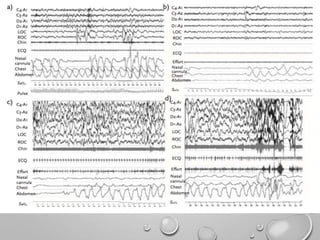
Is scored where there is >90% drop in airflow
compared to pre-event baseline for >90% of the
duration of the event, lasting at least two missed
breaths, with continued effort in chest and
abdomen.
PHYSIOPATHOLOGY
Pathophysiology:
Thus, it appears that childhood OSA is a dynamic process resulting from
a combination of structural and neuromotor abnormalities rather than
from structural abnormalities alone.
These predisposing factors occur as part of a spectrum: In some children
(e.g., those with craniofacial anomalies), structural abnormalities
predominate, whereas in others (e.g., those with cerebral palsy),
neuromuscular factors predominate.
In otherwise healthy children with adenotonsillar hypertrophy,
neuromuscular abnormalities are probably subtle.
Gozal D., Simakajornboon N., Holbrook C.R.: Secular trends in obesity
and parentally reported daytime sleepiness among children referred to
a pediatric sleep center for snoring and suspected sleep-disordered
breathing (SDB). Sleep. 29:A74 2006
Diagnosis
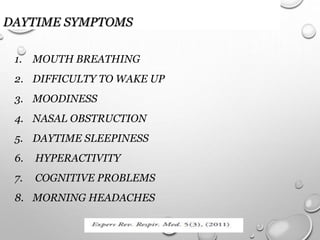
DAYTIME SYMPTOMS
1. MOUTH BREATHING
2. DIFFICULTY TO WAKE UP
3. MOODINESS
4. NASAL OBSTRUCTION
5. DAYTIME SLEEPINESS
6. HYPERACTIVITY
7. COGNITIVE PROBLEMS
8. MORNING HEADACHES
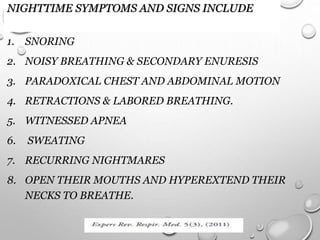
NIGHTTIME SYMPTOMS AND SIGNS INCLUDE
1. SNORING
2. NOISY BREATHING & SECONDARY ENURESIS
3. PARADOXICAL CHEST AND ABDOMINAL MOTION
4. RETRACTIONS & LABORED BREATHING.
5. WITNESSED APNEA
6. SWEATING
7. RECURRING NIGHTMARES
8. OPEN THEIR MOUTHS AND HYPEREXTEND THEIR
NECKS TO BREATHE.
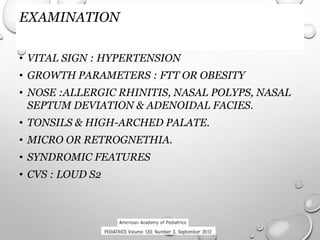
EXAMINATION
• VITAL SIGN : HYPERTENSION
• GROWTH PARAMETERS : FTT OR OBESITY
• NOSE :ALLERGIC RHINITIS, NASAL POLYPS, NASAL
SEPTUM DEVIATION & ADENOIDAL FACIES.
• TONSILS & HIGH-ARCHED PALATE.
• MICRO OR RETROGNETHIA.
• SYNDROMIC FEATURES
• CVS : LOUD S2
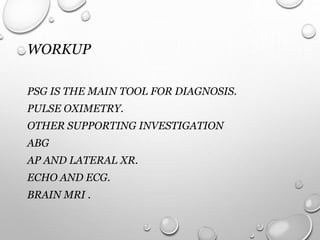
WORKUP
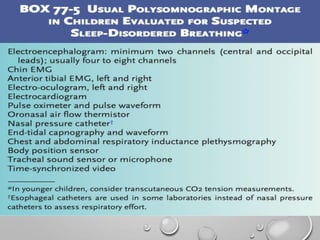
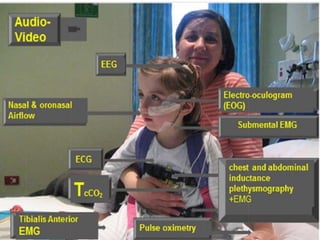
PSG IS THE MAIN TOOL FOR DIAGNOSIS.
PULSE OXIMETRY.
OTHER SUPPORTING INVESTIGATION
ABG
AP AND LATERAL XR.
ECHO AND ECG.
BRAIN MRI .
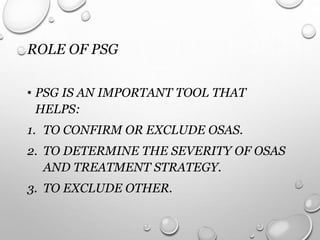
ROLE OF PSG
• PSG IS AN IMPORTANT TOOL THAT
HELPS:
1. TO CONFIRM OR EXCLUDE OSAS.
2. TO DETERMINE THE SEVERITY OF OSAS
AND TREATMENT STRATEGY.
3. TO EXCLUDE OTHER.
OTHER OPTION?
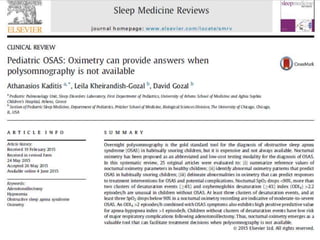
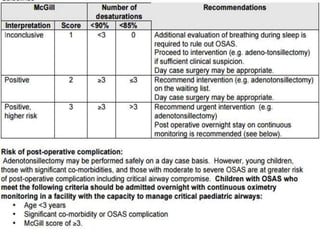
• OXIMETRY MAY BE USED AS A SCREENING
TOOL IN SELECTED POPULATIONS BUT
THERE IS NO EVIDENCES SUPPORTING THE
IDEA THAT OXIMETRY ALONE CAN REPLACE
PSG FOR OSAS.
• POSITIVE NOCTURNAL OXIMETRY MAY BE
RELATIVELY SPECIFIC FOR OSAS, BUT
NEGATIVE OXIMETRY DOES NOT EXCLUDE
THE DISORDER.
Treatment
Genral measures
Wt reduction
Avoidance of sedatives
Way of sleep
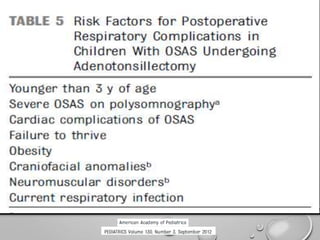
• TONSILLECTOMY AND ADENOIDECTOMY IS
USUALLY THE FIRST LINE OF TREATMENT
FOR PEDIATRIC OSA
• (EVIDENCE QUALITY: GRADE B )
•CPAP
- PATIENTS SHOULD BE REFERRED FOR CPAP
MANAGEMENT IF SYMPTOMS/ SIGNS OR
OBJECTIVE EVIDENCE OF OSAS PERSISTS
AFTER ADENOTONSILLECTOMY OR IF
ADENOTONSILLECTOMY IS NOT
PERFORMED. (EVIDENCE QUALITY: GRADE B
)
• TOPICAL INTRANASAL CORTICOSTEROIDS
FOR CHILDREN WITH MILD OSAS IN
WHOM ADENOTONSILLECTOMY IS
CONTRAINDICATED OR FOR CHILDREN
WITH MILD POSTOPERATIVE OSAS.
• (EVIDENCE QUALITY: GRADE B)
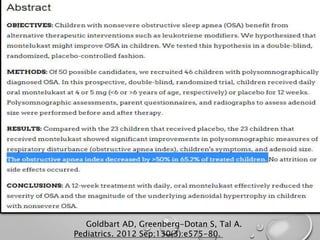
Pediatrics. 2012 Sep;130(3):e575-80.
Goldbart AD, Greenberg-Dotan S, Tal A.
•Introduction
•DS occurs in approximately 1.5 of 1000 births.
•10% of mentally retarded persons.
•DS children commonly have otolaryngologic
problems.
•They also fall into the group of children with
craniofacial and neurologic anomalies which
predispose them to OSA.
•Small midface and cranium
•Relatively narrow nasopharynx
•Marcroglossia
•Hypotonia
•Tendency for obesity
•Relatively small larynx
•In addition, given their congenital heart
defects, they are already predisposed to cor
pulmonale.
•Known complication of prolonged OSA (part
of the Pickwickian syndrome).
•Because of these factors, the incidence
of OSA in patients with DS has been
estimated to be from 54% to 100%
•Summary
•T&A is successful in the majority of patients with Down
Syndrome (69%).
•More aggressive intervention such as CPAP,
tracheostomy are necessary in some patients
•Preoperative evaluation should include assessment for
cardiac, thyroid, and cervical abnormalities.
•Surgical planning should be based on the severity of
disease.
•Follow up sleep studies are indicated to evaluate for the
need for more aggressive treatment in patients with
persistent symptoms.
•DS patients should be admitted post-operatively as
persistent OSA and other complications are common.
•ICU monitoring is often necessary
REFERENCES
• CLINICAL PRACTICE GUIDELINE DIAGNOSIS AND MANAGEMENT OF
CHILDHOOD OBSTRUCTIVE SLEEP APNEA SYNDROME PEDIATRICS
VOLUME 130, NUMBER 3, SEPTEMBER 2012 .
• KENDIK PEDIATRIC PULMONOLOGY
• A. KADITIS ET AL. / SLEEP MEDICINE REVIEWS 27 (2016).
• PEDIATRICS. 2012 SEP;130(3): MONTELUKAST FOR CHILDREN WITH
OBSTRUCTIVE SLEEP APNEA: A DOUBLE-BLIND, PLACEBO-
CONTROLLED STUDY.
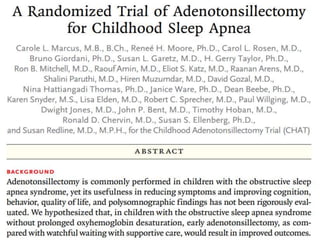
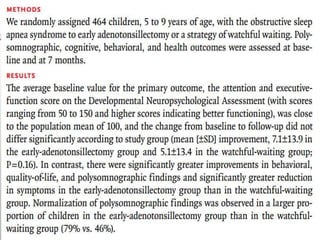
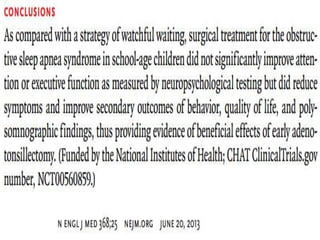
• N ENGL J MED. 2013 MAY 21. A RANDOMIZED TRIAL OF
ADENOTONSILLECTOMY FOR CHILDHOOD SLEEP APNEA.
THANKSA LOT ANDHAVEANICE
DAY

Obstructive sleep apnoea

  • 1.
  • 2.
    Sleep-disordered breathing (SDB)refers to the clinical spectrum of repetitive episodes of complete or partial obstruction of the airway during sleep that disrupt nocturnal respiration and sleep architecture.
  • 3.
    •Primary Snoring (PS) •Snoringwithout obstructive apnea, frequent arousals from sleep, or gas exchange abnormalities. •Obstructive Hypoventilation Syndrome (OHS) •Persistent partial upper airway obstruction associated with gas exchange abnormalities, rather than discrete, cyclic apneas.
  • 4.
    •Upper Airway ResistanceSyndrome (UARS) •Increasingly negative intrathoracic pressures during inspiration that lead to arousals and sleep fragmentation.
  • 5.
    •Obstructive sleep apnea(OSA) •Disorder of breathing during sleep characterized by prolonged partial upper airway obstruction and/or intermittent complete obstruction. •Disrupts normal ventilation. •Disrupts normal sleep patterns
  • 6.
    OSA common inyoung children, with a peak prevalence around 2 to 8 years, and subsequent declines in frequency. is currently estimated to affect approximately 2% to 3% of young children..
  • 7.
    Is scored wherethere is >90% drop in airflow compared to pre-event baseline for >90% of the duration of the event, lasting at least two missed breaths, with continued effort in chest and abdomen.
  • 8.
  • 9.
    Pathophysiology: Thus, it appearsthat childhood OSA is a dynamic process resulting from a combination of structural and neuromotor abnormalities rather than from structural abnormalities alone. These predisposing factors occur as part of a spectrum: In some children (e.g., those with craniofacial anomalies), structural abnormalities predominate, whereas in others (e.g., those with cerebral palsy), neuromuscular factors predominate. In otherwise healthy children with adenotonsillar hypertrophy, neuromuscular abnormalities are probably subtle. Gozal D., Simakajornboon N., Holbrook C.R.: Secular trends in obesity and parentally reported daytime sleepiness among children referred to a pediatric sleep center for snoring and suspected sleep-disordered breathing (SDB). Sleep. 29:A74 2006
  • 12.
  • 13.
    DAYTIME SYMPTOMS 1. MOUTHBREATHING 2. DIFFICULTY TO WAKE UP 3. MOODINESS 4. NASAL OBSTRUCTION 5. DAYTIME SLEEPINESS 6. HYPERACTIVITY 7. COGNITIVE PROBLEMS 8. MORNING HEADACHES
  • 14.
    NIGHTTIME SYMPTOMS ANDSIGNS INCLUDE 1. SNORING 2. NOISY BREATHING & SECONDARY ENURESIS 3. PARADOXICAL CHEST AND ABDOMINAL MOTION 4. RETRACTIONS & LABORED BREATHING. 5. WITNESSED APNEA 6. SWEATING 7. RECURRING NIGHTMARES 8. OPEN THEIR MOUTHS AND HYPEREXTEND THEIR NECKS TO BREATHE.
  • 15.
    EXAMINATION • VITAL SIGN: HYPERTENSION • GROWTH PARAMETERS : FTT OR OBESITY • NOSE :ALLERGIC RHINITIS, NASAL POLYPS, NASAL SEPTUM DEVIATION & ADENOIDAL FACIES. • TONSILS & HIGH-ARCHED PALATE. • MICRO OR RETROGNETHIA. • SYNDROMIC FEATURES • CVS : LOUD S2
  • 18.
    WORKUP PSG IS THEMAIN TOOL FOR DIAGNOSIS. PULSE OXIMETRY. OTHER SUPPORTING INVESTIGATION ABG AP AND LATERAL XR. ECHO AND ECG. BRAIN MRI .
  • 19.
    ROLE OF PSG •PSG IS AN IMPORTANT TOOL THAT HELPS: 1. TO CONFIRM OR EXCLUDE OSAS. 2. TO DETERMINE THE SEVERITY OF OSAS AND TREATMENT STRATEGY. 3. TO EXCLUDE OTHER.
  • 23.
    OTHER OPTION? • OXIMETRYMAY BE USED AS A SCREENING TOOL IN SELECTED POPULATIONS BUT THERE IS NO EVIDENCES SUPPORTING THE IDEA THAT OXIMETRY ALONE CAN REPLACE PSG FOR OSAS. • POSITIVE NOCTURNAL OXIMETRY MAY BE RELATIVELY SPECIFIC FOR OSAS, BUT NEGATIVE OXIMETRY DOES NOT EXCLUDE THE DISORDER.
  • 26.
  • 27.
    • TONSILLECTOMY ANDADENOIDECTOMY IS USUALLY THE FIRST LINE OF TREATMENT FOR PEDIATRIC OSA • (EVIDENCE QUALITY: GRADE B )
  • 32.
    •CPAP - PATIENTS SHOULDBE REFERRED FOR CPAP MANAGEMENT IF SYMPTOMS/ SIGNS OR OBJECTIVE EVIDENCE OF OSAS PERSISTS AFTER ADENOTONSILLECTOMY OR IF ADENOTONSILLECTOMY IS NOT PERFORMED. (EVIDENCE QUALITY: GRADE B )
  • 33.
    • TOPICAL INTRANASALCORTICOSTEROIDS FOR CHILDREN WITH MILD OSAS IN WHOM ADENOTONSILLECTOMY IS CONTRAINDICATED OR FOR CHILDREN WITH MILD POSTOPERATIVE OSAS. • (EVIDENCE QUALITY: GRADE B)
  • 34.
    Pediatrics. 2012 Sep;130(3):e575-80. GoldbartAD, Greenberg-Dotan S, Tal A.
  • 35.
    •Introduction •DS occurs inapproximately 1.5 of 1000 births. •10% of mentally retarded persons. •DS children commonly have otolaryngologic problems.
  • 36.
    •They also fallinto the group of children with craniofacial and neurologic anomalies which predispose them to OSA. •Small midface and cranium •Relatively narrow nasopharynx •Marcroglossia •Hypotonia •Tendency for obesity •Relatively small larynx
  • 37.
    •In addition, giventheir congenital heart defects, they are already predisposed to cor pulmonale. •Known complication of prolonged OSA (part of the Pickwickian syndrome). •Because of these factors, the incidence of OSA in patients with DS has been estimated to be from 54% to 100%
  • 38.
    •Summary •T&A is successfulin the majority of patients with Down Syndrome (69%). •More aggressive intervention such as CPAP, tracheostomy are necessary in some patients •Preoperative evaluation should include assessment for cardiac, thyroid, and cervical abnormalities. •Surgical planning should be based on the severity of disease. •Follow up sleep studies are indicated to evaluate for the need for more aggressive treatment in patients with persistent symptoms. •DS patients should be admitted post-operatively as persistent OSA and other complications are common. •ICU monitoring is often necessary
  • 40.
    REFERENCES • CLINICAL PRACTICEGUIDELINE DIAGNOSIS AND MANAGEMENT OF CHILDHOOD OBSTRUCTIVE SLEEP APNEA SYNDROME PEDIATRICS VOLUME 130, NUMBER 3, SEPTEMBER 2012 . • KENDIK PEDIATRIC PULMONOLOGY • A. KADITIS ET AL. / SLEEP MEDICINE REVIEWS 27 (2016). • PEDIATRICS. 2012 SEP;130(3): MONTELUKAST FOR CHILDREN WITH OBSTRUCTIVE SLEEP APNEA: A DOUBLE-BLIND, PLACEBO- CONTROLLED STUDY. • N ENGL J MED. 2013 MAY 21. A RANDOMIZED TRIAL OF ADENOTONSILLECTOMY FOR CHILDHOOD SLEEP APNEA.
  • 41.

Editor's Notes