By
Ebtessam Nada
associate professor of Audiology
Zagazig University
It is well recognized that hearing is critical for
language and speech development,
communication, and learning. The earlier
hearing loss occurs in a child's life, the more
serious are the effects on the child's
development. Similarly, the earlier the problem
is identified and intervention begun, the less
serious is the ultimate impact (JCIH, 2000).
"critical period" for primary language acquisition is
a certain developmental stage at which the
auditory signals will be received and utilized for
pre-linguistic activities (Downs and Sterritt, 1964).
This period mentioned by some researchers as 3 to 4
years after birth (NIH, 1993). While others
proposed a critical period under 2 years of age
during which access to spoken language is
essential for normal language development (Birgit
May- Mederake 2012).
Objectives
The aims of this study were to explore the
age within this critical period that is
considered really early that a hearing
impaired child can be as nearly normal as
possible and also, to find out if there is a
difference between acoustic and electric
types of stimulation.
Patients and methods
We included 58 children from those attending
the Audiology and Phoniatric Units, Zagazig
University Hospital, in the period from 2006 to
2012. The age range, at first seen, was between 2
and 24 months.
Older children were presented by lack of
response to loud sounds or DLD. On the other
hand, positive family history of hearing loss
contributed to very early presentation of other
cases.
 Absent response in ABR with failed
TEOAEs.
 Regular use of binaural fully digital hearing
aids with satisfactory aided response.
 Assessment of hearing aids performance
was done on regular basis using aided
behavioral pure tone audiometry and
functional gain assessment according to the
age of the child.
patients were divided into 4 groups according to
time of intervention and type of stimulation
 Group (A) (16 children) were amplified before
the age of 6 months,
 group (B) (22 children) were amplified between
6 and 12 months of age.
 group (C) (14 children) were amplified at age of
12 to 24 months.
 Group (D) are 6 children with Unilateral CI
implanted by the age of 4 years after failure of
their HAs. Their delay was due to routine
procedures for health insurance.
 Language stimulation programs were included
with regular attendance from all children. It
included active therapy sessions which aimed at:
improving cognitive abilities, increasing the size of
active vocabularies, increasing the length of
sentences, correction of syntactic and phonologic
errors.
 Parents are informed about the normal growth of
language and activities to encourage speech and
language development.
Regular language and speech assessment were
used as informative results for efficiency of
the intervention program. However,
assessments involved in this study were
those done around school age (6 ± 1.2 years).
Language assessment was done using the
Standardized Arabic Language Test (Kotby et al.,
1995a) which measures receptive and expressive
language skills giving a total language age in
years.
Speech analysis was performed using Speech
assessment protocol which includes analysis of
supra-segmental phonology (rate, stress and
tonality), segmental phonology (consonants and
vowels), nasal resonance and general
intelligibility of speech as well as voice giving
scores that ranged from 0 (normal) to 4
(denoting severe abnormality) except for general
intelligibility where (score 4 means normal and 0
means severely un-intelligible speech) (Kotby et
al., 1995b)
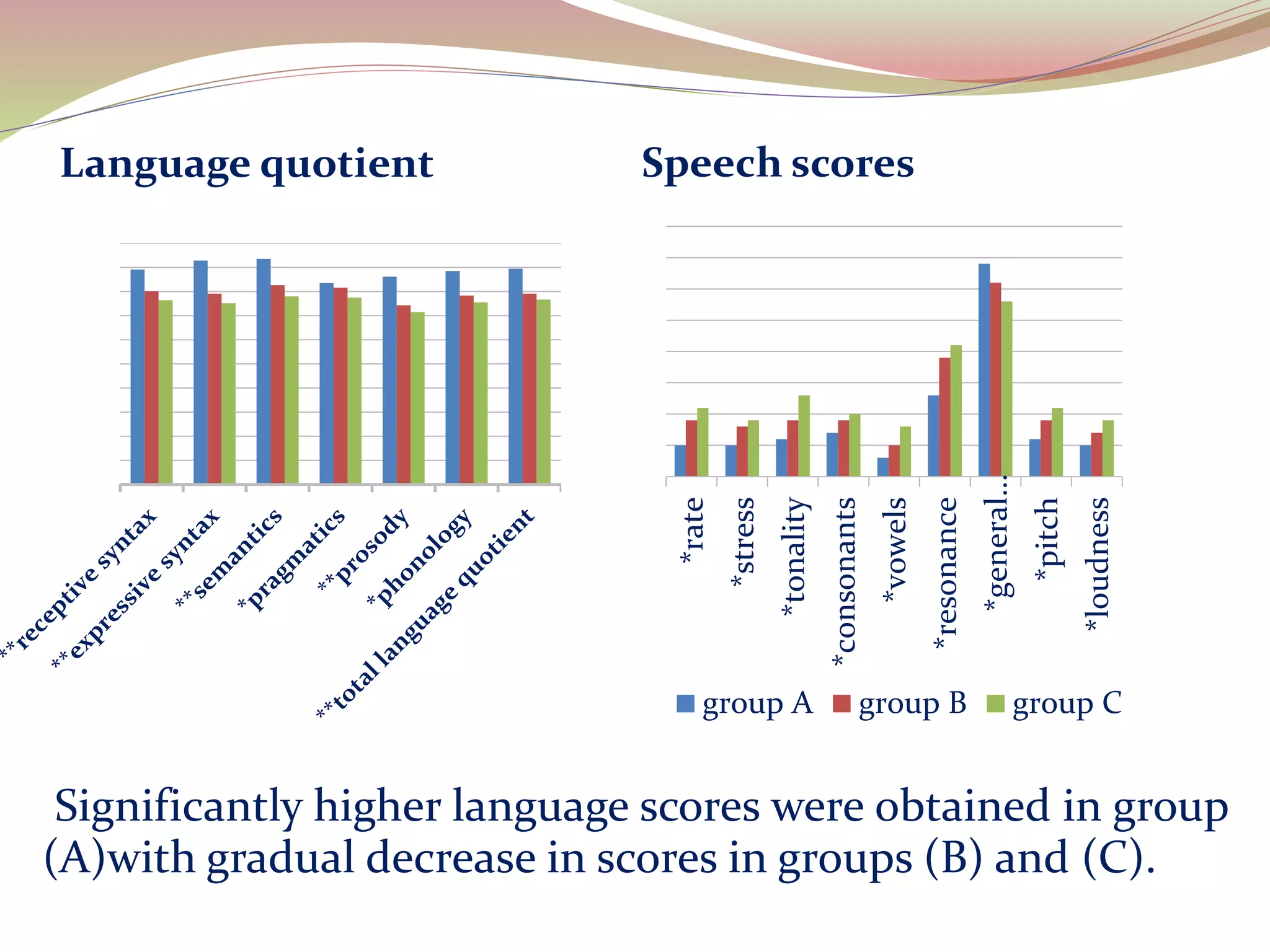
Significantly higher language scores were obtained in group
(A)with gradual decrease in scores in groups (B) and (C).
Language quotient Speech scores
*rate
*stress
*tonality
*consonants
*vowels
*resonance
*general…
*pitch
*loudness
group A group B group C
Language quotient
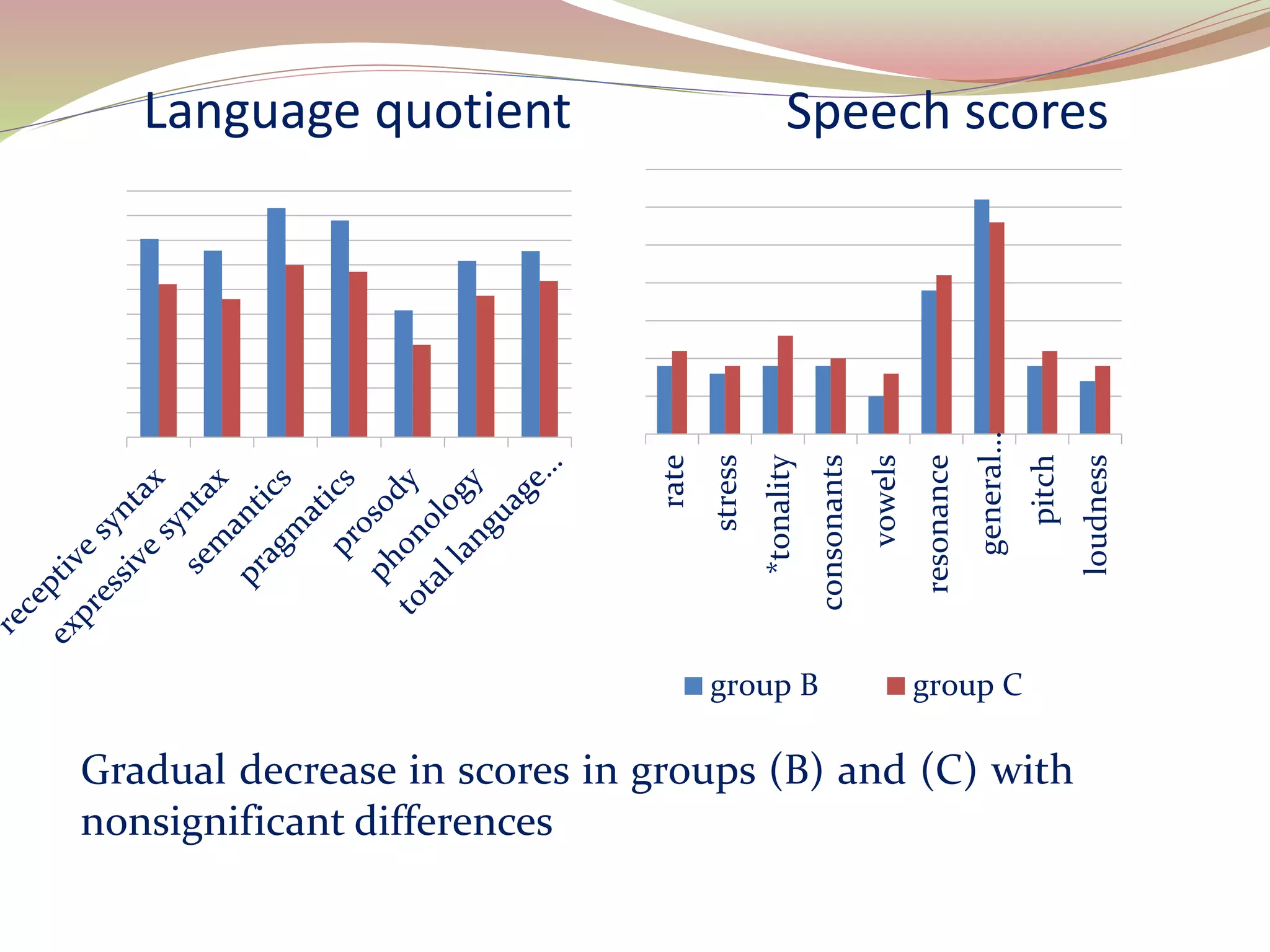
Gradual decrease in scores in groups (B) and (C) with
nonsignificant differences
Speech scores
rate
stress
*tonality
consonants
vowels
resonance
general…
pitch
loudness
group B group C
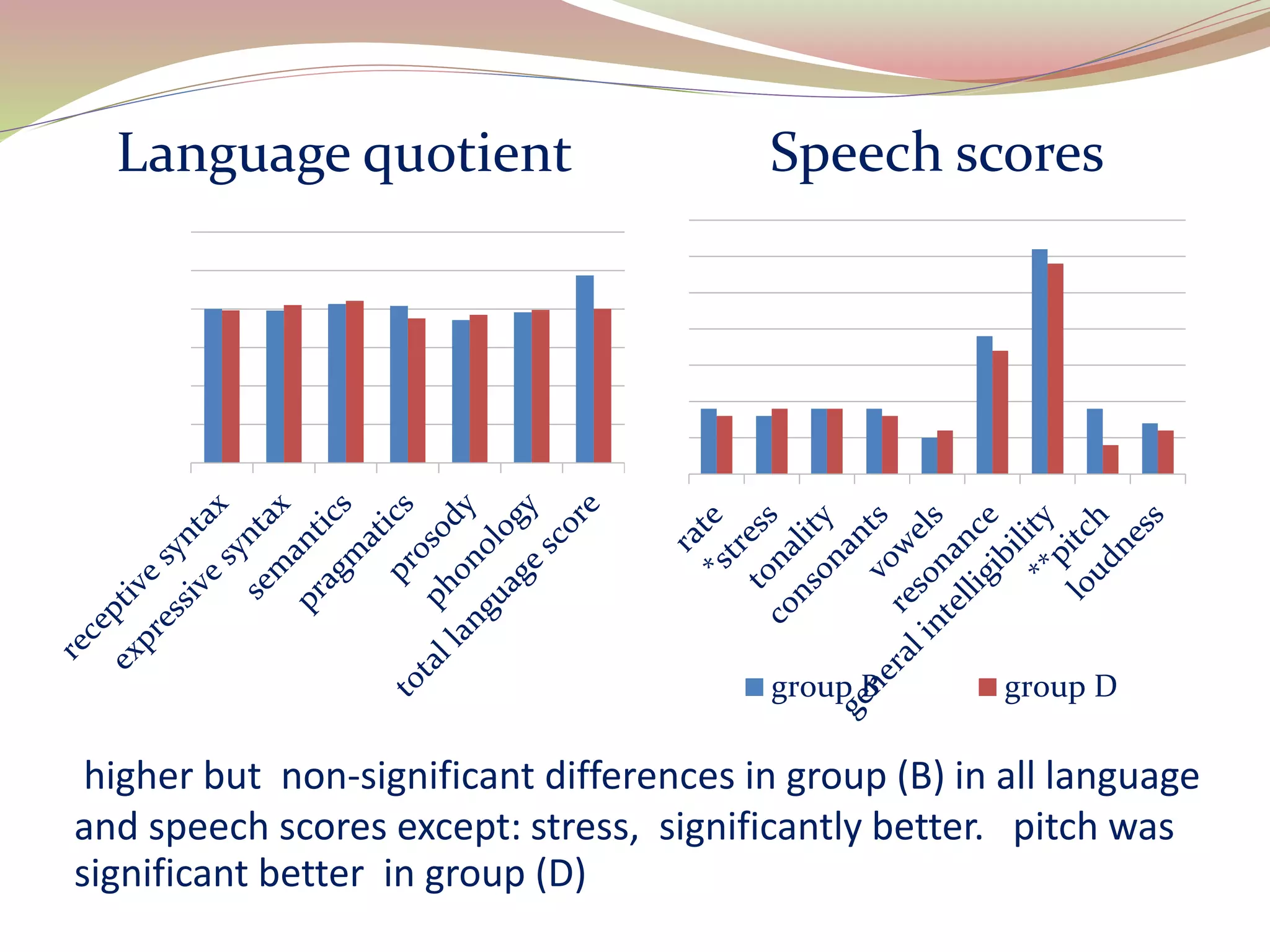
higher but non-significant differences in group (B) in all language
and speech scores except: stress, significantly better. pitch was
significant better in group (D)
Language quotient Speech scores
group B group D
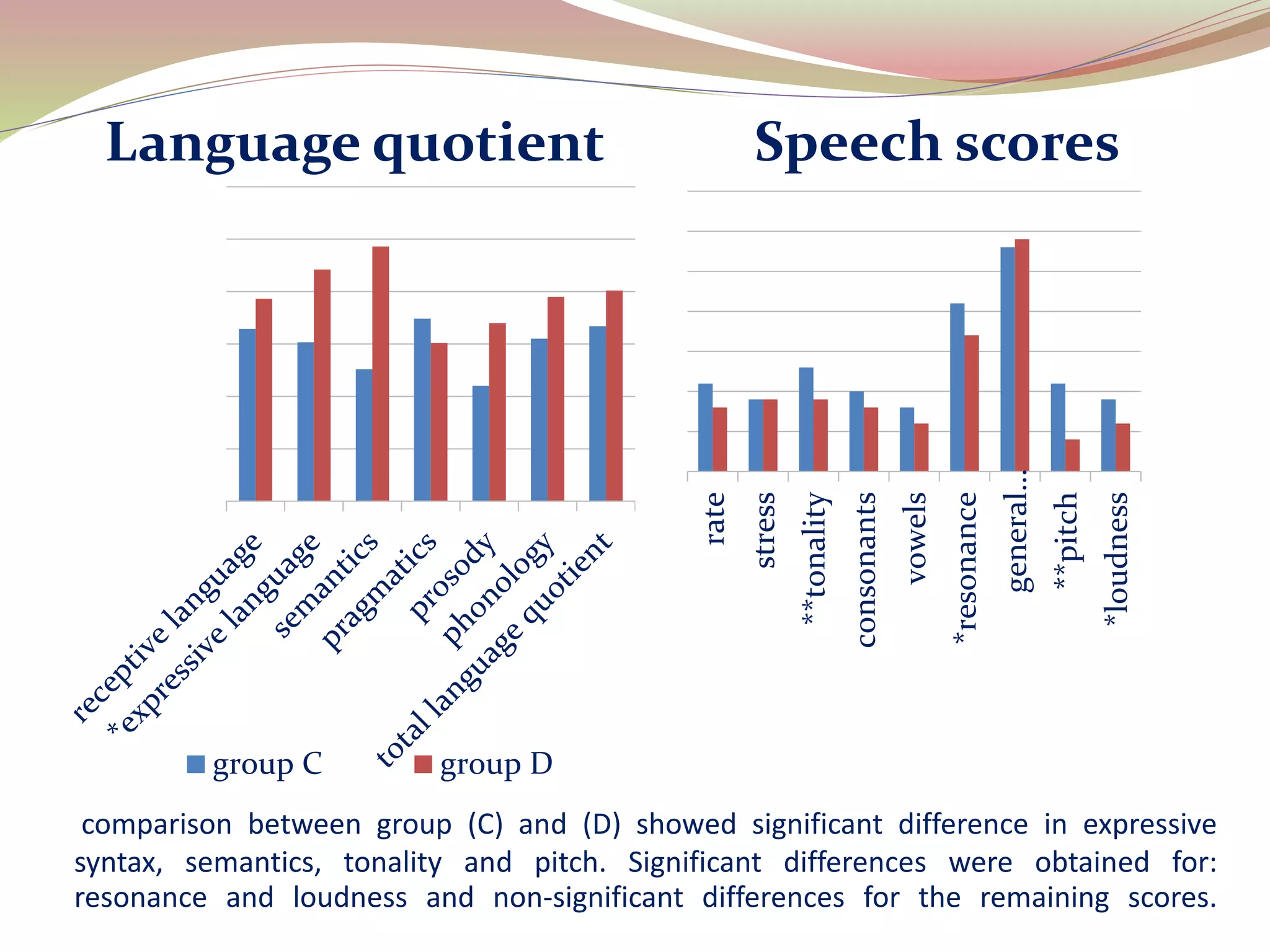
comparison between group (C) and (D) showed significant difference in expressive
syntax, semantics, tonality and pitch. Significant differences were obtained for:
resonance and loudness and non-significant differences for the remaining scores.
Language quotient Speech scores
group C group D
rate
stress
**tonality
consonants
vowels
*resonance
general…
**pitch
*loudness
 The number of neurons in the brain actually decreases
throughout development however, neural connections
grow, the pathways become more efficient and the
supporting structures in the brain increase (Garlick,
2002).
 These neural connections increase rapidly in the first 2
years of life until the synaptic connections are double
that of adult brain. This is followed by pruning of
synapses through the process of apoptosis or
programmed cell death (Boatman et. Al., 1999).
During the critical period, the brain optimizes the
overproduction of synapses present at birth. and the
neuronal pathways are refined based on which synapses are
active and receiving transmission. It is a "use it or lose it"
phenomenon (Purves et. Al., 2008).
The principles "use it or lose it" and "use it and grow it" are
based on the principles of plasticity of the brain. The
sensory experience, stimulation and language exposure
during this period determine synaptogenesis, myelination
and neuronal connectivity. However, this is not continuous
for ever as when mylination increases plasticity decreases.
(Nandini, 2005).
Conclusions
 Best language and speech results are obtained with
hearing impairment detection and intervention
before 6 months of age. Thus emerges the
importance of neonatal hearing screening.
 After 6 months up to 2 years language and speech
scores are non significantly different.
 Language acquisition is still possible even after
critical period has passed in case we replaced
acoustic stimulation with the electrical one. Thus,
beyond 2 years of age electrical stimulation is
considered the only way for better language
outcomes.
Value of early intervention for hearing impairment on speech and language aquizition

Value of early intervention for hearing impairment on speech and language aquizition

  • 1.
    By Ebtessam Nada associate professorof Audiology Zagazig University
  • 2.
    It is wellrecognized that hearing is critical for language and speech development, communication, and learning. The earlier hearing loss occurs in a child's life, the more serious are the effects on the child's development. Similarly, the earlier the problem is identified and intervention begun, the less serious is the ultimate impact (JCIH, 2000).
  • 3.
    "critical period" forprimary language acquisition is a certain developmental stage at which the auditory signals will be received and utilized for pre-linguistic activities (Downs and Sterritt, 1964). This period mentioned by some researchers as 3 to 4 years after birth (NIH, 1993). While others proposed a critical period under 2 years of age during which access to spoken language is essential for normal language development (Birgit May- Mederake 2012).
  • 4.
    Objectives The aims ofthis study were to explore the age within this critical period that is considered really early that a hearing impaired child can be as nearly normal as possible and also, to find out if there is a difference between acoustic and electric types of stimulation.
  • 5.
    Patients and methods Weincluded 58 children from those attending the Audiology and Phoniatric Units, Zagazig University Hospital, in the period from 2006 to 2012. The age range, at first seen, was between 2 and 24 months. Older children were presented by lack of response to loud sounds or DLD. On the other hand, positive family history of hearing loss contributed to very early presentation of other cases.
  • 6.
     Absent responsein ABR with failed TEOAEs.  Regular use of binaural fully digital hearing aids with satisfactory aided response.  Assessment of hearing aids performance was done on regular basis using aided behavioral pure tone audiometry and functional gain assessment according to the age of the child.
  • 7.
    patients were dividedinto 4 groups according to time of intervention and type of stimulation  Group (A) (16 children) were amplified before the age of 6 months,  group (B) (22 children) were amplified between 6 and 12 months of age.  group (C) (14 children) were amplified at age of 12 to 24 months.  Group (D) are 6 children with Unilateral CI implanted by the age of 4 years after failure of their HAs. Their delay was due to routine procedures for health insurance.
  • 8.
     Language stimulationprograms were included with regular attendance from all children. It included active therapy sessions which aimed at: improving cognitive abilities, increasing the size of active vocabularies, increasing the length of sentences, correction of syntactic and phonologic errors.  Parents are informed about the normal growth of language and activities to encourage speech and language development.
  • 9.
    Regular language andspeech assessment were used as informative results for efficiency of the intervention program. However, assessments involved in this study were those done around school age (6 ± 1.2 years).
  • 10.
    Language assessment wasdone using the Standardized Arabic Language Test (Kotby et al., 1995a) which measures receptive and expressive language skills giving a total language age in years.
  • 11.
    Speech analysis wasperformed using Speech assessment protocol which includes analysis of supra-segmental phonology (rate, stress and tonality), segmental phonology (consonants and vowels), nasal resonance and general intelligibility of speech as well as voice giving scores that ranged from 0 (normal) to 4 (denoting severe abnormality) except for general intelligibility where (score 4 means normal and 0 means severely un-intelligible speech) (Kotby et al., 1995b)
  • 13.
    Significantly higher languagescores were obtained in group (A)with gradual decrease in scores in groups (B) and (C). Language quotient Speech scores *rate *stress *tonality *consonants *vowels *resonance *general… *pitch *loudness group A group B group C
  • 14.
    Language quotient Gradual decreasein scores in groups (B) and (C) with nonsignificant differences Speech scores rate stress *tonality consonants vowels resonance general… pitch loudness group B group C
  • 15.
    higher but non-significantdifferences in group (B) in all language and speech scores except: stress, significantly better. pitch was significant better in group (D) Language quotient Speech scores group B group D
  • 16.
    comparison between group(C) and (D) showed significant difference in expressive syntax, semantics, tonality and pitch. Significant differences were obtained for: resonance and loudness and non-significant differences for the remaining scores. Language quotient Speech scores group C group D rate stress **tonality consonants vowels *resonance general… **pitch *loudness
  • 17.
     The numberof neurons in the brain actually decreases throughout development however, neural connections grow, the pathways become more efficient and the supporting structures in the brain increase (Garlick, 2002).  These neural connections increase rapidly in the first 2 years of life until the synaptic connections are double that of adult brain. This is followed by pruning of synapses through the process of apoptosis or programmed cell death (Boatman et. Al., 1999).
  • 18.
    During the criticalperiod, the brain optimizes the overproduction of synapses present at birth. and the neuronal pathways are refined based on which synapses are active and receiving transmission. It is a "use it or lose it" phenomenon (Purves et. Al., 2008). The principles "use it or lose it" and "use it and grow it" are based on the principles of plasticity of the brain. The sensory experience, stimulation and language exposure during this period determine synaptogenesis, myelination and neuronal connectivity. However, this is not continuous for ever as when mylination increases plasticity decreases. (Nandini, 2005).
  • 19.
    Conclusions  Best languageand speech results are obtained with hearing impairment detection and intervention before 6 months of age. Thus emerges the importance of neonatal hearing screening.  After 6 months up to 2 years language and speech scores are non significantly different.  Language acquisition is still possible even after critical period has passed in case we replaced acoustic stimulation with the electrical one. Thus, beyond 2 years of age electrical stimulation is considered the only way for better language outcomes.