Downloaded 12 times




![Form
[has/have + past participle (V3)]
Example: “I have been to
France”
or “I’ve been to France”
This sentence means that you
went to France sometime in your
life.](https://image.slidesharecdn.com/presentandpastperfect-160418094058/85/Present-and-past-perfect-6-320.jpg)











![Form
[had + past participle (V3)]
Example:
I was late. The teacher had
given the test when I arrived.
I felt better after I had taken the
medicine.](https://image.slidesharecdn.com/presentandpastperfect-160418094058/85/Present-and-past-perfect-21-320.jpg)

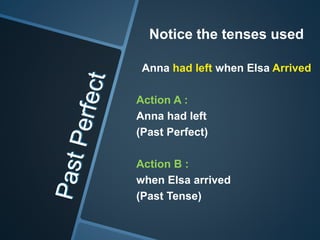


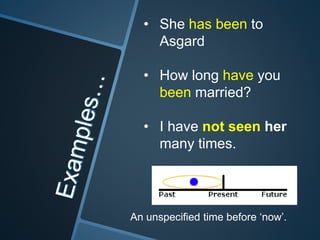
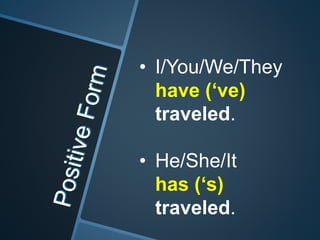
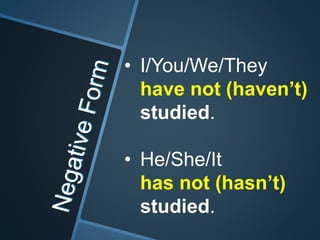
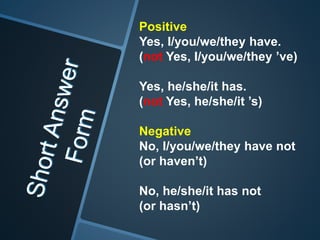
The Present Perfect tense is used to express actions that occurred at an unspecified time in the past or that began in the past and continue in the present. It uses the verb form "has/have + past participle" and refers to actions with relevance to the present. The Present Perfect can describe repeated actions and is used with time expressions like "today," "this week," or adverbs like "recently" and "yet." The Past Perfect tense expresses an action that was completed before another past action, using the form "had + past participle." It is used to show the order of two past events.


