Shoulder Arthroscopic Stabilisation.
Information for patients.
Dr Geoffrey Smith
Anatomic images courtesy of www.biodigital.com
What is shoulder arthroscopy?
• Keyhole surgery of the
shoulder joint.
• Many conditions are amenable
to arthroscopic treatment
• Usually performed under
general anaesthetic (asleep).
• An additional local anaesthetic
nerve block may be used
• The patient is then carefully
positioned on a special
operating table
What happens?
• Several small (0.5cm) incisions are made
• A camera and other instruments are inserted
• The camera has an angled lens which can be
rotated around to give a view all around
• We also change the camera position to get the
best possible view and angle for out working
instruments
• Visualisation is improved by running fluid into the
shoulder
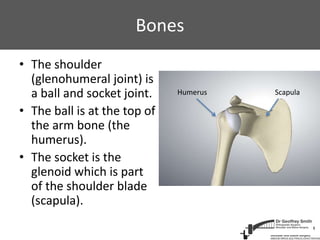
Bones
• The shoulder
(glenohumeral joint) is
a ball and socket joint.
• The ball is at the top of
the arm bone (the
humerus).
• The socket is the
glenoid which is part
of the shoulder blade
(scapula).
Humerus Scapula
Glenoid
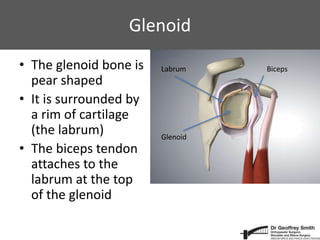
• The glenoid bone is
pear shaped
• It is surrounded by
a rim of cartilage
(the labrum)
• The biceps tendon
attaches to the
labrum at the top
of the glenoid
Labrum Biceps
Glenoid
Soft tissue
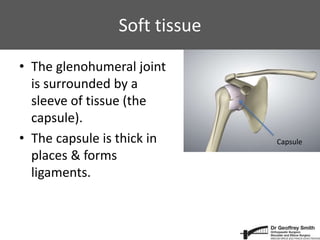
• The glenohumeral joint
is surrounded by a
sleeve of tissue (the
capsule).
• The capsule is thick in
places & forms
ligaments.
Capsule
What happens when a shoulder dislocates?
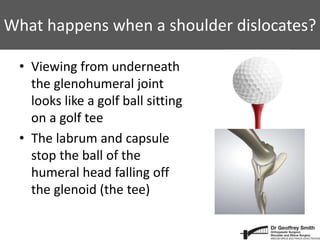
• Viewing from underneath
the glenohumeral joint
looks like a golf ball sitting
on a golf tee
• The labrum and capsule
stop the ball of the
humeral head falling off
the glenoid (the tee)
What happens when a shoulder dislocates?
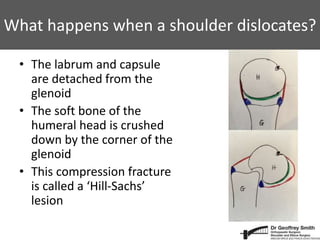
• The labrum and capsule
are detached from the
glenoid
• The soft bone of the
humeral head is crushed
down by the corner of the
glenoid
• This compression fracture
is called a ‘Hill-Sachs’
lesion
What happens when a shoulder dislocates?
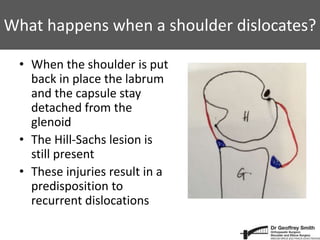
• When the shoulder is put
back in place the labrum
and the capsule stay
detached from the
glenoid
• The Hill-Sachs lesion is
still present
• These injuries result in a
predisposition to
recurrent dislocations
Repair
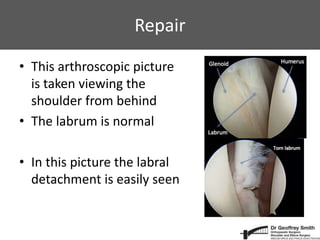
• This arthroscopic picture
is taken viewing the
shoulder from behind
• The labrum is normal
• In this picture the labral
detachment is easily seen
Repair
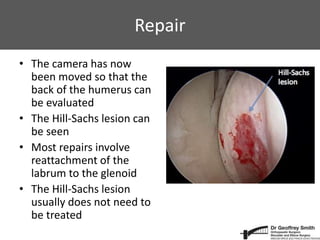
• The camera has now
been moved so that the
back of the humerus can
be evaluated
• The Hill-Sachs lesion can
be seen
• Most repairs involve
reattachment of the
labrum to the glenoid
• The Hill-Sachs lesion
usually does not need to
be treated
Repair
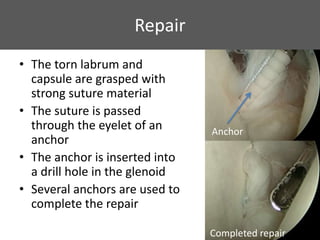
• The torn labrum and
capsule are grasped with
strong suture material
• The suture is passed
through the eyelet of an
anchor
• The anchor is inserted into
a drill hole in the glenoid
• Several anchors are used to
complete the repair
Anchor
Completed repair
After Surgery
• You usually go home on the same day or the
day after surgery
• A sling is worn for 6 weeks
• Strengthening is allowed after 6 weeks
• A return to full activities is expected after 4-6
months

Arthroscopic shoulder stabilisation patient information

  • 1.
    Shoulder Arthroscopic Stabilisation. Informationfor patients. Dr Geoffrey Smith Anatomic images courtesy of www.biodigital.com
  • 2.
    What is shoulderarthroscopy? • Keyhole surgery of the shoulder joint. • Many conditions are amenable to arthroscopic treatment • Usually performed under general anaesthetic (asleep). • An additional local anaesthetic nerve block may be used • The patient is then carefully positioned on a special operating table
  • 3.
    What happens? • Severalsmall (0.5cm) incisions are made • A camera and other instruments are inserted • The camera has an angled lens which can be rotated around to give a view all around • We also change the camera position to get the best possible view and angle for out working instruments • Visualisation is improved by running fluid into the shoulder
  • 4.
    Bones • The shoulder (glenohumeraljoint) is a ball and socket joint. • The ball is at the top of the arm bone (the humerus). • The socket is the glenoid which is part of the shoulder blade (scapula). Humerus Scapula
  • 5.
    Glenoid • The glenoidbone is pear shaped • It is surrounded by a rim of cartilage (the labrum) • The biceps tendon attaches to the labrum at the top of the glenoid Labrum Biceps Glenoid
  • 6.
    Soft tissue • Theglenohumeral joint is surrounded by a sleeve of tissue (the capsule). • The capsule is thick in places & forms ligaments. Capsule
  • 7.
    What happens whena shoulder dislocates? • Viewing from underneath the glenohumeral joint looks like a golf ball sitting on a golf tee • The labrum and capsule stop the ball of the humeral head falling off the glenoid (the tee)
  • 8.
    What happens whena shoulder dislocates? • The labrum and capsule are detached from the glenoid • The soft bone of the humeral head is crushed down by the corner of the glenoid • This compression fracture is called a ‘Hill-Sachs’ lesion
  • 9.
    What happens whena shoulder dislocates? • When the shoulder is put back in place the labrum and the capsule stay detached from the glenoid • The Hill-Sachs lesion is still present • These injuries result in a predisposition to recurrent dislocations
  • 10.
    Repair • This arthroscopicpicture is taken viewing the shoulder from behind • The labrum is normal • In this picture the labral detachment is easily seen
  • 11.
    Repair • The camerahas now been moved so that the back of the humerus can be evaluated • The Hill-Sachs lesion can be seen • Most repairs involve reattachment of the labrum to the glenoid • The Hill-Sachs lesion usually does not need to be treated
  • 12.
    Repair • The tornlabrum and capsule are grasped with strong suture material • The suture is passed through the eyelet of an anchor • The anchor is inserted into a drill hole in the glenoid • Several anchors are used to complete the repair Anchor Completed repair
  • 13.
    After Surgery • Youusually go home on the same day or the day after surgery • A sling is worn for 6 weeks • Strengthening is allowed after 6 weeks • A return to full activities is expected after 4-6 months