CASE STUDY of
ART GALLERY
Design Studio V
Group 3
Tofayel Ahmed (19228013)
Md Sadek Ahmed (18228006)
Chadni Akter (17228008)
Nishat Tasnim Tithy (18228001)
2
Contents of the Project
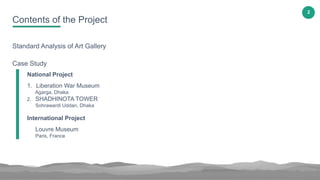
Case Study
National Project
1. Liberation War Museum
Agarga, Dhaka
2. SHADHINOTA TOWER
Sohrawardi Uddan, Dhaka
International Project
Louvre Museum
Paris, France
Standard Analysis of Art Gallery
ART GALLERY
STANDARD ANALYSIS
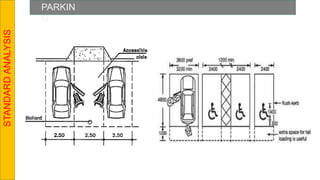
PARKIN
G
STANDARD
ANALYSIS
PARKIN
G
STANDARD
ANALYSIS
PARKIN
G
STANDARD
ANALYSIS
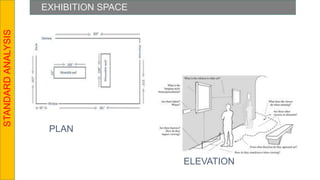
EXHIBITION SPACE
STANDARD
ANALYSIS
PLAN
ELEVATION
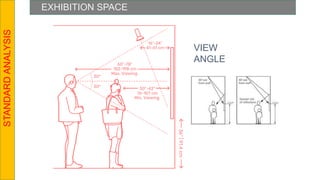
EXHIBITION SPACE
STANDARD
ANALYSIS
VIEW
ANGLE
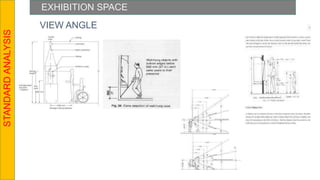
EXHIBITION SPACE
STANDARD
ANALYSIS
VIEW ANGLE
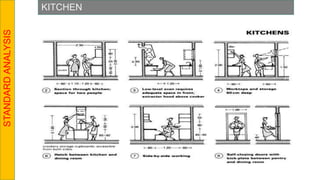
KITCHEN
STANDARD
ANALYSIS
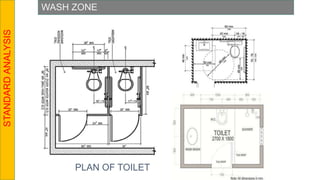
WASH ZONE
STANDARD
ANALYSIS
PLAN OF TOILET
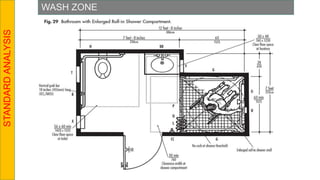
WASH ZONE
STANDARD
ANALYSIS
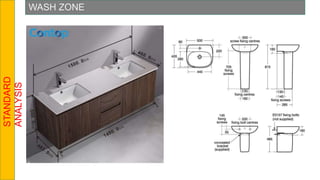
WASH ZONE
STANDARD
ANALYSIS
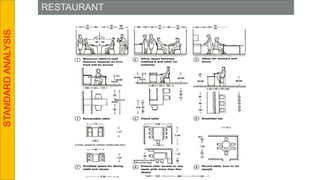
RESTAURANT
STANDARD
ANALYSIS
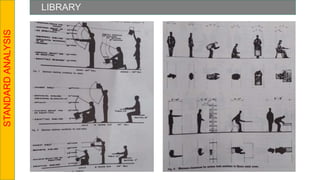
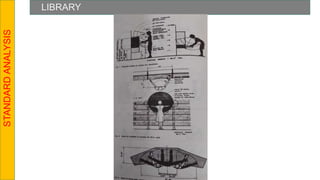
LIBRARY
STANDARD
ANALYSIS
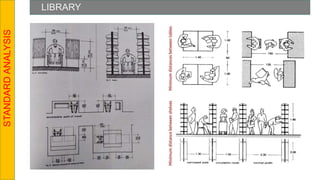
LIBRARY
STANDARD
ANALYSIS
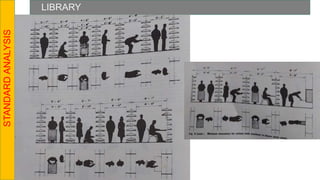
LIBRARY
STANDARD
ANALYSIS
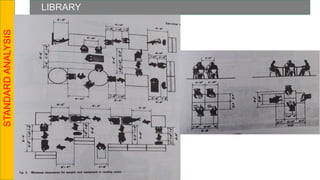
LIBRARY
STANDARD
ANALYSIS
LIBRARY
STANDARD
ANALYSIS
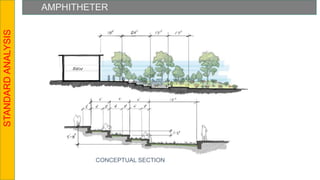
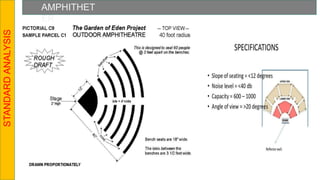
AMPHITHETER
STANDARD
ANALYSIS
CONCEPTUAL SECTION
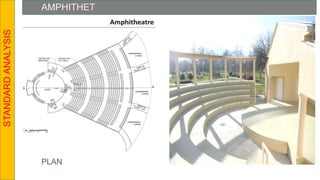
AMPHITHET
ER
STANDARD
ANALYSIS
PLAN
AMPHITHET
ER
STANDARD
ANALYSIS
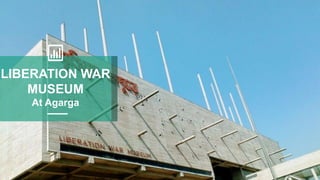
LIBERATION WAR
MUSEUM
At Agarga
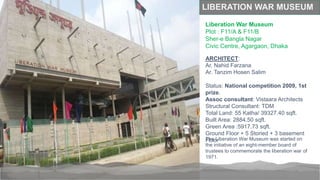
LIBERATION WAR MUSEUM
Liberation War Museum
Plot : F11/A & F11/B
Sher-e Bangla Nagar
Civic Centre, Agargaon, Dhaka
The Liberation War Museum was started on
the initiative of an eight-member board of
trustees to commemorate the liberation war of
1971.
ARCHITECT:
Ar. Nahid Farzana
Ar. Tanzim Hosen Salim
Status: National competition 2009, 1st
prize.
Assoc consultant: Vistaara Architects
Structural Consultant: TDM
Total Land: 55 Katha/ 39327.40 sqft.
Built Area: 2884.50 sqft.
Green Area :5917.73 sqft.
Ground Floor + 5 Storied + 3 basement
Floor
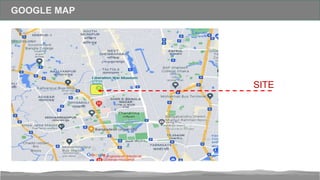
GOOGLE MAP
SITE
26
Concept
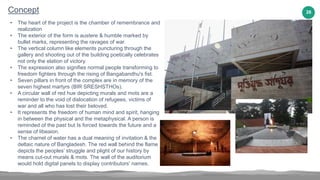
• The heart of the project is the chamber of remembrance and
realization
• The exterior of the form is austere & humble marked by
bullet marks, representing the ravages of war.
• The vertical column like elements puncturing through the
gallery and shooting out of the building poetically celebrates
not only the elation of victory.
• The expression also signifies normal people transforming to
freedom fighters through the rising of Bangabandhu's fist.
• Seven pillars in front of the complex are in memory of the
seven highest martyrs (BIR SRESHSTHOs).
• A circular wall of red hue depicting murals and mots are a
reminder to the void of dislocation of refugees, victims of
war and all who has lost their beloved.
• It represents the freedom of human mind and spirit, hanging
in between the physical and the metaphysical. A person is
reminded of the past but Is forced towards the future and a
sense of libeaion.
• The charnel of water has a dual meaning of invitation & the
deltaic nature of Bangladesh. The red wall behind the flame
depicts the peoples’ struggle and plight of our history by
means cut-out murals & mots. The wall of the auditorium
would hold digital panels to display contributors' names.
27
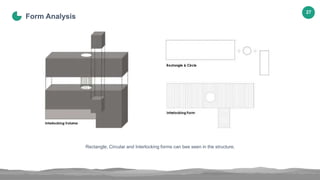
Form Analysis
Rectangle, Circular and Interlocking forms can bee seen in the structure.
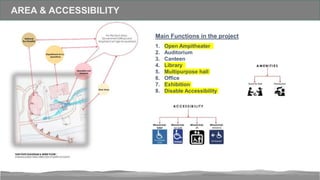
AREA & ACCESSIBILITY
Main Functions in the project
1. Open Ampitheater
2. Auditorium
3. Canteen
4. Library
5. Multipurpose hall
6. Office
7. Exhibition
8. Disable Accessibility
29
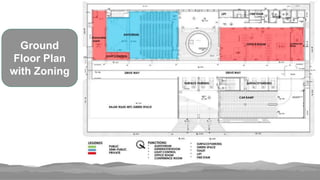
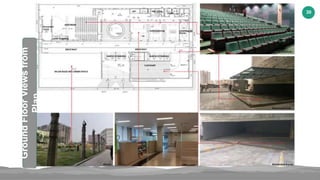
Ground
Floor Plan
with Zoning
30
Ground
Floor
Views
from
Plan
31
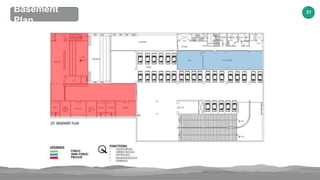
Basement
Plan
32
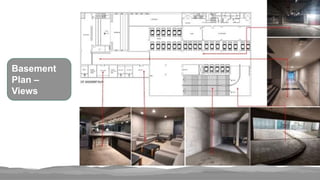
Basement
Plan –
Views
33
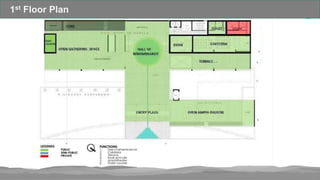
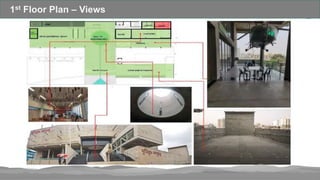
1st Floor Plan
34
1st Floor Plan – Views
35
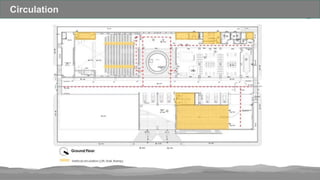
Circulation
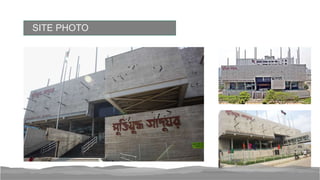
SITE PHOTO
SITE PHOTO
SITE PHOTO
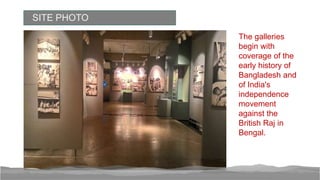
The galleries
begin with
coverage of the
early history of
Bangladesh and
of India's
independence
movement
against the
British Raj in
Bengal.
39
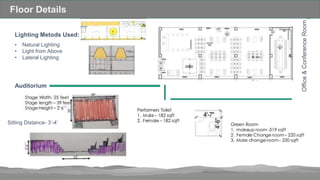
Floor Details
Lighting Metods Used:
• Natural Lighting
• Light from Above
• Lateral Lighting
Office
&
Conference
Room
Auditorium
Sitting Distance- 3’-4’
40
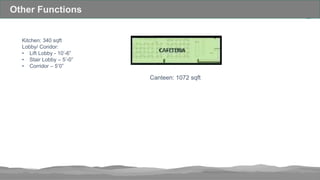
Other Functions
Kitchen: 340 sqft
Lobby/ Coridor:
• Lift Lobby - 10’-6”
• Stair Lobby – 5’-0”
• Corridor – 5’0”
Canteen: 1072 sqft
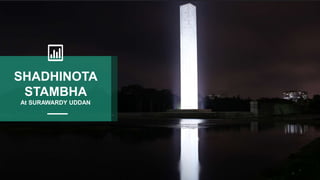
SHADHINOTA
STAMBHA
At SURAWARDY UDDAN
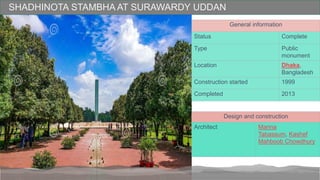
SHADHINOTA STAMBHA AT SURAWARDY UDDAN
General information
Status Complete
Type Public
monument
Location Dhaka,
Bangladesh
Construction started 1999
Completed 2013
Design and construction
Architect Marina
Tabassum, Kashef
Mahboob Chowdhury
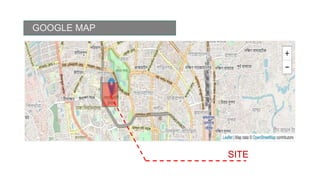
GOOGLE MAP
SITE
44
Concept
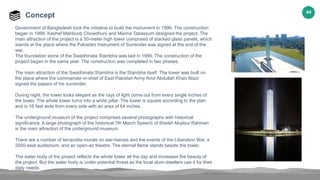
Government of Bangladesh took the initiative to build the monument in 1996. The construction
began in 1999. Kashef Mahboob Chowdhury and Marina Tabassum designed the project. The
main attraction of the project is a 50-meter high tower composed of stacked glass panels, which
stands at the place where the Pakistani Instrument of Surrender was signed at the end of the
war.
The foundation stone of the Swadhinata Stambha was laid in 1999. The construction of the
project began in the same year. The construction was completed in two phases.
The main attraction of the Swadhinata Stambha is the Stambha itself. The tower was built on
the place where the commander-in-chief of East Pakistan Army Amir Abdullah Khan Niazi
signed the papers of his surrender.
During night, the tower looks elegant as the rays of light come out from every single inches of
the tower. The whole tower turns into a white pillar. The tower is square according to the plan
and is 16 feet wide from every side with an area of 64 inches.
The underground museum of the project comprises several photographs with historical
significance. A large photograph of the historical 7th March Speech of Sheikh Mujibur Rahman
is the main attraction of the underground museum.
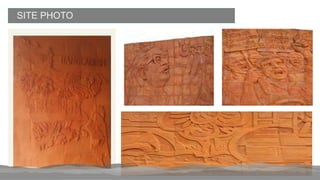
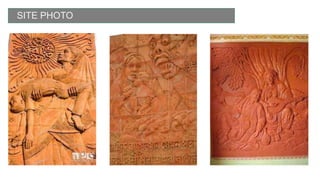
There are a number of terracotta murals on war-heroes and the events of the Liberation War, a
2000-seat auditorium, and an open-air theatre. The eternal flame stands beside the tower.
The water body of the project reflects the whole tower all the day and increases the beauty of
the project. But the water body is under potential threat as the local slum-dwellers use it for their
daily needs.
45
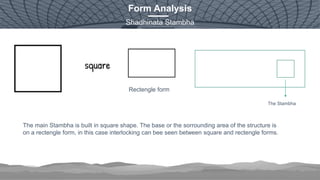
Form Analysis
Shadhinata Stambha
Rectengle form
The main Stambha is built in square shape. The base or the sorrounding area of the structure is
on a rectengle form, in this case interlocking can bee seen between square and rectengle forms.
The Stambha
46
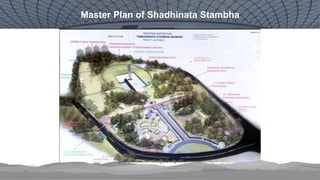
Master Plan of Shadhinata Stambha
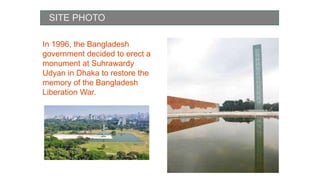
SITE PHOTO
In 1996, the Bangladesh
government decided to erect a
monument at Suhrawardy
Udyan in Dhaka to restore the
memory of the Bangladesh
Liberation War.
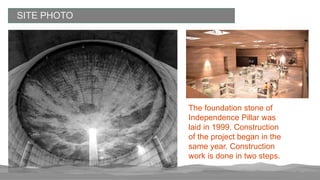
SITE PHOTO
The foundation stone of
Independence Pillar was
laid in 1999. Construction
of the project began in the
same year. Construction
work is done in two steps.
SITE PHOTO
SITE PHOTO
LOUVRE
MUSEUM
At PARIS, FRANCE
LOUVRE MUSEUM AT FRANCE
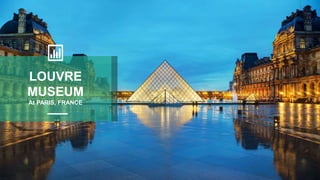
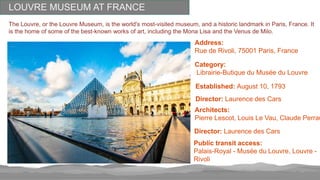
The Louvre, or the Louvre Museum, is the world's most-visited museum, and a historic landmark in Paris, France. It
is the home of some of the best-known works of art, including the Mona Lisa and the Venus de Milo.
Address:
Rue de Rivoli, 75001 Paris, France
Category:
Librairie-Butique du Musée du Louvre
Established: August 10, 1793
Director: Laurence des Cars
Architects:
Pierre Lescot, Louis Le Vau, Claude Perrau
Director: Laurence des Cars
Public transit access:
Palais-Royal - Musée du Louvre, Louvre -
Rivoli
53
Introduction
The Louvre Museum, National Museum of French art, is one of the most important museums in
the world. The creation of the Louvre meant, in the history of museums, the transition from
private collections to the public for the enjoyment of the whole society. With one of the greatest
collections representative, is undoubtedly the most visited art museum in the world.
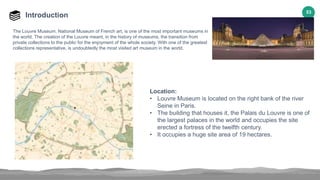
Location:
• Louvre Museum is located on the right bank of the river
Seine in Paris.
• The building that houses it, the Palais du Louvre is one of
the largest palaces in the world and occupies the site
erected a fortress of the twelfth century.
• It occupies a huge site area of 19 hectares.
54
Historical Transformation
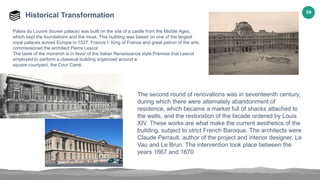
Palais du Louvre (louver palace) was built on the site of a castle from the Middle Ages,
which kept the foundations and the moat. This building was based on one of the largest
royal palaces across Europe in 1527, Francis I, King of France and great patron of the arts,
commissioned the architect Pierre Lescot
The taste of the monarch is in favor of the Italian Renaissance style.Premise that Lescot
employed to perform a classical building organized around a
square courtyard, the Cour Carré.
The second round of renovations was in seventeenth century,
during which there were alternately abandonment of
residence, which became a market full of shacks attached to
the walls, and the restoration of the facade ordered by Louis
XIV. These works are what make the current aesthetics of the
building, subject to strict French Baroque. The architects were
Claude Perrault, author of the project and interior designer, Le
Vau and Le Brun. The intervention took place between the
years 1667 and 1670
55
Design Concept
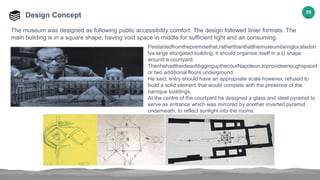
The museum was designed as following public accessibility comfort. The design followed linier formats. The
main building is in a square shape, having void space in middle for sufficient light and air consuming.
Peistartedfromthepremisethat,ratherthanthatthemuseumbeinglocatedon
lya large elongated building, it should organise itself in a U shape
around a courtyard.
ThenhehadtheideaofdiggingupthecourNapoleon,toprovideenoughspacef
or two additional floors underground.
He said, entry should have an appropriate scale however, refused to
build a solid element that would compete with the presence of the
baroque buildings.
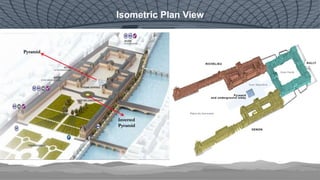
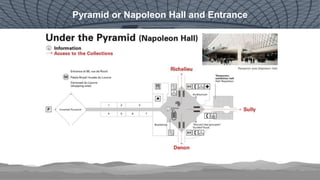
At the centre of the courtyard he designed a glass and steel pyramid to
serve as entrance which was mirrored by another inverted pyramid
underneath, to reflect sunlight into the rooms.
56
Isometric Plan View
57
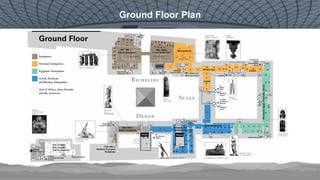
Ground Floor Plan
58
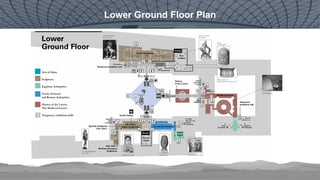
Lower Ground Floor Plan
59
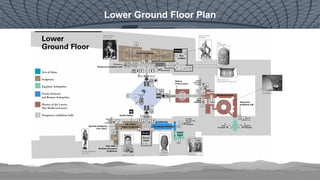
Lower Ground Floor Plan
60
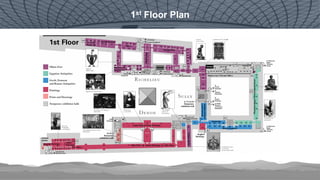
1st Floor Plan
61
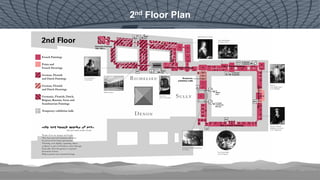
2nd Floor Plan
62
Pyramid or Napoleon Hall and Entrance
THANK YOU
This project is prepared for Ummehani Binte Ahmed
Ma'am of FIU. The presentation has been created by the
students of Group 3 of Design Studio V subject, from FIU.
Thanks again for taking a part to view the presentation.

Art Gallery Case Study

  • 1.
    CASE STUDY of ARTGALLERY Design Studio V Group 3 Tofayel Ahmed (19228013) Md Sadek Ahmed (18228006) Chadni Akter (17228008) Nishat Tasnim Tithy (18228001)
  • 2.
    2 Contents of theProject Case Study National Project 1. Liberation War Museum Agarga, Dhaka 2. SHADHINOTA TOWER Sohrawardi Uddan, Dhaka International Project Louvre Museum Paris, France Standard Analysis of Art Gallery
  • 3.
  • 4.
  • 5.
  • 6.
  • 7.
  • 8.
  • 9.
  • 10.
  • 11.
  • 12.
  • 13.
  • 14.
  • 15.
  • 16.
  • 17.
  • 18.
  • 19.
  • 20.
  • 21.
  • 22.
  • 23.
  • 24.
    LIBERATION WAR MUSEUM LiberationWar Museum Plot : F11/A & F11/B Sher-e Bangla Nagar Civic Centre, Agargaon, Dhaka The Liberation War Museum was started on the initiative of an eight-member board of trustees to commemorate the liberation war of 1971. ARCHITECT: Ar. Nahid Farzana Ar. Tanzim Hosen Salim Status: National competition 2009, 1st prize. Assoc consultant: Vistaara Architects Structural Consultant: TDM Total Land: 55 Katha/ 39327.40 sqft. Built Area: 2884.50 sqft. Green Area :5917.73 sqft. Ground Floor + 5 Storied + 3 basement Floor
  • 25.
  • 26.
    26 Concept • The heartof the project is the chamber of remembrance and realization • The exterior of the form is austere & humble marked by bullet marks, representing the ravages of war. • The vertical column like elements puncturing through the gallery and shooting out of the building poetically celebrates not only the elation of victory. • The expression also signifies normal people transforming to freedom fighters through the rising of Bangabandhu's fist. • Seven pillars in front of the complex are in memory of the seven highest martyrs (BIR SRESHSTHOs). • A circular wall of red hue depicting murals and mots are a reminder to the void of dislocation of refugees, victims of war and all who has lost their beloved. • It represents the freedom of human mind and spirit, hanging in between the physical and the metaphysical. A person is reminded of the past but Is forced towards the future and a sense of libeaion. • The charnel of water has a dual meaning of invitation & the deltaic nature of Bangladesh. The red wall behind the flame depicts the peoples’ struggle and plight of our history by means cut-out murals & mots. The wall of the auditorium would hold digital panels to display contributors' names.
  • 27.
    27 Form Analysis Rectangle, Circularand Interlocking forms can bee seen in the structure.
  • 28.
    AREA & ACCESSIBILITY MainFunctions in the project 1. Open Ampitheater 2. Auditorium 3. Canteen 4. Library 5. Multipurpose hall 6. Office 7. Exhibition 8. Disable Accessibility
  • 29.
  • 30.
  • 31.
  • 32.
  • 33.
  • 34.
  • 35.
  • 36.
  • 37.
  • 38.
    SITE PHOTO The galleries beginwith coverage of the early history of Bangladesh and of India's independence movement against the British Raj in Bengal.
  • 39.
    39 Floor Details Lighting MetodsUsed: • Natural Lighting • Light from Above • Lateral Lighting Office & Conference Room Auditorium Sitting Distance- 3’-4’
  • 40.
    40 Other Functions Kitchen: 340sqft Lobby/ Coridor: • Lift Lobby - 10’-6” • Stair Lobby – 5’-0” • Corridor – 5’0” Canteen: 1072 sqft
  • 41.
  • 42.
    SHADHINOTA STAMBHA ATSURAWARDY UDDAN General information Status Complete Type Public monument Location Dhaka, Bangladesh Construction started 1999 Completed 2013 Design and construction Architect Marina Tabassum, Kashef Mahboob Chowdhury
  • 43.
  • 44.
    44 Concept Government of Bangladeshtook the initiative to build the monument in 1996. The construction began in 1999. Kashef Mahboob Chowdhury and Marina Tabassum designed the project. The main attraction of the project is a 50-meter high tower composed of stacked glass panels, which stands at the place where the Pakistani Instrument of Surrender was signed at the end of the war. The foundation stone of the Swadhinata Stambha was laid in 1999. The construction of the project began in the same year. The construction was completed in two phases. The main attraction of the Swadhinata Stambha is the Stambha itself. The tower was built on the place where the commander-in-chief of East Pakistan Army Amir Abdullah Khan Niazi signed the papers of his surrender. During night, the tower looks elegant as the rays of light come out from every single inches of the tower. The whole tower turns into a white pillar. The tower is square according to the plan and is 16 feet wide from every side with an area of 64 inches. The underground museum of the project comprises several photographs with historical significance. A large photograph of the historical 7th March Speech of Sheikh Mujibur Rahman is the main attraction of the underground museum. There are a number of terracotta murals on war-heroes and the events of the Liberation War, a 2000-seat auditorium, and an open-air theatre. The eternal flame stands beside the tower. The water body of the project reflects the whole tower all the day and increases the beauty of the project. But the water body is under potential threat as the local slum-dwellers use it for their daily needs.
  • 45.
    45 Form Analysis Shadhinata Stambha Rectengleform The main Stambha is built in square shape. The base or the sorrounding area of the structure is on a rectengle form, in this case interlocking can bee seen between square and rectengle forms. The Stambha
  • 46.
    46 Master Plan ofShadhinata Stambha
  • 47.
    SITE PHOTO In 1996,the Bangladesh government decided to erect a monument at Suhrawardy Udyan in Dhaka to restore the memory of the Bangladesh Liberation War.
  • 48.
    SITE PHOTO The foundationstone of Independence Pillar was laid in 1999. Construction of the project began in the same year. Construction work is done in two steps.
  • 49.
  • 50.
  • 51.
  • 52.
    LOUVRE MUSEUM ATFRANCE The Louvre, or the Louvre Museum, is the world's most-visited museum, and a historic landmark in Paris, France. It is the home of some of the best-known works of art, including the Mona Lisa and the Venus de Milo. Address: Rue de Rivoli, 75001 Paris, France Category: Librairie-Butique du Musée du Louvre Established: August 10, 1793 Director: Laurence des Cars Architects: Pierre Lescot, Louis Le Vau, Claude Perrau Director: Laurence des Cars Public transit access: Palais-Royal - Musée du Louvre, Louvre - Rivoli
  • 53.
    53 Introduction The Louvre Museum,National Museum of French art, is one of the most important museums in the world. The creation of the Louvre meant, in the history of museums, the transition from private collections to the public for the enjoyment of the whole society. With one of the greatest collections representative, is undoubtedly the most visited art museum in the world. Location: • Louvre Museum is located on the right bank of the river Seine in Paris. • The building that houses it, the Palais du Louvre is one of the largest palaces in the world and occupies the site erected a fortress of the twelfth century. • It occupies a huge site area of 19 hectares.
  • 54.
    54 Historical Transformation Palais duLouvre (louver palace) was built on the site of a castle from the Middle Ages, which kept the foundations and the moat. This building was based on one of the largest royal palaces across Europe in 1527, Francis I, King of France and great patron of the arts, commissioned the architect Pierre Lescot The taste of the monarch is in favor of the Italian Renaissance style.Premise that Lescot employed to perform a classical building organized around a square courtyard, the Cour Carré. The second round of renovations was in seventeenth century, during which there were alternately abandonment of residence, which became a market full of shacks attached to the walls, and the restoration of the facade ordered by Louis XIV. These works are what make the current aesthetics of the building, subject to strict French Baroque. The architects were Claude Perrault, author of the project and interior designer, Le Vau and Le Brun. The intervention took place between the years 1667 and 1670
  • 55.
    55 Design Concept The museumwas designed as following public accessibility comfort. The design followed linier formats. The main building is in a square shape, having void space in middle for sufficient light and air consuming. Peistartedfromthepremisethat,ratherthanthatthemuseumbeinglocatedon lya large elongated building, it should organise itself in a U shape around a courtyard. ThenhehadtheideaofdiggingupthecourNapoleon,toprovideenoughspacef or two additional floors underground. He said, entry should have an appropriate scale however, refused to build a solid element that would compete with the presence of the baroque buildings. At the centre of the courtyard he designed a glass and steel pyramid to serve as entrance which was mirrored by another inverted pyramid underneath, to reflect sunlight into the rooms.
  • 56.
  • 57.
  • 58.
  • 59.
  • 60.
  • 61.
  • 62.
    62 Pyramid or NapoleonHall and Entrance
  • 63.
    THANK YOU This projectis prepared for Ummehani Binte Ahmed Ma'am of FIU. The presentation has been created by the students of Group 3 of Design Studio V subject, from FIU. Thanks again for taking a part to view the presentation.