MAPEH (ARTS)
PHILIPPINE ARCHITECTURE
Subject teacher: Ms. Rose Anne S. Magtalas
` As a popular quotation goes. “There’s
no place like home.” This means that
nothing gives greater comfort, safer
sanctuary, or loving environment than the
place one calls home. Do you agree? Think
about home. Think about the very structure
of your house. Describe its characteristics.
Does it express something about the ones
who live in it?
One of the most defining artistic
expression of a culture is its architecture.
Architecture is the art and science of
designing and building habitable
structures. An artist who designs and
plans architectures is called an architect.
Below are different architectural
structures in the Philippines.
Pre-Hispanic Period
The following are different houses
built by our ancestors before the arrival of
the Spaniards.
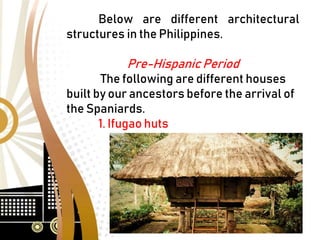
1. Ifugao huts
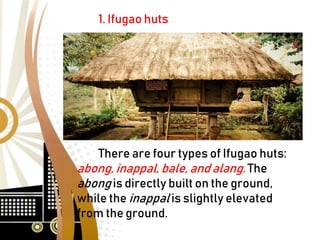
1. Ifugao huts
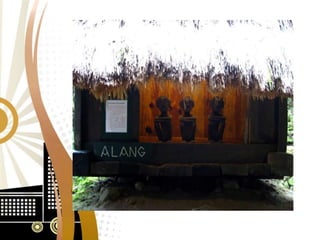
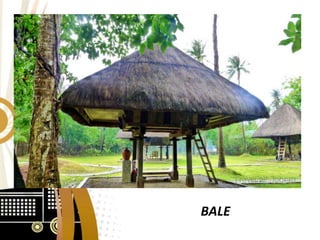
There are four types of Ifugao huts:
abong, inappal, bale, and alang. The
abong is directly built on the ground,
while the inappal is slightly elevated
from the ground.
The bale is a dwelling house for the
families. Elevated about 10 feet high, the
bale has a ground floor, a main level, and
an attic. The alang is a granary house
where dried house and bulul, or Ifugao rice
gods, are stored and kept.
BALE
ABONG
2. Bahay Kubo
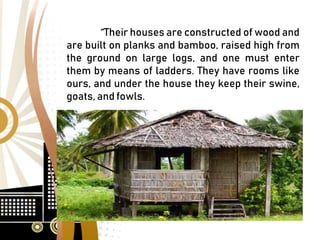
The bahay kubo is considered a
vernacular Filipino house. It is literally a
cube house (from “cubo” or cube in
Spanish). Antonio Pigafetta, the chronicler
who travelled with Magellan described the
bahay kubo as follows:
“ Their houses are constructed of wood and
are built on planks and bamboo, raised high from
the ground on large logs, and one must enter
them by means of ladders. They have rooms like
ours, and under the house they keep their swine,
goats, and fowls.
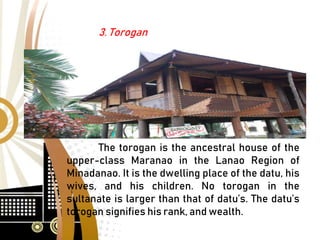
3. Torogan
The torogan is the ancestral house of the
upper-class Maranao in the Lanao Region of
Minadanao. It is the dwelling place of the datu, his
wives, and his children. No torogan in the
sultanate is larger than that of datu’s. The datu’s
torogan signifies his rank, and wealth.
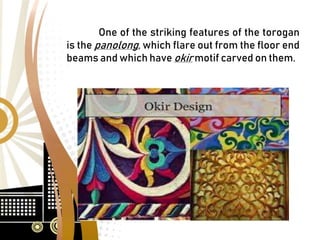
One of the striking features of the torogan
is the panolong, which flare out from the floor end
beams and which have okir motif carved on them.
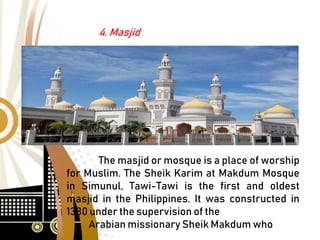
4. Masjid
The masjid or mosque is a place of worship
for Muslim. The Sheik Karim at Makdum Mosque
in Simunul, Tawi-Tawi is the first and oldest
masjid in the Philippines. It was constructed in
1380 under the supervision of the
Arabian missionary Sheik Makdum who
Arabian missionary Sheik Makdum
who introduced the Islam faith in the
archipelago in 1376.
SPANISH ERA
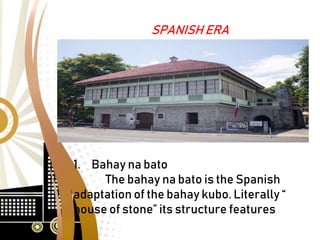
1. Bahay na bato
The bahay na bato is the Spanish
adaptation of the bahay kubo. Literally “
house of stone” its structure features
SPANISH ERA
1. Bahay na bato
The bahay na bato is the Spanish
adaptation of the bahay kubo. Literally “
house of stone” its structure features the
use of brick and stone in the lower level of
the house. Like the bahay kubo, the bahay
na bato is a two-storey house, with the
main living area located on the upper level.
SPANISH ERA
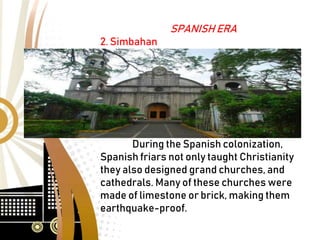
2. Simbahan
During the Spanish colonization,
Spanish friars not only taught Christianity
they also designed grand churches, and
cathedrals. Many of these churches were
made of limestone or brick, making them
earthquake-proof.
SPANISH ERA
2. Simbahan
The Church in the picture above is St.
John the Baptist Parish Church in Liliw,
Laguna. It was built in 1643

MAPEH-5-PHILIPPINE-ARCHITECTURE (1).pptx

  • 1.
    MAPEH (ARTS) PHILIPPINE ARCHITECTURE Subjectteacher: Ms. Rose Anne S. Magtalas
  • 2.
    ` As apopular quotation goes. “There’s no place like home.” This means that nothing gives greater comfort, safer sanctuary, or loving environment than the place one calls home. Do you agree? Think about home. Think about the very structure of your house. Describe its characteristics. Does it express something about the ones who live in it?
  • 3.
    One of themost defining artistic expression of a culture is its architecture. Architecture is the art and science of designing and building habitable structures. An artist who designs and plans architectures is called an architect.
  • 4.
    Below are differentarchitectural structures in the Philippines. Pre-Hispanic Period The following are different houses built by our ancestors before the arrival of the Spaniards. 1. Ifugao huts
  • 5.
    1. Ifugao huts Thereare four types of Ifugao huts: abong, inappal, bale, and alang. The abong is directly built on the ground, while the inappal is slightly elevated from the ground.
  • 6.
    The bale isa dwelling house for the families. Elevated about 10 feet high, the bale has a ground floor, a main level, and an attic. The alang is a granary house where dried house and bulul, or Ifugao rice gods, are stored and kept.
  • 8.
  • 9.
  • 10.
    2. Bahay Kubo Thebahay kubo is considered a vernacular Filipino house. It is literally a cube house (from “cubo” or cube in Spanish). Antonio Pigafetta, the chronicler who travelled with Magellan described the bahay kubo as follows:
  • 11.
    “ Their housesare constructed of wood and are built on planks and bamboo, raised high from the ground on large logs, and one must enter them by means of ladders. They have rooms like ours, and under the house they keep their swine, goats, and fowls.
  • 12.
    3. Torogan The toroganis the ancestral house of the upper-class Maranao in the Lanao Region of Minadanao. It is the dwelling place of the datu, his wives, and his children. No torogan in the sultanate is larger than that of datu’s. The datu’s torogan signifies his rank, and wealth.
  • 13.
    One of thestriking features of the torogan is the panolong, which flare out from the floor end beams and which have okir motif carved on them.
  • 14.
    4. Masjid The masjidor mosque is a place of worship for Muslim. The Sheik Karim at Makdum Mosque in Simunul, Tawi-Tawi is the first and oldest masjid in the Philippines. It was constructed in 1380 under the supervision of the Arabian missionary Sheik Makdum who
  • 15.
    Arabian missionary SheikMakdum who introduced the Islam faith in the archipelago in 1376.
  • 16.
    SPANISH ERA 1. Bahayna bato The bahay na bato is the Spanish adaptation of the bahay kubo. Literally “ house of stone” its structure features
  • 17.
    SPANISH ERA 1. Bahayna bato The bahay na bato is the Spanish adaptation of the bahay kubo. Literally “ house of stone” its structure features the use of brick and stone in the lower level of the house. Like the bahay kubo, the bahay na bato is a two-storey house, with the main living area located on the upper level.
  • 18.
    SPANISH ERA 2. Simbahan Duringthe Spanish colonization, Spanish friars not only taught Christianity they also designed grand churches, and cathedrals. Many of these churches were made of limestone or brick, making them earthquake-proof.
  • 19.
    SPANISH ERA 2. Simbahan TheChurch in the picture above is St. John the Baptist Parish Church in Liliw, Laguna. It was built in 1643