Analytic
Philosophy and
Education
Mr. Arpie P. Lapugot
Reporter
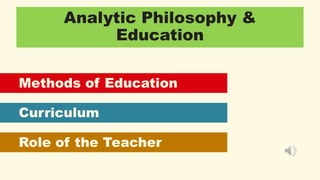
Analytic Philosophy &
Education
Methods of Education
Curriculum
Role of the Teacher
Methods
of
Education
 Methods of Education
-Analysts are aware that methods and media of
all kinds educate the child in many ways.
When the McGuffey readers were used in the
early 1900s, for example, they taught not only
reading skills but also particular values
concerning religion, patriotism, and family.
 Methods of Education
-Analysts do not attempt to say what kinds of
books children should read; rather, they
examine the meaning of the claims made
regarding the merits of such activities.
-Instead of saying what a child should read,
think, study, or learn, the analysts examines
what is meant by the words think, read or learn
and the statements people make regarding these
words.
 Methods of Education
-Some analysts advocate devising paradigms-
that is, constructing models of logic that help
clarify and order concepts.
-Paradigms are useful for looking at educational
problems in an objective, nonpartisan, and
unemotive way.
 Methods of Education
-One area with which analysts have spent much time
is the activity of teaching.
-Paul Hirst has shown the need for empirical research
on the effectiveness of various teaching methods. In
Hirst’s opinion, teaching is a “polymorphous” activity
that can take many different forms.
-To know that teaching is going on, the aims and
intentions must be clarified so that each activity is
seen in a clear relationship to those aims.
 Methods of Education
-Successful teaching seems to be teaching that brings
about desired learning. Yet, this desired learning
could result from conditioning or indoctrination.
-Analysis is an ongoing activity. The major thrust of
analytic philosophy is to try to arrive at clarified
principles, agreements, and conclusions, rather than
to start with them. In this sense, philosophical
analysis followed in the footsteps of the Socratic view
of philosophy as the search for wisdom.
Curriculum
 Curriculum
-Curriculum used to be viewed as something
established to achieve certain ends, but it seems that
today the ends flow from the curriculum itself.
-Hugh Sockett maintains that the literature in
curriculum contains much talk about taking means to
ends and conceiving of the relationship between
means and ends as contingent.
 Curriculum
-Philosophical analysts are concerned about the way
plans are made.
-Little planning seems to be systematic or careful.
-People need to examine current curricula in terms of
these problems, as well as to promote an ongoing
critical attitude toward curriculum restructuring in
which meanings and purposes are clarified.
 Curriculum
-Richard Pring says that the foremost philosophical
problems in curriculum and curriculum integration
are what meanings are involved, what assumptions
are made about knowledge, what the forms of
knowledge are, what the interrelationship among
these forms is, and what the structural unity of
language is.
-Analysts believe that greater attention must be given
to the philosophical aspects, and they have
encouraged greater work in this area.
Role of the
Teacher
 Role of the Teacher
-Language analysts are concerned that teachers have
a good understanding of the language used in their
classrooms.
-Language can be in spoken or written form, and
through this medium ideas are conveyed.
-Analysts point out, however, that language is not
always used well and that it does not always convey
ideas clearly. Because language is such an important
part of education.
 Role of the Teacher
-Language is a powerful tool for conveying ideas when
it is used carefully, but when it is used poorly, it
makes good thinking difficult.
-Teachers need to use language in ways that make
their meanings clear.
-Much language is value-laden and emotive in nature.
 Role of the Teacher
-The way the teacher uses words, the inflections and
emphases, often convey a variety of unconscious and
perhaps unintended meanings.
-These meanings may include religious and
philosophical attitudes, economic beliefs, or even
racial and class biases.
-It is often difficult to change such things because
they are part of historical usage and literature, and
not everyone is sensitive to such expressions.
 Role of the Teacher
-Analysts would like teachers to understand the logic
of language.
-Also, teachers need to be skilled in the ability to
analyze language and to point out the improper use of
language in whatever form it appears newspaper
editorials, textbooks, advertisements, television
newscasts, and so on.
 Role of the Teacher
-Teachers need to share this knowledge with students
to help them develop the ability to analyze language
so that the, too, will become adept at uncovering
fallacious usage.
-Analysts believe that if students develop this ability,
then they will become better readers, better
consumers, and also better citizens
Thank you!

Analytic Philosophy in Education- a report

  • 1.
  • 2.
    Analytic Philosophy & Education Methodsof Education Curriculum Role of the Teacher
  • 3.
  • 4.
     Methods ofEducation -Analysts are aware that methods and media of all kinds educate the child in many ways. When the McGuffey readers were used in the early 1900s, for example, they taught not only reading skills but also particular values concerning religion, patriotism, and family.
  • 5.
     Methods ofEducation -Analysts do not attempt to say what kinds of books children should read; rather, they examine the meaning of the claims made regarding the merits of such activities. -Instead of saying what a child should read, think, study, or learn, the analysts examines what is meant by the words think, read or learn and the statements people make regarding these words.
  • 6.
     Methods ofEducation -Some analysts advocate devising paradigms- that is, constructing models of logic that help clarify and order concepts. -Paradigms are useful for looking at educational problems in an objective, nonpartisan, and unemotive way.
  • 7.
     Methods ofEducation -One area with which analysts have spent much time is the activity of teaching. -Paul Hirst has shown the need for empirical research on the effectiveness of various teaching methods. In Hirst’s opinion, teaching is a “polymorphous” activity that can take many different forms. -To know that teaching is going on, the aims and intentions must be clarified so that each activity is seen in a clear relationship to those aims.
  • 8.
     Methods ofEducation -Successful teaching seems to be teaching that brings about desired learning. Yet, this desired learning could result from conditioning or indoctrination. -Analysis is an ongoing activity. The major thrust of analytic philosophy is to try to arrive at clarified principles, agreements, and conclusions, rather than to start with them. In this sense, philosophical analysis followed in the footsteps of the Socratic view of philosophy as the search for wisdom.
  • 9.
  • 10.
     Curriculum -Curriculum usedto be viewed as something established to achieve certain ends, but it seems that today the ends flow from the curriculum itself. -Hugh Sockett maintains that the literature in curriculum contains much talk about taking means to ends and conceiving of the relationship between means and ends as contingent.
  • 11.
     Curriculum -Philosophical analystsare concerned about the way plans are made. -Little planning seems to be systematic or careful. -People need to examine current curricula in terms of these problems, as well as to promote an ongoing critical attitude toward curriculum restructuring in which meanings and purposes are clarified.
  • 12.
     Curriculum -Richard Pringsays that the foremost philosophical problems in curriculum and curriculum integration are what meanings are involved, what assumptions are made about knowledge, what the forms of knowledge are, what the interrelationship among these forms is, and what the structural unity of language is. -Analysts believe that greater attention must be given to the philosophical aspects, and they have encouraged greater work in this area.
  • 14.
  • 15.
     Role ofthe Teacher -Language analysts are concerned that teachers have a good understanding of the language used in their classrooms. -Language can be in spoken or written form, and through this medium ideas are conveyed. -Analysts point out, however, that language is not always used well and that it does not always convey ideas clearly. Because language is such an important part of education.
  • 16.
     Role ofthe Teacher -Language is a powerful tool for conveying ideas when it is used carefully, but when it is used poorly, it makes good thinking difficult. -Teachers need to use language in ways that make their meanings clear. -Much language is value-laden and emotive in nature.
  • 17.
     Role ofthe Teacher -The way the teacher uses words, the inflections and emphases, often convey a variety of unconscious and perhaps unintended meanings. -These meanings may include religious and philosophical attitudes, economic beliefs, or even racial and class biases. -It is often difficult to change such things because they are part of historical usage and literature, and not everyone is sensitive to such expressions.
  • 18.
     Role ofthe Teacher -Analysts would like teachers to understand the logic of language. -Also, teachers need to be skilled in the ability to analyze language and to point out the improper use of language in whatever form it appears newspaper editorials, textbooks, advertisements, television newscasts, and so on.
  • 19.
     Role ofthe Teacher -Teachers need to share this knowledge with students to help them develop the ability to analyze language so that the, too, will become adept at uncovering fallacious usage. -Analysts believe that if students develop this ability, then they will become better readers, better consumers, and also better citizens
  • 20.