FREE SPEECH
AND FAIR USE IN
THE ACADEMIC
ENVIRONMENT

Pat Aufderheide
OVERVIEW
• Copyright and Fair Use
• The Best Practices Approach
• Academics and Fair Use
• Code of Best Practices in Fair
  Use for Academic and
  Research Libraries
THE PURPOSE
OF COPYRIGHT
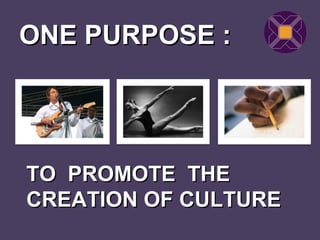
ONE PURPOSE :


TO PROMOTE THE
CREATION OF CULTURE
BY:

 • Rewarding creators with
   limited monopoly
 • Encouraging new makers
   to use existing culture
BIGGEST BALANCING
FEATURE:


       FAIR USE
  legal, unauthorized use of
 copyrighted material−under
     some circumstances
09/30/09
“FOUR FACTORS”
• Reason for the use
• Kind of work used
• Amount used
• Effect on the market
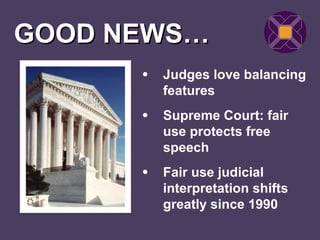
GOOD NEWS…
      •   Judges love balancing
          features
      •   Supreme Court: fair
          use protects free
          speech
      •   Fair use judicial
          interpretation shifts
          greatly since 1990
JUDGES ASK:
• Is your use “transformative”?
  (i.e., use for new purpose,
  context, audience, insight)

• Did you use the appropriate
  amount to satisfy the
  transformative use?
“TRANSFORM?”
• E.g., use of works for
  scholarly study
• Use of works for teaching
• Use for exhibits
• Etc.
PLUS…
Custom and practice of
individual creative
communities…

...especially when well-
documented
BEST
PRACTICES
CODES
COMMUNITIES
INTERPRET FAIR USE:
  • Documentary filmmakers
  • Scholars
  • Media literacy teachers
  • Online video
  • Dance collections
  • OpenCourseWare
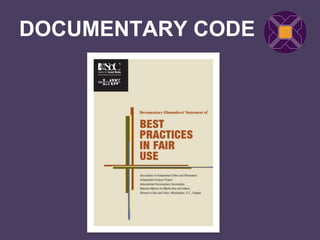
DOCUMENTARY CODE
RESULTS:
• TV programmers air films
• New kinds of films
• All insurers of errors and
  omissions insurance now
  accept fair use claims
• Lawyers use the Statement to build
  their practices
BEST PRACTICES,
NOT GUIDELINES
• Principles, not rules
• Limitations, not bans
• Reasoning, not rote
WHY
FAIR USE
MATTERS TO
LIBRARIANS
FAIR USE ENABLES
MISSION
• Mission to serve knowledge
  past, present, future
• Need to access copyrighted
  work
• Digital
  innovation/obsolescence
BUT…
• Insecurity and hesitation=staff
  costs, mission deformed

• Fair use would help, but is
  under-used

• Risk aversion substituted for
  fair use analysis
THE CODE OF
BEST PRACTICES
IN FAIR USE
FOR ACADEMIC
AND RESEARCH
LIBRARIES
CREATED BY
LIBRARIANS
Deep deliberation by 90
librarians from 64 inst’ns in
nine 4-hour discussions.
Review by diverse panel of
legal experts.
NEW INPUT FOR
RISK MANAGEMENT
• Put legal risks into
  perspective, “mission risk”
• Consider views of librarians
• Grounding for solidarity
Fair Use Applies
in 8 Common
Situations
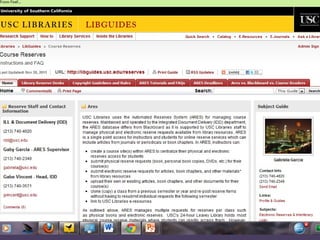
ONE:
Digital access to teaching
materials for students and
profs
-limitations!
-enhancements
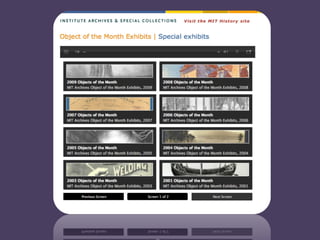
TWO:
 Exhibits, both physical &
 virtual

 …with limitations

 …and enhancements!
THREE:
Digitizing to preserve
at-risk items
…when you can’t buy it
(plus more limitations &
enhancements).
12/17/09
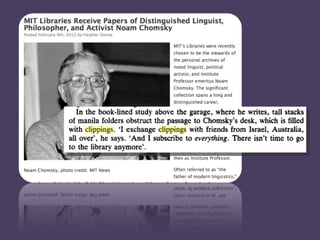
FOUR:
Digital collections of
archives and special
collections

(+ limitations and
enhancements)
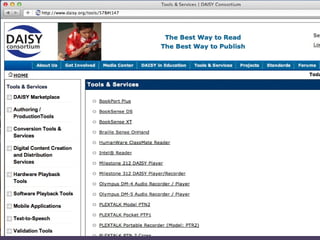
FIVE:
Access to research and
teaching materials for
disabled users

(+ limitations and
enhancements)
12/17/09
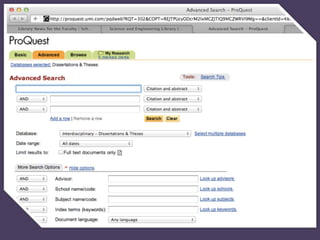
SIX:
 Institutional repositories,
 e.g., dissertations,
 multimedia research

 (+ limitations and
 enhancements)
SEVEN:
Create digital databases for
“non-consumptive uses”
(digitizing, indexing for
search)

(+ limitations and
enhancements, of course)
12/17/09
EIGHT:
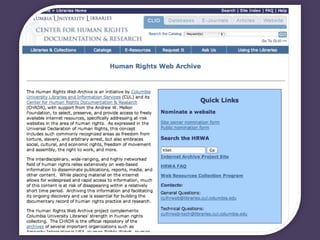
Making topically-based
collections of Web-based
material

(+ limitations and
enhancements)
12/17/09
FAIR USE:

 Practice
 Makes
 Practice
MORE
INFORMATION
The code and much
    more (videos!
Presentations! FAQs!)
• www.arl.org/fairuse
• Centerforsocialmedia.org/fair-
  use
Please feel free to share this
presentation in its entirety.
For excerpting, kindly
employ
the principles of fair use.
THANK YOU!
The Andrew W. Mellon
Foundation

Research librarians
everywhere
CONTACT INFO
  Brandon Butler
  brandon@arl.org

  Peter Jaszi
  pjaszi@wcl.american.edu

Arl Code Librarians USC

Editor's Notes