ICHD-3 AND YOGA IN
SHIROROG:
AN INTEGRATIVE APPROACH TO HEADACHE
MANAGEMENT
Created By : Abhinay Kureel
NAIMINATH AYURVEDIC MEDICAL COLLEGE AND RESEARCH CENTER
DEPARTMENT OF SHALAKYA TANTRA
LEARNING OBJECTIVES
• • Understand ICHD 3 (International Classification of Headache Disorders, 3rd
Edition)
• • Explore Ayurvedic concept of Shirorog and its classifications
• • Learn about yoga therapy and pranayama for headache management
• • Understand the integration of modern and traditional approaches
• • Examine evidence-based research on yoga for migraine and headache relief
INTRODUCTION TO ICHD 3
• • International Classification of Headache Disorders, 3rd
Edition
• • Published by International Headache Society (IHS)
• • Provides standardized diagnostic criteria for headache
disorders
• • Globally recognized classification system
• • Updated from ICHD-2 with refined criteria and new entities
ICHD 3: MAJOR CLASSIFICATIONS
• PART 1: PRIMARY HEADACHES
• • 1. Migraine
• • 2. Tension-Type Headache (TTH)
• • 3. Trigeminal Autonomic Cephalalgias
• • 4. Other Primary Headache Disorders
• PART 2: SECONDARY HEADACHES
• • 5-12. Various secondary causes (trauma, vascular, infection, etc.)
• PART 3: CRANIAL NEURALGIAS AND FACIAL PAIN
• • 13-14. Cranial nerve disorders and other headaches
ICHD 3: PRIMARY HEADACHES - MIGRAINE
• 1.1 Migraine without aura
• • ≥5 attacks, 4-72 hours duration
• • ≥2 characteristics: unilateral, pulsating, moderate-severe, aggravated by activity
• • Nausea/vomiting OR photophobia/phonophobia
• 1.2 Migraine with aura
• • ≥2 attacks with reversible aura symptoms
• • Visual, sensory, speech/language, motor, brainstem, or retinal
• 1.3 Chronic migraine
• • ≥15 headache days/month for >3 months
ICHD 3:TENSION-TYPE HEADACHE
• 2.1 Infrequent episodic TTH: <1 day/month
• 2.2 Frequent episodic TTH: 1-14 days/month
• 2.3 Chronic TTH: ≥15 days/month
• Characteristics:
• • Bilateral location
• • Pressing/tightening quality
• • Mild to moderate intensity
• • Not aggravated by routine physical activity
• • No nausea/vomiting
• •photophobia/phonophobia
INTRODUCTION TO SHIROROG IN AYURVEDA
• • Shiro = Head, Rog = Disease
• • Encompasses various disorders of the head region
• • Mentioned in classical texts: Charaka Samhita, Sushruta Samhita
• • Head (Shira) considered as Uttamanga (superior organ)
• • Seat of all sense organs and vital functions
• • Controls Prana (vital force) and mental activities
CLASSICAL CLASSIFICATIONS OF SHIROROG
• According to Acharya Charaka (5 types):
• • Vataja, Pittaja, Kaphaja, Sannipataja, Krimija
• According to Acharya Sushruta (11 types):
• • Vataja, Pittaja, Kaphaja, Raktaja, Sannipataja
• • Kshayaja, Krimija, Suryavarta, Anantavata
• • Ardhavabhedaka, Shankhaka
VATAJA SHIROROG
• Characteristics:
• • Severe, sharp, pricking pain
• • Pain like piercing needle
• • Aggravates at night
• • Associated with stiffness
• • Giddiness and confusion
• Modern Correlation:
• • Tension-type headache
• Treatment:Vata pacifying therapies, Nasya, Shirobasti
PITTAJA SHIROROG
• Characteristics:
• • Burning sensation in head
• • Associated with heat and inflammation
• • Aggravates in daytime/heat
• • May have fever
• • Redness of eyes
• Modern Correlation:
• • Inflammatory headaches
• Treatment: Pitta pacifying therapies, cooling treatments,Virechana
KAPHAJA SHIROROG
• Characteristics:
• • Heaviness in head
• • Mucus accumulation
• • Stiffness and coldness
• • Swelling around eyes
• • Nasal congestion
• Modern Correlation:
• • Sinusitis-related headaches
• • Cluster headaches
• Treatment: Kapha pacifying therapies,Vamana, Nasya, Dhumapana
SPECIAL TRIDOSHAJA SHIROROGAS
• Ardhavabhedaka (Migraine):
• • Severe pain in half of head
• • Pricking, tearing pain
• • Mental confusion
• • 10-15 days duration
• Suryavarta:
• • Starts gradually, peaks midday
• • Subsides with sunset
• • Related to sun's movement
• Anantavata:
• • Neck and shoulder involvement
• • Stiffness in cervical region
• • Eye symptoms
AYURVEDIC TREATMENT PRINCIPLES FOR
SHIROROG
• 1. Nidana Parivarjana (Avoid causative factors)
• 2. Samshodhana Chikitsa (Purification therapies):
• • Nasya (Nasal therapy) - Primary treatment
• • Vamana (Therapeutic vomiting) - Kapha disorders
• • Virechana (Therapeutic purgation) - Pitta disorders
• • Basti (Therapeutic enemas) - Vata disorders
• 3. Samshamana Chikitsa (Palliative treatments)
• 4. External therapies: Shirobasti, Shirodhara, Shirolepa
• 5. Lifestyle modifications andYoga
INTRODUCTION TOYOGA THERAPY FOR
HEADACHES
• • Ancient mind-body practice from India
• • Combines physical postures (Asanas), breathing (Pranayama), and meditation
• • Addresses multiple factors contributing to headaches:
• • Stress reduction
• • Muscle tension relief
• • Improved circulation
• • Nervous system regulation
• • Hormonal balance
• • Growing scientific evidence for headache management
MECHANISMS OFYOGA IN HEADACHE RELIEF
• 1. Stress Reduction:
• • Activates parasympathetic nervous system
• • Reduces cortisol levels
• • Improves stress tolerance
• 2. Physical Benefits:
• • Relieves muscle tension in neck, shoulders
• • Improves blood circulation to brain
• • Enhances flexibility and posture
• 3. Neurological Effects:
• • Balances autonomic nervous system
• • Increases vagal tone
• • Reduces sympathetic overactivity
SCIENTIFIC EVIDENCE FORYOGA IN
HEADACHE MANAGEMENT
• Recent Research Findings:
• • 2020 Neurology study: 3 months yoga reduced headache frequency and intensity
• • Patients reduced migraine medication by ~50%
• • Meta-analysis (2022): Significant reduction in pain intensity, frequency, duration
• • Improved HIT-6 scores and MIDAS scores
• • Better than medication alone
• Specific Benefits:
• • Reduced headache frequency: p<0.00001
• • Decreased pain intensity: p<0.0004
• • Improved quality of life scores
SPECIFICYOGA ASANAS FOR HEADACHE
RELIEF
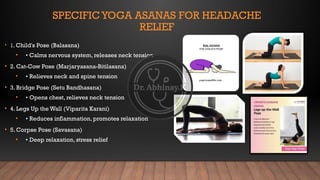
• 1. Child's Pose (Balasana)
• • Calms nervous system, releases neck tension
• 2. Cat-Cow Pose (Marjaryasana-Bitilasana)
• • Relieves neck and spine tension
• 3. Bridge Pose (Setu Bandhasana)
• • Opens chest, relieves neck tension
• 4. Legs Up the Wall (Viparita Karani)
• • Reduces inflammation, promotes relaxation
• 5. Corpse Pose (Savasana)
• • Deep relaxation, stress relief
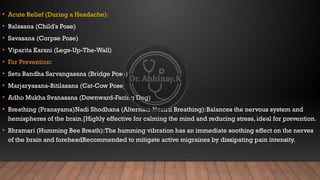
• Acute Relief (During a Headache):​
• Balasana (Child's Pose) ​
• Savasana (Corpse Pose)
• Viparita Karani (Legs-Up-The-Wall)
• ​
For Prevention:​
• Setu Bandha Sarvangasana (Bridge Pose)
• Marjaryasana-Bitilasana (Cat-Cow Pose)
• Adho Mukha Svanasana (Downward-Facing Dog)
• Breathing (Pranayama)​
Nadi Shodhana (Alternate Nostril Breathing):​
Balances the nervous system and
hemispheres of the brain.[​
Highly effective for calming the mind and reducing stress, ideal for prevention.
• ​
Bhramari (Humming Bee Breath):​
The humming vibration has an immediate soothing effect on the nerves
of the brain and forehead​
Recommended to mitigate active migraines by dissipating pain intensity.
PRANAYAMA TECHNIQUES FOR HEADACHE
MANAGEMENT
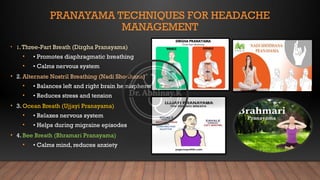
• 1.Three-Part Breath (Dirgha Pranayama)
• • Promotes diaphragmatic breathing
• • Calms nervous system
• 2. Alternate Nostril Breathing (Nadi Shodhana)
• • Balances left and right brain hemispheres
• • Reduces stress and tension
• 3. Ocean Breath (Ujjayi Pranayama)
• • Relaxes nervous system
• • Helps during migraine episodes
• 4. Bee Breath (Bhramari Pranayama)
• • Calms mind, reduces anxiety
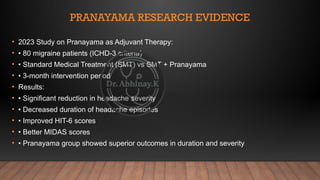
PRANAYAMA RESEARCH EVIDENCE
• 2023 Study on Pranayama as Adjuvant Therapy:
• • 80 migraine patients (ICHD-3 criteria)
• • Standard Medical Treatment (SMT) vs SMT + Pranayama
• • 3-month intervention period
• Results:
• • Significant reduction in headache severity
• • Decreased duration of headache episodes
• • Improved HIT-6 scores
• • Better MIDAS scores
• • Pranayama group showed superior outcomes in duration and severity
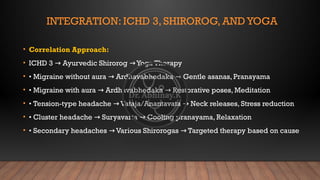
INTEGRATION: ICHD 3, SHIROROG, AND YOGA
• Correlation Approach:
• ICHD 3 Ayurvedic Shirorog Yoga Therapy
→ →
• • Migraine without aura Ardhavabhedaka Gentle asanas, Pranayama
→ →
• • Migraine with aura Ardhavabhedaka Restorative poses, Meditation
→ →
• • Tension-type headache Vataja/Anantavata Neck releases, Stress reduction
→ →
• • Cluster headache Suryavarta Cooling pranayama, Relaxation
→ →
• • Secondary headaches Various Shirorogas Targeted therapy based on cause
→ →
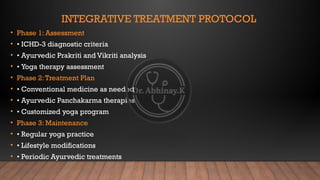
INTEGRATIVE TREATMENT PROTOCOL
• Phase 1: Assessment
• • ICHD-3 diagnostic criteria
• • Ayurvedic Prakriti and Vikriti analysis
• • Yoga therapy assessment
• Phase 2:Treatment Plan
• • Conventional medicine as needed
• • Ayurvedic Panchakarma therapies
• • Customized yoga program
• Phase 3: Maintenance
• • Regular yoga practice
• • Lifestyle modifications
• • Periodic Ayurvedic treatments
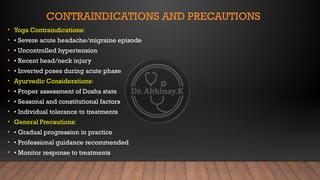
CONTRAINDICATIONS AND PRECAUTIONS
• Yoga Contraindications:
• • Severe acute headache/migraine episode
• • Uncontrolled hypertension
• • Recent head/neck injury
• • Inverted poses during acute phase
• Ayurvedic Considerations:
• • Proper assessment of Dosha state
• • Seasonal and constitutional factors
• • Individual tolerance to treatments
• General Precautions:
• • Gradual progression in practice
• • Professional guidance recommended
• • Monitor response to treatments
CLINICAL CASE STUDY APPROACH
• Case Example: 35-year-old female with chronic migraine
• ICHD-3 Diagnosis: Chronic Migraine (1.3)
• • ≥15 headache days/month for 6 months
• • Meets migraine criteria ≥8 days/month
• Ayurvedic Assessment: Ardhavabhedaka (Vata-Pitta predominance)
• • Stress-triggered, left-sided pain
• • Associated with digestive issues
• Yoga Intervention:
• • 6-week program: 3 sessions/week
• • Focus on stress reduction and neck releases
• • Daily pranayama practice
KEY TAKEAWAYS
• 1. ICHD-3 provides standardized modern diagnostic framework
• 2. Ayurvedic Shirorog offers holistic understanding and treatment
• 3.Yoga therapy shows strong evidence for headache management
• 4. Integration of all three approaches offers comprehensive care
• 5. Personalized treatment plans yield better outcomes
• 6. Regular practice and lifestyle modifications are essential
• 7. Professional guidance enhances safety and efficacy
CONCLUSION
• The integration of ICHD-3 classification, Ayurvedic Shirorog concepts, and evidence-
based yoga therapy offers:
• • Comprehensive diagnostic approach
• • Holistic treatment strategies
• • Evidence-based interventions
• • Cost-effective management options
• • Reduced dependency on medications
• • Improved quality of life for patients
• This integrative model represents the future of headache management, combining
ancient wisdom with modern science.
REFERENCES
• 1. Headache Classification Committee of IHS. ICHD-3. Cephalalgia. 2018;38(1):1-211.
• 2. Charaka Samhita, Sutra Sthana, Chapter 17. Chaukhambha Publications.
• 3. Sushruta Samhita, Uttara Tantra, Chapter 25-26. Chaukhambha Publications.
• 4. Kumar A, et al. Effect ofYoga on migraine. PMC4097897.
• 5. Long C, et al. Effectiveness of yoga therapy for migraine treatment. Am J Emergency Med. 2022.
• 6. Effect of Pranayama as Adjuvant to Medical Treatment. PMC10666878. 2023.
• 7. Kisan R, et al. Effect ofYoga on migraine: Clinical and autonomic functions. PMC4097897.
• 8.Various Ayurvedic classical texts and modern research studies.
THANKYOU

ICHD & Shirorog.pptx

  • 1.
    ICHD-3 AND YOGAIN SHIROROG: AN INTEGRATIVE APPROACH TO HEADACHE MANAGEMENT Created By : Abhinay Kureel NAIMINATH AYURVEDIC MEDICAL COLLEGE AND RESEARCH CENTER DEPARTMENT OF SHALAKYA TANTRA
  • 2.
    LEARNING OBJECTIVES • •Understand ICHD 3 (International Classification of Headache Disorders, 3rd Edition) • • Explore Ayurvedic concept of Shirorog and its classifications • • Learn about yoga therapy and pranayama for headache management • • Understand the integration of modern and traditional approaches • • Examine evidence-based research on yoga for migraine and headache relief
  • 3.
    INTRODUCTION TO ICHD3 • • International Classification of Headache Disorders, 3rd Edition • • Published by International Headache Society (IHS) • • Provides standardized diagnostic criteria for headache disorders • • Globally recognized classification system • • Updated from ICHD-2 with refined criteria and new entities
  • 4.
    ICHD 3: MAJORCLASSIFICATIONS • PART 1: PRIMARY HEADACHES • • 1. Migraine • • 2. Tension-Type Headache (TTH) • • 3. Trigeminal Autonomic Cephalalgias • • 4. Other Primary Headache Disorders • PART 2: SECONDARY HEADACHES • • 5-12. Various secondary causes (trauma, vascular, infection, etc.) • PART 3: CRANIAL NEURALGIAS AND FACIAL PAIN • • 13-14. Cranial nerve disorders and other headaches
  • 5.
    ICHD 3: PRIMARYHEADACHES - MIGRAINE • 1.1 Migraine without aura • • ≥5 attacks, 4-72 hours duration • • ≥2 characteristics: unilateral, pulsating, moderate-severe, aggravated by activity • • Nausea/vomiting OR photophobia/phonophobia • 1.2 Migraine with aura • • ≥2 attacks with reversible aura symptoms • • Visual, sensory, speech/language, motor, brainstem, or retinal • 1.3 Chronic migraine • • ≥15 headache days/month for >3 months
  • 6.
    ICHD 3:TENSION-TYPE HEADACHE •2.1 Infrequent episodic TTH: <1 day/month • 2.2 Frequent episodic TTH: 1-14 days/month • 2.3 Chronic TTH: ≥15 days/month • Characteristics: • • Bilateral location • • Pressing/tightening quality • • Mild to moderate intensity • • Not aggravated by routine physical activity • • No nausea/vomiting • •photophobia/phonophobia
  • 7.
    INTRODUCTION TO SHIROROGIN AYURVEDA • • Shiro = Head, Rog = Disease • • Encompasses various disorders of the head region • • Mentioned in classical texts: Charaka Samhita, Sushruta Samhita • • Head (Shira) considered as Uttamanga (superior organ) • • Seat of all sense organs and vital functions • • Controls Prana (vital force) and mental activities
  • 8.
    CLASSICAL CLASSIFICATIONS OFSHIROROG • According to Acharya Charaka (5 types): • • Vataja, Pittaja, Kaphaja, Sannipataja, Krimija • According to Acharya Sushruta (11 types): • • Vataja, Pittaja, Kaphaja, Raktaja, Sannipataja • • Kshayaja, Krimija, Suryavarta, Anantavata • • Ardhavabhedaka, Shankhaka
  • 9.
    VATAJA SHIROROG • Characteristics: •• Severe, sharp, pricking pain • • Pain like piercing needle • • Aggravates at night • • Associated with stiffness • • Giddiness and confusion • Modern Correlation: • • Tension-type headache • Treatment:Vata pacifying therapies, Nasya, Shirobasti
  • 10.
    PITTAJA SHIROROG • Characteristics: •• Burning sensation in head • • Associated with heat and inflammation • • Aggravates in daytime/heat • • May have fever • • Redness of eyes • Modern Correlation: • • Inflammatory headaches • Treatment: Pitta pacifying therapies, cooling treatments,Virechana
  • 11.
    KAPHAJA SHIROROG • Characteristics: •• Heaviness in head • • Mucus accumulation • • Stiffness and coldness • • Swelling around eyes • • Nasal congestion • Modern Correlation: • • Sinusitis-related headaches • • Cluster headaches • Treatment: Kapha pacifying therapies,Vamana, Nasya, Dhumapana
  • 12.
    SPECIAL TRIDOSHAJA SHIROROGAS •Ardhavabhedaka (Migraine): • • Severe pain in half of head • • Pricking, tearing pain • • Mental confusion • • 10-15 days duration • Suryavarta: • • Starts gradually, peaks midday • • Subsides with sunset • • Related to sun's movement • Anantavata: • • Neck and shoulder involvement • • Stiffness in cervical region • • Eye symptoms
  • 13.
    AYURVEDIC TREATMENT PRINCIPLESFOR SHIROROG • 1. Nidana Parivarjana (Avoid causative factors) • 2. Samshodhana Chikitsa (Purification therapies): • • Nasya (Nasal therapy) - Primary treatment • • Vamana (Therapeutic vomiting) - Kapha disorders • • Virechana (Therapeutic purgation) - Pitta disorders • • Basti (Therapeutic enemas) - Vata disorders • 3. Samshamana Chikitsa (Palliative treatments) • 4. External therapies: Shirobasti, Shirodhara, Shirolepa • 5. Lifestyle modifications andYoga
  • 14.
    INTRODUCTION TOYOGA THERAPYFOR HEADACHES • • Ancient mind-body practice from India • • Combines physical postures (Asanas), breathing (Pranayama), and meditation • • Addresses multiple factors contributing to headaches: • • Stress reduction • • Muscle tension relief • • Improved circulation • • Nervous system regulation • • Hormonal balance • • Growing scientific evidence for headache management
  • 15.
    MECHANISMS OFYOGA INHEADACHE RELIEF • 1. Stress Reduction: • • Activates parasympathetic nervous system • • Reduces cortisol levels • • Improves stress tolerance • 2. Physical Benefits: • • Relieves muscle tension in neck, shoulders • • Improves blood circulation to brain • • Enhances flexibility and posture • 3. Neurological Effects: • • Balances autonomic nervous system • • Increases vagal tone • • Reduces sympathetic overactivity
  • 16.
    SCIENTIFIC EVIDENCE FORYOGAIN HEADACHE MANAGEMENT • Recent Research Findings: • • 2020 Neurology study: 3 months yoga reduced headache frequency and intensity • • Patients reduced migraine medication by ~50% • • Meta-analysis (2022): Significant reduction in pain intensity, frequency, duration • • Improved HIT-6 scores and MIDAS scores • • Better than medication alone • Specific Benefits: • • Reduced headache frequency: p<0.00001 • • Decreased pain intensity: p<0.0004 • • Improved quality of life scores
  • 17.
    SPECIFICYOGA ASANAS FORHEADACHE RELIEF • 1. Child's Pose (Balasana) • • Calms nervous system, releases neck tension • 2. Cat-Cow Pose (Marjaryasana-Bitilasana) • • Relieves neck and spine tension • 3. Bridge Pose (Setu Bandhasana) • • Opens chest, relieves neck tension • 4. Legs Up the Wall (Viparita Karani) • • Reduces inflammation, promotes relaxation • 5. Corpse Pose (Savasana) • • Deep relaxation, stress relief
  • 18.
    • Acute Relief(During a Headache):​ • Balasana (Child's Pose) ​ • Savasana (Corpse Pose) • Viparita Karani (Legs-Up-The-Wall) • ​ For Prevention:​ • Setu Bandha Sarvangasana (Bridge Pose) • Marjaryasana-Bitilasana (Cat-Cow Pose) • Adho Mukha Svanasana (Downward-Facing Dog) • Breathing (Pranayama)​ Nadi Shodhana (Alternate Nostril Breathing):​ Balances the nervous system and hemispheres of the brain.[​ Highly effective for calming the mind and reducing stress, ideal for prevention. • ​ Bhramari (Humming Bee Breath):​ The humming vibration has an immediate soothing effect on the nerves of the brain and forehead​ Recommended to mitigate active migraines by dissipating pain intensity.
  • 19.
    PRANAYAMA TECHNIQUES FORHEADACHE MANAGEMENT • 1.Three-Part Breath (Dirgha Pranayama) • • Promotes diaphragmatic breathing • • Calms nervous system • 2. Alternate Nostril Breathing (Nadi Shodhana) • • Balances left and right brain hemispheres • • Reduces stress and tension • 3. Ocean Breath (Ujjayi Pranayama) • • Relaxes nervous system • • Helps during migraine episodes • 4. Bee Breath (Bhramari Pranayama) • • Calms mind, reduces anxiety
  • 20.
    PRANAYAMA RESEARCH EVIDENCE •2023 Study on Pranayama as Adjuvant Therapy: • • 80 migraine patients (ICHD-3 criteria) • • Standard Medical Treatment (SMT) vs SMT + Pranayama • • 3-month intervention period • Results: • • Significant reduction in headache severity • • Decreased duration of headache episodes • • Improved HIT-6 scores • • Better MIDAS scores • • Pranayama group showed superior outcomes in duration and severity
  • 21.
    INTEGRATION: ICHD 3,SHIROROG, AND YOGA • Correlation Approach: • ICHD 3 Ayurvedic Shirorog Yoga Therapy → → • • Migraine without aura Ardhavabhedaka Gentle asanas, Pranayama → → • • Migraine with aura Ardhavabhedaka Restorative poses, Meditation → → • • Tension-type headache Vataja/Anantavata Neck releases, Stress reduction → → • • Cluster headache Suryavarta Cooling pranayama, Relaxation → → • • Secondary headaches Various Shirorogas Targeted therapy based on cause → →
  • 22.
    INTEGRATIVE TREATMENT PROTOCOL •Phase 1: Assessment • • ICHD-3 diagnostic criteria • • Ayurvedic Prakriti and Vikriti analysis • • Yoga therapy assessment • Phase 2:Treatment Plan • • Conventional medicine as needed • • Ayurvedic Panchakarma therapies • • Customized yoga program • Phase 3: Maintenance • • Regular yoga practice • • Lifestyle modifications • • Periodic Ayurvedic treatments
  • 23.
    CONTRAINDICATIONS AND PRECAUTIONS •Yoga Contraindications: • • Severe acute headache/migraine episode • • Uncontrolled hypertension • • Recent head/neck injury • • Inverted poses during acute phase • Ayurvedic Considerations: • • Proper assessment of Dosha state • • Seasonal and constitutional factors • • Individual tolerance to treatments • General Precautions: • • Gradual progression in practice • • Professional guidance recommended • • Monitor response to treatments
  • 24.
    CLINICAL CASE STUDYAPPROACH • Case Example: 35-year-old female with chronic migraine • ICHD-3 Diagnosis: Chronic Migraine (1.3) • • ≥15 headache days/month for 6 months • • Meets migraine criteria ≥8 days/month • Ayurvedic Assessment: Ardhavabhedaka (Vata-Pitta predominance) • • Stress-triggered, left-sided pain • • Associated with digestive issues • Yoga Intervention: • • 6-week program: 3 sessions/week • • Focus on stress reduction and neck releases • • Daily pranayama practice
  • 25.
    KEY TAKEAWAYS • 1.ICHD-3 provides standardized modern diagnostic framework • 2. Ayurvedic Shirorog offers holistic understanding and treatment • 3.Yoga therapy shows strong evidence for headache management • 4. Integration of all three approaches offers comprehensive care • 5. Personalized treatment plans yield better outcomes • 6. Regular practice and lifestyle modifications are essential • 7. Professional guidance enhances safety and efficacy
  • 26.
    CONCLUSION • The integrationof ICHD-3 classification, Ayurvedic Shirorog concepts, and evidence- based yoga therapy offers: • • Comprehensive diagnostic approach • • Holistic treatment strategies • • Evidence-based interventions • • Cost-effective management options • • Reduced dependency on medications • • Improved quality of life for patients • This integrative model represents the future of headache management, combining ancient wisdom with modern science.
  • 27.
    REFERENCES • 1. HeadacheClassification Committee of IHS. ICHD-3. Cephalalgia. 2018;38(1):1-211. • 2. Charaka Samhita, Sutra Sthana, Chapter 17. Chaukhambha Publications. • 3. Sushruta Samhita, Uttara Tantra, Chapter 25-26. Chaukhambha Publications. • 4. Kumar A, et al. Effect ofYoga on migraine. PMC4097897. • 5. Long C, et al. Effectiveness of yoga therapy for migraine treatment. Am J Emergency Med. 2022. • 6. Effect of Pranayama as Adjuvant to Medical Treatment. PMC10666878. 2023. • 7. Kisan R, et al. Effect ofYoga on migraine: Clinical and autonomic functions. PMC4097897. • 8.Various Ayurvedic classical texts and modern research studies.
  • 28.