Rahanuma Islam Mithila
Id:16121035
Department of Development Studies
BUP
STATUS QUO
Contents
1. What is STATUS QUO?
2. Types of people who generally challenge the status
quo in the organization
3. 3 Easy Steps as a Leader to Challenge the Status Quo
4. Managers defend the status quo
5. 5 Reason the Status Quo is Not Enough
6. Challenging the Status Quo
7. Conclusion
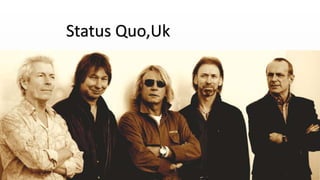
Status Quo,Uk
What is STATUS QUO?
Latin phrase means the existing state of affairs.
 The status quo refers to how conditions are at
the time and how the affirmative team can solve
these conditions.
In the sociological sense, it generally applies to
maintain or change existing social structure and
values.
Karl Marx viewed
organized religion as a
means for the bourgeoisie
to keep the proletariat
content with an unequal
status quo, and education
is seen by others as a
means of maintaining the
status quo of society.
Types of people who generally challenge the status
quo in the organization
• People who have nothing to lose now.
•People who know that the art of challenging,
equals not irritating, annoying or putting people off.
•People who have their own intellectual and moral
power, credibility, and standing.
•Corporate useful idiots .
•People who have bosses who genuinely
ask to be challenged, pushed back and
who look for alternative world views.
•Combination of others characters.
CONTINUE……
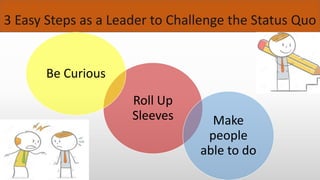
3 Easy Steps as a Leader to Challenge the Status Quo
Roll Up
Sleeves Make
people
able to do
Be Curious
Managers defend the status quo
 Fear of loss
 Full plate
 Lack of skills
 Doubt
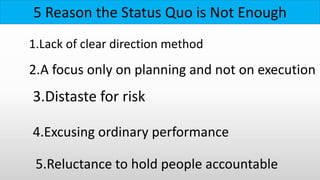
5 Reason the Status Quo is Not Enough
1.Lack of clear direction method
2.A focus only on planning and not on execution
3.Distaste for risk
4.Excusing ordinary performance
5.Reluctance to hold people accountable
some people choose to challenge the status
quo as it imply a strong belief in one’s position
as the correct one, and thus efforts may be
undertaken to undermine the position of
others.
Challenging the Status Quo
Challengers felt more negatively toward their
opponents and these negative emotions in turn
predicted biased attributions. Results are
important as they add to the understanding of
how intergroup conflict may arise, providing
explanations for why challengers are less
tolerant of others’ point of view.
Continue….
Conclusion
Status Quo Bias is linked to the Endowment Effect
and Negativity Bias, which make you place more
weight on negative impacts than benefits. Those
suffering from Status Quo Bias often cannot see the
benefits because they are too fearful of the
negative impacts.
"Nothing will kill your
business quicker than the
we've always done it like
that attitude."
REFERENCES
I. Dr. C. Michael Botterweck. "Glossary for Sociology 100".
academics.triton.edu. Retrieved 8 February 2015.
II. "Status Quo Definition". dictionary.reference.com. Dictionary.com. Retrieved
8 February 2015.
III.Clark, Pamela (2000). "The Social Climate". The Optimal Environment: Part
Four. www.featherpicking.com. Retrieved 2009-03-11.
IV.Boundless. "Religion and Social Control." Boundless Sociology. Boundless, 27
Jun. 2014. Retrieved 08 Feb. 2015
Status quo

Status quo

  • 2.
  • 3.
  • 4.
    Contents 1. What isSTATUS QUO? 2. Types of people who generally challenge the status quo in the organization 3. 3 Easy Steps as a Leader to Challenge the Status Quo 4. Managers defend the status quo 5. 5 Reason the Status Quo is Not Enough 6. Challenging the Status Quo 7. Conclusion
  • 5.
  • 6.
    What is STATUSQUO? Latin phrase means the existing state of affairs.  The status quo refers to how conditions are at the time and how the affirmative team can solve these conditions. In the sociological sense, it generally applies to maintain or change existing social structure and values.
  • 7.
    Karl Marx viewed organizedreligion as a means for the bourgeoisie to keep the proletariat content with an unequal status quo, and education is seen by others as a means of maintaining the status quo of society.
  • 8.
    Types of peoplewho generally challenge the status quo in the organization • People who have nothing to lose now. •People who know that the art of challenging, equals not irritating, annoying or putting people off. •People who have their own intellectual and moral power, credibility, and standing. •Corporate useful idiots .
  • 9.
    •People who havebosses who genuinely ask to be challenged, pushed back and who look for alternative world views. •Combination of others characters. CONTINUE……
  • 10.
    3 Easy Stepsas a Leader to Challenge the Status Quo Roll Up Sleeves Make people able to do Be Curious
  • 11.
    Managers defend thestatus quo  Fear of loss  Full plate  Lack of skills  Doubt
  • 12.
    5 Reason theStatus Quo is Not Enough 1.Lack of clear direction method 2.A focus only on planning and not on execution 3.Distaste for risk 4.Excusing ordinary performance 5.Reluctance to hold people accountable
  • 13.
    some people chooseto challenge the status quo as it imply a strong belief in one’s position as the correct one, and thus efforts may be undertaken to undermine the position of others. Challenging the Status Quo
  • 14.
    Challengers felt morenegatively toward their opponents and these negative emotions in turn predicted biased attributions. Results are important as they add to the understanding of how intergroup conflict may arise, providing explanations for why challengers are less tolerant of others’ point of view. Continue….
  • 15.
    Conclusion Status Quo Biasis linked to the Endowment Effect and Negativity Bias, which make you place more weight on negative impacts than benefits. Those suffering from Status Quo Bias often cannot see the benefits because they are too fearful of the negative impacts.
  • 16.
    "Nothing will killyour business quicker than the we've always done it like that attitude."
  • 18.
    REFERENCES I. Dr. C.Michael Botterweck. "Glossary for Sociology 100". academics.triton.edu. Retrieved 8 February 2015. II. "Status Quo Definition". dictionary.reference.com. Dictionary.com. Retrieved 8 February 2015. III.Clark, Pamela (2000). "The Social Climate". The Optimal Environment: Part Four. www.featherpicking.com. Retrieved 2009-03-11. IV.Boundless. "Religion and Social Control." Boundless Sociology. Boundless, 27 Jun. 2014. Retrieved 08 Feb. 2015