Ariba Knowledge Nuggets

                       Why Auctions Work!
These event types are more specifically known as reverse auctions in Ariba Sourcing. A reverse auction is a real–
time online event during which participants submit competitive bids for specific goods or services. Since auctions
require a lot of preparation to be successful, sourcing professionals typically prepare for them by running qualifying
information-collecting events (RFIs and RFPs). Depending on how the event is configured, Ariba Sourcing can pro-
vide participants with feedback on how their prices compare with other participants’ prices, in the form of:
        • The value of the lead bid
        • Their rank in the auction
         • A graph comparing the bids in the auction
Auctions are directly competitive and allow the real-time exchange of information between participants. You must
carefully schedule your auctions so that all participants can participate at the same time. Auctions can be a great
source of savings derived by the power of the dynamic online market. In order for the auction to be successful, there
are some key considerations:
        •   How many suppliers will be attracted to participate in the online market?
        •   How should the goods and services be described to ensure all suppliers are bidding “apples to apples”?
        •   How can we use lotting to maximize supplier coverage and participation?
        •   Where should the ceiling be set for each lot?
Auctions can be run as standalone events, or following an RFP. The RFP can be used to assess the market place:
•   Provides evidence of the number of interested suppliers.
•   Provides the platform to leverage suppliers through negotiations.
•   Allows refinement of the auction strategy.
Pre-bids are also recommended in advance of single round auctions. The type of auction format and set-up you se-
lect is determined by the level of market knowledge, and the number of participating suppliers.


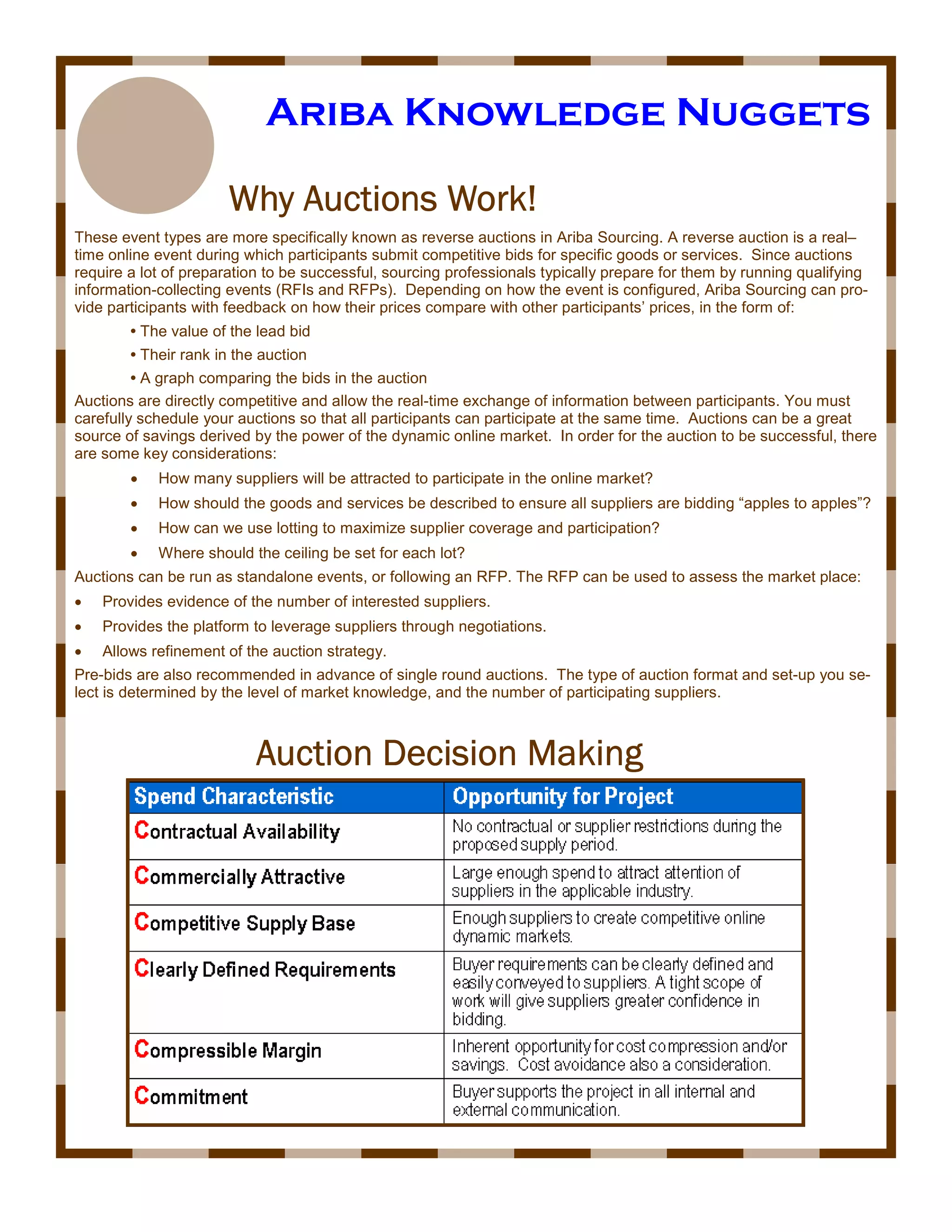
                           Auction Decision Making
Tangible Benefits of Auctions
•   Improved Competition: Price transparency
    enhances the competitive bidding
•   environment to generate additional sav-
    ings
•   Faster Execution: Auctions speed bid
    response time by providing real-time
    feedback to suppliers
•   Efficient Decision Making: Auctions
    improve efficiency and facilitate group
    decision-making
•   Flexibility: Auctions can support a variety
    of bid formats


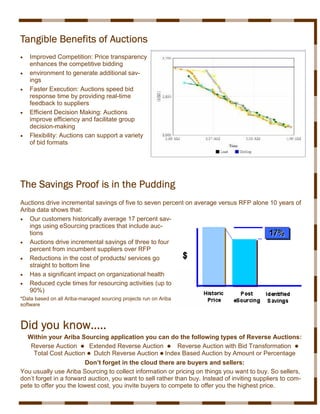
The Savings Proof is in the Pudding
Auctions drive incremental savings of five to seven percent on average versus RFP alone 10 years of
Ariba data shows that:
• Our customers historically average 17 percent sav-
    ings using eSourcing practices that include auc-
    tions
• Auctions drive incremental savings of three to four
    percent from incumbent suppliers over RFP
• Reductions in the cost of products/ services go
    straight to bottom line
• Has a significant impact on organizational health
• Reduced cycle times for resourcing activities (up to
    90%)
*Data based on all Ariba-managed sourcing projects run on Ariba
software


Did you know…..
  Within your Ariba Sourcing application you can do the following types of Reverse Auctions:
    Reverse Auction       Extended Reverse Auction          Reverse Auction with Bid Transformation
     Total Cost Auction Dutch Reverse Auction Index Based Auction by Amount or Percentage
                         Don’t forget in the cloud there are buyers and sellers:
You usually use Ariba Sourcing to collect information or pricing on things you want to buy. So sellers,
don’t forget in a forward auction, you want to sell rather than buy. Instead of inviting suppliers to com-
pete to offer you the lowest cost, you invite buyers to compete to offer you the highest price.
Of course, auctions aren’t always the right answer…
Try Different Strategies IF:
1. Category is on the black list
        •   Challenging to create “apples to apples” scenario
        •   Suppliers won’t participate
        •   Ex: Small Parcel
2. You don’t know what you’re buying
        •   Supplier proposals are used to define service levels
        •   RFP to finalize SLAs
3. Not enough players
        •   Single source scenario or 2-bidder market
        •   Few suppliers with large difference in RFP pricing
4. You plan to negotiate after the event
        •   Undermines the auction process
        •   Borderline unethical practice
5. Proprietary Technology or Patents are an issue
        •   Suppliers control technology and might have product patents


                                                                                        Are you
Common Auction Misconceptions                                                           working with
                                                                                        your suppliers
1. Auctions are only for “commodity” items                                              to continue to
                                                                                        drive savings?
2. Auctions only work in markets where there are large numbers of suppliers
                                                                                        Suppliers can
   with similar capabilities                                                            be a strategic
3. Auctions are only about price                                                        partner in the
                                                                                        ongoing effort
4. Auction benefits are not sustainable or fully implementable                          to engineer
5. Auctions ruin supplier relationships and long-term partnerships                      costs out of
                                                                                        the supply
                                                                                        chain.

                        Best Practice Tip for eSourcing
 WORK WITH SUPPLIERS for performance assessment and new savings ideas!
Suppliers can help drive costs out of the supply chain in a range of areas including logistics
improvements (such as packaging/handling, warehousing and inventory management), better
resource utilization (this would include long-term planning, forecasting and production planning),
better transactional interaction (ordering, tracking and payment) and better product cost
management (such as NPI co development and design). Suppliers, for their part, can often bring a
new perspective to the situation. They are more familiar with their own cost drivers, of course, and
sometimes even have a more intimate understanding of their customers’ supply chain practices.

Ariba Knowledge Nuggets: Reverse Auctions

  • 1.
    Ariba Knowledge Nuggets Why Auctions Work! These event types are more specifically known as reverse auctions in Ariba Sourcing. A reverse auction is a real– time online event during which participants submit competitive bids for specific goods or services. Since auctions require a lot of preparation to be successful, sourcing professionals typically prepare for them by running qualifying information-collecting events (RFIs and RFPs). Depending on how the event is configured, Ariba Sourcing can pro- vide participants with feedback on how their prices compare with other participants’ prices, in the form of: • The value of the lead bid • Their rank in the auction • A graph comparing the bids in the auction Auctions are directly competitive and allow the real-time exchange of information between participants. You must carefully schedule your auctions so that all participants can participate at the same time. Auctions can be a great source of savings derived by the power of the dynamic online market. In order for the auction to be successful, there are some key considerations: • How many suppliers will be attracted to participate in the online market? • How should the goods and services be described to ensure all suppliers are bidding “apples to apples”? • How can we use lotting to maximize supplier coverage and participation? • Where should the ceiling be set for each lot? Auctions can be run as standalone events, or following an RFP. The RFP can be used to assess the market place: • Provides evidence of the number of interested suppliers. • Provides the platform to leverage suppliers through negotiations. • Allows refinement of the auction strategy. Pre-bids are also recommended in advance of single round auctions. The type of auction format and set-up you se- lect is determined by the level of market knowledge, and the number of participating suppliers. Auction Decision Making
  • 2.
    Tangible Benefits ofAuctions • Improved Competition: Price transparency enhances the competitive bidding • environment to generate additional sav- ings • Faster Execution: Auctions speed bid response time by providing real-time feedback to suppliers • Efficient Decision Making: Auctions improve efficiency and facilitate group decision-making • Flexibility: Auctions can support a variety of bid formats The Savings Proof is in the Pudding Auctions drive incremental savings of five to seven percent on average versus RFP alone 10 years of Ariba data shows that: • Our customers historically average 17 percent sav- ings using eSourcing practices that include auc- tions • Auctions drive incremental savings of three to four percent from incumbent suppliers over RFP • Reductions in the cost of products/ services go straight to bottom line • Has a significant impact on organizational health • Reduced cycle times for resourcing activities (up to 90%) *Data based on all Ariba-managed sourcing projects run on Ariba software Did you know….. Within your Ariba Sourcing application you can do the following types of Reverse Auctions: Reverse Auction Extended Reverse Auction Reverse Auction with Bid Transformation Total Cost Auction Dutch Reverse Auction Index Based Auction by Amount or Percentage Don’t forget in the cloud there are buyers and sellers: You usually use Ariba Sourcing to collect information or pricing on things you want to buy. So sellers, don’t forget in a forward auction, you want to sell rather than buy. Instead of inviting suppliers to com- pete to offer you the lowest cost, you invite buyers to compete to offer you the highest price.
  • 3.
    Of course, auctionsaren’t always the right answer… Try Different Strategies IF: 1. Category is on the black list • Challenging to create “apples to apples” scenario • Suppliers won’t participate • Ex: Small Parcel 2. You don’t know what you’re buying • Supplier proposals are used to define service levels • RFP to finalize SLAs 3. Not enough players • Single source scenario or 2-bidder market • Few suppliers with large difference in RFP pricing 4. You plan to negotiate after the event • Undermines the auction process • Borderline unethical practice 5. Proprietary Technology or Patents are an issue • Suppliers control technology and might have product patents Are you Common Auction Misconceptions working with your suppliers 1. Auctions are only for “commodity” items to continue to drive savings? 2. Auctions only work in markets where there are large numbers of suppliers Suppliers can with similar capabilities be a strategic 3. Auctions are only about price partner in the ongoing effort 4. Auction benefits are not sustainable or fully implementable to engineer 5. Auctions ruin supplier relationships and long-term partnerships costs out of the supply chain. Best Practice Tip for eSourcing WORK WITH SUPPLIERS for performance assessment and new savings ideas! Suppliers can help drive costs out of the supply chain in a range of areas including logistics improvements (such as packaging/handling, warehousing and inventory management), better resource utilization (this would include long-term planning, forecasting and production planning), better transactional interaction (ordering, tracking and payment) and better product cost management (such as NPI co development and design). Suppliers, for their part, can often bring a new perspective to the situation. They are more familiar with their own cost drivers, of course, and sometimes even have a more intimate understanding of their customers’ supply chain practices.