Bulgaria
Ewopharma
MedReps Training Course
14 December 2010
Agenda
8.30-10.00 am
 Who is the allergic patient ?
 How the allergic patient is managed ?
 Why the allergic patient is underdiagnosed ?
 Why the allergic patient is undertreated ?
Break
10.15 – 12.30 am
 Grass rationalisation,
 Posology - arguments to increase to 8 drops per day
 Patient follow up,
 Post graduate course presentation and arguments
Allergic patient: the current practice
 Who is the allergic patient ?
 How the allergic patient is managed ?
 Why the allergic patient is underdiagnosed ?
 Why the allergic patient is undertreated ?
Who is the allergic patient ?
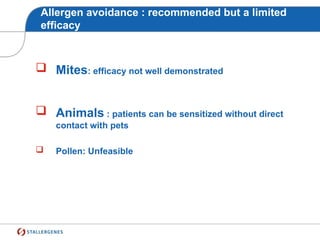
 Epidemiology of respiratory allergic diseases
 ECHRS
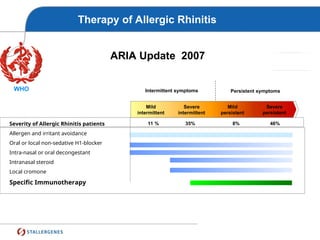
 ISAAC
 Classification of respiratory allergic diseases
 ARIA
 GINA
 The natural course of allergic diseases
Allergic Rhinitis: prevalence in Europe
20.6%1
24.5%1
21.5%1
21.0%3
16.9%1
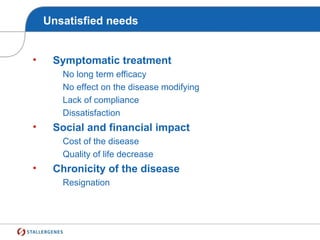
29.8%2
AR European prevalence
is 23%, of which 45% are
undiagnosed1
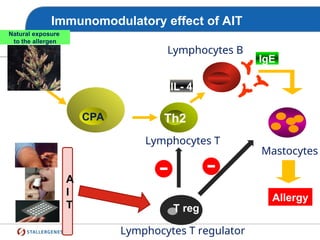
26.0%1
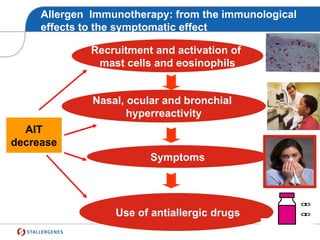
1.Bauchau V., Durham S.R., Eur Respir J 2004:758-764
2.Bachert C. Allergy 2006: 61: 693-698
3.Brehl P. Ind Health 2003 Apr; 41 (2): 121-3
Prevalence of AR in a population-based survey in 6 EU countries1
:
UK, Germany, France, Belgium, Italy and Spain
500 million people suffer
from AR worlwide
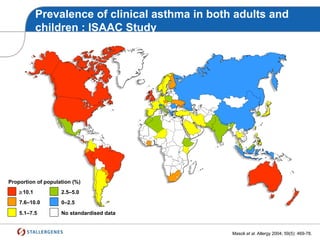
Prevalence of clinical asthma in both adults and
children : ISAAC Study
Masoli et al. Allergy 2004; 59(5): 469-78.
10.1
7.6–10.0
5.1–7.5
2.5–5.0
0–2.5
No standardised data
Proportion of population (%)
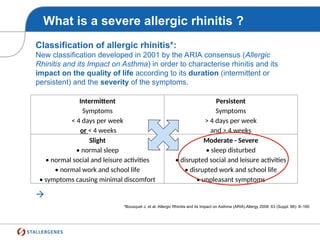
What is a severe allergic rhinitis ?
Classification of allergic rhinitis*:
New classification developed in 2001 by the ARIA consensus (Allergic
Rhinitis and its Impact on Asthma) in order to characterise rhinitis and its
impact on the quality of life according to its duration (intermittent or
persistent) and the severity of the symptoms.

*Bousquet J. et al. Allergic Rhinitis and its Impact on Asthma (ARIA).Allergy 2008: 63 (Suppl. 86): 8–160
Intermittent
Symptoms
< 4 days per week
or < 4 weeks
Persistent
Symptoms
> 4 days per week
and > 4 weeks
Slight
• normal sleep
• normal social and leisure activities
• normal work and school life
• symptoms causing minimal discomfort
Moderate - Severe
• sleep disturbed
• disrupted social and leisure activities
• disrupted work and school life
• unpleasant symptoms
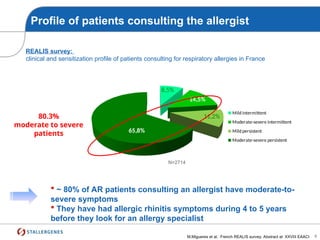
8,5%
14,5%
11,2%
65,8%
Mild intermittent
Moderate-severe intermittent
Mild persistent
Moderate-severe persistent
8
Profile of patients consulting the allergist
 ~ 80% of AR patients consulting an allergist have moderate-to-
severe symptoms
 They have had allergic rhinitis symptoms during 4 to 5 years
before they look for an allergy specialist
M.Migueres et al. French REALIS survey. Abstract at XXVIII EAACI
80.3%
moderate to severe
patients
N=2714
REALIS survey:
clinical and sensitization profile of patients consulting for respiratory allergies in France
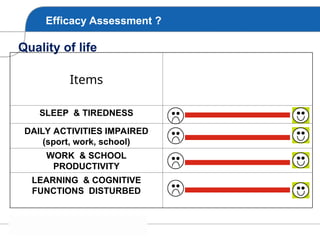
Altered quality of life due to the allergic symptoms
Impact on
Allergic
Respiratory
Diseases
SLEEP & TIREDNESS
77 % of patients had sleep troubles
46 % of patients felt tired
LEARNING & COGNITIVE
FUNCTIONS DISTURBED
EMBARRASSMENT
Adolescents embarassed to
use inhalers
WORK & SCHOOL
PRODUCTIVITY
< 90 % effectiveness at work
< 93 % impaired classroom
performance
DAILY ACTIVITIES
IMPAIRED
WHO – Initiative 2000
ALLERGIC RHINITIS AND ITS IMPACT ON ASTHMA (ARIA)
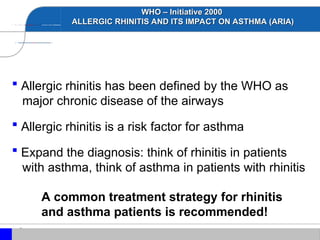
 Allergic rhinitis has been defined by the WHO as
major chronic disease of the airways
 Allergic rhinitis is a risk factor for asthma
 Expand the diagnosis: think of rhinitis in patients
with asthma, think of asthma in patients with rhinitis
A common treatment strategy for rhinitis
and asthma patients is recommended!
Why the allergic patient is underdiagnosed ?
 How the allergy diagnosis must be performed ?
 How the GPs diagnose the allergic diseases ?
 What’s going wrong with the allergy diagnosis ?
Diagnosis Process in Allergology
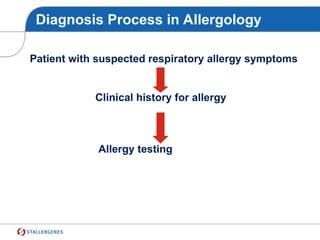
Patient with suspected respiratory allergy symptoms
Clinical history for allergy
Allergy testing
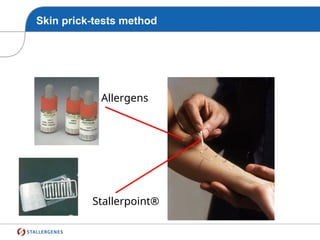
Stallerpoint®
Allergens
Skin prick-tests method
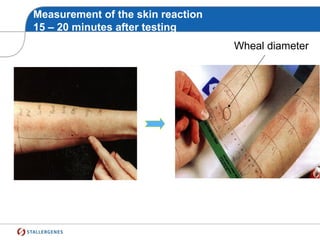
Measurement of the skin reaction
15 – 20 minutes after testing
Wheal diameter
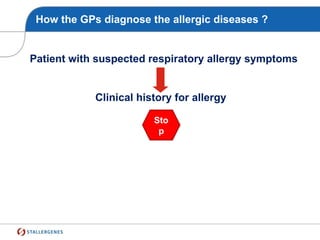
How the GPs diagnose the allergic diseases ?
Patient with suspected respiratory allergy symptoms
Clinical history for allergy
Sto
p
Why the allergic patient is underdiagnosed ?
 What’s going wrong with the allergy diagnosis ?
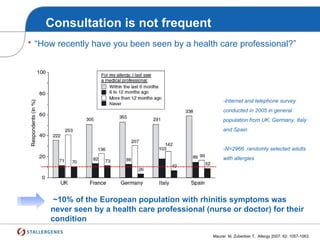
Consultation is not frequent
~10% of the European population with rhinitis symptoms was
never seen by a health care professional (nurse or doctor) for their
condition
Maurer M, Zuberbier T, Allergy 2007: 62: 1057-1063.
-Internet and telephone survey
conducted in 2005 in general
population from UK, Germany, Italy
and Spain
-N=2966 randomly selected adults
with allergies
 “How recently have you been seen by a health care professional?”
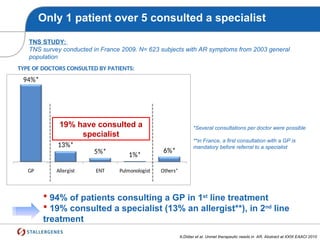
6%*
1%*
5%*
13%*
94%*
Others*
Pulmonologist
ENT
Allergist
GP
Only 1 patient over 5 consulted a specialist
19% have consulted a
specialist
A.Didier et al. Unmet therapeutic needs in AR. Abstract at XXIX EAACI 2010
*Several consultations per doctor were possible
**in France, a first consultation with a GP is
mandatory before referral to a specialist
 94% of patients consulting a GP in 1st
line treatment
 19% consulted a specialist (13% an allergist**), in 2nd
line
treatment
TYPE OF DOCTORS CONSULTED BY PATIENTS:
TNS STUDY:
TNS survey conducted in France 2009. N= 623 subjects with AR symptoms from 2003 general
population
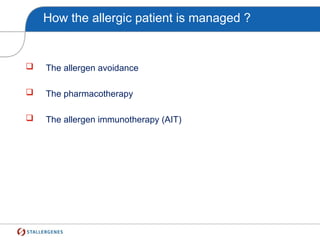
How the allergic patient is managed ?
 The allergen avoidance
 The pharmacotherapy
 The allergen immunotherapy (AIT)
The optimal management of the allergic patient
The patient education Allergen avoidance
Pharmacotherapy
Allergen Immunotherapy
Why the allergic patient is undertreated ?
 The efficacy of the allergen avoidance ?
Allergen avoidance : recommended but a limited
efficacy
 Mites: efficacy not well demonstrated
 Animals : patients can be sensitized without direct
contact with pets
 Pollen: Unfeasible
Why the allergic patient is undertreated ?
 The efficacy of the pharmacotherapy ?
Therapy of Allergic Rhinitis
ARIA Update 2007
Severe
persistent
Mild
persistent
Severe
intermittent
Mild
intermittent
Intermittent symptoms Persistent symptoms
Severity of Allergic Rhinitis patients
Allergen and irritant avoidance
Oral or local non-sedative H1-blocker
Intra-nasal or oral decongestant
Intranasal steroid
Local cromone
Specific Immunotherapy
11 % 35% 8% 46%
WHO
Current Symptomatic Treatments
Rhinitis
Asthma
Asthma
Rhinitis
Rhinitis
Asthma
0
10
20
30
40
50
60
70
80
90
4 8 15 22 29
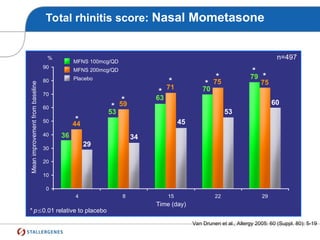
Total rhinitis score: Nasal Mometasone
Mean
improvement
from
baseline
%
MFNS 100mcg/QD
MFNS 200mcg/QD
Placebo
36
44
29
53
59
34
63
71
45
70
75
53
79
75
60
n=497




 



* p0.01 relative to placebo
Time (day)
Van Drunen et al., Allergy 2005: 60 (Suppl. 80): 5-19
Total rhinitis score : Nasal Mometasone
Van Drunen et al., Allergy 2005; 60 (Suppl. 80): 5-19
n=479
Improvement
in
total
nasal
symptom
scores
Time (day)
MFNS 50mcg/QD
MFNS 100mcg/QD
MFNS 200mcg/QD
MFNS 800mcg/QD
Placebo
0
10
20
30
40
50
60
Baseline 3 7 14 21 28 Endpoint
Rhinitis symptoms in seasonal AR
Montelukast vs. placebo and Loratadin
n=1 302
Change
from
baseline
(0-3
scale;
LS
mean

SE)
-0.6
-0.5
-0.4
-0.3
-0.2
-0.1
0
Daytime nasal
symptoms
Night-time symptoms
Daily composite (daytime
nasal & night-time)
(a) (b) (c)



 

-9% -16% -22% -8% -20% -15% -9% -16% -20%
Montelukast
Loratadine
Placebo
Philip et al., Clin Exp Allergy 2002; 32: 1020-1028
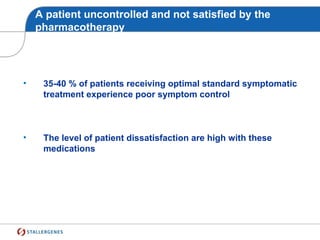
A patient uncontrolled and not satisfied by the
pharmacotherapy
• 35-40 % of patients receiving optimal standard symptomatic
treatment experience poor symptom control
• The level of patient dissatisfaction are high with these
medications
What are the unmet needs ?
 Patient satisfaction / perception
 Patient expectation: a long term efficacy
What are the unmet needs ?
 Patient satisfaction / perception
Allergic Rhinitis Management
White et al. , Clin Exp Allergy1998
0%
25%
50%
100%
regular
Medium
Good
regular intermittent intermittent
How do patients feel after their symptomatic treatment (anti
H1, corticosteroid) ?
Bad
Nasal corticosteroid
Anti-histamine
75%
regular intermittent regular intermittent
The paradox of allergy
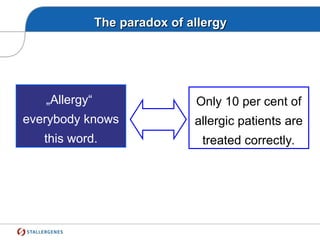
„Allergy“
everybody knows
this word.
Only 10 per cent of
allergic patients are
treated correctly.
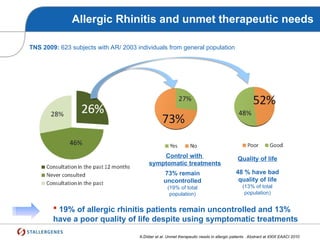
Allergic Rhinitis and unmet therapeutic needs
Control with
symptomatic treatments
Quality of life
73% remain
uncontrolled
(19% of total
population)
48 % have bad
quality of life
(13% of total
population)
 19% of allergic rhinitis patients remain uncontrolled and 13%
have a poor quality of life despite using symptomatic treatments
A.Didier et al. Unmet therapeutic needs in allergic patients . Abstract at XXIX EAACI 2010
TNS 2009: 623 subjects with AR/ 2003 individuals from general population
Unsatisfied needs
• Symptomatic treatment
No long term efficacy
No effect on the disease modifying
Lack of compliance
Dissatisfaction
• Social and financial impact
Cost of the disease
Quality of life decrease
• Chronicity of the disease
Resignation
What are the unmet needs ?
 Patient expectation: a long term efficacy
Why AIT can satisfy the unmet needs ?
 Immunomodulatory effect
 Long term and sustained effect
Definition
Specific immunotherapy is the repeated administration
of allergen products to allergic subjects to activate
immunomodulatory mechanisms and provide
sustained relief of symptoms during subsequent
natural allergen exposure
WHO Guideline 1998
EMEA Guideline 2008
Immunomodulatory effect of AIT
CPA Th2
Mastocytes
IgE
Allergy
IL- 4
Natural exposure
to the allergen
Lymphocytes T
Lymphocytes B
A
I
T T reg
Lymphocytes T regulator
Allergen Immunotherapy: from the immunological
effects to the symptomatic effect
Symptoms
Use of antiallergic drugs
Nasal, ocular and bronchial
hyperreactivity
Recruitment and activation of
mast cells and eosinophils
AIT
decrease
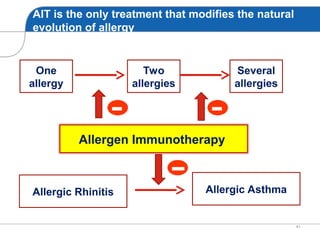
AIT is the only treatment that modifies the natural
evolution of allergy
One
allergy
Allergen Immunotherapy
Allergic Rhinitis Allergic Asthma
41
Two
allergies
Several
allergies
Why the allergist is the expert ?
 Diagnosis
 AIT indications
 Patient management and follow-up
Diagnostic Approach In Allergology
Allergy
History
Skin Tests/
IgE
Symptoms
Moderate/severe
Poor QOL
Positive Positive
D
I
A
G
N
O
S
I
S
AIT Indication Pathway
Allergy
History
Skin Tests/
IgE
Symptoms
Moderate/severe
Poor QOL
SLIT with pollens
mixtures or 2 non
related allergens
SLIT with one
allergen
Indication for AIT ?
Contra indications:
-Immunoptahologic diseases
-Severe asthma
- Malignancy
- Treatment withβ-blockers
- Chronic mouth disease
- Pregnancy: avoid initiaition
of immunotherapy during
pregnancy
NO
Positive Positive
YES
Age ≥ 4 yrs
old
D
I
A
G
N
O
S
I
S
• A patient with moderate/severe symptoms
during/after allergen exposure
• A patient with an altered quality of life due
to the allergic symptoms
• A patient not improved and not satisfied
by the pharmacotherapy
• A patient accurately diagnosed
• For allergic respiratory diseases
Monosensitization
Polysensitization
Which Allergen for AIT ?
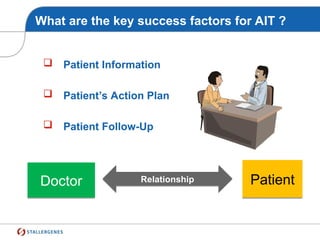
What are the key success factors for AIT ?
 Patient Information
 Patient’s Action Plan
 Patient Follow-Up
Doctor Patient
Relationship
Key success factors for AIT
Patient information = Patient Education
I. Patient should understand :
• His/her allergic disease
• The goals of SIT
• The disease modifyer effect of SIT
• Why 3-5 years of SLIT ?
• The onset of action of SLIT
• The importance of compliance for the success of SLIT
Agenda
10.15 – 12.30 am
 Grass rationalisation
 Posology - arguments to increase to 8 drops per day
 Patient follow up
 Post graduate course: presentation and arguments
Grass rationalisation
 5 Grasses / 4 cereals mixture: is it still relevant ?
 High level of allergens cross-reactivity between 5 grasses
and cereals
 5 grasses alone is sufficient to treat the allergic patient
sensitized to grass pollen and cereal pollen.
RATIONALE TO INCREASE TO 8 DROPS
PER DAY
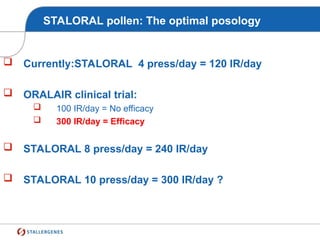
STALORAL pollen: The optimal posology
 Currently:STALORAL 4 press/day = 120 IR/day
 ORALAIR clinical trial:
 100 IR/day = No efficacy
 300 IR/day = Efficacy
 STALORAL 8 press/day = 240 IR/day
 STALORAL 10 press/day = 300 IR/day ?
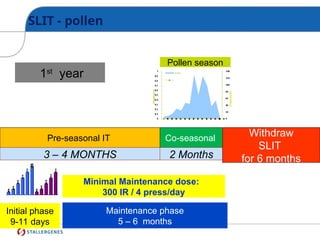
SLIT - pollen
Initial phase
9-11 days
Maintenance phase
5 – 6 months
Pre-seasonal IT Co-seasonal
Pollen season
1st
year
2 Months
3 – 4 MONTHS
Minimal Maintenance dose:
300 IR / 4 press/day
1
2
4
6
8
10
1
2
4
6
8
1 2 3 4 5 6 7 8 9 10 11
Withdraw
SLIT
for 6 months
Patient follow up
Patient Information/Communication
Give the right message to the patient !!
 “Allergy is a chronic disease not curable by pharmacotherapy
alone..”
 “Rhinitis will develop into asthma in 50 % of the patients..”
 “You may develop new allergic sensitizations..”
 “The only way to affect the disease is by immune intervention..”
 “ SIT is a three years treatment but compared to lifelong drug
intake..”
 “ Efficacy of SIT persists longtime after cessation “
 “ SIT would positivily affect your quality of life…”
Key success factors for SIT
Patient Information/Education needs from the doctor
 Time
 Conviction / Enthousiasm/Persuasion
 To be done at regular intervals (not a one shot
issue)
Patient compliance: a major issue
Factors of non-compliance :
• Daily intake
• Treatment duration: 3-5 years
Key success factors for AIT
Patient compliance: a major issue
Patient Follow-Up
• Optimal patient follow-up
• SIT efficacy assessment
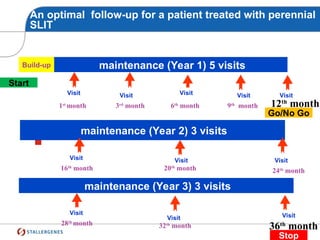
An optimal follow-up for a patient treated with perennial
SLIT
maintenance (Year 1) 5 visits
Build-up
1st
month 3rd
month 6th
month 9th
month 12th
month
maintenance (Year 2) 3 visits
maintenance (Year 3) 3 visits
16th
month 20th
month 24th
month
28th
month 32th
month 36th
month
Visit
Start
Stop
Go/No Go
Visit
Visit
Visit
Visit
Visit
Visit
Visit
Visit
Visit
Visit
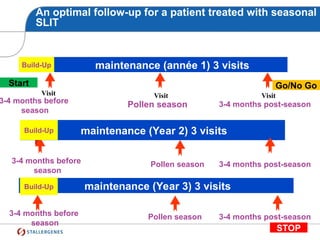
An optimal follow-up for a patient treated with seasonal
SLIT
maintenance (année 1) 3 visits
Build-Up
Visit
3-4 months before
season
maintenance (Year 2) 3 visits
maintenance (Year 3) 3 visits
Start
STOP
Go/No Go
Pollen season 3-4 months post-season
Build-Up
Build-Up
Visit Visit
3-4 months before
season
Pollen season 3-4 months post-season
3-4 months before
season
Pollen season 3-4 months post-season
Content of follow-up visits
Safety
Staloral
intake
One month
after starting
3 months
Safety
Staloral
intake
Compliance
6 months
Compliance
Efficacy
9 months
Compliance
Satisfaction
Efficacy
12 months
Compliance
Satisfaction
Efficacy
Willingness
to continue
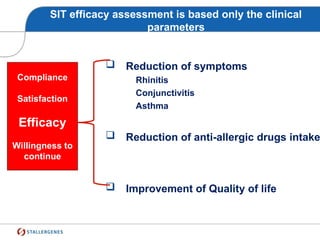
SIT efficacy assessment is based only the clinical
parameters
 Reduction of symptoms
Rhinitis
Conjunctivitis
Asthma
 Reduction of anti-allergic drugs intake
 Improvement of Quality of life
Compliance
Satisfaction
Efficacy
Willingness to
continue
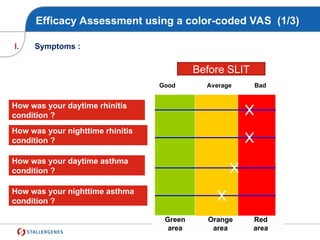
Efficacy Assessment using a color-coded VAS (1/3)
I. Symptoms :
Good Average Bad
How was your daytime rhinitis
condition ?
How was your nighttime rhinitis
condition ?
How was your daytime asthma
condition ?
How was your nighttime asthma
condition ?
Green
area
Orange
area
Red
area
Before SLIT
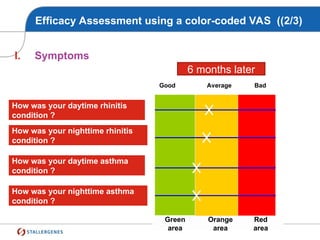
Efficacy Assessment using a color-coded VAS ((2/3)
I. Symptoms
Good Average Bad
How was your daytime rhinitis
condition ?
How was your nighttime rhinitis
condition ?
How was your daytime asthma
condition ?
How was your nighttime asthma
condition ?
Green
area
Orange
area
Red
area
6 months later
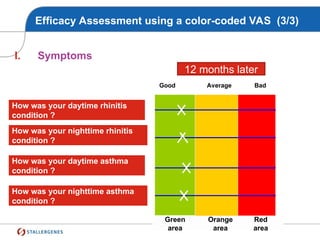
Efficacy Assessment using a color-coded VAS (3/3)
I. Symptoms
Good Average Bad
How was your daytime rhinitis
condition ?
How was your nighttime rhinitis
condition ?
How was your daytime asthma
condition ?
How was your nighttime asthma
condition ?
Green
area
Orange
area
Red
area
12 months later
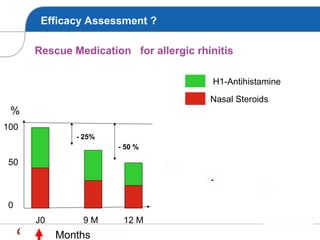
Efficacy Assessment ?
Rescue Medication for allergic rhinitis
J0 9 M 12 M
H1-Antihistamine
Nasal Steroids
100
0
50
%
- 25%
- 50 %
-
Months
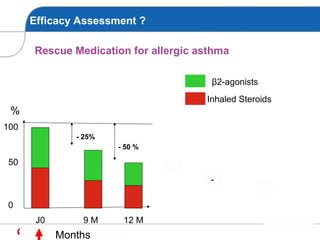
Efficacy Assessment ?
Rescue Medication for allergic asthma
J0 9 M 12 M
β2-agonists
Inhaled Steroids
100
0
50
%
- 25%
- 50 %
-
Months
Efficacy Assessment ?
Quality of life
Items
SLEEP & TIREDNESS
DAILY ACTIVITIES IMPAIRED
(sport, work, school)
WORK & SCHOOL
PRODUCTIVITY
LEARNING & COGNITIVE
FUNCTIONS DISTURBED
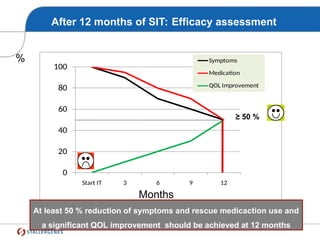
0
20
40
60
80
100
Start IT 3 6 9 12
Symptoms
Medication
QOL Improvement
After 12 months of SIT: Efficacy assessment
At least 50 % reduction of symptoms and rescue medicaction use and
a significant QOL improvement should be achieved at 12 months
Months
%
≥ 50 %
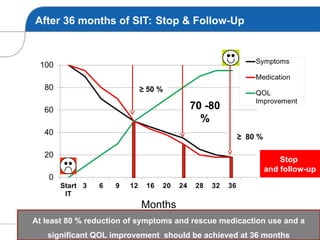
After 36 months of SIT: Stop & Follow-Up
Months
≥ 50 %
70 -80
%
≥ 80 %
At least 80 % reduction of symptoms and rescue medicaction use and a
significant QOL improvement should be achieved at 36 months
Stop
and follow-up
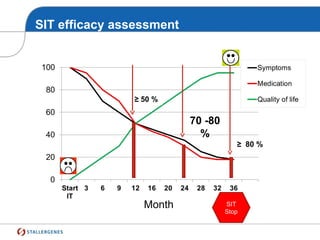
SIT efficacy assessment
Month
≥ 50 %
70 -80
%
≥ 80 %
SIT
Stop
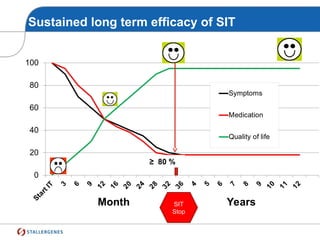
Sustained long term efficacy of SIT
Month
≥ 80 %
Years
SIT
Stop
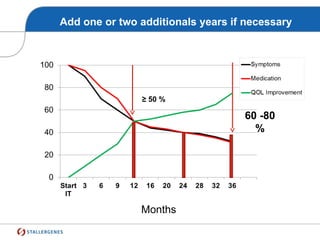
Add one or two additionals years if necessary
Months
≥ 50 %
60 -80
%
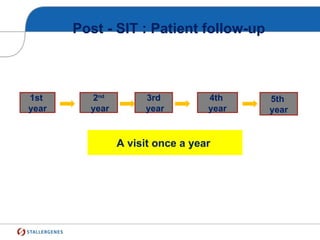
Post - SIT : Patient follow-up
1st
year
2nd
year
3rd
year
4th
year
5th
year
A visit once a year
After 12 months of SIT: a key milestones
STOP ?
Symptoms weakly improved
No change in rescue medications
QOL not improved
Compliance poor
Safety average / bad
Patient/parent not satisfied
0
20
40
60
80
100
StartIT 3 6 9 12
Symptoms
Medication
QOL Improvement
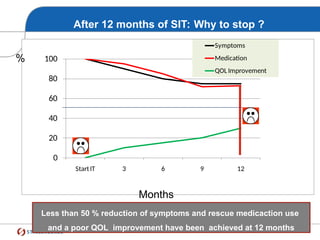
After 12 months of SIT: Why to stop ?
Less than 50 % reduction of symptoms and rescue medicaction use
and a poor QOL improvement have been achieved at 12 months
Months
%
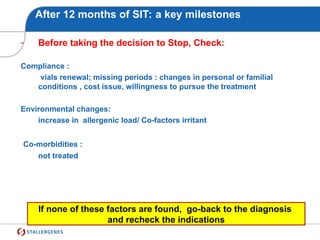
After 12 months of SIT: a key milestones
- Before taking the decision to Stop, Check:
Compliance :
vials renewal; missing periods : changes in personal or familial
conditions , cost issue, willingness to pursue the treatment
Environmental changes:
increase in allergenic load/ Co-factors irritant
Co-morbidities :
not treated
If none of these factors are found, go-back to the diagnosis
and recheck the indications
Key Message
To be successful SLIT needs:
A good indication
The best candidate
An optimal patient management
Post graduate course presentation and arguments
 Objectives
 Contents
 Organisation
Post graduate course presentation and arguments (1)
STALLERGENES
Post Graduate Course
An Essential Half-Day Training Course On :
Sublingual Immunotherapy in Practice
Post graduate course
What The Course Will Cover ?
•A stepwise approach for the indications of SLIT
•The place of SLIT in the treatment of allergic respiratory diseases
•The key factors to make SLIT a success
•The compliance/adherence issue and how to tackle it
Post graduate course : the agenda
•Welcome – Introduction 15’
•The basics of SLIT : recall 15’
•Workshop 1 : Choosing the right patient for SLIT 60’
•Coffee Break 15’
•Workshop 2 : Managing the patient optimally 60’
•The patient follow-up handbook 15’
•Interactive Quizz 15’
•Take-home messages 15’
3 hours 30 duration
Post graduate course
Who Should Attend ?
 Allergists
 Experience with SLIT: at least 1 year
 10 to 15 attendees/ session
Post graduate course : Meeting Date 2011
 March 2011
 Varna
 Plovdiv
 Sofia

Allergisch rhinitis behandeling en preventie

  • 1.
  • 2.
    Agenda 8.30-10.00 am  Whois the allergic patient ?  How the allergic patient is managed ?  Why the allergic patient is underdiagnosed ?  Why the allergic patient is undertreated ? Break 10.15 – 12.30 am  Grass rationalisation,  Posology - arguments to increase to 8 drops per day  Patient follow up,  Post graduate course presentation and arguments
  • 3.
    Allergic patient: thecurrent practice  Who is the allergic patient ?  How the allergic patient is managed ?  Why the allergic patient is underdiagnosed ?  Why the allergic patient is undertreated ?
  • 4.
    Who is theallergic patient ?  Epidemiology of respiratory allergic diseases  ECHRS  ISAAC  Classification of respiratory allergic diseases  ARIA  GINA  The natural course of allergic diseases
  • 5.
    Allergic Rhinitis: prevalencein Europe 20.6%1 24.5%1 21.5%1 21.0%3 16.9%1 29.8%2 AR European prevalence is 23%, of which 45% are undiagnosed1 26.0%1 1.Bauchau V., Durham S.R., Eur Respir J 2004:758-764 2.Bachert C. Allergy 2006: 61: 693-698 3.Brehl P. Ind Health 2003 Apr; 41 (2): 121-3 Prevalence of AR in a population-based survey in 6 EU countries1 : UK, Germany, France, Belgium, Italy and Spain 500 million people suffer from AR worlwide
  • 6.
    Prevalence of clinicalasthma in both adults and children : ISAAC Study Masoli et al. Allergy 2004; 59(5): 469-78. 10.1 7.6–10.0 5.1–7.5 2.5–5.0 0–2.5 No standardised data Proportion of population (%)
  • 7.
    What is asevere allergic rhinitis ? Classification of allergic rhinitis*: New classification developed in 2001 by the ARIA consensus (Allergic Rhinitis and its Impact on Asthma) in order to characterise rhinitis and its impact on the quality of life according to its duration (intermittent or persistent) and the severity of the symptoms.  *Bousquet J. et al. Allergic Rhinitis and its Impact on Asthma (ARIA).Allergy 2008: 63 (Suppl. 86): 8–160 Intermittent Symptoms < 4 days per week or < 4 weeks Persistent Symptoms > 4 days per week and > 4 weeks Slight • normal sleep • normal social and leisure activities • normal work and school life • symptoms causing minimal discomfort Moderate - Severe • sleep disturbed • disrupted social and leisure activities • disrupted work and school life • unpleasant symptoms
  • 8.
    8,5% 14,5% 11,2% 65,8% Mild intermittent Moderate-severe intermittent Mildpersistent Moderate-severe persistent 8 Profile of patients consulting the allergist  ~ 80% of AR patients consulting an allergist have moderate-to- severe symptoms  They have had allergic rhinitis symptoms during 4 to 5 years before they look for an allergy specialist M.Migueres et al. French REALIS survey. Abstract at XXVIII EAACI 80.3% moderate to severe patients N=2714 REALIS survey: clinical and sensitization profile of patients consulting for respiratory allergies in France
  • 9.
    Altered quality oflife due to the allergic symptoms Impact on Allergic Respiratory Diseases SLEEP & TIREDNESS 77 % of patients had sleep troubles 46 % of patients felt tired LEARNING & COGNITIVE FUNCTIONS DISTURBED EMBARRASSMENT Adolescents embarassed to use inhalers WORK & SCHOOL PRODUCTIVITY < 90 % effectiveness at work < 93 % impaired classroom performance DAILY ACTIVITIES IMPAIRED
  • 10.
    WHO – Initiative2000 WHO – Initiative 2000 ALLERGIC RHINITIS AND ITS IMPACT ON ASTHMA (ARIA) ALLERGIC RHINITIS AND ITS IMPACT ON ASTHMA (ARIA)  Allergic rhinitis has been defined by the WHO as major chronic disease of the airways  Allergic rhinitis is a risk factor for asthma  Expand the diagnosis: think of rhinitis in patients with asthma, think of asthma in patients with rhinitis A common treatment strategy for rhinitis and asthma patients is recommended!
  • 11.
    Why the allergicpatient is underdiagnosed ?  How the allergy diagnosis must be performed ?  How the GPs diagnose the allergic diseases ?  What’s going wrong with the allergy diagnosis ?
  • 12.
    Diagnosis Process inAllergology Patient with suspected respiratory allergy symptoms Clinical history for allergy Allergy testing
  • 13.
  • 14.
    Measurement of theskin reaction 15 – 20 minutes after testing Wheal diameter
  • 15.
    How the GPsdiagnose the allergic diseases ? Patient with suspected respiratory allergy symptoms Clinical history for allergy Sto p
  • 16.
    Why the allergicpatient is underdiagnosed ?  What’s going wrong with the allergy diagnosis ?
  • 17.
    Consultation is notfrequent ~10% of the European population with rhinitis symptoms was never seen by a health care professional (nurse or doctor) for their condition Maurer M, Zuberbier T, Allergy 2007: 62: 1057-1063. -Internet and telephone survey conducted in 2005 in general population from UK, Germany, Italy and Spain -N=2966 randomly selected adults with allergies  “How recently have you been seen by a health care professional?”
  • 18.
    6%* 1%* 5%* 13%* 94%* Others* Pulmonologist ENT Allergist GP Only 1 patientover 5 consulted a specialist 19% have consulted a specialist A.Didier et al. Unmet therapeutic needs in AR. Abstract at XXIX EAACI 2010 *Several consultations per doctor were possible **in France, a first consultation with a GP is mandatory before referral to a specialist  94% of patients consulting a GP in 1st line treatment  19% consulted a specialist (13% an allergist**), in 2nd line treatment TYPE OF DOCTORS CONSULTED BY PATIENTS: TNS STUDY: TNS survey conducted in France 2009. N= 623 subjects with AR symptoms from 2003 general population
  • 19.
    How the allergicpatient is managed ?  The allergen avoidance  The pharmacotherapy  The allergen immunotherapy (AIT)
  • 20.
    The optimal managementof the allergic patient The patient education Allergen avoidance Pharmacotherapy Allergen Immunotherapy
  • 21.
    Why the allergicpatient is undertreated ?  The efficacy of the allergen avoidance ?
  • 22.
    Allergen avoidance :recommended but a limited efficacy  Mites: efficacy not well demonstrated  Animals : patients can be sensitized without direct contact with pets  Pollen: Unfeasible
  • 23.
    Why the allergicpatient is undertreated ?  The efficacy of the pharmacotherapy ?
  • 24.
    Therapy of AllergicRhinitis ARIA Update 2007 Severe persistent Mild persistent Severe intermittent Mild intermittent Intermittent symptoms Persistent symptoms Severity of Allergic Rhinitis patients Allergen and irritant avoidance Oral or local non-sedative H1-blocker Intra-nasal or oral decongestant Intranasal steroid Local cromone Specific Immunotherapy 11 % 35% 8% 46% WHO
  • 25.
  • 26.
    0 10 20 30 40 50 60 70 80 90 4 8 1522 29 Total rhinitis score: Nasal Mometasone Mean improvement from baseline % MFNS 100mcg/QD MFNS 200mcg/QD Placebo 36 44 29 53 59 34 63 71 45 70 75 53 79 75 60 n=497          * p0.01 relative to placebo Time (day) Van Drunen et al., Allergy 2005: 60 (Suppl. 80): 5-19
  • 27.
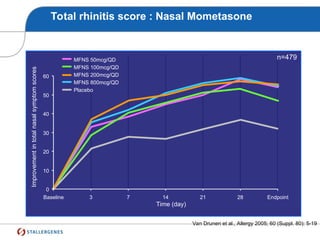
    Total rhinitis score: Nasal Mometasone Van Drunen et al., Allergy 2005; 60 (Suppl. 80): 5-19 n=479 Improvement in total nasal symptom scores Time (day) MFNS 50mcg/QD MFNS 100mcg/QD MFNS 200mcg/QD MFNS 800mcg/QD Placebo 0 10 20 30 40 50 60 Baseline 3 7 14 21 28 Endpoint
  • 28.
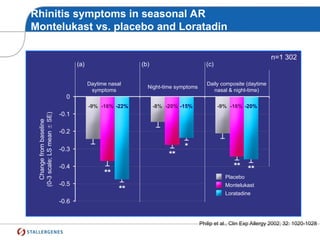
    Rhinitis symptoms inseasonal AR Montelukast vs. placebo and Loratadin n=1 302 Change from baseline (0-3 scale; LS mean  SE) -0.6 -0.5 -0.4 -0.3 -0.2 -0.1 0 Daytime nasal symptoms Night-time symptoms Daily composite (daytime nasal & night-time) (a) (b) (c)       -9% -16% -22% -8% -20% -15% -9% -16% -20% Montelukast Loratadine Placebo Philip et al., Clin Exp Allergy 2002; 32: 1020-1028
  • 29.
    A patient uncontrolledand not satisfied by the pharmacotherapy • 35-40 % of patients receiving optimal standard symptomatic treatment experience poor symptom control • The level of patient dissatisfaction are high with these medications
  • 30.
    What are theunmet needs ?  Patient satisfaction / perception  Patient expectation: a long term efficacy
  • 31.
    What are theunmet needs ?  Patient satisfaction / perception
  • 32.
    Allergic Rhinitis Management AllergicRhinitis Management White et al. , Clin Exp Allergy1998 0% 25% 50% 100% regular Medium Good regular intermittent intermittent How do patients feel after their symptomatic treatment (anti H1, corticosteroid) ? Bad Nasal corticosteroid Anti-histamine 75% regular intermittent regular intermittent
  • 33.
    The paradox ofallergy The paradox of allergy „Allergy“ everybody knows this word. Only 10 per cent of allergic patients are treated correctly.
  • 34.
    Allergic Rhinitis andunmet therapeutic needs Control with symptomatic treatments Quality of life 73% remain uncontrolled (19% of total population) 48 % have bad quality of life (13% of total population)  19% of allergic rhinitis patients remain uncontrolled and 13% have a poor quality of life despite using symptomatic treatments A.Didier et al. Unmet therapeutic needs in allergic patients . Abstract at XXIX EAACI 2010 TNS 2009: 623 subjects with AR/ 2003 individuals from general population
  • 35.
    Unsatisfied needs • Symptomatictreatment No long term efficacy No effect on the disease modifying Lack of compliance Dissatisfaction • Social and financial impact Cost of the disease Quality of life decrease • Chronicity of the disease Resignation
  • 36.
    What are theunmet needs ?  Patient expectation: a long term efficacy
  • 37.
    Why AIT cansatisfy the unmet needs ?  Immunomodulatory effect  Long term and sustained effect
  • 38.
    Definition Specific immunotherapy isthe repeated administration of allergen products to allergic subjects to activate immunomodulatory mechanisms and provide sustained relief of symptoms during subsequent natural allergen exposure WHO Guideline 1998 EMEA Guideline 2008
  • 39.
    Immunomodulatory effect ofAIT CPA Th2 Mastocytes IgE Allergy IL- 4 Natural exposure to the allergen Lymphocytes T Lymphocytes B A I T T reg Lymphocytes T regulator
  • 40.
    Allergen Immunotherapy: fromthe immunological effects to the symptomatic effect Symptoms Use of antiallergic drugs Nasal, ocular and bronchial hyperreactivity Recruitment and activation of mast cells and eosinophils AIT decrease
  • 41.
    AIT is theonly treatment that modifies the natural evolution of allergy One allergy Allergen Immunotherapy Allergic Rhinitis Allergic Asthma 41 Two allergies Several allergies
  • 42.
    Why the allergistis the expert ?  Diagnosis  AIT indications  Patient management and follow-up
  • 43.
    Diagnostic Approach InAllergology Allergy History Skin Tests/ IgE Symptoms Moderate/severe Poor QOL Positive Positive D I A G N O S I S
  • 44.
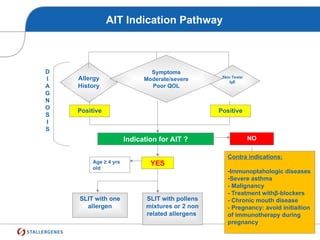
    AIT Indication Pathway Allergy History SkinTests/ IgE Symptoms Moderate/severe Poor QOL SLIT with pollens mixtures or 2 non related allergens SLIT with one allergen Indication for AIT ? Contra indications: -Immunoptahologic diseases -Severe asthma - Malignancy - Treatment withβ-blockers - Chronic mouth disease - Pregnancy: avoid initiaition of immunotherapy during pregnancy NO Positive Positive YES Age ≥ 4 yrs old D I A G N O S I S
  • 45.
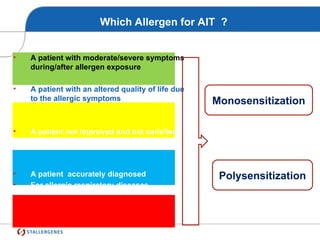
    • A patientwith moderate/severe symptoms during/after allergen exposure • A patient with an altered quality of life due to the allergic symptoms • A patient not improved and not satisfied by the pharmacotherapy • A patient accurately diagnosed • For allergic respiratory diseases Monosensitization Polysensitization Which Allergen for AIT ?
  • 46.
    What are thekey success factors for AIT ?  Patient Information  Patient’s Action Plan  Patient Follow-Up Doctor Patient Relationship
  • 47.
    Key success factorsfor AIT Patient information = Patient Education I. Patient should understand : • His/her allergic disease • The goals of SIT • The disease modifyer effect of SIT • Why 3-5 years of SLIT ? • The onset of action of SLIT • The importance of compliance for the success of SLIT
  • 49.
    Agenda 10.15 – 12.30am  Grass rationalisation  Posology - arguments to increase to 8 drops per day  Patient follow up  Post graduate course: presentation and arguments
  • 50.
    Grass rationalisation  5Grasses / 4 cereals mixture: is it still relevant ?  High level of allergens cross-reactivity between 5 grasses and cereals  5 grasses alone is sufficient to treat the allergic patient sensitized to grass pollen and cereal pollen.
  • 51.
    RATIONALE TO INCREASETO 8 DROPS PER DAY
  • 52.
    STALORAL pollen: Theoptimal posology  Currently:STALORAL 4 press/day = 120 IR/day  ORALAIR clinical trial:  100 IR/day = No efficacy  300 IR/day = Efficacy  STALORAL 8 press/day = 240 IR/day  STALORAL 10 press/day = 300 IR/day ?
  • 53.
    SLIT - pollen Initialphase 9-11 days Maintenance phase 5 – 6 months Pre-seasonal IT Co-seasonal Pollen season 1st year 2 Months 3 – 4 MONTHS Minimal Maintenance dose: 300 IR / 4 press/day 1 2 4 6 8 10 1 2 4 6 8 1 2 3 4 5 6 7 8 9 10 11 Withdraw SLIT for 6 months
  • 54.
  • 55.
    Patient Information/Communication Give theright message to the patient !!  “Allergy is a chronic disease not curable by pharmacotherapy alone..”  “Rhinitis will develop into asthma in 50 % of the patients..”  “You may develop new allergic sensitizations..”  “The only way to affect the disease is by immune intervention..”  “ SIT is a three years treatment but compared to lifelong drug intake..”  “ Efficacy of SIT persists longtime after cessation “  “ SIT would positivily affect your quality of life…”
  • 56.
    Key success factorsfor SIT Patient Information/Education needs from the doctor  Time  Conviction / Enthousiasm/Persuasion  To be done at regular intervals (not a one shot issue)
  • 57.
    Patient compliance: amajor issue Factors of non-compliance : • Daily intake • Treatment duration: 3-5 years
  • 58.
    Key success factorsfor AIT Patient compliance: a major issue Patient Follow-Up • Optimal patient follow-up • SIT efficacy assessment
  • 59.
    An optimal follow-upfor a patient treated with perennial SLIT maintenance (Year 1) 5 visits Build-up 1st month 3rd month 6th month 9th month 12th month maintenance (Year 2) 3 visits maintenance (Year 3) 3 visits 16th month 20th month 24th month 28th month 32th month 36th month Visit Start Stop Go/No Go Visit Visit Visit Visit Visit Visit Visit Visit Visit Visit
  • 60.
    An optimal follow-upfor a patient treated with seasonal SLIT maintenance (année 1) 3 visits Build-Up Visit 3-4 months before season maintenance (Year 2) 3 visits maintenance (Year 3) 3 visits Start STOP Go/No Go Pollen season 3-4 months post-season Build-Up Build-Up Visit Visit 3-4 months before season Pollen season 3-4 months post-season 3-4 months before season Pollen season 3-4 months post-season
  • 61.
    Content of follow-upvisits Safety Staloral intake One month after starting 3 months Safety Staloral intake Compliance 6 months Compliance Efficacy 9 months Compliance Satisfaction Efficacy 12 months Compliance Satisfaction Efficacy Willingness to continue
  • 62.
    SIT efficacy assessmentis based only the clinical parameters  Reduction of symptoms Rhinitis Conjunctivitis Asthma  Reduction of anti-allergic drugs intake  Improvement of Quality of life Compliance Satisfaction Efficacy Willingness to continue
  • 63.
    Efficacy Assessment usinga color-coded VAS (1/3) I. Symptoms : Good Average Bad How was your daytime rhinitis condition ? How was your nighttime rhinitis condition ? How was your daytime asthma condition ? How was your nighttime asthma condition ? Green area Orange area Red area Before SLIT
  • 64.
    Efficacy Assessment usinga color-coded VAS ((2/3) I. Symptoms Good Average Bad How was your daytime rhinitis condition ? How was your nighttime rhinitis condition ? How was your daytime asthma condition ? How was your nighttime asthma condition ? Green area Orange area Red area 6 months later
  • 65.
    Efficacy Assessment usinga color-coded VAS (3/3) I. Symptoms Good Average Bad How was your daytime rhinitis condition ? How was your nighttime rhinitis condition ? How was your daytime asthma condition ? How was your nighttime asthma condition ? Green area Orange area Red area 12 months later
  • 66.
    Efficacy Assessment ? RescueMedication for allergic rhinitis J0 9 M 12 M H1-Antihistamine Nasal Steroids 100 0 50 % - 25% - 50 % - Months
  • 67.
    Efficacy Assessment ? RescueMedication for allergic asthma J0 9 M 12 M β2-agonists Inhaled Steroids 100 0 50 % - 25% - 50 % - Months
  • 68.
    Efficacy Assessment ? Qualityof life Items SLEEP & TIREDNESS DAILY ACTIVITIES IMPAIRED (sport, work, school) WORK & SCHOOL PRODUCTIVITY LEARNING & COGNITIVE FUNCTIONS DISTURBED
  • 69.
    0 20 40 60 80 100 Start IT 36 9 12 Symptoms Medication QOL Improvement After 12 months of SIT: Efficacy assessment At least 50 % reduction of symptoms and rescue medicaction use and a significant QOL improvement should be achieved at 12 months Months % ≥ 50 %
  • 70.
    After 36 monthsof SIT: Stop & Follow-Up Months ≥ 50 % 70 -80 % ≥ 80 % At least 80 % reduction of symptoms and rescue medicaction use and a significant QOL improvement should be achieved at 36 months Stop and follow-up
  • 71.
    SIT efficacy assessment Month ≥50 % 70 -80 % ≥ 80 % SIT Stop
  • 72.
    Sustained long termefficacy of SIT Month ≥ 80 % Years SIT Stop
  • 73.
    Add one ortwo additionals years if necessary Months ≥ 50 % 60 -80 %
  • 74.
    Post - SIT: Patient follow-up 1st year 2nd year 3rd year 4th year 5th year A visit once a year
  • 75.
    After 12 monthsof SIT: a key milestones STOP ? Symptoms weakly improved No change in rescue medications QOL not improved Compliance poor Safety average / bad Patient/parent not satisfied
  • 76.
    0 20 40 60 80 100 StartIT 3 69 12 Symptoms Medication QOL Improvement After 12 months of SIT: Why to stop ? Less than 50 % reduction of symptoms and rescue medicaction use and a poor QOL improvement have been achieved at 12 months Months %
  • 77.
    After 12 monthsof SIT: a key milestones - Before taking the decision to Stop, Check: Compliance : vials renewal; missing periods : changes in personal or familial conditions , cost issue, willingness to pursue the treatment Environmental changes: increase in allergenic load/ Co-factors irritant Co-morbidities : not treated If none of these factors are found, go-back to the diagnosis and recheck the indications
  • 78.
    Key Message To besuccessful SLIT needs: A good indication The best candidate An optimal patient management
  • 79.
    Post graduate coursepresentation and arguments  Objectives  Contents  Organisation
  • 80.
    Post graduate coursepresentation and arguments (1) STALLERGENES Post Graduate Course An Essential Half-Day Training Course On : Sublingual Immunotherapy in Practice
  • 81.
    Post graduate course WhatThe Course Will Cover ? •A stepwise approach for the indications of SLIT •The place of SLIT in the treatment of allergic respiratory diseases •The key factors to make SLIT a success •The compliance/adherence issue and how to tackle it
  • 82.
    Post graduate course: the agenda •Welcome – Introduction 15’ •The basics of SLIT : recall 15’ •Workshop 1 : Choosing the right patient for SLIT 60’ •Coffee Break 15’ •Workshop 2 : Managing the patient optimally 60’ •The patient follow-up handbook 15’ •Interactive Quizz 15’ •Take-home messages 15’ 3 hours 30 duration
  • 83.
    Post graduate course WhoShould Attend ?  Allergists  Experience with SLIT: at least 1 year  10 to 15 attendees/ session
  • 84.
    Post graduate course: Meeting Date 2011  March 2011  Varna  Plovdiv  Sofia

Editor's Notes

  • #5 AR prevalence is quite high, with almost half of sufferers not being diagnosed. From those, a percentage have severe uncontrolled symptoms (target population for AIT).
  • #8 Allergists and pulmonologists recruited patients consulting for respiratory allergy and who were being tested for allergy for the first time (September 2007 - January 2008) The severity of allergic rhinitis or asthma was assessed by ARIA 2001 and GINA 2006 guidelines Among patients who were seen by a specialist, the majority (more than 8 in 10) had moderate to severe AR.
  • #10 WHO – Initiative 2000: Ein aktuelles Dokument der Weltgesundheitsorganisation WHO mit dem Titel „ALLERGIC RHINITIS AND IT´S IMPACT ON ASTHMA (ARIA)“ weist auf die enge Bezeihung zwischen einer Allergie an der Nase und der Lunge hin und fordert eine gemeinsame Behandlungsstrategie für beide Organsysteme.
  • #12 In allergy medicine, the diagnostic process itself is relatively simple but does need to follow a specific sequence. Firstly, one has to draw up a detailed medical profile of the patient on the basis of his or her clinical history and a detailed interview. This will enable the practitioner to broadly identify the allergen or group of allergens that are most likely to cause the patient's symptoms. During the patient interview, the practitioner seeks to establish the individual's personal medical history. Did he or she suffer from asthma or rhinitis as a child? And how about atopic dermatitis (an aggravating factor for the appearance of allergy)? In childhood, did the patient suffered from hypersensitivity to known allergenic foods? The second phase will then involve specific allergen testing.
  • #15 In allergy medicine, the diagnostic process itself is relatively simple but does need to follow a specific sequence. Firstly, one has to draw up a detailed medical profile of the patient on the basis of his or her clinical history and a detailed interview. This will enable the practitioner to broadly identify the allergen or group of allergens that are most likely to cause the patient's symptoms. During the patient interview, the practitioner seeks to establish the individual's personal medical history. Did he or she suffer from asthma or rhinitis as a child? And how about atopic dermatitis (an aggravating factor for the appearance of allergy)? In childhood, did the patient suffered from hypersensitivity to known allergenic foods? The second phase will then involve specific allergen testing.
  • #17 Despite a high number of European population suffering from allergy, the consultation is not frequent.
  • #18 When patients consult a doctor, the majority sees a GP. Only one patient in 5 consult a specialist. It is important to note that in France a patient must first be seen by a GP, who then decides if the patient should be referred to a specialist. In
  • #26 Slide 21: Safety and tolerability of grass pollen tablet sublingual immunotherapy The oral mucosa contains a limited number of proinflammatory cells, such as mast cells, which probably contributes to the absence of anaphylactic reactions with sublingual immunotherapy the basis of the therapy’s excellent safety profile. In this study all treatment doses were well-tolerated and as in previous studies of sublingual immunotherapy there were few serious and no fatal adverse events. The slide shows the treatment-emergent adverse events with an incidence of more than 5% in the safety population. These were almost all local reactions related to direct oral contact with the allergen and mainly occurred at the beginning of the treatment course during the initiation phase. They were seen rarely or were absent from the placebo treated group. All local reactions resolved without medical intervention. Other frequently reported adverse events were headache and nasopharyngitis the incidence of which was similar across all treatment groups including the placebo group. Can we say something about formulation or adjuvants improvements underway here to reduce these AEs? The number of patients reporting “severe” AEs was similar in each of the active treatment groups, 10 for 100 IR and 500 IR and 8 for 300 IR. Not all patients experiencing severe adverse events left the study, only 3 withdrew from the 100 IR, 6 from the 300 IR and 8 from the 500 IR. No patients withdrew from the placebo group because of treatment-emergent adverse events. One patient in the 300 IR group and two in the 500 IR group experienced serious adverse events but these were not related to the study medication.
  • #34 Three quarters of patients who have consulted a doctor within the last 12 months remain uncontrolled despite the use of symptomatic treatments. Half of those uncontrolled patients have a bad quality of life.