ECUADOR
Cultural and Tourist attractions of the
Caribbean and Latin America
414-T03-AS
By: Maria Camila Jaramillo & Vanessa
Pallotta
Teacher: Carole Martin
College LaSalle, Montreal
March 23rd, 2016
1
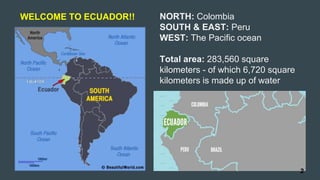
NORTH: Colombia
SOUTH & EAST: Peru
WEST: The Pacific ocean
Total area: 283,560 square
kilometers - of which 6,720 square
kilometers is made up of water
WELCOME TO ECUADOR!!
2
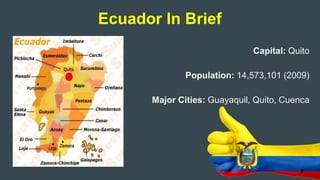
Capital: Quito
Population: 14,573,101 (2009)
Major Cities: Guayaquil, Quito, Cuenca
Ecuador In Brief
3
Official Language: Spanish
Religion: Catholic
Government: Republic
Currency: Us dollar,
Ecuadorian Centaro
Time Zone: UTC-5
Ecuador In Brief
4
Major Airports:
Mariscal Sucre International Airport (Quito)
Jose Joaquin de Olmedo International Airport
(Guayaquil)
Mariscal Lamar International Airport (Cuenca)
Ecuador In Brief
5
Major Industries:
Petroleum, fish, timber, and hydropower.
Major Hazards:
Frequent earthquakes, landslides, volcanic
activity, floods and periodic droughts.
Ecuador In Brief
6
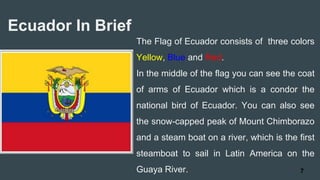
The Flag of Ecuador consists of three colors
Yellow, Blue and Red.
In the middle of the flag you can see the coat
of arms of Ecuador which is a condor the
national bird of Ecuador. You can also see
the snow-capped peak of Mount Chimborazo
and a steam boat on a river, which is the first
steamboat to sail in Latin America on the
Guaya River.
Ecuador In Brief
7
Climate
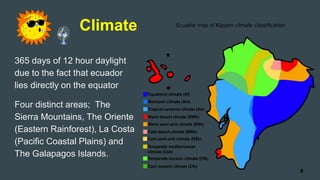
365 days of 12 hour daylight
due to the fact that ecuador
lies directly on the equator
Four distinct areas; The
Sierra Mountains, The Oriente
(Eastern Rainforest), La Costa
(Pacific Coastal Plains) and
The Galapagos Islands.
8
ECUADOR TIMELINE (HISTORY)
1400’s AD: Incas from Peru invade what is now Ecuador and conquer the natives.
1526 - 1534: The Spanish conquistadores land in northern Ecuador and overthrow
the Incan empire. The area comes under Spanish control.
1535: Galapagos island discovered by Bishop Thomas de Berlanga.
1822: Battle of Pichincha ended Spanish rule; Ecuador became part of Gran
Colombia republic, which also encompasses Colombia, Panama and Venezuela.
1830: Ecuador leaves Gran Colombia and becomes fully independent.
1835: Charles Darwin visited the Galapagos Islands, where he studies animals
and plants and develops his theories of evolution!
1925-1948: The country had many political, social and economic problems. There
are 22 presidents, not one serves a complete term.
9
1972: Oil production starts and Ecuador emerges as a significant oil producer.
1979: Democracy returns. A new constitution is adopted, and elections are held.
1982: A deterioration of the economy due to falling oil prices leads to strikes.
1998: Ecuador and Peru sign a peace treaty, ending their border dispute.
2000: In an effort to aid the economy, the US dollar is adopted as Ecuador’s official
currency.
2003: Lucio Gutierrez becomes president and continuous efforts to reform the
country’s political structure.
2006: Rafael Correa wins the presidential elections. He is reelected in 2009.
2008: A change to the constitution increases the President’s powers.
TODAY: Ecuador’s tourism industry is growing rapidly! Ecuador is doing all it can to
attract foreign tourists to its historical monuments and tropical rainforests that are
flush with wildlife.
HISTORY CON’T… :)
10
Attractions
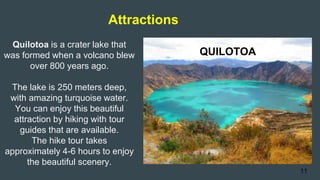
QUILOTOA
Quilotoa is a crater lake that
was formed when a volcano blew
over 800 years ago.
The lake is 250 meters deep,
with amazing turquoise water.
You can enjoy this beautiful
attraction by hiking with tour
guides that are available.
The hike tour takes
approximately 4-6 hours to enjoy
the beautiful scenery.
11
Attractions
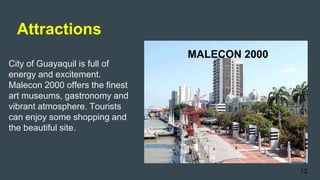
City of Guayaquil is full of
energy and excitement.
Malecon 2000 offers the finest
art museums, gastronomy and
vibrant atmosphere. Tourists
can enjoy some shopping and
the beautiful site.
12
MALECON 2000
Attractions
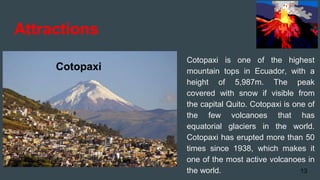
Cotopaxi is one of the highest
mountain tops in Ecuador, with a
height of 5,987m. The peak
covered with snow if visible from
the capital Quito. Cotopaxi is one of
the few volcanoes that has
equatorial glaciers in the world.
Cotopaxi has erupted more than 50
times since 1938, which makes it
one of the most active volcanoes in
the world. 13
Cotopaxi
Attractions
14
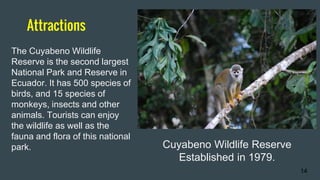
Cuyabeno Wildlife Reserve
Established in 1979.
The Cuyabeno Wildlife
Reserve is the second largest
National Park and Reserve in
Ecuador. It has 500 species of
birds, and 15 species of
monkeys, insects and other
animals. Tourists can enjoy
the wildlife as well as the
fauna and flora of this national
park.
Attractions
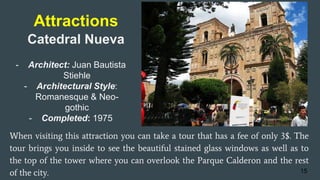
When visiting this attraction you can take a tour that has a fee of only 3$. The
tour brings you inside to see the beautiful stained glass windows as well as to
the top of the tower where you can overlook the Parque Calderon and the rest
of the city. 15
Catedral Nueva
- Architect: Juan Bautista
Stiehle
- Architectural Style:
Romanesque & Neo-
gothic
- Completed: 1975
Attractions
Quito’s Skyrail - Teleferico
16
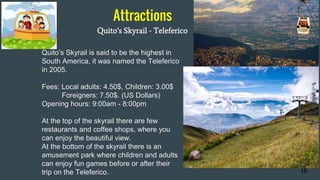
Quito’s Skyrail is said to be the highest in
South America, it was named the Teleferico
in 2005.
Fees: Local adults: 4.50$, Children: 3.00$
Foreigners: 7.50$. (US Dollars)
Opening hours: 9:00am - 8:00pm
At the top of the skyrail there are few
restaurants and coffee shops, where you
can enjoy the beautiful view.
At the bottom of the skyrail there is an
amusement park where children and adults
can enjoy fun games before or after their
trip on the Teleferico.
Attraction
Parque La Carolina
17
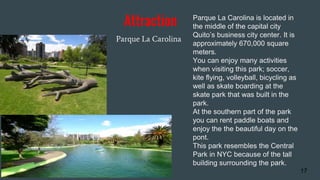
Parque La Carolina is located in
the middle of the capital city
Quito’s business city center. It is
approximately 670,000 square
meters.
You can enjoy many activities
when visiting this park; soccer,
kite flying, volleyball, bicycling as
well as skate boarding at the
skate park that was built in the
park.
At the southern part of the park
you can rent paddle boats and
enjoy the the beautiful day on the
pont.
This park resembles the Central
Park in NYC because of the tall
building surrounding the park.
Plaza San Francisco
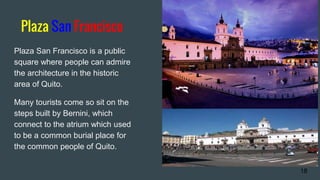
Plaza San Francisco is a public
square where people can admire
the architecture in the historic
area of Quito.
Many tourists come so sit on the
steps built by Bernini, which
connect to the atrium which used
to be a common burial place for
the common people of Quito.
18
Galapagos Island
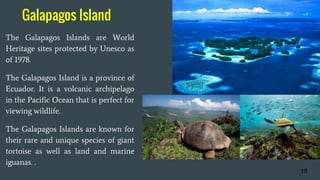
The Galapagos Islands are World
Heritage sites protected by Unesco as
of 1978.
The Galapagos Island is a province of
Ecuador. It is a volcanic archipelago
in the Pacific Ocean that is perfect for
viewing wildlife.
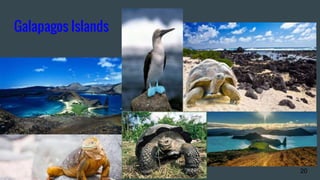
The Galapagos Islands are known for
their rare and unique species of giant
tortoise as well as land and marine
iguanas. .
19
Galapagos Islands
20
Floreana Island
Floreana Island is an island of the Galapagos Islands. This beautiful island was
named after the president of Ecuador; Juan Jose Flores that during his time as
president took possession of the archipelago.
21
Gastronomy
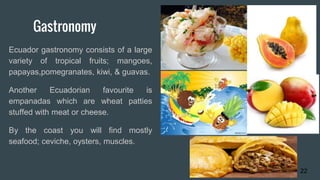
Ecuador gastronomy consists of a large
variety of tropical fruits; mangoes,
papayas,pomegranates, kiwi, & guavas.
Another Ecuadorian favourite is
empanadas which are wheat patties
stuffed with meat or cheese.
By the coast you will find mostly
seafood; ceviche, oysters, muscles.
22
MUSIC
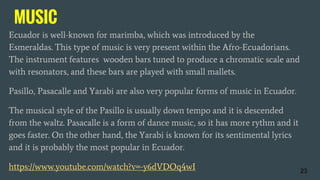
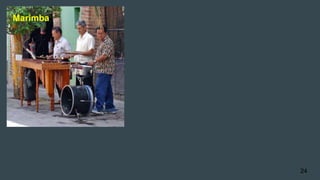
Ecuador is well-known for marimba, which was introduced by the
Esmeraldas. This type of music is very present within the Afro-Ecuadorians.
The instrument features wooden bars tuned to produce a chromatic scale and
with resonators, and these bars are played with small mallets.
Pasillo, Pasacalle and Yarabi are also very popular forms of music in Ecuador.
The musical style of the Pasillo is usually down tempo and it is descended
from the waltz. Pasacalle is a form of dance music, so it has more rythm and it
goes faster. On the other hand, the Yarabi is known for its sentimental lyrics
and it is probably the most popular in Ecuador.
https://www.youtube.com/watch?v=-y6dVDOq4wI 23
24
Marimba
Quiz
1. When was the Galapagos Island discovered?
2. Which philosopher studied the Galapagos Island and its unique
species?
3. What are the two countries bordering Ecuador?
4. How high is one of the largest mountains in Ecuador?
a. 2000m
b. 3790meters
c. 5987meters
25
REFERENCES
http://www.ecuador.com/music
http://news.bbc.co.uk/2/hi/americas/1212826.stm
http://www.ecuador.com/geography/
http://www.nearshoreamericas.com/ecuadors-tourism-industry-grows-rapid-pace/
http://www.touropia.com/tourist-attractions-in-ecuador/
https://www.tripadvisor.ca/Attraction_Review-g294309-d314601-Reviews-
New_Cathedral_Catedral_de_la_Immaculada-Cuenca_Azuay_Province.html
http://www.lonelyplanet.com/ecuador/quito/sights/parks-gardens/parque-la-carolina
http://www.ecuador.com/sights/plaza-de-san-francisco/
http://travel.nationalgeographic.com/travel/world-heritage/galapagos-islands/ 26

Ecuador oral presentation

  • 1.
    ECUADOR Cultural and Touristattractions of the Caribbean and Latin America 414-T03-AS By: Maria Camila Jaramillo & Vanessa Pallotta Teacher: Carole Martin College LaSalle, Montreal March 23rd, 2016 1
  • 2.
    NORTH: Colombia SOUTH &EAST: Peru WEST: The Pacific ocean Total area: 283,560 square kilometers - of which 6,720 square kilometers is made up of water WELCOME TO ECUADOR!! 2
  • 3.
    Capital: Quito Population: 14,573,101(2009) Major Cities: Guayaquil, Quito, Cuenca Ecuador In Brief 3
  • 4.
    Official Language: Spanish Religion:Catholic Government: Republic Currency: Us dollar, Ecuadorian Centaro Time Zone: UTC-5 Ecuador In Brief 4
  • 5.
    Major Airports: Mariscal SucreInternational Airport (Quito) Jose Joaquin de Olmedo International Airport (Guayaquil) Mariscal Lamar International Airport (Cuenca) Ecuador In Brief 5
  • 6.
    Major Industries: Petroleum, fish,timber, and hydropower. Major Hazards: Frequent earthquakes, landslides, volcanic activity, floods and periodic droughts. Ecuador In Brief 6
  • 7.
    The Flag ofEcuador consists of three colors Yellow, Blue and Red. In the middle of the flag you can see the coat of arms of Ecuador which is a condor the national bird of Ecuador. You can also see the snow-capped peak of Mount Chimborazo and a steam boat on a river, which is the first steamboat to sail in Latin America on the Guaya River. Ecuador In Brief 7
  • 8.
    Climate 365 days of12 hour daylight due to the fact that ecuador lies directly on the equator Four distinct areas; The Sierra Mountains, The Oriente (Eastern Rainforest), La Costa (Pacific Coastal Plains) and The Galapagos Islands. 8
  • 9.
    ECUADOR TIMELINE (HISTORY) 1400’sAD: Incas from Peru invade what is now Ecuador and conquer the natives. 1526 - 1534: The Spanish conquistadores land in northern Ecuador and overthrow the Incan empire. The area comes under Spanish control. 1535: Galapagos island discovered by Bishop Thomas de Berlanga. 1822: Battle of Pichincha ended Spanish rule; Ecuador became part of Gran Colombia republic, which also encompasses Colombia, Panama and Venezuela. 1830: Ecuador leaves Gran Colombia and becomes fully independent. 1835: Charles Darwin visited the Galapagos Islands, where he studies animals and plants and develops his theories of evolution! 1925-1948: The country had many political, social and economic problems. There are 22 presidents, not one serves a complete term. 9
  • 10.
    1972: Oil productionstarts and Ecuador emerges as a significant oil producer. 1979: Democracy returns. A new constitution is adopted, and elections are held. 1982: A deterioration of the economy due to falling oil prices leads to strikes. 1998: Ecuador and Peru sign a peace treaty, ending their border dispute. 2000: In an effort to aid the economy, the US dollar is adopted as Ecuador’s official currency. 2003: Lucio Gutierrez becomes president and continuous efforts to reform the country’s political structure. 2006: Rafael Correa wins the presidential elections. He is reelected in 2009. 2008: A change to the constitution increases the President’s powers. TODAY: Ecuador’s tourism industry is growing rapidly! Ecuador is doing all it can to attract foreign tourists to its historical monuments and tropical rainforests that are flush with wildlife. HISTORY CON’T… :) 10
  • 11.
    Attractions QUILOTOA Quilotoa is acrater lake that was formed when a volcano blew over 800 years ago. The lake is 250 meters deep, with amazing turquoise water. You can enjoy this beautiful attraction by hiking with tour guides that are available. The hike tour takes approximately 4-6 hours to enjoy the beautiful scenery. 11
  • 12.
    Attractions City of Guayaquilis full of energy and excitement. Malecon 2000 offers the finest art museums, gastronomy and vibrant atmosphere. Tourists can enjoy some shopping and the beautiful site. 12 MALECON 2000
  • 13.
    Attractions Cotopaxi is oneof the highest mountain tops in Ecuador, with a height of 5,987m. The peak covered with snow if visible from the capital Quito. Cotopaxi is one of the few volcanoes that has equatorial glaciers in the world. Cotopaxi has erupted more than 50 times since 1938, which makes it one of the most active volcanoes in the world. 13 Cotopaxi
  • 14.
    Attractions 14 Cuyabeno Wildlife Reserve Establishedin 1979. The Cuyabeno Wildlife Reserve is the second largest National Park and Reserve in Ecuador. It has 500 species of birds, and 15 species of monkeys, insects and other animals. Tourists can enjoy the wildlife as well as the fauna and flora of this national park.
  • 15.
    Attractions When visiting thisattraction you can take a tour that has a fee of only 3$. The tour brings you inside to see the beautiful stained glass windows as well as to the top of the tower where you can overlook the Parque Calderon and the rest of the city. 15 Catedral Nueva - Architect: Juan Bautista Stiehle - Architectural Style: Romanesque & Neo- gothic - Completed: 1975
  • 16.
    Attractions Quito’s Skyrail -Teleferico 16 Quito’s Skyrail is said to be the highest in South America, it was named the Teleferico in 2005. Fees: Local adults: 4.50$, Children: 3.00$ Foreigners: 7.50$. (US Dollars) Opening hours: 9:00am - 8:00pm At the top of the skyrail there are few restaurants and coffee shops, where you can enjoy the beautiful view. At the bottom of the skyrail there is an amusement park where children and adults can enjoy fun games before or after their trip on the Teleferico.
  • 17.
    Attraction Parque La Carolina 17 ParqueLa Carolina is located in the middle of the capital city Quito’s business city center. It is approximately 670,000 square meters. You can enjoy many activities when visiting this park; soccer, kite flying, volleyball, bicycling as well as skate boarding at the skate park that was built in the park. At the southern part of the park you can rent paddle boats and enjoy the the beautiful day on the pont. This park resembles the Central Park in NYC because of the tall building surrounding the park.
  • 18.
    Plaza San Francisco PlazaSan Francisco is a public square where people can admire the architecture in the historic area of Quito. Many tourists come so sit on the steps built by Bernini, which connect to the atrium which used to be a common burial place for the common people of Quito. 18
  • 19.
    Galapagos Island The GalapagosIslands are World Heritage sites protected by Unesco as of 1978. The Galapagos Island is a province of Ecuador. It is a volcanic archipelago in the Pacific Ocean that is perfect for viewing wildlife. The Galapagos Islands are known for their rare and unique species of giant tortoise as well as land and marine iguanas. . 19
  • 20.
  • 21.
    Floreana Island Floreana Islandis an island of the Galapagos Islands. This beautiful island was named after the president of Ecuador; Juan Jose Flores that during his time as president took possession of the archipelago. 21
  • 22.
    Gastronomy Ecuador gastronomy consistsof a large variety of tropical fruits; mangoes, papayas,pomegranates, kiwi, & guavas. Another Ecuadorian favourite is empanadas which are wheat patties stuffed with meat or cheese. By the coast you will find mostly seafood; ceviche, oysters, muscles. 22
  • 23.
    MUSIC Ecuador is well-knownfor marimba, which was introduced by the Esmeraldas. This type of music is very present within the Afro-Ecuadorians. The instrument features wooden bars tuned to produce a chromatic scale and with resonators, and these bars are played with small mallets. Pasillo, Pasacalle and Yarabi are also very popular forms of music in Ecuador. The musical style of the Pasillo is usually down tempo and it is descended from the waltz. Pasacalle is a form of dance music, so it has more rythm and it goes faster. On the other hand, the Yarabi is known for its sentimental lyrics and it is probably the most popular in Ecuador. https://www.youtube.com/watch?v=-y6dVDOq4wI 23
  • 24.
  • 25.
    Quiz 1. When wasthe Galapagos Island discovered? 2. Which philosopher studied the Galapagos Island and its unique species? 3. What are the two countries bordering Ecuador? 4. How high is one of the largest mountains in Ecuador? a. 2000m b. 3790meters c. 5987meters 25
  • 26.

Editor's Notes

  • #12 http://www.touropia.com/tourist-attractions-in-ecuador/
  • #14 http://www.touropia.com/tourist-attractions-in-ecuador/
  • #16 https://www.youtube.com/watch?v=Nry1SO45RT4 (ecuador video)