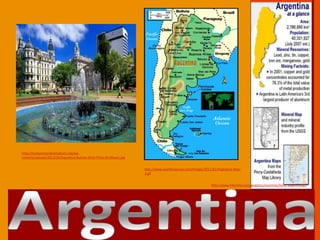
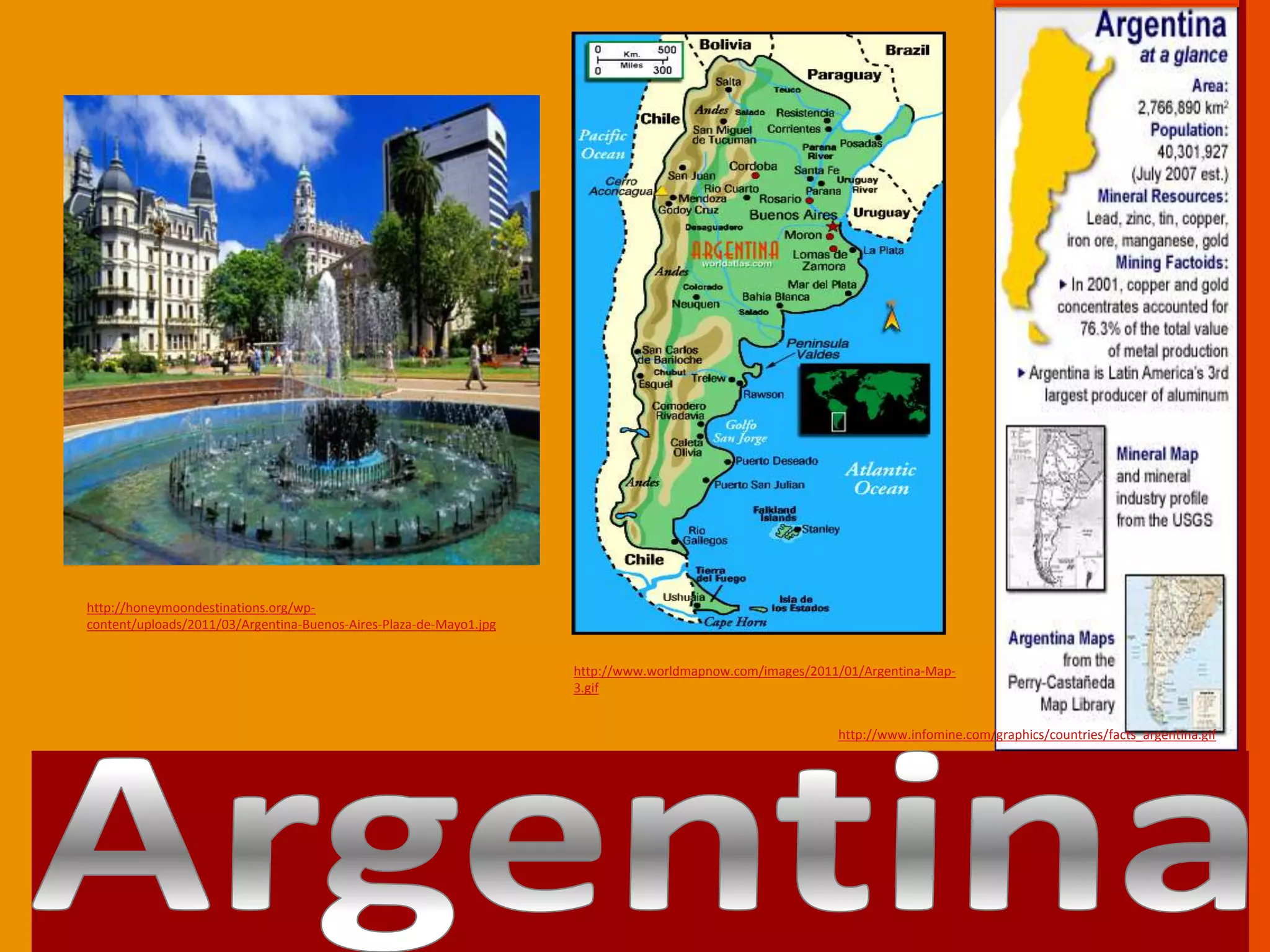
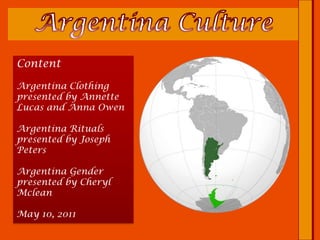
http://honeymoondestinations.org/wp-content/uploads/2011/03/Argentina-Buenos-Aires-Plaza-de-Mayo1.jpghttp://www.worldmapnow.com/images/2011/01/Argentina-Map-3.gifhttp://www.infomine.com/graphics/countries/facts_argentina.gifArgentina
Argentina Culture ContentArgentina Clothing presented by Annette Lucas and Anna OwenArgentina Rituals presented by Joseph PetersArgentina Gender presented by Cheryl McleanMay 10, 2011
Argentina: ClothingClothing with comments and communication concept text (communication concept is “non-verbal communication”)
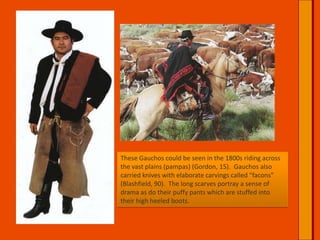
Cowboys in Argentina, called Gauchos, are seen here wearing wide rimmed hats against the sun as well as baggy pants that are called “Bombachas” (Gordon, 15).  These are traditional clothes, but can often be still seen in festivals and shows.  If these gaucho clothes were looked at as non-verbal communication, they seem to put across a sense of control, masculinity and strength.
These Gauchos could be seen in the 1800s riding across the vast plains (pampas) (Gordon, 15).  Gauchos also carried knives with elaborate carvings called “facons” (Blashfield, 90).  The long scarves portray a sense of drama as do their puffy pants which are stuffed into their high heeled boots.
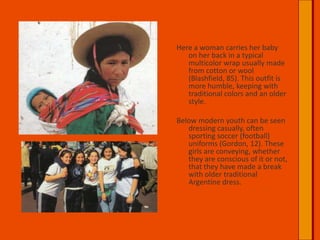
Here a woman carries her baby on her back in a typical multicolor wrap usually made from cotton or wool (Blashfield, 85). This outfit is more humble, keeping with traditional colors and an older style.Below modern youth can be seen dressing casually, often sporting soccer (football) uniforms (Gordon, 12). These girls are conveying, whether they are conscious of it or not, that they have made a break with older traditional Argentine dress.
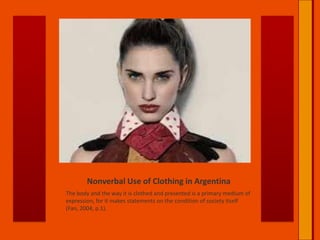
Nonverbal Use of Clothing in ArgentinaThe body and the way it is clothed and presented is a primary medium of expression, for it makes statements on the condition of society itself (Fan, 2004, p.1).
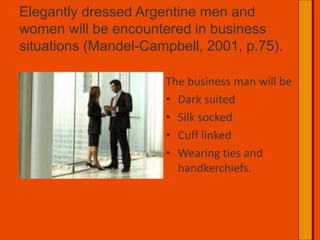
Elegantly dressed Argentine men and women will be encountered in business situations (Mandel-Campbell, 2001, p.75).	The business man will beDark suitedSilk sockedCuff linkedWearing ties and handkerchiefs.
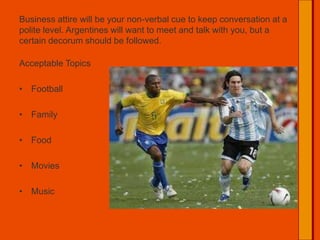
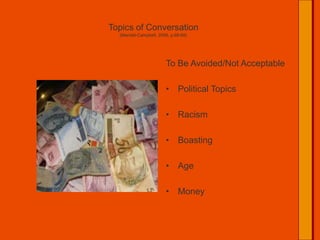
Business attire will be your non-verbal cue to keep conversation at a polite level. Argentines will want to meet and talk with you, but a certain decorum should be followed.Acceptable TopicsFootballFamilyFoodMoviesMusic
The Rituals of Argentina Verbal and Nonverbal
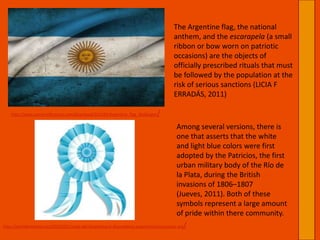
The Argentine flag, the national anthem, and the escarapela (a small ribbon or bow worn on patriotic occasions) are the objects of officially prescribed rituals that must be followed by the population at the risk of serious sanctions (LICIA F ERRADÁS, 2011)http://www.scenicreflections.com/download/261183/Argentina_flag_Wallpaper/Among several versions, there is one that asserts that the white and light blue colors were first adopted by the Patricios, the first urban military body of the Río de la Plata, during the British invasions of 1806–1807 (Jueves, 2011). Both of these symbols represent a large amount of pride within there community. http://estilofemenino.com/2010/05/moda-del-bicentenario-disenadores-argentinos/escarapela-arg/
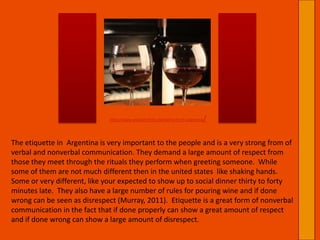
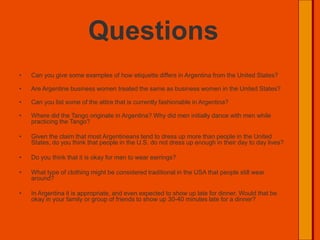
http://www.winebrothers.net/wine-from-argentina/The etiquette in  Argentina is very important to the people and is a very strong from of verbal and nonverbal communication. They demand a large amount of respect from those they meet through the rituals they perform when greeting someone.  While some of them are not much different then in the united states  like shaking hands. Some or very different, like your expected to show up to social dinner thirty to forty minutes late.  They also have a large number of rules for pouring wine and if done wrong can be seen as disrespect (Murray, 2011).  Etiquette is a great form of nonverbal communication in the fact that if done properly can show a great amount of respect and if done wrong can show a large amount of disrespect.
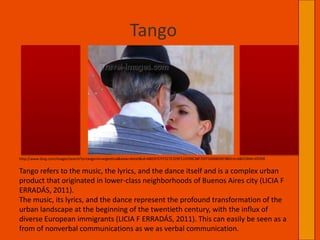
TangoTango refers to the music, the lyrics, and the dance itself and is a complex urban product that originated in lower-class neighborhoods of Buenos Aires city (LICIA F ERRADÁS, 2011).The music, its lyrics, and the dance represent the profound transformation of the urban landscape at the beginning of the twentieth century, with the influx of diverse European immigrants (LICIA F ERRADÁS, 2011). This can easily be seen as a from of nonverbal communications as we as verbal communication. http://www.bing.com/images/search?q=tango+in+argentina&view=detail&id=4805F97FF527E329F51FE99E38F70FF5490BDBF9&first=0&FORM=IDFRIR
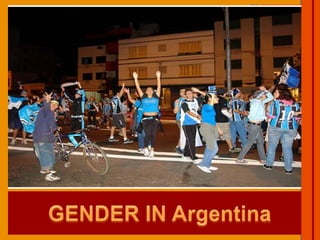
GENDER IN Argentina
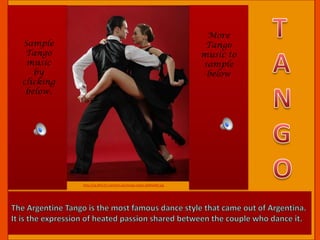
The Argentine Tango is the most famous dance style that came out of Argentina. It is the expression of heated passion shared between the couple who dance it.TANGOMore Tango music to sample belowSample Tango music by clicking below.http://sp.life123.com/bm.pix/tango-steps.s600x600.jpg
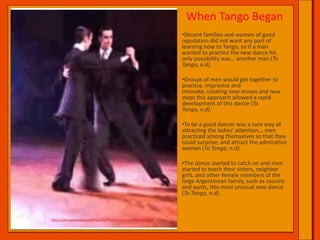
When Tango BeganDecent families and women of good reputation did not want any part of learning how to Tango, so if a man wanted to practice the new dance his only possibility was… another man (To Tango, n.d).
Groups of men would get together to practice, improvise and innovate, creating new moves and new steps this approach allowed a rapid development of this dance (To Tango, n.d).
To be a good dancer was a sure way of attracting the ladies' attention... men practiced among themselves so that they could surprise, and attract the admiration women (To Tango, n.d).
The dance started to catch on and men started to teach their sisters, neighbor girls, and other female members of the large Argentinean family, such as cousins and aunts, this most unusual new dance (To Tango, n.d). http://www.pleasedancewithme.com/PhotoLosHermanosMacana6.gif
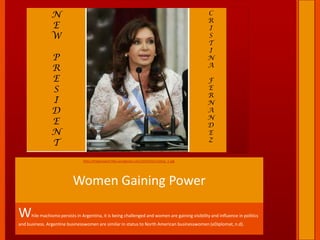
Women Gaining PowerNEWPRESIDENTCRISTINAFERNANDEZhttp://thebsreport.files.wordpress.com/2010/01/cristina_1.jpgWhile machismo persists in Argentina, it is being challenged and women are gaining visibility and influence in politics and business. Argentine businesswomen are similar in status to North American businesswomen (eDiplomat, n.d).
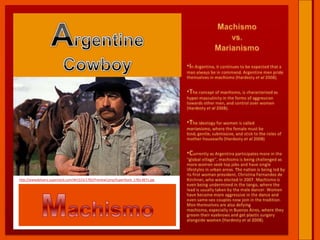
Machismo vs. MarianismoIn Argentina, it continues to be expected that a man always be in command. Argentine men pride themselves in machismo (Hardesty et al 2008).
The concept of machismo, is characterized as hyper-masculinity in the forms of aggression towards other men, and control over women (Hardesty et al 2008).
The ideology for women is called marianismo, where the female must be kind, gentle, submissive, and stick to the roles of mother-housewife (Hardesty et al 2008)

Argentina group project

  • 1.
  • 2.
    Argentina Culture ContentArgentinaClothing presented by Annette Lucas and Anna OwenArgentina Rituals presented by Joseph PetersArgentina Gender presented by Cheryl McleanMay 10, 2011
  • 3.
    Argentina: ClothingClothing withcomments and communication concept text (communication concept is “non-verbal communication”)
  • 4.
    Cowboys in Argentina,called Gauchos, are seen here wearing wide rimmed hats against the sun as well as baggy pants that are called “Bombachas” (Gordon, 15). These are traditional clothes, but can often be still seen in festivals and shows. If these gaucho clothes were looked at as non-verbal communication, they seem to put across a sense of control, masculinity and strength.
  • 5.
    These Gauchos couldbe seen in the 1800s riding across the vast plains (pampas) (Gordon, 15). Gauchos also carried knives with elaborate carvings called “facons” (Blashfield, 90). The long scarves portray a sense of drama as do their puffy pants which are stuffed into their high heeled boots.
  • 6.
    Here a womancarries her baby on her back in a typical multicolor wrap usually made from cotton or wool (Blashfield, 85). This outfit is more humble, keeping with traditional colors and an older style.Below modern youth can be seen dressing casually, often sporting soccer (football) uniforms (Gordon, 12). These girls are conveying, whether they are conscious of it or not, that they have made a break with older traditional Argentine dress.
  • 7.
    Nonverbal Use ofClothing in ArgentinaThe body and the way it is clothed and presented is a primary medium of expression, for it makes statements on the condition of society itself (Fan, 2004, p.1).
  • 8.
    Elegantly dressed Argentinemen and women will be encountered in business situations (Mandel-Campbell, 2001, p.75). The business man will beDark suitedSilk sockedCuff linkedWearing ties and handkerchiefs.
  • 9.
    Business attire willbe your non-verbal cue to keep conversation at a polite level. Argentines will want to meet and talk with you, but a certain decorum should be followed.Acceptable TopicsFootballFamilyFoodMoviesMusic
  • 10.
    The Rituals ofArgentina Verbal and Nonverbal
  • 11.
    The Argentine flag,the national anthem, and the escarapela (a small ribbon or bow worn on patriotic occasions) are the objects of officially prescribed rituals that must be followed by the population at the risk of serious sanctions (LICIA F ERRADÁS, 2011)http://www.scenicreflections.com/download/261183/Argentina_flag_Wallpaper/Among several versions, there is one that asserts that the white and light blue colors were first adopted by the Patricios, the first urban military body of the Río de la Plata, during the British invasions of 1806–1807 (Jueves, 2011). Both of these symbols represent a large amount of pride within there community. http://estilofemenino.com/2010/05/moda-del-bicentenario-disenadores-argentinos/escarapela-arg/
  • 12.
    http://www.winebrothers.net/wine-from-argentina/The etiquette in Argentina is very important to the people and is a very strong from of verbal and nonverbal communication. They demand a large amount of respect from those they meet through the rituals they perform when greeting someone. While some of them are not much different then in the united states like shaking hands. Some or very different, like your expected to show up to social dinner thirty to forty minutes late. They also have a large number of rules for pouring wine and if done wrong can be seen as disrespect (Murray, 2011). Etiquette is a great form of nonverbal communication in the fact that if done properly can show a great amount of respect and if done wrong can show a large amount of disrespect.
  • 13.
    TangoTango refers tothe music, the lyrics, and the dance itself and is a complex urban product that originated in lower-class neighborhoods of Buenos Aires city (LICIA F ERRADÁS, 2011).The music, its lyrics, and the dance represent the profound transformation of the urban landscape at the beginning of the twentieth century, with the influx of diverse European immigrants (LICIA F ERRADÁS, 2011). This can easily be seen as a from of nonverbal communications as we as verbal communication. http://www.bing.com/images/search?q=tango+in+argentina&view=detail&id=4805F97FF527E329F51FE99E38F70FF5490BDBF9&first=0&FORM=IDFRIR
  • 14.
  • 15.
    The Argentine Tangois the most famous dance style that came out of Argentina. It is the expression of heated passion shared between the couple who dance it.TANGOMore Tango music to sample belowSample Tango music by clicking below.http://sp.life123.com/bm.pix/tango-steps.s600x600.jpg
  • 16.
    When Tango BeganDecentfamilies and women of good reputation did not want any part of learning how to Tango, so if a man wanted to practice the new dance his only possibility was… another man (To Tango, n.d).
  • 17.
    Groups of menwould get together to practice, improvise and innovate, creating new moves and new steps this approach allowed a rapid development of this dance (To Tango, n.d).
  • 18.
    To be agood dancer was a sure way of attracting the ladies' attention... men practiced among themselves so that they could surprise, and attract the admiration women (To Tango, n.d).
  • 19.
    The dance startedto catch on and men started to teach their sisters, neighbor girls, and other female members of the large Argentinean family, such as cousins and aunts, this most unusual new dance (To Tango, n.d). http://www.pleasedancewithme.com/PhotoLosHermanosMacana6.gif
  • 20.
    Women Gaining PowerNEWPRESIDENTCRISTINAFERNANDEZhttp://thebsreport.files.wordpress.com/2010/01/cristina_1.jpgWhilemachismo persists in Argentina, it is being challenged and women are gaining visibility and influence in politics and business. Argentine businesswomen are similar in status to North American businesswomen (eDiplomat, n.d).
  • 21.
    Machismo vs. MarianismoInArgentina, it continues to be expected that a man always be in command. Argentine men pride themselves in machismo (Hardesty et al 2008).
  • 22.
    The concept ofmachismo, is characterized as hyper-masculinity in the forms of aggression towards other men, and control over women (Hardesty et al 2008).
  • 23.
    The ideology forwomen is called marianismo, where the female must be kind, gentle, submissive, and stick to the roles of mother-housewife (Hardesty et al 2008)

Editor's Notes

  • #8 The body and the way it is clothed and presented is a primary medium of expression, for it makes statements on the condition of society itself (Fan, 2004, p.1).
  • #22 ReferencesAdams, F. (2001). Culture Shock! Argentina. Portland, OR: Graphic Arts Center Publishing Company.Fan, J.W. (n.d). Clothing Appearance and Fit: Science and Technology. Retrieved from EBSCOhost.Mandel-Campbell, A. (n.d). Passport Argentina: Your Pocket Guide to Argentine Business, Customs & Etiquette. Retrieved from EBSCOhost.