Are Open Source Phone Systems Possible? 
Kent Brooks, IT DirectorDon Lewis, Computer Systems 
Technician 
#edu14 
@educause
● Converge three (3) 
Objectives: ● Upgrade & improve 
phone systems to one (1) 
● Standardize campus 
handsets 
● Drive recurring costs 
near zero 
voice 
/communication 
capabilities 
● Obtain greatest 
value for initial 
investment
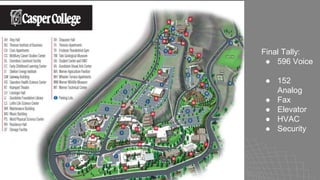
Final Tally: 
● 596 Voice 
● 152 
Analog 
● Fax 
● Elevator 
● HVAC 
● Security
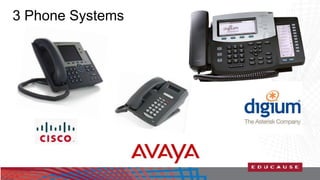
3 Phone Systems
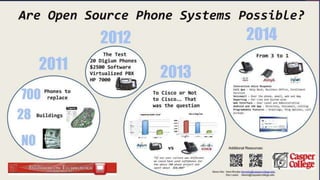
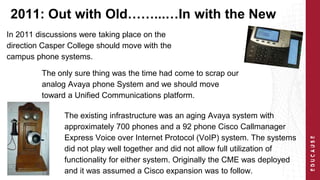
2011: Out with Old……...…In with the New 
In 2011 discussions were taking place on the 
direction Casper College should move with the 
campus phone systems. 
The only sure thing was the time had come to scrap our 
analog Avaya phone System and we should move 
toward a Unified Communications platform. 
The existing infrastructure was an aging Avaya system with 
approximately 700 phones and a 92 phone Cisco Callmanager 
Express Voice over Internet Protocol (VoIP) system. The systems 
did not play well together and did not allow full utilization of 
functionality for either system. Originally the CME was deployed 
and it was assumed a Cisco expansion was to follow.
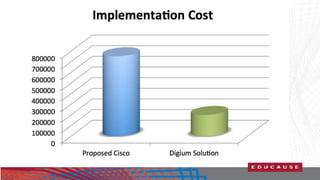
The Problem...the Cost 
As we began evaluating the cost we were 
going to have to take one of the following 
steps: 
1) Ask for more money to accelerate the 
change 
2) Phase the costs in over a 3-4 year period 
3) Look at other alternatives
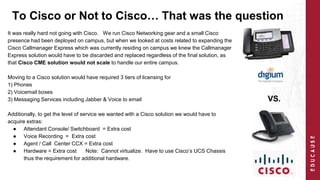
To Cisco or Not to Cisco… That was the question 
It was really hard not going with Cisco. We run Cisco Networking gear and a small Cisco 
presence had been deployed on campus, but when we looked at costs related to expanding the 
Cisco Callmanager Express which was currently residing on campus we knew the Callmanager 
Express solution would have to be discarded and replaced regardless of the final solution, as 
that Cisco CME solution would not scale to handle our entire campus. 
Moving to a Cisco solution would have required 3 tiers of licensing for 
1) Phones 
2) Voicemail boxes 
3) Messaging Services including Jabber & Voice to email 
Additionally, to get the level of service we wanted with a Cisco solution we would have to 
acquire extras: 
● Attendant Console/ Switchboard = Extra cost 
● Voice Recording = Extra cost 
● Agent / Call Center CCX = Extra cost 
● Hardware = Extra cost Note: Cannot virtualize. Have to use Cisco’s UCS Chassis 
thus the requirement for additional hardware. 
VS.
The Alternative 
As our discussions continued into the fall of 2012 we decided to test another solution. We installed 
Digium Switchvox software on existing server hardware in a virtual environment and integrated it so 
that it work with our other two existing systems. Digium Switchvox is the commercially supported 
version of the open source Asterisk Phone System. Although not encouraged by Digium the 
virtualized solution was supported by a Digium reseller and thus would provide us a level of support to 
make us feel comfortable moving this direction. With a successful pilot of the Digium product 
underway following objectives of this VoIP project were identified: 
● Converge three (3) phone systems to one (1) 
● Standardize handsets across campus 
● Upgrade and improve our voice communication capabilities 
● Obtain the greatest value for our initial investment 
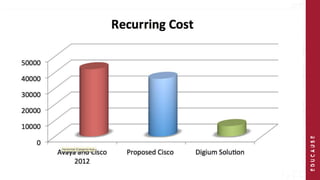
● Drive our recurring costs to near zero
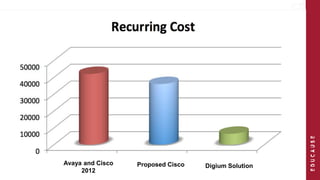
Avaya and Cisco Proposed Cisco 
2012 
Digium Solution
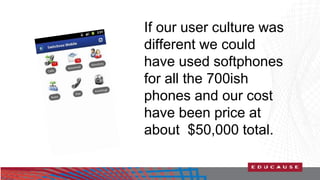
If our user culture was 
different we could 
have used softphones 
for all the 700ish 
phones and our cost 
have been price at 
about $50,000 total.
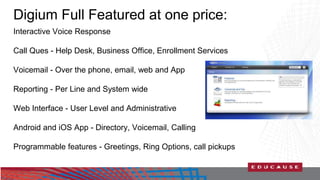
Digium Full Featured at one price: 
Interactive Voice Response 
Call Ques - Help Desk, Business Office, Enrollment Services 
Voicemail - Over the phone, email, web and App 
Reporting - Per Line and System wide 
Web Interface - User Level and Administrative 
Android and iOS App - Directory, Voicemail, Calling 
Programmable features - Greetings, Ring Options, call pickups
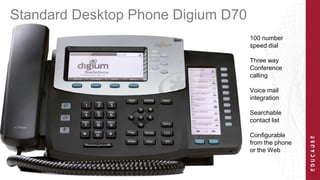
Standard Desktop Phone Digium D70 
100 number 
speed dial 
Three way 
Conference 
calling 
Voice mail 
integration 
Searchable 
contact list 
Configurable 
from the phone 
or the Web
Benefits: 
• Unified Communications features such as voice mail being pushed to email 
• Fast Forward and Rewind Voice Mail (I have heard multiple end users react positively to this 
one) 
• Status Buttons allow you to look and see if someone is on the phone 
• User Level Web Interface for configuration and a full featured switchboardfree and accessible to 
all 
• Automated Accounting: No account codes, access or trunk number to get to the outside. 
• Users can now redial long distance calls 
• There is a smartphone app which allows: 
– Access to Campus phone directory 
– Make calls look like it is coming from your office phone rather than personal cell phone 
– Access Voice Mail 
– Change Greeting and Status through the App 
• IVR’s are a standard feature 
• Intercom System for library was a cheap add vs. purchasing a separate new system 
• Will supplement our Emergency Notification System options
Things to Remember 
Commercial Support is Key 
A key influence in choosing a commercially supported approach for a 
project this size was a successful deployment at Sam Houston State 
University of 6000 VoIP phones running Asterisk which turned into a 
failed deployment in 2009. After the deployment they were forced to 
move back to a proprietary Cisco solutions they lost key staff with 
Asterisk specific knowledge. Losing those key staff who were 
instrumental to the 2006 deployment was key in failed deployment.
Things to Remember 
● You should have a strong POE network environment to make this work 
● You need solid server hardware to install the virtualized environment.I wanted to do the virtualized 
environment based on my experience deploying a 250 phone system at a previous institution. In my 
opinion the Digium appliance hardware is a little underpowered. In the previous case, for example, we 
immediately had to upgrade memory. I guess the lesson if you are using appliances take whatever the 
recommended specification is and bump that specification. Following the successful install of the 
Digium software on existing hardware in the spring of 2013, we began with a test of approximately 20 
phones within the IT department. The VoIP software itself runs in a VMware virtual environment on 
existing HP c7000 blade hardware consisting of g8 bl460c blades and virtual connect switches. The 
storage for this environment is the Lefthand p4000 series SAN. Although the software version of 
Switchvox is not supported directly by Digium, it is supported through NP Information Systems who is 
part of the Digium reseller network. This was another strategic risk we were willing to assume. 
● If transitioning with multiple systems simultaneously, differences in systems can create extra 
troubleshooting challenges.
So is it Possible…. 
● Yes… 
○ If you're broke you can still upgrade your phones 
○ It’s a feature rich system even if you're not broke 
○ Your organizational culture must be right 
○ Commercial support can ensure long term success
Are there other alternatives to explore…. 
● Yes… 
○ Yate: http://yate.null.ro 
○ CallWeaver: http://www.callweaver.org 
○ FreeSwitch: http://www.freeswitch.org 
○ SipXecs: http://www.freeswitch.org 
○ Starfish PBX: http://www.starfish-pbx.org/ 
○ OpenVBX: http://www.openvbx.org/
Additional Resources: 
Casper College VoIP 
Phone Learning Center Web Site: 
http://goo.gl/fYScEK 
Blog Posts Related to this project : 
http://goo.gl/hNqTh3
For More Info: 
Kent Brooks 
@kentbrooks 
kbrooks@caspercollege.edu 
Don Lewis 
dlewis@caspercollege.edu

Are Open Source Phone Systems Possible? educause (1)

  • 1.
    Are Open SourcePhone Systems Possible? Kent Brooks, IT DirectorDon Lewis, Computer Systems Technician #edu14 @educause
  • 3.
    ● Converge three(3) Objectives: ● Upgrade & improve phone systems to one (1) ● Standardize campus handsets ● Drive recurring costs near zero voice /communication capabilities ● Obtain greatest value for initial investment
  • 4.
    Final Tally: ●596 Voice ● 152 Analog ● Fax ● Elevator ● HVAC ● Security
  • 5.
  • 6.
    2011: Out withOld……...…In with the New In 2011 discussions were taking place on the direction Casper College should move with the campus phone systems. The only sure thing was the time had come to scrap our analog Avaya phone System and we should move toward a Unified Communications platform. The existing infrastructure was an aging Avaya system with approximately 700 phones and a 92 phone Cisco Callmanager Express Voice over Internet Protocol (VoIP) system. The systems did not play well together and did not allow full utilization of functionality for either system. Originally the CME was deployed and it was assumed a Cisco expansion was to follow.
  • 7.
    The Problem...the Cost As we began evaluating the cost we were going to have to take one of the following steps: 1) Ask for more money to accelerate the change 2) Phase the costs in over a 3-4 year period 3) Look at other alternatives
  • 8.
    To Cisco orNot to Cisco… That was the question It was really hard not going with Cisco. We run Cisco Networking gear and a small Cisco presence had been deployed on campus, but when we looked at costs related to expanding the Cisco Callmanager Express which was currently residing on campus we knew the Callmanager Express solution would have to be discarded and replaced regardless of the final solution, as that Cisco CME solution would not scale to handle our entire campus. Moving to a Cisco solution would have required 3 tiers of licensing for 1) Phones 2) Voicemail boxes 3) Messaging Services including Jabber & Voice to email Additionally, to get the level of service we wanted with a Cisco solution we would have to acquire extras: ● Attendant Console/ Switchboard = Extra cost ● Voice Recording = Extra cost ● Agent / Call Center CCX = Extra cost ● Hardware = Extra cost Note: Cannot virtualize. Have to use Cisco’s UCS Chassis thus the requirement for additional hardware. VS.
  • 9.
    The Alternative Asour discussions continued into the fall of 2012 we decided to test another solution. We installed Digium Switchvox software on existing server hardware in a virtual environment and integrated it so that it work with our other two existing systems. Digium Switchvox is the commercially supported version of the open source Asterisk Phone System. Although not encouraged by Digium the virtualized solution was supported by a Digium reseller and thus would provide us a level of support to make us feel comfortable moving this direction. With a successful pilot of the Digium product underway following objectives of this VoIP project were identified: ● Converge three (3) phone systems to one (1) ● Standardize handsets across campus ● Upgrade and improve our voice communication capabilities ● Obtain the greatest value for our initial investment ● Drive our recurring costs to near zero
  • 12.
    Avaya and CiscoProposed Cisco 2012 Digium Solution
  • 13.
    If our userculture was different we could have used softphones for all the 700ish phones and our cost have been price at about $50,000 total.
  • 14.
    Digium Full Featuredat one price: Interactive Voice Response Call Ques - Help Desk, Business Office, Enrollment Services Voicemail - Over the phone, email, web and App Reporting - Per Line and System wide Web Interface - User Level and Administrative Android and iOS App - Directory, Voicemail, Calling Programmable features - Greetings, Ring Options, call pickups
  • 15.
    Standard Desktop PhoneDigium D70 100 number speed dial Three way Conference calling Voice mail integration Searchable contact list Configurable from the phone or the Web
  • 16.
    Benefits: • UnifiedCommunications features such as voice mail being pushed to email • Fast Forward and Rewind Voice Mail (I have heard multiple end users react positively to this one) • Status Buttons allow you to look and see if someone is on the phone • User Level Web Interface for configuration and a full featured switchboardfree and accessible to all • Automated Accounting: No account codes, access or trunk number to get to the outside. • Users can now redial long distance calls • There is a smartphone app which allows: – Access to Campus phone directory – Make calls look like it is coming from your office phone rather than personal cell phone – Access Voice Mail – Change Greeting and Status through the App • IVR’s are a standard feature • Intercom System for library was a cheap add vs. purchasing a separate new system • Will supplement our Emergency Notification System options
  • 17.
    Things to Remember Commercial Support is Key A key influence in choosing a commercially supported approach for a project this size was a successful deployment at Sam Houston State University of 6000 VoIP phones running Asterisk which turned into a failed deployment in 2009. After the deployment they were forced to move back to a proprietary Cisco solutions they lost key staff with Asterisk specific knowledge. Losing those key staff who were instrumental to the 2006 deployment was key in failed deployment.
  • 18.
    Things to Remember ● You should have a strong POE network environment to make this work ● You need solid server hardware to install the virtualized environment.I wanted to do the virtualized environment based on my experience deploying a 250 phone system at a previous institution. In my opinion the Digium appliance hardware is a little underpowered. In the previous case, for example, we immediately had to upgrade memory. I guess the lesson if you are using appliances take whatever the recommended specification is and bump that specification. Following the successful install of the Digium software on existing hardware in the spring of 2013, we began with a test of approximately 20 phones within the IT department. The VoIP software itself runs in a VMware virtual environment on existing HP c7000 blade hardware consisting of g8 bl460c blades and virtual connect switches. The storage for this environment is the Lefthand p4000 series SAN. Although the software version of Switchvox is not supported directly by Digium, it is supported through NP Information Systems who is part of the Digium reseller network. This was another strategic risk we were willing to assume. ● If transitioning with multiple systems simultaneously, differences in systems can create extra troubleshooting challenges.
  • 19.
    So is itPossible…. ● Yes… ○ If you're broke you can still upgrade your phones ○ It’s a feature rich system even if you're not broke ○ Your organizational culture must be right ○ Commercial support can ensure long term success
  • 20.
    Are there otheralternatives to explore…. ● Yes… ○ Yate: http://yate.null.ro ○ CallWeaver: http://www.callweaver.org ○ FreeSwitch: http://www.freeswitch.org ○ SipXecs: http://www.freeswitch.org ○ Starfish PBX: http://www.starfish-pbx.org/ ○ OpenVBX: http://www.openvbx.org/
  • 21.
    Additional Resources: CasperCollege VoIP Phone Learning Center Web Site: http://goo.gl/fYScEK Blog Posts Related to this project : http://goo.gl/hNqTh3
  • 22.
    For More Info: Kent Brooks @kentbrooks kbrooks@caspercollege.edu Don Lewis dlewis@caspercollege.edu