Federal Networking and Information Technology
Research and Development (NITRD)
November 4, 2015 Slide 1
Keith Marzullo
Director, NITRD National Coordination Office (NCO)
A Cross-Agency Framework for
Smart Cities and Connected Communities
IT R&D
Smart Cities Initiative announced 9/9/2015
“Every community is different, with different needs and
different approaches. But communities that are making
the most progress on these issues have some things in
common. They don't look for a single silver bullet;
instead they bring together local government and
nonprofits and businesses and teachers and parents
around a shared goal.” – President Barack Obama
November 4, 2015 Slide 2
NITRD and NCO
White House Executive Office of the President
Office of Science and Technology Policy
National Science and
Technology Council
Subcommittee on
Networking and Information
Technology R&D (NITRD)
National Coordination
Office for NITRD
Committee on
Technology
CPS SSG
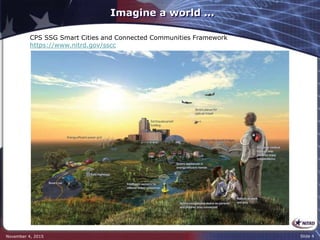
Imagine a world …
November 4, 2015 Slide 4
CPS SSG Smart Cities and Connected Communities Framework
https://www.nitrd.gov/sscc
VISION
 Communities in all settings and at all scales have
access to information, advanced technologies and
smart services that enhance the sustainability and
quality of life, improve health and safety, and help
provide economic prosperity for their residents.
November 4, 2015 Slide 5
GOALS
 Creating next-generation capabilities
 Supporting the R&D necessary to create smart
cities
 Building and expanding access to smart cities and
connected communities resources
 Promoting interoperable, standards-based smart
city solutions
 Improving the national landscape for education
and training
November 4, 2015 Slide 6
OUTCOMES
 Applications - innovative technology
 Analytics - acquiring information from the social,
biological, and physical elements
 People - the education and tools necessary to create a
smart city workforce and a citizenry
 Partnerships – with a wide set of stakeholders
 Deployments – Pilot and at-scale smart city deployments
November 4, 2015 Slide 7
BENEFITS
 Economic growth and new jobs in businesses
 Increased safety and mobility of roadway travelers and
reduced traffic-related pollution
 Reduced energy consumption
 Faster and more resilient wired and wireless
communications
 Improved response and recovery to disasters
 Improved monitoring of air and water quality
 Reduced crime
 Increased private sector investment
 Expanded public participation
 Increased safety of infrastructure
 Improved healthcare
November 4, 2015 Slide 8
PARTICIPATING AGENCIES
National Institute of Standards and Technology (NIST)
National Science Foundation (NSF)
Department of Transportation (DOT)
Department of Energy (DOE)
National Institute of Food and agriculture (NIFA)
National Institutes of Health (NIH)
National Aeronautics and Space Administration (NASA)
November 4, 2015 Slide 9
CONTACTS
 Department of Energy (DOE)
 Carol Hawk Carol.Hawk@hq.doe.gov
 Department of Transportation (DOT)
 Dan Morgan daniel.morgan@dot.gov
 National Institute of Food and agriculture (NIFA)
 Daniel Schmoldt - NIFA DSCHMOLDT@nifa.usda.gov
 National Institutes of Health (NIH)
 Richard Conroy (NIH/NIBIB) [E] Richard.Conroy@nih.gov
 National Institute of Standards and Technology (NIST)
 Chris Greer christopher.greer@nist.gov
 National Science Foundation (NSF)
 Erwin Gianchandani egiancha@nsf.gov
 National Aeronautics and Space Administration (NASA)
 Yuri Gawdiak yuri.o.gawdiak@nasa.gov
November 4, 2015 Slide 10
November 4, 2015 Slide 11
marzullo@nitrd.gov
www.nitrd.gov
Thank you!
CPS SSG Smart Cities and Connected Communities Framework
https://www.nitrd.gov/sscc

Day1 Keith Marzullo

  • 1.
    Federal Networking andInformation Technology Research and Development (NITRD) November 4, 2015 Slide 1 Keith Marzullo Director, NITRD National Coordination Office (NCO) A Cross-Agency Framework for Smart Cities and Connected Communities IT R&D
  • 2.
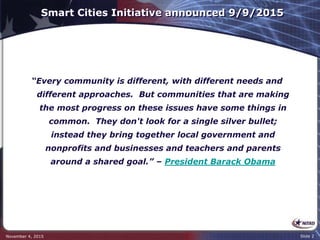
    Smart Cities Initiativeannounced 9/9/2015 “Every community is different, with different needs and different approaches. But communities that are making the most progress on these issues have some things in common. They don't look for a single silver bullet; instead they bring together local government and nonprofits and businesses and teachers and parents around a shared goal.” – President Barack Obama November 4, 2015 Slide 2
  • 3.
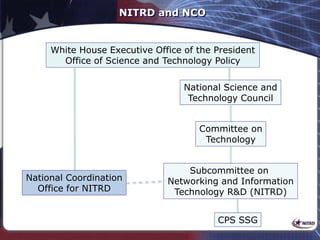
    NITRD and NCO WhiteHouse Executive Office of the President Office of Science and Technology Policy National Science and Technology Council Subcommittee on Networking and Information Technology R&D (NITRD) National Coordination Office for NITRD Committee on Technology CPS SSG
  • 4.
    Imagine a world… November 4, 2015 Slide 4 CPS SSG Smart Cities and Connected Communities Framework https://www.nitrd.gov/sscc
  • 5.
    VISION  Communities inall settings and at all scales have access to information, advanced technologies and smart services that enhance the sustainability and quality of life, improve health and safety, and help provide economic prosperity for their residents. November 4, 2015 Slide 5
  • 6.
    GOALS  Creating next-generationcapabilities  Supporting the R&D necessary to create smart cities  Building and expanding access to smart cities and connected communities resources  Promoting interoperable, standards-based smart city solutions  Improving the national landscape for education and training November 4, 2015 Slide 6
  • 7.
    OUTCOMES  Applications -innovative technology  Analytics - acquiring information from the social, biological, and physical elements  People - the education and tools necessary to create a smart city workforce and a citizenry  Partnerships – with a wide set of stakeholders  Deployments – Pilot and at-scale smart city deployments November 4, 2015 Slide 7
  • 8.
    BENEFITS  Economic growthand new jobs in businesses  Increased safety and mobility of roadway travelers and reduced traffic-related pollution  Reduced energy consumption  Faster and more resilient wired and wireless communications  Improved response and recovery to disasters  Improved monitoring of air and water quality  Reduced crime  Increased private sector investment  Expanded public participation  Increased safety of infrastructure  Improved healthcare November 4, 2015 Slide 8
  • 9.
    PARTICIPATING AGENCIES National Instituteof Standards and Technology (NIST) National Science Foundation (NSF) Department of Transportation (DOT) Department of Energy (DOE) National Institute of Food and agriculture (NIFA) National Institutes of Health (NIH) National Aeronautics and Space Administration (NASA) November 4, 2015 Slide 9
  • 10.
    CONTACTS  Department ofEnergy (DOE)  Carol Hawk Carol.Hawk@hq.doe.gov  Department of Transportation (DOT)  Dan Morgan daniel.morgan@dot.gov  National Institute of Food and agriculture (NIFA)  Daniel Schmoldt - NIFA DSCHMOLDT@nifa.usda.gov  National Institutes of Health (NIH)  Richard Conroy (NIH/NIBIB) [E] Richard.Conroy@nih.gov  National Institute of Standards and Technology (NIST)  Chris Greer christopher.greer@nist.gov  National Science Foundation (NSF)  Erwin Gianchandani egiancha@nsf.gov  National Aeronautics and Space Administration (NASA)  Yuri Gawdiak yuri.o.gawdiak@nasa.gov November 4, 2015 Slide 10
  • 11.
    November 4, 2015Slide 11 marzullo@nitrd.gov www.nitrd.gov Thank you! CPS SSG Smart Cities and Connected Communities Framework https://www.nitrd.gov/sscc

Editor's Notes

  • #6 Strategy: The Cyber-Physical Systems Senior Steering Group (CPS-SSG) will work to coordinate efforts among Federal agency and with public-private partnerships for smart cities and connected communities. The relevant agency activities include: Performing foundational research and accelerating innovation and transition in scalable and replicable smart city solutions Applying advanced cyber-physical systems concepts, coupled with sociotechnical system understanding, to integrate city-scale IT and physical infrastructures Enabling replicable smart city solutions that provide powerful new safe, reliable, sustainable, resilient, secure, privacy-enhancing, and cost-saving platforms and services Promoting discovery, innovation, and entrepreneurship in smart city technologies Facilitating the ability of communities to apply cyber-physical systems concepts to solutions that make them more livable, workable, safe, and sustainable and that support an informed and engaged populace
  • #7 Creating next-generation capabilities by furthering and leveraging (via fundamental R&D) cyber physical systems, smart systems, sociotechnical systems understanding, and other emerging technologies, processes, and policies Supporting the R&D necessary to create smart cities using data analytics to enhance individuals' Quality of Life, to improve their health and safety, and economic prosperity, to make better decisions and breakthrough discoveries, and to take confident action based on the analytics Building and expanding access to the smart cities and connected communities resources – both domain specific and shared – that are needed for agencies to best achieve their mission goals and for the country to innovate and benefit Promoting interoperable, standards-based smart city solutions that reduce deployment costs and enable modular architectures that are flexible and adaptable in meeting a community’s needs Improving the national landscape for education and training to fulfill increasing demand for both analytical talent and capacity for the broader workforce to support smart cities and connected communities
  • #8 Applications - innovative technology that will enhance sustainable livelihoods, and the quality of life Analytics - acquiring information from the social, biological, and physical elements that constitute the environment People (smart citizens) - the education and tools necessary to create a smart city workforce and a citizenry able to benefit from smart city solutions Partnerships - across federal agencies and with stakeholders in industry, academia, and other government entities to achieve positive outcomes Deployments – Pilot and at-scale smart city deployments that demonstrate value, feasibility, sustainability, and resiliency
  • #9 Economic growth and new jobs in businesses that are globally competitive in smart city technologies Increase the safety and mobility of roadway travelers and reduce traffic-related pollution Reduced energy consumption in human mobility, in commercial and residential buildings, and in commercial operations Faster and more resilient wired and wireless communications Improved response and recovery to natural and man-made disasters Improved monitoring of air and water quality Reduced crime through several socio-technical factors Increased private sector investment in new and growing businesses as a result of new services Expanded public participation in important decisions, such as planning and zoning Increased safety of infrastructure from condition-based monitoring Improved healthcare and aging in place through the connection of emergency services to hospitals, diagnostic equipment, and care providers