 Slonim city was first mentioned in the "
Ipatiev Chronicle " under the 1252.
 In 1531 , he received the Magdeburg Law.
 Slonim was often in a combat zone .
 In 1915, the city was captured by the
Germans and destroyed.
 In 1921, Slonim became part of Poland ,
and in 1939 - the Soviet Union.
 On the left bank of
the river Schara there
is a central part of the
city with the historic
layout. There is the
middle of the town
hall XVIII
 Town Hall is a two-
storey stone building.
Previously,it was
decorated with
sculptures placed on
the front of the screen
saver .
 A short distance away ,
on the south- east is
located the former
Bernardine monastery
church.
 Church was built in the
1639-1645 . High bell
tower is reinforced on the
front of the base of the
buttresses . The tower is a
land element . Among the
attractions of the church
consists of two cubic
extensions on the sides of
which are covered with
helmet-shaped domes.
The Holy Virgin Mary
The shape of the tower is
associated with ancient castles
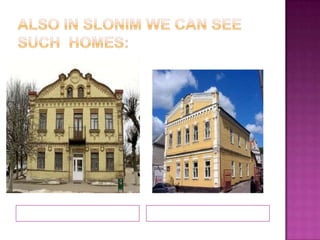
Residential Housing
 Church is representative of the
baroque style. It is surprising
wealth of sculpture and
decorative treatment and
plastic facade . The main
decoration is on the main
facade.. Reinforce plastic
building two towers , which are
set at an angle to the front . The
architectural complex includes
pomfret and monastery
building . Catholic church of St.
Andrew is involved in the
formation of a panorama of
Slonim and is associated with a
complex historical center of the
city.
 In 1745 was built the
chapel of St. Dominic
 It is located in the
western part of the city ,
it once meant its border.
Chapel takes the form of
a small long-line
structure, which
resembles the upper tier
of the tower of the
church . Its simplified
forms , baroque . Under
a canopy erected a stone
sculpture of St. Dominic.
 A large stone building
is a synagogue , built
in 1642
 The synagogue was
partially preserved
wall paintings . It
operated until 1940.
Architecture in slonim

Architecture in slonim

  • 2.
     Slonim citywas first mentioned in the " Ipatiev Chronicle " under the 1252.  In 1531 , he received the Magdeburg Law.  Slonim was often in a combat zone .  In 1915, the city was captured by the Germans and destroyed.  In 1921, Slonim became part of Poland , and in 1939 - the Soviet Union.
  • 3.
     On theleft bank of the river Schara there is a central part of the city with the historic layout. There is the middle of the town hall XVIII  Town Hall is a two- storey stone building. Previously,it was decorated with sculptures placed on the front of the screen saver .
  • 4.
     A shortdistance away , on the south- east is located the former Bernardine monastery church.  Church was built in the 1639-1645 . High bell tower is reinforced on the front of the base of the buttresses . The tower is a land element . Among the attractions of the church consists of two cubic extensions on the sides of which are covered with helmet-shaped domes.
  • 5.
    The Holy VirginMary The shape of the tower is associated with ancient castles Residential Housing
  • 6.
     Church isrepresentative of the baroque style. It is surprising wealth of sculpture and decorative treatment and plastic facade . The main decoration is on the main facade.. Reinforce plastic building two towers , which are set at an angle to the front . The architectural complex includes pomfret and monastery building . Catholic church of St. Andrew is involved in the formation of a panorama of Slonim and is associated with a complex historical center of the city.
  • 7.
     In 1745was built the chapel of St. Dominic  It is located in the western part of the city , it once meant its border. Chapel takes the form of a small long-line structure, which resembles the upper tier of the tower of the church . Its simplified forms , baroque . Under a canopy erected a stone sculpture of St. Dominic.
  • 8.
     A largestone building is a synagogue , built in 1642  The synagogue was partially preserved wall paintings . It operated until 1940.