COMPLEX SENTENCES
A SENTENCE
• We had a landline telephone in our house.
subject
predicate
attribute
object
adverbial
сложносочинительное
предложение
• сочинительные союзы:
• And (и);
• but (но);
• while, whereas (а, в то время как);
• or (или);
• otherwise (иначе) ;
• either... оr (или ... или).
• Latin was the lingua franca of the Roman Empire
and it helped people of different nationalities to
communicate with each other.
Сложноподчиненное предложение
• He is a person whose invention made him
popular all over the world.
The principle
(main) clause Subordinate clause
Subject subordinate clause
Linking words:
– that (что),
– if / whether (ли),
– who (кто),
– what (что),
– which (который),
– when (когда),
– where (где),
– how (как),
– why (почему).
• That the Internet is an effective means of communication is
well known. — To, что Интернет — эффективное
средство общения, хорошо известно.
Предикативные придаточные
предложения
– Linking words
– that (что),
– if / whether (ли),
– who (кто),
– what (что),
– which (который),
– when (когда),
– where (где),
– how (как),
– why (почему).
• The problem is that young people get addicted to mobile phones
and the Internet. — Проблема в том, что молодые люди
развивают зависимость от мобильных телефонов и Интернета
Придаточные дополнительные
предложения
Linking words:
that(что),
If/whether(ли)
what(что),
who(кто),
which(который),
where(где),
how(как),
why(почему).
• I don't know where the contradiction lies. — Я не
знаю, где лежит противоречие.
Придаточные предложения
определительные
– who(который),
– whose(чей),
– which/ that(который),
– where(где),why(почему).
• Here is the gadget (that / which) we have
spoken about. — Вот приспособление, о
котором мы говорили.
Придаточные предложения
обстоятельственные
• 1. adverbial clauses of place
• Linking words:
• where(где, куда)
• wherever(где бы ни, куда бы ни).
• Do you know where I can access the Internet? — Вы не знаете, где я
могу получить доступ к Интернету?
• 2. adverbial clauses of time
• Linking words:: when(когда), after(после того как), before(до того
как), till(до тех пор, пока), while(в то время как), since(с тех пор
как), as soon as(как только), by the time(к тому времени когда).
•
• By the time you finish school, new means of communication will be
developed. — К тому времени, когда ты закончишь школу, будут
созданы новые средства связи.
Придаточные предложения
обстоятельственные
• 3. adverbial clauses of reason
• Linking words:
• because(потому что),
• as/ since(так как).
• I called you yesterday because I couldn't help waiting. —
• Я позвонил тебе вчера, потому что больше не мог ждать.
• 4. adverbial clauses of purpose
• Linking words:
• that (чтобы),
• So that / in order that (для того чтобы),
• lest (чтобы не).
• She must speak in a low voice so that nobody could eavesdrop. — Она должна
говорить тише, чтобы никто не смог подслушать.
• He's saving money in order that he can afford himself to buy an expensive smart
phone. — Он собирает деньги, чтобы позволить себе купить дорогой
смартфон.
Придаточные предложения
обстоятельственные
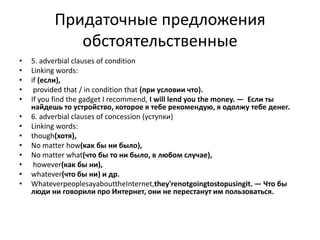
• 5. adverbial clauses of condition
• Linking words:
• if (если),
• provided that / in condition that (при условии что).
• If you find the gadget I recommend, I will lend you the money. — Если ты
найдешь то устройство, которое я тебе рекомендую, я одолжу тебе денег.
• 6. adverbial clauses of concession (уступки)
• Linking words:
• though(хотя),
• No matter how(как бы ни было),
• No matter what(что бы то ни было, в любом случае),
• however(как бы ни),
• whatever(что бы ни) и др.
• WhateverpeoplesayabouttheInternet,they'renotgoingtostopusingit. — Что бы
люди ни говорили про Интернет, они не перестанут им пользоваться.
Придаточные предложения
обстоятельственные
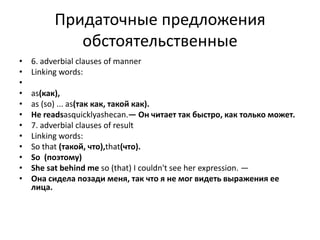
• 6. adverbial clauses of manner
• Linking words:
•
• as(как),
• as (so) ... as(так как, такой как).
• Не readsasquicklyashecan.— Он читает так быстро, как только может.
• 7. adverbial clauses of result
• Linking words:
• So that (такой, что),that(что).
• So (поэтому)
• She sat behind me so (that) I couldn't see her expression. —
• Она сидела позади меня, так что я не мог видеть выражения ее
лица.

9 form complex sentences

  • 1.
  • 2.
    A SENTENCE • Wehad a landline telephone in our house. subject predicate attribute object adverbial
  • 3.
    сложносочинительное предложение • сочинительные союзы: •And (и); • but (но); • while, whereas (а, в то время как); • or (или); • otherwise (иначе) ; • either... оr (или ... или). • Latin was the lingua franca of the Roman Empire and it helped people of different nationalities to communicate with each other.
  • 4.
    Сложноподчиненное предложение • Heis a person whose invention made him popular all over the world. The principle (main) clause Subordinate clause
  • 5.
    Subject subordinate clause Linkingwords: – that (что), – if / whether (ли), – who (кто), – what (что), – which (который), – when (когда), – where (где), – how (как), – why (почему). • That the Internet is an effective means of communication is well known. — To, что Интернет — эффективное средство общения, хорошо известно.
  • 6.
    Предикативные придаточные предложения – Linkingwords – that (что), – if / whether (ли), – who (кто), – what (что), – which (который), – when (когда), – where (где), – how (как), – why (почему). • The problem is that young people get addicted to mobile phones and the Internet. — Проблема в том, что молодые люди развивают зависимость от мобильных телефонов и Интернета
  • 7.
  • 8.
    Придаточные предложения определительные – who(который), –whose(чей), – which/ that(который), – where(где),why(почему). • Here is the gadget (that / which) we have spoken about. — Вот приспособление, о котором мы говорили.
  • 9.
    Придаточные предложения обстоятельственные • 1.adverbial clauses of place • Linking words: • where(где, куда) • wherever(где бы ни, куда бы ни). • Do you know where I can access the Internet? — Вы не знаете, где я могу получить доступ к Интернету? • 2. adverbial clauses of time • Linking words:: when(когда), after(после того как), before(до того как), till(до тех пор, пока), while(в то время как), since(с тех пор как), as soon as(как только), by the time(к тому времени когда). • • By the time you finish school, new means of communication will be developed. — К тому времени, когда ты закончишь школу, будут созданы новые средства связи.
  • 10.
    Придаточные предложения обстоятельственные • 3.adverbial clauses of reason • Linking words: • because(потому что), • as/ since(так как). • I called you yesterday because I couldn't help waiting. — • Я позвонил тебе вчера, потому что больше не мог ждать. • 4. adverbial clauses of purpose • Linking words: • that (чтобы), • So that / in order that (для того чтобы), • lest (чтобы не). • She must speak in a low voice so that nobody could eavesdrop. — Она должна говорить тише, чтобы никто не смог подслушать. • He's saving money in order that he can afford himself to buy an expensive smart phone. — Он собирает деньги, чтобы позволить себе купить дорогой смартфон.
  • 11.
    Придаточные предложения обстоятельственные • 5.adverbial clauses of condition • Linking words: • if (если), • provided that / in condition that (при условии что). • If you find the gadget I recommend, I will lend you the money. — Если ты найдешь то устройство, которое я тебе рекомендую, я одолжу тебе денег. • 6. adverbial clauses of concession (уступки) • Linking words: • though(хотя), • No matter how(как бы ни было), • No matter what(что бы то ни было, в любом случае), • however(как бы ни), • whatever(что бы ни) и др. • WhateverpeoplesayabouttheInternet,they'renotgoingtostopusingit. — Что бы люди ни говорили про Интернет, они не перестанут им пользоваться.
  • 12.
    Придаточные предложения обстоятельственные • 6.adverbial clauses of manner • Linking words: • • as(как), • as (so) ... as(так как, такой как). • Не readsasquicklyashecan.— Он читает так быстро, как только может. • 7. adverbial clauses of result • Linking words: • So that (такой, что),that(что). • So (поэтому) • She sat behind me so (that) I couldn't see her expression. — • Она сидела позади меня, так что я не мог видеть выражения ее лица.