SIENA, ITALY
HISTORY : Siena Pursued their rivalry with neighbouring city Florence.
• Preserved their Gothic style acquired between 12th-15th century
• Work of Duccio, Lorenzetti brothers and Simone Martini influenced European art at
this period
• In 1348, devastating plague infected it’s citizens.
• City was developed on its topography like other
European cities.
• Located on three hills – connected by 3 major
streets – forming a ‘Y’ shape – intersecting in a
valley, ie Piazza del campo.
1
• All the streets branch out from
this enormous concave shell shaped
center square - piazza del campo
aka el campo.
• El campo is the Meeting place,
hangout center & venue for horse
race.
• Paved with red bricks in herringbone
pattern. Divided into sunburst design.
1
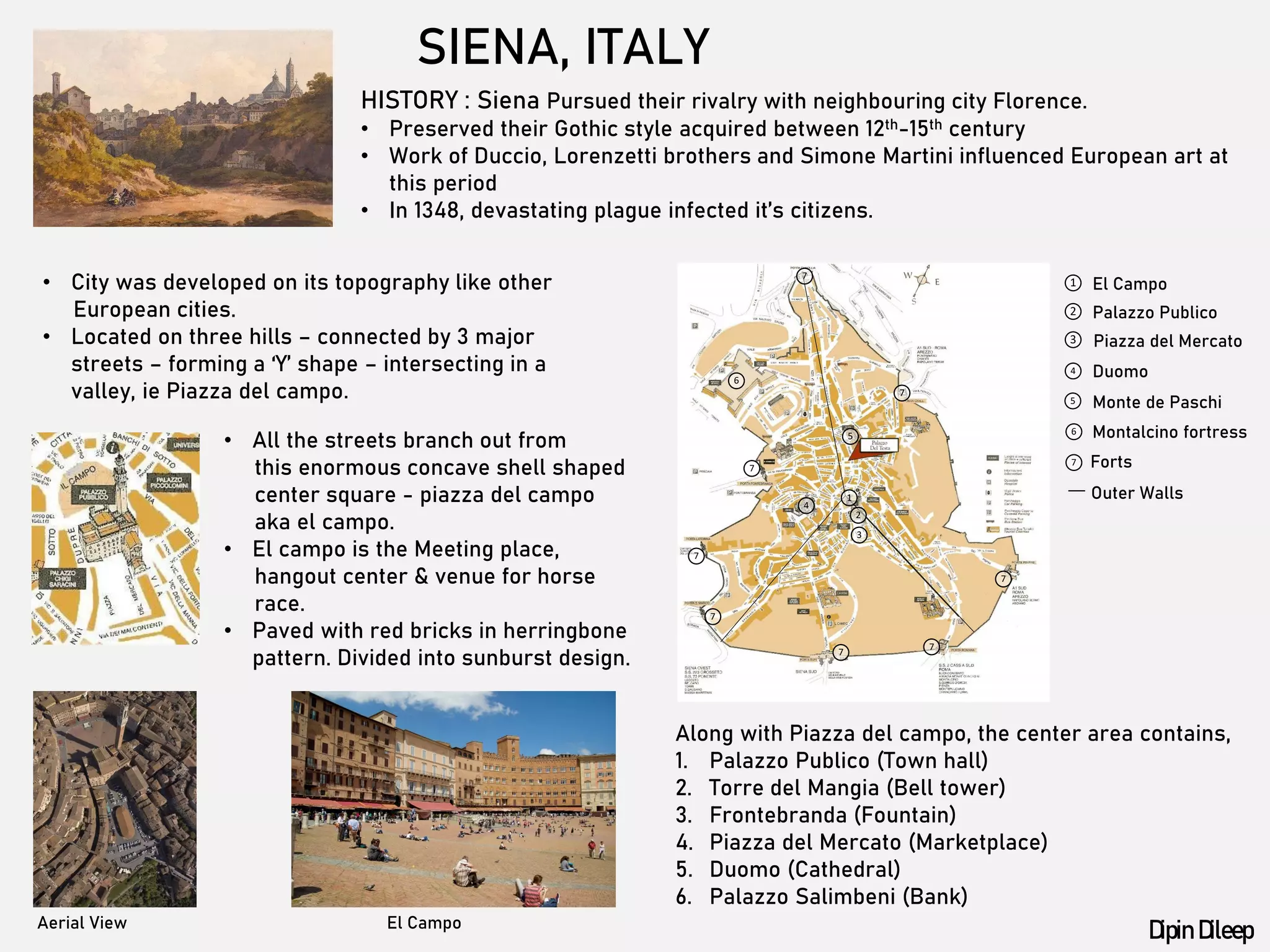
Along with Piazza del campo, the center area contains,
1. Palazzo Publico (Town hall)
2. Torre del Mangia (Bell tower)
3. Frontebranda (Fountain)
4. Piazza del Mercato (Marketplace)
5. Duomo (Cathedral)
6. Palazzo Salimbeni (Bank)
El Campo
2
2
3
Palazzo Publico
Piazza del Mercato
3
4
4 Duomo
5
5 Monte de Paschi
6
6 Montalcino fortress
7
7
7
7
7
7
7
7
7 Forts
Aerial View El Campo
Outer Walls
Dipin Dileep
Administration, religion,
trade, events
Residential, education
Defense,
Entrance
Basic Structure
Palazzo Publico
• Example of civic-gothic
architecture
• At the base : Chapel of the
virgin
Piazzo del maracato
• Opposite of el campo and older
than it.
• Rectangular in shape with various
edifices lying in its 2 longer sides
• Center- covered stall – wooden
roof with tiles supported by brick
columns
Duomo
• Italian gothic church – depicts mary, coronation of
the virgin.
• Columns are richly covered with foliage,
sculptures of humans and animals.
• Has a stripped black and white Romanesque tower
• This church represents siena’s wealth and
prosperity
• Includes mosaics, ornaments, relics on the interior
Dipin Dileep
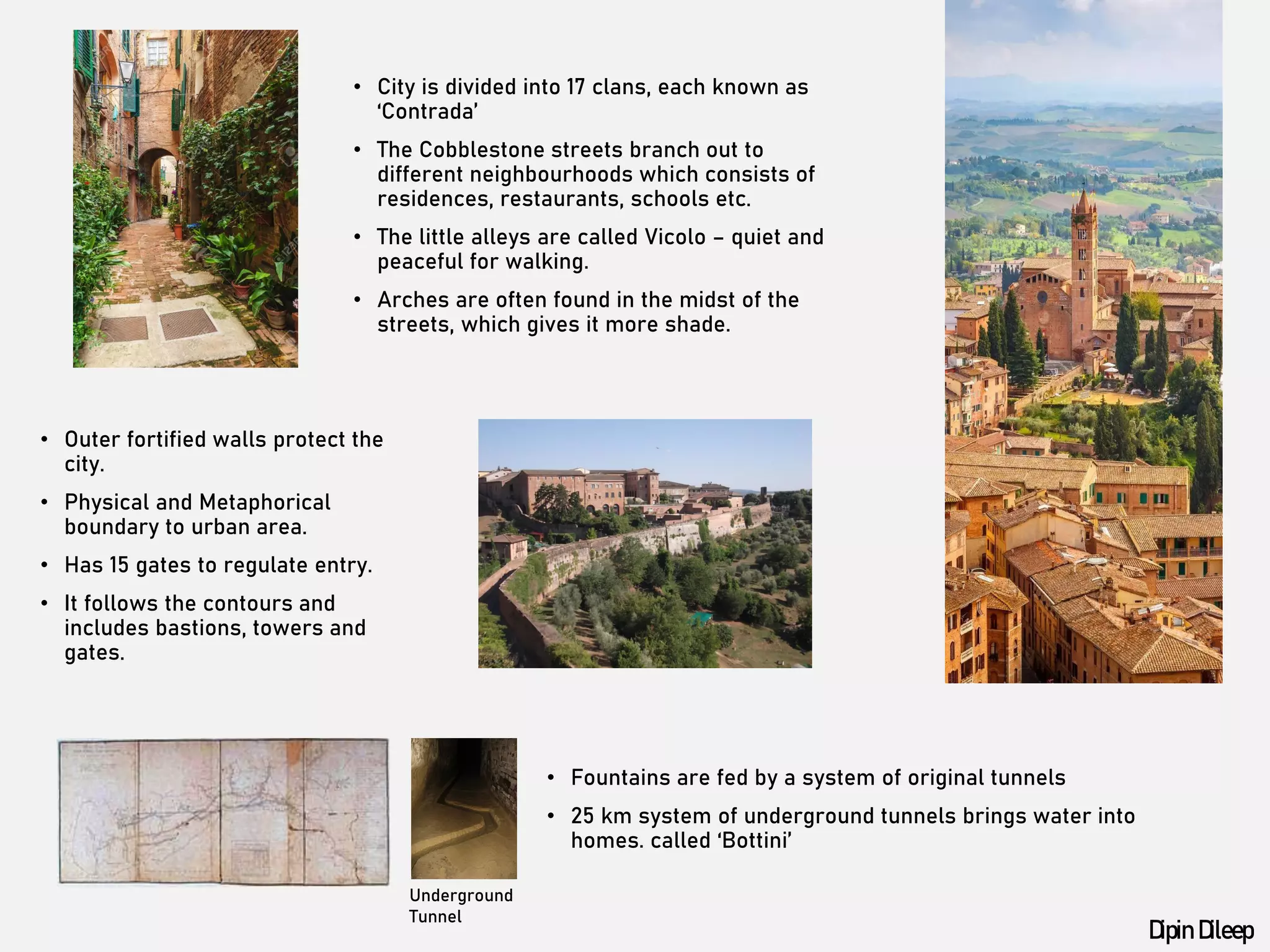
• City is divided into 17 clans, each known as
‘Contrada’
• The Cobblestone streets branch out to
different neighbourhoods which consists of
residences, restaurants, schools etc.
• The little alleys are called Vicolo – quiet and
peaceful for walking.
• Arches are often found in the midst of the
streets, which gives it more shade.
• Outer fortified walls protect the
city.
• Physical and Metaphorical
boundary to urban area.
• Has 15 gates to regulate entry.
• It follows the contours and
includes bastions, towers and
gates.
• Fountains are fed by a system of original tunnels
• 25 km system of underground tunnels brings water into
homes. called ‘Bottini’
Underground
Tunnel
Dipin Dileep

Siena, Medieval city, Italy

  • 1.
    SIENA, ITALY HISTORY :Siena Pursued their rivalry with neighbouring city Florence. • Preserved their Gothic style acquired between 12th-15th century • Work of Duccio, Lorenzetti brothers and Simone Martini influenced European art at this period • In 1348, devastating plague infected it’s citizens. • City was developed on its topography like other European cities. • Located on three hills – connected by 3 major streets – forming a ‘Y’ shape – intersecting in a valley, ie Piazza del campo. 1 • All the streets branch out from this enormous concave shell shaped center square - piazza del campo aka el campo. • El campo is the Meeting place, hangout center & venue for horse race. • Paved with red bricks in herringbone pattern. Divided into sunburst design. 1 Along with Piazza del campo, the center area contains, 1. Palazzo Publico (Town hall) 2. Torre del Mangia (Bell tower) 3. Frontebranda (Fountain) 4. Piazza del Mercato (Marketplace) 5. Duomo (Cathedral) 6. Palazzo Salimbeni (Bank) El Campo 2 2 3 Palazzo Publico Piazza del Mercato 3 4 4 Duomo 5 5 Monte de Paschi 6 6 Montalcino fortress 7 7 7 7 7 7 7 7 7 Forts Aerial View El Campo Outer Walls Dipin Dileep
  • 2.
    Administration, religion, trade, events Residential,education Defense, Entrance Basic Structure Palazzo Publico • Example of civic-gothic architecture • At the base : Chapel of the virgin Piazzo del maracato • Opposite of el campo and older than it. • Rectangular in shape with various edifices lying in its 2 longer sides • Center- covered stall – wooden roof with tiles supported by brick columns Duomo • Italian gothic church – depicts mary, coronation of the virgin. • Columns are richly covered with foliage, sculptures of humans and animals. • Has a stripped black and white Romanesque tower • This church represents siena’s wealth and prosperity • Includes mosaics, ornaments, relics on the interior Dipin Dileep
  • 3.
    • City isdivided into 17 clans, each known as ‘Contrada’ • The Cobblestone streets branch out to different neighbourhoods which consists of residences, restaurants, schools etc. • The little alleys are called Vicolo – quiet and peaceful for walking. • Arches are often found in the midst of the streets, which gives it more shade. • Outer fortified walls protect the city. • Physical and Metaphorical boundary to urban area. • Has 15 gates to regulate entry. • It follows the contours and includes bastions, towers and gates. • Fountains are fed by a system of original tunnels • 25 km system of underground tunnels brings water into homes. called ‘Bottini’ Underground Tunnel Dipin Dileep