Architectural Anti Patterns
Notes on Data Distribution and Handling Failures
Gleicon Moraes
http://zenmachine.wordpress.com
http://github.com/gleicon
@gleicon
Required Listening: King Crimson - Discipline
Anti Patterns
Evolution from SQL Anti Patterns (NoSQL:br May 2010)
More than just RDBMS
Large volumes of data
Distribution
Architecture
Research on other tools
Message Queues, DHT, Job Schedulers, NoSQL
Indexing, Map/Reduce
New revision since QConSP 2010: included Hierarchical
Sharding, Embedded lists and Distributed Global Locking
RDBMS Anti Patterns
Not all things fit on a relational database, single ou distributed
The eternal table-as-a-tree
Dynamic table creation
Table as cache
Table as queue
Table as log file
Stoned Procedures
Row Alignment
Extreme JOINs
Your scheme must be printed in an A3 sheet.
Your ORM issue full queries for Dataset iterations
Hierarchical Sharding
Embedded lists
Distributed global locking
Doing it wrong, Junior !
The eternal tree
Problem: Most threaded discussion example uses something
like a table which contains all threads and answers, relating to
each other by an id. Usually the developer will come up with
his own binary-tree version to manage this mess.
id - parent_id -author - text
1 - 0 - gleicon - hello world
2 - 1 - elvis - shout !
Alternative: Document storage:
{ thread_id:1, title: 'the meeting', author: 'gleicon', replies:[
{
'author': elvis, text:'shout', replies:[{...}]
}
]
}
Dynamic table creation
Problem: To avoid huge tables, one must come with a
"dynamic schema". For example, lets think about a document
management company, which is adding new facilities over the
country. For each storage facility, a new table is created:
item_id - row - column - stuff
1 - 10 - 20 - cat food
2 - 12 - 32 - trout
Now you have to come up with "dynamic queries", which will
probably query a "central storage" table and issue a huge join
to check if you have enough cat food over the country.
Alternatives:
- Document storage, modeling a facility as a document
- Key/Value, modeling each facility as a SET
Table as cache
Problem: Complex queries demand that a result be stored in a
separated table, so it can be queried quickly. Worst than views
Alternatives:
- Really ?
- Memcached
- Redis + AOF + EXPIRE
- De-normalization
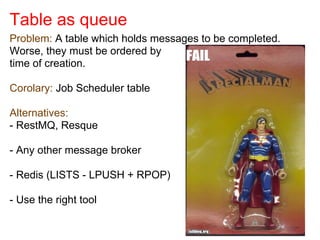
Table as queue
Problem: A table which holds messages to be completed.
Worse, they must be ordered by
time of creation.
Corolary: Job Scheduler table
Alternatives:
- RestMQ, Resque
- Any other message broker
- Redis (LISTS - LPUSH + RPOP)
- Use the right tool
Table as log file
Problem: A table in which data gets written as a log file. From
time to time it needs to be purged. Truncating this table once
a day usually is the first task assigned to new DBAs.
Alternative:
- MongoDB capped collection
- Redis, and RRD pattern
- RIAK
Stoned procedures
Problem: Stored procedures hold most of your applications
logic. Also, some triggers are used to - well - trigger important
data events.
SP and triggers has the magic property of vanishing of our
memories and being impossible to keep versioned.
Alternative:
- Now be careful so you dont use map/reduce as modern
stoned procedures. Unfit for real time search/processing
- Use your preferred language for business stuff, and let event
handling to pub/sub or message queues.
Row Alignment
Problem: Extra rows are created but not used, just in case.
Usually they are named as a1, a2, a3, a4 and called padding.
There's good will behind that, specially when version 1 of the
software needed an extra column in a 150M lines database
and it took 2 days to run an ALTER TABLE. But that's no
excuse.
Alternative:
- Quit being cheap. Quit feeling 'hacker' about padding
- Document based databases as MongoDB and CouchDB, has
no schema. New atributes are local to the document and can
be added easily.
Extreme JOINs
Problem: Business stuff modeled as tables. Table inheritance
(Product -> SubProduct_A). To find the complete data for a
user plan, one must issue gigantic queries with lots of JOINs.
Alternative:
- Document storage, as MongoDB
might help having important
information together.
- De-normalization
- Serialized objects
Your scheme fits in an A3 sheet
Problem: Huge data schemes are difficult to manage. Extreme
specialization creates tables which converges to key/value
model. The normal form get priority over common sense.
Product_A Product_B
id - desc id - desc
Alternatives:
- De-normalization
- Another scheme ?
- Document store for flattening model
- Key/Value
- See 'Extreme JOINs'
Your ORM ...
Problem: Your ORM issue full queries for dataset iterations,
your ORM maps and creates tables which mimics your
classes, even the inheritance, and the performance is bad
because the queries are huge, etc, etc
Alternative:
- Apart from denormalization and good old common sense,
ORMs are trying to bridge two things with distinct impedance.
- There is nothing to relational models which maps cleanly to
classes and objects. Not even the basic unit which is the
domain(set) of each column. Black Magic ?
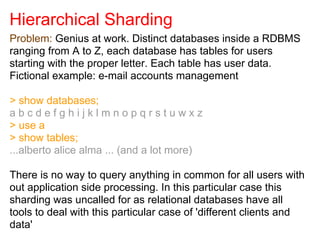
Hierarchical Sharding
Problem: Genius at work. Distinct databases inside a RDBMS
ranging from A to Z, each database has tables for users
starting with the proper letter. Each table has user data.
Fictional example: e-mail accounts management
> show databases;
a b c d e f g h i j k l m n o p q r s t u w x z
> use a
> show tables;
...alberto alice alma ... (and a lot more)
There is no way to query anything in common for all users with
out application side processing. In this particular case this
sharding was uncalled for as relational databases have all
tools to deal with this particular case of 'different clients and
data'
Embedded Lists
Problem: As data complexity grows, one thinks that it's proper
for the application to handle different data structures
embedded in a single cell or row. The popular 'Let's use
commas to separe it'. Another name could be Stored CSV
> select group_field from that_email_sharded_database.user
"a@email1.net, b@email1.net,c@email2.net"
This is a bit complementar of 'Your scheme fits in a A3 sheet'.
This kind of optimization, while harmless at first sight, spreads
without control. Querying such fields yields unwanted results.
You might only use languages where string splitting is not
expensive or remember to compile RegExps before querying a
large data volume. Either learn to model your data, or resort to
K/V stores as Redis.
Distributed Global Locking
Problem: Someone learns java and synchronize. A bit later
genius thinks that a distributed synchronize would be
awesome. The proper place to do that would be the database
of course. Start with a reference counter in a table and end up
with this:
> select COALESCE(GET_LOCK('my_lock',0 ),0 )
Plain and simple, you might find it embedded in a magic class
called DistributedSynchronize or ClusterSemaphore. Locks,
transactions and reference counters (which may act as soft
locks) doesn't belongs to the database. While its they use is
questionable even in code, the matter of fact is that you are
doing it wrong, if you are doing like that.
No silver bullet
- Think about data
handling and your
system architecture
- Think outside the norm
- De-normalize
- Simplify
- Know stuff (Message
queues, NoSQL, DHT)
Cycle of changes - Product A
1. There was the database model
2. Then, the cache was needed. Performance was no good.
3. Cache key: query, value: resultset
4. High or inexistent expiration time [w00t]
(Now there's a turning point. Data didn't need to change often.
Denormalization was a given with cache)
5. The cache needs to be warmed or the app wont work.
6. Key/Value storage was a natural choice. No data on MySQL
anymore.
Cycle of changes - Product B
1. Postgres DB storing crawler results.
2. There was a counter in each row, and updating this counter
caused contention errors.
3. Memcache for reads. Performance is better.
4. First MongoDB test, no more deadlocks from counter
update.
5. Data model was simplified, the entire crawled doc was
stored.
Stuff to think about
Think if the data you use aren't de-normalized somewhere
(cached)
Most of the anti-patterns signals that there are architectural
issues instead of only database issues.
The NoSQL route (or at least a partial NoSQL route) may
simplify it.
Are you dependent on cache ? Does your application fails
when there is no cache ? Does it just slows down ?
Think about the way to put and to get back your data from the
database (be it SQL or NoSQL).
Thanks
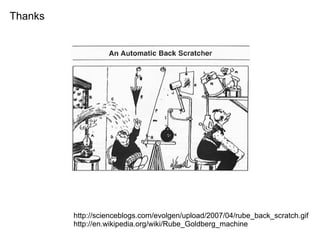
http://scienceblogs.com/evolgen/upload/2007/04/rube_back_scratch.gif
http://en.wikipedia.org/wiki/Rube_Goldberg_machine

Architectural anti-patterns for data handling

  • 1.
    Architectural Anti Patterns Noteson Data Distribution and Handling Failures Gleicon Moraes http://zenmachine.wordpress.com http://github.com/gleicon @gleicon
  • 2.
    Required Listening: KingCrimson - Discipline
  • 3.
    Anti Patterns Evolution fromSQL Anti Patterns (NoSQL:br May 2010) More than just RDBMS Large volumes of data Distribution Architecture Research on other tools Message Queues, DHT, Job Schedulers, NoSQL Indexing, Map/Reduce New revision since QConSP 2010: included Hierarchical Sharding, Embedded lists and Distributed Global Locking
  • 4.
    RDBMS Anti Patterns Notall things fit on a relational database, single ou distributed The eternal table-as-a-tree Dynamic table creation Table as cache Table as queue Table as log file Stoned Procedures Row Alignment Extreme JOINs Your scheme must be printed in an A3 sheet. Your ORM issue full queries for Dataset iterations Hierarchical Sharding Embedded lists Distributed global locking
  • 5.
  • 6.
    The eternal tree Problem:Most threaded discussion example uses something like a table which contains all threads and answers, relating to each other by an id. Usually the developer will come up with his own binary-tree version to manage this mess. id - parent_id -author - text 1 - 0 - gleicon - hello world 2 - 1 - elvis - shout ! Alternative: Document storage: { thread_id:1, title: 'the meeting', author: 'gleicon', replies:[ { 'author': elvis, text:'shout', replies:[{...}] } ] }
  • 7.
    Dynamic table creation Problem:To avoid huge tables, one must come with a "dynamic schema". For example, lets think about a document management company, which is adding new facilities over the country. For each storage facility, a new table is created: item_id - row - column - stuff 1 - 10 - 20 - cat food 2 - 12 - 32 - trout Now you have to come up with "dynamic queries", which will probably query a "central storage" table and issue a huge join to check if you have enough cat food over the country. Alternatives: - Document storage, modeling a facility as a document - Key/Value, modeling each facility as a SET
  • 8.
    Table as cache Problem:Complex queries demand that a result be stored in a separated table, so it can be queried quickly. Worst than views Alternatives: - Really ? - Memcached - Redis + AOF + EXPIRE - De-normalization
  • 9.
    Table as queue Problem:A table which holds messages to be completed. Worse, they must be ordered by time of creation. Corolary: Job Scheduler table Alternatives: - RestMQ, Resque - Any other message broker - Redis (LISTS - LPUSH + RPOP) - Use the right tool
  • 10.
    Table as logfile Problem: A table in which data gets written as a log file. From time to time it needs to be purged. Truncating this table once a day usually is the first task assigned to new DBAs. Alternative: - MongoDB capped collection - Redis, and RRD pattern - RIAK
  • 11.
    Stoned procedures Problem: Storedprocedures hold most of your applications logic. Also, some triggers are used to - well - trigger important data events. SP and triggers has the magic property of vanishing of our memories and being impossible to keep versioned. Alternative: - Now be careful so you dont use map/reduce as modern stoned procedures. Unfit for real time search/processing - Use your preferred language for business stuff, and let event handling to pub/sub or message queues.
  • 12.
    Row Alignment Problem: Extrarows are created but not used, just in case. Usually they are named as a1, a2, a3, a4 and called padding. There's good will behind that, specially when version 1 of the software needed an extra column in a 150M lines database and it took 2 days to run an ALTER TABLE. But that's no excuse. Alternative: - Quit being cheap. Quit feeling 'hacker' about padding - Document based databases as MongoDB and CouchDB, has no schema. New atributes are local to the document and can be added easily.
  • 13.
    Extreme JOINs Problem: Businessstuff modeled as tables. Table inheritance (Product -> SubProduct_A). To find the complete data for a user plan, one must issue gigantic queries with lots of JOINs. Alternative: - Document storage, as MongoDB might help having important information together. - De-normalization - Serialized objects
  • 14.
    Your scheme fitsin an A3 sheet Problem: Huge data schemes are difficult to manage. Extreme specialization creates tables which converges to key/value model. The normal form get priority over common sense. Product_A Product_B id - desc id - desc Alternatives: - De-normalization - Another scheme ? - Document store for flattening model - Key/Value - See 'Extreme JOINs'
  • 15.
    Your ORM ... Problem:Your ORM issue full queries for dataset iterations, your ORM maps and creates tables which mimics your classes, even the inheritance, and the performance is bad because the queries are huge, etc, etc Alternative: - Apart from denormalization and good old common sense, ORMs are trying to bridge two things with distinct impedance. - There is nothing to relational models which maps cleanly to classes and objects. Not even the basic unit which is the domain(set) of each column. Black Magic ?
  • 16.
    Hierarchical Sharding Problem: Geniusat work. Distinct databases inside a RDBMS ranging from A to Z, each database has tables for users starting with the proper letter. Each table has user data. Fictional example: e-mail accounts management > show databases; a b c d e f g h i j k l m n o p q r s t u w x z > use a > show tables; ...alberto alice alma ... (and a lot more) There is no way to query anything in common for all users with out application side processing. In this particular case this sharding was uncalled for as relational databases have all tools to deal with this particular case of 'different clients and data'
  • 17.
    Embedded Lists Problem: Asdata complexity grows, one thinks that it's proper for the application to handle different data structures embedded in a single cell or row. The popular 'Let's use commas to separe it'. Another name could be Stored CSV > select group_field from that_email_sharded_database.user "a@email1.net, b@email1.net,c@email2.net" This is a bit complementar of 'Your scheme fits in a A3 sheet'. This kind of optimization, while harmless at first sight, spreads without control. Querying such fields yields unwanted results. You might only use languages where string splitting is not expensive or remember to compile RegExps before querying a large data volume. Either learn to model your data, or resort to K/V stores as Redis.
  • 18.
    Distributed Global Locking Problem:Someone learns java and synchronize. A bit later genius thinks that a distributed synchronize would be awesome. The proper place to do that would be the database of course. Start with a reference counter in a table and end up with this: > select COALESCE(GET_LOCK('my_lock',0 ),0 ) Plain and simple, you might find it embedded in a magic class called DistributedSynchronize or ClusterSemaphore. Locks, transactions and reference counters (which may act as soft locks) doesn't belongs to the database. While its they use is questionable even in code, the matter of fact is that you are doing it wrong, if you are doing like that.
  • 19.
    No silver bullet -Think about data handling and your system architecture - Think outside the norm - De-normalize - Simplify - Know stuff (Message queues, NoSQL, DHT)
  • 20.
    Cycle of changes- Product A 1. There was the database model 2. Then, the cache was needed. Performance was no good. 3. Cache key: query, value: resultset 4. High or inexistent expiration time [w00t] (Now there's a turning point. Data didn't need to change often. Denormalization was a given with cache) 5. The cache needs to be warmed or the app wont work. 6. Key/Value storage was a natural choice. No data on MySQL anymore.
  • 21.
    Cycle of changes- Product B 1. Postgres DB storing crawler results. 2. There was a counter in each row, and updating this counter caused contention errors. 3. Memcache for reads. Performance is better. 4. First MongoDB test, no more deadlocks from counter update. 5. Data model was simplified, the entire crawled doc was stored.
  • 22.
    Stuff to thinkabout Think if the data you use aren't de-normalized somewhere (cached) Most of the anti-patterns signals that there are architectural issues instead of only database issues. The NoSQL route (or at least a partial NoSQL route) may simplify it. Are you dependent on cache ? Does your application fails when there is no cache ? Does it just slows down ? Think about the way to put and to get back your data from the database (be it SQL or NoSQL).
  • 23.