INTELLIGENT
TRANSPORTATION
SYSTEMS
Submitted By
Archana
Id No.
50337
Submitted To
Swati Rajput
Ma'am
• Presentation Outline
• Introduction
• Background Situation of Promoting ITS
• Intelligent Transportation Technologies
• Intelligent Transportation Applications
• Benefits of Intelligent Transportation System
• References
•ITS is the integrated
application of advanced
technologies using
Electronics, Computers,
Communications, and
Advanced sensors. These
applications provide
travellers with important
information while improving
the safety and efficiency of
the transportation system.
INTRODUCTION
BACKGROUND SITUATION OF PROMOTING ITS
To Solve Social
Problems caused by
Road
T
o activate
the Economy
To reach an
Advanced
Information and Tele
communication
Society
INTELLIGENT TRANSPORTATION TECHNOLOGIES
(1) Wireless Communications :
• Dedicated Short-
Range
Communications
(DSRC) :
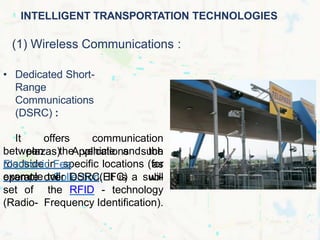
It offers communication
between the vehicle and the
roadside in specific locations (for
example toll
Electronic Fee
Collection(EFC)
plazas) Applications such
as
will
operate over DSRC. It is a sub-
set of the RFID - technology
(Radio- Frequency Identification).
vehicl
e
using
and the
roadside a
variety of
communication media,
including cellular and
infra- red links.
• Continuous Air
interface Long and
Medium range
(CALM) :
Continuous Air
interface Long and
Medium range
(CALM)provides
continuous
communications between
a
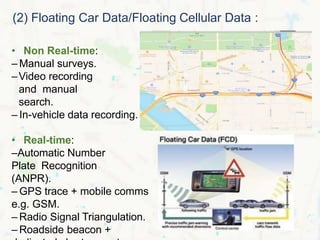
(2) Floating Car Data/Floating Cellular Data :
• Non Real-time:
– Manual surveys.
–Video recording
and manual
search.
– In-vehicle data recording.
• Real-time:
–Automatic Number
Plate Recognition
(ANPR).
– GPS trace + mobile comms
e.g. GSM.
– Radio Signal Triangulation.
– Roadside beacon +
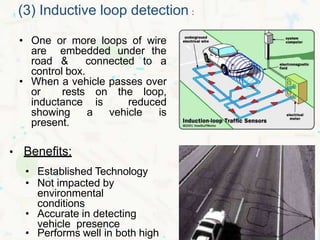
(3) Inductive loop detection :
• One or more loops of wire
are embedded under the
road & connected to a
control box.
• When a vehicle passes over
or rests on the loop,
inductance is reduced
showing a vehicle is
present.
• Benefits:
• Established Technology
• Not impacted by
environmental
conditions
• Accurate in detecting
vehicle presence
• Performs well in both high
Radar and acoustic sensors are also used for detecting
vehicles in
the roadway.
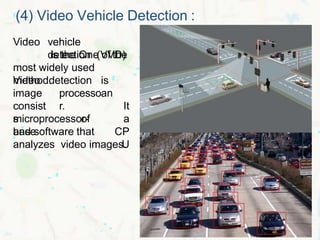
(4) Video Vehicle Detection :
Video vehicle
detection (VVD)
is the One of the
most widely used
method.
Video
image
consist
s
processo
r.
of
microprocessor-
base
detection is
an
It
a
CP
U
and software that
analyzes video images.
INTELLIGENT TRANSPORTATION APPLICATIONS
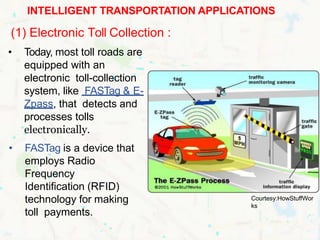
(1) Electronic Toll Collection :
• Today, most toll roads are
equipped with an
electronic toll-collection
system, like FASTag & E-
Zpass, that detects and
processes tolls
electronically.
• FASTag is a device that
employs Radio
Frequency
Identification (RFID)
technology for making
toll payments.
Courtesy:HowStuffWor
ks
FASTag enabled Toll
Plaza
Tag affixed on Wind
RFID Tag
Reader
What are the benefits of using FASTag?
Environmental benefit Social benefit Economic benefit
•Reduced toll payment • Reduced effort in
• Reduced air pollution hassles management at toll plaza
• Reduced use of paper •Analytics for better • Reduced effort in
highway management monitoring centrally
1.Ease of payment – No need to carry cash for
the toll transactions, saves time
2.Near non-stop movement of vehicles leading to
lower
fuel cost.
3.Online Recharge – FASTag can be recharged
online through Credit Card / Debit Card /
NEFT/ RTGS or Net banking
4.SMS alerts for toll transactions, low balance,
etc. 5.Online Portal for customers
Other benefits are:
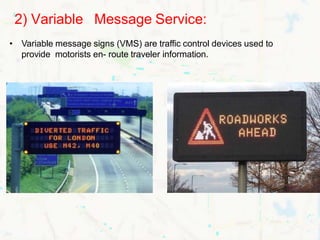
2) Variable Message Service:
• Variable message signs (VMS) are traffic control devices used to
provide motorists en- route traveler information.
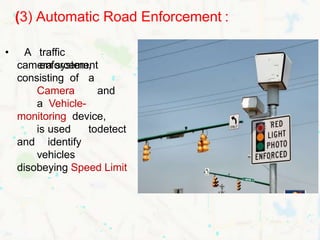
• A traffic
enforcement
camera system,
consisting of a
Camera and
a Vehicle-
monitoring device,
is used todetect
and identify
vehicles
disobeying Speed Limit
(3) Automatic Road Enforcement :
(4) Collision Avoidance Systems :
Intersection Collision Warning Obstacle Detection
Lane Change assistance Lane Departure Warning
WWW.CIVILSCHOLAR.
COM
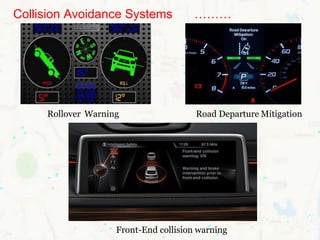
Collision Avoidance Systems ………
Rollover Warning Road Departure Mitigation
Front-End collision warning
(5) Traveler Information Service :
Information is
Generated …
Traffic
Sensor
Aerial
surveillance
Weather
Monitoring
Incident
Detection
Transit
Location
• Delay
• Incident
• Road Weather
• Next Bus
• Traveler Times
• Emergency
Alerts
• Alternate
Routes
Sent to
Travelers ..
Travelers
Respond
Change
Route
Change
Departur
e Time
Change
Mode
Change
Destinatio
n
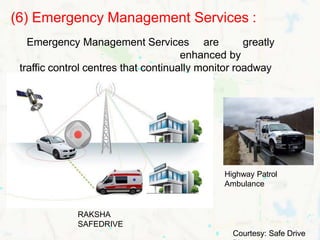
(6) Emergency Management Services :
Emergency Management Services are greatly
enhanced by
traffic control centres that continually monitor roadway
conditions.
RAKSHA
SAFEDRIVE
Highway Patrol
Ambulance
Courtesy: Safe Drive
Image Courtesy:
ETSI
FUNCTIONING OF ITS
• Time Savings
• Better emergency response times and services
• Reduced Crashes and Fatalities
• Cost Avoidance
• Increased Customer Satisfaction
• Energy and Environmental Benefits
• Decreasing of probability of congestion occurrence
ADVANTAGES OF ITS :
DISADVANTAGES OF ITS:
• Difficult to use in mixed traffic
• Preliminary difficulties in understanding
• Equipment of ITS is costly
• High Maintenance cost
PROJECTED ITS INFRASTRUCTURE
BENEFITS
(2000-2020)
Source : Apogee Report on Global ITS
Benefits
Accident
Cost
Savings
44%
Time
Saving
41%
Fuel
Savings
11%
Operating
Cost
Savings
4%
References :
https://en.wikipedia.org/wiki/Intelligent_transportation_syste
m
http://rno-its.piarc.org/en
https://www.bmw.co.uk/
https://safedriveblogs.wordpress.co
m/ www.team-bhp.com
www.nhai.org
archana50337.pptx

archana50337.pptx

  • 1.
  • 2.
    • Presentation Outline •Introduction • Background Situation of Promoting ITS • Intelligent Transportation Technologies • Intelligent Transportation Applications • Benefits of Intelligent Transportation System • References
  • 3.
    •ITS is theintegrated application of advanced technologies using Electronics, Computers, Communications, and Advanced sensors. These applications provide travellers with important information while improving the safety and efficiency of the transportation system. INTRODUCTION
  • 4.
    BACKGROUND SITUATION OFPROMOTING ITS To Solve Social Problems caused by Road T o activate the Economy To reach an Advanced Information and Tele communication Society
  • 5.
    INTELLIGENT TRANSPORTATION TECHNOLOGIES (1)Wireless Communications : • Dedicated Short- Range Communications (DSRC) : It offers communication between the vehicle and the roadside in specific locations (for example toll Electronic Fee Collection(EFC) plazas) Applications such as will operate over DSRC. It is a sub- set of the RFID - technology (Radio- Frequency Identification).
  • 6.
    vehicl e using and the roadside a varietyof communication media, including cellular and infra- red links. • Continuous Air interface Long and Medium range (CALM) : Continuous Air interface Long and Medium range (CALM)provides continuous communications between a
  • 7.
    (2) Floating CarData/Floating Cellular Data : • Non Real-time: – Manual surveys. –Video recording and manual search. – In-vehicle data recording. • Real-time: –Automatic Number Plate Recognition (ANPR). – GPS trace + mobile comms e.g. GSM. – Radio Signal Triangulation. – Roadside beacon +
  • 8.
    (3) Inductive loopdetection : • One or more loops of wire are embedded under the road & connected to a control box. • When a vehicle passes over or rests on the loop, inductance is reduced showing a vehicle is present. • Benefits: • Established Technology • Not impacted by environmental conditions • Accurate in detecting vehicle presence • Performs well in both high
  • 9.
    Radar and acousticsensors are also used for detecting vehicles in the roadway.
  • 10.
    (4) Video VehicleDetection : Video vehicle detection (VVD) is the One of the most widely used method. Video image consist s processo r. of microprocessor- base detection is an It a CP U and software that analyzes video images.
  • 11.
    INTELLIGENT TRANSPORTATION APPLICATIONS (1)Electronic Toll Collection : • Today, most toll roads are equipped with an electronic toll-collection system, like FASTag & E- Zpass, that detects and processes tolls electronically. • FASTag is a device that employs Radio Frequency Identification (RFID) technology for making toll payments. Courtesy:HowStuffWor ks
  • 12.
    FASTag enabled Toll Plaza Tagaffixed on Wind RFID Tag Reader
  • 13.
    What are thebenefits of using FASTag? Environmental benefit Social benefit Economic benefit •Reduced toll payment • Reduced effort in • Reduced air pollution hassles management at toll plaza • Reduced use of paper •Analytics for better • Reduced effort in highway management monitoring centrally 1.Ease of payment – No need to carry cash for the toll transactions, saves time 2.Near non-stop movement of vehicles leading to lower fuel cost. 3.Online Recharge – FASTag can be recharged online through Credit Card / Debit Card / NEFT/ RTGS or Net banking 4.SMS alerts for toll transactions, low balance, etc. 5.Online Portal for customers Other benefits are:
  • 14.
    2) Variable MessageService: • Variable message signs (VMS) are traffic control devices used to provide motorists en- route traveler information.
  • 15.
    • A traffic enforcement camerasystem, consisting of a Camera and a Vehicle- monitoring device, is used todetect and identify vehicles disobeying Speed Limit (3) Automatic Road Enforcement :
  • 16.
    (4) Collision AvoidanceSystems : Intersection Collision Warning Obstacle Detection Lane Change assistance Lane Departure Warning WWW.CIVILSCHOLAR. COM
  • 17.
    Collision Avoidance Systems……… Rollover Warning Road Departure Mitigation Front-End collision warning
  • 18.
    (5) Traveler InformationService : Information is Generated … Traffic Sensor Aerial surveillance Weather Monitoring Incident Detection Transit Location • Delay • Incident • Road Weather • Next Bus • Traveler Times • Emergency Alerts • Alternate Routes Sent to Travelers .. Travelers Respond Change Route Change Departur e Time Change Mode Change Destinatio n
  • 19.
    (6) Emergency ManagementServices : Emergency Management Services are greatly enhanced by traffic control centres that continually monitor roadway conditions. RAKSHA SAFEDRIVE Highway Patrol Ambulance Courtesy: Safe Drive
  • 20.
  • 21.
    • Time Savings •Better emergency response times and services • Reduced Crashes and Fatalities • Cost Avoidance • Increased Customer Satisfaction • Energy and Environmental Benefits • Decreasing of probability of congestion occurrence ADVANTAGES OF ITS :
  • 22.
    DISADVANTAGES OF ITS: •Difficult to use in mixed traffic • Preliminary difficulties in understanding • Equipment of ITS is costly • High Maintenance cost
  • 23.
    PROJECTED ITS INFRASTRUCTURE BENEFITS (2000-2020) Source: Apogee Report on Global ITS Benefits Accident Cost Savings 44% Time Saving 41% Fuel Savings 11% Operating Cost Savings 4%
  • 24.