• Introduction
• Background Situation and Significance of
Promoting ITS
• Intelligent Transportation Technologies
• Benefits of Intelligent Transportation System
Content
Introduction
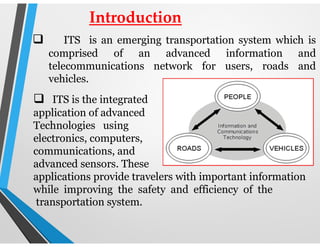
 ITS is an emerging transportation system which is
comprised of an advanced information and
telecommunications network for users, roads and
vehicles.
 ITS is the integrated
application of advanced
Technologies using
electronics, computers,
communications, and
advanced sensors. These
applications provide travelers with important information
while improving the safety and efficiency of the
transportation system.
Background Situation of Promoting ITS
 To Solve Social Problems caused by Road
 To activate the Economy
 To reach an Advanced Information and Telecommunication
Society
 To Co-ordinate different Transport Modes
 To reduce Driver’s run
Significance of Promoting ITS
Breakthrough for Solving Road Transport Problems
 Creation of New Industries
 Leader of an Advanced Information
and Telecommunications
Intelligent Transportation Technologies
Wireless Communications
 Dedicated Short-Range Communications (DSRC) :
It offers communication between the vehicle and th
roadside in specific locations (for example toll plazas
Applications such as Electronic Fee Collection (EFC) wil
operate over DSRC. It is a sub-set of the RFID - technology
(Radio-frequency identification).
 Continuous Air interface Long and Medium range
(CALM) :
Continuous Air interface Long and Medium range (CALM)
provides continuous communications between a vehicle and
the roadside using a variety of communication media,
including cellular and infra-red links.
Computational Technologies
The CTS (Computational Transportation Science) fellows
will develop technologies in which sensors, travellers
computers , in-vehicle computers, and computers in the static
infrastructure.
The installation of operational systems and processors in
transportation vehicles have also allowed software
applications and artificial intelligence systems to be installed.
These systems include internal control of model based
processes, ubiquitous computing and other programs
designed to be integrated into a greater transportation
system.

INTELLIGENT TRANSPORT SYSTEM .pdf

  • 1.
    • Introduction • BackgroundSituation and Significance of Promoting ITS • Intelligent Transportation Technologies • Benefits of Intelligent Transportation System Content
  • 2.
    Introduction  ITS isan emerging transportation system which is comprised of an advanced information and telecommunications network for users, roads and vehicles.  ITS is the integrated application of advanced Technologies using electronics, computers, communications, and advanced sensors. These applications provide travelers with important information while improving the safety and efficiency of the transportation system.
  • 3.
    Background Situation ofPromoting ITS  To Solve Social Problems caused by Road  To activate the Economy  To reach an Advanced Information and Telecommunication Society  To Co-ordinate different Transport Modes  To reduce Driver’s run Significance of Promoting ITS Breakthrough for Solving Road Transport Problems  Creation of New Industries  Leader of an Advanced Information and Telecommunications
  • 4.
    Intelligent Transportation Technologies WirelessCommunications  Dedicated Short-Range Communications (DSRC) : It offers communication between the vehicle and th roadside in specific locations (for example toll plazas Applications such as Electronic Fee Collection (EFC) wil operate over DSRC. It is a sub-set of the RFID - technology (Radio-frequency identification).  Continuous Air interface Long and Medium range (CALM) : Continuous Air interface Long and Medium range (CALM) provides continuous communications between a vehicle and the roadside using a variety of communication media, including cellular and infra-red links.
  • 5.
    Computational Technologies The CTS(Computational Transportation Science) fellows will develop technologies in which sensors, travellers computers , in-vehicle computers, and computers in the static infrastructure. The installation of operational systems and processors in transportation vehicles have also allowed software applications and artificial intelligence systems to be installed. These systems include internal control of model based processes, ubiquitous computing and other programs designed to be integrated into a greater transportation system.