a simple, rolling-release
      distribution

Tom Gundersen
teg@jklm.no
Overview

●
    Arch Linux

●
    Packaging

●
    The community

●
    Future plans
Arch Linux - Simplicity


●
    Creating and building packages is easy

●
    Divergence from upstream is minimal

●
    Choice for its own sake is avoided

●
    The workings of the system is not hidden
    from the user
Arch Linux – Rolling Release


●
    Ship the latest stable release of our
    packages (there are exceptions)

●
    Don't necessarily be the very first to switch
    to new or experimental technologies or
    introduce new packages to our repositories
Arch Linux – Target Audience


●
    People wanting to learn about Linux

●
    Advanced users

●
    Developers
Arch Linux - Background

●
    Started in 2001 by Judd Vinet

●
    Inspired by Slackware, Polish Linux
    Distribution and CRUX
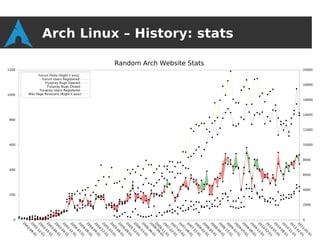
Arch Linux – History: stats

                                            Random Arch Website Stats
1200                                                                    20000
             Forum Posts (Right Y-axis)
                Forum Users Registered
                  Flyspray Bugs Opened
                                                                        18000
                   Flyspray Bugs Closed
              Flyspray Users Registered
1000   Wiki Page Revisions (Right Y-axis)
                                                                        16000


                                                                        14000
 800


                                                                        12000


 600                                                                    10000


                                                                        8000


 400
                                                                        6000


                                                                        4000
 200


                                                                        2000


   0                                                                    0
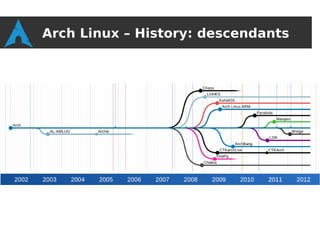
Arch Linux – History: descendants
Arch Linux – Current Status

●
    ~3000 Official Packages

●
    ~3000 Semi-Official Packages

●
    ~40000 Unsupported PKGBUILDs

●
    One kernel

●
    i686 and x86_64 architectures

●
    Proprietary software available

●
    All major desktop environment, etc.
Packaging - Repositories


    [core]
●
    needed for building, booting and installing
●
     ~200 packages
●
    updates must go through the [testing]
    repository

    [extra]
●
    commonly used packages (>5% of users)

    [community]
●
    less commonly used packages (>1% of
    users)
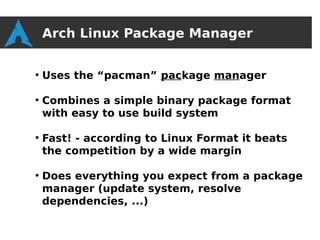
Arch Linux Package Manager

●
    Uses the “pacman” package manager

●
    Combines a simple binary package format
    with easy to use build system

●
    Fast! - according to Linux Format it beats
    the competition by a wide margin

●
    Does everything you expect from a package
    manager (update system, resolve
    dependencies, ...)
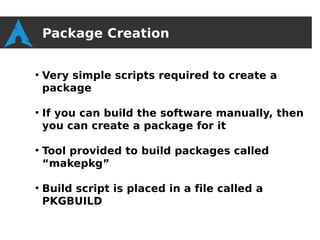
Package Creation

●
    Very simple scripts required to create a
    package

●
    If you can build the software manually, then
    you can create a package for it

●
    Tool provided to build packages called
    “makepkg”

●
    Build script is placed in a file called a
    PKGBUILD
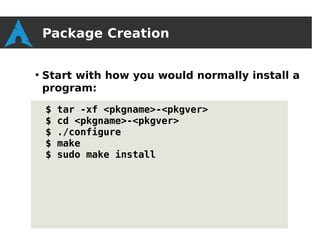
Package Creation

●
    Start with how you would normally install a
    program:

    $   tar -xf <pkgname>-<pkgver>
    $   cd <pkgname>-<pkgver>
    $   ./configure
    $   make
    $   sudo make install
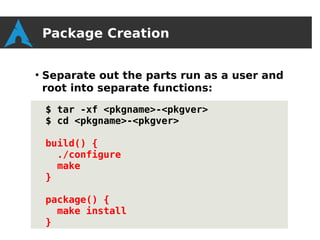
Package Creation

●
    Separate out the parts run as a user and
    root into separate functions:

    $ tar -xf <pkgname>-<pkgver>
    $ cd <pkgname>-<pkgver>

    build() {
      ./configure
      make
    }

    package() {
      make install
    }
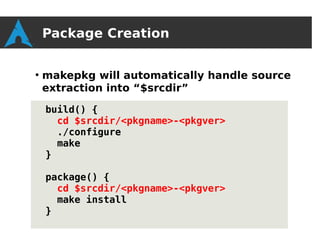
Package Creation

●
    makepkg will automatically handle source
    extraction into “$srcdir”

    build() {
      cd $srcdir/<pkgname>-<pkgver>
      ./configure
      make
    }

    package() {
      cd $srcdir/<pkgname>-<pkgver>
      make install
    }
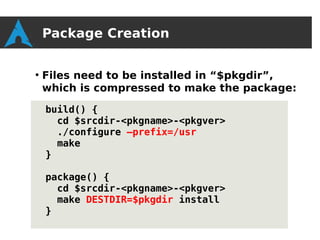
Package Creation

●
    Files need to be installed in “$pkgdir”,
    which is compressed to make the package:

    build() {
      cd $srcdir-<pkgname>-<pkgver>
      ./configure –prefix=/usr
      make
    }

    package() {
      cd $srcdir-<pkgname>-<pkgver>
      make DESTDIR=$pkgdir install
    }
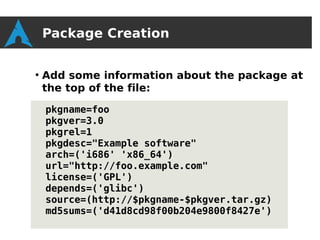
Package Creation

●
    Add some information about the package at
    the top of the file:

    pkgname=foo
    pkgver=3.0
    pkgrel=1
    pkgdesc="Example software"
    arch=('i686' 'x86_64')
    url="http://foo.example.com"
    license=('GPL')
    depends=('glibc')
    source=(http://$pkgname-$pkgver.tar.gz)
    md5sums=('d41d8cd98f00b204e9800f8427e')
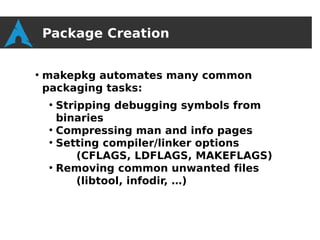
Package Creation

●
    makepkg automates many common
    packaging tasks:
    ●
      Stripping debugging symbols from
      binaries
    ●
      Compressing man and info pages
    ●
      Setting compiler/linker options
          (CFLAGS, LDFLAGS, MAKEFLAGS)
    ●
      Removing common unwanted files
          (libtool, infodir, …)
Package Creation

●
    Two files are placed in the $pkgdir directory
    with all package meta data

●
    Then a (compressed) tar archive of the
    $pkgdir directory is created

●
    DONE!
Package Creation - Example

●
    See terminal ->
Community - Developers

●
    1 Project Leader

●
    Deals with legal matters (exclusively)

●
    33 Developers / Junior Developers

●
    Runs infrastructure

●
    Packages the packages in the official [core]
    and [extra] repositories
Community – Developers

●
    No formal rules of governance

●
    Consensus-based decision making

●
    Developers may in principle do whatever
    they want, as long as they inform the other
    developers of their intentions beforehand
    and there is no serious, technical oposition

●
    New developers added by invitation only
Community – Trusted Users

●
    37 Trusted Users (Tus)

●
    Disjont form the Developers

●
    Runs the Arch User Repository (AUR)

●
    Packages the semi-official packages in the
    [community] repository

●
    Ran as a democracy, governed by formal by-
    laws

●
    New TUs may apply to join
Community – AUR

●
    Repository of PKGBUILDs

●
    Anyone may sign-up and upload PKGBUILDs

●
    Absolutely no quality-control of the
    resulting packages, but some style
    guidelines on the PKGBUILDs themselves

●
    Popular, high-quality PKGBUILDS are often
    picked up by TU's and added to the
    [community] repository
Community – others...

●
    Forum, wiki, bug tracker, mailing-lists, irc
    channels are ran by separate teams

●
    Disjoint from each other (and the
    developers)
Getting involved

●
    Actively contribute to the community
     ●
       Provide PKGBUILDs for unpackaged
       software
     ●
       Help on the bug tracker
     ●
       Contributing code to our projects
     ●
       Update the wiki

●
    Apply to become a Trusted User
     ●
         Sponsoring and voting process...

●
    Be invited onto the Developer team
Evolution of an example package


systemd: a Linux init system
Example - systemd

●
    First packages for systemd were placed in
    AUR in 2010

●
    Lots of work was required to make it work
    with Arch

    “I'm highly dubious that Arch's kernel
     will ever natively support systemd, but
     I'm willing to give that a try as well
     once 2.6.36 hits.”
Example - systemd


    Over the next two years...

●
  Unified the legacy Arch init system and
  systemd
●
  systemd moved from the AUR to
  [community]
●
  The systemd packager was invited to join
  the dev team and moved systemd to [extra]
●
  systemd moved to [core]
●
  The legacy init system was deprecated and
  systemd is now our only supported init
  system
Why does it work at all?

●
    Software developers write code that is
    supposed to work...

●
    Only suport the most recent version of our
    packages

●
    Don't support more options than strictly
    necessary at the lower levels
●
    Accept occasional user intervention
Vanilla Packages

●
    Means packaging the software as the
    upstream developers intended

●
    Minimise patching – preferably only to fix
    build issues

●
    Result in any bug we find is (probably) not
    distribution specific

●
    Allows us to work more closely with
    software developers to fix bugs
Working With Software Developers

●
    All bug fix patches in Arch must be approved
    by the upstream developers

●
    That means that the Arch developers and
    community have become regular code
    contributors

●
    Many Arch developers also have commit
    access to upstream projects
Future Directions for Arch Linux

●
    Majority response...


      “Keep updating packages”


●
    Add more focus on a particular areas

●
    Add more architectures

●
    Simplify the system further
Keeping Packages Updated

●
    One of Arch Linux's greatest contributions
    to the Linux community

●
    Arch gets packages in their stable
    repositories before some major distributions
    get it in their developmental versions

●
    The Arch community will identify bugs early
    and report the issue to the software
    developers

●
    Fixes benefit all Linux distributions
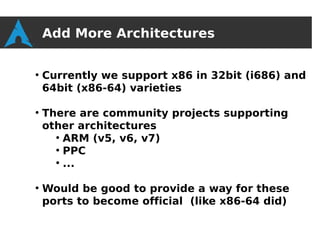
Add More Architectures

●
    Currently we support x86 in 32bit (i686) and
    64bit (x86-64) varieties

●
    There are community projects supporting
    other architectures
      ●
        ARM (v5, v6, v7)
      ●
        PPC
      ●
        ...

●
    Would be good to provide a way for these
    ports to become official (like x86-64 did)
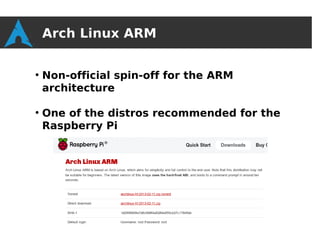
Arch Linux ARM

●
    Non-official spin-off for the ARM
    architecture

●
    One of the distros recommended for the
    Raspberry Pi
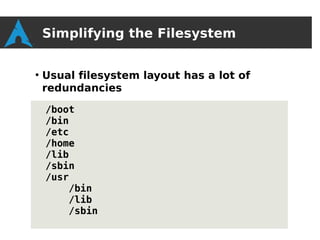
Simplifying the Filesystem

●
    Usual filesystem layout has a lot of
    redundancies

    /boot
    /bin
    /etc
    /home
    /lib
    /sbin
    /usr
        /bin
        /lib
        /sbin
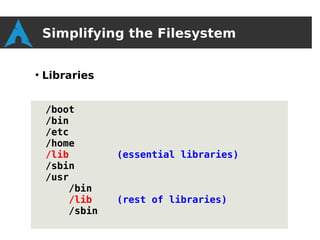
Simplifying the Filesystem

●
    Libraries


    /boot
    /bin
    /etc
    /home
    /lib        (essential libraries)
    /sbin
    /usr
        /bin
        /lib    (rest of libraries)
        /sbin
Simplifying the Filesystem

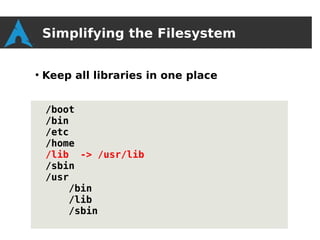
●
    Keep all libraries in one place


    /boot
    /bin
    /etc
    /home
    /lib -> /usr/lib
    /sbin
    /usr
        /bin
        /lib
        /sbin
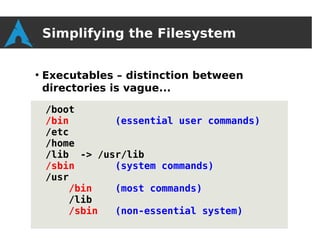
Simplifying the Filesystem

●
    Executables – distinction between
    directories is vague...

    /boot
    /bin       (essential user commands)
    /etc
    /home
    /lib -> /usr/lib
    /sbin      (system commands)
    /usr
        /bin   (most commands)
        /lib
        /sbin  (non-essential system)
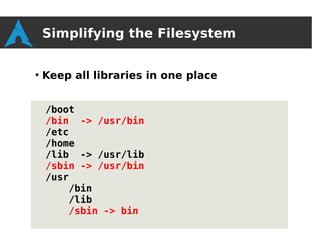
Simplifying the Filesystem

●
    Keep all libraries in one place


    /boot
    /bin -> /usr/bin
    /etc
    /home
    /lib -> /usr/lib
    /sbin -> /usr/bin
    /usr
        /bin
        /lib
        /sbin -> bin
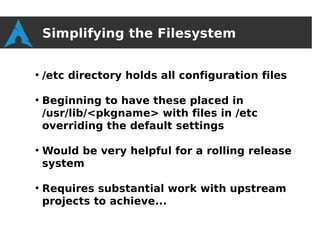
Simplifying the Filesystem

●
    /etc directory holds all configuration files

●
    Beginning to have these placed in
    /usr/lib/<pkgname> with files in /etc
    overriding the default settings

●
    Would be very helpful for a rolling release
    system

●
    Requires substantial work with upstream
    projects to achieve...
Automating More Packaging

●
    Task like rebuilds for library soname
    changes are typically trivial

●
    Would save a lot of time if we could
    automate (most of) this

●
    Most packages do not require architecture
    specific changes – build for one and
    automate the rest

●
    Would allow us to focus more on improving
    other areas of the distribution

Distro Recipes 2013 : Introduction to Arch Linux: a simple, rolling-release distribution

  • 1.
    a simple, rolling-release distribution Tom Gundersen teg@jklm.no
  • 2.
    Overview ● Arch Linux ● Packaging ● The community ● Future plans
  • 3.
    Arch Linux -Simplicity ● Creating and building packages is easy ● Divergence from upstream is minimal ● Choice for its own sake is avoided ● The workings of the system is not hidden from the user
  • 4.
    Arch Linux –Rolling Release ● Ship the latest stable release of our packages (there are exceptions) ● Don't necessarily be the very first to switch to new or experimental technologies or introduce new packages to our repositories
  • 5.
    Arch Linux –Target Audience ● People wanting to learn about Linux ● Advanced users ● Developers
  • 6.
    Arch Linux -Background ● Started in 2001 by Judd Vinet ● Inspired by Slackware, Polish Linux Distribution and CRUX
  • 7.
    Arch Linux –History: stats Random Arch Website Stats 1200 20000 Forum Posts (Right Y-axis) Forum Users Registered Flyspray Bugs Opened 18000 Flyspray Bugs Closed Flyspray Users Registered 1000 Wiki Page Revisions (Right Y-axis) 16000 14000 800 12000 600 10000 8000 400 6000 4000 200 2000 0 0
  • 8.
    Arch Linux –History: descendants
  • 9.
    Arch Linux –Current Status ● ~3000 Official Packages ● ~3000 Semi-Official Packages ● ~40000 Unsupported PKGBUILDs ● One kernel ● i686 and x86_64 architectures ● Proprietary software available ● All major desktop environment, etc.
  • 10.
    Packaging - Repositories [core] ● needed for building, booting and installing ● ~200 packages ● updates must go through the [testing] repository [extra] ● commonly used packages (>5% of users) [community] ● less commonly used packages (>1% of users)
  • 11.
    Arch Linux PackageManager ● Uses the “pacman” package manager ● Combines a simple binary package format with easy to use build system ● Fast! - according to Linux Format it beats the competition by a wide margin ● Does everything you expect from a package manager (update system, resolve dependencies, ...)
  • 12.
    Package Creation ● Very simple scripts required to create a package ● If you can build the software manually, then you can create a package for it ● Tool provided to build packages called “makepkg” ● Build script is placed in a file called a PKGBUILD
  • 13.
    Package Creation ● Start with how you would normally install a program: $ tar -xf <pkgname>-<pkgver> $ cd <pkgname>-<pkgver> $ ./configure $ make $ sudo make install
  • 14.
    Package Creation ● Separate out the parts run as a user and root into separate functions: $ tar -xf <pkgname>-<pkgver> $ cd <pkgname>-<pkgver> build() { ./configure make } package() { make install }
  • 15.
    Package Creation ● makepkg will automatically handle source extraction into “$srcdir” build() { cd $srcdir/<pkgname>-<pkgver> ./configure make } package() { cd $srcdir/<pkgname>-<pkgver> make install }
  • 16.
    Package Creation ● Files need to be installed in “$pkgdir”, which is compressed to make the package: build() { cd $srcdir-<pkgname>-<pkgver> ./configure –prefix=/usr make } package() { cd $srcdir-<pkgname>-<pkgver> make DESTDIR=$pkgdir install }
  • 17.
    Package Creation ● Add some information about the package at the top of the file: pkgname=foo pkgver=3.0 pkgrel=1 pkgdesc="Example software" arch=('i686' 'x86_64') url="http://foo.example.com" license=('GPL') depends=('glibc') source=(http://$pkgname-$pkgver.tar.gz) md5sums=('d41d8cd98f00b204e9800f8427e')
  • 18.
    Package Creation ● makepkg automates many common packaging tasks: ● Stripping debugging symbols from binaries ● Compressing man and info pages ● Setting compiler/linker options (CFLAGS, LDFLAGS, MAKEFLAGS) ● Removing common unwanted files (libtool, infodir, …)
  • 19.
    Package Creation ● Two files are placed in the $pkgdir directory with all package meta data ● Then a (compressed) tar archive of the $pkgdir directory is created ● DONE!
  • 20.
    Package Creation -Example ● See terminal ->
  • 21.
    Community - Developers ● 1 Project Leader ● Deals with legal matters (exclusively) ● 33 Developers / Junior Developers ● Runs infrastructure ● Packages the packages in the official [core] and [extra] repositories
  • 22.
    Community – Developers ● No formal rules of governance ● Consensus-based decision making ● Developers may in principle do whatever they want, as long as they inform the other developers of their intentions beforehand and there is no serious, technical oposition ● New developers added by invitation only
  • 23.
    Community – TrustedUsers ● 37 Trusted Users (Tus) ● Disjont form the Developers ● Runs the Arch User Repository (AUR) ● Packages the semi-official packages in the [community] repository ● Ran as a democracy, governed by formal by- laws ● New TUs may apply to join
  • 24.
    Community – AUR ● Repository of PKGBUILDs ● Anyone may sign-up and upload PKGBUILDs ● Absolutely no quality-control of the resulting packages, but some style guidelines on the PKGBUILDs themselves ● Popular, high-quality PKGBUILDS are often picked up by TU's and added to the [community] repository
  • 25.
    Community – others... ● Forum, wiki, bug tracker, mailing-lists, irc channels are ran by separate teams ● Disjoint from each other (and the developers)
  • 26.
    Getting involved ● Actively contribute to the community ● Provide PKGBUILDs for unpackaged software ● Help on the bug tracker ● Contributing code to our projects ● Update the wiki ● Apply to become a Trusted User ● Sponsoring and voting process... ● Be invited onto the Developer team
  • 27.
    Evolution of anexample package systemd: a Linux init system
  • 28.
    Example - systemd ● First packages for systemd were placed in AUR in 2010 ● Lots of work was required to make it work with Arch “I'm highly dubious that Arch's kernel will ever natively support systemd, but I'm willing to give that a try as well once 2.6.36 hits.”
  • 29.
    Example - systemd Over the next two years... ● Unified the legacy Arch init system and systemd ● systemd moved from the AUR to [community] ● The systemd packager was invited to join the dev team and moved systemd to [extra] ● systemd moved to [core] ● The legacy init system was deprecated and systemd is now our only supported init system
  • 30.
    Why does itwork at all? ● Software developers write code that is supposed to work... ● Only suport the most recent version of our packages ● Don't support more options than strictly necessary at the lower levels ● Accept occasional user intervention
  • 31.
    Vanilla Packages ● Means packaging the software as the upstream developers intended ● Minimise patching – preferably only to fix build issues ● Result in any bug we find is (probably) not distribution specific ● Allows us to work more closely with software developers to fix bugs
  • 32.
    Working With SoftwareDevelopers ● All bug fix patches in Arch must be approved by the upstream developers ● That means that the Arch developers and community have become regular code contributors ● Many Arch developers also have commit access to upstream projects
  • 33.
    Future Directions forArch Linux ● Majority response... “Keep updating packages” ● Add more focus on a particular areas ● Add more architectures ● Simplify the system further
  • 34.
    Keeping Packages Updated ● One of Arch Linux's greatest contributions to the Linux community ● Arch gets packages in their stable repositories before some major distributions get it in their developmental versions ● The Arch community will identify bugs early and report the issue to the software developers ● Fixes benefit all Linux distributions
  • 35.
    Add More Architectures ● Currently we support x86 in 32bit (i686) and 64bit (x86-64) varieties ● There are community projects supporting other architectures ● ARM (v5, v6, v7) ● PPC ● ... ● Would be good to provide a way for these ports to become official (like x86-64 did)
  • 36.
    Arch Linux ARM ● Non-official spin-off for the ARM architecture ● One of the distros recommended for the Raspberry Pi
  • 37.
    Simplifying the Filesystem ● Usual filesystem layout has a lot of redundancies /boot /bin /etc /home /lib /sbin /usr /bin /lib /sbin
  • 38.
    Simplifying the Filesystem ● Libraries /boot /bin /etc /home /lib (essential libraries) /sbin /usr /bin /lib (rest of libraries) /sbin
  • 39.
    Simplifying the Filesystem ● Keep all libraries in one place /boot /bin /etc /home /lib -> /usr/lib /sbin /usr /bin /lib /sbin
  • 40.
    Simplifying the Filesystem ● Executables – distinction between directories is vague... /boot /bin (essential user commands) /etc /home /lib -> /usr/lib /sbin (system commands) /usr /bin (most commands) /lib /sbin (non-essential system)
  • 41.
    Simplifying the Filesystem ● Keep all libraries in one place /boot /bin -> /usr/bin /etc /home /lib -> /usr/lib /sbin -> /usr/bin /usr /bin /lib /sbin -> bin
  • 42.
    Simplifying the Filesystem ● /etc directory holds all configuration files ● Beginning to have these placed in /usr/lib/<pkgname> with files in /etc overriding the default settings ● Would be very helpful for a rolling release system ● Requires substantial work with upstream projects to achieve...
  • 43.
    Automating More Packaging ● Task like rebuilds for library soname changes are typically trivial ● Would save a lot of time if we could automate (most of) this ● Most packages do not require architecture specific changes – build for one and automate the rest ● Would allow us to focus more on improving other areas of the distribution